
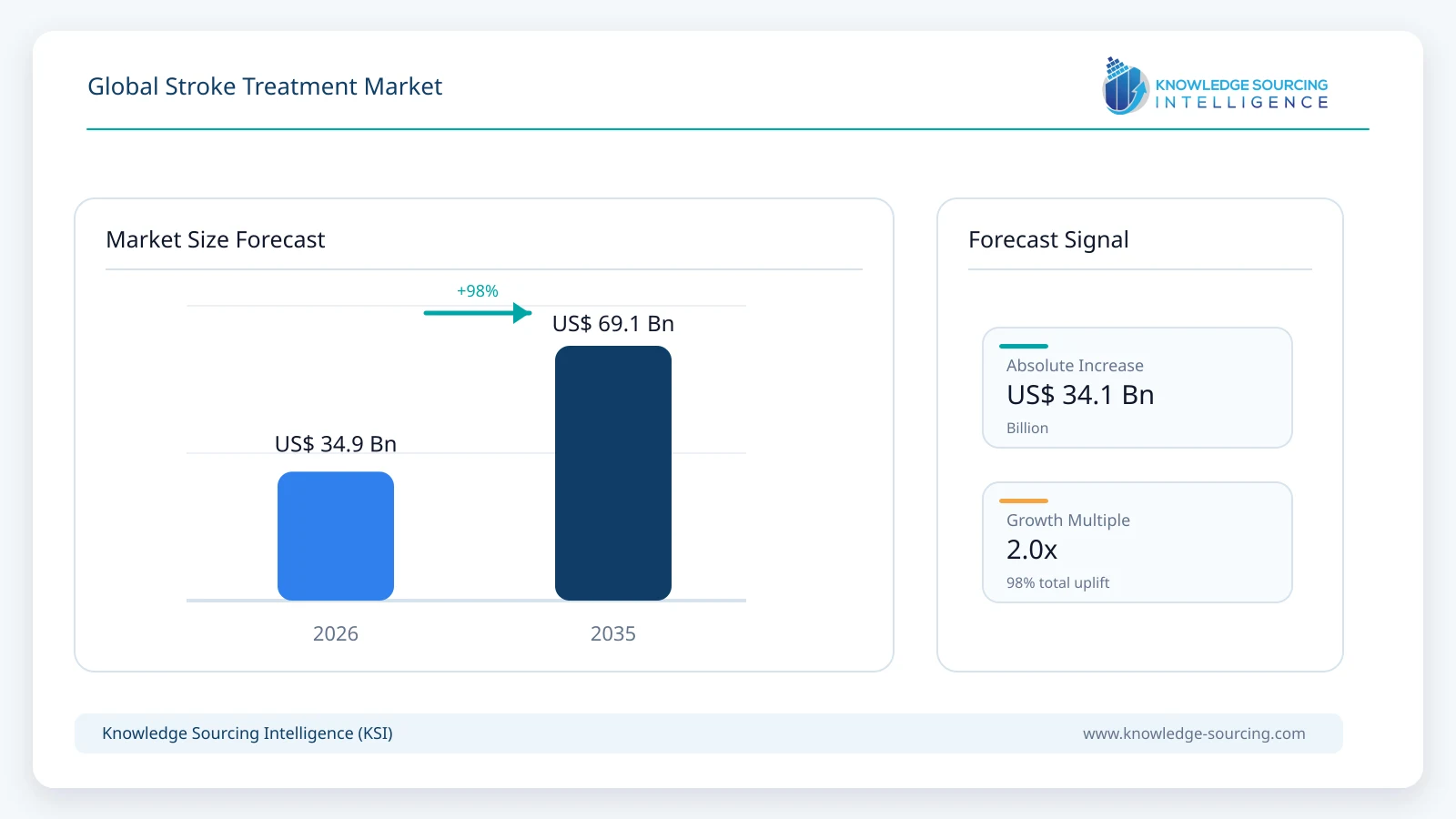
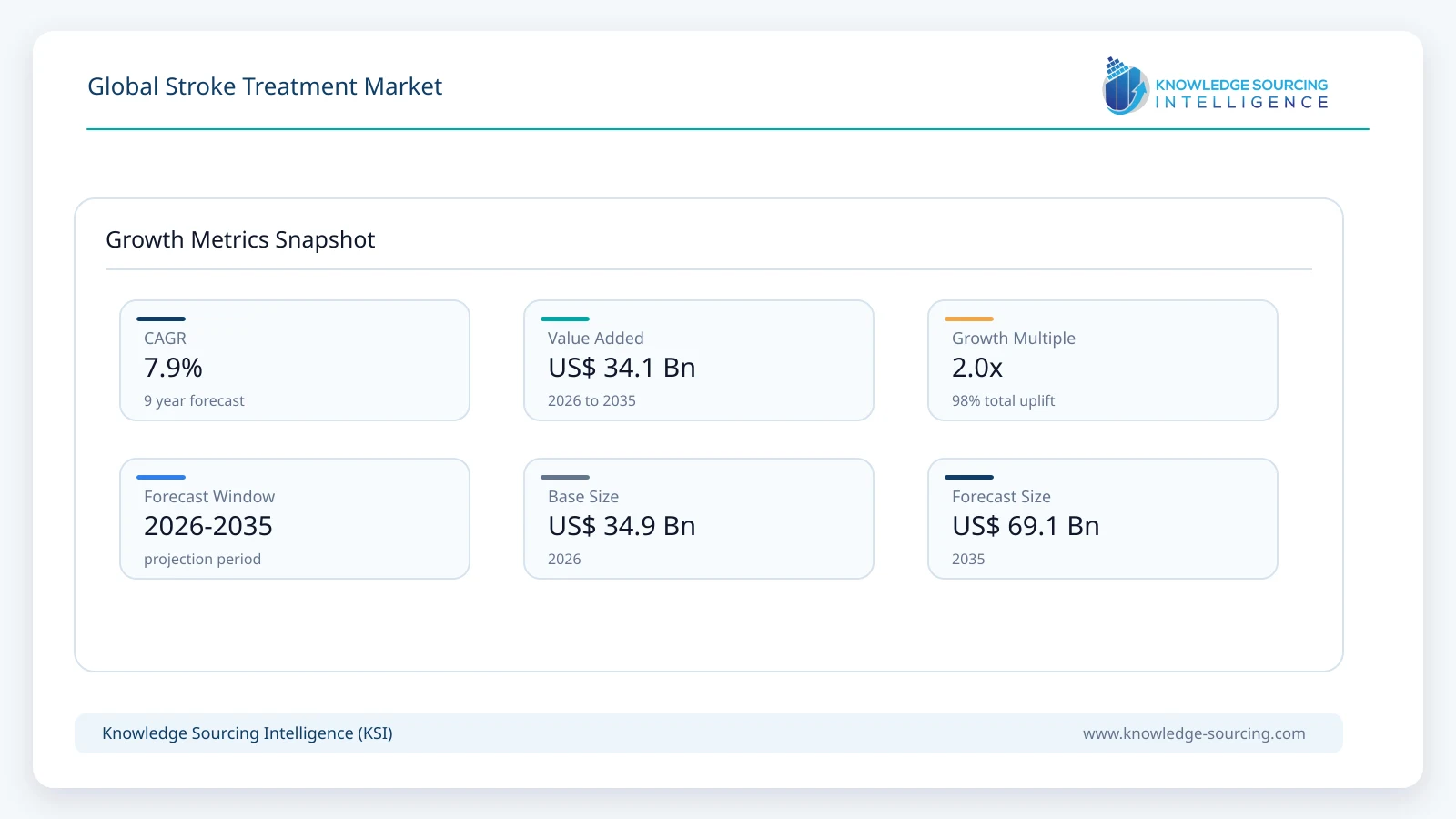
The Global Stroke Treatment Market is projected to grow at a CAGR of 7.9% during the forecast period, increasing from USD 34.94 billion in 2026 to USD 69.06 billion by 2035.
Highlights:
- 1Expanding thrombectomy eligibility increases demand for adjunctive therapies because more patients are receiving mechanical reperfusion.
- 2Ongoing biomarker and imaging adoption improves patient selection because clinicians require evidence-based treatment stratification.
- 3Regulatory support for breakthrough neurological therapies encourages pipeline investment because unmet clinical need remains substantial.
- 4Growing focus on post-stroke recovery increases demand for regenerative and neuroprotective approaches because functional restoration remains limited.
Stroke treatment addresses acute vascular occlusion, intracranial bleeding, secondary prevention, and long-term neurological recovery. Demand remains linked to aging populations because stroke incidence rises significantly with age. Healthcare systems are expanding stroke center networks because treatment delays reduce the effectiveness of available interventions. This expansion increases utilization of advanced diagnostics, reperfusion therapies, and rehabilitation services.
Regulatory agencies increasingly prioritize therapies that demonstrate meaningful functional improvement because mortality endpoints alone no longer capture the full burden of disease. Sponsors are developing combination approaches because successful vessel recanalization does not consistently prevent neurological disability. The resulting competitive environment favors assets that improve both acute and long-term outcomes.
Market Dynamics
Market Drivers
Expansion of Mechanical Thrombectomy Utilization: Mechanical thrombectomy remains a cornerstone of severe ischemic stroke management. Treatment centers are expanding thrombectomy access because clinical evidence supports improved outcomes in selected patients. Capacity limitations persist in many regions because specialized neurointerventional expertise remains concentrated in urban facilities. Healthcare systems are investing in stroke networks to reduce treatment delays. The result is stronger demand for therapies that enhance reperfusion-related recovery.
Aging Population and Rising Cerebrovascular Risk: Stroke incidence increases with age. Demographic structures are shifting toward older populations because life expectancy continues to rise across major healthcare markets. Comorbidity burdens remain significant because hypertension, diabetes, obesity, and atrial fibrillation increase stroke risk. Prevention programs are expanding across healthcare systems. The outcome is sustained demand for acute and chronic stroke interventions.
Increasing Focus on Functional Outcomes: Neurological recovery determines long-term healthcare costs. Clinical development programs are increasingly measuring disability reduction because survival gains alone provide limited value. Recovery constraints persist because neuronal damage develops rapidly after vascular events. Sponsors are pursuing neuroprotective and regenerative strategies. The result is broader therapeutic diversification beyond reperfusion.
Advancing Stroke Imaging Infrastructure: Advanced imaging improves treatment selection. Hospitals are deploying imaging-guided workflows because clinicians require rapid identification of salvageable brain tissue. Access disparities remain across developing markets because infrastructure investments are uneven. Healthcare providers are expanding stroke-ready diagnostic capabilities. The outcome is greater utilization of precision-based treatment pathways.
Market Restraints
Limited treatment windows restrict eligibility for acute interventions.
High infrastructure and specialist requirements constrain advanced stroke care access.
Repeated failures of neuroprotection programs increase clinical development risk.
Market Opportunities
Neuroprotective Therapeutics: Functional disability remains a major unmet need. Researchers are advancing neuroprotective candidates because reperfusion alone does not prevent secondary injury. Translational challenges remain because historical clinical outcomes have been inconsistent. Sponsors are refining biomarker-guided development strategies. The outcome is renewed interest in neuroprotection.
Regenerative Medicine: Post-stroke disability drives long-term healthcare burden. Cell-based therapies are progressing through clinical evaluation because tissue repair mechanisms remain inadequately addressed. Manufacturing complexity persists because biologic products require specialized production systems. Companies are strengthening translational research programs. The result is expanding regenerative medicine investment.
Combination Therapy Approaches: Stroke pathology involves multiple biological pathways. Clinical developers are evaluating adjunctive combinations because single-mechanism approaches often produce limited recovery benefits. Regulatory expectations remain rigorous because combination efficacy requires clear differentiation. Sponsors are designing multidimensional treatment programs. The outcome is a broader innovation pipeline.
AI-Enabled Patient Stratification: Treatment outcomes depend on rapid patient identification. Stroke centers are adopting AI-supported imaging because decision speed influences eligibility. Data integration challenges remain because healthcare systems use heterogeneous infrastructure. Technology providers are expanding clinical deployment initiatives. The result is improved treatment pathway efficiency.
Disease & Epidemiology Analysis
Stroke remains one of the leading causes of death and long-term disability globally. Ischemic stroke represents the majority of diagnosed cases because arterial occlusion occurs more frequently than intracranial hemorrhage. Population aging is increasing the absolute number of stroke events because vascular risk accumulates over time. Prevention efforts remain challenged by rising metabolic disease prevalence. The outcome is sustained pressure on acute treatment systems.
Hypertension remains the dominant modifiable risk factor. Cardiovascular disease prevalence is increasing in many regions because lifestyle-related conditions continue to expand. Early diagnosis gaps persist because many risk factors remain underdiagnosed. Public health programs are strengthening screening initiatives. The result is growing emphasis on preventive care alongside acute intervention.
Treatment Guidelines Landscape
Guideline Area | Current Direction |
Acute Ischemic Stroke | Rapid imaging, IV thrombolysis when eligible, thrombectomy in selected patients |
Large Vessel Occlusion | Mechanical thrombectomy with imaging-guided selection |
Secondary Prevention | Antiplatelet, anticoagulation, lipid-lowering and risk-factor management |
Hemorrhagic Stroke | Blood pressure control, reversal of anticoagulation, neurosurgical evaluation |
Market Segmentation
By Stroke Type
Ischemic stroke represents the primary demand center within stroke treatment. Clinical pathways are increasingly focusing on rapid vessel recanalization because irreversible neuronal injury develops quickly after occlusion. Eligibility constraints remain significant because treatment timing affects outcomes. Healthcare systems are expanding stroke-ready infrastructure to accelerate intervention. The result is sustained demand for thrombolytic and endovascular therapies.
By Treatment Type
Endovascular therapy defines a major area of treatment evolution. Adoption is increasing because thrombectomy demonstrates strong clinical benefits in selected patients. Access limitations remain because specialized expertise and infrastructure requirements are substantial. Hospitals are expanding neurointerventional capabilities to meet clinical demand. The outcome is increasing integration of procedural and pharmacological treatment strategies.
By End User
Hospitals remain the primary treatment setting for acute stroke. Patient volumes are increasing because comprehensive stroke centers provide multidisciplinary care. Resource pressures remain evident because advanced imaging and intervention services require substantial investment. Healthcare providers are strengthening coordinated stroke response systems. The result is continued concentration of acute treatment demand within hospital environments.
Regional Analysis
North America Market Analysis
North America represents a major center for stroke innovation. Advanced diagnostic adoption remains widespread because healthcare providers prioritize rapid treatment initiation. Stroke programs are increasingly integrating AI-assisted imaging because treatment decisions depend on time-sensitive interpretation. Cost pressures persist because advanced interventions require specialized infrastructure. Health systems are expanding comprehensive stroke center capabilities. The outcome is a strong demand for premium therapeutic and procedural solutions.
Clinical research activity remains significant across the United States and Canada. Sponsors are evaluating neuroprotection, regenerative medicine, and recovery-focused interventions because the unmet need remains substantial after successful reperfusion. Development risk persists because neurological endpoints remain difficult to optimize. Companies are pursuing biomarker-supported trial designs. The result is a robust innovation environment.
Europe Market Analysis
Europe maintains a strong stroke treatment framework. National healthcare systems support structured stroke pathways because coordinated care improves outcomes. Capacity constraints remain in some regions because specialist availability differs across countries. Governments are strengthening stroke network development initiatives. The outcome is continued growth in evidence-based intervention adoption.
Research institutions remain active in cerebrovascular science. Interest is increasing in recovery-focused therapies because disability reduction represents a healthcare priority. Budget limitations persist because healthcare spending remains closely managed. Academic-industry collaborations are expanding translational research efforts. The result is sustained pipeline activity across multiple therapeutic classes.
Asia Pacific Market Analysis
Asia Pacific represents a rapidly evolving stroke treatment environment. Stroke burden remains substantial because large populations and cardiovascular risk factors drive incidence. Healthcare infrastructure is improving across emerging economies because governments are prioritizing neurological care. Regional disparities persist because advanced treatment access varies significantly. Providers are expanding specialized stroke services. The outcome is growing demand for acute intervention technologies.
Clinical trial activity continues expanding throughout the region. Sponsors are increasing investment because patient recruitment opportunities remain attractive. Regulatory complexity persists because approval pathways vary among countries. Companies are strengthening regional development strategies. The result is increasing participation in global stroke innovation programs.
Rest of the World
Stroke treatment access remains uneven across many developing healthcare systems. Disease burden remains high because preventive care infrastructure often remains limited. Resource constraints persist because advanced imaging and intervention capabilities require significant investment. Governments are improving healthcare capacity through targeted initiatives. The outcome is gradual expansion of treatment availability.
International organizations continue supporting stroke awareness and prevention efforts. Demand is increasing for scalable treatment approaches because specialist shortages remain widespread. Healthcare providers are adopting pragmatic care models. The result is expanding interest in cost-effective interventions.
Regulatory Landscape
Stroke treatment regulation focuses heavily on clinical outcome evidence because neurological improvement remains the primary measure of patient benefit. Regulatory agencies require demonstration of meaningful functional gains because surrogate endpoints alone rarely establish therapeutic value. Development challenges remain substantial because stroke populations are clinically heterogeneous. Sponsors are adopting precision-based trial designs. The outcome is increasingly targeted clinical development.
Regulators continue supporting innovation in areas of significant unmet need. Fast-track and accelerated development mechanisms remain available where eligibility criteria are satisfied. Evidence expectations remain rigorous because safety and efficacy must be demonstrated across diverse patient populations. Companies are incorporating advanced imaging and biomarker strategies. The result is improved trial efficiency.
Pipeline Analysis
The stroke pipeline increasingly focuses on neuroprotection, inflammation modulation, stem-cell therapies, and recovery enhancement. Traditional reperfusion strategies remain important because acute vessel restoration continues to define standard care. Biological limitations persist because successful reperfusion does not consistently prevent neuronal damage. Developers are targeting secondary injury pathways. The outcome is greater diversification of therapeutic mechanisms.
Emerging candidates are investigating mechanisms including neuroinflammation reduction, cellular regeneration, mitochondrial stabilization, excitotoxicity control, and vascular repair. Clinical programs are increasingly evaluating adjunctive use with thrombectomy because combination approaches may enhance recovery. Endpoint complexity remains challenging because functional improvement requires long-term assessment. Sponsors are implementing adaptive development strategies. The result is the gradual maturation of next-generation stroke therapeutics.
Reimbursement Landscape
Reimbursement decisions emphasize functional outcomes because disability reduction influences long-term healthcare expenditures. Payers increasingly assess real-world effectiveness because acute intervention costs remain substantial. Evidence requirements remain high because resource allocation decisions affect population-level budgets. Manufacturers are generating health-economic data. The outcome is a stronger emphasis on value-based evidence.
Coverage frameworks generally favor interventions supported by robust clinical guidelines. Adoption barriers persist where infrastructure costs remain elevated. Healthcare systems are expanding outcome measurement initiatives. The result is closer alignment between reimbursement and clinical effectiveness.
Competitive Landscape
Genentech
Genentech remains strategically distinct because it commercialized alteplase, one of the most influential thrombolytic therapies in stroke treatment history. The company maintains strong neurological expertise because cerebrovascular disease remains linked to broader vascular and biologic research capabilities. Competitive pressure is increasing because treatment paradigms are shifting toward integrated reperfusion strategies.
Boehringer Ingelheim
Boehringer Ingelheim remains strategically distinct through its historical role in thrombolytic development and cardiovascular medicine. Stroke management continues depending on rapid reperfusion because treatment timing strongly influences outcomes. Clinical complexity remains substantial because patient heterogeneity affects outcomes. The company continues supporting evidence generation across vascular disease areas.
F. Hoffmann-La Roche Ltd
Roche remains strategically distinct because of its diagnostics leadership. Precision medicine adoption is increasing because treatment decisions increasingly depend on imaging and biomarker data. Integration challenges remain because stroke pathways require rapid decision-making. Roche continues to align diagnostics and therapeutic capabilities.
Novartis AG
Novartis remains strategically distinct because cardiovascular and neuroscience capabilities support cerebrovascular research opportunities. Stroke prevention remains linked to chronic disease management because vascular risk factors drive incidence. Healthcare systems are emphasizing integrated care pathways. The company continues exploring innovation opportunities across related therapeutic areas.
Bayer AG
Bayer remains strategically distinct because anticoagulation and cardiovascular management remain critical components of stroke prevention. Demand for preventive strategies is increasing because recurrent stroke risk remains significant. Clinical management complexity persists because balancing efficacy and bleeding risk remains essential. Bayer continues strengthening evidence generation across vascular disease categories.
Johnson & Johnson
Johnson & Johnson remains strategically distinct because medical technology capabilities complement neurological intervention pathways. Procedural treatment adoption is increasing because thrombectomy continues expanding globally. Infrastructure constraints remain present because advanced stroke care requires specialized resources.
Key Developments
April 2026: The TRIDENT randomized controlled trial showed that GMRx2, a once-daily triple combination blood pressure pill containing telmisartan 20mg, amlodipine 2.5mg, and indapamide 1.25mg, cut the risk of recurrent stroke by 39% in patients with intracerebral hemorrhage and high blood pressure. The international study involved 1,670 patients who had experienced intracerebral hemorrhage with systolic blood pressure of 130-160mmHg. It was followed for an average of 3 years, where stroke occurred in 4.6% of GMRx2 patients compared to 7.4% in the placebo group, equating to one stroke prevented for every 35 patients treated.
February 2026: In a phase III clinical trial in China, stroke patients treated intravenously with loberamisal, a novel neuroprotective medication, daily for 10 days starting within 48 hours of stroke symptoms, had a higher proportion of brain cell recovery. The research showed that patients receiving loberamisal had improved neurological outcomes compared to placebo, with the medication helping to protect brain cells during the critical recovery period after stroke.
November 2025: Bayer's asundexian met primary efficacy and safety endpoints in the Phase III OCEANIC-STROKE study, which investigated the efficacy and safety of the oral Factor XIa inhibitor asundexian 50 mg once daily compared to placebo. The study enrolled over 12,300 patients following a non-cardioembolic ischemic stroke or high-risk transient ischemic attack.
Strategic Insights and Future Market Outlook
The future stroke treatment landscape increasingly depends on therapies that improve neurological recovery rather than solely restoring blood flow. Reperfusion technologies continue to define acute care because vessel recanalization remains clinically essential. Functional outcome limitations persist because neuronal injury progresses despite successful intervention. Developers are expanding investment into adjunctive and regenerative therapies. The outcome is a broader innovation framework focused on disability reduction.
Clinical development strategies increasingly emphasize precision medicine because stroke populations remain heterogeneous. Biomarker utilization is expanding because improved patient selection may increase trial success rates. Regulatory expectations remain stringent because meaningful functional benefit remains the key approval criterion. Sponsors are designing more targeted studies. The result is a gradual evolution toward personalized stroke treatment pathways.
Stroke treatment remains one of the most clinically important areas of neurological medicine because disability burden continues affecting healthcare systems globally. Demand is shifting toward integrated care models that combine acute intervention, recovery optimization, and long-term prevention. Scientific uncertainty remains a development challenge because neurological recovery involves complex biological pathways. Innovation is continuing across pharmacological, procedural, and regenerative approaches. The outcome is a treatment landscape that increasingly prioritizes durable functional recovery and improved quality of life.
Market Scope:
| Report Metric | Details |
|---|---|
| Total Market Size in 2026 | USD 34.94 billion |
| Total Market Size in 2035 | USD 69.06 billion |
| Forecast Unit | USD Billion |
| Growth Rate | 7.9% |
| Study Period | 2021 to 2035 |
| Historical Data | 2021 to 2024 |
| Base Year | 2025 |
| Forecast Period | 2026 – 2035 |
| Segmentation | Drug Type, Stroke Type, Treatment Type, Geography |
| Companies |
|
Market Segmentation
By Geography
Key Countries Analysis
Regulatory & Policy Landscape
Table of Contents
1. EXECUTIVE SUMMARY
1.1 Market Overview
1.2 Key Findings
1.3 Stroke Burden Snapshot
1.4 Current Treatment Paradigm
1.5 Major Market Trends
1.6 Competitive Highlights
1.7 Pipeline Outlook
1.8 Future Market Opportunities
2. DISEASE & EPIDEMIOLOGY ANALYSIS
2.1 Stroke Disease Overview
2.1.1 Definition and Clinical Background
2.1.2 Disease Pathophysiology
2.1.3 Risk Factors and Comorbidities
2.1.4 Disease Burden and Healthcare Impact
2.2 Stroke Classification
2.2.1 Ischemic Stroke
2.2.2 Hemorrhagic Stroke
2.2.2.1 Intracerebral Hemorrhage (ICH)
2.2.2.2 Subarachnoid Hemorrhage (SAH)
2.2.3 Transient Ischemic Attack (TIA)
2.3 Epidemiology Analysis
2.3.1 Incident Cases
2.3.2 Prevalent Cases
2.3.3 Mortality Trends
2.3.4 Disability-Adjusted Life Years (DALYs)
2.3.5 Age-wise Distribution
2.3.6 Gender-wise Distribution
2.3.7 Stroke Recurrence Rates
2.4 Epidemiology by Stroke Type
2.4.1 Ischemic Stroke Epidemiology
2.4.2 Hemorrhagic Stroke Epidemiology
2.4.3 TIA Epidemiology
2.5 Unmet Clinical Needs
2.5.1 Early Diagnosis Challenges
2.5.2 Treatment Window Limitations
2.5.3 Access to Specialized Stroke Centers
2.5.4 Long-Term Disability Management
3. MARKET DYNAMICS
3.1 Market Drivers
3.1.1 Rising Global Stroke Incidence
3.1.2 Aging Population
3.1.3 Increasing Prevalence of Cardiovascular Risk Factors
3.1.4 Growing Awareness of Early Intervention
3.1.5 Expansion of Stroke Care Infrastructure
3.2 Market Restraints
3.2.1 Narrow Therapeutic Time Window
3.2.2 High Cost of Advanced Stroke Care
3.2.3 Limited Access in Developing Regions
3.2.4 Post-Stroke Rehabilitation Challenges
3.3 Market Opportunities
3.3.1 Neuroprotection Therapies
3.3.2 Advanced Reperfusion Strategies
3.3.3 AI-Enabled Stroke Management
3.3.4 Emerging Regenerative Medicine Approaches
3.4 Market Challenges
3.4.1 Clinical Trial Complexity
3.4.2 Reimbursement Variability
3.4.3 Long-Term Outcome Assessment
3.5 Porter’s Five Forces Analysis
3.6 PESTLE Analysis
3.7 Value Chain Analysis
3.8 Stakeholder Ecosystem Analysis
4. COMMERCIAL & MARKET ACCESS
4.1 Market Access Overview
4.2 Reimbursement Landscape
4.3 Pricing Analysis
4.4 Healthcare Infrastructure Assessment
4.5 Treatment Accessibility Analysis
4.6 Public Health Initiatives
4.7 Patient Journey Assessment
4.7.1 Symptom Recognition
4.7.2 Emergency Care
4.7.3 Acute Treatment
4.7.4 Rehabilitation
4.7.5 Secondary Prevention
5. INNOVATION & PIPELINE LANDSCAPE
5.1 Pipeline Overview
5.2 Pipeline Distribution by Development Stage
5.2.1 Discovery and Preclinical
5.2.2 Phase I
5.2.3 Phase II
5.2.4 Phase III
5.3 Pipeline Analysis by Modality
5.3.1 Small Molecules
5.3.2 Biologics
5.3.3 Cell Therapies
5.3.4 Gene-Based Therapies
5.3.5 Combination Therapies
5.4 Pipeline Analysis by Mechanism of Action
5.4.1 Thrombolysis Enhancement
5.4.2 Neuroprotection
5.4.3 Anti-Inflammatory Mechanisms
5.4.4 Vascular Repair and Regeneration
5.4.5 Secondary Prevention Approaches
5.5 Clinical Trial Landscape
5.5.1 Ongoing Trials by Phase
5.5.2 Trials by Sponsor Type
5.5.3 Trials by Stroke Subtype
5.5.4 Geographic Distribution of Trials
5.6 Emerging Technologies
5.6.1 AI-Assisted Stroke Management
5.6.2 Digital Therapeutics
5.6.3 Advanced Imaging Technologies
5.6.4 Biomarker Development
6. TREATMENT LANDSCAPE
6.1 Current Treatment Algorithm
6.2 Acute Stroke Management
6.2.1 Intravenous Thrombolysis
6.2.2 Mechanical Thrombectomy
6.2.3 Antithrombotic Therapy
6.2.4 Blood Pressure Management
6.3 Secondary Prevention
6.3.1 Antiplatelet Therapy
6.3.2 Anticoagulation Therapy
6.3.3 Lipid-Lowering Therapy
6.3.4 Diabetes Management
6.3.5 Hypertension Control
6.4 Rehabilitation Landscape
6.4.1 Physical Rehabilitation
6.4.2 Occupational Therapy
6.4.3 Speech and Language Therapy
6.4.4 Digital Rehabilitation Solutions
6.5 Treatment Guidelines Assessment
6.5.1 American Guidelines
6.5.2 European Guidelines
6.5.3 Asian Clinical Practice Trends
7. GLOBAL STROKE TREATMENT LANDSCAPE REPORT SIZE & FORECAST
7.1 Global Market Size Analysis (Historical)
7.2 Global Market Forecast
7.3 Market Forecast by Drug Type
7.4 Market Forecast by Stroke Type
7.5 Market Forecast by Route of Administration
7.6 Market Forecast by End User
7.7 Scenario Analysis
7.8.1 Base Case
7.8.2 Optimistic Case
7.8.3 Conservative Case
8. GLOBAL STROKE TREATMENT LANDSCAPE REPORT SEGMENTATION
8.1 By Drug Type
8.1.1 Thrombolytics
8.1.2 Antiplatelet Agents
8.1.3 Anticoagulants
8.1.4 Others
8.2 By Stroke Type
8.2.1 Ischemic Stroke
8.2.1.1. Thrombotic
8.2.1.2. Embolic
8.2.2 Hemorrhagic Stroke
8.2.3 Transient Ischemic Attack
8.2.4 Others
8.3 By Treatment Type
8.3.1 IV Medication
8.3.2 Endovascular Therapy
8.3.3 Surgical Procedures
8.3.3.1 Mechanical Thrombectomy
8.3.3.2 Carotid Endarterectomy (CEA)
8.3.3.3 Others
8.4 By Route of Administration
8.4.1 Oral
8.4.2 Intravenous
8.4.3 Others
8.5 By End User
8.5.1 Hospitals
8.5.2 Specialty Neurology Centers
8.5.3 Rehabilitation Centers
8.5.4 Others
9. GEOGRAPHICAL ANALYSIS
9.1 North America
9.1.1 Market Size and Forecast
9.1.2 Epidemiology Overview
9.1.3 Demand Drivers
9.1.4 Regulatory Overview
9.1.5 Reimbursement Environment
9.1.6 Competitive Intensity
9.2 Europe
9.2.1 Market Size and Forecast
9.2.2 Epidemiology Overview
9.2.3 Demand Drivers
9.2.4 Regulatory Overview
9.2.5 Reimbursement Environment
9.2.6 Competitive Intensity
9.3 Asia-Pacific
9.3.1 Market Size and Forecast
9.3.2 Epidemiology Overview
9.3.3 Demand Drivers
9.3.4 Regulatory Overview
9.3.5 Reimbursement Environment
9.3.6 Competitive Intensity
9.4 Latin America
9.4.1 Market Size and Forecast
9.4.2 Epidemiology Overview
9.4.3 Demand Drivers
9.4.4 Regulatory Overview
9.4.5 Reimbursement Environment
9.4.6 Competitive Intensity
9.5 Middle East & Africa
9.5.1 Market Size and Forecast
9.5.2 Epidemiology Overview
9.5.3 Demand Drivers
9.5.4 Regulatory Overview
9.5.5 Reimbursement Environment
9.5.6 Competitive Intensity
10. KEY COUNTRIES ANALYSIS
10.1 United States
10.1.1 Market Size
10.1.2 Epidemiology
10.1.3 Regulatory Framework
10.1.4 Reimbursement
10.1.5 Key Companies and Product Presence
10.2 Canada
10.3 Germany
10.4 United Kingdom
10.5 France
10.6 Italy
10.7 Spain
10.8 China
10.9 Japan
10.10 India
10.11 South Korea
10.12 Australia
10.13 Brazil
10.14 Mexico
10.15 Saudi Arabia
10.16 South Africa
11. REGULATORY & POLICY LANDSCAPE
11.1 Global Regulatory Overview
11.2 United States (FDA)
11.2.1 Drug Approval Pathways
11.2.2 Expedited Programs
11.2.3 Post-Marketing Requirements
11.3 Europe (EMA)
11.3.1 Centralized Approval Process
11.3.2 Pharmacovigilance Requirements
11.4 Japan (PMDA)
11.4.1 Approval Framework
11.4.2 Safety Monitoring Requirements
11.5 India (CDSCO)
11.5.1 Regulatory Approval Pathway
11.5.2 Clinical Trial Requirements
11.6 China (NMPA)
11.6.1 Drug Registration Framework
11.6.2 Accelerated Review Programs
11.7 Health Technology Assessment Landscape
11.8 Reimbursement Policy Trends
11.9 Market Access Challenges
12. COMPETITIVE LANDSCAPE
12.1 Market Share Analysis
12.2 Competitive Benchmarking
12.3 Product Positioning Analysis
12.4 Strategic Initiatives
12.4.1 Collaborations and Partnerships
12.4.2 Licensing Agreements
12.4.3 Mergers and Acquisitions
12.4.4 Clinical Development Strategies
12.5 SWOT Analysis
12.6 Future Competitive Outlook
13. COMPANY PROFILES
13.1 Genentech
13.1.1 Company Overview
13.1.2 Stroke-Relevant Approved Products
13.1.3 Key Indications
13.1.4 Verified Clinical Pipeline
13.1.5 Strategic Outlook
13.2 Boehringer Ingelheim
13.2.1 Company Overview
13.2.2 Stroke-Relevant Approved Products
13.2.3 Key Indications
13.2.4 Verified Clinical Pipeline
13.2.5 Strategic Outlook
13.3 F. Hoffmann-La Roche Ltd
13.3.1 Company Overview
13.3.2 Stroke-Relevant Approved Products
13.3.3 Key Indications
13.3.4 Verified Clinical Pipeline
13.3.5 Strategic Outlook
13.4 Novartis AG
13.4.1 Company Overview
13.4.2 Stroke-Relevant Approved Products
13.4.3 Key Indications
13.4.4 Verified Clinical Pipeline
13.4.5 Strategic Outlook
13.5 Bayer AG
13.5.1 Company Overview
13.5.2 Stroke-Relevant Approved Products
13.5.3 Key Indications
13.5.4 Verified Clinical Pipeline
13.5.5 Strategic Outlook
13.6 Johnson & Johnson
13.6.1 Company Overview
13.6.2 Stroke-Relevant Approved Products
13.6.3 Key Indications
13.6.4 Verified Clinical Pipeline
13.6.5 Strategic Outlook
13.7 Daiichi Sankyo
13.7.1 Company Overview
13.7.2 Stroke-Relevant Approved Products
13.7.3 Key Indications
13.7.4 Verified Clinical Pipeline
13.7.5 Strategic Outlook
13.8 Sanofi
13.8.1 Company Overview
13.8.2 Stroke-Relevant Approved Products
13.8.3 Key Indications
13.8.4 Verified Clinical Pipeline
13.8.5 Strategic Outlook
13.9 Novo Nordisk
13.9.1 Company Overview
13.9.2 Stroke-Relevant Approved Products
13.9.3 Key Indications
13.9.4 Verified Clinical Pipeline
13.9.5 Strategic Outlook
13.10 AstraZeneca PLC
13.10.1 Company Overview
13.10.2 Stroke-Relevant Approved Products
13.10.3 Key Indications
13.10.4 Verified Clinical Pipeline
13.10.5 Strategic Outlook
13.11 Merck & Co., Inc.
13.11.1 Company Overview
13.11.2 Stroke-Relevant Approved Products
13.11.3 Key Indications
13.11.4 Verified Clinical Pipeline
13.11.5 Strategic Outlook
13.12 GlaxoSmithKline plc
13.12.1 Company Overview
13.12.2 Stroke-Relevant Approved Products
13.12.3 Key Indications
13.12.4 Verified Clinical Pipeline
13.12.5 Strategic Outlook
13.13 Eli Lilly and Company
13.13.1 Company Overview
13.13.2 Stroke-Relevant Approved Products
13.13.3 Key Indications
13.13.4 Verified Clinical Pipeline
13.13.5 Strategic Outlook
13.14 AbbVie Inc.
13.14.1 Company Overview
13.14.2 Stroke-Relevant Approved Products
13.14.3 Key Indications
13.14.4 Verified Clinical Pipeline
13.14.5 Strategic Outlook
14. FUTURE OUTLOOK
14.1 Future Market Projections
14.2 Emerging Therapeutic Trends
14.3 Next-Generation Stroke Therapies
14.4 Precision Medicine Potential
14.5 AI and Digital Health Impact
14.6 Investment Opportunities
14.7 Strategic Recommendations
14.8 Analyst Conclusions
15. METHODOLOGY
15.1 Research Scope
15.2 Market Definition
15.3 Study Assumptions
15.4 Secondary Research Methodology
15.5 Primary Research Methodology
15.6 Epidemiology Modeling Framework
15.7 Market Estimation Methodology
15.8 Forecasting Methodology
15.9 Data Triangulation
15.10 Quality Control and Validation
15.11 Abbreviations
15.12 References and Data Sources
Navigate
Trusted by the world's leading organizations











