
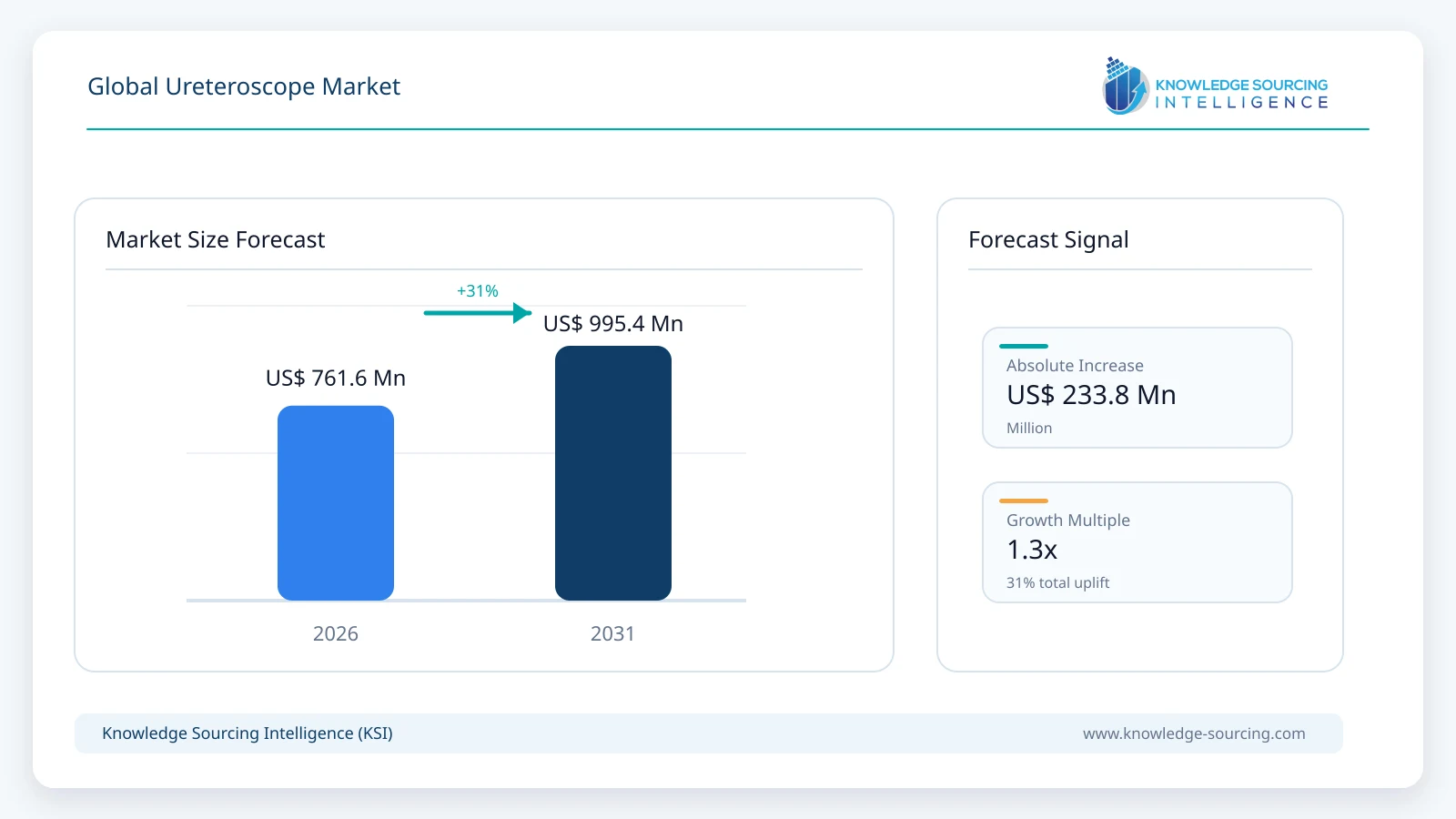
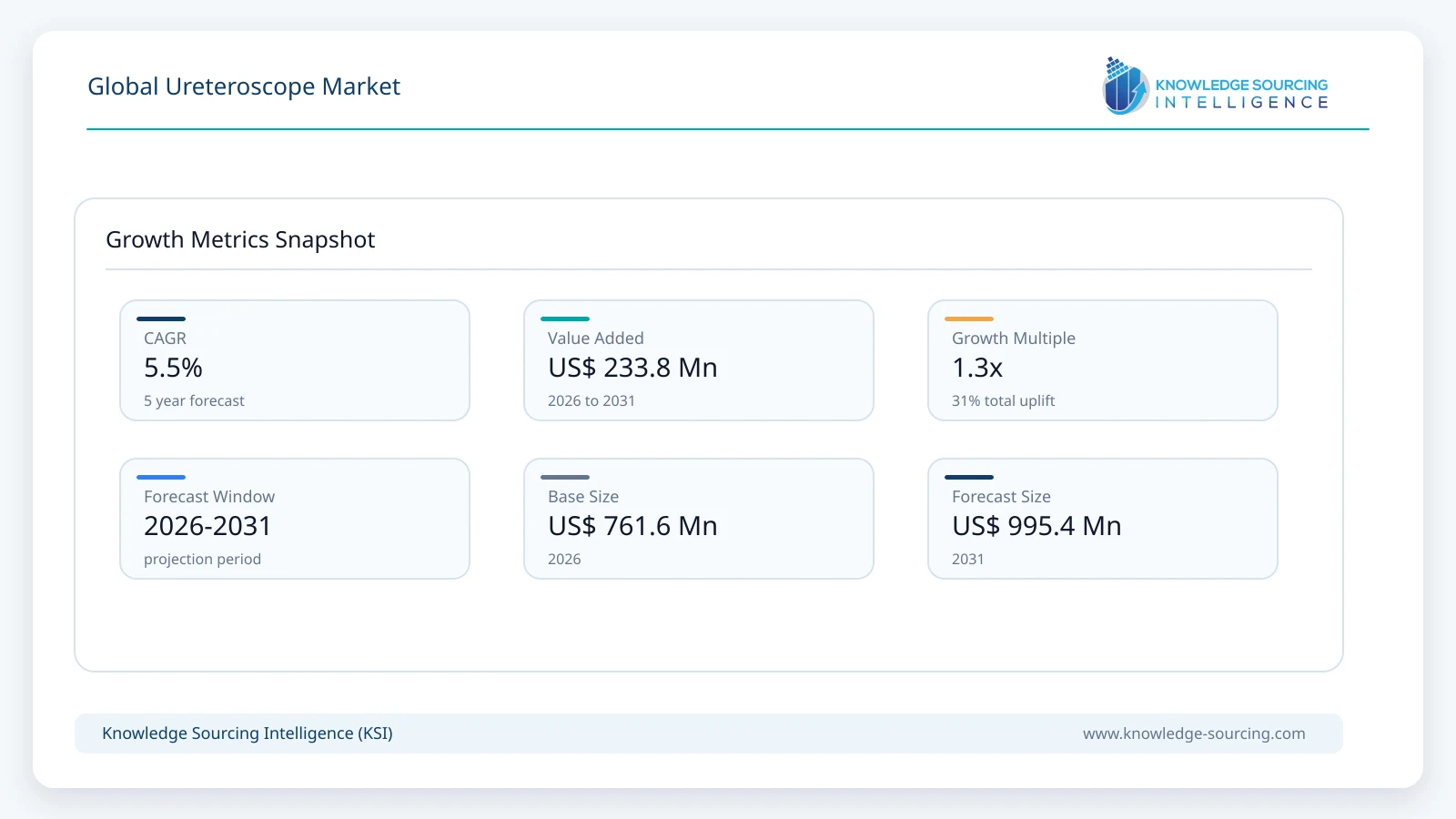
The global ureteroscope market is forecast to grow at a CAGR of 5.5%, reaching USD 995.4 million in 2031 from USD 761.6 million in 2026.
Highlights:
- 1Stone management remains the principal demand catalyst, with ureteroscopy providing direct visualization and minimally invasive access for renal and ureteral stone treatment.
- 2Flexible ureteroscopes represent the most commercially important product category, particularly for renal procedures requiring access to the upper urinary tract and difficult calyceal anatomy.
- 3Single-use digital ureteroscopes are gaining strategic importance, as hospitals evaluate infection-control requirements, reprocessing costs, repair rates, turnaround time, and procedural availability.
- 4North America and Europe remain important technology and procurement markets, supported by established urology infrastructure and sophisticated endourological practice.
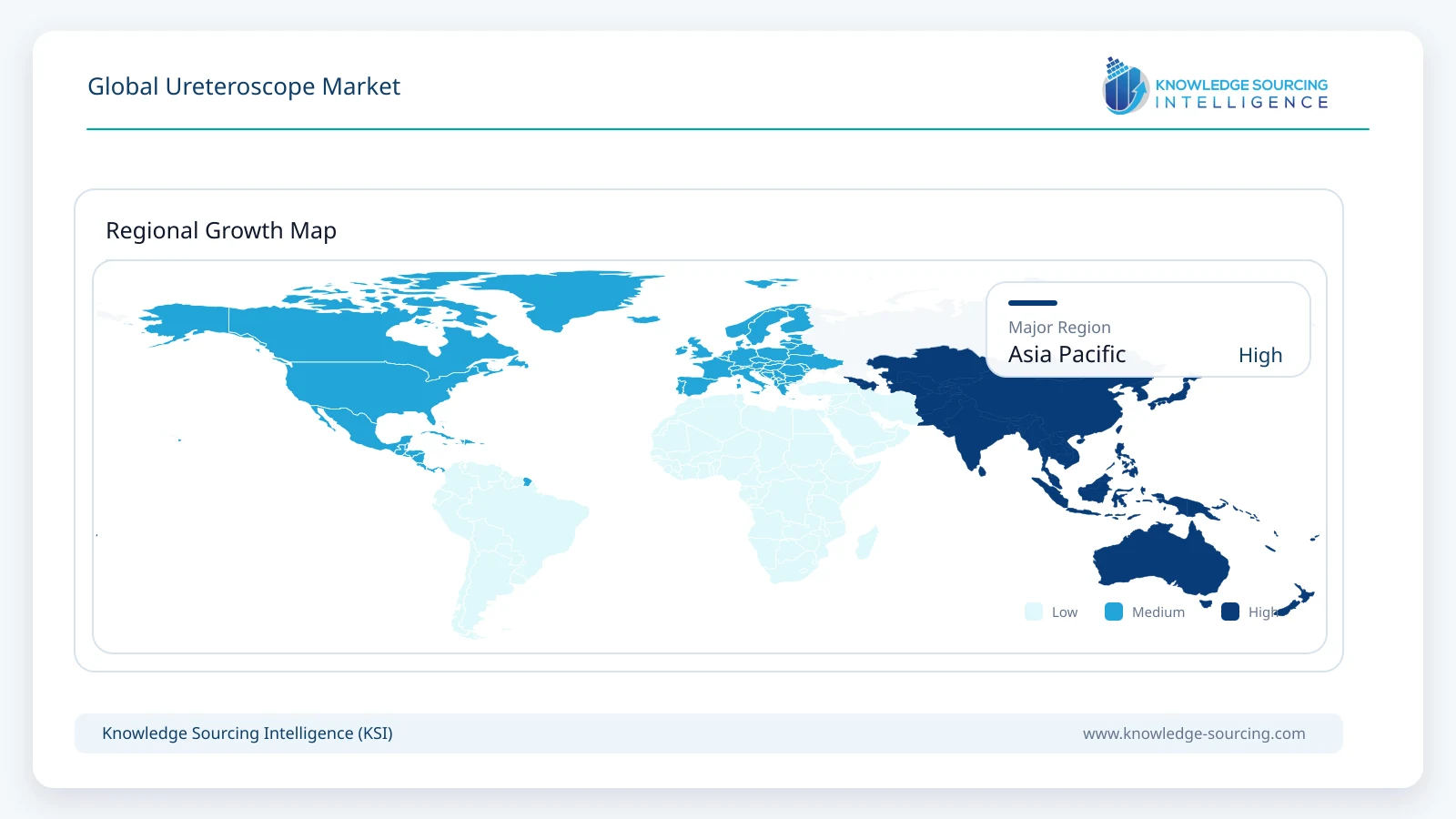
- 5Asia-Pacific offers substantial equipment expansion opportunities, supported by growing hospital capacity, increasing access to minimally invasive procedures, and development of domestic medical-device manufacturing.
- 6Regulatory scrutiny and reprocessing requirements influence purchasing decisions, particularly for reusable scopes, while recent product clearances demonstrate continued regulatory activity around single-use digital ureteroscopes.
The Ureteroscope Market covers endoscopic instruments used to access, visualize, diagnose, and treat conditions affecting the ureter and renal collecting system. The market includes flexible, semi-rigid, and rigid ureteroscopes, with product configurations differentiated by imaging technology, reusability, working-channel design, deflection, diameter, irrigation capability, and integration with stone-treatment systems. Ureteroscopes are used most extensively in endourological procedures, particularly ureteroscopy and retrograde intrarenal surgery (RIRS), where physicians require controlled access to the upper urinary tract.
Demand is closely linked to the clinical burden of urinary stones and the increasing use of minimally invasive stone-treatment procedures. Ureteroscopy allows physicians to visualize the urinary tract and remove or fragment stones through natural urinary passages, often enabling same-day discharge. The U.S. National Institute of Diabetes and Digestive and Kidney Diseases describes ureteroscopy as a procedure in which a thin ureteroscope provides detailed visualization of the ureters and kidneys, with stones subsequently removed or fragmented.
The commercial market is therefore shaped less by standalone scope replacement cycles and more by procedure volumes, operating-room utilization, urology infrastructure, and the economics of reusable versus single-use instruments. Hospitals with high urology caseloads can justify investments in reusable platforms because the initial capital expenditure is distributed across multiple procedures. Conversely, ambulatory facilities and lower-volume centers may favor single-use scopes when sterilization capacity, scope repair, instrument turnaround, and inventory management become material cost considerations.
Clinical requirements are also influencing purchasing decisions. Physicians need reliable deflection, adequate irrigation, a sufficiently large working channel, clear visualization, dependable access through complex anatomy, and compatibility with laser lithotripsy and stone-retrieval accessories. The 2026 European Association of Urology (EAU) guidance notes that technical improvements in endoscope miniaturization, deflection, optical quality, and disposable instruments have expanded the use of ureteroscopy for ureteral and renal stones. The same guidance identifies digital scopes as an important technical development and notes shorter operating times associated with improved image quality.
The market is also moving toward greater procedural integration. A ureteroscope increasingly functions as one component within a broader stone-management workflow involving access sheaths, guidewires, baskets, lasers, irrigation systems, imaging processors, pressure-monitoring systems, and operating-room displays. This creates opportunities for suppliers that can combine scopes with complementary devices rather than compete only on the price of an individual instrument.
Market Drivers
Increasing Use of Ureteroscopy for Urinary Stone Management
Urinary stone treatment is the central demand engine for ureteroscopes because the instruments provide direct access to stones without requiring open surgery. Ureteroscopy is used for both ureteral and renal stones, while flexible scopes extend access into the kidney and enable RIRS procedures.
The clinical preference for ureteroscopy is strengthened when physicians prioritize a high probability of achieving stone-free status in a single intervention. The EAU's 2026 guidance states that ureteroscopy offers a better chance of achieving stone-free status with a single procedure compared with observation or alternative treatment pathways in appropriate patients, although it also recognizes higher complication rates than shock-wave lithotripsy in relevant comparisons.
For device manufacturers, this creates recurring demand linked to procedural volume rather than one-time diagnostic use. Hospitals with active stone-management programs therefore require a continuing supply of scopes, accessories, repair services, imaging systems, and related procedural equipment.
Expansion of Flexible Ureteroscopy and RIRS
Flexible ureteroscopy has become commercially important because the instrument can navigate the upper urinary tract and renal collecting system. Its value increases when stones are located in anatomically difficult positions or when physicians require access to multiple calyces during one intervention.
Purchasing decisions in this segment extend beyond optical quality. Urologists assess tip deflection, scope diameter, working-channel dimensions, irrigation performance, durability, laser compatibility, image resolution, and maneuverability. The EAU identifies improvements in these technical characteristics as contributors to the wider use of flexible ureteroscopy.
This favors manufacturers capable of improving several performance parameters simultaneously. A scope that provides better visualization but compromises irrigation or deflection may have limited clinical value. Suppliers therefore compete through system-level performance rather than a single headline specification.
Shift Toward Single-Use Ureteroscopes
Single-use ureteroscopes are creating a different purchasing model from conventional reusable equipment. Hospitals no longer need to evaluate only acquisition price and expected instrument life. They must also consider cleaning, disinfection, sterilization, maintenance, repairs, inventory availability, turnaround time, and the operational consequences of scope damage.
The FDA's 2025–2026 510(k) database shows continued regulatory activity involving single-use flexible ureteroscopes. Examples include clearances for devices from Hunan Vathin Medical Instrument in May 2025, Scivita Medical Technology in March 2025, Guangzhou Red Pine Medical in December 2025, and Zhejiang Geyi Medical Instrument in December 2025.
Boston Scientific also received FDA clearance in September 2025 for its LithoVue Elite single-use digital flexible ureteroscope with intrarenal pressure monitoring.
The commercial implication is a widening supplier base and greater scope for procurement teams to compare disposable devices based on clinical performance, per-procedure economics, availability, and integration with existing stone-management infrastructure.
Greater Emphasis on Procedural Safety and Intrarenal Pressure
Intrarenal pressure is becoming a more visible consideration in flexible ureteroscopy because irrigation and instrument manipulation can raise pressure within the collecting system. The EAU notes that sustained elevated intrarenal pressure is associated with infectious risk and emphasizes attention to pressure during ureteroscopic procedures.
This clinical concern creates a technology pathway beyond conventional visualization. Boston Scientific's LithoVue Elite integrates intrarenal pressure monitoring into a single-use digital flexible ureteroscope, demonstrating how manufacturers can differentiate products through procedural information rather than imaging alone.
For buyers, the value proposition depends on whether pressure monitoring can improve procedural decision-making without adding excessive equipment or workflow complexity. Suppliers therefore need to demonstrate clinical utility alongside technical functionality.
Growth of Ambulatory and Lower-Acuity Procedure Settings
Ureteroscopy is increasingly compatible with outpatient workflows because many procedures can be completed without prolonged hospitalization. NIDDK notes that ureteroscopy is performed with anesthesia and that patients can typically return home the same day.
This supports demand from ambulatory surgical centers and specialty urology facilities. These buyers typically have different procurement criteria from large tertiary hospitals. They may place greater emphasis on predictable availability, compact systems, simplified setup, procedure throughput, and limited dependence on centralized sterile-processing capacity.
Market Restraints and Challenges
High Total Cost of Advanced Ureteroscope Systems
The acquisition price of a sophisticated ureteroscope is only one element of the hospital's total cost. Reusable platforms require cleaning, disinfection, sterilization, inspection, maintenance, repairs, and inventory management. Single-use platforms eliminate many reprocessing activities but transfer expenditure toward per-procedure consumables.
The resulting economic comparison is highly facility-specific. A high-volume tertiary hospital may obtain a favorable cost per procedure from reusable scopes, while a smaller facility may value the operational simplicity of a disposable device. Manufacturers must therefore demonstrate economic value under different utilization assumptions rather than rely on list-price comparisons.
Reprocessing and Infection-Control Requirements
Reusable ureteroscopes require strict processing because they enter the urinary tract and may contact normally sterile anatomical sites. ISO 17664-1:2021 establishes requirements for manufacturer-provided processing information covering activities such as cleaning, disinfection, drying, inspection, maintenance, packaging, sterilization, storage, and transportation.
The CDC's Healthcare Infection Control Practices Advisory Committee has also emphasized facility-level training and competency as essential elements of flexible-endoscope reprocessing programs.
These requirements create costs for hospitals and operational risks when staff, equipment, documentation, or workflow controls are inadequate. They simultaneously create an opportunity for single-use ureteroscopes, particularly in facilities where reprocessing capacity is constrained.
Fragility and Repair Requirements for Reusable Scopes
Reusable flexible ureteroscopes contain delicate components and must repeatedly withstand insertion, deflection, irrigation, laser procedures, cleaning, disinfection, and sterilization. Damage to the distal tip, optical components, working channel, or deflection mechanism can result in repair expenditure and instrument downtime.
Repair economics influence procurement decisions because a hospital may need multiple scopes to maintain procedural availability while damaged devices are serviced. Manufacturers with reliable service infrastructure can therefore gain an advantage even when their initial device price is higher.
Technical Trade-Offs Between Miniaturization and Performance
Ureteroscope design requires a balance between diameter, maneuverability, visualization, irrigation, working-channel capacity, durability, and access. Smaller instruments can facilitate passage through challenging anatomy, but reducing dimensions may constrain other performance characteristics.
The EAU specifically highlights endoscope miniaturization and improved deflection as important technological developments while also recognizing that performance differences remain between reusable fiber-optic and disposable flexible devices.
This creates a difficult engineering problem for manufacturers. Improvements in one parameter may affect another, meaning that product development requires system-level optimization rather than isolated specification improvements.
Capital and Infrastructure Constraints in Emerging Markets
Ureteroscopy requires more than the scope itself. Hospitals may need compatible imaging processors, lasers, irrigation systems, access sheaths, baskets, anesthesia infrastructure, trained urologists, and sterile-processing capabilities.
In lower-resource healthcare systems, limited access to advanced urology equipment can restrict adoption even when clinical demand exists. Procurement may therefore proceed in stages, beginning with rigid or semi-rigid ureteroscopy and subsequently expanding into flexible digital systems as case volumes and capital budgets increase.
Major Segment Analysis
Flexible Ureteroscope
Flexible ureteroscopes represent the most commercially important segment because they provide access to the renal collecting system and support RIRS for kidney stone treatment.
The segment's commercial value derives from its broader anatomical reach compared with rigid instruments. Flexible scopes allow physicians to negotiate the ureter and access multiple renal calyces, making them important for renal stones that cannot be treated efficiently through more limited access routes.
Purchasing decisions increasingly center on maneuverability and visualization. Distal tip deflection, outer diameter, working-channel dimensions, image quality, irrigation, and resistance to damage all influence physician preference. The EAU's current guidance recognizes digital scopes, improved deflection, miniaturization, and enhanced optical quality as factors supporting broader use of flexible ureteroscopy.
The reusable-versus-single-use decision is particularly important within this segment. Reusable flexible scopes provide an established economic model for high-volume centers. Their value increases when hospitals maintain strong sterile-processing infrastructure and achieve high utilization rates. Single-use scopes, by contrast, offer predictable instrument availability and avoid the need to reprocess the scope after each case.
The competitive distinction is therefore moving toward total procedure economics. Manufacturers can compete through lower device cost, higher durability, superior imaging, improved deflection, pressure monitoring, smaller diameters, better working channels, or integration with stone-management platforms.
Digital technology is also becoming central to the segment. Digital flexible ureteroscopes can provide improved visualization compared with traditional fiber-optic systems, while newer systems combine imaging with additional procedural information. Boston Scientific's LithoVue Elite, for example, combines digital imaging with real-time intrarenal pressure monitoring.
For manufacturers, flexible ureteroscopes also create opportunities to sell adjacent products. A supplier that provides the scope, imaging platform, laser, access sheath, basket, and supporting software can influence a larger portion of the hospital's stone-management budget. This makes portfolio breadth increasingly relevant to competitive positioning.
Regional Analysis
North America
North America represents a mature market for ureteroscopy, supported by established urology departments, ambulatory surgical centers, advanced imaging systems, and widespread availability of minimally invasive stone-treatment technologies.
The United States is particularly important because procurement decisions are influenced by procedure economics, reimbursement structures, infection-control requirements, and hospital purchasing organizations. Single-use ureteroscopes have gained commercial attention as providers evaluate the cost of scope repairs and reprocessing against per-procedure disposable expenditure.
Regulatory activity also supports continued product introduction. FDA records show multiple 510(k) clearances for single-use flexible ureteroscopes during 2025 and 2026, including Boston Scientific's LithoVue Elite.
Canada maintains a developed endourology infrastructure, while Mexico provides longer-term expansion potential as private hospitals and specialized surgical facilities invest in minimally invasive urological equipment. Procurement conditions remain more price-sensitive outside the largest tertiary centers.
Europe
Europe has a strong clinical base for ureteroscopy and a mature medical-device regulatory framework. Germany, France, the United Kingdom, Italy, and Spain represent important procurement markets because of established hospital systems and specialist urology capacity.
The EAU's guideline framework is particularly relevant to technology adoption because it addresses ureteroscopy technique, digital scopes, intrarenal pressure, disposable instruments, and stone-treatment strategies.
European procurement is also shaped by the Medical Device Regulation. EU MDR Article 17 regulates reprocessing and further use of single-use devices and establishes specific obligations where such reprocessing is permitted.
This regulatory environment makes documentation, traceability, device labeling, and validated processing procedures important elements of the purchasing decision. Manufacturers supplying European hospitals must therefore compete on compliance and service support alongside clinical performance.
Asia Pacific
Asia Pacific presents a wide range of market conditions. Japan and South Korea have sophisticated healthcare systems and established demand for advanced endourological equipment. China is important both as a large healthcare market and as a growing manufacturing base for endoscopic devices.
India offers expansion potential as hospitals increase access to minimally invasive urology and specialist surgical services. Thailand, Indonesia, Taiwan, and Australia contribute additional demand, although procurement capacity varies considerably.
The region is also becoming more important to the supply side. FDA records from 2025–2026 show several Chinese manufacturers receiving U.S. clearances for single-use flexible ureteroscope products, indicating continued development of disposable endoscopic-device capabilities in the region.
Middle East and Africa
The Middle East market is concentrated around higher-capacity healthcare systems, particularly in Saudi Arabia and the UAE. Government investment in specialist hospitals, private healthcare infrastructure, and advanced surgical services supports demand for endourology equipment.
Procurement in these markets is generally influenced by clinical capability, physician preference, international accreditation requirements, service availability, and equipment reliability. Disposable scopes may be attractive where facilities want predictable procedural readiness without building extensive reprocessing capacity.
Africa remains more heterogeneous. Larger private hospitals and tertiary institutions can adopt advanced ureteroscopy systems, while lower-resource settings face constraints related to capital expenditure, trained specialists, maintenance infrastructure, and availability of compatible lasers and accessories.
South America
Brazil represents the largest commercial opportunity in South America because of its large healthcare system and concentration of specialist hospitals. Argentina and other markets provide additional demand through private healthcare networks and tertiary centers.
The main constraint is uneven access to advanced urology infrastructure. High-end flexible digital systems can face procurement barriers where hospitals have limited capital budgets or lower procedure volumes. Suppliers with strong distributor networks, service support, and flexible purchasing models are better positioned to address these conditions.
Competitive Landscape
The competitive structure includes diversified medical-technology companies, specialist endoscopy manufacturers, urology-focused suppliers, and companies with established lithotripsy portfolios.
The provided competitive set comprises Boston Scientific Corporation, Olympus Corporation, Richard Wolf GmbH, Stryker Corporation, KARL STORZ SE & Co. KG, ELMED Medical Systems, Dornier MedTech GmbH, Maxer Endoscopy GmbH, Cook Medical, PENTAX Medical, and EMS Electro Medical Systems.
Competition is based on several overlapping dimensions. Reusable-scope suppliers compete through durability, image quality, deflection, service infrastructure, and installed-base relationships. Single-use manufacturers compete more heavily on per-procedure economics, visualization, maneuverability, reliability, availability, and elimination of reprocessing requirements.
Portfolio breadth is another competitive factor. Suppliers that combine ureteroscopes with lithotripsy systems, imaging processors, access products, retrieval devices, and related urology technologies can influence procurement at the procedure-platform level.
Olympus illustrates this broader portfolio approach. In September 2025, the company announced an exclusive global distribution agreement with MacroLux Medical covering single-use urology products, including ureteroscopes and suction access sheaths, across the United States, Canada, Europe, and Asia Pacific.
Boston Scientific has pursued differentiation through integration of digital flexible ureteroscopy with intrarenal pressure monitoring. Its LithoVue Elite platform demonstrates how manufacturers can move beyond basic visualization toward additional procedural information and operating-room integration.
Competition therefore extends beyond scope specifications. Suppliers must demonstrate clinical usability, procurement economics, training, technical service, inventory reliability, regulatory compliance, and compatibility with existing hospital systems.
Recent Developments
August 2026: The U.S. FDA cleared Scivita Medical Technology’s SUV-5C-B single-use flexible ureteroscope on August 14, 2026, expanding cleared single-use ureteroscope options in the United States.
March 2026: Boston Scientific received FDA clearance for its Asurys Fluid Management System on March 30, 2026, integrating irrigation control with the LithoVue Elite Ureteroscope.
March 2026: Cook Medical commercially launched its new 7.5 Fr Ascend Single-Use Flexible Ureteroscope in the United States and Canada, adding a smaller scope size.
November 2025: Olympus announced a corporate strategy emphasizing investment in endoscopy-enabled care and continued development of its urology portfolio. Its 2025 integrated reporting identifies single-use ureteroscopes as a future growth driver within its upper-tract stone-management business.
Regulatory and Policy Environment
Ureteroscopes are regulated as medical devices, with requirements varying by jurisdiction according to device classification, intended use, sterility status, reusable or single-use designation, and claims made by the manufacturer.
In the United States, the FDA classifies ureteroscopes and associated accessories under a medical-device framework that includes flexible and rigid ureteroscope products. Recent 510(k) decisions demonstrate continued regulatory review of single-use digital and flexible ureteroscopes.
For manufacturers, FDA clearance requires adequate evidence demonstrating substantial equivalence for applicable 510(k) submissions. Commercial implications extend beyond initial clearance because companies must maintain quality systems, labeling, post-market surveillance, complaint handling, and compliance with applicable medical-device requirements.
Reusable devices face additional operational considerations. ISO 17664-1:2021 requires manufacturers to provide processing information for critical and semi-critical medical devices, covering activities such as cleaning, disinfection, drying, inspection, maintenance, packaging, sterilization, storage, and transportation.
The CDC's flexible-endoscope reprocessing recommendations reinforce the importance of trained personnel, documented procedures, and competency within healthcare facilities. This creates a direct link between regulation, infection prevention, procurement, and device selection.
European regulation adds another layer. Under the EU Medical Device Regulation, reprocessing and reuse of single-use devices are permitted only under specified conditions and national-law provisions. Where permitted, reprocessors can assume manufacturer-like responsibilities and must meet applicable safety, performance, and traceability requirements.
These regulatory requirements influence competitive strategy. Reusable-scope suppliers must support validated processing workflows and documentation, while single-use manufacturers can position disposable products around simplified post-procedure processing. Neither model eliminates compliance obligations; the nature of those obligations differs.
Outlook and Strategic Implications
The 2026–2031 outlook for the Ureteroscope Market will be shaped by procedure volumes, flexible ureteroscopy adoption, single-use economics, imaging improvements, regulatory requirements, and hospital efforts to control total procedural costs.
Investment priorities are likely to favor technologies that solve identifiable clinical or operational problems. Improved image quality alone may become insufficient as a differentiation strategy. Manufacturers are likely to place greater emphasis on deflection, smaller diameters, irrigation, pressure monitoring, integrated visualization, ergonomic control, and compatibility with laser lithotripsy.
Procurement teams will increasingly compare reusable and single-use scopes through total-cost-of-ownership models. For reusable systems, the relevant calculation includes acquisition, utilization, reprocessing, repairs, maintenance, depreciation, and replacement. For single-use products, buyers must assess device price, procedural reliability, inventory requirements, waste management, and compatibility with existing processors and accessories.
The EAU's 2026 guidance supports the continued importance of flexible ureteroscopy and recognizes the contribution of improved digital scopes and disposable instruments. It also emphasizes procedural factors such as intrarenal pressure and operative duration, reinforcing the commercial relevance of technologies that can improve procedural control.
Single-use ureteroscopes are likely to remain an important competitive battleground. Recent FDA clearances from multiple manufacturers demonstrate that the category is attracting continued product development. The commercial question will increasingly shift from whether disposable scopes can substitute for reusable products to which clinical and economic conditions justify each model.
Regional strategies will also need to diverge. North American suppliers can emphasize procedural economics, ambulatory care, and technology integration. European suppliers must place greater weight on regulatory compliance, reprocessing policy, and established hospital procurement frameworks. Asia Pacific offers opportunities for both premium technology suppliers and cost-competitive manufacturers, while emerging markets require distributor strength and service availability.
Manufacturers with broad urology portfolios may have an advantage when hospitals seek integrated stone-management solutions. Scope suppliers can strengthen their commercial position by connecting ureteroscopy with lasers, access products, retrieval devices, imaging systems, pressure-monitoring capabilities, and procedural education.
The main risks include pricing pressure from new single-use entrants, regulatory changes, reimbursement uncertainty, supply-chain disruptions, hospital capital constraints, and the technical difficulty of improving scope performance without increasing cost. Reusable systems will continue to face reprocessing and repair considerations, while disposable systems must address per-procedure economics and environmental concerns.
Strategically, the most attractive opportunities will lie where manufacturers can demonstrate measurable value to hospitals and urologists. Product development should prioritize clinically relevant performance, predictable procedure availability, simplified workflows, and compatibility with existing infrastructure. Commercial success will depend increasingly on the complete economics of ureteroscopy rather than the technical specifications of the scope alone.
For healthcare providers, procurement decisions during 2026–2031 will require a case-volume-specific assessment of reusable and single-use platforms. High-volume centers may continue to support reusable systems where utilization and reprocessing infrastructure justify them, while lower-volume or capacity-constrained facilities may find single-use platforms more operationally attractive.
Overall, the market's direction will be determined by the intersection of minimally invasive stone treatment, endourological capacity, device economics, infection-control requirements, and technology differentiation. The suppliers best positioned for the next five years will be those capable of addressing these factors together rather than competing solely through incremental changes in scope design.
Ureteroscope Market Scope:
| Report Metric | Details |
|---|---|
| Total Market Size in 2026 | USD 761.6 million |
| Total Market Size in 2031 | USD 995.4 million |
| Forecast Unit | Million |
| Growth Rate | 5.5% |
| Study Period | 2021 to 2031 |
| Historical Data | 2021 to 2024 |
| Base Year | 2025 |
| Forecast Period | 2026 – 2031 |
| Segmentation | Type, Application, Technology, Usability, End-User, Geography |
| Companies |
|
Market Segmentation
By Type
- Flexible Ureteroscope
- Semi-Rigid Ureteroscope
- Rigid Ureteroscope
By Application
- Urolithiasis
- Upper Urinary Tract Urothelial Carcinoma
- Ureteral Stricture
- Others
By Technology
- Digital Ureteroscope
- Fiber-Optic Ureteroscope
By Usability
- Single-Use Ureteroscope
- Reusable Ureteroscope
By End-User
- Hospitals and Clinics
- Ambulatory Surgical Centers
- Specialty Urology Centers
- Others
By Geography
- North America
- United States
- Canada
- Mexico
- South America
- Brazil
- Argentina
- Others
- Europe
- Germany
- France
- United Kingdom
- Italy
- Spain
- Others
- Middle East and Africa
- Saudi Arabia
- UAE
- Others
- Asia-Pacific
- China
- India
- Japan
- South Korea
- Taiwan
- Thailand
- Indonesia
- Australia
- Others
Table of Contents
1. INTRODUCTION
1.1. Market Definition
1.2. Market Segmentation
2. RESEARCH METHODOLOGY
2.1. Research Approach
2.2. Research Data
2.3. Data Sources and Validation
2.4. Market Estimation and Forecasting
2.5. Assumptions and Limitations
3. EXECUTIVE SUMMARY
3.1. Research Highlights
4. MARKET DYNAMICS
4.1. Market Drivers
4.2. Market Restraints
4.3. Porter’s Five Forces Analysis
4.3.1. Bargaining Power of Suppliers
4.3.2. Bargaining Power of Buyers
4.3.3. Threat of New Entrants
4.3.4. Threat of Substitutes
4.3.5. Competitive Rivalry in the Industry
4.4. Industry Value Chain Analysis
5. GLOBAL URETEROSCOPE MARKET ANALYSIS, BY TYPE
5.1. Introduction
5.2. Flexible Ureteroscope
5.3. Semi-Rigid Ureteroscope
5.4. Rigid Ureteroscope
6. GLOBAL URETEROSCOPE MARKET ANALYSIS, BY APPLICATION
6.1. Introduction
6.2. Urolithiasis
6.3. Upper Urinary Tract Urothelial Carcinoma
6.4. Ureteral Stricture
6.5. Others
7. GLOBAL URETEROSCOPE MARKET ANALYSIS, BY TECHNOLOGY
7.1. Introduction
7.2. Digital Ureteroscope
7.3. Fiber-Optic Ureteroscope
8. GLOBAL URETEROSCOPE MARKET ANALYSIS, BY USABILITY
8.1. Introduction
8.2. Single-Use Ureteroscope
8.3. Reusable Ureteroscope
9. GLOBAL URETEROSCOPE MARKET ANALYSIS, BY END-USER
9.1. Introduction
9.2. Hospitals and Clinics
9.3. Ambulatory Surgical Centers
9.4. Specialty Urology Centers
9.5. Others
10. GLOBAL URETEROSCOPE MARKET ANALYSIS, BY GEOGRAPHY
10.1. Introduction
10.2. North America
10.2.1. United States
10.2.2. Canada
10.2.3. Mexico
10.3. South America
10.3.1. Brazil
10.3.2. Argentina
10.3.3. Others
10.4. Europe
10.4.1. Germany
10.4.2. France
10.4.3. United Kingdom
10.4.4. Italy
10.4.5. Spain
10.4.6. Others
10.5. Middle East and Africa
10.5.1. Saudi Arabia
10.5.2. UAE
10.5.3. Others
10.6. Asia-Pacific
10.6.1. China
10.6.2. India
10.6.3. Japan
10.6.4. South Korea
10.6.5. Taiwan
10.6.6. Thailand
10.6.7. Indonesia
10.6.8. Australia
10.6.9. Others
11. COMPETITIVE ENVIRONMENT AND ANALYSIS
11.1. Major Players and Strategy Analysis
11.2. Emerging Players and Growth Opportunities
11.3. Mergers, Acquisitions, Agreements, and Collaborations
11.4. Vendor Competitiveness Matrix
12. REGULATORY AND POLICY ENVIRONMENT
12.1. U.S. Regulatory Framework
12.2. European Regulatory Framework
12.3. Asia-Pacific Regulatory Environment
12.4. Sterilization and Reprocessing Considerations
13. COMPANY PROFILES
13.1. Boston Scientific Corporation
13.2. Olympus Corporation
13.3. Richard Wolf GmbH
13.4. Stryker Corporation
13.5. KARL STORZ SE & Co. KG
13.6. ELMED Medical Systems
13.7. Dornier MedTech GmbH
13.8. Maxer Endoscopy GmbH
13.9. Cook Medical
13.10. PENTAX Medical
13.11. EMS Electro Medical Systems
Navigate
Trusted by the world's leading organizations











