
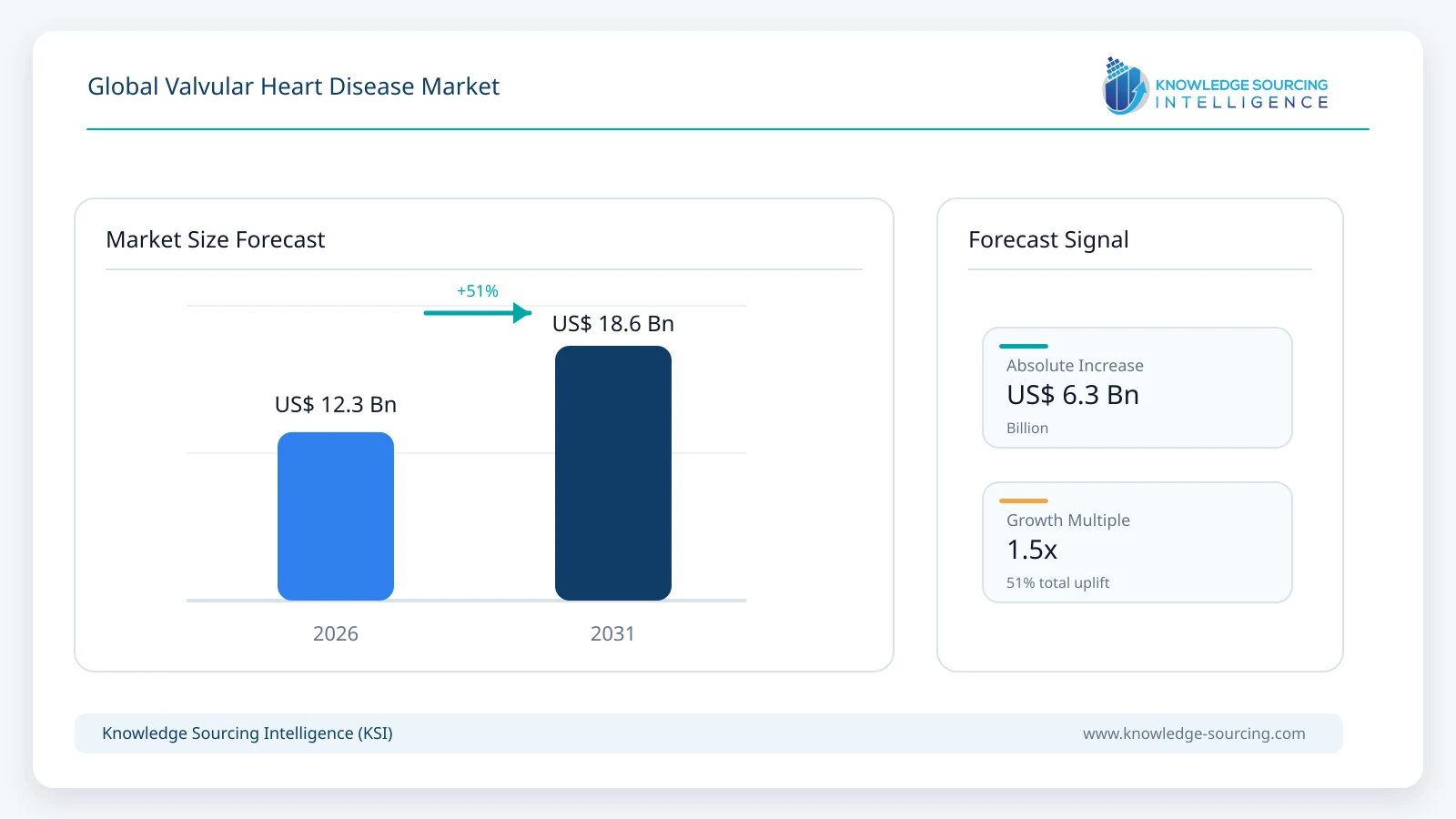
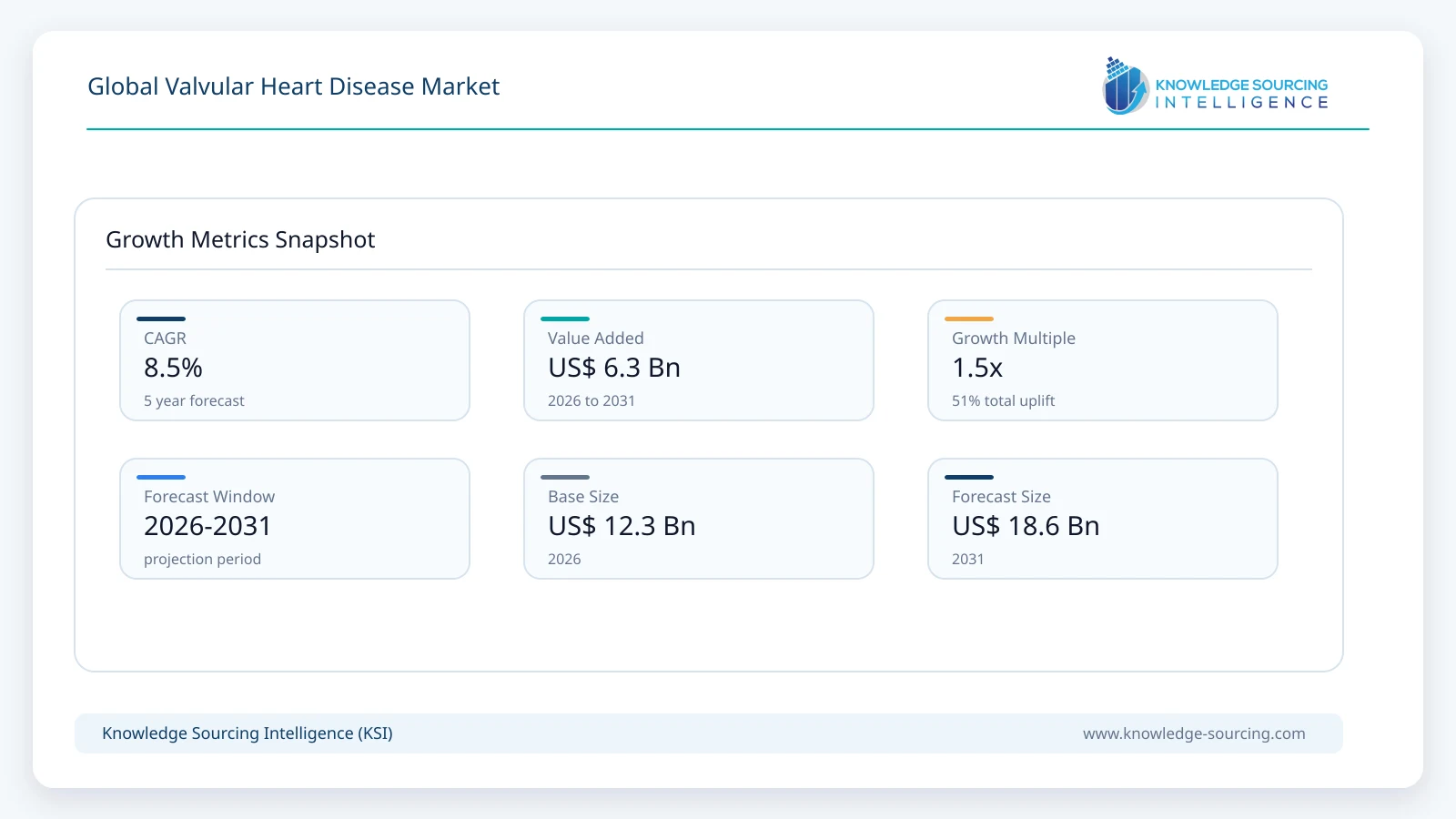
The Global Valvular Heart Disease market is projected to grow at a CAGR of 8.5% over the forecast period, increasing from USD 12.3 billion in 2026 to USD 18.6 billion by 2031.
Highlights:
- 1Aging populations are increasing degenerative aortic stenosis prevalence, which is expanding long-term demand for transcatheter valve replacement systems and imaging-guided structural intervention technologies.
- 2Hospitals are adopting minimally invasive valve interventions because healthcare systems are attempting to reduce surgical mortality, intensive care utilization, and procedural recovery burden among elderly cardiovascular patients.
- 3Demand for transcatheter mitral and tricuspid repair systems is increasing because high-risk surgical populations require lower procedural morbidity and shorter hospitalization timelines.
- 4Structural heart imaging investment is expanding because procedural precision increasingly depends on high-resolution echocardiography, CT planning, and AI-assisted catheter navigation systems.
- 5Healthcare providers are strengthening outpatient structural heart surveillance because chronic valvular disease management increasingly depends on long-term hemodynamic monitoring and repeat imaging assessment.
The valvular heart disease market addresses structural abnormalities affecting cardiac valve function because stenotic and regurgitant valve disorders progressively impair cardiovascular hemodynamics and long-term cardiac performance. The market structure combines surgical valve replacement, transcatheter interventions, pharmacological management, cardiac imaging technologies, and long-term monitoring systems because advanced valvular disease frequently progresses toward chronic heart failure and arrhythmia burden. Aging demographics are increasing dependence on structural heart programs because degenerative calcific valve disease prevalence rises substantially among elderly cardiovascular populations.
The treatment ecosystem depends on multidisciplinary structural heart infrastructure because transcatheter valve interventions require coordinated integration between interventional cardiologists, cardiac surgeons, imaging specialists, anesthesiologists, and intensive cardiovascular care teams. Demand is shifting toward catheter-based valve replacement and repair because healthcare systems are reducing dependence on open-heart surgery among high-risk patient groups. This transition is increasing adoption of transcatheter aortic valve replacement systems, mitral repair platforms, tricuspid intervention technologies, and AI-assisted procedural imaging solutions.
Regulatory systems are accelerating structural heart innovation because minimally invasive cardiovascular technologies increasingly reduce hospitalization burden and procedural mortality across elderly patient populations. The market is evolving from isolated surgical correction toward longitudinal structural heart disease management, which is increasing dependence on repeat imaging surveillance, remote cardiac monitoring, and long-term prosthetic valve durability assessment.
Market Dynamics
Market Drivers
Rising Prevalence of Degenerative Valve Disease: Degenerative valvular disease prevalence increases because aging populations experience progressive calcification and structural deterioration across aortic and mitral valve systems. Demand is increasing for structural heart intervention because untreated stenotic disease significantly elevates heart failure progression and mortality risk. Surgical capacity remains constrained because elderly cardiovascular patients frequently present with multiple comorbidities and elevated procedural risk. Hospitals are expanding transcatheter valve programs because minimally invasive intervention improves procedural eligibility across frail patient populations. Degenerative valve disease increasingly drives long-term structural heart treatment demand.
Expansion of Transcatheter Valve Intervention Programs: Transcatheter valve technologies reduce procedural invasiveness because catheter-delivered systems avoid sternotomy and prolonged cardiopulmonary bypass exposure. Demand is shifting toward TAVR and transcatheter mitral repair because healthcare systems are prioritizing shorter recovery timelines and lower hospitalization burden. Procedural complexity remains substantial because structural heart intervention depends heavily on imaging-guided precision and patient-specific anatomical assessment. Manufacturers are expanding structural heart clinical programs because transcatheter intervention adoption continues to increase globally. Catheter-based valve intervention now defines a major transformation across cardiovascular treatment pathways.
Increasing Dependence on Structural Heart Imaging: Advanced cardiac imaging improves procedural planning because valvular intervention requires accurate anatomical visualization and hemodynamic assessment. Demand is increasing for echocardiography, cardiac CT, and transesophageal imaging because structural heart programs increasingly depend on real-time procedural guidance. Diagnostic variability remains challenging because valvular anatomy and calcification burden differ substantially across patient populations. Imaging companies are integrating AI-assisted workflow systems because hospitals require faster and more standardized procedural assessment. Imaging infrastructure increasingly shapes structural heart procedural efficiency and treatment outcomes.
Growth in High-Risk Cardiovascular Populations: High-risk cardiovascular populations continue expanding because heart failure prevalence, diabetes incidence, and chronic hypertension increasingly accelerate valvular degeneration. Demand is shifting toward minimally invasive intervention because elderly patients frequently remain ineligible for conventional surgical replacement. Healthcare infrastructure remains pressured because structural heart procedures require specialized cardiovascular centers and multidisciplinary expertise. Providers are strengthening chronic valve surveillance programs because delayed intervention significantly worsens long-term cardiac outcomes. Structural heart management increasingly reflects chronic cardiovascular disease dependency.
Market Restraints
High procedural costs continue limiting structural heart intervention accessibility because transcatheter valve systems and imaging-guided procedures require specialized infrastructure and multidisciplinary expertise.
Workforce shortages constrain procedural scalability because structural heart intervention depends on highly trained interventional cardiologists and advanced imaging specialists.
Long-term prosthetic valve durability uncertainty increases repeat intervention dependency because biological valve degeneration remains clinically significant among younger cardiovascular populations.
Market Opportunities
Expansion of AI-Assisted Structural Heart Imaging: AI-enabled imaging improves valve assessment because automated analytics strengthen procedural planning accuracy and anatomical visualization. Demand is increasing for imaging-guided intervention systems because structural heart procedures increasingly depend on real-time hemodynamic interpretation. Workflow variability remains substantial because complex valvular anatomy requires highly specialized procedural assessment. Imaging companies are integrating predictive analytics because hospitals require improved procedural standardization and efficiency. AI-assisted imaging increasingly strengthens structural heart intervention programs.
Growth in Transcatheter Mitral and Tricuspid Repair: Transcatheter repair systems reduce surgical burden because high-risk cardiovascular patients frequently remain unsuitable for open-heart valve reconstruction. Adoption is increasing because mitral and tricuspid regurgitation prevalence continues rising across aging populations. Long-term durability evaluation remains ongoing because structural heart intervention technologies continue evolving rapidly. Device manufacturers are expanding transcatheter repair trials because healthcare systems increasingly prioritize minimally invasive cardiovascular treatment. Transcatheter repair technologies increasingly support long-term valvular disease management.
Expansion of Structural Heart Programs in Asia-Pacific: Structural heart infrastructure investment improves cardiovascular treatment access because governments are strengthening tertiary cardiac care capabilities across emerging economies. Demand is increasing because aging populations and cardiovascular risk factors continue elevating valvular disease burden. Regional disparities remain significant because rural healthcare systems frequently lack advanced imaging and interventional cardiology expertise. Hospitals are increasing structural heart partnerships because demand for minimally invasive cardiovascular intervention continues expanding. Infrastructure modernization increasingly strengthens procedural accessibility across emerging markets.
Development of Next-Generation Prosthetic Valves: Next-generation valve technologies improve long-term procedural outcomes because manufacturers are enhancing prosthetic durability and hemodynamic performance. Clinical interest is increasing because repeat intervention dependency remains a major structural heart challenge. Regulatory validation remains complex because long-term cardiovascular safety assessment requires extended outcome monitoring. Companies are expanding biological and polymer-based valve innovation programs because structural heart therapy increasingly depends on lifelong durability optimization. Advanced prosthetic technologies may reshape future structural heart treatment pathways.
Government Regulations
Region | Regulatory Authority | Regulatory Focus |
United States | FDA | Structural heart device approvals, PMA pathways for transcatheter valves, post-market surveillance |
Europe | EMA / EU MDR | Valve device safety monitoring, CE certification, long-term implant durability compliance |
Japan | PMDA | Structural heart intervention approvals and long-term cardiovascular safety evaluation |
India | CDSCO | Cardiovascular device approvals, structural heart procedural oversight, post-market monitoring |
China | NMPA | Accelerated structural heart technology review and local cardiovascular clinical validation |
Market Segmentation
By Therapy Type
Pharmacological therapies remain essential because valvular heart disease patients frequently develop heart failure, atrial fibrillation, pulmonary hypertension, and thromboembolic complications during long-term disease progression. Demand is shifting toward transcatheter valve interventions because structural heart programs are reducing dependence on open-heart surgery among elderly and high-risk cardiovascular populations. Surgical valve replacement continues maintaining clinical importance because severe multivalvular disease and complex anatomical abnormalities frequently require direct surgical correction. Diagnostic imaging technologies are expanding because structural heart intervention depends heavily on continuous echocardiographic and hemodynamic assessment. Cardiac monitoring systems maintain growing relevance because chronic valvular disease increasingly requires long-term rhythm and hemodynamic surveillance.
By Indication
Aortic stenosis remains the dominant intervention segment because degenerative calcific valve disease prevalence continues increasing substantially across aging populations. Demand is increasing for transcatheter aortic valve replacement because healthcare systems are prioritizing minimally invasive structural intervention among elderly cardiovascular patients. Mitral regurgitation continues to generate long-term treatment demand because progressive ventricular remodeling frequently worsens chronic hemodynamic instability and heart failure progression. Tricuspid regurgitation treatment adoption is increasing because structural heart programs are expanding transcatheter repair eligibility across previously undertreated patient populations. Pulmonary valve disease maintains specialized intervention demand because congenital and acquired structural abnormalities frequently require repeat valve replacement and chronic cardiovascular monitoring.
By Route of Administration
Oral therapies maintain long-term utilization because valvular heart disease patients frequently require chronic anticoagulation, heart failure management, and arrhythmia control during disease progression. Intravenous administration remains critical because perioperative stabilization and acute hemodynamic deterioration frequently require rapid cardiovascular support and intensive care intervention. Catheter-based delivery systems are expanding because transcatheter valve replacement and repair procedures reduce procedural invasiveness and improve recovery timelines. Healthcare providers are increasing adoption of imaging-guided catheter technologies because structural heart intervention requires precise anatomical navigation and valve positioning accuracy. Catheter-based administration increasingly defines modernization across structural heart treatment pathways.
Regional Analysis
North America Market Analysis
North America maintains leadership in valvular heart disease management because advanced structural heart infrastructure supports broad adoption of transcatheter valve replacement and minimally invasive repair technologies. Demand is increasing for TAVR and transcatheter mitral repair systems because hospitals are attempting to reduce surgical mortality and shorten cardiovascular recovery timelines among elderly populations. Healthcare expenditure remains elevated because structural heart intervention requires multidisciplinary procedural teams, advanced imaging systems, and long-term cardiovascular surveillance infrastructure. Hospitals are expanding structural heart programs because aging demographics continue increasing degenerative valve disease prevalence and chronic cardiovascular dependency. Regulatory agencies continue accelerating structural heart innovation because valvular disease remains a major contributor to heart failure progression and cardiovascular hospitalization burden. The region maintains strong competitive intensity because cardiovascular manufacturers continue expanding transcatheter intervention portfolios and AI-assisted imaging capabilities.
Europe Market Analysis
Europe maintains a strong structural heart treatment ecosystem because universal healthcare systems support broad access to advanced cardiovascular intervention and long-term valvular disease monitoring programs. Demand is shifting toward transcatheter interventions because hospitals are reducing invasive surgical exposure among elderly cardiovascular patients. Workforce constraints continue affecting procedural accessibility because structural heart specialists remain concentrated within tertiary cardiovascular referral centers. Healthcare systems are increasing investment in advanced cardiac imaging because accurate valve assessment directly improves procedural planning and long-term hemodynamic outcomes. Regulatory oversight remains stringent because implantable cardiovascular devices require extensive post-market durability monitoring under MDR frameworks. The region maintains strong adoption of imaging technologies and structural heart interventions because chronic valvular disease prevalence continues increasing across aging populations.
Asia Pacific Market Analysis
Asia Pacific represents a rapidly expanding valvular heart disease market because aging populations, rheumatic valve disease burden, and cardiovascular risk factors continue increasing structural heart treatment demand across major economies. Demand is increasing for transcatheter valve intervention and advanced cardiac imaging because governments are improving tertiary cardiovascular infrastructure and structural heart capabilities. Access disparities remain significant because rural healthcare systems frequently lack advanced structural heart expertise and procedural infrastructure. Hospitals are expanding minimally invasive cardiovascular intervention programs because catheter-based procedures reduce hospitalization burden and procedural recovery timelines. International device manufacturers continue strengthening regional partnerships because structural heart diagnosis and intervention rates are improving across urban healthcare systems. The region maintains long-term growth potential because cardiovascular screening and structural heart treatment accessibility continue expanding.
Rest of the World
Rest of the World markets maintain uneven structural heart treatment accessibility because healthcare infrastructure variability limits advanced cardiovascular intervention availability. Demand is increasing for early valvular disease diagnosis because untreated structural heart abnormalities continue contributing significantly to heart failure progression and mortality burden across underserved regions. Financial limitations continue restricting access to transcatheter valve systems and advanced imaging technologies because specialized cardiovascular centers remain concentrated in urban referral hospitals. Governments are increasing cardiovascular healthcare investment because chronic valvular disease continues placing pressure on long-term healthcare sustainability. International partnerships are supporting structural heart program expansion because specialist shortages continue constraining procedural accessibility. Long-term market expansion depends on cardiovascular infrastructure modernization and structural heart workforce development.
Regulatory Landscape
Regulatory systems increasingly prioritize long-term structural heart device safety because transcatheter valve interventions require extensive durability validation and post-procedural monitoring across aging cardiovascular populations. The FDA maintains accelerated structural heart review pathways because minimally invasive valve intervention increasingly reduces hospitalization burden and cardiovascular mortality among high-risk patient groups. European MDR frameworks strengthen post-market surveillance requirements because implantable transcatheter valve systems require extensive long-term safety and performance assessment.
Device approval complexity remains substantial because valvular heart disease intervention frequently involves anatomical variability, calcification burden, repeat intervention dependency, and high-risk cardiovascular comorbidity profiles. Regulatory agencies are increasing real-world evidence integration because long-term prosthetic valve durability and hemodynamic performance require extended clinical evaluation. Manufacturers continue expanding structural heart registry programs because implantable cardiovascular technologies require continuous lifecycle monitoring across diverse patient populations.
Global regulatory harmonization remains limited because structural heart device approval requirements differ substantially across regional healthcare systems and reimbursement environments. Companies are expanding regional regulatory partnerships because transcatheter valve adoption increasingly depends on localized cardiovascular validation and reimbursement integration. Regulatory evolution continues shaping structural heart innovation pathways and long-term procedural accessibility.
Pipeline Analysis
The valvular heart disease pipeline increasingly focuses on minimally invasive structural interventions because healthcare systems are attempting to reduce surgical morbidity and long-term cardiovascular hospitalization burden. Transcatheter aortic, mitral, and tricuspid valve replacement programs continue expanding because degenerative valve disease prevalence remains increasing globally. Companies are increasing investment in next-generation catheter delivery systems because anatomical precision and procedural efficiency remain essential for structural heart intervention success.
Regenerative valve technologies are progressing because conventional bioprosthetic valves frequently require repeat replacement due to long-term degeneration and durability limitations. Research institutions are developing tissue-engineered valve systems because younger cardiovascular populations require extended prosthetic adaptability and long-term hemodynamic performance. Clinical development remains complex because structural heart safety validation requires prolonged monitoring periods and large-scale cardiovascular outcome studies.
AI-assisted cardiac imaging programs are expanding because valvular heart disease diagnosis and procedural planning depend heavily on accurate structural visualization and hemodynamic assessment. Imaging manufacturers are integrating advanced analytics because transcatheter intervention increasingly requires automated valve sizing, calcification analysis, and procedural simulation. The pipeline increasingly reflects integration between structural intervention, imaging, digital cardiovascular monitoring, and long-term chronic disease management systems.
Competitive Landscape
Edwards Lifesciences
Edwards Lifesciences maintains strategic differentiation through advanced structural heart technologies because transcatheter valve replacement increasingly defines minimally invasive cardiovascular intervention pathways. The company continues expanding SAPIEN transcatheter valve adoption because hospitals are prioritizing reduced surgical trauma and shorter cardiovascular recovery periods. Its structural heart expertise strengthens competitive positioning because long-term valvular disease management increasingly depends on integrated intervention and imaging ecosystems.
Medtronic
Medtronic maintains strong structural heart positioning because the CoreValve Evolut platform supports minimally invasive aortic valve replacement across high-risk cardiovascular populations. Demand is increasing for transcatheter pulmonary valve replacement because structural heart programs continue expanding minimally invasive procedural eligibility. The company continues strengthening catheter-based intervention capabilities because aging populations increasingly require lower-risk cardiovascular treatment options.
Abbott Laboratories
Abbott Laboratories strengthens structural heart leadership through the MitraClip G4 System because mitral regurgitation management increasingly depends on minimally invasive repair technologies. Adoption is increasing for catheter-based mitral intervention because hospitals are reducing surgical dependency among elderly cardiovascular patients. The company maintains strong structural heart positioning because long-term valvular disease prevalence continues expanding globally.
Boston Scientific
Boston Scientific maintains cardiovascular procedural expertise because structural heart intervention demand continues increasing across advanced valvular disease populations. The company continues expanding minimally invasive cardiovascular technologies because healthcare systems prioritize procedural efficiency and reduced hospitalization burden. Its structural heart platform supports long-term participation in transcatheter valve intervention markets.
Artivion
Artivion maintains strategic relevance through mechanical valve and cardiovascular surgical technologies because complex valvular reconstruction frequently requires advanced prosthetic durability and surgical support infrastructure. Demand for mechanical heart valves remains significant because younger cardiovascular populations frequently require long-term prosthetic longevity. The company strengthens structural heart participation through integrated surgical cardiovascular technologies.
LivaNova
LivaNova maintains relevance through cardiopulmonary bypass and extracorporeal circulation technologies because surgical valve replacement depends heavily on advanced perfusion systems and cardiovascular procedural infrastructure. Demand for surgical support technologies remains strong because severe multivalvular disease frequently requires open-heart intervention. The company supports tertiary cardiovascular centers through integrated structural heart surgical solutions.
Terumo Corporation
Terumo Corporation maintains cardiovascular procedural positioning because structural heart intervention requires advanced catheter systems, perfusion technologies, and interventional cardiovascular support devices. Hospitals continue adopting minimally invasive cardiovascular technologies because procedural efficiency and patient recovery outcomes remain critical priorities. The company strengthens structural heart participation through cardiovascular procedural integration.
Siemens Healthineers
Siemens Healthineers maintains strategic importance because valvular heart disease diagnosis depends heavily on advanced cardiac imaging and procedural planning infrastructure. Demand is increasing for AI-assisted imaging because structural heart intervention requires highly precise anatomical assessment and procedural simulation. The company continues integrating advanced imaging analytics because structural heart workflows increasingly depend on diagnostic automation.
GE HealthCare
GE HealthCare strengthens structural heart management through imaging infrastructure because echocardiography and cardiac CT remain essential throughout valvular disease diagnosis, intervention planning, and long-term monitoring. Hospitals are increasing imaging investment because structural heart programs require repeated hemodynamic and anatomical assessment. The company continues supporting cardiovascular workflows through advanced imaging integration.
Philips
Philips maintains strong structural heart positioning because advanced imaging and monitoring systems increasingly support transcatheter valve intervention and procedural navigation. Demand is increasing for real-time cardiovascular visualization because minimally invasive structural intervention requires precise catheter guidance and valve deployment accuracy. The company continues integrating connected cardiovascular technologies because structural heart programs increasingly depend on imaging-guided procedural ecosystems.
Key Developments
March 2026: JenaValve Technology, Inc., developer and manufacturer of the Trilogy™ Transcatheter Heart Valve (THV) System, announced that the U.S. Food and Drug Administration (FDA) has granted premarket approval (PMA) of the Trilogy THV System for the treatment of patients with symptomatic, severe AR who are at high or greater risk for surgical aortic valve replacement (SAVR).
Strategic Insights and Future Market Outlook
The valvular heart disease market continues transitioning toward minimally invasive chronic structural heart management because aging populations are increasing long-term cardiovascular treatment dependency globally. Demand is shifting toward transcatheter valve intervention because healthcare systems are reducing reliance on open-heart surgery and prioritizing shorter recovery timelines among elderly cardiovascular patients. This transition strengthens long-term adoption of transcatheter valve replacement systems, repair devices, advanced cardiac imaging platforms, and AI-assisted procedural technologies.
Healthcare systems are increasing investment in structural heart screening and advanced imaging infrastructure because early valvular disease diagnosis directly improves intervention timing and long-term hemodynamic stability. Structural intervention technologies continue evolving because chronic valvular disease patients frequently require repeat valve replacement, rhythm monitoring, and continuous cardiovascular surveillance. Manufacturers are integrating imaging, catheter-based intervention, and long-term monitoring systems because structural heart management increasingly depends on continuous multidisciplinary cardiovascular care.
The competitive landscape will continue emphasizing structural heart innovation because minimally invasive intervention adoption remains accelerating globally. Emerging economies are expanding tertiary cardiovascular infrastructure because degenerative valve disease burden continues increasing substantially across aging populations. Long-term market development depends on imaging accessibility, reimbursement expansion, specialist workforce growth, and continued advancement in transcatheter and regenerative valve technologies.
Valvular heart disease management increasingly reflects a structural-heart-centered chronic care model because advances in transcatheter intervention, cardiac imaging, and minimally invasive cardiovascular technologies continue transforming long-term patient outcomes across global healthcare systems.
Global Valvular Heart Disease Market Scope:
| Report Metric | Details |
|---|---|
| Total Market Size in 2026 | USD 12.3 billion |
| Total Market Size in 2031 | USD 18.6 billion |
| Forecast Unit | USD Billion |
| Growth Rate | 8.5% |
| Study Period | 2021 to 2031 |
| Historical Data | 2021 to 2024 |
| Base Year | 2025 |
| Forecast Period | 2026 – 2031 |
| Segmentation | Therapy Type, Indication, Route of Administration, Geography |
| Companies |
|
Market Segmentation
By Geography
Key Countries Analysis
Regulatory & Policy Landscape
Table of Contents
1. EXECUTIVE SUMMARY
1.1 Market Overview
1.2 Valvular Heart Disease Burden Overview
1.3 Key Market Insights
1.4 Treatment and Intervention Landscape Snapshot
1.5 Technological and Clinical Trends
1.6 Market Forecast Highlights
1.7 Strategic Opportunity Assessment
1.8 Future Industry Outlook
2. DISEASE & EPIDEMIOLOGY ANALYSIS
2.1 Introduction to Valvular Heart Disease
2.2 Anatomy and Physiology of Cardiac Valves
2.3 Classification of Valvular Heart Disease
2.3.1 Aortic Valve Disease
2.3.2 Mitral Valve Disease
2.3.3 Tricuspid Valve Disease
2.3.4 Pulmonary Valve Disease
2.4 Major Valvular Heart Disease Types
2.4.1 Aortic Stenosis
2.4.2 Aortic Regurgitation
2.4.3 Mitral Regurgitation
2.4.4 Mitral Stenosis
2.4.5 Tricuspid Regurgitation
2.4.6 Pulmonary Valve Stenosis
2.5 Etiology and Risk Factors
2.5.1 Degenerative Valve Disease
2.5.2 Rheumatic Heart Disease
2.5.3 Congenital Valve Abnormalities
2.5.4 Infective Endocarditis
2.5.5 Aging Population and Calcification Burden
2.6 Epidemiology Overview
2.6.1 Global Incidence Analysis
2.6.2 Global Prevalence Analysis
2.6.3 Diagnosed Patient Population
2.6.4 Treated Patient Population
2.6.5 Mortality and Morbidity Trends
2.7 Epidemiology by Age Group
2.7.1 Pediatric Population
2.7.2 Adult Population
2.7.3 Geriatric Population
2.8 Epidemiology by Gender
2.9 Disease Burden and Long-Term Complications
2.9.1 Heart Failure Association
2.9.2 Arrhythmia Burden
2.9.3 Stroke Risk
2.9.4 Repeat Valve Intervention Burden
2.10 Unmet Clinical Needs and Diagnostic Challenges
3. MARKET DYNAMICS
3.1 Market Drivers
3.1.1 Increasing Aging Population and Degenerative Valve Disease
3.1.2 Rising Adoption of Transcatheter Valve Interventions
3.1.3 Advancements in Structural Heart Imaging Technologies
3.1.4 Expansion of Minimally Invasive Cardiac Surgery Programs
3.2 Market Restraints
3.2.1 High Cost of Valve Replacement Procedures
3.2.2 Limited Access to Specialized Structural Heart Centers
3.2.3 Long-Term Durability Concerns in Bioprosthetic Valves
3.3 Market Opportunities
3.3.1 Expansion of Transcatheter Mitral and Tricuspid Therapies
3.3.2 AI-Enabled Cardiac Imaging Integration
3.3.3 Growth in Emerging Healthcare Markets
3.3.4 Development of Next-Generation Valve Technologies
3.4 Market Challenges
3.4.1 Post-Procedural Complication Management
3.4.2 Reimbursement Complexity Across Healthcare Systems
3.4.3 Surgical Workforce Limitations
3.5 Porter’s Five Forces Analysis
3.6 PESTLE Analysis
4. COMMERCIAL & MARKET ACCESS
4.1 Reimbursement Landscape
4.1.1 Public Reimbursement Frameworks
4.1.2 Private Insurance Coverage Trends
4.1.3 Structural Heart Procedure Reimbursement
4.1.4 Hospital Procurement and Device Purchasing
4.2 Pricing Analysis
4.2.1 Surgical Valve Replacement Cost Analysis
4.2.2 Transcatheter Valve Procedure Pricing
4.2.3 Diagnostic Imaging Cost Assessment
4.3 Healthcare Infrastructure Assessment
4.3.1 Structural Heart Centers
4.3.2 Cardiac Surgery Facilities
4.3.3 Catheterization Laboratories
4.3.4 Advanced Imaging Infrastructure
4.4 Market Access Strategies
4.4.1 Early Diagnosis Programs
4.4.2 Multidisciplinary Heart Team Adoption
4.4.3 Public-Private Healthcare Collaborations
5. INNOVATION & PIPELINE LANDSCAPE
5.1 Innovation Trends in Valvular Heart Disease
5.1.1 Transcatheter Aortic Valve Replacement (TAVR) Innovation
5.1.2 Transcatheter Mitral Valve Repair and Replacement
5.1.3 Tricuspid Valve Intervention Technologies
5.1.4 AI-Assisted Echocardiography and Imaging
5.1.5 Robotic and Minimally Invasive Valve Surgery
5.2 Pipeline Landscape by Development Stage
5.2.1 Preclinical Programs
5.2.2 Phase I Pipeline Candidates
5.2.3 Phase II Pipeline Candidates
5.2.4 Phase III Pipeline Candidates
5.3 Pipeline Landscape by Mechanism and Modality
5.3.1 Transcatheter Valve Replacement Systems
5.3.2 Valve Repair Devices
5.3.3 Annuloplasty Systems
5.3.4 Surgical Bioprosthetic Valves
5.3.5 Mechanical Valve Technologies
5.4 Clinical Trial Landscape
5.4.1 Aortic Valve Intervention Studies
5.4.2 Mitral Valve Repair and Replacement Trials
5.4.3 Tricuspid Valve Clinical Programs
5.4.4 Structural Heart Imaging Trials
5.5 Strategic Collaborations and Licensing Activities
6. TREATMENT LANDSCAPE
6.1 Standard of Care Overview
6.2 Pharmacological Management
6.2.1 Anticoagulants
6.2.2 Diuretics
6.2.3 Antiarrhythmic Agents
6.2.4 Heart Failure Therapies
6.3 Surgical Treatment Landscape
6.3.1 Surgical Aortic Valve Replacement (SAVR)
6.3.2 Mitral Valve Repair Surgery
6.3.3 Mechanical Valve Replacement
6.3.4 Bioprosthetic Valve Replacement
6.4 Transcatheter Intervention Landscape
6.4.1 Transcatheter Aortic Valve Replacement (TAVR)
6.4.2 Transcatheter Mitral Valve Repair (TMVr)
6.4.3 Transcatheter Mitral Valve Replacement (TMVR)
6.4.4 Transcatheter Tricuspid Valve Interventions
6.5 Diagnostic Landscape
6.5.1 Echocardiography
6.5.2 Transesophageal Echocardiography
6.5.3 Cardiac MRI
6.5.4 CT Angiography
6.5.5 Cardiac Catheterization
6.6 Treatment Guidelines Landscape
6.6.1 American College of Cardiology Guidelines
6.6.2 European Society of Cardiology Guidelines
6.6.3 Structural Heart Intervention Recommendations
6.6.4 Anticoagulation Management Guidelines
7. GLOBAL VALVULAR HEART DISEASE MARKET SIZE & FORECAST
7.1 Global Market Overview
7.2 Historical Market Analysis
7.3 Forecast Methodology
7.4 Market Forecast by Therapy Type
7.5 Market Forecast by Indication
7.6 Market Forecast by Route of Administration
7.7 Market Forecast by End User
7.8 Market Forecast by Distribution Channel
8. GLOBAL VALVULAR HEART DISEASE MARKET SEGMENTATION
8.1 By Therapy Type
8.1.1 Pharmacological Therapies
8.1.2 Surgical Valve Replacement
8.1.3 Transcatheter Valve Interventions
8.1.4 Valve Repair Devices
8.1.5 Cardiac Monitoring Technologies
8.1.6 Diagnostic Imaging Technologies
8.2 By Indication
8.2.1 Aortic Stenosis
8.2.2 Aortic Regurgitation
8.2.3 Mitral Regurgitation
8.2.4 Mitral Stenosis
8.2.5 Tricuspid Regurgitation
8.2.6 Pulmonary Valve Disease
8.3 By Route of Administration
8.3.1 Oral
8.3.2 Intravenous
8.3.3 Catheter-Based Delivery
8.4 By End User
8.4.1 Hospitals
8.4.2 Cardiac Specialty Centers
8.4.3 Ambulatory Surgical Centers
8.4.4 Catheterization Laboratories
8.5 By Distribution Channel
8.5.1 Hospital Pharmacies
8.5.2 Retail Pharmacies
8.5.3 Specialty Pharmacies
8.5.4 Direct Device Procurement
9. GEOGRAPHICAL ANALYSIS
9.1 North America
9.1.1 Market Size and Forecast
9.1.2 Valvular Heart Disease Burden
9.1.3 Regulatory Overview
9.1.4 Reimbursement Trends
9.1.5 Competitive Intensity
9.2 Europe
9.2.1 Market Size and Forecast
9.2.2 Epidemiology Overview
9.2.3 Regulatory Overview
9.2.4 Reimbursement Trends
9.2.5 Competitive Intensity
9.3 Asia-Pacific
9.3.1 Market Size and Forecast
9.3.2 Rheumatic and Degenerative Valve Disease Burden
9.3.3 Regulatory Overview
9.3.4 Healthcare Infrastructure Trends
9.3.5 Competitive Intensity
9.4 Latin America
9.4.1 Market Size and Forecast
9.4.2 Structural Heart Disease Burden
9.4.3 Regulatory Overview
9.4.4 Reimbursement Trends
9.4.5 Competitive Intensity
9.5 Middle East & Africa
9.5.1 Market Size and Forecast
9.5.2 Rheumatic Valve Disease Burden
9.5.3 Regulatory Overview
9.5.4 Healthcare Access Trends
9.5.5 Competitive Intensity
10. KEY COUNTRIES ANALYSIS
10.1 United States
10.2 Canada
10.3 Germany
10.4 United Kingdom
10.5 France
10.6 Italy
10.7 Spain
10.8 China
10.9 Japan
10.10 India
10.11 South Korea
10.12 Australia
10.13 Brazil
10.14 Mexico
10.15 Saudi Arabia
10.16 South Africa
11. REGULATORY & POLICY LANDSCAPE
11.1 United States Regulatory Framework (FDA)
11.2 European Regulatory Framework (EMA / MDR)
11.3 Japan Regulatory Framework (PMDA)
11.4 India Regulatory Framework (CDSCO)
11.5 China Regulatory Framework (NMPA)
11.6 Structural Heart Device Approval Pathways
11.7 Clinical Trial and Post-Market Surveillance Requirements
11.8 Valve Replacement and Implant Safety Regulations
12. COMPETITIVE LANDSCAPE
12.1 Market Share Analysis
12.2 Competitive Benchmarking
12.3 Strategic Collaborations and Partnerships
12.4 Mergers and Acquisitions
12.5 Product Launch and Expansion Strategies
12.6 Structural Heart Innovation Landscape
12.7 Transcatheter Valve Competition Analysis
12.8 Emerging Market Participants
13. COMPANY PROFILES
13.1 Edwards Lifesciences
13.1.1 Company Overview
13.1.2 Approved Products
13.1.2.1 SAPIEN 3 Transcatheter Heart Valve
13.1.2.2 PASCAL Precision System
13.1.3 Key Indications
13.1.4 Pipeline Candidates and Clinical Programs
13.2 Medtronic
13.2.1 Company Overview
13.2.2 Approved Products
13.2.2.1 CoreValve Evolut System
13.2.2.2 Harmony Transcatheter Pulmonary Valve
13.2.3 Key Indications
13.2.4 Pipeline Candidates and Clinical Programs
13.3 Abbott Laboratories
13.3.1 Company Overview
13.3.2 Approved Products
13.3.2.1 MitraClip G4 System
13.3.2.2 Epic Plus Valve System
13.3.3 Key Indications
13.3.4 Pipeline Candidates and Clinical Programs
13.4 Boston Scientific
13.4.1 Company Overview
13.4.2 Structural Heart Portfolio Overview
13.4.3 Key Indications
13.4.4 Pipeline Candidates and Clinical Programs
13.5 Artivion
13.5.1 Company Overview
13.5.2 Approved Products
13.5.2.1 On-X Mechanical Heart Valve
13.5.2.2 BioGlue Surgical Adhesive
13.5.3 Key Indications
13.5.4 Pipeline Candidates and Clinical Programs
13.6 LivaNova
13.6.1 Company Overview
13.6.2 Cardiovascular Surgery Portfolio
13.6.3 Key Indications
13.6.4 Pipeline Candidates and Clinical Programs
13.7 Terumo Corporation
13.7.1 Company Overview
13.7.2 Cardiovascular Surgery and Catheter Portfolio
13.7.3 Key Indications
13.7.4 Pipeline Candidates and Clinical Programs
13.8 Siemens Healthineers
13.8.1 Company Overview
13.8.2 Cardiac Imaging Portfolio
13.8.3 Key Indications
13.8.4 Pipeline Candidates and Clinical Programs
13.9 GE HealthCare
13.9.1 Company Overview
13.9.2 Echocardiography and Cardiac Imaging Solutions
13.9.3 Key Indications
13.9.4 Pipeline Candidates and Clinical Programs
13.10 Philips
13.10.1 Company Overview
13.10.2 Structural Heart Imaging and Monitoring Portfolio
13.10.3 Key Indications
13.10.4 Pipeline Candidates and Clinical Programs
14. FUTURE OUTLOOK
14.1 Future Trends in Structural Heart Interventions
14.2 Expansion of Transcatheter Mitral and Tricuspid Therapies
14.3 AI Integration in Valve Imaging and Diagnosis
14.4 Next-Generation Valve Durability Innovations
14.5 Future Competitive Dynamics
14.6 Long-Term Epidemiology and Treatment Outlook
15. METHODOLOGY
15.1 Research Methodology Overview
15.2 Primary Research Methodology
15.3 Secondary Research Methodology
15.4 Epidemiology Data Collection Framework
15.5 Forecasting Methodology
15.6 Data Validation and Triangulation
15.7 Assumptions and Limitations
15.8 Abbreviations and Definitions
Navigate
Trusted by the world's leading organizations











