
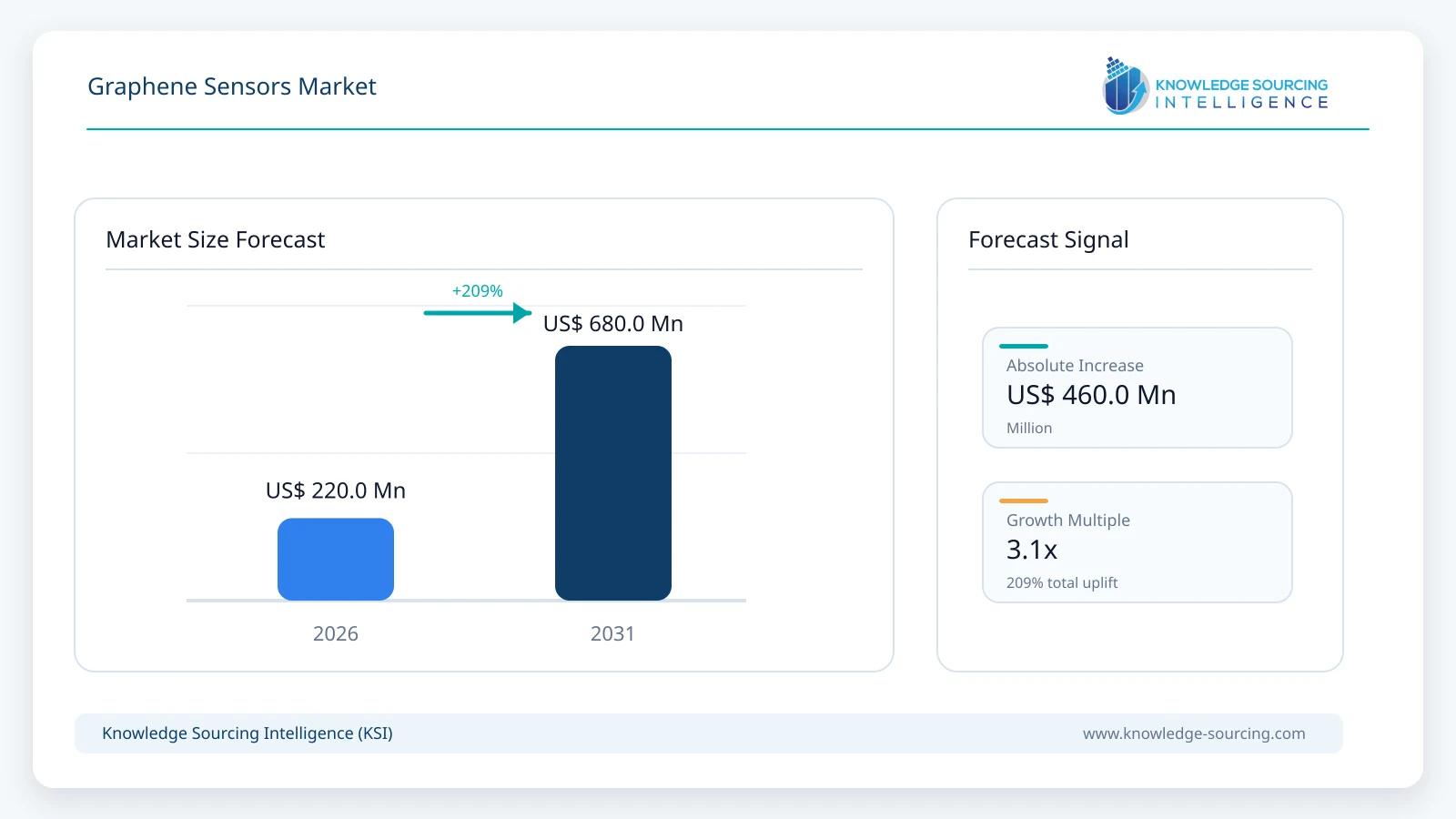
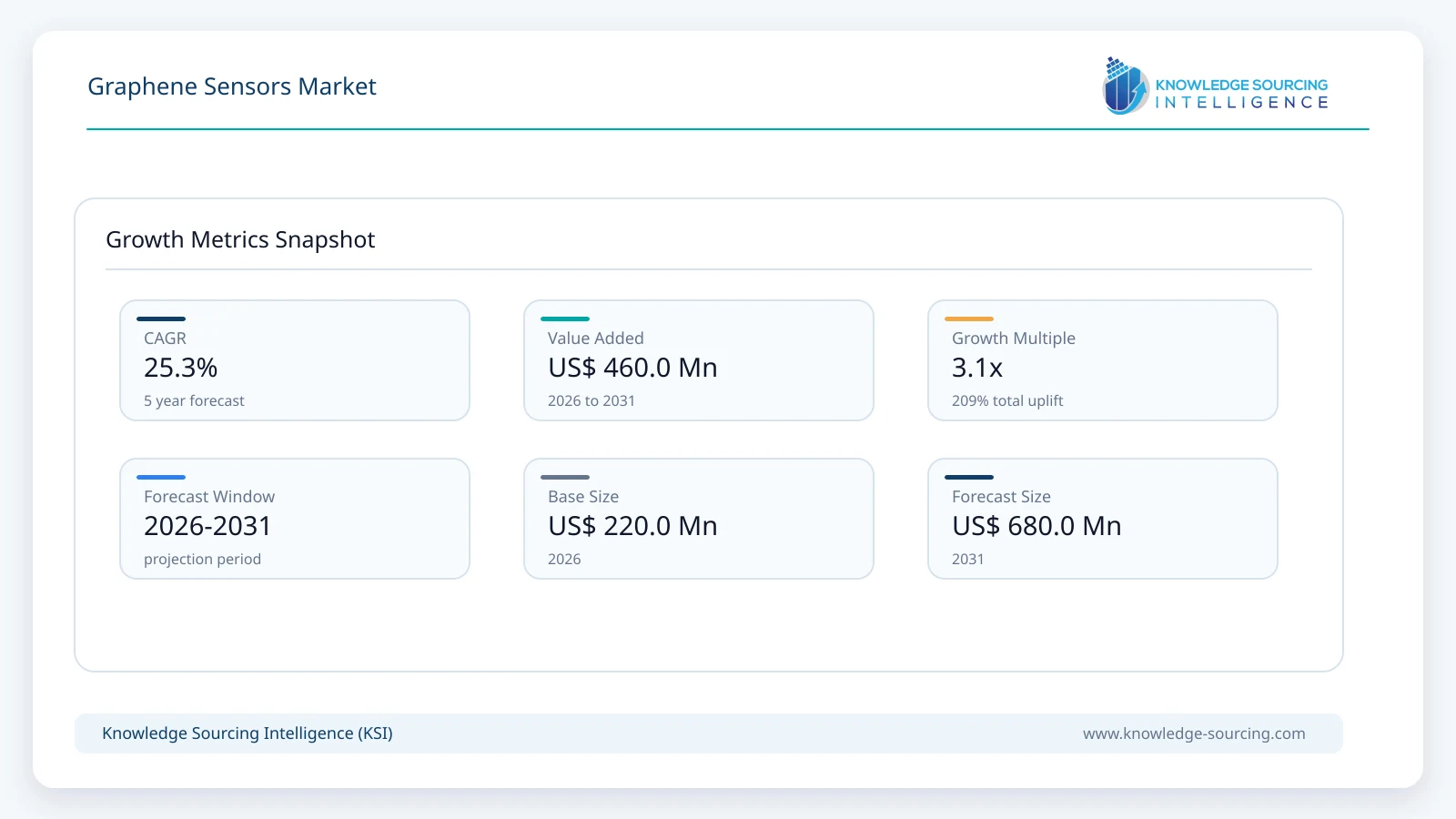
The global graphene sensors market is forecast to grow from USD 220.0 million in 2026 to USD 680.0 million in 2031, representing a CAGR of 25.3% across the forecast period.
Highlights:
- 1Biosensors are estimated to account for approximately 48.0% of global graphene sensor revenue in 2026, supported by commercial GFET platforms, diagnostic-development systems and strong research activity in molecular sensing.
- 2Healthcare and life-sciences applications are estimated to represent approximately 45.0% of global graphene sensor revenue in 2026, led by biosensing, diagnostic development and emerging neural-interface applications.
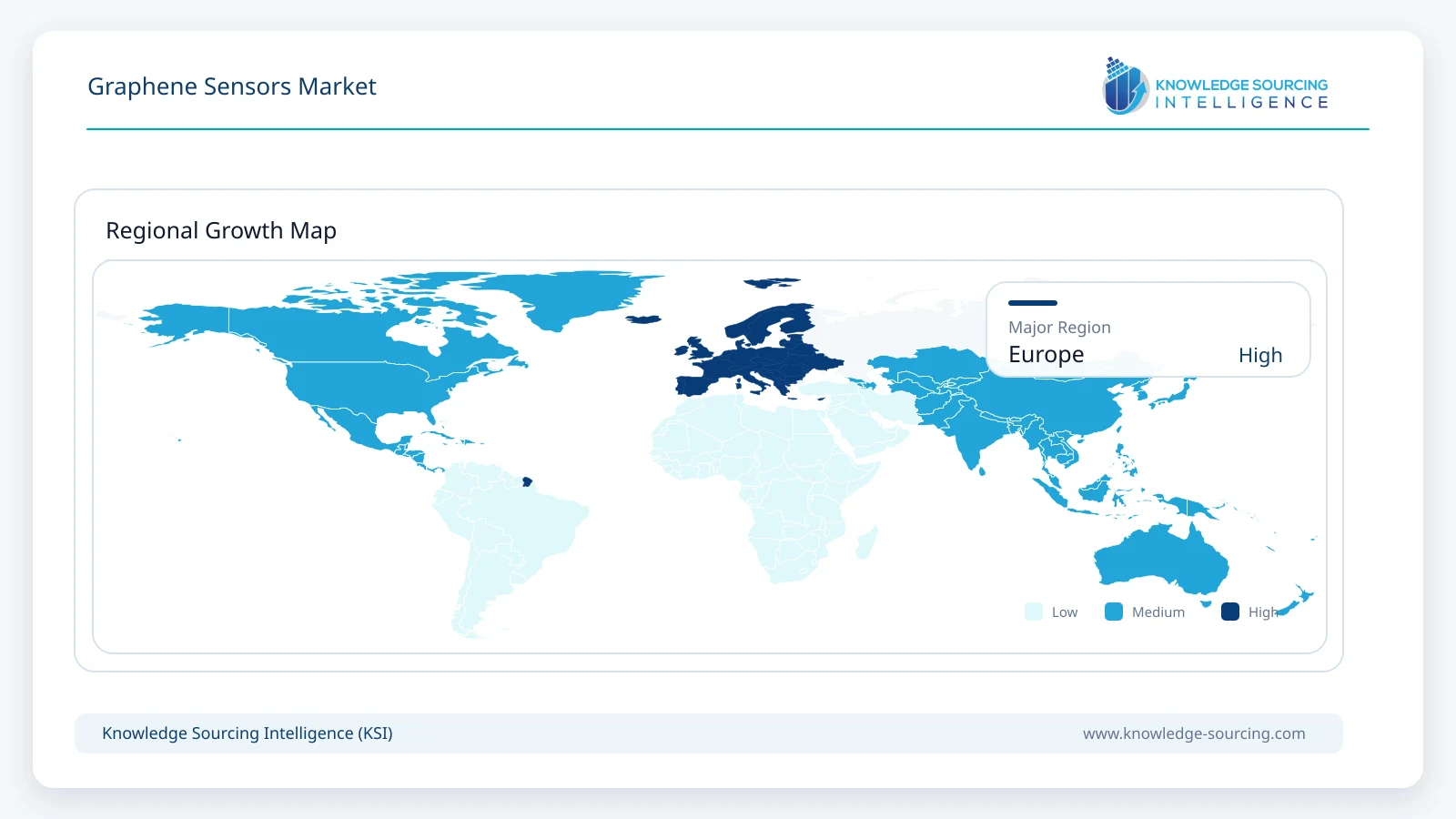
- 3Europe is estimated to account for approximately 34.0% of global market revenue in 2026, reflecting a dense concentration of commercial graphene sensor companies, foundry capability and 2D-material pilot-line activity.
- 4Commercialization remains early-stage-small-scale production and research/development platforms are available, but graphene sensors have not yet reached broad million-unit annual production across mainstream applications.
- 5Magnetic sensing is one of the clearest commercial niches, with graphene Hall sensors already sold for general-purpose, high-field and cryogenic measurement applications.
- 6Biosensor commercialization is accelerating through packaged GFET devices, integrated readers, multiplexed sensing architectures and GFET-on-CMOS development platforms.
The market remains at an early commercialization stage. Graphenea sells multiple GFET sensor chips and foundry services, Paragraf markets graphene Hall sensors and commercial GFET molecular-sensing platforms, Grapheal operates graphene biosensing products and development systems, and Melexis offers a graphene sensor development kit linked to its GFET-on-CMOS biosensing work. At the same time, Graphenea has noted that 2D-material sensors have entered small-scale production but are not yet in million-unit annual production.
This creates a market structure that differs from mature silicon sensing. Current revenue is concentrated in high-value research and development platforms, specialist industrial sensors, foundry services and early commercial diagnostic or environmental products rather than in high-volume consumer sensor shipments. Average selling prices are therefore relatively high, but unit volumes remain modest.
The 2026-2031 outlook is supported by progress in wafer-scale integration, improved packaging, multiplexed GFET architectures and partnerships between graphene specialists and semiconductor companies. The Graphene Flagship and related pilot-line programs are helping move devices from laboratory fabrication toward repeatable foundry processes, while commercial companies are improving readout electronics and sensor-system integration.
Market Trends
GFET Platforms Move from Research Chips Toward Integrated Sensing Systems
Graphene field-effect transistor platforms are becoming easier to use through packaged devices, liquid-compatible passivation, integrated gates and dedicated readers. Graphenea markets multiple GFET products for liquid, gas, magnetic and biosensing research, while Paragraf introduced new multi-channel GFET products and an enterprise reader in 2026.
This reduces the engineering work required to evaluate graphene sensing and allows customers to focus on surface functionalization, assay development and signal interpretation. The transition from bare graphene material to packaged sensing platforms is an important step toward broader commercial adoption.
Biosensing Remains the Main Commercialization Path
Graphene offers high surface sensitivity and direct electrical transduction, making it attractive for label-free molecular detection. Commercial development is concentrated in disease biomarkers, environmental analytes, PFAS detection and other applications where conventional laboratory methods are slow or difficult to deploy at point of need.
Grapheal is developing field-deployable graphene sensors for ultra-trace PFAS detection, while Graphenea and Melexis are collaborating on integrated GFET-on-CMOS biosensing. AttenBio is developing a graphene-based point-of-care diagnostic platform, demonstrating the breadth of healthcare-oriented commercialization activity.
Graphene Hall Sensors Establish a Real Industrial Niche
Graphene Hall sensors are already commercially available for magnetic-field measurement. Paragraf sells general-purpose and cryogenic products that operate across unusually wide temperature and field ranges, including applications in current sensing, position sensing, quantum systems, particle accelerators and MRI-related environments.
This niche is important because it demonstrates commercial graphene sensing outside the laboratory. Performance in extreme temperature and high-field conditions gives graphene a clear functional advantage rather than relying only on potential cost reduction.
Wafer-Scale Integration and CMOS Readout Become Central
The key commercialization challenge is no longer proving that graphene can sense a target; it is manufacturing devices reproducibly and integrating them with conventional electronics. European 2D-material pilot-line programs are offering wafer-scale fabrication routes and integrated readout options, while Melexis and Graphenea are evaluating GFET-on-CMOS biosensing platforms.
Improved manufacturing repeatability is expected to lower sensor cost, increase channel density and support larger production runs. This will determine whether graphene sensing moves from specialist instrumentation into higher-volume medical, industrial and environmental applications.
Graphene Sensors Market Segment Analysis
By Product Type
Biosensors
Graphene biosensors are estimated at approximately USD 105.6 million in 2026. The segment includes GFET biosensing chips, molecular-sensing development platforms, diagnostic-development systems and graphene-enabled biochemical sensors sold for research, assay development and emerging point-of-care applications.
Biosensors form the largest value pool because graphene provides direct electrical sensitivity to surface interactions and can be functionalized for specific biomarkers or chemical species. Commercial activity is expanding through multiplexed GFET devices, packaged readers and integrated semiconductor readout systems.
By End-User Industry
Healthcare and Life Sciences
Healthcare and life sciences are estimated at approximately USD 99.0 million in 2026. Demand includes diagnostic development, biomarker detection, laboratory research, wearable sensing and emerging graphene neural interfaces.
The sector supports higher average selling prices than many industrial sensor applications because products are often sold as development platforms, research instruments or specialized diagnostic technologies. Regulatory validation remains a major barrier to large-scale clinical deployment, but current product and partnership activity is concentrated heavily in healthcare.
By Geography
Europe
Europe is estimated at approximately USD 74.8 million in 2026. The region hosts several important commercial graphene-sensor companies and research-to-industrialization programs, including Paragraf in the United Kingdom, Graphenea in Spain, Grapheal in France, INBRAIN in Spain and major Graphene Flagship pilot-line activities.
Europe also has strong semiconductor, medical-device and materials-science ecosystems that support collaborative development. The region is expected to remain important as graphene sensing transitions toward foundry-based manufacturing and integrated electronics.
Market Drivers
Need for High-Sensitivity Molecular and Chemical Detection
Graphene has a large active surface and strong electrical response to changes in its local environment, supporting very sensitive detection when paired with suitable functionalization. This is driving work in biomarkers, pathogens, PFAS, gas sensing and other low-concentration analytes.
Commercial Availability of Packaged GFET Devices
Researchers and product developers can now purchase packaged graphene sensor chips and readers rather than fabricating devices from raw graphene. This lowers entry barriers and expands the number of organizations able to evaluate graphene sensing.
Demand for Extreme-Environment Magnetic Sensors
Graphene Hall sensors can operate across broad temperature and magnetic-field ranges. Cryogenic and high-field measurement creates a differentiated niche in quantum, fusion, accelerator and advanced scientific systems.
Progress in Wafer-Scale Manufacturing
Foundry processes, multi-project wafer runs and CMOS integration are improving reproducibility and scalability. These advances are necessary for graphene sensors to move from low-volume specialist products toward larger commercial deployments.
Market Restraints
Limited High-Volume Production
Graphene sensors remain far below mature silicon and MEMS sensors in manufacturing scale. Small-scale production exists, but broad million-unit annual production has not yet been established across the category.
Functionalization and Reproducibility Challenges
Biosensor performance depends not only on graphene quality but also on surface chemistry, packaging, liquid handling, calibration and readout electronics. Variability in any of these stages can affect sensitivity and specificity.
Competition from Mature Sensor Technologies
Silicon, MEMS, electrochemical, optical and conventional Hall sensors benefit from mature supply chains and known reliability. Graphene must provide a clear performance or integration advantage to justify adoption in commercial systems.
Regulatory and Qualification Timelines
Healthcare, automotive and aerospace applications require extensive validation. Even when graphene devices show strong laboratory performance, qualification and regulatory approval can delay volume commercialization.
Regional Outlook
Europe
Europe has the strongest concentration of visible commercial graphene-sensor development and pilot manufacturing. Paragraf, Graphenea, Grapheal and INBRAIN are active in magnetic, molecular, biosensing and neural-interface applications, while European pilot-line programs support wafer-scale device fabrication.
North America
North America has substantial demand from life-sciences research, quantum technology, advanced instrumentation and semiconductor R&D. Commercial distribution of GFET devices and active biosensor development support market growth, although much of the current activity remains pre-volume commercialization.
Asia Pacific
Asia Pacific has strong long-term potential because of its semiconductor, electronics, automotive and sensor-manufacturing base. Japan also hosts commercial graphene FET products, while regional universities and companies continue to develop graphene-based sensing and flexible electronics.
South America and Middle East & Africa
Current commercial activity is comparatively limited and is concentrated mainly in research, imported development platforms and specialized industrial applications. Growth will depend on wider commercialization and lower-cost packaged sensor systems.
Competitive Environment
The graphene sensors market is fragmented and still forming. Paragraf is one of the clearest commercial sensor-device companies, with graphene Hall sensors and GFET molecular-sensing platforms. Graphenea combines a dedicated graphene foundry with a broad catalog of GFET devices for biosensing, gas sensing, magnetic measurement and other research applications. Grapheal is developing integrated graphene biosensing systems for healthcare and environmental monitoring.
Melexis is moving into integrated GFET-on-CMOS biosensing through collaboration with Graphenea, while AttenBio is developing a graphene point-of-care diagnostic platform. AirMembrane sells graphene FET devices for sensor development in Japan, Haydale supplies functionalized graphene sensor inks, and Grolltex supports sensor development through monolayer graphene materials and strain-sensor intellectual property.
Because the market is early-stage, company positioning varies substantially. Some participants sell finished sensors, others sell sensor chips, readers, inks or foundry services, and several are developing regulated products that have not yet reached broad commercial deployment. This makes manufacturing repeatability and system integration as important as raw sensor sensitivity.
Recent Developments
August 2026: Paragraf launched the PMF2002 12-channel GFET platform and an Enterprise Reader for real-time molecular-sensing development, expanding its commercially available graphene sensing portfolio.
June 2026: Grapheal announced EIC Accelerator support for PFAST, a field-deployable graphene sensor platform targeting ultra-trace PFAS detection in water.
May 2026: Paragraf introduced the PMF2000 GFET molecular-sensing platform, expanding beyond its established graphene Hall sensor business.
April 2026: INBRAIN reported completion of patient recruitment in its first-in-human study evaluating a graphene-based brain-computer interface for neural mapping and decoding.
January 2026: the Graphene Flagship highlighted continued expansion of multi-project wafer programs designed to industrialize graphene and other 2D-material sensing devices.
November 2025: Melexis and Graphenea announced collaboration on an integrated GFET-on-CMOS platform for biosensing, with a development kit made available for evaluation.
Market Outlook
The graphene sensors market is expected to grow rapidly through 2031, but from a relatively small commercial base. Growth will be driven by biosensor development platforms, specialized magnetic sensing, environmental monitoring, graphene-enabled neural interfaces and a gradual shift from research chips toward integrated sensor systems.
Biosensors are expected to remain the largest commercial product category because they combine strong research activity with visible product launches and semiconductor-integration partnerships. Healthcare and life sciences will remain the largest end-user market, although environmental sensing, quantum systems and industrial magnetic measurement are likely to generate important incremental revenue.
The central market transition will be from low-volume, high-value development products toward repeatable wafer-scale production. Companies that solve packaging, readout, functionalization and manufacturing reproducibility are positioned to capture the largest share of future growth. The market is forecast to add approximately USD 460.0 million in annual revenue between 2026 and 2031.
Graphene Sensors Market Scope:
| Report Metric | Details |
|---|---|
| Total Market Size in 2026 | USD 220.0 million |
| Total Market Size in 2031 | 680.0 million |
| Forecast Unit | Million |
| Growth Rate | 25.3% |
| Study Period | 2021 to 2031 |
| Historical Data | 2021 to 2024 |
| Base Year | 2025 |
| Forecast Period | 2026 – 2031 |
| Segmentation | Product Type, End-user Industry, Geography |
| Companies |
|
Market Segmentation
By Product Type
Biosensors
Magnetic and Hall Sensors
Chemical and Gas Sensors
Strain and Pressure Sensors
Optical and Photodetector Sensors
Temperature and Other Sensors
By End-User Industry
Healthcare and Life Sciences
Consumer Electronics
Automotive
Aerospace and Defense
Industrial and Scientific Instrumentation
Environmental Monitoring
Others
By Geography
North America
United States
Canada
South America
Brazil
Others
Europe
United Kingdom
Spain
France
Germany
Others
Middle East and Africa
UAE
Saudi Arabia
Others
Asia Pacific
China
Japan
South Korea
India
Others
Table of Contents
1. INTRODUCTION
1.1. Market Overview
1.2. Market Definition
1.3. Scope of the Study
1.4. Market Segmentation
1.5. Currency
1.6. Assumptions
1.7. Base and Forecast Years Timeline
1.8. Key Benefits to Stakeholders
2. RESEARCH METHODOLOGY
2.1. Research Design
2.2. Secondary Research
2.3. Primary Validation
2.4. Market Estimation and Forecasting
2.5. Data Triangulation and Quality Control
3. EXECUTIVE SUMMARY
3.1. Key Findings
3.2. Global Market Size, 2026-2031
3.3. Commercialization Status
3.4. Segment and Regional Summary
3.5. Analyst View
4. MARKET DYNAMICS
4.1. Market Drivers
4.1.1. High-Sensitivity Molecular and Chemical Detection
4.1.2. Commercial Availability of Packaged GFET Devices
4.1.3. Extreme-Environment Magnetic Sensing
4.1.4. Progress in Wafer-Scale Manufacturing
4.2. Market Restraints
4.2.1. Limited High-Volume Production
4.2.2. Functionalization and Reproducibility Challenges
4.2.3. Competition from Mature Sensor Technologies
4.2.4. Regulatory and Qualification Timelines
4.3. Porter’s Five Forces Analysis
4.4. Industry Value Chain Analysis
4.5. Graphene Device Manufacturing and Packaging
4.6. Commercialization Roadmap
5. GRAPHENE SENSORS MARKET BY PRODUCT TYPE
5.1. Introduction
5.2. Biosensors
5.3. Magnetic and Hall Sensors
5.4. Chemical and Gas Sensors
5.5. Strain and Pressure Sensors
5.6. Optical and Photodetector Sensors
5.7. Temperature and Other Sensors
6. GRAPHENE SENSORS MARKET BY END-USER INDUSTRY
6.1. Introduction
6.2. Healthcare and Life Sciences
6.3. Consumer Electronics
6.4. Automotive
6.5. Aerospace and Defense
6.6. Industrial and Scientific Instrumentation
6.7. Environmental Monitoring
6.8. Others
7. GRAPHENE SENSORS MARKET BY GEOGRAPHY
7.1. Introduction
7.2. North America
7.2.1. United States
7.2.2. Canada
7.3. South America
7.3.1. Brazil
7.3.2. Others
7.4. Europe
7.4.1. United Kingdom
7.4.2. Spain
7.4.3. France
7.4.4. Germany
7.4.5. Others
7.5. Middle East and Africa
7.5.1. UAE
7.5.2. Saudi Arabia
7.5.3. Others
7.6. Asia Pacific
7.6.1. China
7.6.2. Japan
7.6.3. South Korea
7.6.4. India
7.6.5. Others
8. COMPETITIVE ENVIRONMENT AND ANALYSIS
8.1. Major Players and Strategy Analysis
8.2. GFET Platform Competition
8.3. Magnetic Sensor and Biosensor Positioning
8.4. Foundry and Manufacturing Capability
8.5. Partnerships and Commercialization Activity
8.6. Competitive Dashboard
9. COMPANY PROFILES
9.1. Paragraf Limited
9.2. Graphenea Semiconductor
9.3. Grapheal
9.4. Melexis NV
9.5. AttenBio
9.6. AirMembrane Corporation
9.7. Haydale Graphene Industries plc
9.8. Grolltex, Inc.
9.9. INBRAIN Neuroelectronics
9.10. Hawkeye Bio, Inc.
10. APPENDIX
Navigate
Trusted by the world's leading organizations











