
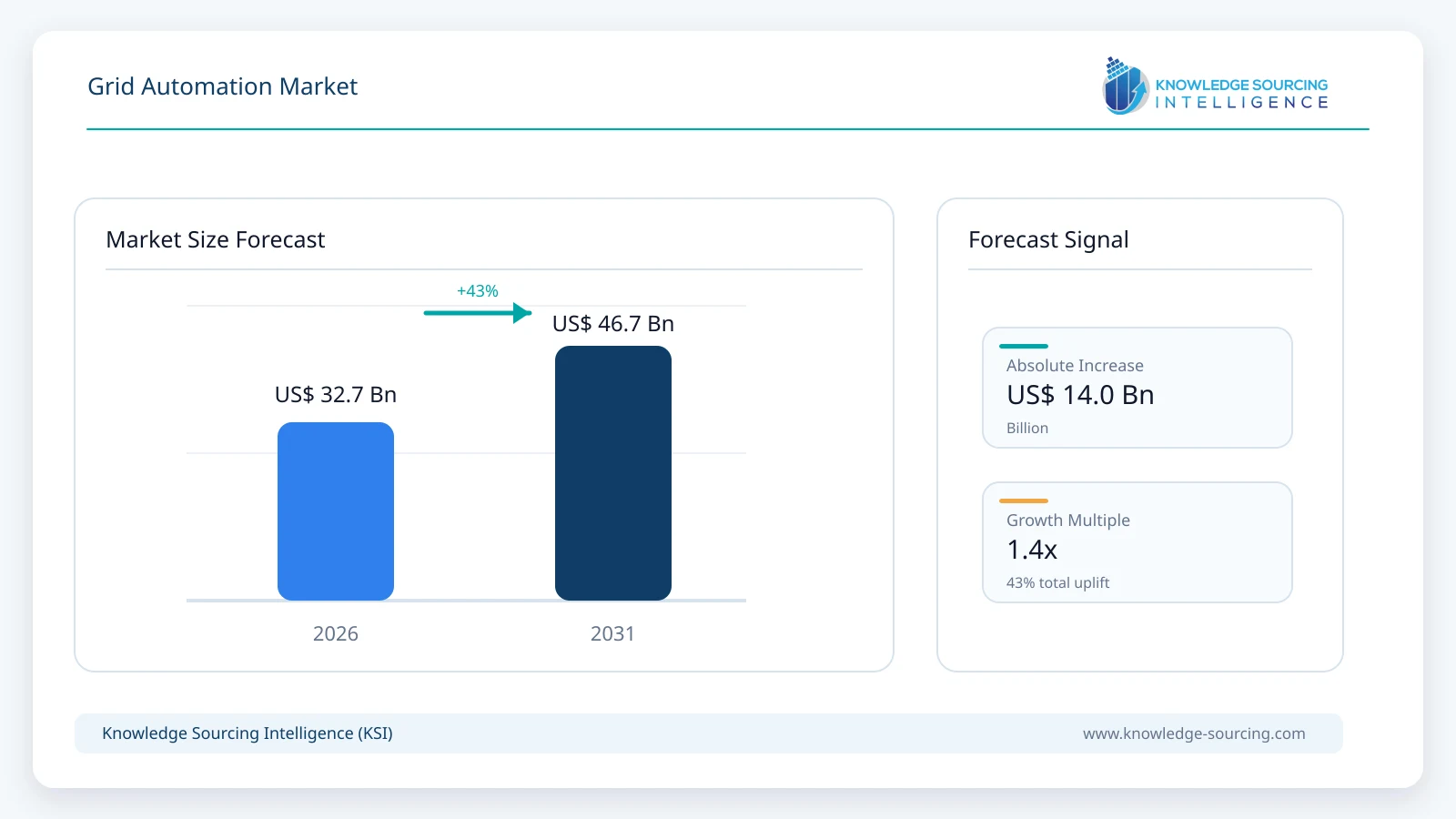
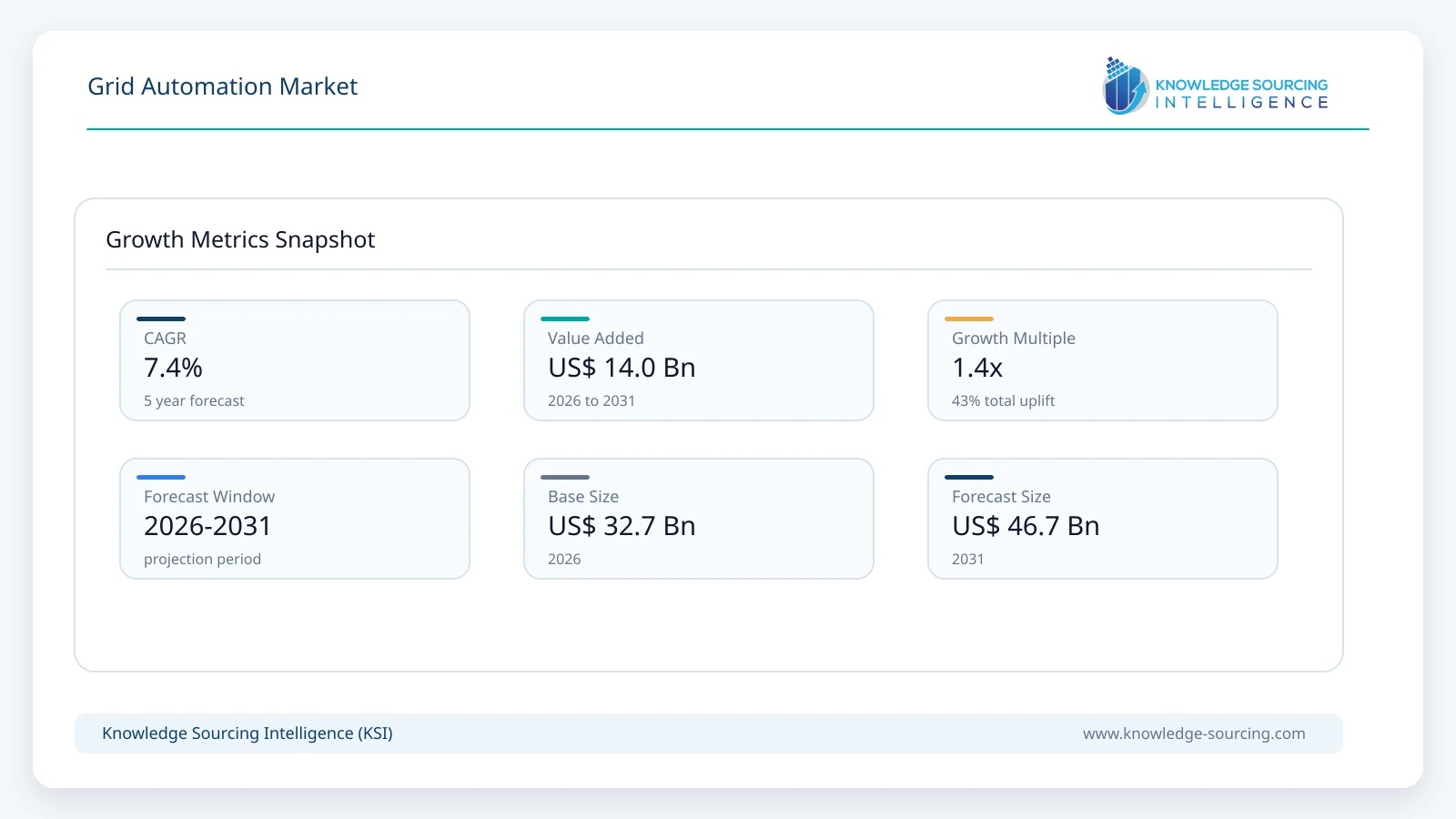
The Grid Automation Market is projected to increase from USD 32.7 billion in 2026 to USD 46.7 billion by 2031, growing at a CAGR of 7.4%.
Highlights:
- 1Hardware still remains the biggest component, including RTUs, IEDs, sensors, controllers, communication equipment, protection devices, and automation equipment.
- 2Software is the most rapidly evolving, driven by ADMS, DERMS, SCADA, grid-management platforms, analytics, and AI-enabled operations.
- 3Distribution grids emerge as the strongest automation opportunity as DERs, EVs, and batteries create increasingly dynamic network conditions.
- 4Electric utilities are the largest end user, while renewable developers and data centers emerge as key users of grid automation technologies.
Grid Automation Market includes hardware, software, communications, control systems, protection systems, monitoring technologies, and professional services that are used primarily to automate the monitoring and operation of electricity transmission and distribution networks while optimizing their performance to restore them during contingencies.
Grid automation empowers utilities to transition from manual or partially monitored network operations into real-time, remotely controlled, data-driven electricity networks. Core technologies include SCADA systems, RTUs, intelligent electronic devices, protection and control systems, substation automation, automated feeder equipment, communications networks, distribution management systems (DMS), advanced distribution management systems (ADMS), and grid analytics.
The system is deployed for transmission grids, distribution networks, microgrids, and smart-grid environments. At the level of transmission, automation enables wide-area monitoring, protection and control, and power-flow management. Automation is becoming more prevalent at the distribution level for fault detection, isolation, and service restoration, voltage optimization, DER management, and real-time network visibility.
The growing penetration of distributed energy resources is also supporting market expansion. As the IEA reports, distribution grids are becoming increasingly dynamic, with rooftop solar, batteries, EVs, and flexible demand creating two-way flows requiring more detailed monitoring and control.
Grid automation is also driven by software; for instance, GE Vernova's GridOS for distribution, which brings together network modeling, real-time operations, DER management, field execution, and visual intelligence on a governed grid-data platform.
Market Dynamics
Market Drivers
Rise in grid congestion and constrained capacity: More electricity grids are the bottleneck between new generation, storage, and electricity demand. More than 2,500 GW of renewable, storage, and large-load projects sit in grid connection queues globally, according to the IEA. It enables utility operators to utilize existing infrastructure more efficiently through real-time monitoring, dynamic control, automated switching, congestion management, and better visibility in grid automation. Further, automation is an important component of grid-capacity strategy for utilities when trying to connect more generation without relying on large physical network expansions.
Rapid integration of renewable energy and DER: Power networks are becoming more variable and complex due to solar PV, wind, battery storage, EVs, and flexible loads. Distribution systems that have traditionally been seen for their relatively predictable one-way electricity flows are shifting to bidirectional electric flow. DERMS, ADMS, smart-meter data, and automation are the key tools needed to coordinate these resources, as per the IEA. Automation is used to monitor voltage, manage DER generation, control switching equipment, detect faults, and coordinate DERs with network operating requirements.
Aging grid infrastructure and reliability requirements: A significant number of electricity infrastructure assets in mature markets were installed decades ago. Growing demand for modernization of aging transformers, switchgear, substations, lines, and protection systems. Utilities are being forced to upgrade their operational capabilities; automation allows utilities to do so without replacing every physical grid asset. Implementing remote monitoring, intelligent protection, digital substations, condition monitoring, and automated restoration can improve the effective utilization of existing networks.
Increasing demand for electricity from data centers and electrification: G There is growing electricity demand among data centers, EVs, industrial electrification, cooling, heat pumps, and digital infrastructure. According to the IEA, electricity demand from data centres is set to accelerate until 2030, and account for over 2,500 GW worth of generation, storage, and large load projects awaiting grid connections. In addition, data centres are becoming major stakeholders by needing very reliable grid connections and interacting more with on-site generation, storage, and flexible loads.
Market Restraints & Opportunities
Grid automation requires investment in hardware, software, communications infrastructure, cybersecurity, engineering and integration, as well as the training necessary for a prepared workforce. Utilities operating older networks likely have to replace or modify equipment before using advanced automation platforms.
Utility operators usually use SCADA, GIS, AMI, OMS, EMS, DMS, protection, and field systems, supplied by varying vendors and installed on overlapping timelines. Integrating these systems into a common operating environment can become increasingly complex.
AI is providing opportunity for automated anomaly detection, predictive maintenance, demand forecasting, renewable forecasting, network optimization, and operational decision support: IEA's analysis of grid modernization in 2026 pinpointed AI-enhanced solutions as a key component of the new digital grid toolbox.
Utilities are increasingly automating feeders, substations, switches and reclosers, and voltage-control equipment to support faster fault isolation and restoration. This offers the opportunity for software- and hardware-integrated platforms which can automatically respond to network disturbances.
Key Developments
May 2026: Netcontrol's SCADA, RTU, and engineering competencies were embedded into ABB's Distribution Solutions portfolio to bolster ABB's grid-automation solutions for tomorrow's more fluid distribution networks.
January 2026: Envelio announced the launch of Strategic Grid Planner, part of its Intelligent Grid Platform that automates multi-year distribution-grid planning. The app relied on load-flow analysis, high-performance simulation, network modelling, and self-learning AI-based technology to identify tens of thousands of technically viable and cost-optimized options for various milestones like 2030, 2035, and 2045.
June 2026: Landis+Gyr unveiled the new Grid Intelligence structure. The Grid Intelligence segment consists of grid-operations software, data and analytics, and managed/advisory services, also with a $3.9 billion backlog and over 127 million intelligent devices deployed globally.
Grid Automation Market Segmentation
The market is segmented by component, grid type, automation type, end user, and geography.
By Component
Hardware
Hardware is predicted to dominate the component segment due to grid automation needs for device-centric physical hardware for sensing, measurement, protection, control, communication, and remote operation of the electric utility network. RTUs, intelligent electronic devices, protection relays, sensors, automatic switches, reclosers, and controllers of communication equipment and substation automation make up the hardware ecosystem.
These devices make up the field layer that is responsible for collecting data on a network and executing commands generated by control systems. For example, SICAM from Siemens integrates RTU functionality, substation monitoring and automation, telecontrol, fault-record management, as well as network monitoring. Similarly, Eaton offers similar capabilities like RTUs, IEDs, protection systems, automated distribution equipment communications, and SCADA integration.
By Automation Type
SCADA-Based Automation
SCADA-based automation will continue to be a major segment under the automation type due to its role as a system for providing the basic monitoring, data acquisition, alarms, visualization, and remote control capabilities across transmission and distribution networks.
Honeywell defines integrated SCADA as the near-real-time monitoring and control of generation, transmission, and distribution across the grid, and remote operation of breakers and switches.
Schneider Electric supplies SCADA and grid-automation software along with ADMS and outage-management systems, as accessible from their SICAM automation control monitoring telecontrol substation platform.
Regional Analysis
North America Market Analysis
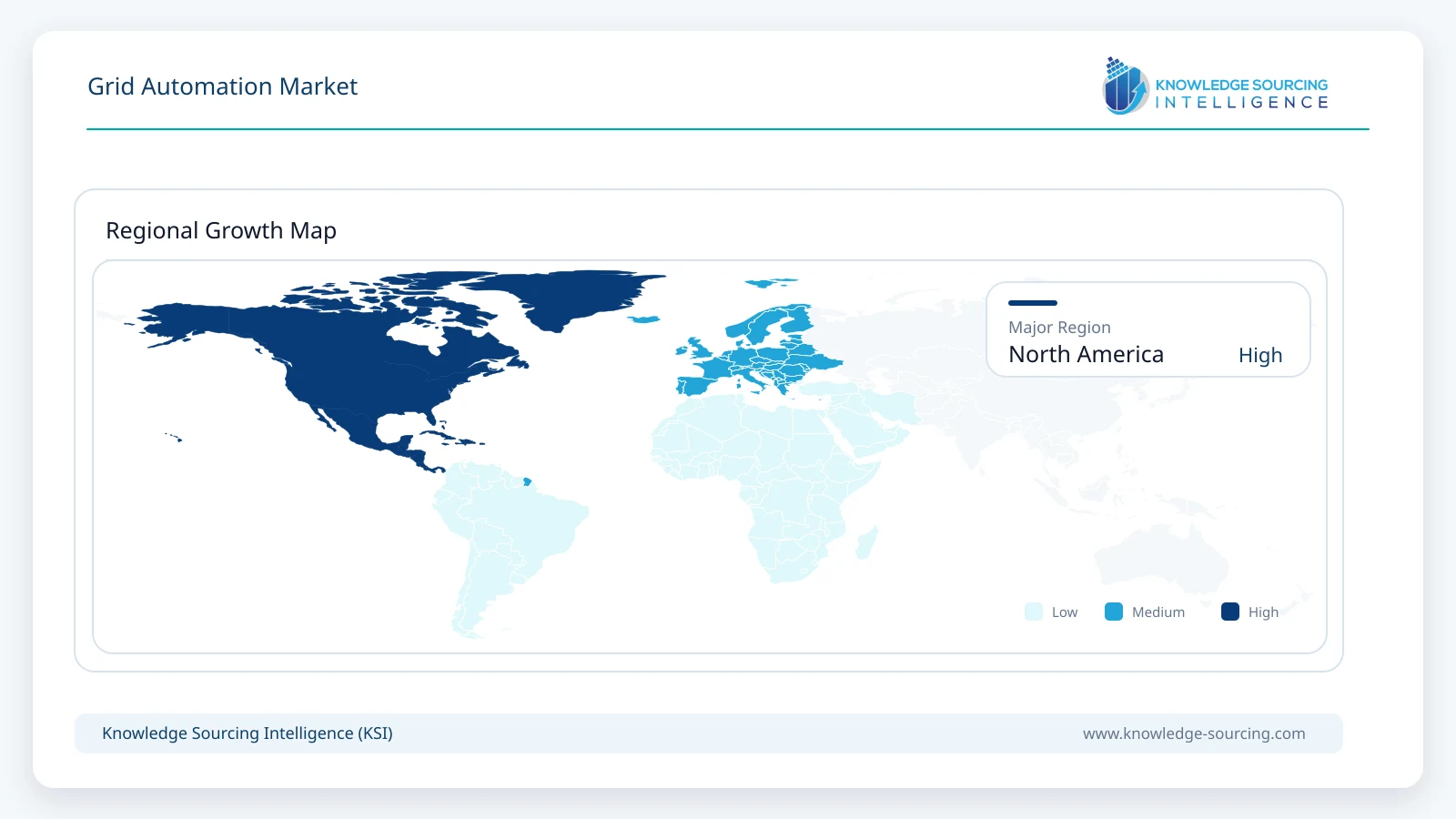
A major grid automation market share will account for the North American market as utilities across the region benefit from multiple trends such as old infrastructure, bad weather, renewable integration pressure, and large new loads and data centers. Data-center expansion adds further pressure to transmission and distribution systems, boosting the value of real-time network visibility. A mature ecosystem of automation suppliers can be found throughout the region, with presence from GE Vernova, Eaton, Honeywell, ABB, Siemens, and Schneider Electric. The use of AI-enabled grid analytics and predictive maintenance is also becoming increasingly significant as utilities seek to manage more complex networks.
South America Market Analysis
There are major grid-automation opportunities developing in South America driven by the growing presence of renewable generation and the rise in utilities strengthening their transmission and distribution networks. Brazil is the biggest regional opportunity given the size of its electricity grid and the large scale of hydro, wind, and solar projects, coupled with low-cost storage. Additionally, adapting to the increased penetration of renewables requires further enhancement in monitoring and control capabilities for management of variable generation and power flows.
Europe Market Analysis
Europe has a substantial grid-automation market share driven by renewable-energy penetration, distributed generation, cross-border electricity flows, electrification, and even grid congestion, which increase operational complexity. Digital substations, distribution automation, ADMS, DERMS, and intelligent grid edge are all being leveraged by European utilities in a push towards greater flexibility. Additionally, European utilities are also prioritizing cybersecurity, resilience, and auto-restoration.
Middle East and Africa Market Analysis
The growth of electricity demand, development of renewable energy, and modernisation of existing utility infrastructure offer strong support for the Middle East and Africa market. Gulf states are building more complex transmission and distribution networks, in addition to utility-scale solar and storage projects, including ever-increasing demands for automation and digital control. Africa provides opportunities for AI and automation as utilities are looking to drive improved resilience and greater visibility across the network.
Asia Pacific Market Analysis
The grid-automation market in Asia Pacific will remain one of the largest and fastest-growing regions, led by electricity-demand growth, industrialization, renewable deployment, EV adoption, data centers, and large-scale grid investment. China and India are implementing large-scale grid modernization initiatives while Japan and South Korea hold some of the most sophisticated electricity networks in need of automation. Further, India is facing especially robust needs for distribution automation to accommodate growth of renewable generation, EVs, distributed solar, and electrification.
List of Companies
Siemens AG
Schneider Electric
Hitachi Energy
GE Vernova
ABB
Honeywell International Inc.
Eaton Corporation
Mitsubishi Electric Corporation
Toshiba Corporation
Landis+Gyr Group AG
Siemens AG
Siemens is an important grid-automation vendor with its SICAM Power Automation platform that supports power-system monitoring, control, substation automation, telecontrol, RTU functions, fault-record management, and cybersecurity. SICAM works in transmission, distribution, decentralized energy, as well as substation environments.
Schneider Electric
Schneider Electric has a wide portfolio of grid-automation solutions, including SCADA, ADMS, outage management (OMS), Distributed Energy Resources Management Systems (DERMS), Geospatial Information System (GIS) tools for integration/interoperability with third-party devices and systems such as automation control hardware and applications, grid metering in transmission/distribution networks, and real-time data quality verification. Its EcoStruxure ADMS facilitates monitoring, analysis, control, optimisation, planning and training functions for distribution networks.
Hitachi Energy
Hitachi Energy is a supplier of transformation management, grid automation, protection and control digital substations, communications, as well as grid-management software and services. It operates through Grid & Automation, which includes network control, communication, digital substations, software, and protection and control.
Analyst View
The Grid Automation Market is evolving from traditional SCADA and hardware-centric top-down automation to a more integrated, software-defined grid intelligence. As renewable generation, EVs, data centers, and distributed resources drive dynamic grid operations, distribution automation, ADMS, DERMS, digital substations, and AI-enabled analytics are also becoming more relevant. Consequently, utilities continue to be the primary customers, whereas digital grid platforms present the highest sustainable long-term growth potential.
Grid Automation Market Scope:
| Report Metric | Details |
|---|---|
| Total Market Size in 2026 | USD 32.7 billion |
| Total Market Size in 2031 | USD 46.7 billion |
| Forecast Unit | USD Billion |
| Growth Rate | 7.4% |
| Study Period | 2021 to 2031 |
| Historical Data | 2021 to 2024 |
| Base Year | 2025 |
| Forecast Period | 2026 – 2031 |
| Segmentation | Component, Grid Type, Automation Type, End User, Geography |
| Companies |
|
Market Segmentation
By Component
Hardware
Software
Services
By Grid Type
Transmission Grid
Distribution Grid
Microgrid and Smart Grid
Others
By Automation Type
SCADA-Based Automation
Substation Automation
Distribution Automation
Remote Terminal Unit (RTU)-Based Automation
Others
By End User
Electric Utilities
Renewable Energy Developers
Data Centers
Independent Power Producers (IPPs)
Others
By Geography
North America
USA
Canada
Mexico
South America
Brazil
Argentina
Others
Europe
United Kingdom
Germany
France
Others
Middle East and Africa
Saudi Arabia
UAE
Others
Asia Pacific
China
Japan
India
South Korea
Others
Table of Contents
1. EXECUTIVE SUMMARY
2. MARKET SNAPSHOT
2.1. Market Overview
2.2. Market Definition
2.3. Scope of the Study
2.4. Market Segmentation
3. MARKET DYNAMICS
3.1. Market Drivers
3.2. Market Restraints
3.3. Market Opportunities
3.4. Porter’s Five Forces Analysis
3.5. Industry Value Chain Analysis
4. BUSINESS LANDSCAPE
4.1. Regulatory, Grid Codes & Smart Grid Standards Landscape
4.2. Grid Automation Equipment, Software & System Integration Ecosystem
4.3. Grid Automation Technology, Communication & Supply Chain Analysis
4.4. Global Trade Analysis
4.5. Strategic Recommendations
5. TECHNOLOGICAL OUTLOOK
5.1. Advanced SCADA, EMS, DMS & ADMS Technologies
5.2. Digital Substation, Intelligent Electronic Device & IEC 61850 Technologies
5.3. Distribution Automation, FLISR & Self-Healing Grid Technologies
5.4. DERMS, Microgrid & Distributed Energy Resource Integration Technologies
5.5. AI-Enabled, Edge Computing, Digital Twin & Predictive Grid Automation Technologies
6. GRID AUTOMATION MARKET BY COMPONENT
6.1. Introduction
6.2. Hardware
6.3. Software
6.4. Services
7. GRID AUTOMATION MARKET BY GRID TYPE
7.1. Introduction
7.2. Transmission Grid
7.3. Distribution Grid
7.4. Microgrid and Smart Grid
7.5. Others
8. GRID AUTOMATION MARKET BY AUTOMATION TYPE
8.1. Introduction
8.2. SCADA-Based Automation
8.3. Substation Automation
8.4. Distribution Automation
8.5. Remote Terminal Unit (RTU)-Based Automation
8.6. Others
9. GRID AUTOMATION MARKET BY END USER
9.1. Introduction
9.2. Electric Utilities
9.3. Renewable Energy Developers
9.4. Data Centers
9.5. Independent Power Producers (IPPs)
9.6. Others
10. GRID AUTOMATION MARKET BY GEOGRAPHY
10.1. Introduction
10.2. North America
10.2.1. USA
10.2.2. Canada
10.2.3. Mexico
10.3. South America
10.3.1. Brazil
10.3.2. Argentina
10.3.3. Others
10.4. Europe
10.4.1. United Kingdom
10.4.2. Germany
10.4.3. France
10.4.4. Others
10.5. Middle East and Africa
10.5.1. Saudi Arabia
10.5.2. UAE
10.5.3. Others
10.6. Asia Pacific
10.6.1. China
10.6.2. Japan
10.6.3. India
10.6.4. South Korea
10.6.5. Others
11. COMPETITIVE ENVIRONMENT AND ANALYSIS
11.1. Major Players and Strategy Analysis
11.2. Market Share Analysis
11.3. Mergers, Acquisitions, Agreements, and Collaborations
11.4. Competitive Dashboard
12. COMPANY PROFILES
12.1. Siemens AG
12.2. Schneider Electric
12.3. Hitachi Energy
12.4. GE Vernova
12.5. ABB
12.6. Honeywell International Inc.
12.7. Eaton Corporation
12.8. Mitsubishi Electric Corporation
12.9. Toshiba Corporation
12.10. Landis+Gyr Group AG
13. APPENDIX
13.1. Currency
13.2. Assumptions
13.3. Base and Forecast Years Timeline
13.4. Key benefits for the stakeholders
13.5. Research Methodology
13.6. Abbreviations
Navigate
Trusted by the world's leading organizations











