Healthcare Education Market - Strategic Insights and Forecasts (2026-2031)
Healthcare Education Market Size, Share, Forecasts and Trends Analysis By Delivery Mode (Classroom-Based, E-Learning Solutions), By Medical Field (Cardiology, Neurology, Radiology, Internal Medicine, Pediatrics, Others), By End User (Students, Physicians, Non-Physicians), and Region
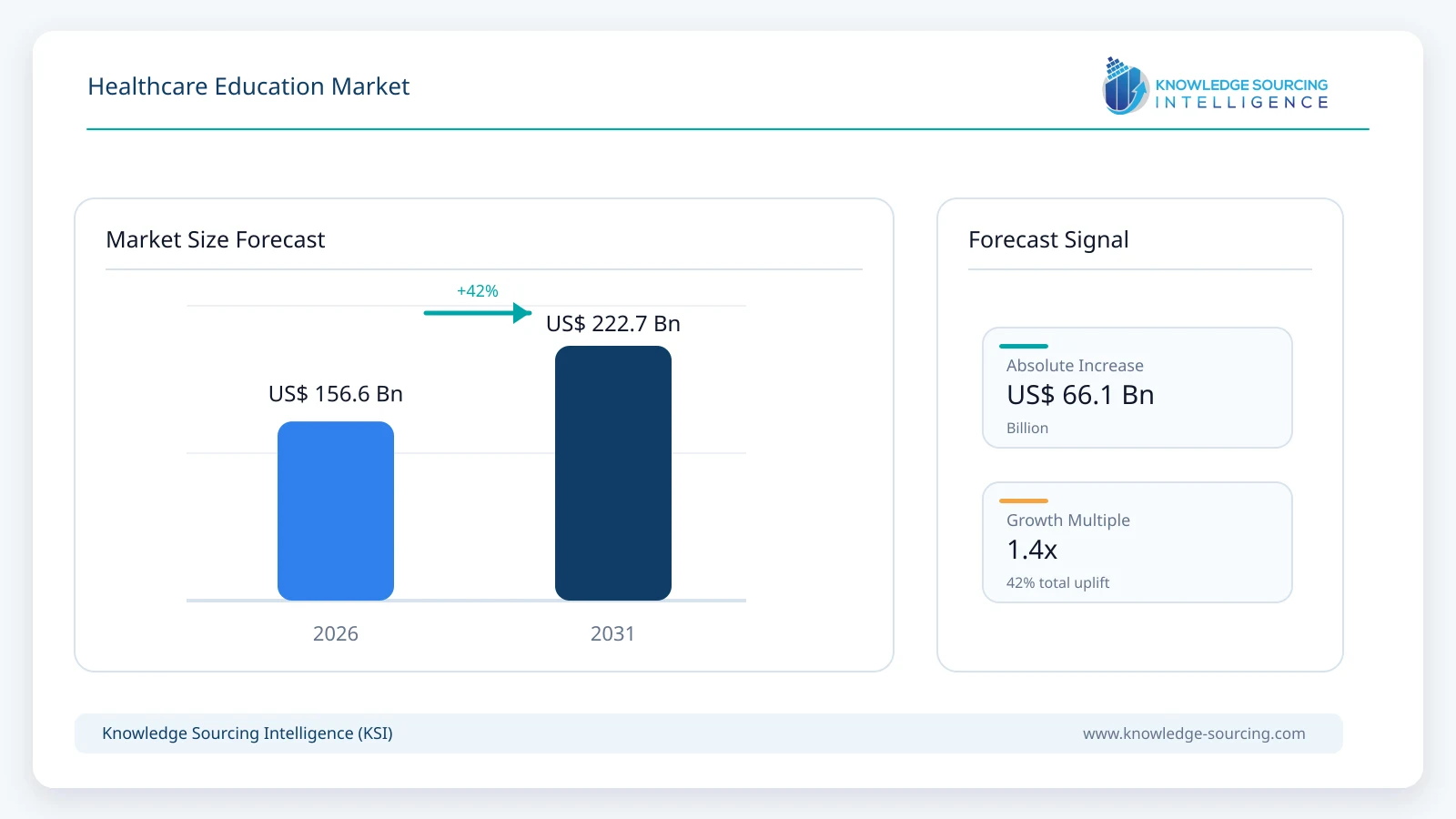
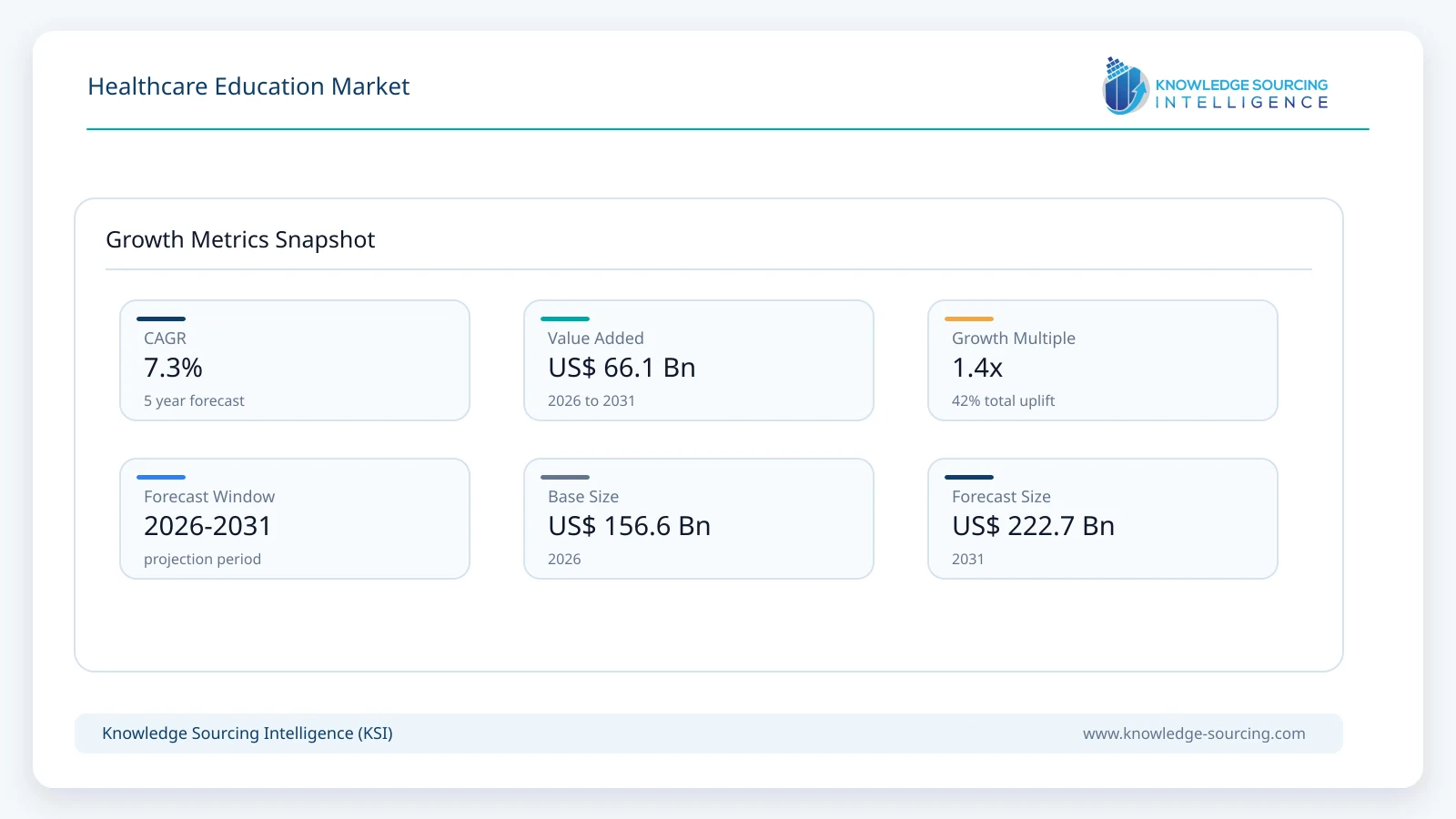
The healthcare education market is forecast to grow at a CAGR of 7.30%, reaching USD 222.7 billion in 2031 from USD 156.6 billion in 2026.
Highlights:
1
E-learning solutions account for approximately 64% of global healthcare education market value in 2026, equivalent to around USD 100.2 billion.
2
Internal medicine represents approximately 24% of market value by medical field in 2026, reflecting its broad application across general clinical education and continuing professional development.
3
Physicians account for approximately 40% of market value by end user in 2026, equivalent to around USD 62.6 billion.
4
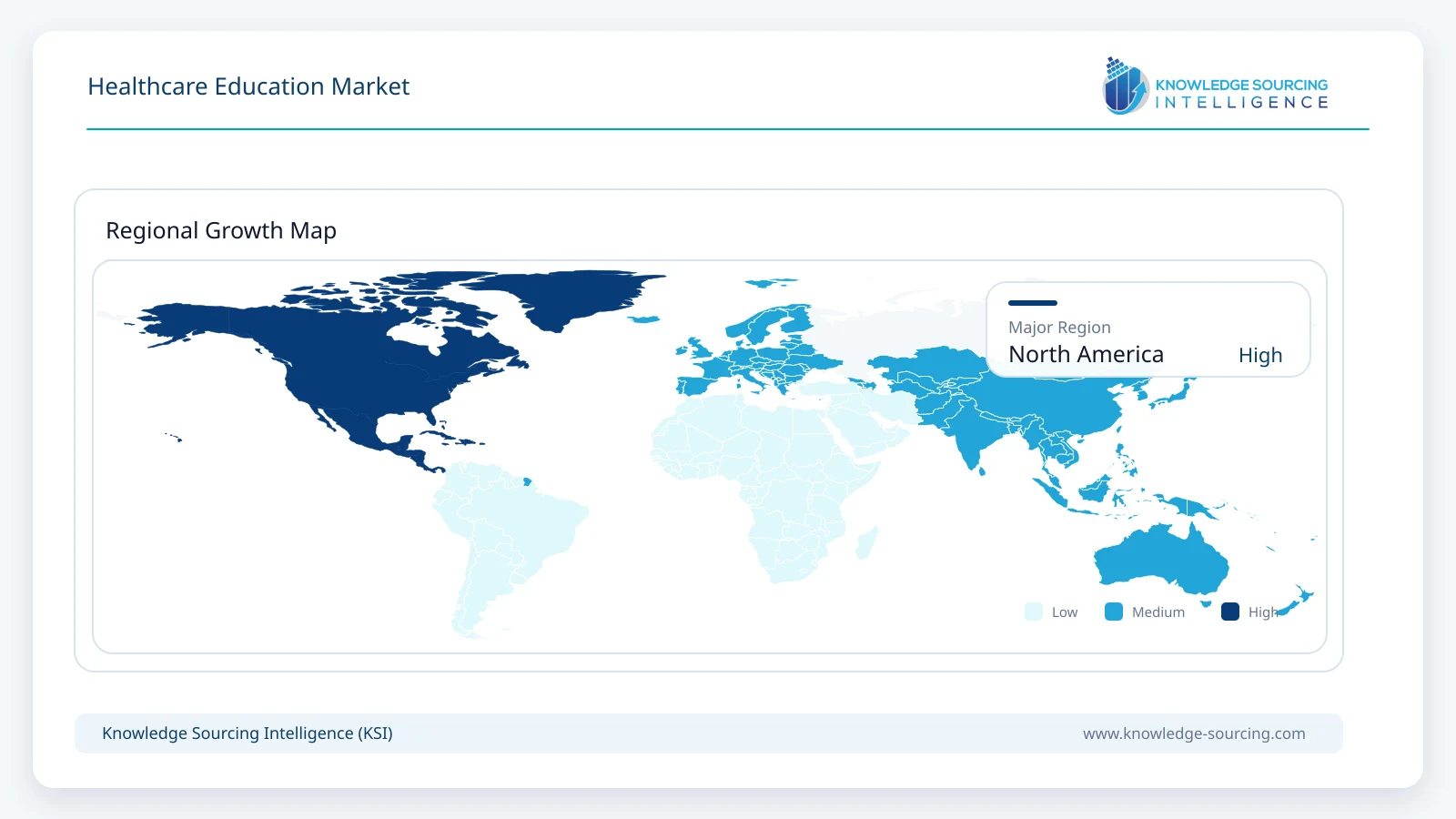
North America accounts for approximately 39% of global market value in 2026 due to its large academic medicine, continuing education and commercial healthcare training ecosystem.
5
Non-physician healthcare education is projected to grow at approximately 9.0% annually through 2031 as nursing, allied-health and caregiver workforce requirements increase.
The market spans undergraduate and postgraduate medical education, nursing and allied-health education, continuing professional education, digital learning platforms, clinical simulation and training associated with medical technologies and evolving clinical practice. The need for continued education is increasing as healthcare systems expand their workforces while simultaneously introducing more complex diagnostic, therapeutic and digital technologies.
The scale of continuing education is already substantial. The Accreditation Council for Continuing Medical Education reported more than 242,000 accredited educational activities during 2025, generating 57.5 million learner interactions across its system. Reported income associated with accredited continuing education reached approximately USD 3.85 billion during the year. In parallel, the pipeline of future clinicians continues expanding. U.S. MD-granting medical-school enrollment exceeded 100,000 students for the first time during the 2025-26 academic year, reaching 100,723 enrolled students, while 23,440 students entered medical school during 2025.
Digital healthcare education is becoming more integrated with conventional educational content rather than operating as a separate delivery channel. HealthStream reports a healthcare workforce course library containing more than 20,000 online courses and educational activities from its own content and over 90 industry partners, while approximately 400,000 American Red Cross Resuscitation Suite certifications were completed through its platform in 2025. Elsevier, Wolters Kluwer, GE HealthCare and other providers are similarly incorporating AI-assisted tutoring, adaptive learning and clinical technology education into existing healthcare training environments.
Market Trends
AI-Assisted Learning Is Moving Into Mainstream Medical and Nursing Education
Healthcare education platforms are increasingly integrating generative AI directly into established learning environments rather than offering AI as a standalone experimental tool. Elsevier launched Osmosis AI in March 2026 as a study companion combining AI-powered conversation with medical content and visual learning. In August 2026, the company expanded this approach with Nora AI, embedding evidence-based conversational learning within Elsevier eBooks on VitalSource’s Bookshelf platform.
Nursing education is developing along the same path. Wolters Kluwer introduced an Expert AI-powered Faculty Assistant within Lippincott CoursePoint+ in May 2026, enabling educators to generate case studies, quizzes and learning activities from evidence-based nursing content. Elsevier’s Sherpath AI similarly supports students and faculty with conversational access to nursing education materials, adaptive quizzing and performance analytics.
AI is consequently affecting both sides of healthcare education. Learners receive personalized explanations and study support, while faculty use AI to create educational materials, identify learning gaps and reduce administrative workload. This increases the value of digital platforms that combine trusted clinical content with AI rather than relying on unrestricted general-purpose models.
Simulation Is Becoming More Closely Integrated With Competency-Based Training
Simulation remains a central component of healthcare education because it allows clinicians and students to practice procedures, decision-making and team communication without exposing patients to training risk. Laerdal’s current simulation portfolio spans emergency medicine, nursing, geriatric care and multidisciplinary training, while its SimMan platforms reproduce complex patient scenarios and integrate with clinical devices and debriefing software.
The role of simulation is extending beyond procedural demonstrations toward structured competency assessment. Laerdal’s 2026 educational programs emphasize integration of simulation with competency-based medical education, program evaluation and leadership development. The company is also combining conventional simulation with virtual reality, adaptive learning and AI-supported workflows.
This broadens the commercial opportunity from purchasing manikins to maintaining complete simulation ecosystems consisting of hardware, software, scenarios, assessment tools, debriefing systems and faculty training. Medical schools and hospital education centers can therefore use simulation repeatedly across undergraduate education, residency, nursing training and continuing professional development.
Healthcare AI Adoption Is Creating a New Continuing-Education Requirement
AI is becoming a subject of healthcare education as well as a technology used to deliver it. GE HealthCare made more than 20 hours of its HelloAI Professional training publicly available in May 2026 alongside its introductory AI curriculum, reflecting the need to train clinicians to interpret and use AI-supported medical technologies. GE HealthCare cited American Medical Association data indicating physician use of AI had more than doubled since 2023 to 81%, while education had not advanced at the same pace.
The AMA expanded formal education in August 2026 by introducing an Ethical AI Use in Medicine CME series developed with the Duke Institute for Health Innovation and the Health AI Partnership. The program addresses practical and ethical use of AI in clinical care.
Healthcare education providers therefore gain a recurring subject area created by technological change itself. Clinicians must learn not only how to operate new AI-enabled tools but also how to evaluate output quality, recognize limitations and apply technology within clinical, regulatory and ethical frameworks.
Market Drivers
Global Healthcare Workforce Requirements
Healthcare systems require substantially more trained personnel while existing clinicians need continuing education throughout their careers. WHO estimates that the global health workforce now exceeds 70 million people but projects a shortage of around 11 million workers by 2030, concentrated particularly in lower-income regions. WHO identifies underinvestment in education and training as one of the factors contributing to persistent shortages and workforce mismatches.
The shortage increases demand across several education categories simultaneously. Universities need to expand physician, nursing and allied-health capacity; hospitals need faster onboarding and competency development; governments need scalable programs for community and primary-care workers; and existing staff require continuous education as roles and technologies change.
This creates demand beyond formal degree programs. Health systems increasingly invest in continuing education, certification, clinical competency, resuscitation training and role-specific development. HealthStream’s course ecosystem and high volume of annual clinical certifications demonstrate the scale of recurring workforce education inside healthcare organizations after employees have completed their initial professional qualifications.
Continuing Professional Education Is Embedded in Clinical Practice
Healthcare professionals must continually update their knowledge as clinical guidelines, drugs, devices and technologies change. The scale of accredited continuing education demonstrates that education remains a recurring professional activity rather than a one-time qualification. ACCME-accredited providers delivered more than 242,000 educational activities and recorded 57.5 million learner interactions in 2025.
Digital delivery strengthens this market because online and hybrid formats allow clinicians to complete learning alongside clinical schedules. Hospitals can distribute mandatory training across large workforces while retaining records of completion, competency and accreditation. HealthStream’s platform combines learning management with credentialing, competency assessment and clinical workforce development, illustrating how education is increasingly becoming part of a broader workforce technology stack.
The combination of professional requirements and continuously changing clinical practice supports recurrent spending on education platforms, specialist content and certification management throughout the forecast period.
Medical Technology Is Increasing Training Requirements
Healthcare technologies increasingly require dedicated training before clinicians can use them effectively. Imaging equipment, robotic systems, interventional devices, diagnostic software and AI-assisted clinical systems create ongoing requirements for product-specific and procedural education. Medical technology companies therefore operate substantial education programs alongside their equipment businesses.
GE HealthCare’s HelloAI initiative illustrates this relationship by providing clinicians with training specifically focused on AI in healthcare. Simulation providers also allow physicians and nurses to rehearse complex procedures using realistic patient scenarios before applying techniques in real clinical environments.
The relationship between technology and education becomes stronger as devices and software are updated more frequently. A hospital’s training requirement no longer ends when equipment is installed. New software versions, clinical applications and workflow changes can require additional education, allowing equipment suppliers and independent education providers to maintain continuing relationships with healthcare institutions.
Market Restraints
Faculty Capacity Limits Expansion of Healthcare Education
Increasing student numbers does not automatically translate into equivalent educational capacity because healthcare programs require qualified faculty, clinical placements and supervised practical training. Faculty constraints are particularly significant in nursing and other clinical disciplines where educators need both teaching capability and current professional expertise.
Digital learning and AI can improve educator productivity but cannot fully replace faculty supervision for clinical competencies. Elsevier describes Sherpath AI partly as a response to faculty resource constraints in nursing education, while its digital platforms provide adaptive assessment and performance information intended to help educators identify students requiring additional support.
Clinical placements create another constraint because hospitals must accommodate students without compromising patient care or existing workforce requirements. The market therefore cannot expand solely through digital enrollment. Sustainable growth requires additional faculty, simulation capacity, clinical-training infrastructure and effective partnerships between healthcare providers and educational institutions.
Healthcare Education Spending Remains Uneven Across Countries and Institutions
The ability to purchase advanced digital platforms, simulation systems and specialist continuing education varies substantially between healthcare systems. WHO’s projected workforce shortage is concentrated disproportionately in lower-income regions, which are also less able to fund expensive educational infrastructure.
Cloud-based and mobile education can lower delivery costs, but connectivity, device availability, language localization and institutional budgets continue to affect adoption. High-fidelity simulation adds further capital requirements through equipment, facilities and trained simulation staff.
Vendors therefore need different delivery models across markets. Advanced health systems may purchase enterprise learning platforms and simulation centers, while resource-constrained environments require mobile-accessible modules, shared training centers and lower-cost content. These differences limit the speed at which premium education technologies can penetrate the entire addressable healthcare workforce.
Segment Analysis
By Delivery Mode: E-Learning Solutions
E-learning represents approximately USD 100.2 billion of global healthcare education market value in 2026 and is projected to reach around USD 153.6 billion in 2031, representing growth of approximately 8.9% annually. Digital education is particularly well suited to healthcare because clinicians and students frequently need access to learning outside fixed classroom schedules. Recorded courses, adaptive assessments, virtual patient cases and mobile learning can be accessed across hospitals, universities and remote locations while maintaining centralized records of learner activity.
Commercial platforms increasingly combine several learning formats within one environment. Elsevier’s Sherpath integrates eBooks, digital lessons, adaptive quizzing, AI tutoring, video content, competency exercises and faculty analytics, while HealthStream combines learning with competency and workforce applications.
Classroom and face-to-face education remain important for anatomy laboratories, physical examinations, procedures and direct clinical supervision, but the proportion of theoretical and continuing professional education delivered digitally continues to increase.
By Medical Field: Internal Medicine
Internal medicine accounts for approximately USD 37.6 billion in 2026 and is projected to reach around USD 51.2 billion by 2031. The segment remains the largest medical-field category because it covers broad diagnostic and therapeutic knowledge relevant to general physicians, hospital medicine, chronic disease management and multiple subspecialty pathways.
Internal medicine education also intersects with major changes affecting healthcare systems, including multimorbidity, ageing populations, new pharmacological therapies and increasing use of clinical decision-support technology. Physicians therefore require frequent updates across cardiovascular, metabolic, infectious, renal and other conditions rather than education around a single procedural specialty.
Radiology records stronger growth from a smaller base as imaging systems incorporate AI, new modalities and increasingly complex workflow software. The expansion of AI-related clinician education is especially relevant to imaging, where practitioners must understand algorithm outputs and limitations alongside conventional image interpretation.
By End User: Physicians
Physicians account for approximately USD 62.6 billion of global healthcare education market value in 2026 and are projected to reach around USD 86.8 billion by 2031, representing growth of approximately 6.8% annually. Their spending includes undergraduate and postgraduate education, specialty training, continuing medical education, technology-specific training and professional certification.
The continuing-education component is particularly significant. ACCME’s 57.5 million learner interactions during 2025 demonstrate the scale of participation across accredited professional education, while GE HealthCare and the AMA are expanding new curricula specifically around AI adoption.
Non-physician education grows faster at approximately 9.0% annually and also approaches USD 86.8 billion by 2031. Nursing, allied-health, community-care and caregiver workforces are substantially larger in number than the physician population and are assuming broader responsibilities across increasingly distributed healthcare systems.
Regional Outlook
North America
North America remains the largest healthcare education market and is projected to reach approximately USD 77.9 billion by 2031. The region combines large medical and nursing education systems with extensive continuing professional education, enterprise hospital training, simulation facilities and commercial healthcare information providers.
The United States provides several indicators of this scale. MD-granting medical-school enrollment reached 100,723 students in the 2025-26 academic year, while accredited continuing education generated 57.5 million learner interactions during 2025. The region is also home to major healthcare education providers including Elsevier’s U.S. healthcare education operations, Wolters Kluwer Health, HealthStream, Relias, McGraw Hill, Kaplan and simulation provider Laerdal’s substantial U.S. business.
AI integration is occurring rapidly within the regional market. Elsevier, Wolters Kluwer, GE HealthCare and the AMA all introduced or expanded AI-related education offerings during 2026, reinforcing North America’s position in higher-value digital and professional healthcare education.
Asia Pacific
Asia Pacific is projected to grow from approximately USD 42.3 billion in 2026 to USD 71.3 billion in 2031 at a CAGR of approximately 11.0%, making it the fastest-growing major region. The region combines large populations, expanding healthcare infrastructure and substantial requirements to increase physician, nurse and allied-health workforce capacity.
WHO data show particularly large health-workforce requirements across several Asian healthcare systems, while expanding medical-college, hospital and diagnostic infrastructure increases demand for both entry-level education and continuing professional training. India is also expanding use of competency-based medical education and simulation, with Laerdal’s 2026 programs specifically addressing integration of simulation into competency-based curricula.
Digital delivery is particularly important because it allows institutions to reach larger learner populations without creating equivalent physical classroom capacity. Multilingual content, mobile learning and cloud-based assessment are therefore likely to remain important components of regional growth.
Competitive Environment and Analysis
The healthcare education market includes specialist education publishers, healthcare workforce technology companies, simulation providers, medical technology companies and professional-learning platforms. Elsevier combines medical and nursing content with Sherpath, Osmosis and newer AI tools such as Nora AI. Wolters Kluwer competes through Lippincott education platforms, including CoursePoint+, while McGraw Hill maintains medical and health-science education content across academic and professional markets.
HealthStream has a distinct position in hospital-based workforce education. Its healthcare course library contains more than 20,000 online courses and educational activities, and its broader platform integrates education with credentialing, competency, scheduling and workforce management. In September 2026, HealthStream introduced the Enterprise Clinical Workforce Platform concept, placing development and competency within an integrated clinical workforce architecture.
Simulation remains a more specialized competitive segment led by companies such as Laerdal Medical and other clinical simulation providers. Digital-first companies including Lecturio and AMBOSS compete particularly strongly in medical-school learning, exam preparation and clinical knowledge support.
Medical technology manufacturers form another important competitive group. GE HealthCare, Siemens Healthineers, Medtronic, Philips, Olympus and Zimmer Biomet provide clinical and product education around their technologies and procedures. Their advantage lies in integrating training directly with installed equipment and clinical workflows.
Competition through 2031 increasingly centers on trusted clinical content, adaptive learning, AI integration, measurable competency and institutional workflow integration rather than the volume of educational material alone.
Recent Developments
September 2026: HealthStream introduced its Enterprise Clinical Workforce Platform framework, integrating development, competency, credentialing, scheduling and other workforce functions around a verified clinician record.
August 2026: The American Medical Association introduced the Ethical AI Use in Medicine CME series with the Duke Institute for Health Innovation and the Health AI Partnership.
August 2026: Elsevier launched Nora AI within healthcare eBooks on VitalSource’s Bookshelf platform, providing evidence-based conversational learning directly within digital course materials.
July 2026: Elsevier’s Sherpath AI was recognized at the 2026 CODiE Awards for its AI-powered nursing education and tutoring capabilities.
May 2026: Wolters Kluwer introduced an Expert AI-powered Faculty Assistant within Lippincott CoursePoint+ to support nursing faculty with case studies, quizzes and learning activities.
May 2026: GE HealthCare made more than 20 hours of its HelloAI Professional healthcare AI curriculum publicly available alongside its introductory AI education program.
March 2026: Elsevier launched Osmosis AI, combining AI-powered medical study support with verified clinical content and visual learning resources.
Market Outlook
The market continues moving toward digital delivery without eliminating classroom, clinical and simulation-based education. Healthcare training increasingly uses combinations of online content, AI-supported tutoring, adaptive assessment, simulation and supervised clinical experience rather than relying on a single delivery format.
E-learning reaches approximately USD 153.6 billion by 2031 and gains share as universities and healthcare institutions expand scalable digital education. Internal medicine remains the largest medical-field segment at approximately USD 51.2 billion, reflecting the breadth of general medical education and chronic-disease management. Physicians remain the largest individual end-user group at approximately USD 86.8 billion, while non-physician education reaches a similar value by 2031 due to faster growth across nursing, allied-health and caregiver workforces.
North America remains the largest regional market, reaching approximately USD 77.9 billion in 2031, while Asia Pacific grows considerably faster and approaches USD 71.3 billion. Workforce shortages, healthcare infrastructure expansion and increasing demand for scalable education support growth across emerging healthcare systems.
The most significant change through 2031 is expected to be the integration of education directly into healthcare workflows. Learning platforms are increasingly connected with competency assessment, credentialing, workforce records and clinical technologies. AI further accelerates this transition by enabling personalized learning and faculty support, but trusted clinical content and professional oversight remain essential. Providers capable of combining credible healthcare knowledge, measurable competency development and scalable digital delivery are consequently positioned most strongly as healthcare education becomes a continuous component of workforce management.
Healthcare Education Market Scope:
Report Metric
Details
Total Market Size in 2026
USD 156.6 billion
Total Market Size in 2031
USD 222.7 billion
Forecast Unit
USD Billion
Growth Rate
7.29%
Study Period
2021 to 2031
Historical Data
2021 to 2024
Base Year
2025
Forecast Period
2026 – 2031
Segmentation
Delivery Mode, Medical Field, End User, Geography
Companies
Elsevier
Wolters Kluwer N.V.
HealthStream Inc.
Relias LLC
McGraw Hill
Laerdal Medical
Lecturio GmbH
AMBOSS GmbH
Kaplan Inc.
Market Segmentation
By Delivery Mode
Classroom-Based
E-Learning Solutions
By Medical Field
Cardiology
Neurology
Radiology
Internal Medicine
Pediatrics
Others
By End User
Students
Physicians
Non-Physicians
By Geography
North America
United States
Canada
Mexico
South America
Brazil
Argentina
Others
Europe
Germany
France
United Kingdom
Spain
Others
Middle East And Africa
Saudi Arabia
UAE
Israel
Others
Asia Pacific
China
India
Japan
South Korea
Indonesia
Thailand
Taiwan
Others
Table of Contents
1. INTRODUCTION
1.1. Market Overview
1.2. Market Definition
1.3. Scope of the Study
1.4. Market Segmentation
1.5. Currency
1.6. Assumptions
1.7. Base and Forecast Years
1.8. Key Benefits to Stakeholders
2. RESEARCH METHODOLOGY
2.1. Research Design
2.2. Secondary Research
2.3. Market Estimation
2.4. Segment Modelling
2.5. Data Triangulation and Validation
3. EXECUTIVE SUMMARY
3.1. Key Findings
3.2. Healthcare Education Market Size, 2026-2031
3.3. Delivery Mode Outlook
3.4. Medical Field Outlook
3.5. End-User Outlook
3.6. Regional Opportunity Summary
4. MARKET DYNAMICS
4.1. Market Drivers
4.1.1. Global Healthcare Workforce Requirements
4.1.2. Continuing Professional Education Embedded in Clinical Practice
4.1.3. Increasing Medical Technology Training Requirements
4.2. Market Restraints
4.2.1. Faculty and Clinical Training Capacity Constraints
4.2.2. Uneven Education Spending Across Healthcare Systems
4.3. Porter’s Five Forces Analysis
4.4. Industry Value Chain Analysis
4.5. Accreditation and Continuing Education Environment
5. TECHNOLOGICAL OUTLOOK
5.1. AI-Assisted Healthcare Education
5.2. Adaptive and Personalized Learning
5.3. Clinical Simulation
5.4. Virtual Reality and Immersive Training
5.5. Competency Analytics and Assessment
5.6. Mobile and Cloud-Based Learning
6. HEALTHCARE EDUCATION MARKET BY DELIVERY MODE
6.1. Classroom-Based
6.2. E-Learning Solutions
7. HEALTHCARE EDUCATION MARKET BY MEDICAL FIELD
7.1. Cardiology
7.2. Neurology
7.3. Radiology
7.4. Internal Medicine
7.5. Pediatrics
7.6. Others
8. HEALTHCARE EDUCATION MARKET BY END USER
8.1. Students
8.2. Physicians
8.3. Non-Physicians
9. HEALTHCARE EDUCATION MARKET BY GEOGRAPHY
9.1. North America
9.1.1. United States
9.1.2. Canada
9.1.3. Mexico
9.2. South America
9.2.1. Brazil
9.2.2. Argentina
9.2.3. Others
9.3. Europe
9.3.1. Germany
9.3.2. France
9.3.3. United Kingdom
9.3.4. Spain
9.3.5. Others
9.4. Middle East and Africa
9.4.1. Saudi Arabia
9.4.2. UAE
9.4.3. Israel
9.4.4. Others
9.5. Asia Pacific
9.5.1. China
9.5.2. India
9.5.3. Japan
9.5.4. South Korea
9.5.5. Indonesia
9.5.6. Thailand
9.5.7. Taiwan
9.5.8. Others
10. COMPETITIVE ENVIRONMENT AND ANALYSIS
10.1. Major Players and Strategy Analysis
10.2. Market Share Analysis
10.3. Mergers, Acquisitions, Agreements, and Collaborations
The healthcare education market is forecast to experience robust growth at a Compound Annual Growth Rate (CAGR) of 7.30%. This growth is expected to increase the market value significantly, from USD 156.6 billion in 2026 to an estimated USD 222.7 billion by 2031.
E-learning solutions currently dominate the market, accounting for approximately 64% of the global healthcare education market value in 2026. This translates to around USD 100.2 billion, highlighting the widespread adoption and financial significance of digital learning platforms.
Physicians represent the largest end-user segment, contributing approximately 40% of the market value in 2026, equivalent to about USD 62.6 billion. In terms of medical fields, internal medicine accounts for approximately 24% of the market value in 2026, reflecting its broad relevance across clinical education and professional development.
North America is identified as the leading regional contributor, accounting for approximately 39% of the global market value in 2026. This dominance is primarily due to its expansive academic medicine, continuing education, and commercial healthcare training ecosystems.
A primary trend is the mainstream integration of AI-Assisted Learning into medical and nursing education platforms, moving beyond standalone solutions. The market is also driven by an increasing need for continued education, fueled by expanding healthcare workforces and the introduction of complex diagnostic, therapeutic, and digital technologies.
Non-physician healthcare education is projected to be a high-growth segment, with an estimated annual growth rate of approximately 9.0% through 2031. This expansion is driven by the increasing workforce requirements for nursing, allied-health professionals, and caregivers, indicating a critical area of market development.