
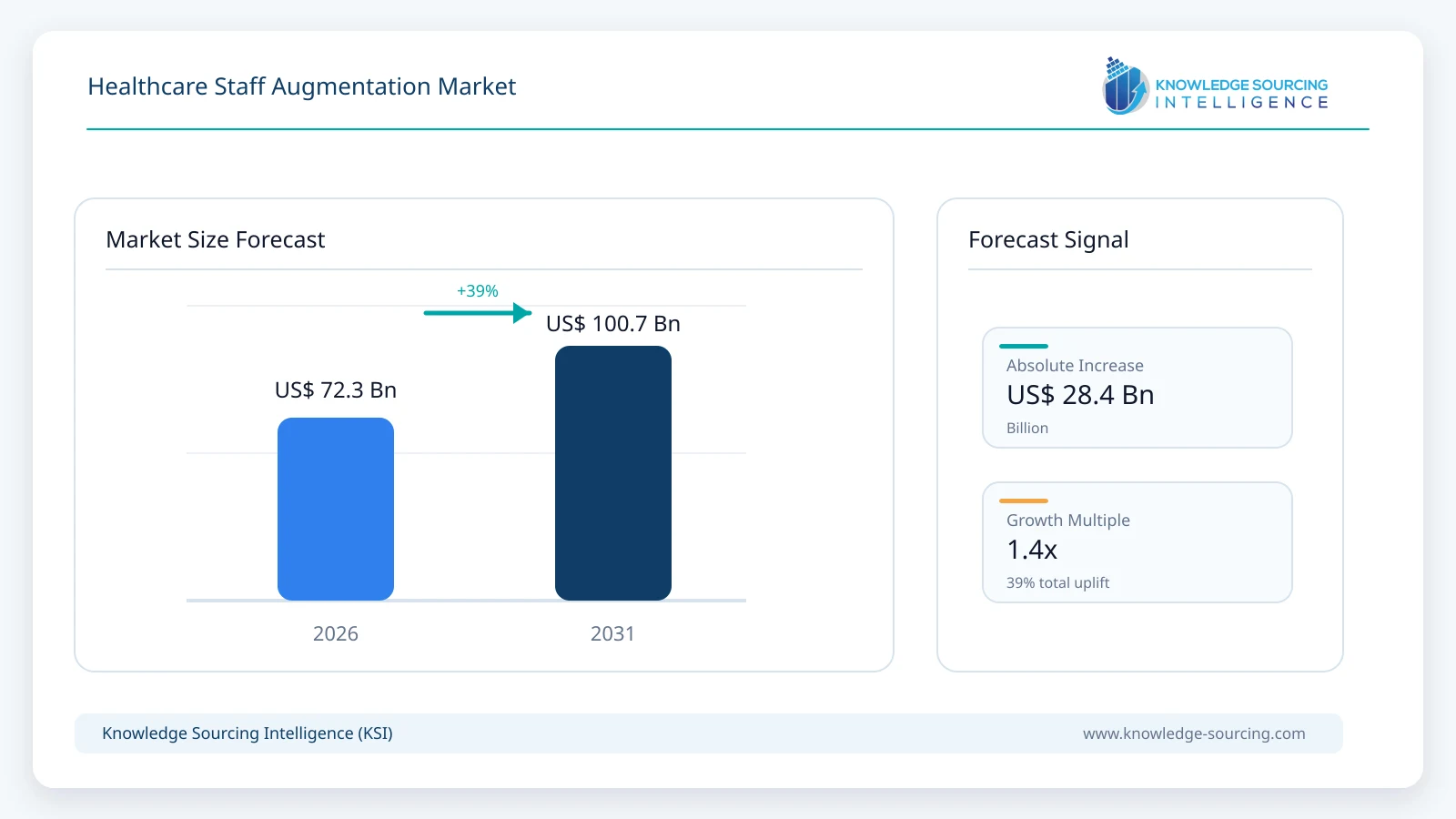
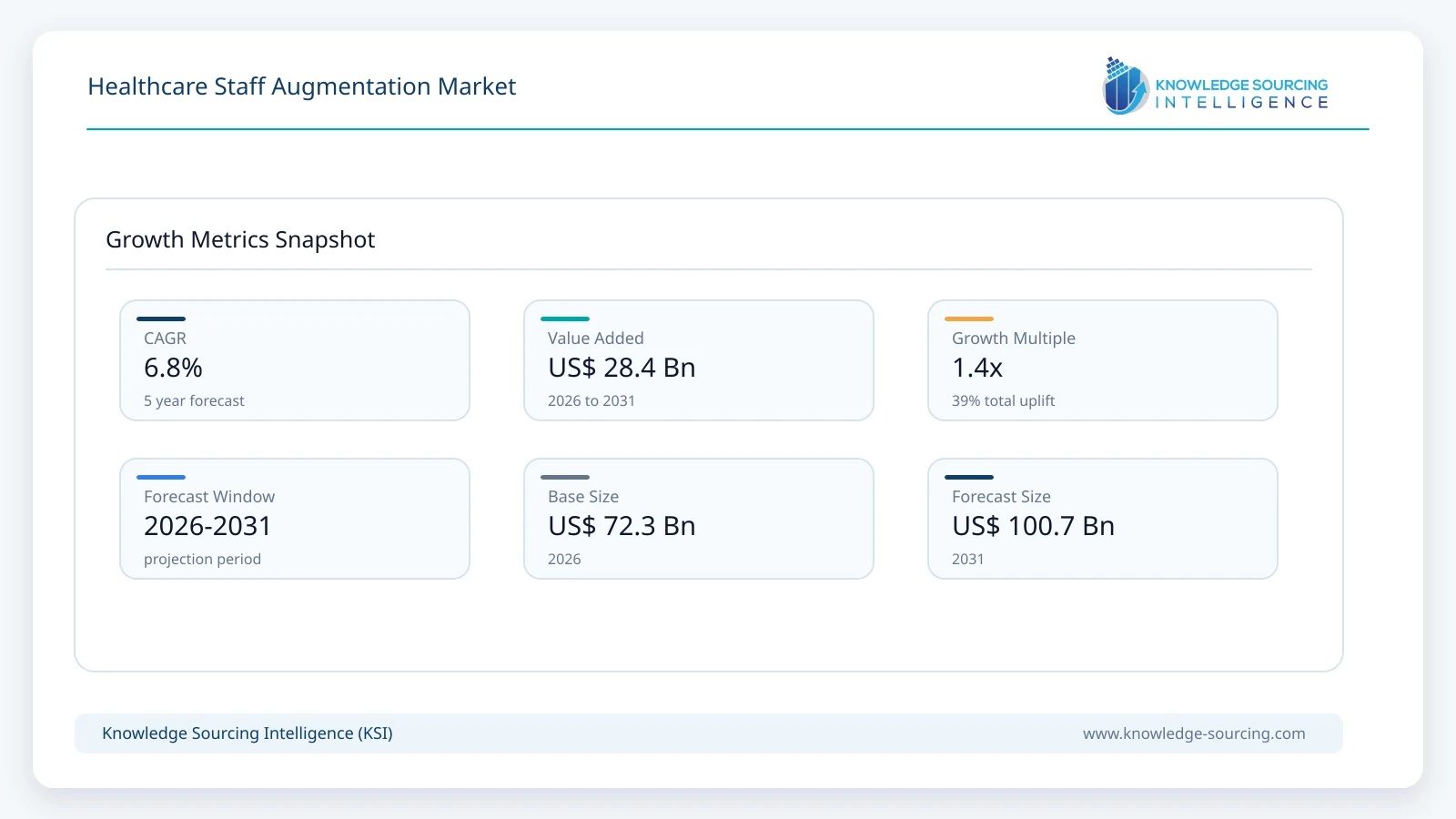
The healthcare staff augmentation market is expected to grow at a 6.85% CAGR, achieving USD 100.68 billion in 2031 from USD 72.30 billion in 2026.
Highlights:
- 1Temporary and contract clinical staffing accounts for approximately 76% of market value in 2026, reflecting the scale of travel, local contract, per diem, allied and locum staffing.
- 2Nursing professionals account for approximately 52% of market demand by professional type in 2026, remaining the largest workforce category.
- 3Hospitals account for approximately 58% of market demand in 2026, supported by continuous coverage requirements and specialist vacancies.
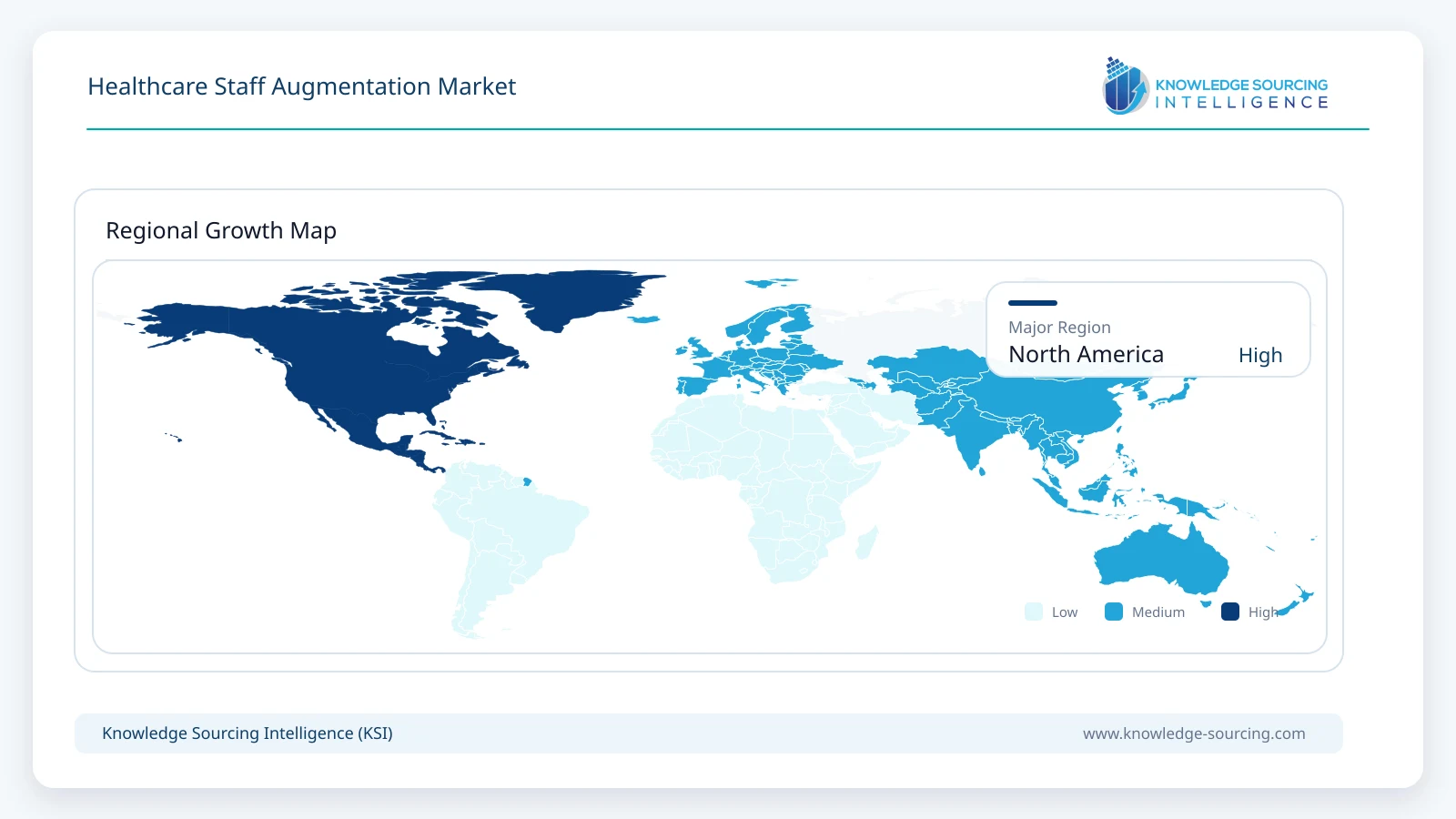
- 4North America accounts for approximately 48% of global market value in 2026, supported by the large U.S. healthcare staffing industry.
- 5Managed workforce solutions, internal talent marketplaces and technology-enabled per diem models are gaining importance as health systems reduce reliance on high-cost travel staffing.
Healthcare staff augmentation includes external workforce services used by hospitals, clinics, long-term care facilities, ambulatory centers, home healthcare organizations and other providers to supplement internal clinical labor. The market includes temporary and contract staffing, travel clinicians, per diem staffing, locum tenens, permanent placement and international recruitment, along with directly related managed workforce and staffing-program services. The market value represents staffing-company billings and workforce-service revenue rather than the salaries of healthcare workers employed directly by healthcare organizations.
The current KSI estimate is commercially reconcilable with observable industry activity. Staffing Industry Analysts estimated the U.S. healthcare staffing market at approximately USD 33 billion in 2025, while an American Staffing Association analysis citing SIA estimates the narrower U.S. core nursing segment alone at approximately USD 17.7 billion in 2026. That nursing figure excludes locum tenens, allied health, international recruitment and several other healthcare labor categories.
Large staffing-company revenues provide an additional cross-check. AMN Healthcare generated USD 2.73 billion in 2025, including USD 1.65 billion from nurse and allied solutions and USD 696 million from physician and leadership solutions. Cross Country Healthcare generated approximately USD 1.05 billion, with USD 863 million from nurse and allied staffing and USD 192 million from physician staffing.
The market therefore remains large despite the normalization of pandemic-era travel rates. The underlying requirement for flexible healthcare labor has not disappeared. WHO estimates that the global health workforce exceeds 70 million people but still projects a shortage of approximately 11 million health workers by 2030. The global nursing workforce reached 29.8 million in 2023, while the nursing shortage remained 5.8 million and is projected at 4.1 million in 2030.
Market Trends
• Healthcare Systems Are Rebalancing Away From Premium Travel Staffing
The post-pandemic staffing market is structurally different from 2021-2022. Hospitals have focused on rebuilding permanent teams, expanding internal float pools and reducing high-cost agency utilization. AMN’s nurse and allied revenue declined 9% in 2025, with the average number of travelers on assignment down 14%, while Cross Country’s nurse and allied revenue fell 24.7%.
This does not mean external staffing demand is disappearing. Instead, spending is moving toward local contracts, per diem labor, managed staffing programs and more targeted travel usage. The American Staffing Association notes that the U.S. core nursing staffing segment remains overcapacity in 2026, with health systems increasingly seeking flexible local staffing instead of automatically filling vacancies with higher-cost travelers.
• Workforce Technology Is Becoming Part of the Staffing Product
Healthcare staffing companies are increasingly competing through workforce orchestration rather than candidate databases alone. In March 2026, ShiftMed integrated its on-demand clinician marketplace with symplr Smart Square, allowing health systems to route open shifts from predictive workforce planning directly into an external talent marketplace. Smart Square can support staffing planning 30 to 60 days in advance.
Cross Country Healthcare is following a similar path. In May 2026, it announced a 36-month partnership to integrate Optimé workforce forecasting and optimization into its Intellify platform, linking staffing supply with patient demand and labor-cost planning.
• Physician and Advanced-Practice Staffing Remains Structurally Tight
Physician staffing has not experienced the same normalization as pandemic-era travel nursing. CHG Healthcare reported in its 2025 locum tenens research that locum usage increased 25%, with healthcare organizations increasingly treating temporary physician coverage as a revenue-protection mechanism. Its analysis estimates that an unfilled physician position can represent approximately USD 2.6 million in lost annual patient revenue, based on median vacancy duration and provider charges.
This supports demand for locum tenens even when hospitals are actively controlling temporary nursing spending.
• International Recruitment Remains Important but More Regulated
Global workforce imbalances continue to encourage international recruitment. WHO reports that high-income countries contain approximately 17% of the world’s population but employ 46% of its nurses, while one in seven nurses globally works in a country other than where they were born.
International recruitment therefore remains an important long-duration solution for markets with persistent shortages. However, staffing companies must manage immigration, credential recognition, licensing and ethical recruitment requirements, making international staffing more operationally complex than domestic temporary placements.
Market Drivers
• Persistent Healthcare Workforce Shortages
The principal market driver remains the mismatch between healthcare workforce supply and demand. WHO’s projected global shortfall of approximately 11 million health workers in 2030 indicates that workforce limitations will remain structural rather than temporary. Nursing alone is projected to face a shortfall of approximately 4.1 million workers by 2030.
The shortage is also geographically uneven. Approximately 78% of nurses work in countries representing only 49% of the global population. This creates shortages even where total workforce growth appears healthy and supports domestic relocation, international recruitment and temporary coverage.
• Healthcare Employment Continues to Expand
U.S. healthcare and social assistance employment reached approximately 23.9 million workers in August 2026, while the sector recorded around 1.53 million job openings in July 2026.
Growing healthcare employment creates additional demand for recruitment and workforce management even when agency penetration remains stable. Expansion in home health, ambulatory services, behavioral health and specialty care also spreads staffing requirements beyond traditional hospitals.
• Vacancies Have Direct Revenue and Service Consequences
Healthcare vacancies are different from vacancies in many office-based industries because unfilled clinical roles can prevent hospitals from operating beds, procedure rooms or service lines. CHG’s research estimates almost USD 2.6 million of potential patient revenue exposure during the median time required to fill a physician vacancy.
The economic cost of an unfilled position makes external staffing attractive even where temporary clinicians command higher hourly rates than permanent staff.
Market Restraints
• Health Systems Are Actively Reducing Agency Spending
External staffing growth is constrained by healthcare-provider cost-control programs. NHS England’s 2025/26 financial guidance explicitly requires systems to reduce agency expenditure and further reduce bank staffing costs. Similar initiatives are visible among U.S. health systems attempting to replace premium contract labor with permanent and internal flexible labor.
This creates a more difficult environment for traditional travel-staffing suppliers and places greater emphasis on lower-cost local staffing, MSP models and workforce technology.
• Staffing Supply Can Be the Constraint Even When Demand Exists
Staffing companies cannot monetize vacancies when qualified professionals are unavailable. Credentialing, state or national licensing, specialist experience and immigration requirements restrict candidate mobility.
This is especially important for physician specialties, anesthesia, behavioral health and specialized nursing roles. Staffing firms therefore increasingly compete on talent acquisition and credentialing infrastructure rather than simply client demand.
Segment Analysis
• By Staffing Model: Temporary and Contract Clinical Staffing
Temporary and contract clinical staffing accounts for approximately 76% of global market value in 2026. The segment includes travel assignments, local contracts, per diem shifts, allied health staffing and temporary physician coverage. Its market leadership is supported by the revenue composition of major staffing suppliers, whose largest businesses continue to derive revenue from placing clinicians on temporary assignments.
AMN’s nurse and allied and physician and leadership businesses together represented 86% of its 2025 revenue, although a portion of physician and leadership revenue includes permanent placement and leadership services. Cross Country’s reported revenue is even more concentrated in nurse, allied and physician staffing.
Permanent recruitment, international recruitment and managed workforce programs represent smaller but increasingly important pools. They can generate lower gross billings than temporary staffing but often carry different margin structures and can become embedded in longer-term client relationships.
• By Professional Type: Nursing
Nursing professionals account for approximately 52% of global market demand in 2026 and remain the largest professional category. In the United States alone, the core travel and per diem nursing staffing segment is estimated at approximately USD 17.7 billion in 2026, excluding locum tenens and allied health.
The nursing staffing market nevertheless remains under significant pricing pressure. High pandemic bill rates expanded supplier capacity rapidly, but health systems subsequently strengthened internal recruitment, local staffing and float-pool models. The opportunity through 2031 therefore rests less on a return to emergency travel rates and more on structural nursing shortages, specialty coverage, flexible schedules, per diem staffing and geographically uneven labor availability.
• By End User: Hospitals
Hospitals account for approximately 58% of market value in 2026. They require continuous clinical coverage across nursing, emergency medicine, anesthesia, surgery, radiology, behavioral health and other specialties. Staffing requirements can increase suddenly because of vacancies, leave, seasonal census changes or service-line expansion.
Hospitals are also among the most aggressive buyers of managed workforce programs because they purchase multiple labor categories at scale. Their procurement model is shifting toward centralized MSP and VMS structures, internal resource pools and predictive workforce planning rather than relying on individual staffing suppliers independently.
Regional Outlook
• North America
North America accounts for approximately 48% of global market value in 2026 and remains the largest regional market. The U.S. healthcare staffing industry alone generated an estimated approximately USD 33 billion in 2025, providing a strong commercial anchor for the regional model.
North America’s market is mature but currently undergoing significant mix changes. Travel nursing has contracted from pandemic highs, while locum tenens, local staffing, home-based staffing and technology-enabled workforce models remain strategically important. Cross Country reported home-based staffing growth of 28% in 2025 despite substantial contraction in its broader nurse and allied business.
Europe is the second-largest market, supported by aging workforces and recruitment challenges within public health systems. Asia Pacific has a much larger underlying healthcare workforce but lower staffing-company penetration and staffing revenue per clinician, creating a smaller current market but a longer-term expansion opportunity. Gulf markets remain particularly dependent on internationally recruited healthcare professionals.
Competitive Landscape
The market includes large diversified workforce providers, specialist nursing and allied staffing companies, locum tenens suppliers and technology-led staffing platforms.
Aya Healthcare operates across travel nursing, allied health, locum tenens, permanent placement and managed workforce solutions. Its locum marketplace reports more than 41,000 monthly active candidates and access to more than 90 partner agencies.
AMN Healthcare remains one of the largest publicly reported healthcare talent companies, generating USD 2.73 billion in 2025. CHG Healthcare has a particularly strong physician and locum-tenens position through brands including CompHealth and Weatherby Healthcare. Medical Solutions remains one of the largest U.S. healthcare staffing businesses and was ranked among the top five healthcare staffing firms in the country in 2025.
Cross Country Healthcare generated USD 1.05 billion in 2025 and was acquired by Knox Lane in July 2026. The company’s strategy increasingly combines staffing with workforce intelligence and predictive analytics.
Jackson Healthcare, TNAA | TotalMed, Maxim Healthcare Services, Ingenovis Health and ShiftMed are also relevant competitors. TeamHealth and Envision are better treated primarily as outsourced physician-practice/service organizations rather than core staff-augmentation comparables and therefore should not lead the company profile set.
Recent Developments
August 2026: CHG Healthcare acquired KREWE Anesthesia, expanding its CRNA staffing and managed anesthesia capabilities.
July 2026: Knox Lane completed its acquisition of Cross Country Healthcare and appointed Joel Tremblay as CEO.
July 2026: ShiftMed integrated its workforce platform with QGenda to connect workforce scheduling with on-demand shift fulfillment.
May 2026: Cross Country Healthcare announced an exclusive 36-month partnership to integrate Optimé workforce forecasting and optimization into Intellify.
March 2026: ShiftMed integrated with symplr Smart Square, linking predictive scheduling with its external clinician marketplace.
May 2025: TNAA and TotalMed completed a strategic merger combining healthcare staffing and MSP capabilities.
Market Outlook
The healthcare staff augmentation market is forecast to increase. Unlike the pandemic period, growth through 2031 is not expected to be driven by extraordinary travel-nurse bill rates. The market is instead transitioning toward a broader mix of temporary clinical staffing, locum tenens, local and per diem staffing, managed workforce programs, permanent recruitment and international talent acquisition.
Temporary and contract staffing remains the largest revenue category, but its composition changes as hospitals reduce premium travel assignments and use more local flexible labor. Nursing remains the largest professional segment, while physician, advanced-practice and specialist allied staffing provide attractive higher-value niches.
Technology becomes increasingly important to supplier differentiation. Large healthcare organizations are moving toward centralized workforce planning, predictive scheduling, MSP/VMS procurement and internal talent marketplaces. Staffing providers that can connect external labor pools with these systems are better positioned than firms relying only on traditional recruiter-led placement.
Healthcare Staff Augmentation Market Scope:
| Report Metric | Details |
|---|---|
| Total Market Size in 2026 | USD 72.30 billion |
| Total Market Size in 2031 | USD 100.68 billion |
| Forecast Unit | Billion |
| Growth Rate | 6.85% |
| Study Period | 2021 to 2031 |
| Historical Data | 2021 to 2024 |
| Base Year | 2025 |
| Forecast Period | 2026 – 2031 |
| Segmentation | Staffing Model, Professional Type, End User, Geography |
| Companies |
|
Market Segmentation
By Staffing Model
Temporary and Contract Clinical Staffing
Permanent Placement and Recruitment
International Recruitment
Managed and Outsourced Workforce Solutions
By Professional Type
Nursing Professionals
Physicians and Advanced Practice Providers
Allied Health Professionals
Other Clinical and Healthcare Support Professionals
By End User
Hospitals
Clinics and Physician Practices
Nursing Homes and Long-Term Care
Ambulatory and Outpatient Facilities
Home Healthcare
Others
By Geography
North America
United States
Canada
Mexico
South America
Brazil
Argentina
Others
Europe
United Kingdom
Germany
France
Italy
Spain
Others
Middle East and Africa
Saudi Arabia
UAE
South Africa
Others
Asia Pacific
China
Japan
India
Australia
Singapore
Others
Table of Contents
1. INTRODUCTION
1.1. Market Overview
1.2. Market Definition and Revenue Boundary
1.3. Scope of the Study
1.4. Market Segmentation
1.5. Currency
1.6. Assumptions
1.7. Base and Forecast Years
2. RESEARCH METHODOLOGY
2.1. Research Design
2.2. Secondary Research
2.3. Primary Research
2.4. Staffing Company Revenue Analysis
2.5. Workforce and Placement Modelling
2.6. Segment Modelling
2.7. Data Triangulation and Validation
3. EXECUTIVE SUMMARY
3.1. Key Findings
3.2. Healthcare Staff Augmentation Market Size, 2026-2031
3.3. Staffing Model Outlook
3.4. Professional Type Outlook
3.5. End-User Outlook
3.6. Regional Opportunity Summary
4. MARKET DYNAMICS
4.1. Market Drivers
4.1.1. Persistent Healthcare Workforce Shortages
4.1.2. Expansion of Healthcare Employment and Service Delivery
4.1.3. Revenue and Service Impact of Clinical Vacancies
4.2. Market Restraints
4.2.1. Healthcare Provider Initiatives to Reduce Agency Spending
4.2.2. Candidate Availability, Licensing and Credentialing Constraints
4.3. Market Opportunities
4.4. Industry Value Chain Analysis
4.5. Staffing Procurement and MSP/VMS Trends
4.6. Workforce Migration and International Recruitment
4.7. Regulatory and Credentialing Environment
5. TECHNOLOGY AND WORKFORCE MODEL OUTLOOK
5.1. Managed Service Programs
5.2. Vendor Management Systems
5.3. Internal Talent Marketplaces and Float Pools
5.4. AI-Based Workforce Forecasting and Matching
5.5. Digital Credentialing and Compliance
5.6. On-Demand and Per Diem Staffing Platforms
6. HEALTHCARE STAFF AUGMENTATION MARKET BY STAFFING MODEL
6.1. Introduction
6.2. Temporary and Contract Clinical Staffing
6.3. Permanent Placement and Recruitment
6.4. International Recruitment
6.5. Managed and Outsourced Workforce Solutions
7. HEALTHCARE STAFF AUGMENTATION MARKET BY PROFESSIONAL TYPE
7.1. Introduction
7.2. Nursing Professionals
7.3. Physicians and Advanced Practice Providers
7.4. Allied Health Professionals
7.5. Other Clinical and Healthcare Support Professionals
8. HEALTHCARE STAFF AUGMENTATION MARKET BY END USER
8.1. Hospitals
8.2. Clinics and Physician Practices
8.3. Nursing Homes and Long-Term Care
8.4. Ambulatory and Outpatient Facilities
8.5. Home Healthcare
8.6. Others
9. HEALTHCARE STAFF AUGMENTATION MARKET BY GEOGRAPHY
9.1. North America
9.1.1. United States
9.1.2. Canada
9.1.3. Mexico
9.2. South America
9.2.1. Brazil
9.2.2. Argentina
9.2.3. Others
9.3. Europe
9.3.1. United Kingdom
9.3.2. Germany
9.3.3. France
9.3.4. Italy
9.3.5. Spain
9.3.6. Others
9.4. Middle East and Africa
9.4.1. Saudi Arabia
9.4.2. UAE
9.4.3. South Africa
9.4.4. Others
9.5. Asia Pacific
9.5.1. China
9.5.2. Japan
9.5.3. India
9.5.4. Australia
9.5.5. Singapore
9.5.6. Others
10. COMPETITIVE ENVIRONMENT AND ANALYSIS
10.1. Major Players and Strategy Analysis
10.2. Nursing and Allied Staffing Positioning
10.3. Physician and Locum Tenens Positioning
10.4. MSP and Workforce Technology Capabilities
10.5. International Recruitment Capabilities
10.6. Candidate Network and Geographic Coverage
10.7. Mergers, Acquisitions and Partnerships
10.8. Competitive Dashboard
11. COMPANY PROFILES
11.1. Aya Healthcare
11.2. AMN Healthcare Services, Inc.
11.3. CHG Healthcare
11.4. Medical Solutions
11.5. Cross Country Healthcare
11.6. Jackson Healthcare
11.7. TNAA | TotalMed
11.8. Maxim Healthcare Services
11.9. Ingenovis Health
11.10. ShiftMed
12. APPENDIX
12.1. Market Definition and Revenue Boundary
12.2. Staffing Model Definitions
12.3. Currency and Conversion Assumptions
12.4. Base Year and Forecast Period
12.5. Market Estimation Approach
12.6. Primary and Secondary Research Framework
Navigate
Trusted by the world's leading organizations











