
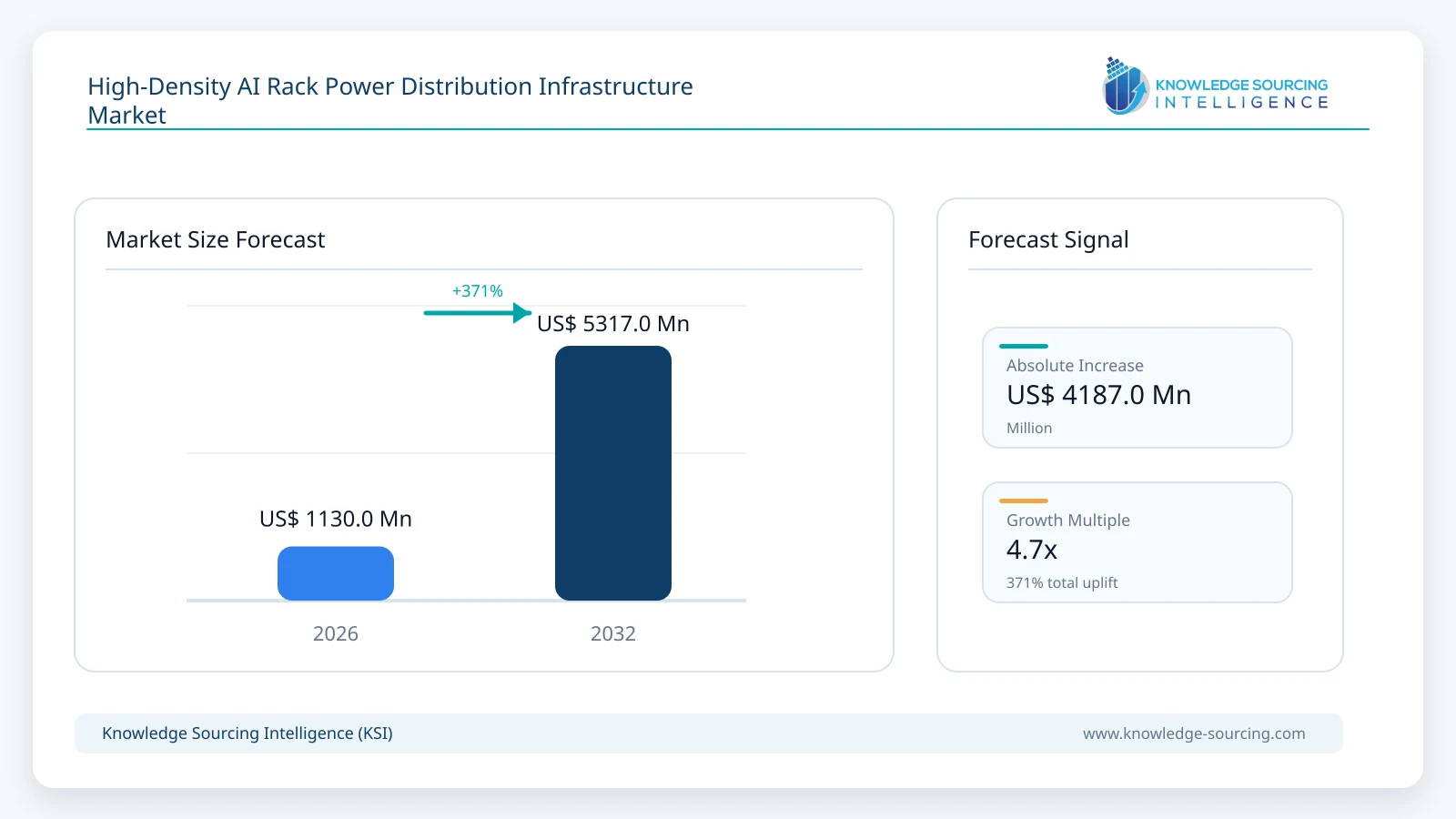
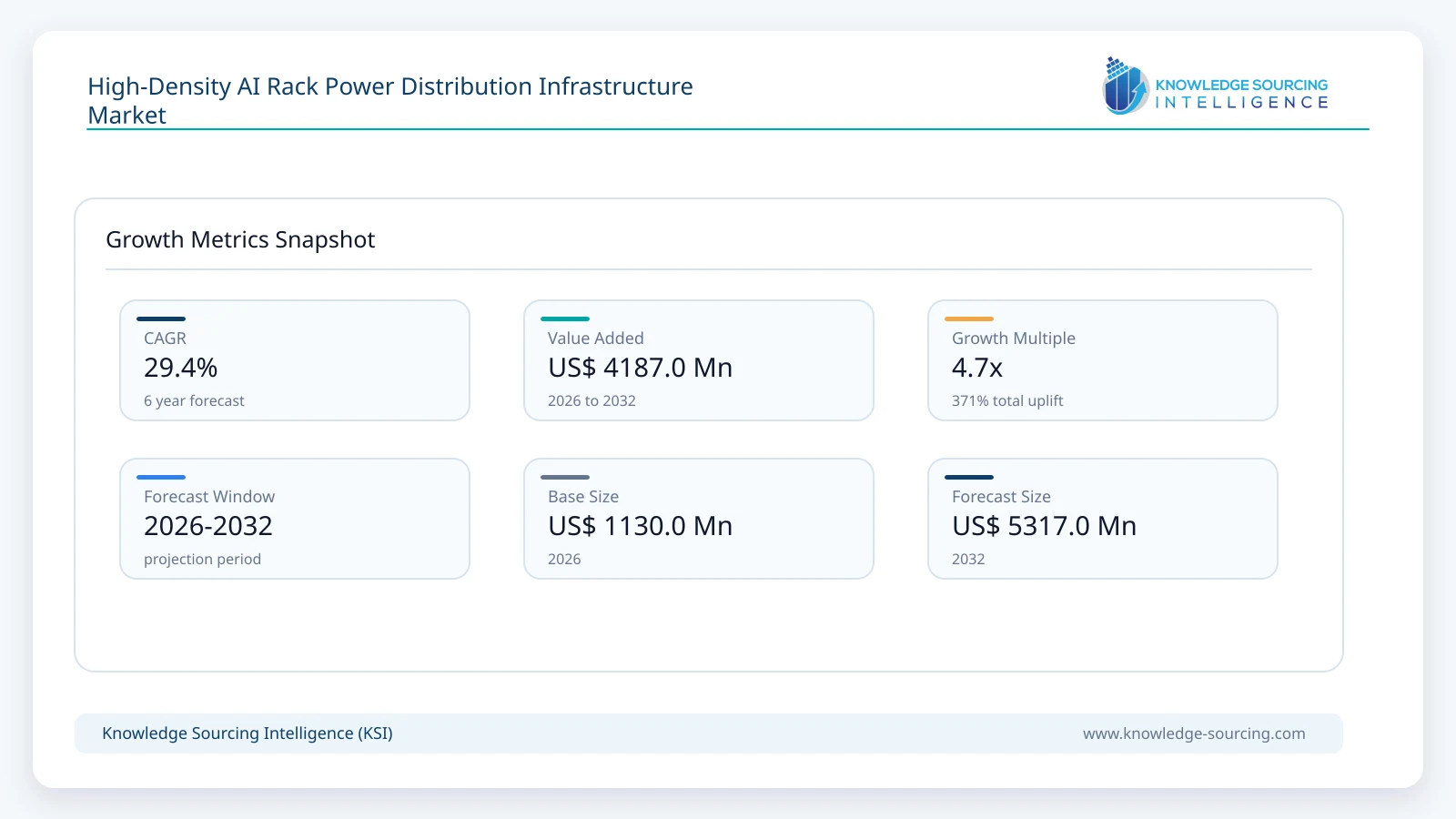
The global high-density AI rack power distribution infrastructure market is forecast to grow at a CAGR of 29.4%, reaching approximately USD 5,317 million by 2032 from USD 1,130 million in 2026.
Highlights:
- 1AI rack power density has moved from tens of kilowatts toward 130-145 kW in current rack-scale platforms, increasing the value of distribution equipment per rack.
- 2New AI platforms are pushing rack requirements toward approximately 240-250 kW, expanding demand for higher-capacity busway, power shelves and rack-level protection.
- 3Busway is gaining importance because modular tap-offs allow operators to add or relocate high-density racks without extensive cable and conduit rework.
- 4High-capacity intelligent rack PDUs are evolving from basic distribution devices into power-quality, branch-level and outlet-level monitoring platforms.
- 5Rack-level DC power shelves and busbars are becoming a larger share of power content as OCP-style rack architectures expand across accelerated computing.
- 6Dynamic GPU load swings are increasing demand for monitoring, protection and power-smoothing capabilities throughout the rack power chain.
- 7Brownfield AI deployment is supporting a retrofit market for higher-voltage feeds, upgraded rack PDUs, busway and modular power distribution.
- 8Hyperscalers and neocloud operators lead deployment, while colocation providers increasingly require repeatable high-density power blocks for multiple tenants.
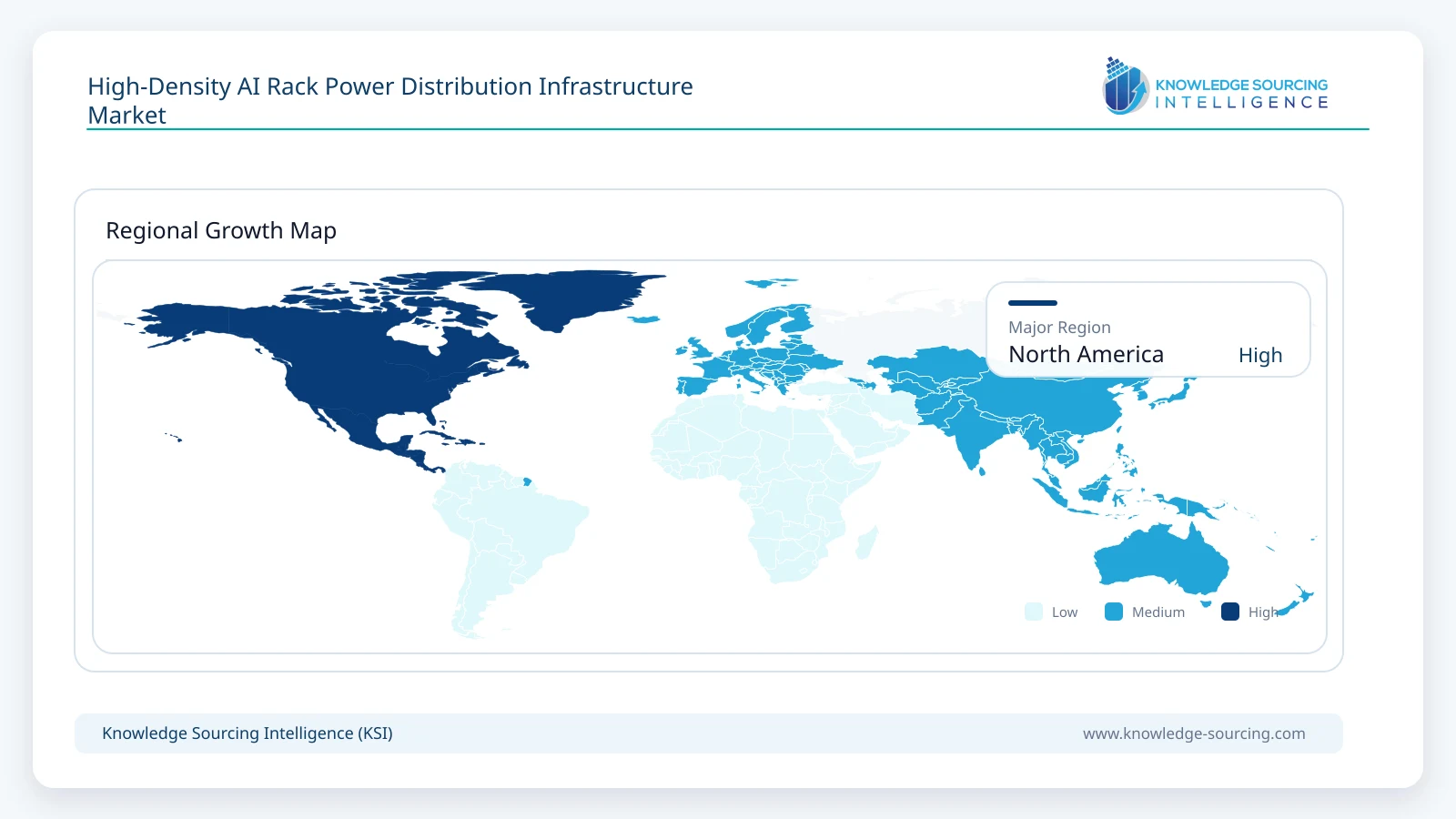
- 9North America remains the principal commercial center, while China, Asia Pacific and Europe are expanding AI-ready data-center capacity and local supplier ecosystems.
- 10Future market growth depends on both AI capacity additions and the amount of rack power infrastructure required per MW as densities and architectures change.
- 11Annual global revenue from high-density rack distribution equipment is projected to rise at a 29.4% CAGR through 2032 as higher-power racks gain share in AI data centers.
Market Definition
High-density AI rack power distribution infrastructure includes electrical distribution, conversion, switching, protection and monitoring equipment that delivers power from the data-hall or row-level distribution point to AI/HPC racks operating at approximately 100 kW per rack and above. This threshold captures rack-scale accelerated-computing environments where conventional rack power arrangements require material redesign rather than routine capacity expansion.
The market includes busway and tap-off systems, rack PDUs, rack-level power shelves and conversion equipment, high-current busbars and connectors, automatic or static transfer equipment used at rack or row level, circuit protection and branch distribution, and embedded monitoring or power-quality systems sold with these products. Market revenue is recognized at the equipment level and excludes server/GPU hardware, cooling systems, general construction, utility generation and upstream medium-voltage electrical infrastructure.
The equipment opportunity depends on the annual volume of high-density AI IT load deployed worldwide. Equipment content per MW varies with rack-density class, redundancy architecture, voltage and deployment type. Higher-density racks reduce the number of racks required for a given MW while increasing power-distribution content, current handling, monitoring and protection requirements per rack.
Market Overview
Power distribution within the data hall is becoming a design constraint as accelerated-computing platforms move beyond the density levels common in conventional enterprise and cloud infrastructure. Vertiv reference designs for NVIDIA GB200 and GB300 systems include rack densities around 130-142 kW, while industry roadmaps point toward approximately 240-250 kW for newer platforms and substantially higher levels later in the decade. At these densities, the power chain must deliver more current through less physical space while preserving redundancy, maintainability and service access.
The immediate commercial opportunity is therefore broader than a single voltage transition. Many 100-250 kW deployments continue to use conventional AC distribution to the row or rack combined with low-voltage DC power shelves inside the compute rack. Operators are responding with higher-capacity busway, denser tap-offs, larger branch circuits, intelligent rack PDUs and integrated monitoring. As densities move higher, power shelves can occupy an increasing share of rack space and copper busbars become heavier, creating pressure for side power racks, high-voltage distribution and new connector and protection designs.
The market is also changing operationally. AI clusters generate rapid and synchronized changes in load that can propagate upstream through the rack, row and facility power train. Suppliers are therefore integrating power-quality measurement, waveform capture, branch monitoring, remote switching and predictive diagnostics into equipment that was historically treated primarily as passive distribution hardware. The result is a larger software and intelligence component within rack power systems, even though the underlying market remains predominantly physical infrastructure.
Prefabrication is another important shift. High-density AI deployments require power, cooling, networking and structural infrastructure to be coordinated before equipment arrives on site. Modular overhead systems and standardized AI pods allow busway, liquid-cooling piping and containment to be installed as repeatable blocks, reducing field integration work. This favors suppliers that can provide coordinated rack, power distribution, controls and commissioning rather than individual products in isolation.
Market Drivers
AI Rack Densification
Increasing rack density is the central demand driver. Legrand notes that intelligent rack PDUs, once sized for approximately 10-20 kW racks, are now being specified for environments exceeding 70-100 kW. Vertiv has documented current AI rack designs around 130-142 kW and an industry progression toward approximately 250 kW. As power per rack increases, operators require larger conductors, higher-capacity tap-offs, denser outlet configurations, stronger circuit protection and more granular monitoring.
Expansion of Rack-Scale GPU Systems
Rack-scale computing changes power distribution because the rack becomes a tightly integrated compute domain rather than a collection of independent servers. NVIDIA GB-series and Vera Rubin platforms combine large numbers of GPUs, switches and power shelves inside standardized rack-scale systems. This creates predictable high-density power blocks that can be replicated across AI pods and data halls, supporting standardized busway, PDU and monitoring configurations.
Brownfield AI Retrofit Requirements
A large share of near-term AI infrastructure is being installed inside existing data centers. These facilities often have adequate utility or building capacity but insufficient white-space power density at the rack. Overhead busway, modular tap-offs, high-capacity rack PDUs and localized power-conversion systems allow operators to increase rack density without replacing all upstream equipment. Retrofit demand therefore broadens the addressable market beyond newly constructed AI factories.
Power Quality and Dynamic Load Management
GPU clusters can produce rapid load transitions that require greater visibility into current, voltage, harmonics and branch utilization. Intelligent rack PDUs and monitored busway provide real-time information that supports capacity planning, overload prevention and fault diagnosis. As AI infrastructure becomes more expensive per rack, the economic value of avoiding power-related downtime also increases, encouraging adoption of higher-specification monitoring and protection systems.
Market Restraints
Architecture Fragmentation
The market is transitioning across several architectures at the same time. Conventional AC, 48-54 VDC in-rack distribution, side power racks and emerging 800 VDC systems can coexist within the forecast period. This complicates supplier product planning and can delay purchases when operators expect new GPU platforms or power standards to change rack requirements within a short period.
Connector, Protection and Thermal Constraints
Higher current increases the physical and thermal burden on connectors, breakers, busbars and cable systems. Equipment must provide higher capacity without consuming excessive rack or overhead space, and it must remain serviceable under increasingly dense liquid-cooled configurations. Qualification and safety requirements can therefore extend development cycles for new high-density products.
Uncertain Timing of Megawatt-Class Racks
The technical roadmap extends toward 600 kW and 1 MW racks, but the timing and scale of commercial deployment remain uncertain. Infrastructure vendors must support near-term 100-250 kW systems while designing products for much higher future densities. Forecasts therefore require separate treatment of current deployed architectures and future roadmap-based opportunities.
Customer Preference for Integrated Systems
Large AI operators increasingly purchase validated power-and-cooling architectures rather than stand-alone components. This can favor integrated infrastructure suppliers and reduce the addressable opportunity for smaller component vendors unless their products are qualified within broader reference designs or OEM ecosystems.
Segmentation Analysis
By Component
The market is segmented into busway and tap-off systems, rack PDUs, rack-level power shelves and conversion systems, busbars and high-current connectors, switching and protection equipment, and monitoring and controls. Busway and tap-off systems represent a major infrastructure layer because high-density deployments require flexible distribution that can be expanded or reconfigured without extensive rewiring. Open-track and overhead systems also help preserve floor space while supporting phased AI capacity additions.
Rack PDUs remain important in AC-fed high-density environments, but their role is becoming more sophisticated. Products increasingly combine high current capacity with branch and outlet metering, power-quality monitoring, remote management and environmental sensing. In parallel, rack-level DC power shelves and busbars are gaining importance in OCP-aligned and rack-scale AI systems where conversion and distribution are integrated directly with the compute architecture.
By Rack-Density Class
Rack-density analysis covers 100-250 kW, 250-500 kW and above-500 kW infrastructure. The 100-250 kW class represents the principal commercial base during the early forecast period because current rack-scale GPU systems already operate in this range and supporting power products are commercially available. This segment relies on a mixture of high-capacity AC distribution, low-voltage DC rack power and modular busway architectures.
The 250-500 kW class becomes increasingly important as new AI platforms and larger integrated compute systems enter production. Infrastructure designs in this range require a greater emphasis on row-level conversion, side power racks, high-capacity busway and higher-voltage distribution. Above 500 kW, the market is primarily roadmap-led during the early forecast period and increasingly associated with native high-voltage DC architectures toward 2032.
By Customer Type
The market is segmented into hyperscale cloud providers, neocloud and GPU-cloud operators, colocation providers, sovereign AI and public-sector compute, and enterprise/HPC users. Hyperscale and neocloud operators lead rack densification because they deploy large homogeneous GPU clusters and can standardize power architecture across multiple sites. Their purchasing volumes also influence supplier product roadmaps and reference designs.
Colocation providers represent a growing opportunity as customers demand dedicated high-density AI capacity without constructing their own facilities. The requirement to support multiple tenant architectures increases the value of modular busway, flexible tap-offs and intelligent power monitoring. Enterprise and HPC deployments are smaller in MW terms but can generate higher infrastructure content per rack where existing sites require significant retrofit work.
Regional Opportunity
North America
North America remains the principal commercial market for high-density AI rack power distribution because the region hosts a large share of hyperscale, neocloud and colocation AI capacity. It is also an important development market for OCP-aligned power systems, high-capacity busway, rack PDUs and integrated AI infrastructure. Large projects in the United States increasingly standardize rack-level power and cooling through validated reference architectures.
China
China combines large domestic cloud and AI infrastructure demand with a substantial local electrical and electronics manufacturing base. Domestic suppliers participate across power conversion, busway, rack systems and data-center electrical equipment, while the pace of AI data-center construction supports a sizeable addressable market for high-density distribution.
Asia Pacific excluding China
Asia Pacific excluding China benefits from AI data-center investment in Japan, South Korea, Taiwan, India, Singapore and other regional hubs. The region also contains a major portion of the global electronics manufacturing supply chain, linking data-center deployment with production of power shelves, connectors, busbars and related components.
Europe
European demand is supported by hyperscale and colocation expansion, sovereign AI initiatives and a strong base of electrical infrastructure suppliers. Grid constraints in several markets increase the importance of efficient white-space distribution and modular fit-out that can maximize usable IT capacity once power is secured.
Middle East and Rest of World
The Middle East is developing large greenfield AI and cloud campuses, creating opportunities for purpose-built high-density power distribution that does not carry the same retrofit constraints as older facilities. Other markets expand more selectively according to cloud, sovereign AI and HPC investment.
Competitive and Technology Landscape
Competition spans integrated data-center infrastructure suppliers, electrical distribution companies and specialist rack-power vendors. Vertiv, Schneider Electric, Eaton and Legrand have broad portfolios across busway, rack PDUs, UPS, racks and monitoring, while ABB, Siemens, Delta Electronics and Socomec participate across power distribution and data-center electrical systems. Specialist brands such as Raritan and Server Technology remain important in intelligent rack PDUs, while Starline is established in track busway.
The competitive advantage is shifting from individual device specifications toward system integration, density, configurability and monitoring. Suppliers that can validate busway, rack power, protection and cooling around specific GPU platforms can reduce deployment risk for operators and shorten the time required to commission AI capacity. Open standards and reference architectures also increase the importance of ecosystem participation because high-density components must be qualified as part of a coordinated rack and row design.
Recent Developments
August 2026: Vertiv expanded the PowerUPS 9000 family with a 1.8 MW model and AI-oriented controls designed to manage rapid GPU load transitions and reduce stress on upstream infrastructure.
June 2026: Vertiv introduced the Rack Extreme platform for high-density AI and HPC deployments, designed to integrate with rack PDUs, power systems and liquid-cooling infrastructure.
February 2026: Legrand highlighted high-density intelligent rack PDUs for AI environments exceeding approximately 70-100 kW per rack, with increased emphasis on metering, monitoring and outlet density.
January 2026: Vertiv launched SmartRun globally as a prefabricated overhead infrastructure system integrating power distribution busbar, liquid-cooling piping, containment and network infrastructure for accelerated data-center fit-out.
2026: Schneider Electric expanded its AI power-train positioning around high-density racks, including busway, high-capacity UPS, power monitoring and validated AI pod architectures.
High-Density AI Rack Power Distribution Infrastructure Market Scope:
| Report Metric | Details |
|---|---|
| Total Market Size in 2026 | USD 1,130 million |
| Total Market Size in 2032 | USD 5,317 million |
| Forecast Unit | USD Million |
| Growth Rate | 29.4% |
| Study Period | 2021 to 2032 |
| Historical Data | 2021 to 2024 |
| Base Year | 2025 |
| Forecast Period | 2026 – 2032 |
| Segmentation | Component, Rack-Density Class, Customer Type, Geography |
| Companies |
|
Market Segmentation
By Component
Busway and Tap-Off Systems
Intelligent Rack Power Distribution Units
Rack-Level Power Shelves and Conversion Systems
Busbars, Connectors and Cabling
Switching and Protection Equipment
Monitoring, Metering and Controls
By Rack-Density Class
100–250 kW Rack Infrastructure
250–500 kW Rack Infrastructure
Above 500 kW and Megawatt-Class Roadmap
By Customer Type
Hyperscale Cloud Providers
Neocloud and GPU-Cloud Operators
Colocation Providers
Sovereign AI and Public-Sector Compute
Enterprise AI and HPC
By Geography
North America
China
Asia Pacific Excluding China
Europe
Middle East and Rest of World
Table of Contents
1. EXECUTIVE SUMMARY
1.1. Market Opportunity and Key Findings
1.2. High-Density AI Rack Power Roadmap
1.3. Major Equipment Revenue Pools
1.4. Competitive Positioning
2. RESEARCH SCOPE AND METHODOLOGY
2.1. Market Definition
2.2. Revenue Recognition Method
2.3. AI IT Load and Component-Content Model
2.4. Rack-Density Assumptions
2.5. Forecast Methodology, 2026-2032
3. AI RACK POWER ARCHITECTURE
3.1. Evolution from Conventional Cloud to Rack-Scale AI
3.2. AC Distribution to High-Density Racks
3.3. Low-Voltage DC Rack Power
3.4. Side Power Rack and Row-Level Architectures
3.5. Transition Toward Higher-Voltage DC
3.6. Power Quality, Load Transients and Monitoring
4. MARKET SIZE AND FORECAST, 2026-2032
4.1. Global Market Revenue
4.2. Supported High-Density AI IT Load, MW
4.3. Equipment Revenue per MW
4.4. Installed and Annual Added AI Power Capacity
4.5. Forecast Sensitivities
5. MARKET BY COMPONENT
5.1. Busway and Tap-Off Systems
5.2. Intelligent Rack Power Distribution Units
5.3. Rack-Level Power Shelves and Conversion Systems
5.4. Busbars, Connectors and Cabling
5.5. Switching and Protection Equipment
5.6. Monitoring, Metering and Controls
6. MARKET BY RACK-DENSITY CLASS
6.1. 100-250 kW Rack Infrastructure
6.2. 250-500 kW Rack Infrastructure
6.3. Above 500 kW and Megawatt-Class Roadmap
6.4. Component Content by Rack-Density Class
6.5. Architecture Transition by Density
7. MARKET BY CUSTOMER TYPE
7.1. Hyperscale Cloud Providers
7.2. Neocloud and GPU-Cloud Operators
7.3. Colocation Providers
7.4. Sovereign AI and Public-Sector Compute
7.5. Enterprise AI and HPC
8. REGIONAL MARKET
8.1. North America
8.2. China
8.3. Asia Pacific excluding China
8.4. Europe
8.5. Middle East and Rest of World
9. TECHNOLOGY AND COMMERCIALIZATION OUTLOOK
9.1. Current Commercial Rack Architectures
9.2. 250 kW-Class Transition
9.3. 500 kW and Megawatt-Class Infrastructure
9.4. AC versus DC Distribution Evolution
9.5. OCP and Reference-Architecture Influence
9.6. Prefabricated Power and AI Pod Infrastructure
10. COMPETITIVE LANDSCAPE
10.1. Value Chain
10.2. Integrated Infrastructure Suppliers
10.3. Busway and Distribution Suppliers
10.4. Rack PDU and Monitoring Suppliers
10.5. Rack Power and Conversion Suppliers
10.6. Partnerships and Platform Qualification
11. COMPANY PROFILES
11.1. ABB
11.2. Advanced Energy Industries
11.3. Chatsworth Products
11.4. Delta Electronics
11.5. Eaton
11.6. Flex
11.7. Huawei Digital Power
11.8. Legrand
11.9. LITEON Technology
11.10. Mitsubishi Electric
11.11. nVent
11.12. Panduit
11.13. Raritan
11.14. Rittal
11.15. Schneider Electric
11.16. Server Technology
11.17. Siemens
11.18. Socomec
11.19. Starline
11.20. Vertiv
12. APPENDIX
Navigate
Trusted by the world's leading organizations











