
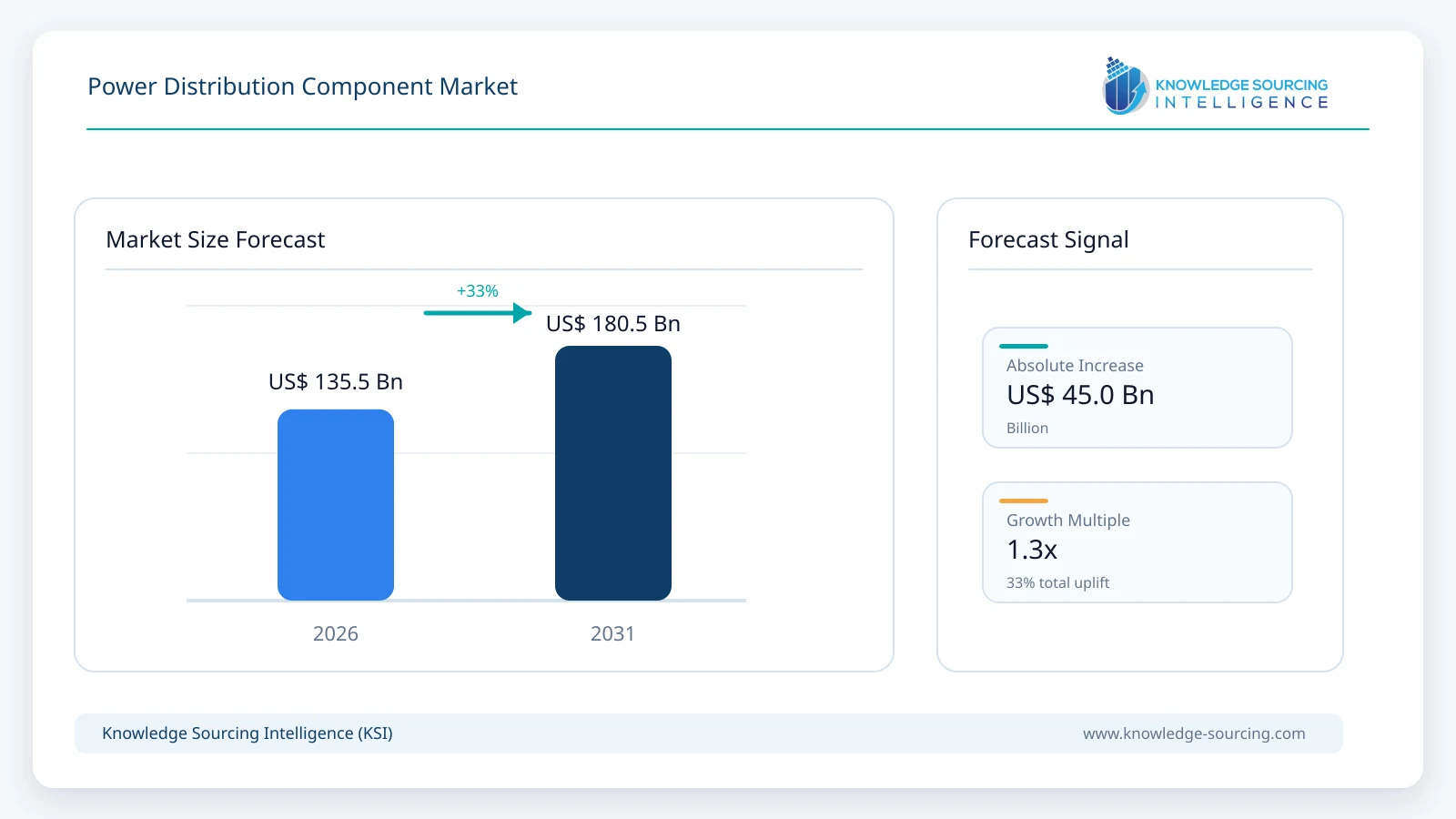
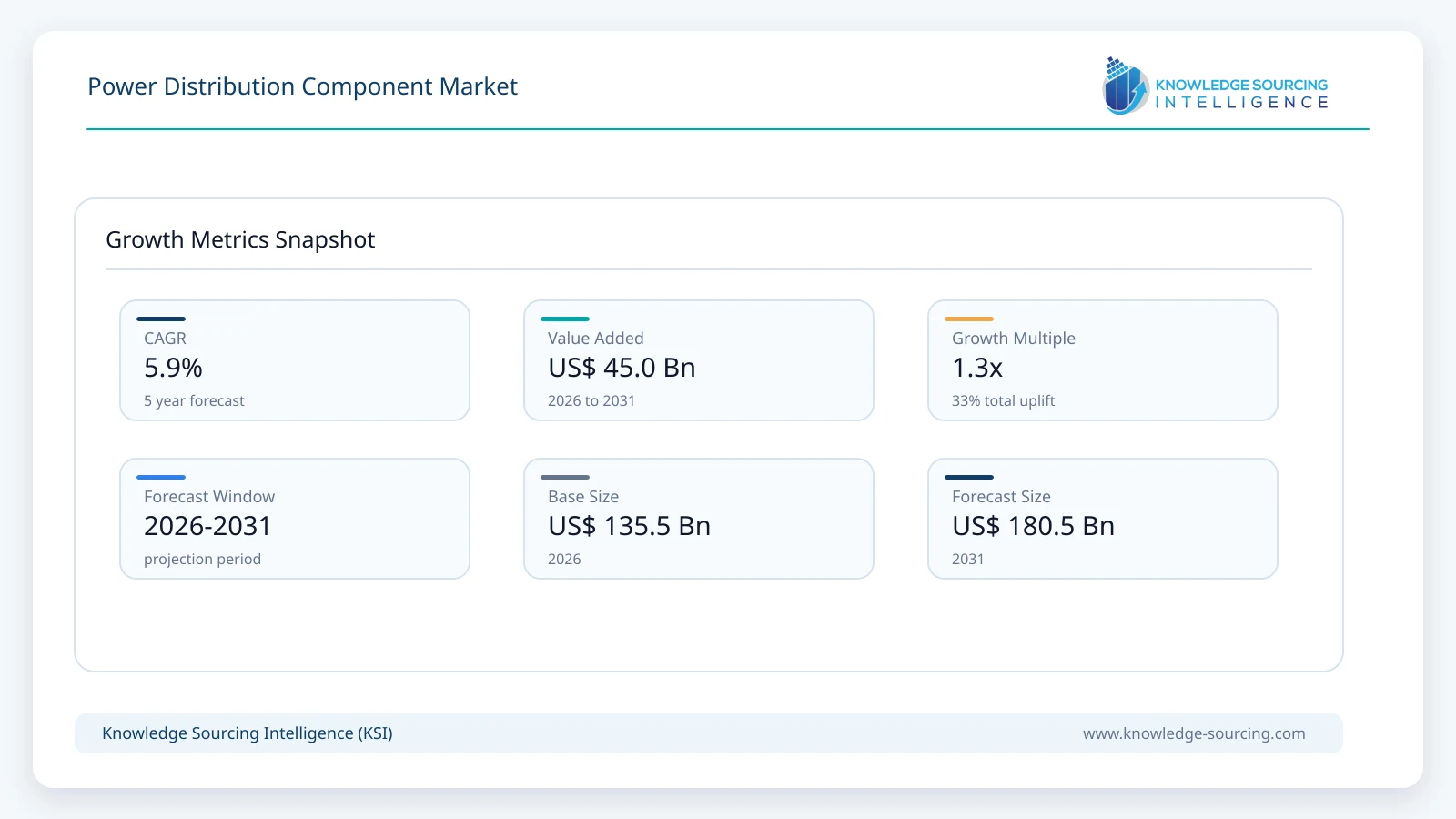
The Global Power Distribution Component Market is forecast to grow at a CAGR of 5.9%, reaching USD 180.5 billion in 2031 from USD 135.5 billion in 2026.
Highlights:
- 1Grid capacity investment is the principal demand catalystUtilities worldwide face aging networks, connection backlogs, increasing peak loads, and requirements to integrate distributed generation and storage. The IEA identifies grid capacity as a major constraint on new electricity infrastructure.
- 2Switchgear remains commercially importantSwitchgear sits directly within protection, isolation, and fault-management functions, making it a core procurement category for substations, industrial facilities, commercial infrastructure, and critical loads.
- 3Asia Pacific offers a large equipment deployment baseChina, India, Japan, South Korea, Indonesia, and Taiwan combine extensive utility networks with industrial investment, manufacturing expansion, urban infrastructure development, and renewable-energy deployment.
- 4Environmental requirements are altering insulation choicesEU restrictions on fluorinated gases are accelerating qualification and procurement of SF6-free medium-voltage equipment.
- 5Digital monitoring is becoming a specification requirementUtilities and industrial operators increasingly seek equipment that can support condition monitoring, remote diagnostics, and integration with supervisory and distribution-management systems.
- 6Manufacturing capacity is becoming a competitive variableEquipment shortages and long project lead times can delay grid projects. Suppliers with local manufacturing, standardized platforms, established qualification status, and service networks have an advantage in time-sensitive projects.
The Power Distribution Component Market covers equipment used to control, protect, isolate, distribute, and manage electrical power between substations, feeders, buildings, industrial facilities, and end-use loads. The market includes switchgear, switchboards, distribution panels, motor control panels, and related equipment, with configurations spanning fixed, plug-in, and withdrawable designs. It also covers air, gas, oil, and vacuum-insulated technologies across indoor and outdoor installations and AC and DC applications.
Demand is shaped less by electricity generation additions alone and more by the condition, capacity, and operating requirements of distribution networks. Utilities must replace aging equipment, accommodate larger loads, improve fault isolation, integrate distributed generation, and maintain service reliability. Industrial users face similar requirements as factories add motors, variable-speed drives, automation systems, electric furnaces, battery systems, and other high-power equipment.
The investment requirement is substantial. The International Energy Agency estimates that global grid investment is currently about USD 400 billion annually and needs to rise by approximately 50% by 2030 to meet electricity demand and address connection constraints. More than 2,500 GW of renewable, storage, and large-load projects are reportedly stalled in grid queues worldwide. The IEA also notes that prices for important grid components have nearly doubled over the past five years, creating both a demand opportunity and a procurement constraint for equipment suppliers.
This environment creates a two-layer demand structure. The first layer consists of replacement and capacity-expansion purchases by utilities. The second comes from new electricity-intensive facilities, including data centers, semiconductor plants, manufacturing sites, transport infrastructure, commercial buildings, and renewable-energy installations. These projects often require higher short-circuit ratings, greater selectivity, compact footprints, improved arc protection, remote monitoring, and shorter commissioning periods.
Buyer behavior therefore increasingly emphasizes total installed cost rather than equipment purchase price alone. Utilities and large industrial customers evaluate reliability records, type-test compliance, lifecycle serviceability, spare-parts availability, installation time, environmental characteristics, and compatibility with existing protection and automation systems. Standardization across multiple substations or facilities can also materially influence supplier selection because common equipment platforms reduce training, maintenance, and inventory requirements.
The market has a strong project-driven component. Utility procurement tends to involve qualification lists, technical specifications, framework agreements, tender processes, and long equipment lifecycles. Industrial and commercial procurement is more frequently influenced by engineering-procurement-construction contractors, electrical consultants, system integrators, and facility owners. Data centers add another procurement layer because operators prioritize power availability, modular expansion, redundancy, and commissioning speed.
Technology selection varies substantially by voltage, application, installation environment, and regulatory requirements. Vacuum interruption is becoming more relevant in medium-voltage applications, while air-insulated equipment remains commercially important because of its established operating characteristics and relatively straightforward maintenance requirements. Gas-insulated designs remain important where space constraints, contamination, environmental exposure, or high-voltage requirements influence the equipment architecture.
Environmental regulation is also changing product specifications. The European Union's Regulation (EU) 2024/573 prohibits the putting into operation of medium-voltage electrical switchgear using fluorinated greenhouse gases for primary and secondary distribution up to and including 24 kV from January 1, 2026. Further restrictions apply to higher voltage classes from 2028 and 2030.
Consequently, suppliers increasingly compete through equipment architecture, insulation technology, factory capacity, testing capability, digital monitoring, retrofit services, and environmental compliance. The commercial opportunity is not limited to new installations. Replacement of aging switchgear, modernization of substations, retrofit of existing panels, and expansion of installed equipment bases create recurring demand.
The market's five-year trajectory will therefore depend on the pace of distribution-grid investment, industrial electrification, data-center construction, renewable integration, replacement cycles, environmental regulation, and equipment supply capacity. The central commercial issue for suppliers will be the ability to deliver compliant equipment within increasingly demanding project schedules without compromising reliability or lifecycle economics.
Market Drivers
Expansion and Modernization of Electricity Distribution Networks
The largest structural driver is the need to expand and modernize electricity distribution infrastructure. Electricity demand is shifting toward more concentrated and more variable loads, while distributed generation is changing power-flow patterns across networks.
The IEA identifies more than 2,500 GW of renewable, storage, and large-load projects waiting in grid connection queues. The issue is not simply a lack of generation capacity. Network capacity, connection processes, equipment availability, and system flexibility increasingly determine when new electricity demand can be served.
For distribution-component suppliers, this translates into procurement of switchgear, panels, breakers, feeder equipment, control assemblies, and associated protection systems. Utilities also need equipment capable of sectionalizing networks and isolating faults without unnecessarily disconnecting large customer groups.
The commercial implication is a sustained replacement-plus-expansion market. Suppliers can capture projects through standard equipment platforms, local engineering support, faster factory acceptance testing, and established utility qualifications.
Electrification of Industry, Buildings, Transport, and Data Centers
Electricity is gaining importance across industrial processes, commercial facilities, transportation infrastructure, heating, and computing. Each additional electrical load increases requirements for power distribution equipment at some point between the grid connection and the end-use equipment.
Data centers are particularly relevant because their power architecture requires high availability, redundancy, selective protection, and modular expansion. Industrial projects similarly require motor control centers, distribution panels, switchboards, and medium-voltage equipment designed around specific production loads.
The procurement effect differs from traditional utility projects. Facility operators place greater emphasis on installation schedules, footprint, modularity, redundancy, maintenance access, and compatibility with backup power systems. Equipment suppliers therefore compete not only on ratings but also on engineering integration and commissioning support.
Eaton's April 2026 announcement illustrates this demand directly. The company announced more than USD 30 million for a new 370,000-square-foot Nebraska manufacturing facility to increase U.S. medium-voltage switchgear production, citing demand associated with data centers, utilities, and industrial applications. Production is expected to begin in 2027.
Renewable Energy and Distributed Energy Integration
Solar generation, wind power, battery storage, electric vehicles, and distributed generation introduce new operating conditions for distribution networks. Electricity can increasingly flow in multiple directions rather than following a simple centralized generation-to-consumer path.
Distribution components must therefore support more complex protection and switching requirements. Utilities may need equipment capable of accommodating distributed generation, storage, microgrids, and changing feeder configurations.
The U.S. Department of Energy's Grid Resilience and Innovation Partnerships program explicitly supports advanced distribution assets, distributed renewable generation, energy storage, microgrid operation, and grid-edge technologies.
This creates opportunities for suppliers that can integrate switchgear with protection, sensing, communication, and control functions. It also increases the importance of equipment interoperability because utilities rarely replace an entire distribution architecture in one project.
Aging Infrastructure and Reliability Requirements
Replacement demand provides an important counterbalance to new-build activity. Distribution assets remain in service for long periods, but aging equipment can create higher maintenance requirements, obsolete components, insulation deterioration, limited spare-parts availability, and inadequate fault ratings.
The European Commission reports that approximately 40% of Europe's distribution grids are more than 40 years old. Its grid strategy identifies modernization, supply-chain strengthening, faster permitting, and improved investment planning as important actions.
Aging infrastructure generates several purchasing patterns. Some utilities undertake complete replacement projects, while others use retrofit solutions that extend the life of switchgear, breakers, protection systems, or control equipment.
For suppliers, retrofit capability can therefore be as commercially important as new equipment development. Customers often prefer modernization approaches that minimize outages, civil works, and operational disruption.
Government-Supported Distribution Investment
Government programs can materially influence procurement volumes where distribution utilities face financial constraints. India provides a clear example. The Revamped Distribution Sector Scheme was established to improve distribution-system reliability and financial sustainability, with a total outlay of Rs. 3,03,758 crore.
By March 2026, the Government of India reported that distribution infrastructure and smart-metering works worth Rs. 2.83 lakh crore had been sanctioned under RDSS. Loss-reduction works include replacement of old conductors, substation augmentation, new substations, new distribution transformers, feeder segregation, and SCADA/DMS implementation.
These programs create a direct procurement channel for distribution equipment. They also influence buyer behavior by linking infrastructure funding with operational and financial performance requirements.
Market Restraints and Challenges
Long Equipment Qualification and Procurement Cycles
Utility customers typically impose stringent technical qualification requirements. Equipment must meet specified voltage, current, short-circuit, insulation, environmental, and safety requirements before suppliers can become approved vendors.
This qualification process creates an entry barrier. It also means that technically competitive products may take years to gain meaningful utility penetration. Suppliers must finance testing, certification, engineering resources, and local support before substantial order volumes materialize.
The mitigation strategy is to build standardized product platforms around recognized standards and maintain established testing capabilities. Strategic partnerships with utilities and engineering firms can also reduce qualification barriers.
Component and Raw-Material Supply Constraints
Power distribution equipment relies on copper, aluminum, electrical steel, insulating materials, electronic components, breakers, sensors, control devices, and specialized manufacturing processes. Disruptions in any critical input can affect delivery schedules.
The IEA reports that prices for key grid components have nearly doubled over the past five years. It also identifies grid supply-chain expansion as necessary to support higher investment.
The impact extends beyond component costs. Longer procurement periods can delay project commissioning and increase working-capital requirements for utilities and contractors.
Suppliers are responding through localization, dual sourcing, inventory planning, vertical integration, and additional manufacturing capacity. Buyers increasingly assess supply assurance alongside technical specifications.
High Switching Costs and Installed-Base Compatibility
Distribution equipment is connected to protection systems, transformers, cables, busbars, control systems, and facility architectures. Replacing one component can therefore create interface and compatibility issues.
Utilities often prefer established equipment families because maintenance teams already understand the technology and spare parts may already exist within their inventories. This favors incumbent suppliers but can slow adoption of new technologies.
Vendors introducing alternative insulation or digital equipment must demonstrate compatibility, lifecycle reliability, maintainability, and acceptable total cost of ownership. Pilot projects and field references can reduce perceived technical risk.
Environmental Compliance and Technology Transition Costs
The shift away from SF?-based equipment creates a technical and commercial transition. Alternative insulation architectures require qualification, manufacturing changes, engineering adaptation, and customer acceptance.
The EU's F-gas regulation makes the transition particularly immediate for medium-voltage switchgear.
The challenge is not limited to Europe. Global suppliers must decide whether to develop region-specific portfolios or standardize around lower-emission technologies across markets. Early investment can increase development costs, while delayed transition can create compliance and product-obsolescence risks.
Skilled Engineering and Installation Capacity
Distribution projects require electrical engineers, commissioning specialists, protection engineers, testing personnel, and experienced installers. A shortage of these skills can delay project execution even when equipment is available.
The problem becomes more pronounced as grid projects increase in complexity. Equipment increasingly interacts with distributed generation, storage, communications, automation, and protection systems.
Suppliers can mitigate this constraint by expanding field-service capabilities, remote commissioning support, standardized engineering packages, training programs, and modular equipment architectures.
Major Segment Analysis
Switchgear
Switchgear is the most commercially important product segment for the Power Distribution Component Market because it performs fundamental protection, isolation, switching, and fault-management functions across utility and customer-owned electrical networks.
The equipment serves a broad range of applications. Utilities deploy medium- and high-voltage switchgear in substations and distribution networks. Industrial operators use it for plant incoming supplies, motor loads, process equipment, and internal distribution. Commercial facilities deploy switchgear where high-capacity electrical systems require controlled isolation and protection.
Demand conditions favor switchgear because new grid connections require switching and protection infrastructure, while existing substations require replacement equipment. Renewable projects also need switching arrangements at collection and interconnection points.
Buyer requirements increasingly extend beyond electrical ratings. Customers evaluate internal-arc performance, maintenance access, environmental characteristics, footprint, monitoring capability, operating mechanism reliability, spare parts, and expected service life.
Configuration is another purchasing consideration. Fixed equipment can offer simpler architecture and lower initial complexity, while withdrawable designs can facilitate maintenance and equipment isolation. Plug-in configurations can support modular applications where standardized installation is valuable.
Insulation selection is becoming strategically important. Air-insulated equipment remains widely applicable, particularly where footprint and environmental conditions permit. Vacuum interruption has become important in medium-voltage circuit breakers. Gas-insulated architectures remain valuable in space-constrained installations, but environmental restrictions are changing the economics and qualification requirements for fluorinated-gas technologies.
Competition within switchgear is consequently moving toward performance plus lifecycle economics. Suppliers with broad product ranges can address multiple voltage classes and applications, while specialists can compete through customized engineering, retrofit capability, or niche utility qualifications.
The segment also benefits from the retrofit market. Existing installations may retain serviceable enclosures, busbars, or supporting infrastructure while breakers and control systems become obsolete. This creates opportunities for suppliers that can modernize equipment without requiring complete substation reconstruction.
The importance of switchgear is further reinforced by international standards. IEC 62271 covers high-voltage switchgear and controlgear, including AC equipment above 1,000 V, while IEC 62271-200 addresses metal-enclosed AC switchgear above 1 kV through 52 kV for indoor and outdoor installation.
In July 2026, IEC also published IEC 62271-201:2026 covering solid-insulation enclosed switchgear and controlgear for AC applications above 1 kV through 52 kV.
These standards reinforce the importance of verified electrical performance, testing, construction quality, and application-specific compliance. Consequently, switchgear suppliers compete through engineering credibility as much as through product price.
Regional Analysis
North America
North America is supported by utility modernization, manufacturing investment, data-center construction, electrification, and resilience programs. The United States is the principal demand center because utilities and large electricity users are investing in capacity, reliability, and network resilience.
The U.S. Department of Energy administers the USD 10.5 billion GRIP program, covering grid resilience, smart-grid deployment, and grid innovation. The program specifically supports advanced distribution assets, grid flexibility, and resilience improvements.
Data centers are adding another procurement channel. Their concentration of electrical load increases requirements for medium-voltage switchgear, low-voltage switchboards, distribution equipment, and redundant electrical architectures.
Canada presents demand through utility modernization, renewable integration, transmission and distribution expansion, and electrification. Mexico offers opportunities linked to industrial facilities, manufacturing, commercial infrastructure, and grid investment.
The principal constraint is project execution capacity. Permitting, interconnection queues, engineering resources, equipment availability, and construction labor can affect project schedules.
Europe
Europe combines substantial replacement demand with new distribution investment. The European Commission estimates €584 billion in electricity-grid investment is necessary, while approximately 40% of distribution grids are more than 40 years old.
Germany, France, the United Kingdom, and Spain are particularly relevant because of industrial electrification, renewable integration, network modernization, and large-scale infrastructure programs.
Regulation is an important differentiator. The EU F-gas regulation is forcing a shift in medium-voltage switchgear insulation and interruption technologies.
This favors suppliers with commercially qualified SF?-free portfolios. It also creates replacement and retrofit opportunities because utilities need equipment that satisfies future regulatory requirements while remaining compatible with existing network designs.
Asia Pacific
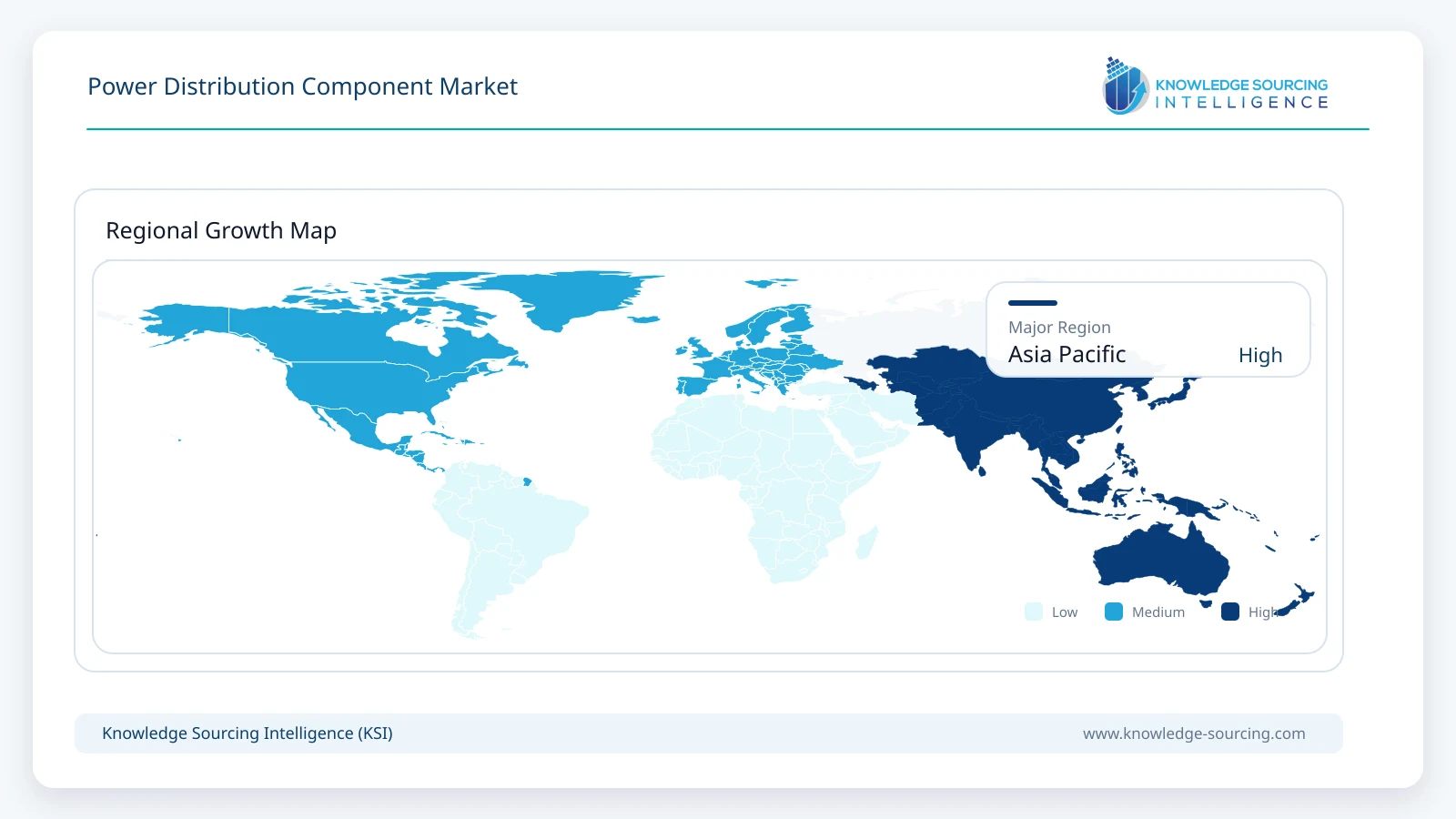
Asia Pacific is expected to remain a major volume market because it combines large electricity networks with industrialization, urbanization, manufacturing capacity, renewable deployment, and infrastructure investment.
China represents a major equipment manufacturing and utility procurement base. India's distribution modernization programs create additional demand, particularly for substations, feeders, distribution transformers, smart systems, and loss-reduction infrastructure.
Japan and South Korea offer mature utility and industrial markets where reliability, compact equipment, automation, and lifecycle performance are important. Indonesia and other Southeast Asian markets provide opportunities through electrification and infrastructure expansion.
India's RDSS program illustrates the scale of public-sector distribution investment. By March 2026, Rs. 2.83 lakh crore of distribution infrastructure and smart-metering works had been sanctioned under the program.
China also provides a strong technology-development market. In May 2025, Hitachi Energy announced the world's first SF?-free 550 kV GIS delivery for China's State Grid Corporation.
Middle East and Africa
Demand across the Middle East is influenced by urban development, industrial projects, desalination, oil and gas facilities, data centers, airports, and utility expansion. Saudi Arabia and the United Arab Emirates are important procurement centers because large infrastructure projects require high-capacity and high-reliability electrical systems.
Africa presents a different demand structure. Grid extension, electrification, utility modernization, industrial development, and renewable-energy projects create opportunities, but financing constraints and project execution capacity can restrict procurement.
Outdoor equipment is particularly relevant in markets where substations and distribution infrastructure must operate under high temperatures, dust, and challenging environmental conditions. Buyers consequently place strong emphasis on environmental ratings, enclosure performance, maintenance requirements, and equipment reliability.
South America
Brazil represents the largest opportunity in South America due to its large electricity system, industrial base, renewable generation capacity, and distribution-network requirements. Argentina and other markets offer additional opportunities through utility modernization, industrial investment, and electrification.
Procurement conditions vary substantially by country. Currency fluctuations, financing availability, import requirements, and utility investment cycles can affect project timing.
Local engineering and service capability can therefore be important differentiators. Suppliers with regional manufacturing or established distribution channels can reduce logistical risks and support customer qualification requirements.
Competitive Landscape
The competitive structure includes multinational electrical-equipment manufacturers, high-voltage specialists, medium-voltage specialists, panel and enclosure suppliers, and companies with strong regional utility relationships. The companies considered in this market include Eaton Corporation plc, Schneider Electric SE, ABB Ltd, Siemens AG, Powell Industries, Inc., Hitachi Energy, Mitsubishi Electric Corporation, HD Hyundai Electric Co., Ltd., GE Vernova Inc., Legrand, Fuji Electric Co., Ltd., Rittal GmbH & Co. KG, Lucy Electric, Hyosung Heavy Industries, and Hubbell Incorporated.
Competition is not based on a single product attribute. Utility customers often prioritize proven field performance, qualification status, lifecycle service, delivery capability, and technical support. Industrial customers place greater emphasis on application engineering, integration, footprint, maintenance, and project schedules.
Product differentiation increasingly occurs around insulation technology, breaker technology, internal-arc protection, modularity, monitoring, automation interfaces, and environmental performance. The transition toward SF?-free equipment is creating a separate competitive dimension because suppliers must demonstrate both environmental compliance and equivalent operational performance.
Manufacturing footprint is also becoming commercially important. Large equipment projects can involve long lead times, while localized manufacturing can reduce logistics exposure and support domestic-content requirements where applicable.
Recent corporate actions demonstrate the importance of capacity expansion. Eaton's 2026 Nebraska investment targets additional medium-voltage switchgear production for data centers, utilities, and industrial customers.
Schneider Electric has also expanded its SF?-free portfolio and customer agreements. In August 2025, the company announced a long-term agreement with E.ON covering primary and secondary medium-voltage switchgear requirements, including GM AirSeT and RM AirSeT systems.
Competitive positioning therefore depends on four capabilities: qualified product platforms, manufacturing capacity, application engineering, and long-term service. Companies able to combine these capabilities can compete for both standardized utility procurement and customized industrial projects.
Recent Developments
June 2026: Schneider Electric announced the deployment of SF?-free gas-insulated substation switchgear with Southern California Edison, using pure air and vacuum technology to support higher substation capacity.
May 2026: ABB announced approximately $200 million in European medium-voltage manufacturing investments, expanding capacity for SF?-free switchgear, breakers, GIS, vacuum interrupters and grid automation technologies.
April 2026: Siemens launched a new DC protection and switching portfolio, including the SENTRON 3QD2 semiconductor circuit breaker and SIRIUS 3RF5 solid-state switching device for low-voltage distribution.
April 2026: Eaton announced an investment of more than USD 30 million in a new Nebraska manufacturing facility for medium-voltage switchgear, with production expected to start in 2027. Commercial relevance: additional North American manufacturing capacity directly addresses equipment demand from data centers, utilities, and industrial projects.
January 2026: ABB India launched ArTu Formula, a low-voltage switchgear platform for power distribution, motor-control centers and sub-distribution boards, compliant with IEC 61439 and IEC 61641 standards.
Regulatory and Policy Environment
Power distribution components operate within a highly regulated technical environment because failures can affect public safety, industrial operations, and electricity-system reliability.
At the international level, IEC standards provide important technical reference points. IEC 62271-1 applies to AC high-voltage switchgear and controlgear above 1,000 V, including indoor and outdoor applications. IEC 62271-200 addresses prefabricated metal-enclosed AC switchgear and controlgear above 1 kV through 52 kV.
Low-voltage switchboards and assemblies fall under the IEC 61439 family. IEC 61439-1:2020 specifies general definitions, service conditions, construction requirements, technical characteristics, and verification requirements for low-voltage switchgear and controlgear assemblies.
The European regulatory environment is particularly influential for insulation technology. Regulation (EU) 2024/573 prohibits putting into operation fluorinated-greenhouse-gas-based medium-voltage switchgear up to and including 24 kV from January 2026. Higher voltage classes face later restrictions.
This regulation changes procurement specifications because European utilities and industrial customers must consider equipment compliance over the full project lifecycle rather than simply selecting the lowest-cost established technology.
The European Commission's grid policy also identifies faster permitting, improved grid planning, better financing access, stronger supply chains, and more efficient use of networks as important priorities.
In the United States, DOE programs provide financial support for grid resilience, advanced distribution infrastructure, smart-grid technologies, and integration of distributed resources. The GRIP program has a total funding framework of USD 10.5 billion.
India provides another policy-driven demand channel. RDSS supports distribution infrastructure, smart metering, loss reduction, substation augmentation, new substations, feeder segregation, and SCADA/DMS deployment. The Government reported Rs. 2.83 lakh crore of sanctioned works under the scheme by March 2026.
Regulation therefore affects the market in three ways. It creates minimum technical requirements, changes the preferred technology mix, and influences the timing of infrastructure investment.
Outlook and Strategic Implications
The Power Distribution Component Market should remain closely tied to electricity-network investment rather than depending solely on total electricity consumption. The strongest demand opportunities will arise where utilities and large electricity users must add capacity while simultaneously replacing aging equipment.
Procurement priorities are likely to shift toward equipment that can be delivered quickly, qualified across multiple projects, and maintained through long operating periods. Standardized platforms can reduce engineering effort and spare-parts requirements, while modular architectures can shorten installation schedules.
The equipment portfolio will also become more differentiated by environmental characteristics. The EU's SF? restrictions create an immediate regulatory market for alternative medium-voltage technologies, while utility customers elsewhere can adopt similar technologies where lifecycle environmental performance becomes part of procurement scoring.
Digital functionality will increasingly become embedded in procurement specifications, particularly for critical facilities and modern utility networks. Condition monitoring, remote diagnostics, event recording, protection coordination, and integration with distribution-management systems can reduce maintenance uncertainty and improve asset visibility.
However, digital capability alone will not determine purchasing decisions. Electrical performance, type-test evidence, reliability, service support, cybersecurity, and compatibility with installed infrastructure remain fundamental. Buyers are likely to favor suppliers that combine conventional equipment reliability with useful monitoring capabilities rather than treating connectivity as a standalone product feature.
The supply side will remain constrained by manufacturing capacity, specialized components, testing requirements, and skilled labor. The IEA's assessment that annual grid investment must rise materially by 2030 indicates that equipment manufacturing and supply chains will need to expand alongside project pipelines.
For suppliers, localization represents an important strategic response. Regional manufacturing can reduce transportation exposure, improve delivery certainty, and support local procurement requirements. It can also shorten engineering feedback cycles when customers require market-specific modifications.
Service capability will become another competitive differentiator. Utilities increasingly need retrofit engineering, field testing, breaker replacement, condition assessment, spare parts, and modernization services. Suppliers with large installed bases can use these relationships to secure replacement orders and introduce new equipment technologies.
The strongest strategic opportunity lies in combining new-build equipment with modernization services. This approach addresses two separate customer budgets: capital expenditure for network expansion and maintenance or reliability expenditure for existing infrastructure.
Asia Pacific should remain an important volume opportunity because of industrial expansion, electricity-system investment, and distribution-network development. North America offers high-value opportunities linked to data centers, manufacturing, resilience projects, and utility modernization. Europe offers particularly strong technology-transition opportunities because of aging networks and environmental restrictions. Middle Eastern demand should remain connected to major infrastructure and industrial projects, while South America offers selective opportunities based on utility investment and industrial development.
The principal risks are project delays, equipment shortages, raw-material cost volatility, regulatory changes, financing constraints, and slower-than-expected utility investment. Suppliers also face the risk of developing technologies before customers are ready to standardize them.
From 2026 through 2031, competitive advantage will therefore depend on technical qualification, manufacturing capacity, environmental compliance, delivery reliability, retrofit capability, and lifecycle service. Companies that align these capabilities with utility and industrial procurement requirements should be better positioned to secure recurring projects across both new distribution infrastructure and installed-base modernization.
The market's commercial direction is ultimately defined by a simple infrastructure requirement: electricity demand can only be served reliably when distribution networks have sufficient capacity, protection, switching capability, and maintainable equipment. Government programs, industrial investment, data-center construction, renewable integration, and regulatory requirements are converging around that requirement. The resulting procurement cycle should support continued investment in power distribution components throughout the 2026–2031 forecast period.
Power Distribution Component Market Scope:
| Report Metric | Details |
|---|---|
| Total Market Size in 2026 | USD 135.5 billion |
| Total Market Size in 2031 | USD 180.5 billion |
| Forecast Unit | Billion |
| Growth Rate | 5.9% |
| Study Period | 2021 to 2031 |
| Historical Data | 2021 to 2024 |
| Base Year | 2025 |
| Forecast Period | 2026 – 2031 |
| Segmentation | Product, Configuration, Voltage Rating, Insulation, Installation, Current Type, Application, Geography |
| Companies |
|
Market Segmentation
By Product
- Switchgear
- Switchboard
- Distribution Panel
- Motor Control Panel
- Others
By Configuration
- Fixed Mounting
- Plug-in
- Withdrawable
By Voltage Rating
- <11 kV
- 11 kV to 33 kV
- 33 kV to 66 kV
- 66 kV to 132 kV
By Insulation
- Air
- Gas
- Oil
- Vacuum
- Others
By Installation
- Indoor
- Outdoor
By Current Type
- Alternating Current (AC)
- Direct Current (DC)
By Application
- Residential
- Commercial
- Industrial
- Utility
By Geography
- North America
- United States
- Canada
- Mexico
- South America
- Brazil
- Argentina
- Others
- Europe
- Germany
- France
- United Kingdom
- Spain
- Others
- Middle East and Africa
- Saudi Arabia
- United Arab Emirates
- Israel
- Others
- Asia Pacific
- China
- Japan
- India
- South Korea
- Indonesia
- Taiwan
- Others
Table of Contents
1. INTRODUCTION
1.1. Market Overview
1.2. Market Definition
1.3. Scope of the Study
1.4. Market Segmentation
1.5. Currency
1.6. Assumptions
1.7. Base and Forecast Years Timeline
1.8. Key Benefits to Stakeholders
2. RESEARCH METHODOLOGY
2.1. Research Design
2.2. Research Process
3. EXECUTIVE SUMMARY
3.1. Key Findings
3.2. CXO Perspective
4. MARKET DYNAMICS
4.1. Market Drivers
4.2. Market Restraints
4.3. Market Opportunities
4.4. Porter’s Five Forces Analysis
4.4.1. Bargaining Power of Suppliers
4.4.2. Bargaining Power of Buyers
4.4.3. Threat of New Entrants
4.4.4. Threat of Substitutes
4.4.5. Competitive Rivalry in the Industry
4.5. Industry Value Chain Analysis
4.6. Regulatory and Standards Landscape
4.7. Analyst View
5. GLOBAL POWER DISTRIBUTION COMPONENT MARKET BY PRODUCT
5.1. Introduction
5.2. Switchgear
5.3. Switchboard
5.4. Distribution Panel
5.5. Motor Control Panel
5.6. Others
6. GLOBAL POWER DISTRIBUTION COMPONENT MARKET BY CONFIGURATION
6.1. Introduction
6.2. Fixed Mounting
6.3. Plug-in
6.4. Withdrawable
7. GLOBAL POWER DISTRIBUTION COMPONENT MARKET BY VOLTAGE RATING
7.1. Introduction
7.2. <11 kV
7.3. 11 kV to 33 kV
7.4. 33 kV to 66 kV
7.5. 66 kV to 132 kV
8. GLOBAL POWER DISTRIBUTION COMPONENT MARKET BY INSULATION
8.1. Introduction
8.2. Air
8.3. Gas
8.4. Oil
8.5. Vacuum
8.6. Others
9. GLOBAL POWER DISTRIBUTION COMPONENT MARKET BY INSTALLATION
9.1. Introduction
9.2. Indoor
9.3. Outdoor
10. GLOBAL POWER DISTRIBUTION COMPONENT MARKET BY CURRENT TYPE
10.1. Introduction
10.2. Alternating Current (AC)
10.3. Direct Current (DC)
11. GLOBAL POWER DISTRIBUTION COMPONENT MARKET BY APPLICATION
11.1. Introduction
11.2. Residential
11.3. Commercial
11.4. Industrial
11.5. Utility
12. GLOBAL POWER DISTRIBUTION COMPONENT MARKET BY GEOGRAPHY
12.1. Introduction
12.2. North America
12.2.1. By Product
12.2.2. By Configuration
12.2.3. By Voltage Rating
12.2.4. By Insulation
12.2.5. By Installation
12.2.6. By Current Type
12.2.7. By Application
12.2.8. By Country
12.2.8.1. United States
12.2.8.2. Canada
12.2.8.3. Mexico
12.3. South America
12.3.1. By Product
12.3.2. By Configuration
12.3.3. By Voltage Rating
12.3.4. By Insulation
12.3.5. By Installation
12.3.6. By Current Type
12.3.7. By Application
12.3.8. By Country
12.3.8.1. Brazil
12.3.8.2. Argentina
12.3.8.3. Others
12.4. Europe
12.4.1. By Product
12.4.2. By Configuration
12.4.3. By Voltage Rating
12.4.4. By Insulation
12.4.5. By Installation
12.4.6. By Current Type
12.4.7. By Application
12.4.8. By Country
12.4.8.1. Germany
12.4.8.2. France
12.4.8.3. United Kingdom
12.4.8.4. Spain
12.4.8.5. Others
12.5. Middle East and Africa
12.5.1. By Product
12.5.2. By Configuration
12.5.3. By Voltage Rating
12.5.4. By Insulation
12.5.5. By Installation
12.5.6. By Current Type
12.5.7. By Application
12.5.8. By Country
12.5.8.1. Saudi Arabia
12.5.8.2. United Arab Emirates
12.5.8.3. Israel
12.5.8.4. Others
12.6. Asia Pacific
12.6.1. By Product
12.6.2. By Configuration
12.6.3. By Voltage Rating
12.6.4. By Insulation
12.6.5. By Installation
12.6.6. By Current Type
12.6.7. By Application
12.6.8. By Country
12.6.8.1. China
12.6.8.2. Japan
12.6.8.3. India
12.6.8.4. South Korea
12.6.8.5. Indonesia
12.6.8.6. Taiwan
12.6.8.7. Others
13. COMPETITIVE LANDSCAPE AND ANALYSIS
13.1. Major Players and Strategy Analysis
13.2. Market Share Analysis
13.3. Mergers, Acquisitions, Agreements, and Collaborations
13.4. Product and Portfolio Analysis
13.5. Competitive Dashboard
14. COMPANY PROFILES
14.1. Eaton Corporation plc
14.2. Schneider Electric SE
14.3. ABB Ltd
14.4. Siemens AG
14.5. Powell Industries, Inc.
14.6. Hitachi Energy
14.7. Mitsubishi Electric Corporation
14.8. HD Hyundai Electric Co., Ltd.
14.9. GE Vernova Inc.
14.10. Legrand
14.11. Fuji Electric Co., Ltd.
14.12. Rittal GmbH & Co. KG
14.13. Lucy Electric
14.14. Hyosung Heavy Industries
14.15. Hubbell Incorporated
Navigate
Trusted by the world's leading organizations











