
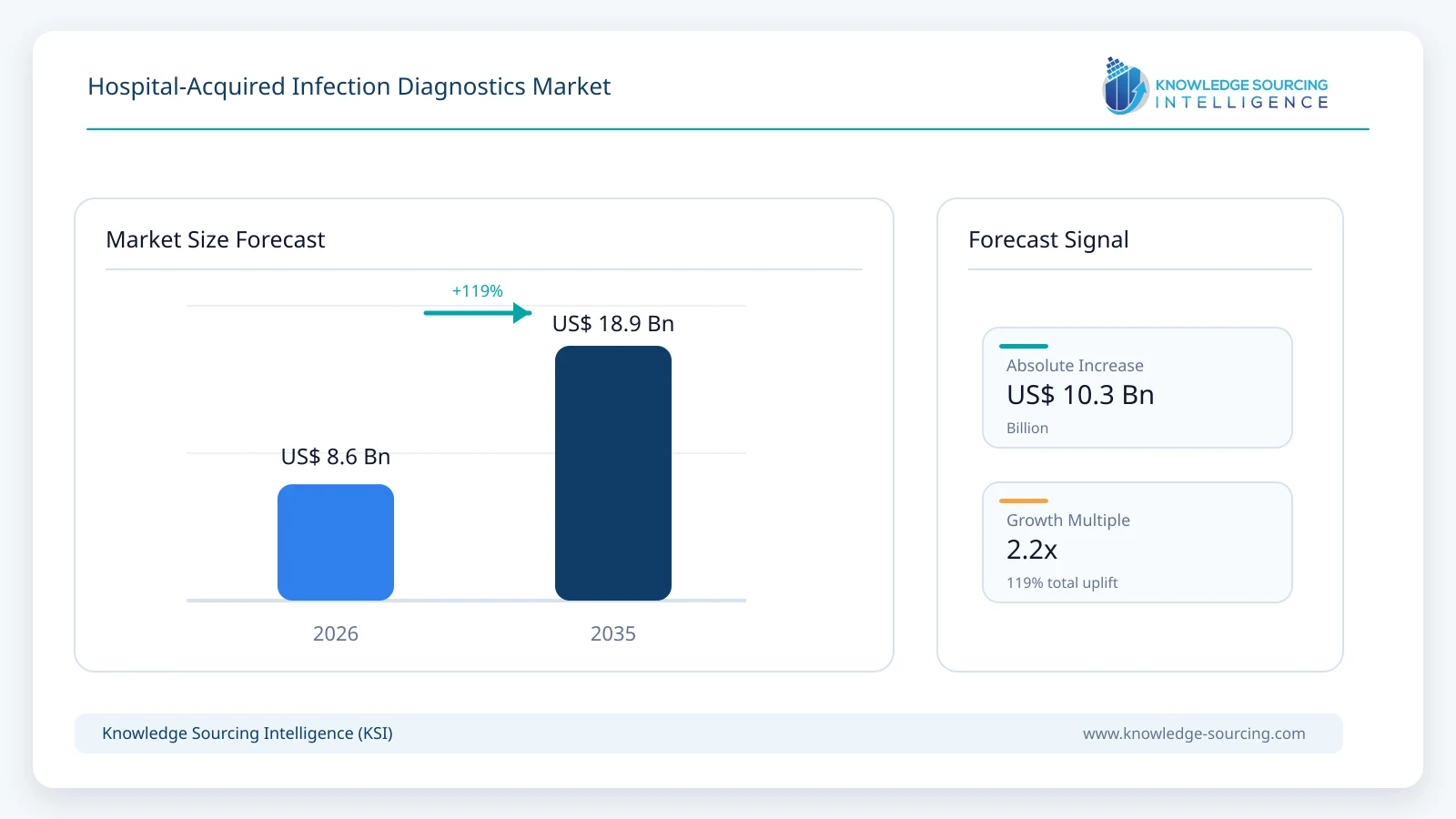
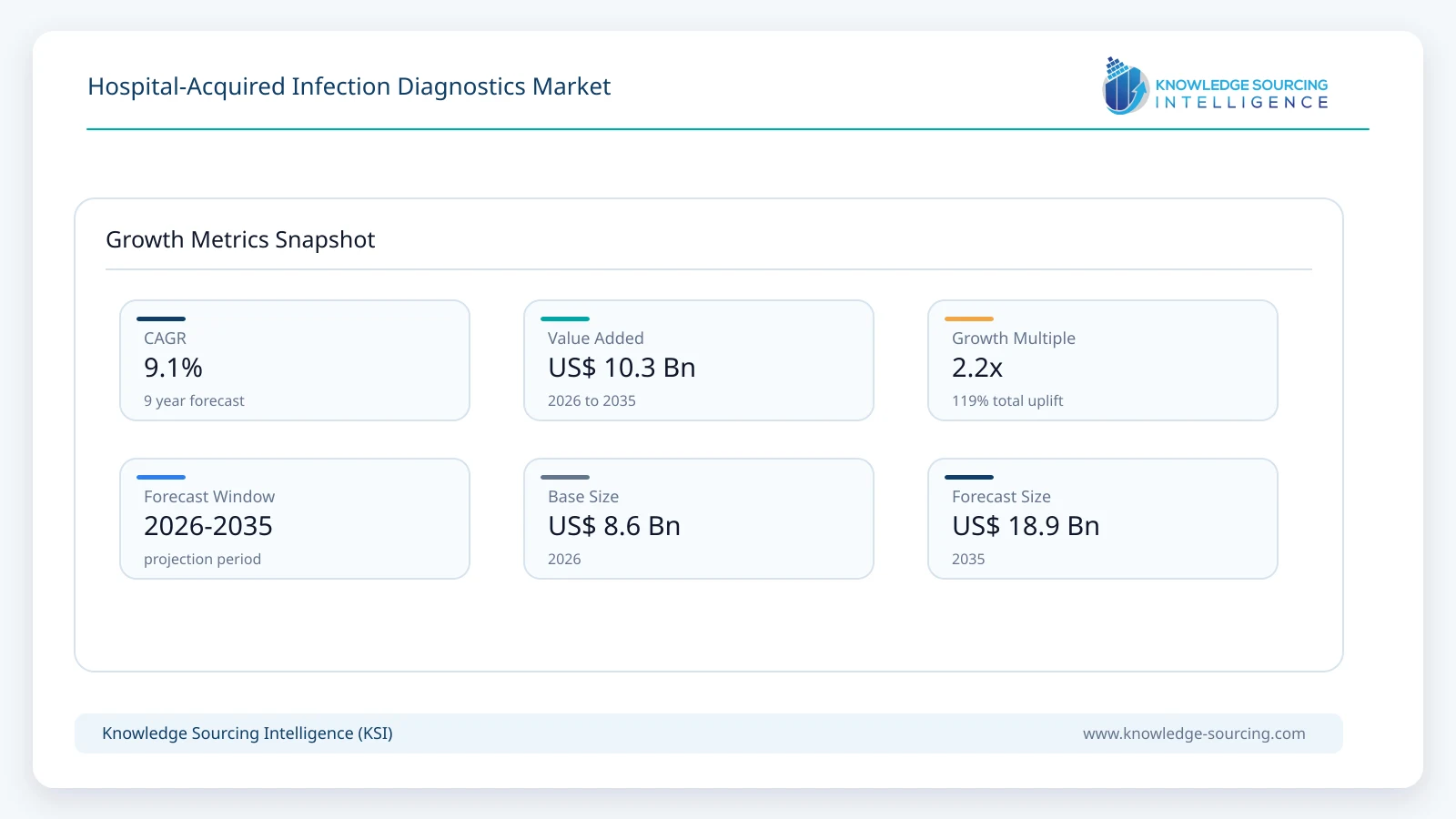
The Hospital-Acquired Infection Diagnostics Market is anticipated to grow at a CAGR of 9.1% from USD 8.62 billion in 2026 to USD 18.88 billion in 2035.
Highlights:
- 1Increasing antimicrobial resistance is accelerating demand for rapid pathogen identification, allowing clinicians to initiate targeted therapy sooner rather than relying on prolonged empirical antibiotic treatment.
- 2Hospitals are expanding infection surveillance programs because healthcare-associated infections continue affecting a substantial proportion of hospitalized patients, creating sustained demand for laboratory automation and molecular diagnostics.
- 3Diagnostic laboratories are integrating multiplex molecular testing with automated microbiology workflows, enabling faster clinical decisions while supporting antimicrobial stewardship initiatives.
- 4Regulatory agencies are strengthening infection prevention and reporting frameworks, encouraging healthcare facilities to adopt standardized diagnostic protocols and surveillance systems.
Hospital-acquired infections remain a significant burden because invasive procedures, prolonged hospitalization, intensive care utilization, and antimicrobial resistance continue increasing clinical complexity. Healthcare systems are expanding diagnostic capabilities to identify pathogens earlier, distinguish resistant organisms, and support targeted antimicrobial therapy before complications progress. This dependence on timely diagnostics is reducing reliance on empirical treatment and strengthening laboratory-guided clinical decision-making.
Regulatory agencies and public health organizations are reinforcing infection surveillance through standardized reporting requirements and antimicrobial stewardship initiatives. Healthcare providers are investing in integrated diagnostic platforms because rapid identification directly supports infection control interventions, reduces inappropriate antibiotic exposure, and improves hospital quality performance. Diagnostic manufacturers are responding through multiplex molecular assays, automated microbiology platforms, and mass spectrometry solutions that shorten turnaround time while expanding pathogen coverage. These developments strengthen the strategic importance of HAI diagnostics as healthcare systems pursue lower infection rates, improved patient outcomes, and greater operational efficiency.
Market Dynamics
Market Drivers
Growing Burden of Healthcare-Associated Infections: Hospital-acquired infections remain a persistent challenge because invasive medical procedures, intensive care admissions, and aging patient populations continue increasing infection susceptibility. Healthcare providers are expanding diagnostic capacity to reduce delays between clinical suspicion and pathogen confirmation. Conventional microbiology often requires extended incubation periods, creating pressure for rapid molecular technologies that shorten treatment initiation. Diagnostic manufacturers are developing multiplex assays capable of detecting multiple pathogens simultaneously. Faster diagnosis improves infection control decisions while supporting antimicrobial stewardship programs that reduce inappropriate antibiotic utilization. The World Health Organization estimates that approximately one in ten hospitalized patients experiences healthcare-associated infections globally, reinforcing sustained diagnostic demand.
Escalating Antimicrobial Resistance: Antimicrobial resistance increases the complexity of hospital infection management because resistant pathogens frequently require organism-specific therapeutic strategies. Healthcare institutions are adopting advanced diagnostic platforms that rapidly identify resistance markers alongside pathogen detection. Delayed identification limits therapeutic effectiveness and increases healthcare costs through prolonged hospitalization. Diagnostic innovation is expanding toward syndromic panels and resistance gene detection to support precision antimicrobial selection. Earlier identification improves patient outcomes while strengthening antimicrobial stewardship programs across healthcare systems.
Expansion of Infection Prevention Programs: Healthcare quality frameworks increasingly emphasize infection prevention as a measurable performance indicator. Hospitals are strengthening surveillance infrastructure to comply with national reporting requirements and accreditation standards. Manual surveillance limits timely intervention during outbreaks, creating demand for automated laboratory reporting and integrated diagnostic systems. Diagnostic vendors are incorporating connectivity features that enable real-time reporting to infection prevention teams. These capabilities improve hospital surveillance while supporting continuous quality improvement initiatives.
Increasing Adoption of Rapid Molecular Diagnostics: Clinical decision-making depends on timely laboratory confirmation because delayed treatment increases morbidity and healthcare expenditure. Healthcare laboratories are replacing single-target assays with multiplex molecular platforms capable of identifying numerous pathogens during one testing cycle. Higher diagnostic accuracy reduces unnecessary antibiotic exposure while improving clinical confidence. Continuous platform innovation supports broader adoption across emergency departments, intensive care units, and hospital microbiology laboratories.
Market Restraints
High capital investment requirements for molecular diagnostic platforms and laboratory automation limit adoption among small and resource-constrained healthcare facilities.
Reimbursement variability across healthcare systems reduces financial incentives for hospitals to replace conventional microbiology workflows with advanced molecular diagnostics.
Skilled laboratory workforce shortages and complex validation requirements slow implementation of sophisticated diagnostic technologies despite increasing clinical demand.
Market Opportunities
Expansion of Multiplex Diagnostic Panels: Healthcare providers increasingly require comprehensive pathogen identification because mixed infections and antimicrobial resistance complicate clinical management. Manufacturers are expanding multiplex diagnostic menus that detect bacteria, fungi, viruses, and resistance genes within a single workflow. Broader diagnostic coverage improves laboratory efficiency while reducing repeat testing requirements. Integrated multiplex testing strengthens clinical confidence and supports personalized antimicrobial therapy.
Integration of Artificial Intelligence into Clinical Microbiology: Laboratory automation continues to advance because healthcare systems require faster interpretation of growing diagnostic volumes. Artificial intelligence is supporting image analysis, microbial identification, and laboratory workflow optimization to improve operational efficiency. Automated interpretation reduces manual review requirements while increasing consistency across laboratories. These technologies strengthen hospital surveillance and accelerate reporting of clinically significant infections.
Growth of Point-of-Care Infection Diagnostics: Critical care environments require rapid treatment decisions that conventional laboratory workflows cannot always provide. Point-of-care molecular testing is expanding into emergency departments and intensive care units to shorten diagnostic turnaround times. Earlier diagnosis enables faster therapeutic intervention while reducing unnecessary isolation and antibiotic exposure. Continued miniaturization of diagnostic platforms supports wider adoption across decentralized healthcare settings.
Rising Investments in Antimicrobial Stewardship: Healthcare organizations increasingly recognize diagnostics as a cornerstone of antimicrobial stewardship because accurate pathogen identification guides evidence-based prescribing. Hospitals are investing in integrated diagnostic and surveillance solutions that generate actionable clinical insights for stewardship teams. Stronger collaboration between microbiology laboratories and infectious disease specialists supports long-term demand for advanced diagnostic technologies.
Supply Chain Analysis
The Hospital-Acquired Infection Diagnostics supply chain begins with manufacturers producing reagents, assay consumables, molecular probes, antibodies, culture media, mass spectrometry components, and automated laboratory instruments. Specialized suppliers provide enzymes, primers, analytical software, and quality-control materials that support diagnostic assay development and regulatory compliance.
Diagnostic companies integrate these components into complete testing platforms before distributing them through direct commercial teams and laboratory distribution partners. Hospitals and clinical laboratories are expanding procurement of automated systems because standardized workflows improve throughput and reduce manual variability. Dependence on high-quality reagents creates supply chain sensitivity, particularly for molecular diagnostics requiring specialized biological materials. Manufacturers are strengthening regional production capacity and supplier diversification to improve resilience against logistical disruptions.
Government Regulations
Region | Regulation/Authority | Impact on Hospital-Acquired Infection Diagnostics |
United States | FDA In Vitro Diagnostic (IVD) regulations | Establishes safety and effectiveness requirements for diagnostic devices before commercialization. |
United States | CDC National Healthcare Safety Network (NHSN) | Standardizes HAI surveillance and reporting, increasing demand for reliable diagnostic testing. |
European Union | In Vitro Diagnostic Regulation (EU) 2017/746 (IVDR) | Strengthens clinical evidence, post-market surveillance, and performance evaluation requirements for diagnostic manufacturers. |
Global | WHO Infection Prevention and Control Programme | Encourages surveillance, laboratory strengthening, and antimicrobial stewardship to reduce healthcare-associated infections. |
Market Segmentation
By Infection Type
Hospital-acquired infections represent distinct diagnostic challenges because pathogen diversity, infection site, and treatment urgency vary substantially across clinical settings. Bloodstream infections generate significant diagnostic demand because delayed identification increases mortality risk and extends hospitalization. Hospitals are prioritizing rapid molecular assays and automated blood culture technologies to accelerate therapeutic decisions. Surgical site infections require precise pathogen characterization because post-operative complications increase healthcare utilization and readmission rates. Healthcare providers are strengthening surveillance programs for hospital-acquired pneumonia, ventilator-associated pneumonia, and catheter-associated urinary tract infections as intensive care utilization remains high. Clostridioides difficile infections continue requiring specialized testing approaches because antimicrobial exposure alters gastrointestinal microbiota and increases recurrence risk. These infection categories collectively drive investment in comprehensive diagnostic workflows that support timely intervention and infection control.
By Diagnostic Technology
Diagnostic technology selection depends on the balance between speed, accuracy, pathogen coverage, and laboratory capacity. Molecular diagnostics increasingly occupy a central role because healthcare providers require actionable results within clinically relevant timeframes. Laboratories are expanding polymerase chain reaction (PCR) and multiplex testing capabilities to identify pathogens and resistance markers simultaneously. Conventional microbiology culture-based testing remains an essential reference method because it supports antimicrobial susceptibility assessment and epidemiological investigations. Immunoassays continue serving targeted applications where rapid screening and cost efficiency remain priorities. Mass spectrometry-based diagnostics are gaining adoption because microbial identification workflows require higher throughput and greater analytical precision. This technological evolution creates a diagnostic ecosystem in which rapid detection and confirmatory testing operate together to support clinical decision-making.
By Test Type
Laboratory-based testing remains the dominant diagnostic approach because hospitals require comprehensive pathogen identification, susceptibility testing, and surveillance reporting. Centralized laboratories maintain advanced infrastructure that supports high-volume processing and complex analytical workflows. Demand is shifting toward automated laboratory systems as healthcare facilities seek faster turnaround times without compromising diagnostic quality. Point-of-care testing is expanding because critical care environments require immediate clinical information to guide treatment initiation. Traditional laboratory workflows sometimes create delays that limit timely intervention during severe infections. Diagnostic manufacturers are developing compact molecular platforms that deliver rapid results closer to the patient. This shift supports earlier therapeutic decisions while reducing dependence on centralized laboratory processing for selected clinical scenarios.
Regional Analysis
North America
North America represents a major market for hospital-acquired infection diagnostics because healthcare systems maintain extensive infection surveillance and reporting frameworks. The region places significant emphasis on patient safety, creating sustained demand for accurate and rapid diagnostic technologies. Hospitals are expanding antimicrobial stewardship programs as resistant pathogens continue increasing clinical complexity. Conventional microbiology workflows often struggle to support the speed required for modern infection management, creating demand for molecular diagnostics and automated laboratory systems. Diagnostic manufacturers are introducing integrated solutions that combine pathogen identification, resistance detection, and laboratory informatics. Strong reimbursement mechanisms and advanced laboratory infrastructure support technology adoption across healthcare settings. Regulatory oversight from agencies such as the U.S. Food and Drug Administration reinforces diagnostic quality standards and encourages continuous innovation. These factors position North America as a leading adopter of advanced HAI diagnostic technologies.
Europe
Europe maintains strong demand for HAI diagnostics because healthcare systems increasingly focus on infection prevention and antimicrobial resistance management. Regional healthcare authorities emphasize standardized surveillance and reporting practices that require reliable laboratory diagnostics. Hospitals are modernizing microbiology infrastructure as infection control programs become more data-driven. Antimicrobial resistance remains a significant concern across European healthcare systems, creating pressure for earlier pathogen identification and targeted treatment selection. Diagnostic providers are expanding molecular and syndromic testing capabilities to address this requirement. The implementation of the In Vitro Diagnostic Regulation (IVDR) strengthens performance and post-market surveillance expectations, encouraging manufacturers to invest in clinically validated solutions. This regulatory environment supports long-term adoption of advanced diagnostics while improving confidence in test performance and reliability.
Asia Pacific
Asia Pacific exhibits significant growth potential because healthcare infrastructure expansion is increasing access to advanced diagnostic services. Rising hospitalization rates and growing awareness of infection prevention are creating stronger demand for laboratory-based diagnostics. Many healthcare systems continue relying on conventional testing methods, creating opportunities for molecular diagnostics and laboratory automation. Healthcare providers are strengthening infection surveillance as antimicrobial resistance becomes a more prominent public health concern. Diagnostic companies are expanding commercial presence across emerging economies because laboratory modernization initiatives are accelerating. Government investments in healthcare infrastructure support broader adoption of diagnostic technologies that improve patient outcomes and operational efficiency. These developments position Asia Pacific as an increasingly important market for HAI diagnostic solutions.
Rest of the World
The Rest of the World region includes diverse healthcare systems that face varying levels of infection burden and diagnostic capability. Healthcare-associated infections remain a significant challenge because access to advanced laboratory infrastructure differs considerably across countries. Hospitals are improving infection surveillance as international organizations continue promoting patient safety initiatives and antimicrobial stewardship programs. Resource limitations often restrict adoption of sophisticated molecular diagnostics, creating reliance on conventional microbiology methods. Diagnostic manufacturers are introducing scalable solutions that balance affordability and clinical utility. Public health investments and healthcare modernization programs are supporting gradual improvements in diagnostic capacity. These trends strengthen long-term opportunities for HAI diagnostics as healthcare systems seek more effective approaches to infection detection and management.
Regulatory Landscape
Hospital-acquired infection diagnostics operate within highly regulated healthcare environments because diagnostic results directly influence patient management and infection control decisions. Regulatory agencies establish requirements for analytical performance, clinical validation, quality management systems, and post-market surveillance to ensure diagnostic reliability. These requirements support confidence in testing outcomes while reducing risks associated with inaccurate pathogen identification.
The regulatory framework continues evolving because molecular diagnostics, multiplex assays, and automated laboratory platforms are becoming more sophisticated. Authorities are strengthening evidence requirements for diagnostic performance as healthcare providers increasingly depend on rapid testing for antimicrobial stewardship and infection prevention. Manufacturers are investing in clinical validation studies and quality assurance programs to satisfy these expectations. This trend supports greater standardization across diagnostic platforms while encouraging continuous innovation.
Global regulatory harmonization remains limited because approval pathways differ among major healthcare markets. Diagnostic companies therefore maintain region-specific regulatory strategies that address local compliance requirements and reimbursement considerations. This environment increases development complexity but strengthens market confidence in approved technologies that meet rigorous performance standards.
Competitive Landscape
F. Hoffmann-La Roche Ltd.
Roche maintains a strong position in infectious disease diagnostics because its molecular testing portfolio supports rapid pathogen detection across hospital and laboratory environments. The company leverages its cobas® platform to provide scalable PCR-based testing solutions that integrate with established laboratory workflows. Healthcare providers increasingly require high-throughput molecular diagnostics, prompting Roche to expand assay capabilities and automation features. Its broad global presence strengthens commercial reach while supporting adoption across both developed and emerging healthcare systems. Continued investment in molecular innovation positions Roche as a significant participant in hospital-acquired infection diagnostics.
Thermo Fisher Scientific Inc.
Thermo Fisher Scientific differentiates itself through a broad life sciences and diagnostics portfolio that supports microbiology, molecular testing, and laboratory automation. The company benefits from strong integration across instruments, reagents, and laboratory services, enabling healthcare providers to streamline diagnostic workflows. Hospitals are seeking greater operational efficiency, encouraging adoption of comprehensive diagnostic ecosystems. Thermo Fisher continues expanding infectious disease capabilities through product development and laboratory solutions that support pathogen identification and antimicrobial resistance monitoring.
bioMérieux SA
bioMérieux remains strategically important because microbiology and infectious disease diagnostics form the core of its business model. The company supports hospital laboratories through culture-based systems, molecular diagnostics, and antimicrobial stewardship solutions. Demand is shifting toward integrated infection management, encouraging bioMérieux to enhance connectivity between diagnostic results and clinical decision-making tools. Its strong expertise in microbiology enables the company to address both rapid testing requirements and confirmatory diagnostic needs. This combination strengthens its position within hospital-acquired infection diagnostics.
Becton, Dickinson and Company
BD occupies a distinctive position because it combines specimen management, microbiology diagnostics, and laboratory automation technologies. Healthcare laboratories are pursuing greater efficiency as testing volumes continue increasing. The company's BD Kiestra™ automation platform supports standardized workflows that reduce manual intervention and improve throughput. Infection surveillance initiatives depend on consistent laboratory performance, encouraging adoption of automated microbiology solutions. BD's broad hospital presence supports long-term participation in infection diagnostics and laboratory modernization programs.
Danaher Corporation
Danaher participates in the market through its diagnostic businesses, including Beckman Coulter and Cepheid. The company benefits from strong capabilities in molecular diagnostics, laboratory automation, and clinical workflow optimization. Hospitals are adopting rapid diagnostic technologies to improve treatment decisions and infection control measures. Danaher continues investing in innovation that addresses these requirements while strengthening operational efficiency within laboratory environments. Its diversified diagnostics portfolio supports broad participation across multiple infection testing applications.
Abbott Laboratories
Abbott leverages expertise in diagnostics, laboratory systems, and point-of-care testing to address infectious disease detection requirements. Healthcare providers increasingly seek faster diagnostic information because timely intervention improves patient outcomes. Abbott's portfolio supports both centralized laboratory testing and decentralized diagnostic applications, creating flexibility across healthcare settings. Continued innovation in molecular diagnostics and infectious disease testing enhances its ability to address evolving hospital infection management needs.
Siemens Healthineers AG
Siemens Healthineers differentiates itself through integration of diagnostics, laboratory automation, and healthcare technology solutions. Hospitals are strengthening digital transformation initiatives, creating demand for connected diagnostic environments. The company supports this transition through laboratory platforms that improve workflow efficiency and data accessibility. Its extensive healthcare infrastructure presence enables broader engagement with hospital networks seeking comprehensive diagnostic modernization. These capabilities support continued participation in the HAI diagnostics market.
Qiagen N.V.
Qiagen maintains strategic relevance because its molecular diagnostic technologies support rapid detection of infectious agents and antimicrobial resistance markers. Healthcare systems increasingly require precise diagnostic information that guides targeted therapy decisions. The company continues expanding syndromic testing and molecular assay capabilities to address these needs. Strong expertise in sample preparation and molecular analysis enhances diagnostic accuracy while supporting efficient laboratory operations. These strengths position Qiagen as an important contributor to evolving infection diagnostic workflows.
Future Market Outlook
Hospital-acquired infection diagnostics are becoming increasingly important because healthcare systems require earlier intervention against complex infectious threats. Antimicrobial resistance continues creating treatment challenges, encouraging broader adoption of molecular diagnostics and rapid pathogen identification technologies. Traditional laboratory workflows remain essential for susceptibility testing and epidemiological analysis, yet hospitals are increasingly integrating these capabilities with automated and digital solutions. This convergence supports faster clinical decision-making while improving infection prevention outcomes.
Diagnostic innovation increasingly focuses on workflow integration rather than standalone testing performance. Healthcare providers are seeking systems that combine pathogen detection, resistance profiling, surveillance reporting, and stewardship support within a unified framework. Manufacturers are responding by expanding multiplex testing capabilities, improving automation, and incorporating artificial intelligence into laboratory operations. These developments strengthen the value proposition of advanced diagnostics beyond simple pathogen identification.
The long-term outlook remains supported by healthcare quality initiatives, regulatory emphasis on infection prevention, and sustained investment in antimicrobial stewardship programs. Hospitals continue prioritizing technologies that reduce diagnostic delays and improve patient safety metrics. As laboratory modernization progresses, demand is expected to favor platforms capable of delivering comprehensive clinical insights while maintaining operational efficiency.
Hospital-Acquired Infection Diagnostics Market Scope:
| Report Metric | Details |
|---|---|
| Total Market Size in 2026 | USD 8.62 billion |
| Total Market Size in 2035 | USD 18.88 billion |
| Forecast Unit | USD Billion |
| Growth Rate | 9.1% |
| Study Period | 2021 to 2035 |
| Historical Data | 2021 to 2024 |
| Base Year | 2025 |
| Forecast Period | 2026 – 2035 |
| Segmentation | Infection Type, Diagnostic Technology, End User, Geography |
| Companies |
|
Market Segmentation
Infection Type
Diagnostic Technology
End User
Geography
- North America
- South America
- Europe
- Middle East and Africa
- Asia Pacific
Table of Contents
1. EXECUTIVE SUMMARY
1.1 Market Snapshot
1.2 Key Findings
1.3 Analyst Insights
1.4 Strategic Recommendations
2. RESEARCH METHODOLOGY
2.1 Research Design
2.2 Data Collection Methodology
2.3 Market Size Estimation
2.4 Forecasting Model
2.5 Assumptions & Limitations
3. HOSPITAL-ACQUIRED INFECTION DIAGNOSTICS MARKET OVERVIEW, SIZE & FORECAST
3.1 Market Definition & Scope
3.2 Hospital-Acquired Infection Overview
3.3 Industry Evolution
3.4 Key Market Trends
3.5 Historical Market Size Analysis (2021-2025)
3.6 Market Forecast Analysis (2026-2035)
3.7 Epidemiology and Disease Burden Analysis
3.8 Incidence of Major Hospital-Acquired Infections
3.9 Diagnosed Patient Population Analysis
3.10 Testing Volume Analysis
3.11 Antimicrobial Resistance and Diagnostic Demand Assessment
3.12 Clinical Diagnostic Pathway Analysis
4. MARKET DYNAMICS
4.1 Market Drivers
4.2 Market Restraints
4.3 Market Opportunities
4.4 Market Challenges
5. INDUSTRY LANDSCAPE
5.1 Industry Value Chain Analysis
5.2 Pricing Analysis
5.3 Reimbursement Landscape
6. INNOVATION LANDSCAPE
6.1 Emerging Diagnostic Technologies
6.2 Molecular Diagnostics Innovation
6.3 Rapid Point-of-Care Testing Developments
6.4 Clinical Trial Analysis
6.5 Pipeline Analysis of Diagnostic Assays and Platforms
6.6 Artificial Intelligence and Machine Learning Integration
6.7 Digital Health Integration and Hospital Surveillance Systems
6.8 Technology Roadmap
7. REGULATORY LANDSCAPE
7.1 Regulatory Framework
7.2 Approval Pathways
7.3 Compliance Requirements
8. HOSPITAL-ACQUIRED INFECTION DIAGNOSTICS MARKET LANDSCAPE ANALYSIS
8.1 Analysis by Technology Platform
8.2 Analysis by Testing Methodology
8.3 Analysis by Biomarker and Pathogen Detection Approach
8.4 Analysis by Sample Type
8.5 Analysis by Clinical Application
8.6 Analysis by Diagnostic Turnaround Time
9. HOSPITAL-ACQUIRED INFECTION DIAGNOSTICS MARKET SEGMENT ANALYSIS (2021-2035)
9.1 By Infection Type
9.1.1 Bloodstream Infections (BSIs)
9.1.2 Surgical Site Infections (SSIs)
9.1.3 Hospital-Acquired Pneumonia (HAP) and Ventilator-Associated Pneumonia (VAP)
9.1.4 Catheter-Associated Urinary Tract Infections (CAUTIs)
9.1.5 Clostridioides difficile Infections (CDI)
9.1.6 Other Hospital-Acquired Infections
9.2 By Diagnostic Technology
9.2.1 Molecular Diagnostics
9.2.2 Immunoassays
9.2.3 Microbiology Culture-Based Testing
9.2.4 Mass Spectrometry-Based Diagnostics
9.2.5 Other Diagnostic Technologies
9.3 By Test Type
9.3.1 Laboratory-Based Testing
9.3.2 Point-of-Care Testing
9.4 By Pathogen Type
9.4.1 Bacterial Pathogens
9.4.2 Viral Pathogens
9.4.3 Fungal Pathogens
9.4.4 Multidrug-Resistant Organisms (MDROs)
9.5 By Sample Type
9.5.1 Blood
9.5.2 Urine
9.5.3 Respiratory Samples
9.5.4 Wound and Tissue Samples
9.5.5 Stool Samples
9.5.6 Other Samples
9.6 By End User
9.6.1 Hospitals
9.6.2 Clinical Laboratories
9.6.3 Reference Laboratories
9.6.4 Academic and Research Institutes
10. HOSPITAL-ACQUIRED INFECTION DIAGNOSTICS MARKET GEOGRAPHICAL ANALYSIS (2021-2035)
10.1 North America
10.2 Europe
10.3 Asia-Pacific
10.4 South America
10.5 Middle East & Africa
11. HOSPITAL-ACQUIRED INFECTION DIAGNOSTICS MARKET COUNTRY ANALYSIS (2021-2035)
11.1 United States
11.2 Canada
11.3 Germany
11.4 United Kingdom
11.5 France
11.6 Italy
11.7 Spain
11.8 Japan
11.9 China
11.10 India
11.11 Australia
11.12 Brazil
11.13 Saudi Arabia
11.14 South Africa
12. COMPETITIVE LANDSCAPE
12.1 Market Share Analysis
12.2 Strategic Developments
12.3 Mergers & Acquisitions, Partnerships & Collaborations
12.4 Product Launches
13. COMPANY PROFILES
13.1 F. Hoffmann-La Roche Ltd.
13.2 Thermo Fisher Scientific Inc.
13.3 bioMérieux SA
13.4 Becton, Dickinson and Company
13.5 Danaher Corporation
13.6 Abbott Laboratories
13.7 Siemens Healthineers AG
13.8 Qiagen N.V.
13.9 Bio-Rad Laboratories, Inc.
13.10 Hologic, Inc.
13.11 Bruker Corporation
13.12 Revvity, Inc.
13.13 Cepheid
13.14 Seegene Inc.
13.15 Werfen S.A.
14. HOSPITAL-ACQUIRED INFECTION DIAGNOSTICS MARKET COMMERCIAL FORECAST ANALYSIS
14.1 Molecular Diagnostic Assays
14.2 Bloodstream Infection Diagnostic Solutions
14.3 Antimicrobial Resistance Detection Assays
14.4 Syndromic Testing Panels
14.5 Microbiology Culture and Identification Systems
14.6 Point-of-Care Infection Diagnostics
14.7 Mass Spectrometry-Based Microbial Identification Platforms
15. INVESTMENT & FUNDING ANALYSIS
15.1 Venture Capital Trends
15.2 Government Funding
15.3 R&D Investments
16. FUTURE OUTLOOK
16.1 Key Growth Opportunities
16.2 Future Industry Trends
Navigate
Trusted by the world's leading organizations











