
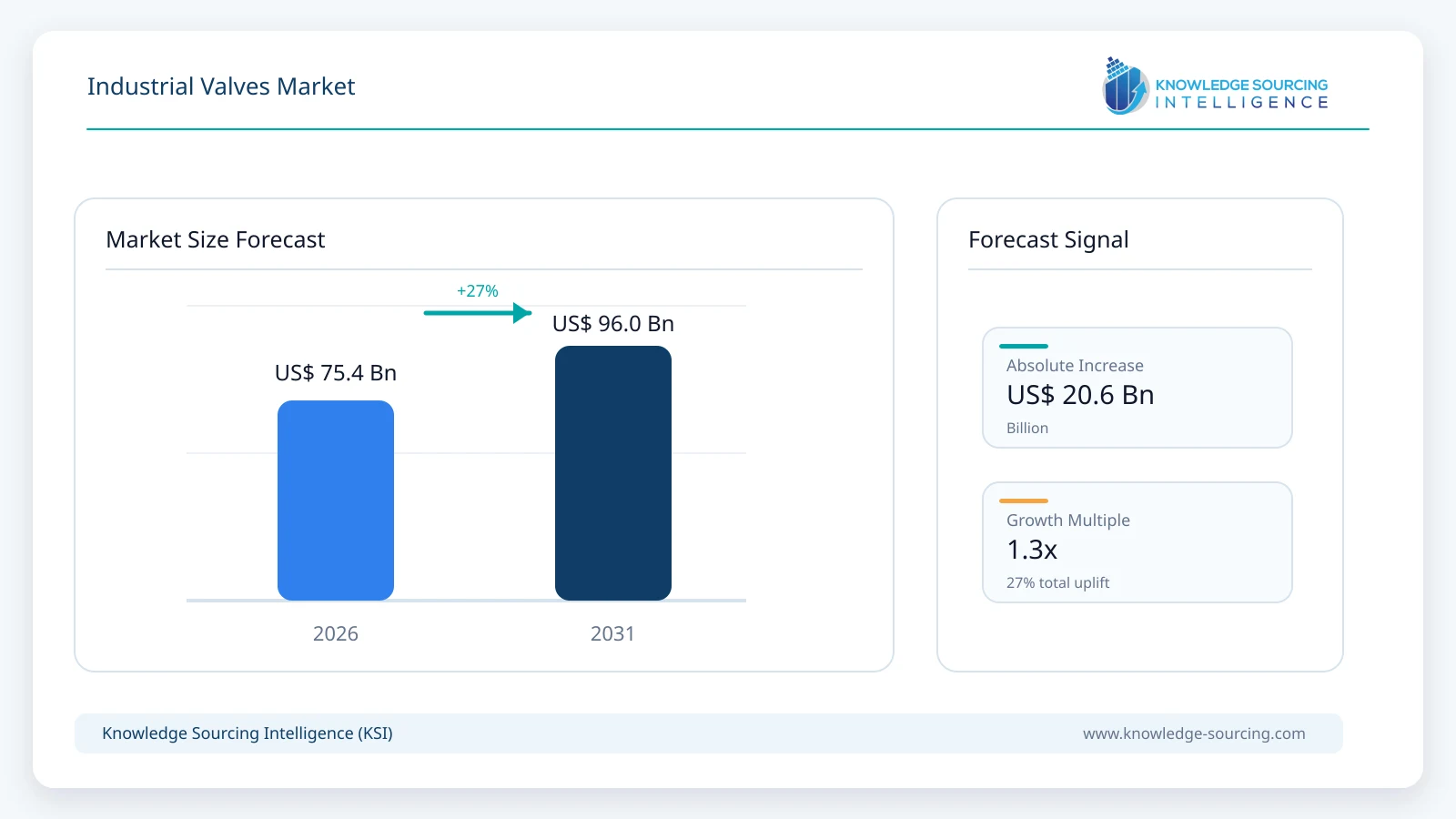
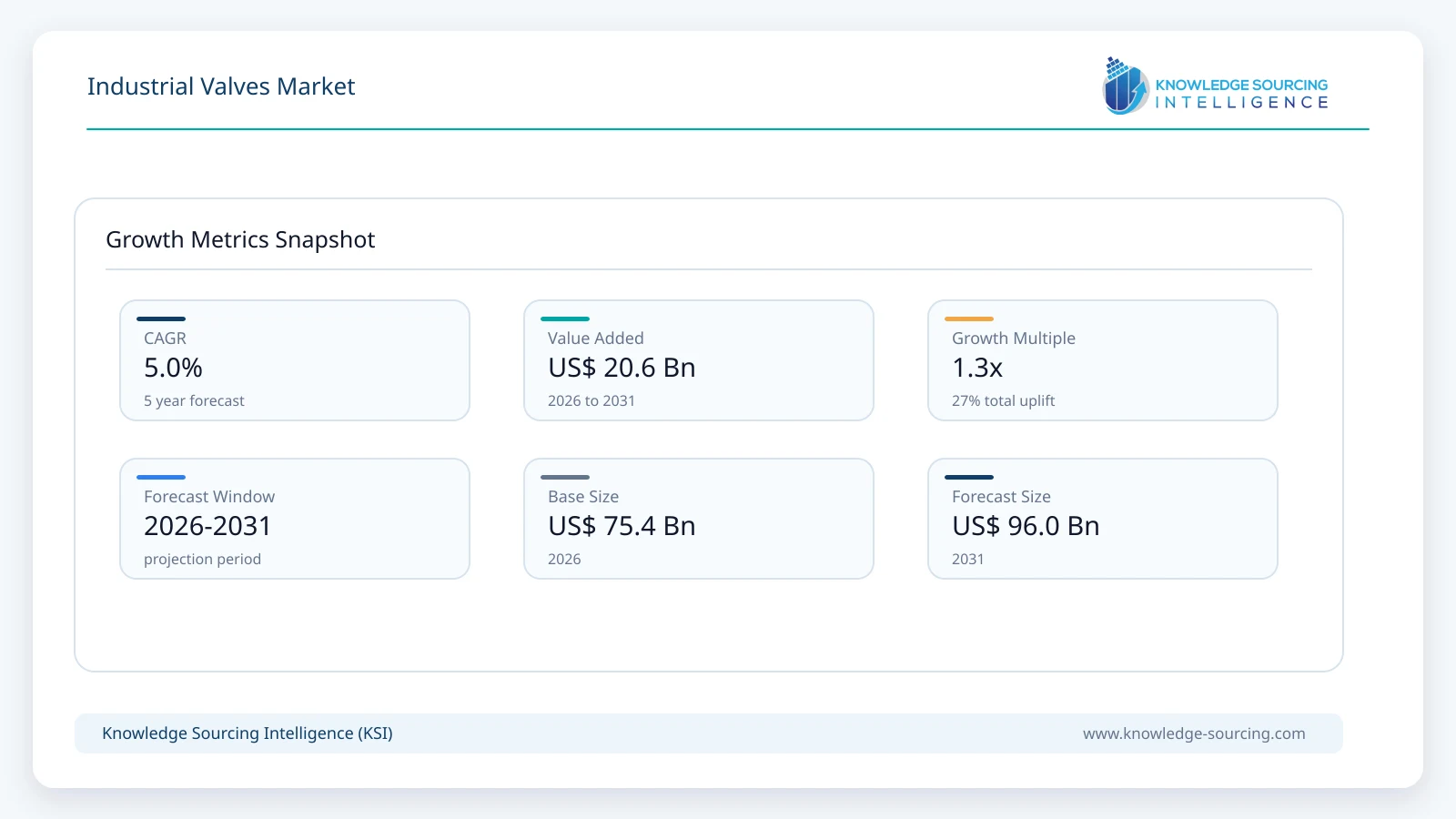
The Industrial Valves Market is growing at a CAGR of 5.0%, from USD 75.4 billion in 2026 to USD 96.0 billion by 2031.
Highlights:
- 1Ball valves account for approximately 28% of global industrial valve market value in 2026, driven by isolation requirements across oil and gas, chemicals, water and industrial processing.
- 2Carbon steel accounts for approximately 32% of market value in 2026, combining broad pressure-service capability with competitive material economics.
- 3Liquid-service applications account for approximately 61% of global market value in 2026, covering water, petroleum products, chemicals and process liquids.
- 4Oil and gas accounts for approximately 30% of industrial valve demand in 2026, supported by upstream, LNG, pipeline, refining and petrochemical infrastructure.
- 5Asia Pacific accounts for approximately 39% of global market value in 2026, led by China, Japan, South Korea and India's industrial investment.
Industrial valves are mechanical or electromechanical devices used to start, stop, regulate or redirect the movement of liquids, gases and slurries through industrial process systems. The market includes manually operated and actuated ball, butterfly, gate, globe, check, diaphragm and other process valves used in oil and gas, power generation, water and wastewater treatment, chemicals, food processing, pharmaceuticals and other industries.
Market Trends
Digital Valve Diagnostics
Valve automation is shifting from basic position control toward continuous diagnostics. Digital positioners and monitoring systems can identify excessive friction, actuator degradation, seat leakage and abnormal operating behavior before these problems cause process interruptions. Emerson's Fisher portfolio combines control valves with digital valve controllers and diagnostic software, while Valmet's Neles ValvGuard systems provide condition monitoring and partial-stroke testing for emergency shutdown valves. The commercial effect extends beyond the initial valve purchase because digital hardware gives suppliers a larger role in lifecycle service, predictive maintenance and plant-wide asset-management programmes.
Severe-Service Expansion
LNG, hydrogen, carbon capture, nuclear power and high-temperature process systems are increasing demand for valves engineered for extreme operating conditions. Cryogenic LNG service requires materials and sealing systems capable of operating at very low temperatures, hydrogen creates additional leakage and material-compatibility requirements, and supercritical steam, corrosive chemicals and high-pressure applications can require nickel alloys, specialized trims and advanced seat designs. Valmet's purchase of Severn added severe-service capabilities through Severn Glocon, ValvTechnologies and LB Bentley, while Flowserve's acquisition of Trillium's Valves Division expanded its nuclear and power-generation portfolio.
Installed Base Value
Valve manufacturers are placing greater emphasis on aftermarket revenue because critical valves can stay in service for decades and require periodic inspection, parts replacement, repair and modernization. An installed valve also gives the original supplier an advantage when the customer needs replacement trim, actuators, diagnostic equipment or engineering support. Valmet highlighted Severn's aftermarket potential as one of the strategic reasons for its acquisition, while Flowserve has built a global service network around brands including Durco, Valtek, Edward and Valbart.
Low-Emission Valve Design
Methane and volatile organic compound regulations are raising the importance of stem sealing, packing design and fugitive-emission certification. Oil and gas operators increasingly specify valves to API and ISO low-emission standards, particularly in gas processing, LNG, refining and chemical applications. Suppliers are responding with improved packing, bellows seals and low-emission stem designs, and the requirement is creating replacement demand in older plants where legacy valves cannot meet new leakage specifications without modification.
Market Drivers
LNG and Hydrocarbon Infrastructure
Oil and gas remains the largest industrial valve end market because valves are used repeatedly from the wellhead to processing plants, pipelines, LNG terminals, storage facilities and refineries. Upstream systems require high-pressure gate, ball and choke valves, pipelines use large-diameter isolation valves, and LNG infrastructure adds cryogenic valves across liquefaction, storage and regasification equipment. Refining and petrochemical plants require large numbers of control, isolation, check and safety valves across individual process units. In February 2026, SLB launched a fully electric Cameron frac fluid delivery system combining its frac valve design with electric actuation and ValveCommander digital control, reducing dependence on hydraulic actuation at well sites.
Water and Desalination Investment
Water and wastewater infrastructure creates large unit volumes because treatment plants and distribution networks contain extensive piping systems. Butterfly, gate, check and control valves are used for isolation, pumping stations, treatment processes and pressure management, while ageing infrastructure adds a substantial replacement market in developed economies and urbanization generates greenfield demand across Asia, the Middle East and parts of Latin America. Desalination is particularly relevant to higher-value valve demand because seawater intake, reverse-osmosis systems and brine handling expose equipment to corrosive fluids, requiring suitable stainless steels, duplex materials or engineered coatings.
Power Infrastructure Requires High-Integrity Valves
Thermal, combined-cycle, nuclear and renewable power facilities use valves across steam, feedwater, cooling and fuel systems, and these applications often involve elevated pressure and temperature. Nuclear investment has a disproportionate impact on value because equipment must satisfy demanding qualification, traceability and safety requirements. Flowserve's USD 490 million acquisition of Trillium's Valves Division in June 2026 specifically strengthened its nuclear and conventional power portfolio, while Emerson's Fisher SVX Steam Conditioning Valve, introduced in April 2026, was designed for turbine bypass and related steam applications.
Market Restraints and Challenges
Capital Spending Cycles Affect Orders
Large industrial valves are purchased as part of broader capital projects, exposing suppliers to changes in oil prices, chemical investment, power-project schedules and government infrastructure budgets. A delayed refinery, LNG terminal or chemical complex can postpone substantial valve orders even if the underlying project has not been cancelled, and large engineered orders also have longer sales and manufacturing cycles than standard distribution products. Manufacturers with broad end-market exposure and established aftermarket operations are better positioned to absorb periods of weaker greenfield spending.
Specialized Materials Raise Cost and Lead Times
Severe-service valves may require duplex stainless steel, nickel alloys, cobalt-based trim materials and other specialized metals, and their prices and availability can materially affect manufacturing costs and project lead times. Customers also require testing and certification under standards such as API, ASME, ISO and regional pressure-equipment regulations, while nuclear, hydrogen and highly corrosive chemical applications add further qualification requirements. These barriers limit the number of suppliers capable of competing for the most demanding projects but also increase engineering costs and slow new-product qualification.
Segment Analysis
By Type: Ball Valves
Ball valves are forecast to generate approximately USD 27.8 billion by 2031, maintaining the largest individual valve-type position. Their quarter-turn design provides rapid isolation and comparatively low pressure loss when fully open, with trunnion-mounted designs used in high-pressure pipelines and energy infrastructure and floating ball valves serving smaller industrial systems. Specialized versions are available for cryogenic LNG, hydrogen, corrosive chemicals and high-cycle applications. Emerson, Flowserve, SLB, Valmet, KITZ, Bray and several regional producers compete across different pressure classes and materials, and high-value applications are shifting toward automated packages combining the valve, actuator, position monitoring and diagnostics.
By Material: Carbon Steel
Carbon steel valves are expected to account for approximately USD 30.2 billion by 2031, supported by their mechanical strength, broad temperature capability and lower cost than high-alloy alternatives. They are widely used in oil and gas pipelines, refining, power generation and general industrial service, while stainless steel takes a stronger position where corrosion resistance or hygienic operation matters, particularly in chemicals, food processing and pharmaceuticals. Nickel-based and other specialty alloys command much higher prices in severe-service applications but represent smaller physical volumes. The revised segmentation separates carbon steel and stainless steel rather than placing both beneath an overlapping generic "steel" category.
By Medium: Liquids
Liquid-service valves are expected to generate approximately USD 58.0 billion by 2031, supported by large installed bases across water, petroleum products, chemicals, food processing and other process industries. Valve selection depends on pressure, temperature, viscosity, corrosiveness, solids content and contamination requirements, which creates a wide range of specifications even within the same application. Gas-service products require tighter sealing because even small leakage rates can create safety, environmental or economic problems, while slurry applications use abrasion-resistant designs in mining, minerals processing and other solids-bearing systems.
By Industry Vertical: Oil and Gas
Oil and gas is forecast to account for approximately USD 28.3 billion of industrial valve revenue by 2031, with demand distributed across upstream production, gathering systems, pipelines, LNG, gas processing, refining and petrochemicals. Large infrastructure projects can require thousands of valve assemblies ranging from commodity isolation valves to engineered control and safety equipment. SLB's Cameron business, Baker Hughes, Emerson Fisher, Flowserve and Valmet's expanded severe-service portfolio are strongly exposed to this market, and aftermarket service also contributes materially because installed valves operate in assets designed for multi-decade service lives.
Regional Analysis
Major Region: Asia Pacific
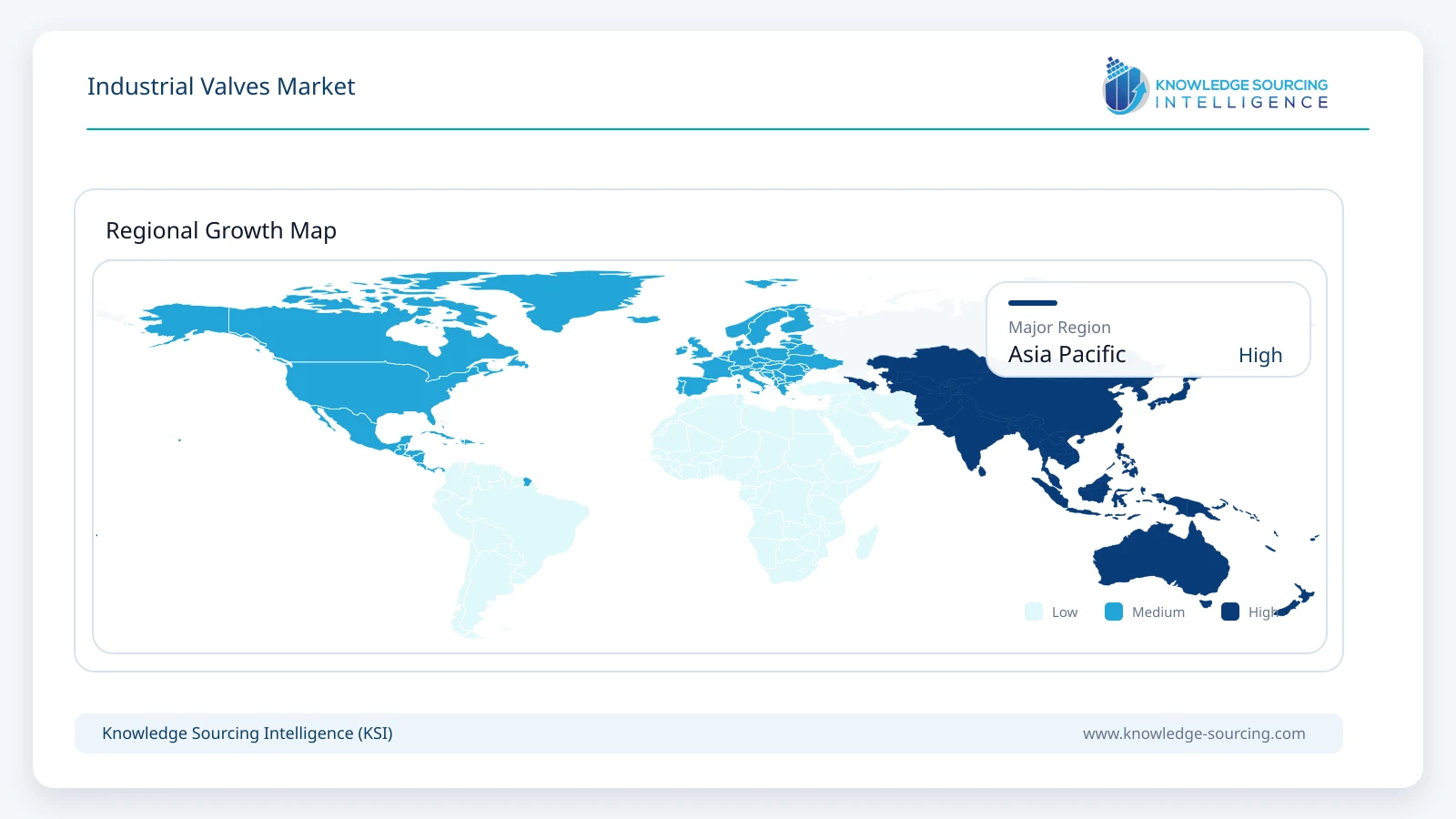
Asia Pacific is expected to generate approximately USD 38.5 billion by 2031, supported by China's chemicals, refining, power, water infrastructure and manufacturing base, India's energy and urban infrastructure investment, and the large installed process-industry bases in Japan and South Korea. Regional manufacturing is extensive, spanning major Japanese suppliers such as KITZ and numerous Chinese valve producers alongside local factories operated by global manufacturers. Demand growth is strongest where new process capacity, municipal infrastructure and replacement spending occur together, while higher-specification control and severe-service valves continue to attract multinational suppliers.
Major Country: China
China is forecast to approach USD 16.2 billion in industrial valve revenue by 2031, supported by a broad industrial demand base spanning petrochemicals, refining, gas pipelines, power generation, water treatment, chemicals, manufacturing and municipal infrastructure. Domestic manufacturers supply a large share of standard and mid-specification valves, while multinational suppliers remain stronger in control valves, severe-service products and other high-specification applications where engineering capability, certification and lifecycle service are more important. Localization is advancing in these higher-value categories as Chinese process industries seek greater domestic sourcing for critical equipment, particularly across refining, chemicals, power and large infrastructure projects.
Competitive Environment and Analysis
The industrial valves market is fragmented despite the presence of several large international suppliers. No single company covers every valve type, pressure class and end-user requirement, and regional manufacturers retain strong positions in commodity and mid-specification products. Emerson is a major control-valve supplier through Fisher, Vanessa, Keystone and related brands, while Flowserve combines control and isolation valves under Durco, Valtek, Valbart, Edward and other established names. Its June 2026 acquisition of Trillium's Valves Division adds nuclear and critical-infrastructure exposure.
SLB's Cameron portfolio has a strong position in upstream and pipeline valves, Baker Hughes operates Masoneilan control valves and Consolidated pressure-relief products, and Valmet has expanded beyond its Neles and Jamesbury portfolio by acquiring Severn Group. IMI participates in severe-service and process automation, Crane serves chemical, pharmaceutical and industrial applications, KITZ is a major Asian valve manufacturer, AVK is particularly strong in water infrastructure, and SAMSON, Bray, Bürkert and GEMÜ occupy important positions in control, process and specialty valves. The market is moving toward suppliers that can combine valves with automation, diagnostics and lifecycle services, increasing customer switching costs in critical processes and creating more recurring revenue from installed equipment.
Recent Developments
July 2026: Valmet completed its acquisition of Severn Group, adding Severn Glocon, ValvTechnologies and LB Bentley to its severe-service flow-control portfolio.
June 2026: Flowserve completed the USD 490 million acquisition of Trillium Flow Technologies' Valves Division, strengthening its nuclear, power and critical-infrastructure offering.
April 2026: Emerson introduced the Fisher SVX Steam Conditioning Valve for pressure and temperature control in combined-cycle power and other high-demand steam applications.
February 2026: SLB launched its fully electric Cameron frac fluid delivery system, combining next-generation frac valves, electric actuation and digital valve control.
April 2026: Valmet opened an expanded flow-control service and manufacturing operation in Sydney to strengthen valve production and lifecycle support for Australian customers.
Market Outlook
Industrial valve demand through 2031 will become more valuable per installation as customers specify higher-performance materials, digital diagnostics and automated actuation. Oil and gas will continue to provide the largest revenue pool, but the mix within energy will broaden as LNG, carbon capture, hydrogen handling, nuclear generation and flexible gas-fired power create specifications that favor engineered valves over standard products. Water infrastructure should provide steadier volume growth than cyclical hydrocarbon projects, particularly in Asia and the Middle East, while desalination will add higher-value corrosion-resistant products to that base.
Consolidation is likely to continue around severe-service technologies and installed valve populations. Recent Flowserve and Valmet acquisitions show the strategic value of acquiring both engineering capability and decades of aftermarket opportunities. By 2031, leading suppliers will compete less on the standalone valve and more on the full lifecycle package: engineered hardware, actuation, digital diagnostics, maintenance, spare parts and process expertise.
Industrial Valves Market Scope:
| Report Metric | Details |
|---|---|
| Total Market Size in 2026 | USD 75.4 billion |
| Total Market Size in 2031 | USD 96.0 billion |
| Forecast Unit | Billion |
| Growth Rate | 5.0% |
| Study Period | 2021 to 2031 |
| Historical Data | 2021 to 2024 |
| Base Year | 2025 |
| Forecast Period | 2026 – 2031 |
| Segmentation | Type, Material, Medium, Industry Vertical, Geography |
| Companies |
|
Market Segmentation
By Type
Ball Valves
Butterfly Valves
Check Valves
Globe Valves
Gate Valves
Diaphragm Valves
Others
By Material
Carbon Steel
Stainless Steel
Cast and Ductile Iron
Alloy Steel and Nickel-Based Alloys
Brass and Bronze
Plastics and Composites
Others
By Medium
Liquids
Gases
Slurries and Others
By Industry Vertical
Oil & Gas
Energy & Power
Water & Wastewater Treatment
Chemical
Food & Beverage
Pharmaceutical
Agriculture
Others
By Geography
North America
United States
Canada
Mexico
South America
Brazil
Argentina
Others
Europe
United Kingdom
Germany
France
Spain
Italy
Others
Middle East and Africa
Saudi Arabia
UAE
Others
Asia Pacific
China
Japan
South Korea
India
Australia
Thailand
Others
Table of Contents
1. EXECUTIVE SUMMARY
2. MARKET SNAPSHOT
2.1. Market Overview
2.2. Market Definition
2.3. Scope of the Study
2.4. Market Segmentation
3. BUSINESS LANDSCAPE
3.1. Market Drivers
3.2. Market Restraints
3.3. Market Opportunities
3.4. Porter's Five Forces Analysis
3.5. Industry Value Chain Analysis
3.6. Standards and Regulatory Landscape
3.7. Strategic Recommendations
4. TECHNOLOGICAL OUTLOOK
4.1. Smart and Connected Valves
4.2. Digital Valve Positioners and Diagnostics
4.3. Electric and Electro-Hydraulic Actuation
4.4. Fugitive-Emission Control
4.5. Severe-Service Valve Technologies
5. INDUSTRIAL VALVES MARKET BY TYPE
5.1. Introduction
5.2. Ball Valves
5.3. Butterfly Valves
5.4. Check Valves
5.5. Globe Valves
5.6. Gate Valves
5.7. Diaphragm Valves
5.8. Others
6. INDUSTRIAL VALVES MARKET BY MATERIAL
6.1. Introduction
6.2. Carbon Steel
6.3. Stainless Steel
6.4. Cast and Ductile Iron
6.5. Alloy Steel and Nickel-Based Alloys
6.6. Brass and Bronze
6.7. Plastics and Composites
6.8. Others
7. INDUSTRIAL VALVES MARKET BY MEDIUM
7.1. Introduction
7.2. Liquids
7.3. Gases
7.4. Slurries and Others
8. INDUSTRIAL VALVES MARKET BY INDUSTRY VERTICAL
8.1. Introduction
8.2. Oil & Gas
8.3. Energy & Power
8.4. Water & Wastewater Treatment
8.5. Chemical
8.6. Food & Beverage
8.7. Pharmaceutical
8.8. Agriculture
8.9. Others
9. INDUSTRIAL VALVES MARKET BY GEOGRAPHY
9.1. Introduction
9.2. North America
9.2.1. United States
9.2.2. Canada
9.2.3. Mexico
9.3. South America
9.3.1. Brazil
9.3.2. Argentina
9.3.3. Others
9.4. Europe
9.4.1. United Kingdom
9.4.2. Germany
9.4.3. France
9.4.4. Spain
9.4.5. Italy
9.4.6. Others
9.5. Middle East and Africa
9.5.1. Saudi Arabia
9.5.2. UAE
9.5.3. Others
9.6. Asia Pacific
9.6.1. China
9.6.2. Japan
9.6.3. South Korea
9.6.4. India
9.6.5. Australia
9.6.6. Thailand
9.6.7. Others
10. COMPETITIVE ENVIRONMENT AND ANALYSIS
10.1. Major Players and Strategy Analysis
10.2. Market Share Analysis
10.3. Mergers, Acquisitions, Agreements, and Collaborations
10.4. Competitive Dashboard
11. COMPANY PROFILES
11.1. Emerson Electric Co.
11.2. Flowserve Corporation
11.3. SLB
11.4. Baker Hughes Company
11.5. Valmet Oyj
11.6. IMI plc
11.7. Crane Company
11.8. KITZ Corporation
11.9. AVK Holding A/S
11.10. SAMSON AG
11.11. Bray International, Inc.
11.12. KSB SE & Co. KGaA
11.13. Spirax Group plc
11.14. Curtiss-Wright Corporation
11.15. Velan Inc.
12. APPENDIX
12.1. Currency
12.2. Assumptions
12.3. Base and Forecast Years Timeline
12.4. Key Benefits for the Stakeholders
12.5. Research Methodology
12.6. Abbreviations
Navigate
Trusted by the world's leading organizations











