Pinch Valves Market - Strategic Insights and Forecasts (2026-2031)
Pinch Valves Market Size, Share, Forecasts and Trends Analysis By Type (Open Pinch Valves, Enclosed Pinch Valves), By Sleeve Type (Standard Cylindrical Sleeves, Reinforced and Double-Wall Sleeves, Cone and Reduced-Port Sleeves), By End-user (Mining and Mineral Processing, Water and Wastewater, Chemical and Petrochemical, Food and Beverage, Pharmaceuticals and Biotechnology, Cement and Bulk Materials, Pulp and Paper, Others), and Region
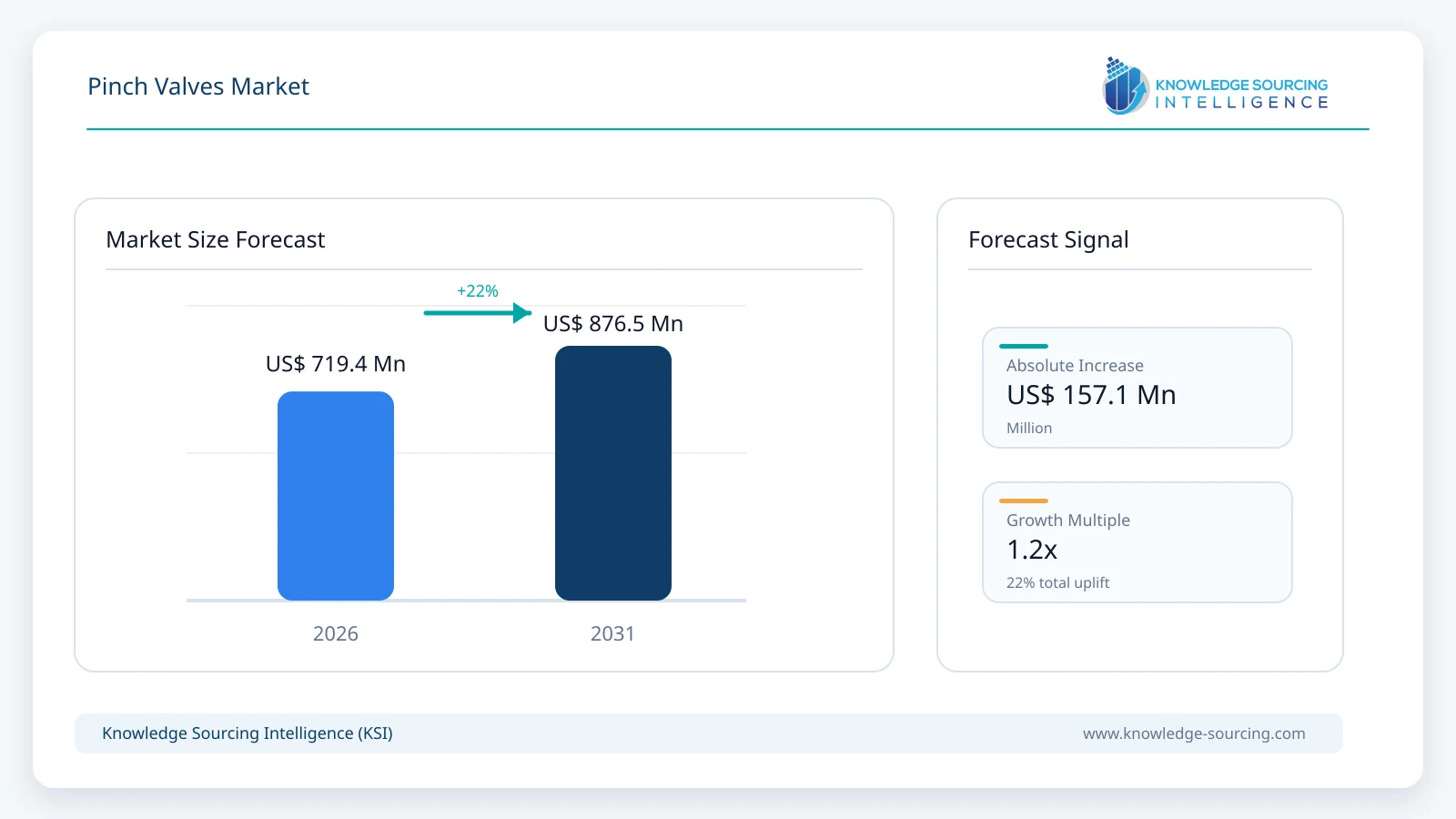
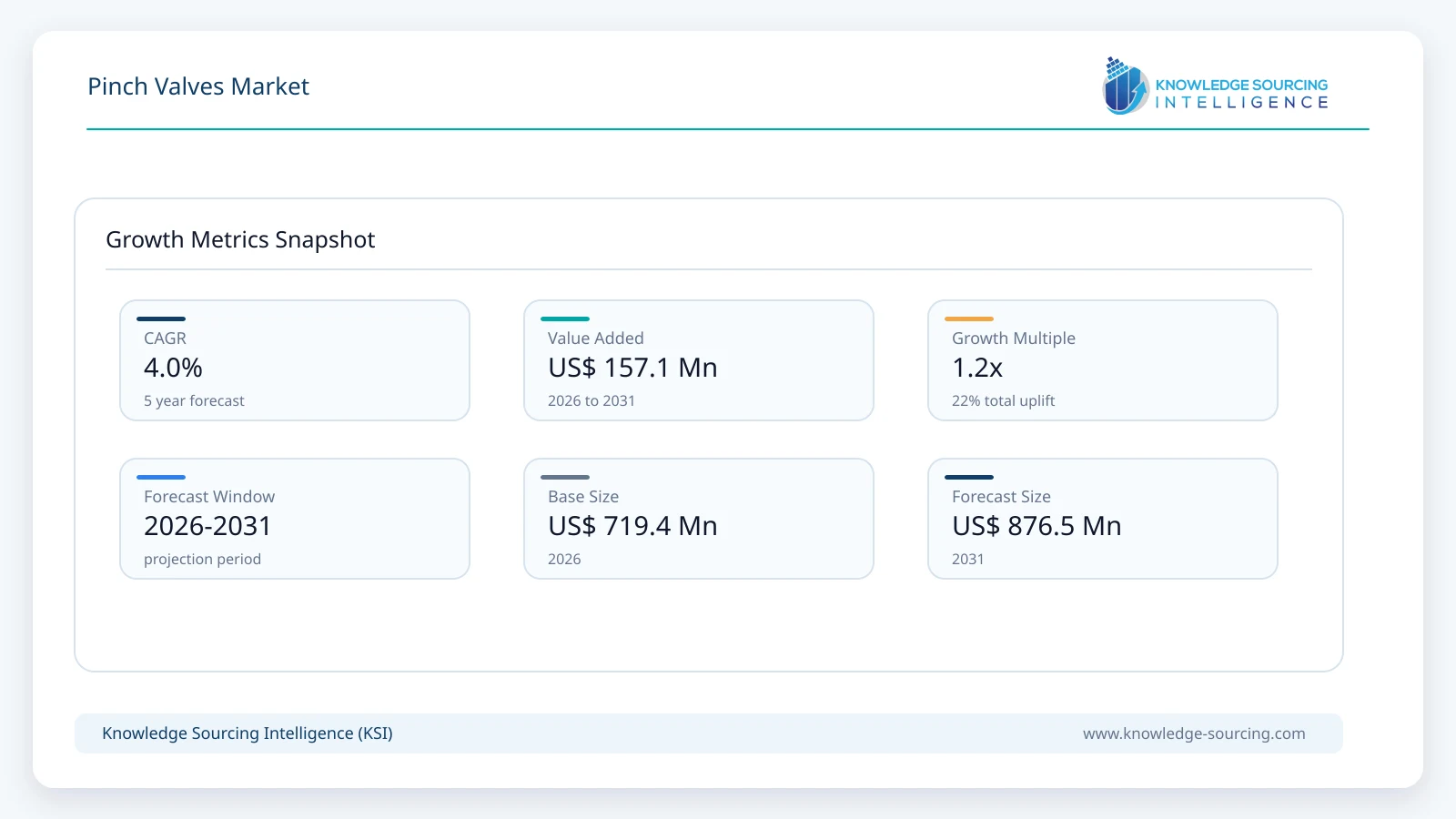
The pinch valves market, with a 4.03% CAGR, is expected to grow to USD 876.5 million in 2031 from USD 719.4 million in 2026.
Highlights:
1
Enclosed-body pinch valves account for approximately 64% of global market value in 2026
, supported by their wider suitability for protected industrial installations and demanding process environments.
2
Standard cylindrical sleeves represent approximately 57% of market value in 2026
, reflecting their broad applicability across isolation, slurry transfer and general flow-control duties.
3
Mining and mineral processing account for approximately 27% of global pinch valve market value in 2026
, driven by tailings, flotation, thickener underflow, concentrate and other abrasive-slurry applications.
4
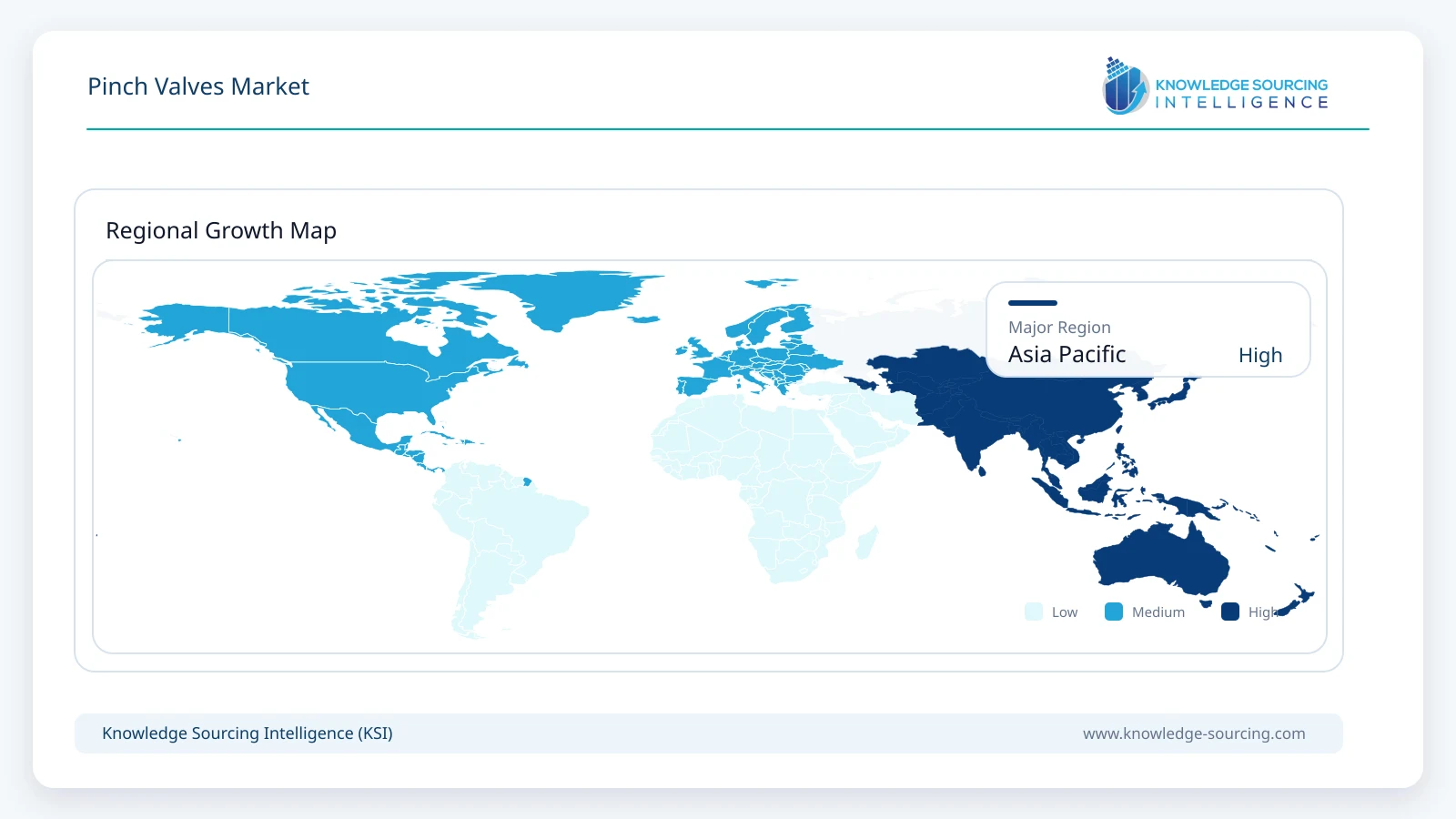
Asia Pacific represents approximately 39% of global market value in 2026
, supported by mining, minerals processing, chemicals, cement, manufacturing and water infrastructure.
5
Lifecycle cost is becoming a more important purchasing criterion as operators compare sleeve replacement frequency, maintenance time and process downtime rather than initial valve price alone.
6
Hygienic and tube-based pinch valves are expanding into biopharmaceutical, food-processing and other applications where the process medium can remain isolated inside replaceable tubing.
Demand remains concentrated in applications where the flexible sleeve provides a technical advantage over conventional metal-seated valves, particularly abrasive slurry handling, wastewater sludge, pneumatic conveying and other processes involving suspended solids.
Market Overview
Pinch valves regulate or isolate flow by mechanically or pneumatically compressing a flexible elastomer sleeve or process tube. In industrial slurry applications, the sleeve forms the principal wetted component, allowing abrasive particles and suspended solids to pass through a relatively unobstructed bore when the valve is open. Metso describes Larox pinch valves as suitable for both on-off and control duties, with the sleeve providing the wetted flow path and offering self-cleaning benefits when solids are present. The company applies the technology across mineral processing, pulp and paper, chemical handling, effluent treatment and water and wastewater systems.
The operating principle gives pinch valves a particularly strong position in abrasive or fouling applications. Conventional valve designs can expose gates, seats, discs, packing or other components directly to slurry, while the pinch valve concentrates wear in a replaceable elastomer element. Valmet’s Flowrox PVEG installations in an Australian nickel operation illustrate the commercial significance of this approach. After initial trials, the mine expanded to more than 160 valves for slurry transfer and tailings duties because the earlier valves experienced seizure, corrosion and maintenance problems.
The market also extends beyond mining. AKO supplies pinch valves across chemicals, plastics, ceramics, food, pharmaceuticals, wastewater, mining, metals and pneumatic conveying and reports more than 3.5 million units sold across 150 countries. This demonstrates that the market combines heavy industrial valves with much smaller air-operated and mechanical products used in process equipment and bulk-solids systems.
Market Trends
Lifecycle Economics Are Becoming More Important
Pinch valve selection is increasingly based on total operating cost rather than acquisition price. The flexible sleeve is simultaneously the valve’s principal wear component and the feature that protects the remainder of the assembly from abrasive media. Metso emphasizes longer sleeve wear life, rapid sleeve replacement and reduced maintenance requirements in its Larox product positioning, while Valmet’s mining references show how replacing conventional slurry valves with pinch designs can reduce unplanned maintenance and operational delays.
This changes procurement behavior in critical process lines. A valve with a higher initial cost can be economically preferable if it reduces line shutdowns, spare-parts requirements or maintenance labor. Manufacturers are therefore competing through improved elastomer formulations, reinforced sleeve construction, simplified change-out systems and application engineering rather than relying solely on valve-body design.
Mining Is Driving More Severe-Service Designs
Mineral-processing applications expose valves to abrasive solids, corrosive chemicals, changing particle sizes and high slurry concentrations. Typical pinch valve duties include thickener underflow, filter feeds, flotation circuits, concentrate pipelines, tailings, cyclones and hydrometallurgical systems. Metso identifies these applications across its slurry-valve portfolio, while Valmet’s recent nickel-mining reference confirms continuing adoption in harsh tailings and transfer duties.
The market is consequently moving toward stronger sleeves, enclosed bodies, improved pressure capability and faster maintenance. This development is particularly relevant where declining ore grades require larger quantities of material to be processed for each unit of final mineral output, increasing wear throughout slurry-handling systems.
Hygienic Pinch Valves Are Expanding the Addressable Market
Pinch technology is increasingly being applied to smaller hygienic and single-use systems where the product remains entirely within flexible tubing. Bürkert introduced its Type 2707 pinch valve for single-use biopharmaceutical production in April 2025, targeting chromatography, tangential-flow filtration, single-use bioreactors, filling and dosing systems. The valve uses interchangeable tube holders and is offered in both modulating and on-off configurations.
These applications remain smaller than mining and wastewater in market value but provide higher-value opportunities because contamination control, tubing integrity, compact automation and repeatability are critical. They also expand the competitive set beyond conventional industrial valve manufacturers to precision-fluid-control specialists.
Automation and Condition Monitoring Are Moving Into Pinch Valves
Pinch valves are becoming easier to integrate into automated process systems through position sensing, valve-status monitoring and more compact actuation. Takasago has been developing a pinch valve capable of detecting open/closed status, tubing presence and abnormal fluid leakage caused by tube disengagement. This illustrates how the technology is evolving from a simple mechanical isolation device toward a monitored fluid-control component.
These capabilities are particularly relevant to pharmaceutical equipment, analytical systems, OEM machinery and automated industrial processes where operators increasingly expect valves to communicate operating status rather than function as unmonitored mechanical components.
Segment Analysis
By Type: Enclosed-Body Pinch Valves
Enclosed-body pinch valves provide greater protection for the sleeve and closing mechanism and are therefore widely used in industrial applications where containment, operating pressure and environmental protection are important. Their stronger position is also supported by the breadth of available actuation options, including manual, pneumatic, hydraulic and electric configurations.
The segment is projected to reach approximately USD 574.1 million by 2031, reflecting continued demand from mining, chemicals, wastewater treatment and other severe-service applications. Growth is supported by customers shifting toward designs that reduce exposure of moving components while still retaining the replaceable-sleeve advantage that distinguishes pinch valves from conventional valve types.
By Sleeve Type: Standard Cylindrical Sleeves
Standard full-bore sleeves remain the primary configuration because they combine simple construction with broad applicability across on-off isolation and general slurry control. Suppliers offer natural rubber, EPDM, nitrile, neoprene and other elastomer compounds so that sleeve selection can be matched to abrasion, chemical compatibility, temperature and food-contact requirements. AKO, for example, maintains specific sleeve documentation and certifications for different elastomer formulations and regulated applications.
The standard sleeve category is projected to grow at approximately 3.5% annually from 2026 to 2031. Growth is slightly below the total market because reinforced, reduced-port and specialized hygienic sleeve configurations are gaining importance in applications that require higher pressure capability, improved control characteristics or more demanding process compatibility.
By End User: Mining and Mineral Processing
Mining remains the largest application because pinch valves address several problems associated with mineral slurry, including abrasion, suspended solids, scale formation and valve seizure. Applications extend across grinding circuits, thickening, filtration, flotation, tailings, hydrometallurgy and concentrate transport. Metso specifically identifies grinding, dewatering, tailings, cyclones, paste, concentrate pipelines and hydrometallurgy among the main slurry-valve applications it serves.
Mining-related pinch valve revenue is projected to reach approximately USD 243.7 million by 2031. This growth reflects continued minerals-processing investment, greater focus on plant availability and replacement of conventional valves where abrasive wear or extended idle periods create reliability problems.
By Geography: Asia Pacific
Asia Pacific combines several of the industries most relevant to pinch valve demand, including minerals processing, chemicals, cement, wastewater treatment, food processing and industrial manufacturing. China, India and Australia provide particularly important demand bases, although the nature of demand differs significantly between large mining projects, process industries and lower-value pneumatic or bulk-solids applications.
The regional market is projected to grow at approximately 4.8% annually between 2026 and 2031, above the global average. Growth is supported by mining investment, industrial infrastructure and an expanding regional manufacturing base for valves and elastomer components, while Australia continues to provide technically demanding mining applications for international slurry-control specialists.
Market Drivers
Abrasive Slurry Handling Creates a Clear Technical Use Case
Abrasive slurry remains the strongest structural driver because pinch valves can isolate the process stream within a replaceable sleeve while avoiding conventional seats and internal cavities. Metso notes that the design can provide full or reduced bore configurations with a smooth flow path, while Valmet’s Australian nickel reference shows how the technology can solve recurring seizure and corrosion problems in tailings operations.
This advantage is especially valuable in mineral processing because valve failure can interrupt larger production systems. The economic case therefore depends less on the price of the individual valve and more on plant availability, maintenance labor and the ability to replace wear components quickly.
Water and Wastewater Treatment Supports Recurring Demand
Wastewater plants handle sludge, grit, suspensions, chemicals and fibrous materials that can create difficulties for conventional valve seating surfaces. Pinch valves are suitable for several of these streams because the sleeve can close around entrained solids while maintaining a relatively unobstructed flow path when open.
The demand base includes municipal wastewater plants as well as industrial effluent systems in mining, chemicals, food processing and pulp and paper. Infrastructure upgrades and tighter industrial-water management therefore provide a stable underlying demand pool even though project timing varies by country.
Pinch valves are also used to isolate powders, granules and other dry bulk materials transported through pneumatic conveying systems. AKO identifies silos, cement, plastics, ceramics, powders and bulk-material applications as important parts of its business.
The flexible sleeve can close around residual particles without relying on a precision metal-to-metal seating surface, making the technology useful in filling, transfer and dosing operations. Demand is consequently linked to cement, food ingredients, polymers, minerals and other dry-processing industries as well as conventional fluid systems.
Hygienic Processing Is Creating Higher-Value Niches
The development of tube-based pinch valves broadens the market into biopharmaceuticals and sanitary processing. Bürkert’s Type 2707 illustrates this transition by allowing process media to remain within interchangeable tubing while the external mechanism provides on-off or modulating control.
These systems reduce the number of wetted valve components and can simplify changeovers in single-use processes. Adoption is therefore being supported by bioreactors, filtration, chromatography, dosing and filling systems, although the associated unit volumes remain considerably lower than those in mainstream industrial flow control.
Automation Is Raising the Value of Monitoring and Control
Industrial customers increasingly expect valves to integrate with automated plant-control systems. Position indication, cycle monitoring and tube-presence detection can reduce the risk of undetected valve failure and make maintenance more predictable.
Takasago’s development of a valve with optical detection of valve status and tubing presence demonstrates the direction of product development. This trend creates opportunities for suppliers that combine mechanical valve capability with sensors, electronics and automation interfaces rather than competing exclusively through elastomer and body design.
Market Restraints
Sleeve Wear Remains the Core Maintenance Requirement
The sleeve protects the valve body from process media but remains exposed to repeated flexing, abrasion and chemical attack. Highly abrasive particles, excessive differential pressure or unsuitable elastomer selection can shorten service life considerably.
This means pinch valves are not maintenance-free. Their value proposition depends on predictable sleeve life and rapid replacement, making application engineering essential. Suppliers that fail to match sleeve composition to process conditions can lose the lifecycle-cost advantage that supports pinch valve adoption.
Pressure and Temperature Capability Limits the Addressable Market
Pinch valves are not suitable for every severe-service condition. Metso notes that Larox pinch valves are particularly suited to lower-pressure slurry applications, with pressure capability dependent on configuration.
High-pressure, very high-temperature or extreme chemical applications may instead require metal-seated ball, gate, globe or other specialized valve designs. This limits pinch valve penetration even in industries where abrasive media are present.
Competing Slurry Valve Technologies Remain Strong
Knife gate, diaphragm, lined ball and specialty slurry valves compete directly with pinch designs. Metso itself maintains multiple slurry-valve technologies because individual process duties require different combinations of pressure capability, throttling performance, wear resistance and installation geometry.
Pinch valves therefore gain share selectively rather than replacing other valve types across an entire processing plant.
Sleeve materials must tolerate abrasion, chemical exposure, temperature and repeated deformation simultaneously. Natural rubber may provide strong abrasion resistance but is unsuitable for certain chemicals, while EPDM, NBR, FKM and other elastomers involve different performance trade-offs.
This requirement increases the importance of supplier engineering support and creates qualification barriers in chemical, pharmaceutical and food-processing applications where process compatibility and certification are critical.
The fundamental pinch-valve mechanism is relatively simple, especially in basic pneumatic and manual configurations. This supports a fragmented supplier base and puts pressure on pricing in standard products.
Established manufacturers increasingly defend their position through engineered sleeve compounds, pressure capability, automation, hygienic certifications, global service and installed-base support rather than competing solely on valve price.
Regional Outlook
Asia Pacific is the largest regional market, accounting for approximately 39% of global pinch valve market value in 2026. The region benefits from a large installed base across mining, mineral processing, chemicals, cement, wastewater treatment and general process manufacturing, with Australia, China and India forming the principal demand centers. Australia is particularly important for heavy-duty slurry applications, while China and India provide broader demand across mining, water treatment, chemicals and industrial processing. Regional suppliers are also expanding their capabilities in standard pneumatic and industrial pinch valves, increasing competition alongside international severe-service valve companies.
The regional market is projected to reach approximately USD 352.7 million by 2031, supported by continued minerals-processing investment, industrial infrastructure development and replacement demand in abrasive and solids-handling applications.
It is also expected to be the fastest-growing regional market, expanding at approximately 4.7% annually between 2026 and 2031. Growth is expected to exceed the global average as new mining and mineral-processing projects, wastewater infrastructure and manufacturing capacity create incremental demand alongside an expanding installed base.
Competitive Landscape
The market combines specialist pinch-valve suppliers, broader slurry-control companies and precision fluid-control manufacturers. AKO Armaturen remains one of the most specialized participants, reporting more than 3.5 million units sold and more than 15,000 pinch valve variants.
Valmet’s Flowrox and Metso’s Larox portfolios are particularly important in mining and abrasive slurry service. Metso’s Larox offering emphasizes long sleeve life and rapid sleeve changes, while Valmet has demonstrated extensive PVEG deployment in Australian mining.
A different competitive group includes Bürkert, Festo, SMC and Takasago, which participate in compact, hygienic and automated pinch-valve systems. Their presence is broadening the technology beyond traditional heavy industry into biopharmaceutical, analytical and OEM fluid-control applications.
Competitive advantage increasingly depends on application knowledge, sleeve-material capabilities, pressure range, ease of maintenance, actuation, monitoring and aftermarket support. This favors companies able to treat the pinch valve as a lifecycle product rather than a standalone mechanical component.
Recent Developments
August 24, 2026: Valmet agreed to sell its Flowrox pump technologies to Metso while retaining the Flowrox trademark and valve business, with Valmet stating that Flowrox valves will remain core to its valve portfolio.
July 1, 2026: Valmet completed its acquisition of Severn Group, expanding its broader flow-control capabilities and severe-service valve portfolio.
April 8, 2026: Valmet inaugurated a new service center and manufacturing unit in Sydney, strengthening its flow-control presence in Australia, an important mining market.
January 25, 2026: Valmet reported that an Australian nickel operation had expanded its installed base to more than 160 Flowrox PVEG pinch valves after successful use in abrasive slurry and tailings duties.
December 12, 2025: Takasago announced development of a pinch valve with optical sensing for open/closed status, tubing presence and abnormal leakage associated with tubing disengagement.
April 29, 2025: Bürkert introduced its Type 2707 pinch valve for single-use biopharmaceutical applications including chromatography, tangential-flow filtration, bioreactors, filling and dosing.
Market Outlook
The pinch valves market growth is expected to remain steady rather than exceptionally rapid because pinch valves occupy well-defined technical niches within the much larger industrial valve market.
Mining and mineral processing will remain the most important industrial demand base. Abrasive slurry, tailings and concentrate circuits create a clear lifecycle-cost argument for isolating wear within a replaceable elastomer sleeve, particularly where conventional valves experience seizure, erosion or frequent maintenance. Water and wastewater treatment provides a second stable demand pool through sludge, grit and chemical-handling applications.
The market is also becoming more diversified, as compact hygienic and single-use pinch valves are opening higher-value opportunities in biopharmaceutical and food-processing systems. In addition, status sensing and automation are improving suitability for OEM and electronically monitored processes.
Asia Pacific is expected to expand faster than the global market, supported by mining, manufacturing and process-industry investment. North America and Europe remain important higher-value markets where engineering support, automation and aftermarket service have greater influence on supplier selection.
Competition through 2031 will therefore center less on the basic pinch mechanism and more on sleeve life, application compatibility, rapid maintenance, automation capability and total lifecycle economics.
Pinch Valves Market Scope:
Report Metric
Details
Total Market Size in 2026
USD 719.4 million
Total Market Size in 2031
USD 876.5 million
Forecast Unit
USD Million
Growth Rate
4.03%
Study Period
2021 to 2031
Historical Data
2021 to 2024
Base Year
2025
Forecast Period
2026 – 2031
Segmentation
Type, Sleeve Type, End User, Geography
Companies
AKO Armaturen & Separationstechnik GmbH
Valmet Oyj
Metso Corporation
DeZURIK Inc.
RF Valves Inc.
Onyx Valve Company
WAMGROUP S.p.A.
Festo SE & Co. KG
Market Segmentation
By Type
Open Pinch Valves
Enclosed Pinch Valves
By Sleeve Type
Standard Cylindrical Sleeves
Reinforced and Double-Wall Sleeves
Cone and Reduced-Port Sleeves
By End User
Mining and Mineral Processing
Water and Wastewater
Chemical and Petrochemical
Food and Beverage
Pharmaceuticals and Biotechnology
Cement and Bulk Materials
Pulp and Paper
Others
By Geography
North America
United States
Canada
Mexico
South America
Brazil
Chile
Peru
Argentina
Others
Europe
Germany
Finland
United Kingdom
France
Italy
Spain
Others
Middle East and Africa
South Africa
Saudi Arabia
UAE
Others
Asia Pacific
China
Australia
India
Japan
South Korea
Indonesia
Others
Table of Contents
1. INTRODUCTION
1.1. Market Overview
1.2. Market Definition
1.3. Revenue Inclusion and Exclusion Criteria
1.4. Scope of the Study
1.5. Pinch Valves versus Alternative Slurry and Process Valves
1.6. Market Segmentation
1.7. Currency
1.8. Assumptions
1.9. Base and Forecast Years
1.10. Key Benefits to Stakeholders
2. RESEARCH METHODOLOGY
2.1. Research Design
2.2. Secondary Research
2.3. Primary Research
2.4. Market Estimation
2.5. Segment Modelling
2.6. Data Triangulation and Validation
3. EXECUTIVE SUMMARY
3.1. Key Findings
3.2. Pinch Valves Market Size, 2026-2031
3.3. Type Outlook
3.4. Sleeve Type Outlook
3.5. End-User Outlook
3.6. Regional Opportunity Summary
4. MARKET DYNAMICS
4.1. Market Drivers
4.1.1. Increasing Requirement for Reliable Abrasive-Slurry Control
4.1.2. Expansion of Water and Wastewater Sludge Handling
4.1.3. Growth in Pneumatic Conveying and Bulk-Solids Handling
4.1.4. Higher Hygienic Requirements in Food and Pharmaceutical Processing
4.1.5. Improvements in Actuation and Condition Monitoring
4.2. Market Restraints
4.2.1. Elastomer Sleeve Wear and Replacement Requirements
4.2.2. Pressure and Temperature Limitations
4.2.3. Competition from Alternative Slurry Valve Technologies
4.2.4. Sleeve-Material Compatibility Requirements
4.2.5. Price Competition from Regional Manufacturers
4.3. Market Opportunities
4.4. Porter’s Five Forces Analysis
4.5. Industry Value Chain Analysis
4.6. Elastomer Sleeve Technology and Replacement Economics
4.7. Valve Automation and Condition Monitoring
5. PINCH VALVES MARKET BY TYPE
5.1. Introduction
5.2. Open Pinch Valves
5.3. Enclosed Pinch Valves
6. PINCH VALVES MARKET BY SLEEVE TYPE
6.1. Introduction
6.2. Standard Cylindrical Sleeves
6.3. Reinforced and Double-Wall Sleeves
6.4. Cone and Reduced-Port Sleeves
7. PINCH VALVES MARKET BY END USER
7.1. Introduction
7.2. Mining and Mineral Processing
7.3. Water and Wastewater
7.4. Chemical and Petrochemical
7.5. Food and Beverage
7.6. Pharmaceuticals and Biotechnology
7.7. Cement and Bulk Materials
7.8. Pulp and Paper
7.9. Others
8. PINCH VALVES MARKET BY GEOGRAPHY
8.1. North America
8.1.1. United States
8.1.2. Canada
8.1.3. Mexico
8.2. South America
8.2.1. Brazil
8.2.2. Chile
8.2.3. Peru
8.2.4. Argentina
8.2.5. Others
8.3. Europe
8.3.1. Germany
8.3.2. Finland
8.3.3. United Kingdom
8.3.4. France
8.3.5. Italy
8.3.6. Spain
8.3.7. Others
8.4. Middle East and Africa
8.4.1. South Africa
8.4.2. Saudi Arabia
8.4.3. UAE
8.4.4. Others
8.5. Asia Pacific
8.5.1. China
8.5.2. Australia
8.5.3. India
8.5.4. Japan
8.5.5. South Korea
8.5.6. Indonesia
8.5.7. Others
9. COMPETITIVE ENVIRONMENT AND ANALYSIS
9.1. Major Players and Strategy Analysis
9.2. Heavy-Duty Slurry Valve Positioning
9.3. Hygienic and Process Pinch Valve Positioning
9.4. Sleeve Technology and Material Capabilities
9.5. Automation and Control Capabilities
9.6. Aftermarket Sleeve and Service Strategies
9.7. Regional Manufacturing Competition
9.8. Partnerships, Product Launches and Portfolio Developments
The Pinch Valves Market is projected to grow from USD 719.4 million in 2026 to USD 876.5 million in 2031. This expansion represents a compound annual growth rate (CAGR) of 4.03% over the forecast period, as detailed in the 'Pinch Valves Market - Strategic Insights and Forecasts (2026-2031)' report.
According to the report's 2026 insights, enclosed-body pinch valves account for approximately 64% of the global market value, largely due to their suitability for protected industrial installations and demanding process environments. Additionally, standard cylindrical sleeves represent approximately 57% of market value, reflecting their broad applicability across various flow-control duties.
Mining and mineral processing is a key driver, accounting for approximately 27% of the global pinch valve market value in 2026, primarily for abrasive-slurry applications like tailings and thickener underflow. Demand is heavily concentrated in applications where the flexible sleeve offers a technical advantage, such as abrasive slurry handling, wastewater sludge, and pneumatic conveying involving suspended solids.
The Asia Pacific region represents the largest share, accounting for approximately 39% of the global pinch valve market value in 2026. This significant regional contribution is supported by robust activities in mining, minerals processing, chemicals, cement, manufacturing, and extensive water infrastructure projects across the area.
The report highlights that lifecycle cost is becoming a more important purchasing criterion for operators. Buyers are increasingly comparing sleeve replacement frequency, maintenance time, and process downtime, indicating a shift towards valuing long-term operational efficiency and total cost of ownership over just the initial valve price.
Pinch valves provide a strong technical advantage in abrasive or fouling applications because the flexible elastomer sleeve forms the principal wetted component, allowing abrasive particles to pass through a relatively unobstructed bore. This design concentrates wear in a replaceable elastomer element, unlike conventional valves where gates or seats are directly exposed, leading to reduced maintenance and enhanced durability.