
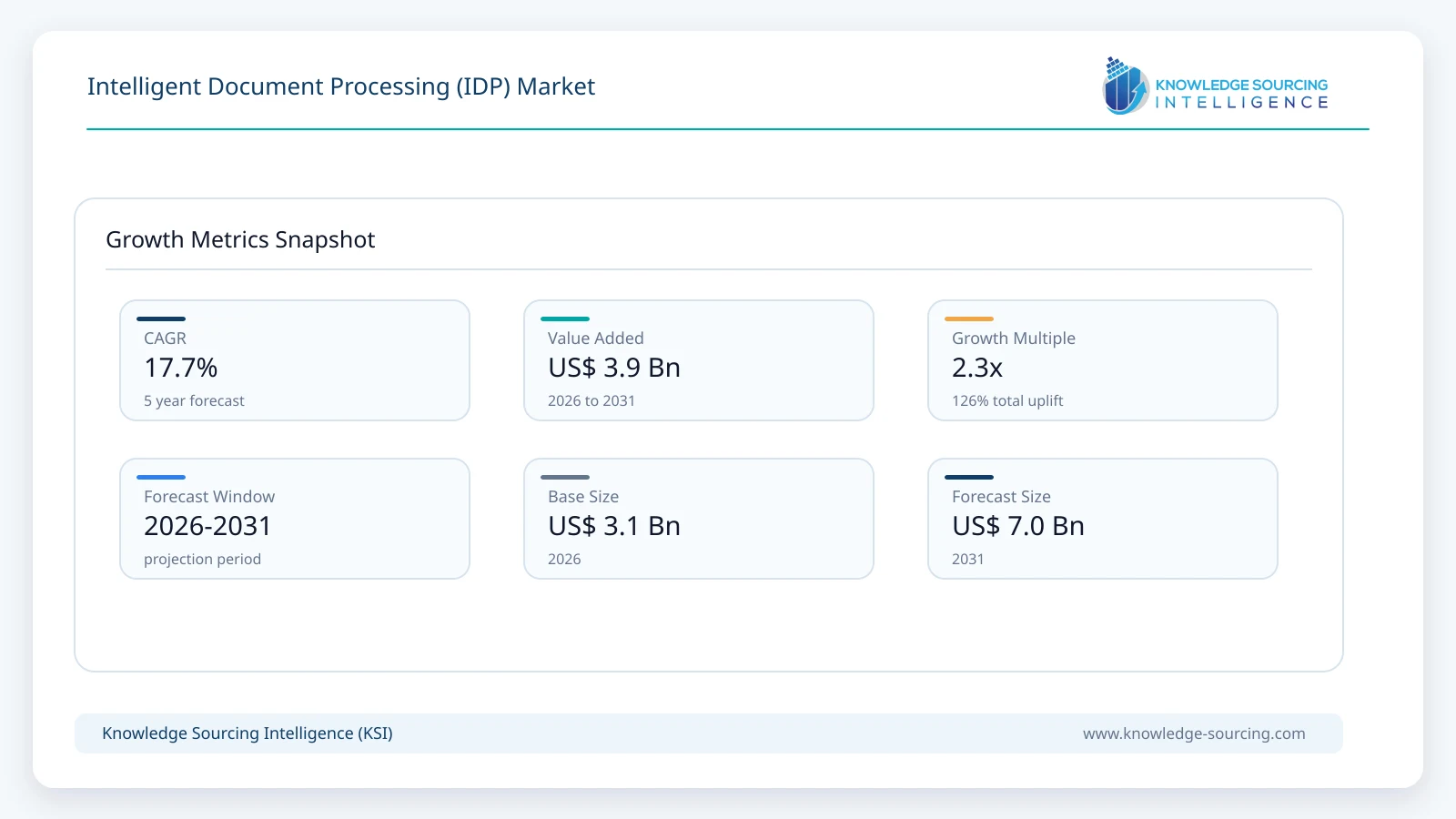
The global Intelligent Document Processing (IDP) Market is forecast to grow at a CAGR of 17.7%, reaching USD 7.0 billion in 2031 from USD 3.1 billion in 2026.
Highlights:
- 1Rising enterprise demand for automated document-intensive workflows remains the primary catalyst supporting IDP adoption across multiple industries.
- 2Cloud-based deployment has become the preferred implementation model for organizations seeking faster deployment and scalable processing capacity.
- 3BFSI represents one of the largest end-user industries due to extensive compliance documentation, customer onboarding, and transaction processing requirements.
- 4Machine learning, NLP, and computer vision are improving document classification accuracy beyond traditional OCR capabilities.
- 5Privacy regulations, financial reporting requirements, and data governance frameworks continue to influence purchasing decisions.
- 6Vendors compete through AI model accuracy, workflow integration, industry-specific solutions, managed services, and enterprise ecosystem partnerships.
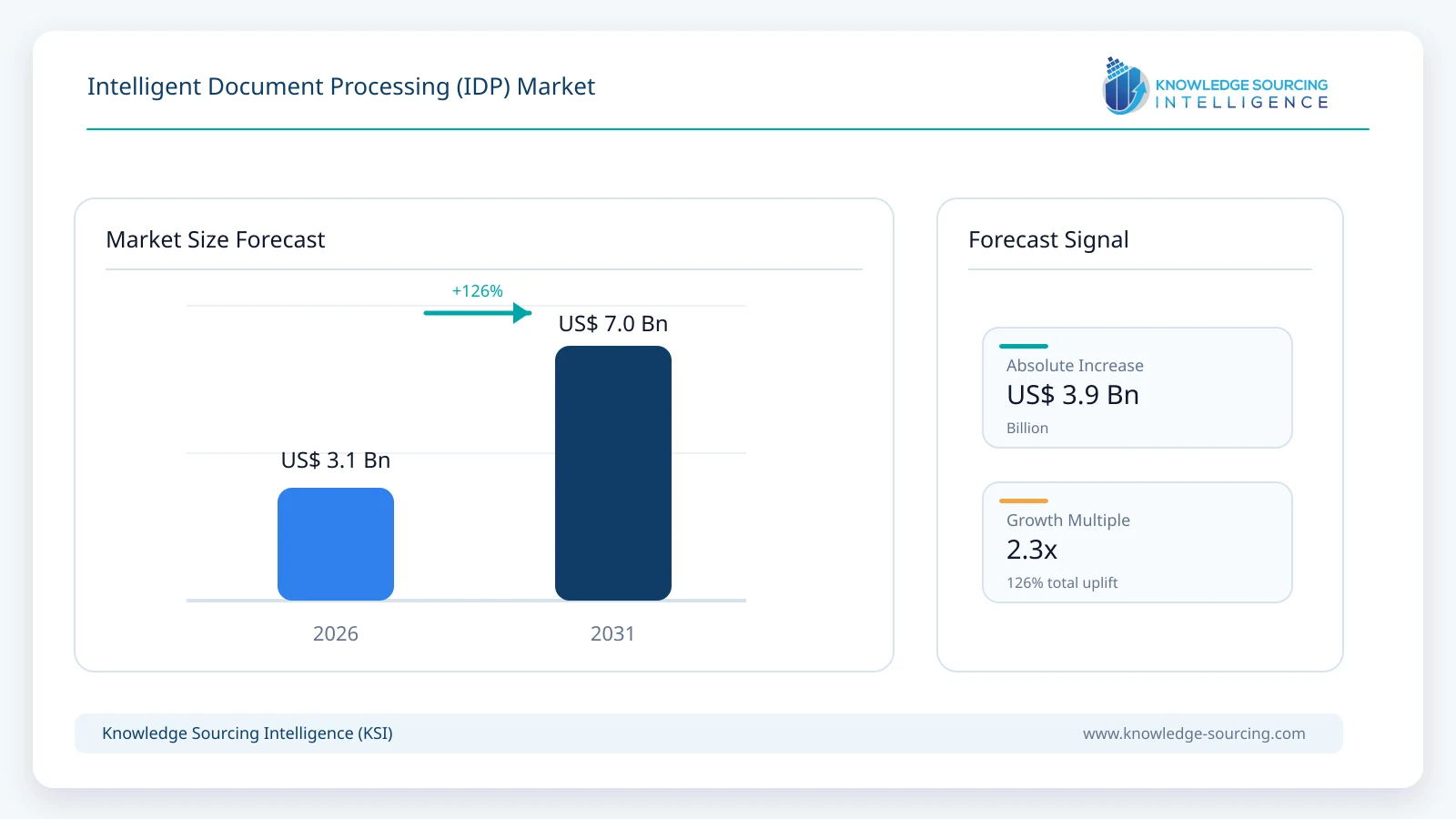
The Intelligent Document Processing (IDP) market comprises software platforms and related services that automate the extraction, classification, validation, and processing of structured, semi-structured, and unstructured business documents using artificial intelligence (AI), optical character recognition (OCR), natural language processing (NLP), computer vision, machine learning, and workflow automation technologies. Organizations use IDP to reduce manual document handling, improve data accuracy, accelerate business processes, and strengthen regulatory compliance across high-volume document environments.
Demand for IDP continues to expand as enterprises seek to modernize document-intensive operations without completely replacing existing enterprise systems. Finance departments process invoices and purchase orders, banks manage customer onboarding documents, healthcare providers digitize patient records, logistics companies automate shipping documentation, and government agencies convert paper-based workflows into digital services. These applications generate measurable returns through lower processing costs, shorter turnaround times, and improved audit readiness, making investment decisions easier to justify.
Procurement priorities have shifted from standalone OCR software toward integrated platforms capable of understanding document context, validating extracted information against enterprise databases, and supporting end-to-end workflow orchestration. Buyers increasingly evaluate vendors based on document accuracy across multiple languages, scalability, cloud deployment flexibility, security certifications, integration with enterprise resource planning (ERP) and customer relationship management (CRM) platforms, and availability of industry-specific document models.
The market structure includes established enterprise software providers, workflow automation specialists, and AI-focused document intelligence companies. Competition extends beyond extraction accuracy to implementation speed, low-code configuration, model training capabilities, deployment flexibility, and post-deployment support. Managed services are also gaining importance as organizations lacking internal AI expertise outsource document automation operations while retaining governance over sensitive business information.
Cloud-based deployments continue to attract organizations pursuing faster implementation and predictable operational spending. Nevertheless, regulated industries such as banking, healthcare, and government maintain demand for hybrid and on-premises deployments where data sovereignty, regulatory compliance, and internal security policies remain primary purchasing considerations.
Growing document volumes generated through digital customer interactions, expanding regulatory reporting obligations, and continued enterprise investment in AI-enabled business process automation are expected to support sustained adoption of Intelligent Document Processing solutions across both developed and emerging economies during the forecast period of 2026–2031.
Market Drivers
Rising Enterprise Demand for Process Automation
Organizations continue to automate repetitive administrative processes to improve operational efficiency and reduce dependence on manual data entry. Finance, procurement, human resources, legal, and customer service departments process millions of documents annually, creating a substantial business case for intelligent automation.
Enterprise buyers increasingly seek platforms capable of automating complete document workflows rather than digitizing individual files. Software providers respond by integrating workflow orchestration, AI-based validation, and robotic process automation into unified platforms. This expands average contract values while increasing long-term customer retention through broader enterprise deployment.
Expanding Regulatory Documentation Requirements
Financial institutions, healthcare providers, insurance companies, and public agencies face growing documentation obligations related to customer identification, financial reporting, healthcare records, taxation, and regulatory audits. Manual processing creates operational bottlenecks and increases compliance risks.
IDP solutions enable automated document verification, metadata extraction, audit trail creation, and standardized record management. Buyers prioritize solutions that provide traceability, security controls, and configurable workflows aligned with regulatory requirements. Vendors therefore invest heavily in compliance certifications, governance features, and secure deployment architectures.
AI Advancements Improve Commercial Viability
Earlier document automation projects often struggled with inconsistent document formats and handwritten content. Recent advances in machine learning, intelligent character recognition, natural language understanding, and computer vision have significantly improved extraction accuracy across diverse document types.
Higher processing accuracy reduces manual intervention and improves return on investment. Buyers increasingly evaluate measurable automation rates rather than OCR accuracy alone, encouraging vendors to develop industry-trained AI models capable of handling invoices, contracts, tax forms, medical records, and logistics documentation with minimal customization.
Growth in Digital Customer Onboarding
Banks, insurers, telecommunications providers, and digital commerce platforms continue expanding remote customer onboarding. Identity verification, document authentication, application processing, and compliance checks require rapid document analysis while maintaining security standards.
IDP supports faster customer acquisition by shortening verification cycles and minimizing manual review. Commercial buyers increasingly prefer configurable platforms that integrate with identity verification services, workflow management systems, and customer engagement platforms.
Market Restraints and Challenges
Complexity of Legacy System Integration
Many enterprises operate decades-old ERP, document management, and workflow systems that lack standardized integration capabilities. Integrating AI-powered document processing with existing infrastructure often increases implementation costs and project duration.
Organizations frequently adopt phased deployment strategies to reduce operational disruption. Vendors address this challenge through APIs, pre-built connectors, and low-code integration tools, although integration complexity remains a significant procurement consideration.
Data Privacy and Information Security Concerns
Document processing platforms frequently manage confidential financial records, healthcare information, legal contracts, and customer identities. Security breaches can create financial liabilities, regulatory penalties, and reputational damage.
Enterprise buyers therefore conduct extensive security assessments before procurement. Vendors compete by offering encryption, access controls, regional data hosting, audit capabilities, and compliance with international security standards.
Variable Document Quality
Organizations continue receiving handwritten forms, low-resolution scans, multilingual documents, and inconsistent layouts. These conditions reduce extraction accuracy and increase exception handling requirements.
Suppliers mitigate these challenges through continuous AI model training, human-in-the-loop validation, and adaptive learning capabilities. However, organizations processing highly variable document formats often experience slower automation rates than initially anticipated.
Skills and Change Management
Successful IDP implementation requires expertise in AI model configuration, workflow design, data governance, and business process optimization. Organizations lacking internal capabilities may underestimate deployment complexity.
Professional services and managed service providers increasingly bridge this skills gap by supporting implementation, optimization, and ongoing AI model maintenance.
Major Segment Analysis
Banking, Financial Services, and Insurance (BFSI)
The BFSI segment represents one of the most commercially important markets for Intelligent Document Processing due to its exceptionally high document volumes, regulatory oversight, and continuous customer interaction. Financial institutions process account applications, loan documentation, insurance claims, compliance records, tax forms, payment instructions, and customer identification documents daily.
Procurement decisions within BFSI prioritize processing accuracy, fraud detection support, regulatory compliance, multilingual capability, and seamless integration with core banking systems. Buyers also evaluate scalability because transaction volumes fluctuate significantly during financial reporting cycles and seasonal lending activities.
Competition within this segment centers on industry-specific AI models capable of recognizing financial document formats with minimal customization. Vendors offering pre-trained templates for banking documentation often reduce implementation timelines and improve customer adoption. Managed services also attract institutions seeking operational efficiency without expanding internal AI teams.
As regulatory reporting requirements continue expanding and digital banking services generate larger document volumes, BFSI is expected to remain a primary revenue contributor for IDP solution providers throughout the forecast period.
Regional Analysis
North America
North America maintains a strong position due to extensive enterprise software adoption, mature cloud infrastructure, substantial AI investment, and widespread deployment of automation technologies. Financial institutions, healthcare organizations, and government agencies continue investing in document automation to improve operational efficiency and regulatory compliance. Enterprise buyers generally prioritize integration capabilities, cybersecurity, and measurable productivity improvements.
Europe
European demand is supported by strict data protection requirements, electronic government initiatives, and enterprise modernization programs. Organizations frequently evaluate vendors based on compliance capabilities, regional data hosting, multilingual processing, and long-term governance features. Manufacturing, financial services, and public administration remain important adoption sectors.
Asia Pacific
Asia Pacific represents an attractive growth opportunity due to expanding digital economies, government digitization programs, rising enterprise software investment, and increasing adoption among financial institutions and manufacturing companies. Large populations generate substantial document volumes, while growing SME adoption supports broader market expansion. Cost sensitivity remains an important procurement consideration, encouraging demand for scalable cloud-based offerings.
Middle East & Africa
Governments continue investing in digital public services, financial modernization, and smart city initiatives that require efficient document management capabilities. Banking, public administration, healthcare, and telecommunications contribute to regional demand. Budget limitations and varying digital infrastructure maturity influence implementation timelines across individual countries.
South America
South American organizations increasingly automate finance, procurement, and compliance operations to improve productivity and reduce administrative costs. Brazil represents the largest regional opportunity, supported by financial sector modernization and enterprise digital investment. Economic uncertainty and varying technology budgets remain important purchasing constraints across several markets.
Competitive Landscape
The Intelligent Document Processing market combines established enterprise software vendors with AI-native document automation providers and workflow automation specialists. Competition focuses on document extraction accuracy, AI model sophistication, deployment flexibility, integration capabilities, implementation speed, and total cost of ownership.
Vendors increasingly differentiate themselves through industry-specific document models, low-code workflow development, multilingual processing, cloud-native architecture, and partnerships with enterprise application providers. Strategic collaborations with cloud infrastructure companies, system integrators, and consulting organizations extend market reach while supporting enterprise-scale implementations.
Companies including ABBYY USA Software House, Inc., Tungsten Automation Corporation, UiPath Inc., Automation Anywhere, Inc., Hyperscience, Inc., OpenText Corporation, Microsoft Corporation, IBM Corporation, Parascript, LLC, and Rossum Ltd. continue expanding AI functionality while strengthening enterprise integration capabilities and managed service offerings.
Recent Developments
May 2026: Microsoft announced expanded AI document processing capabilities within its enterprise automation portfolio, improving integration between generative AI services and business workflow applications. The enhancement strengthens enterprise document automation options for existing Microsoft customers.
November 2025: UiPath introduced additional intelligent document processing capabilities within its automation platform, enhancing AI-based document classification and extraction for enterprise workflows. The release supports broader end-to-end automation deployment.
September 2025: ABBYY expanded its intelligent document processing portfolio with new AI-driven document understanding capabilities designed to improve processing accuracy for complex business documents. The update reinforces competitive positioning in enterprise automation.
Regulatory and Policy Environment
The regulatory environment significantly influences Intelligent Document Processing adoption because document automation frequently involves personal, financial, healthcare, and government information. Compliance with privacy regulations, financial reporting obligations, healthcare record requirements, and public sector information management standards directly affects procurement decisions.
Organizations operating internationally frequently align deployments with the European Union's General Data Protection Regulation (GDPR), while financial institutions implement controls supporting anti-money laundering (AML) and know-your-customer (KYC) obligations. Healthcare organizations prioritize compliance with patient information protection requirements, whereas government agencies emphasize secure records management and digital public service initiatives.
International standards covering information security management, cloud security, electronic records management, and AI governance increasingly shape vendor product development. Buyers evaluate suppliers based on security certifications, audit capabilities, encryption, identity management, and configurable data retention policies before enterprise-wide deployment.
Outlook and Strategic Implications
Investment over the next five years is expected to concentrate on AI models capable of understanding increasingly complex document formats while reducing manual validation requirements. Organizations will continue prioritizing solutions that integrate document intelligence with enterprise workflow automation, analytics, and business process management platforms.
Procurement strategies are likely to emphasize measurable productivity improvements, implementation flexibility, cybersecurity, and long-term scalability instead of standalone document capture capabilities. Managed services are expected to gain wider acceptance among organizations seeking predictable operating costs and specialized AI expertise.
Competitive differentiation will increasingly depend on industry-trained AI models, integration ecosystems, multilingual processing, and governance capabilities rather than OCR functionality alone. Vendors capable of combining document intelligence with broader enterprise automation platforms will be well positioned to capture larger enterprise contracts.
Although implementation complexity, privacy requirements, and integration challenges will continue influencing purchasing decisions, organizations facing rising document volumes, expanding compliance obligations, and workforce efficiency pressures are expected to maintain investment in Intelligent Document Processing solutions throughout the 2026–2031 forecast period.
Intelligent Document Processing (IDP) Market Scope
| Report Metric | Details |
|---|---|
| Total Market Size in 2026 | USD 3.1 billion |
| Total Market Size in 2031 | USD 7.0 billion |
| Forecast Unit | Billion |
| Growth Rate | 17.7% |
| Study Period | 2021 to 2031 |
| Historical Data | 2021 to 2024 |
| Base Year | 2025 |
| Forecast Period | 2026 – 2031 |
| Segmentation | Component, Technology, Deployment Mode, Enterprise Size, End-User Industry, Geography |
| Companies |
|
Market Segmentation
By Component
By Technology
By Deployment Mode
By Enterprise Size
By End-user Industry
By Geography
Table of Contents
1. EXECUTIVE SUMMARY
2. MARKET SNAPSHOT
2.1. Market Overview
2.2. Market Definition
2.3. Scope of the Study
2.4. Market Segmentation
3. BUSINESS LANDSCAPE
3.1. Market Drivers
3.2. Market Restraints
3.3. Market Opportunities
3.4. Porter’s Five Forces Analysis
3.5. Industry Value Chain Analysis
3.6. Policies and Regulations
3.7. Strategic Recommendations
4. TECHNOLOGICAL OUTLOOK
5. INTELLIGENT DOCUMENT PROCESSING (IDP) MARKET BY COMPONENT
5.1. Introduction
5.2. Solutions
5.3. Services
5.3.1. Professional Services
5.3.2. Managed Services
6. INTELLIGENT DOCUMENT PROCESSING (IDP) MARKET BY TECHNOLOGY
6.1. Introduction
6.2. Optical Character Recognition (OCR)
6.3. Intelligent Character Recognition (ICR)
6.4. Natural Language Processing (NLP)
6.5. Computer Vision
6.6. Robotic Process Automation (RPA)
6.7. Machine Learning and Deep Learning
7. INTELLIGENT DOCUMENT PROCESSING (IDP) MARKET BY DEPLOYMENT MODE
7.1. Introduction
7.2. Cloud-Based
7.3. On-Premises
7.4. Hybrid
8. INTELLIGENT DOCUMENT PROCESSING (IDP) MARKET BY ENTERPRISE SIZE
8.1. Introduction
8.2. Large Enterprises
8.3. Small and Medium-Sized Enterprises (SMEs)
9. INTELLIGENT DOCUMENT PROCESSING (IDP) MARKET BY END-USER INDUSTRY
9.1. Introduction
9.2. Banking, Financial Services, and Insurance (BFSI)
9.3. Healthcare
9.4. Government
9.5. Retail and E-Commerce
9.6. Manufacturing
9.7. IT and Telecommunications
9.8. Transportation and Logistics
9.9. Others
10. INTELLIGENT DOCUMENT PROCESSING (IDP) MARKET BY GEOGRAPHY
10.1. Introduction
10.2. North America
10.2.1. By Component
10.2.2. By Technology
10.2.3. By Deployment Mode
10.2.4. By Enterprise Size
10.2.5. By End-User Industry
10.2.6. By Country
10.2.6.1. United States
10.2.6.2. Canada
10.2.6.3. Mexico
10.3. South America
10.3.1. By Component
10.3.2. By Technology
10.3.3. By Deployment Mode
10.3.4. By Enterprise Size
10.3.5. By End-User Industry
10.3.6. By Country
10.3.6.1. Brazil
10.3.6.2. Argentina
10.3.6.3. Others
10.4. Europe
10.4.1. By Component
10.4.2. By Technology
10.4.3. By Deployment Mode
10.4.4. By Enterprise Size
10.4.5. By End-User Industry
10.4.6. By Country
10.4.6.1. Germany
10.4.6.2. United Kingdom
10.4.6.3. France
10.4.6.4. Italy
10.4.6.5. Spain
10.4.6.6. Others
10.5. Middle East and Africa
10.5.1. By Component
10.5.2. By Technology
10.5.3. By Deployment Mode
10.5.4. By Enterprise Size
10.5.5. By End-User Industry
10.5.6. By Country
10.5.6.1. Saudi Arabia
10.5.6.2. United Arab Emirates
10.5.6.3. South Africa
10.5.6.4. Others
10.6. Asia Pacific
10.6.1. By Component
10.6.2. By Technology
10.6.3. By Deployment Mode
10.6.4. By Enterprise Size
10.6.5. By End-User Industry
10.6.6. By Country
10.6.6.1. China
10.6.6.2. Japan
10.6.6.3. India
10.6.6.4. South Korea
10.6.6.5. Australia
10.6.6.6. Others
11. COMPETITIVE ENVIRONMENT AND ANALYSIS
11.1. Major Players and Strategy Analysis
11.2. Market Share Analysis
11.3. Mergers, Acquisitions, Agreements, and Collaborations
11.4. Competitive Dashboard
12. COMPANY PROFILES
12.1. ABBYY USA Software House, Inc.
12.2. Tungsten Automation Corporation
12.3. UiPath Inc.
12.4. Automation Anywhere, Inc.
12.5. Hyperscience, Inc.
12.6. OpenText Corporation
12.7. Microsoft Corporation
12.8. IBM Corporation
12.9. Parascript, LLC
12.10. Rossum Ltd.
13. APPENDIX
13.1. Currency
13.2. Assumptions
13.3. Base and Forecast Years Timeline
13.4. Key Benefits for Stakeholders
13.5. Research Methodology
13.6. Abbreviations
Navigate
Trusted by the world's leading organizations











