
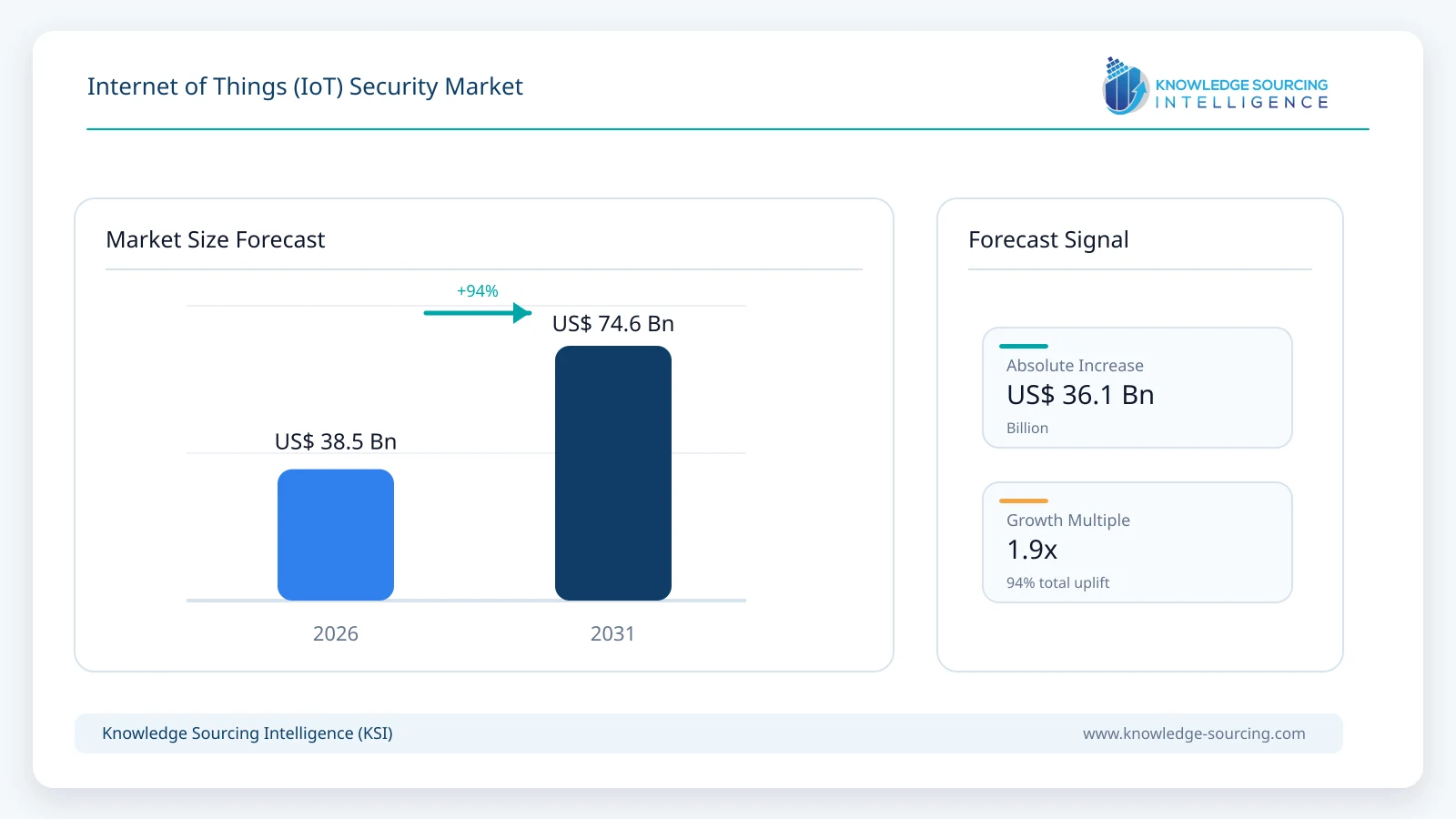
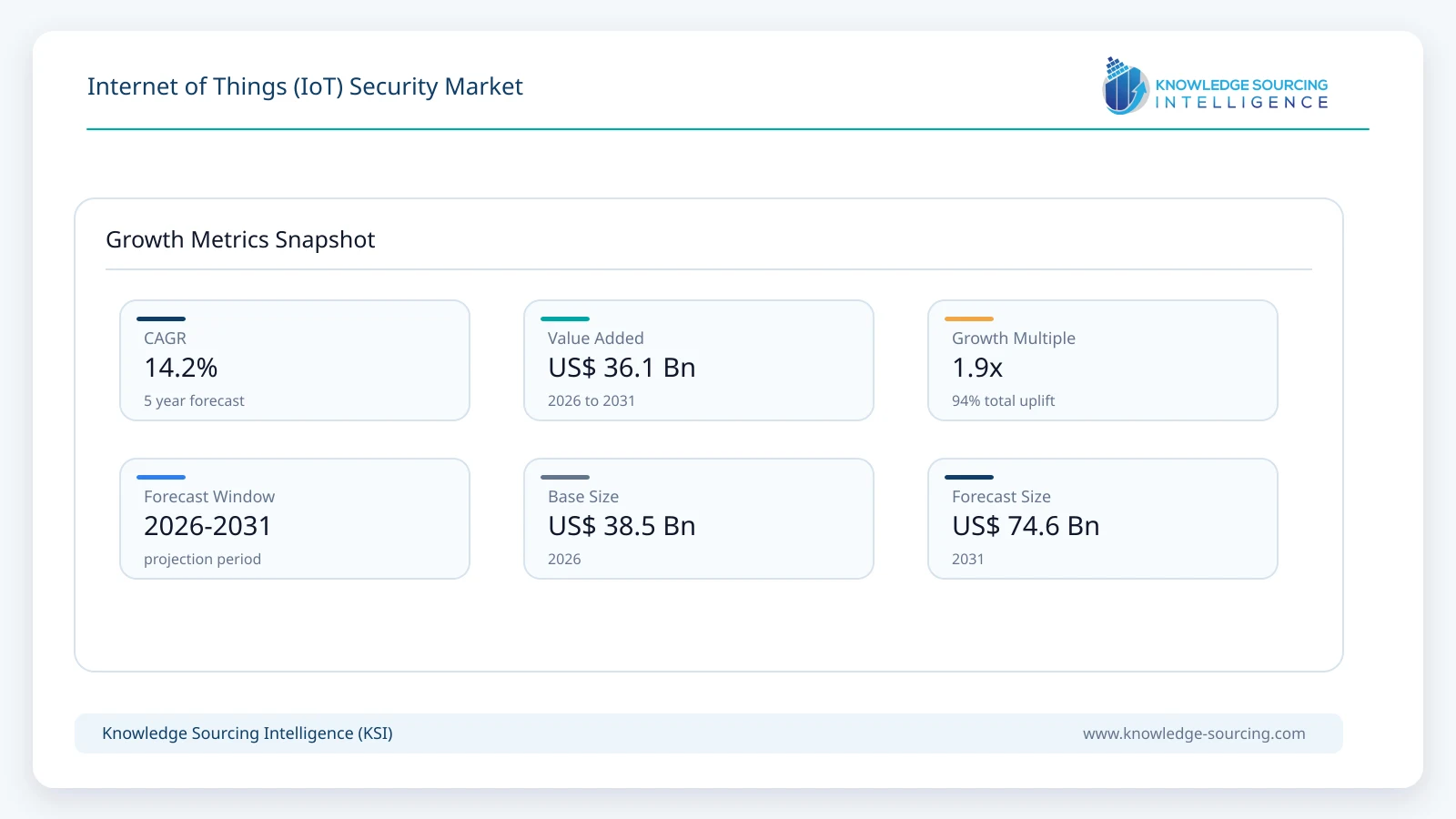
The Internet of Things Security Market is projected to increase from USD 38.47 billion in 2026 to USD 74.61 billion by 2031, growing at a CAGR of 14.2% during forecast period.
Highlights:
- 1Network security represents the largest security segment, while cloud and virtual security is the fastest-growing security type, driven by increasing adoption of cloud-based infrastructure and virtualized environments.
- 2Solutions remain the largest contributor to market revenue, while services are growing at the fastest rate as organizations seek integration, deployment and managed-security expertise.
- 3Cloud-delivered security-as-a-service accounts for a substantial share of the market, while hybrid edge deployments are gaining traction by combining localized threat detection and enforcement with centralized cloud-based policy management and analytics.
- 4Smart manufacturing is the leading end-user vertical, driven by the growing adoption of connected industrial devices, while energy and utilities is among the fastest-growing verticals due to smart grid modernization and increasing connectivity across energy infrastructure.
- 5North America maintains a strong market position, supported by early enterprise adoption, an established vendor ecosystem and evolving regulatory requirements, while Asia-Pacific is expected to record the fastest growth, driven by smart-city initiatives and large-scale industrial digitalization.
- 6Key trends influencing vendor strategies include the convergence of IT and OT security, the adoption of artificial intelligence for threat detection, and increasingly stringent device-security regulations.
As organizations seek out expertise to inventory, segment and monitor large device estates, solutions make up the bulk of spending, and services are growing at the fastest rate through 2031. Security is most likely to be deployed in the network, as network security is the only security type that can be deployed at the network edge across all devices that cannot run security agents, while cloud and virtual security is the fastest-growing segment.
Cloud-delivered security-as-a-service represented a significant share of the market in 2025 and was expected to expand rapidly; hybrid edge deployments, which leave detection and enforcement close to devices and centralize policy and analytics in the cloud, are also expected to grow rapidly. Smart manufacturing is the biggest vertical, while energy and utilities is one of the fastest-growing verticals, with smart grid and plant operators becoming increasingly connected.
Early enterprise adoption, a limited vendor base and active regulation supported North America's market position in 2025. Volumes of connected devices will surge in Asia-Pacific, with China, India, Japan and Southeast Asia fueling smart-city initiatives and large-scale industrial digitalization in the region, which is expected to experience rapid growth through 2031.
Market Dynamics
Market Drivers
As the number of connected devices in Industry, healthcare, commercial and consumer environments has quickly grown, the scope of attack is expanding at a faster rate than security is being built up, which is driving the need for dedicated IoT discovery, segmentation and monitoring tools.
Integration of operational technology (OT) and IT security stacks is driving organizations to integrate, and bring a unified perspective and policy enforcement, to the previously disjointed worlds of OT and IT, especially in manufacturing, energy and utilities.
Regulations and standards are increasing in security requirements for device manufacturers and operators, such as the EU Cyber Resilience Act, UK Product Security and Telecommunications Infrastructure (PSTI) regime and U.S. Cyber Trust Mark program.
The speed and accuracy of anomaly detection on large, diverse estates is being enhanced by advances in AI-driven threat detection that allows for behavior-based monitoring of devices lacking a security agent.
Market Restraints & Opportunities
There's a huge variety of devices, protocols and vendors, and they're expected to last for years, with limited patchability and compute power, making consistent security challenging to apply and deployment slow in legacy estates.
Lack of professionals knowledgeable of both the cybersecurity environment and industrial or medical device environments, as well as a lack of budget control by the IT or OT or facilities professionals, are still causing delays in adoption.
However, as demand for managed and cloud security continues to increase and the rising zero trust strategy for devices is expanding, along with early planning for the next quantum leap in cryptography, there's significant opportunity for vendors wishing to provide scalable, agentless and automated security.
Key Developments
October 2026: Aqara, a global leader in IoT announced its Canadian retail debut through a new partnership with Canadian Tire.
October 2026: WISeSat.Space Holdings Corp., a space technology company, announced the closing of a $10 million private investment in public equity (PIPE) by SEALSQ Corp, a company that focuses on developing and selling Semiconductors, PKI, and Post-Quantum technology hardware and software products.
Internet of Things (IoT) Security Market Segmentation
The market is segmented by component, security type, deployment mode, end-user vertical, and geography.
By Component
Solutions
Solutions account for the majority of spending, spanning device identity and certificate management, network detection and segmentation, vulnerability management and security analytics tailored to connected-device environments.
Armis, Inc. provides agentless asset visibility and threat detection across IT, OT and IoT devices.
Forescout Technologies, Inc. offers device visibility, classification and network access control for connected assets.
By Security Type
Network Security
Network security holds the largest share because the network edge is often the only uniformly controllable enforcement point for devices that cannot run security agents, making segmentation and traffic monitoring central to most deployments.
Cisco Systems, Inc. offers industrial network visibility and security through its Cyber Vision portfolio.
Fortinet, Inc. supplies network and OT security appliances with segmentation and threat protection for industrial environments.
By End-User Vertical
Smart Manufacturing
Smart manufacturing is the largest vertical, as factories connect machinery, sensors and robotics to enterprise networks and need to protect production continuity while meeting growing regulatory and customer security requirements.
Claroty Ltd. specializes in security for industrial and cyber-physical systems, covering asset discovery, risk and threat detection.
Microsoft Corporation provides Defender for IoT for monitoring and securing IoT and OT networks.
Regional Analysis
North America Market Analysis
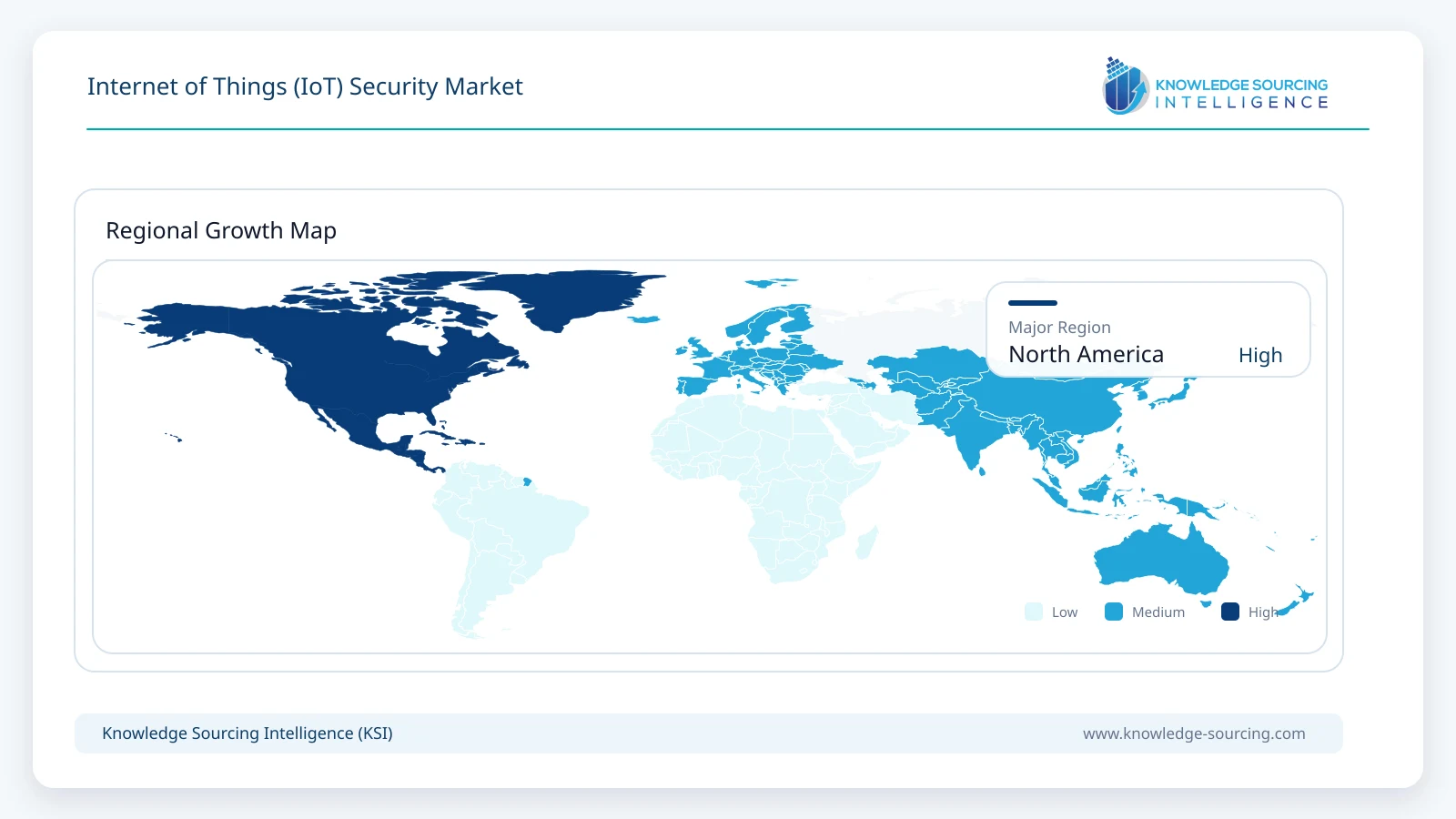
North America accounts for significant share of 2026 revenue, supported by early enterprise adoption, a concentration of leading security vendors and active federal and state attention to device security and critical-infrastructure protection.
Europe Market Analysis
Europe's market is shaped by regulation, notably the Cyber Resilience Act and NIS2, which are raising security obligations for manufacturers and operators across industrial, healthcare and critical-infrastructure sectors.
Asia-Pacific Market Analysis
Asia-Pacific is forecasted to grow fastest through 2031, driven by large-scale industrial digitalization, smart-city programs and rapidly expanding connected-device volumes in China, India, Japan and Southeast Asia.
Middle East and Africa Market Analysis
The Middle East and Africa are seeing rising investment in IoT and OT security as Gulf states advance smart-city, energy and utilities modernization programs and national cybersecurity strategies.
South America Market Analysis
South America is a developing market, with utilities, telecommunications operators and manufacturers in Brazil and neighboring countries increasing spending on connected-device protection as digitalization expands.
List of Companies
Cisco Systems, Inc.
Palo Alto Networks, Inc.
Fortinet, Inc.
Microsoft Corporation
IBM Corporation
Check Point Software Technologies Ltd.
Thales Group
Armis, Inc.
Claroty Ltd.
Forescout Technologies, Inc.
Trend Micro Incorporated
Nozomi Networks Inc.
Competitive Landscape
Cisco Systems, Inc.
Cisco combines industrial networking with security visibility and segmentation, using its installed network base to extend protection to OT and IoT environments through Cyber Vision and its broader security portfolio.
Armis, Inc.
Armis focuses on agentless discovery and risk management of all connected assets, positioning itself as a unified visibility layer across IT, OT, IoT and medical devices.
Claroty Ltd.
Claroty specializes in cyber-physical systems security, serving industrial, healthcare and critical-infrastructure customers with asset discovery, exposure management and threat detection.
Thales Group
Thales supplies device identity, encryption, key management and secure connectivity technologies that underpin trust in IoT deployments, including embedded and cloud-based credential management.
Analyst View
The IoT Security market is expanding to become a foundational component of an enterprise and industrial cyber defense. While many devices aren't capable of running security software, network-centric/agentless security is the dominant model, with cloud security and hybrid edge models gaining momentum as estates expand. Market size estimates vary widely by scope and should be interpreted in the context of scope when determining what to buy or invest in. Steady regulatory changes are turning good practice into law and the growing IT and OT security convergence is driving a change in vendor approach to unified visibility and enforcement.
Internet of Things (IoT) Security Market Scope:
| Report Metric | Details |
|---|---|
| Total Market Size in 2026 | USD 38.47 billion |
| Total Market Size in 2031 | USD 74.61 billion |
| Forecast Unit | USD Billion |
| Growth Rate | 14.2% |
| Study Period | 2021 to 2031 |
| Historical Data | 2021 to 2024 |
| Base Year | 2025 |
| Forecast Period | 2026 – 2031 |
| Segmentation | Component, Security Type, Deployment Mode, End-User Vertical, Geography |
| Companies |
|
Market Segmentation
By Component
Solutions
Services
By Security Type
Network Security
Cloud / Virtual Security
Endpoint Security
Application Security
Others
By Deployment Mode
Cloud / SECaaS
On-Premises
Hybrid Edge
By End-User Vertical
Smart Manufacturing
Energy & Utilities
Healthcare
Smart Cities & Transportation
Others
By Geography
North America
USA
Canada
Mexico
South America
Brazil
Others
Europe
Germany
France
United Kingdom
Others
Middle East and Africa
UAE
Saudi Arabia
Others
Asia Pacific
China
India
Japan
Others
Table of Contents
1. EXECUTIVE SUMMARY
2. MARKET SNAPSHOT
2.1. Market Overview
2.2. Market Definition
2.3. Scope of the Study
2.4. Market Segmentation
3. BUSINESS LANDSCAPE
3.1. Market Drivers
3.2. Market Restraints
3.3. Market Opportunities
3.4. Porter's Five Forces Analysis
3.5. Industry Value Chain Analysis
3.6. Policies and Regulations (EU Cyber Resilience Act, NIS2, UK PSTI, US Cyber Trust Mark)
3.7. Strategic Recommendations
4. TECHNOLOGICAL OUTLOOK
4.1. Agentless Device Discovery & Behavioral Analytics
4.2. IT/OT Security Convergence
4.3. Device Identity & PKI
4.4. Post-Quantum Cryptography Readiness
5. IOT SECURITY MARKET BY COMPONENT
5.1. Introduction
5.2. Solutions
5.3. Services
6. IOT SECURITY MARKET BY SECURITY TYPE
6.1. Introduction
6.2. Network Security
6.3. Cloud / Virtual Security
6.4. Endpoint Security
6.5. Application Security
6.6. Others
7. IOT SECURITY MARKET BY DEPLOYMENT MODE
7.1. Introduction
7.2. Cloud / SECaaS
7.3. On-Premises
7.4. Hybrid Edge
8. IOT SECURITY MARKET BY END-USER VERTICAL
8.1. Introduction
8.2. Smart Manufacturing
8.3. Energy & Utilities
8.4. Healthcare
8.5. Smart Cities & Transportation
8.6. Others
9. IOT SECURITY MARKET BY GEOGRAPHY
9.1. Introduction
9.2. North America
9.2.1. USA
9.2.2. Canada
9.2.3. Mexico
9.3. South America
9.3.1. Brazil
9.3.2. Others
9.4. Europe
9.4.1. Germany
9.4.2. France
9.4.3. United Kingdom
9.4.4. Others
9.5. Middle East and Africa
9.5.1. UAE
9.5.2. Saudi Arabia
9.5.3. Others
9.6. Asia Pacific
9.6.1. China
9.6.2. India
9.6.3. Japan
9.6.4. Others
10. COMPETITIVE ENVIRONMENT AND ANALYSIS
10.1. Major Players and Strategy Analysis
10.2. Market Share Analysis
10.3. Mergers, Acquisitions, Agreements, and Collaborations
10.4. Competitive Dashboard
11. COMPANY PROFILES
11.1. Cisco Systems, Inc.
11.2. Palo Alto Networks, Inc.
11.3. Fortinet, Inc.
11.4. Microsoft Corporation
11.5. IBM Corporation
11.6. Check Point Software Technologies Ltd.
11.7. Thales Group
11.8. Armis, Inc.
11.9. Claroty Ltd.
11.10. Forescout Technologies, Inc.
11.11. Trend Micro Incorporated
11.12. Nozomi Networks Inc.
12. APPENDIX
12.1. Currency
12.2. Assumptions
12.3. Base and Forecast Years Timeline
12.4. Key Benefits for the Stakeholders
12.5. Research Methodology
12.6. Abbreviations
Navigate
Trusted by the world's leading organizations











