
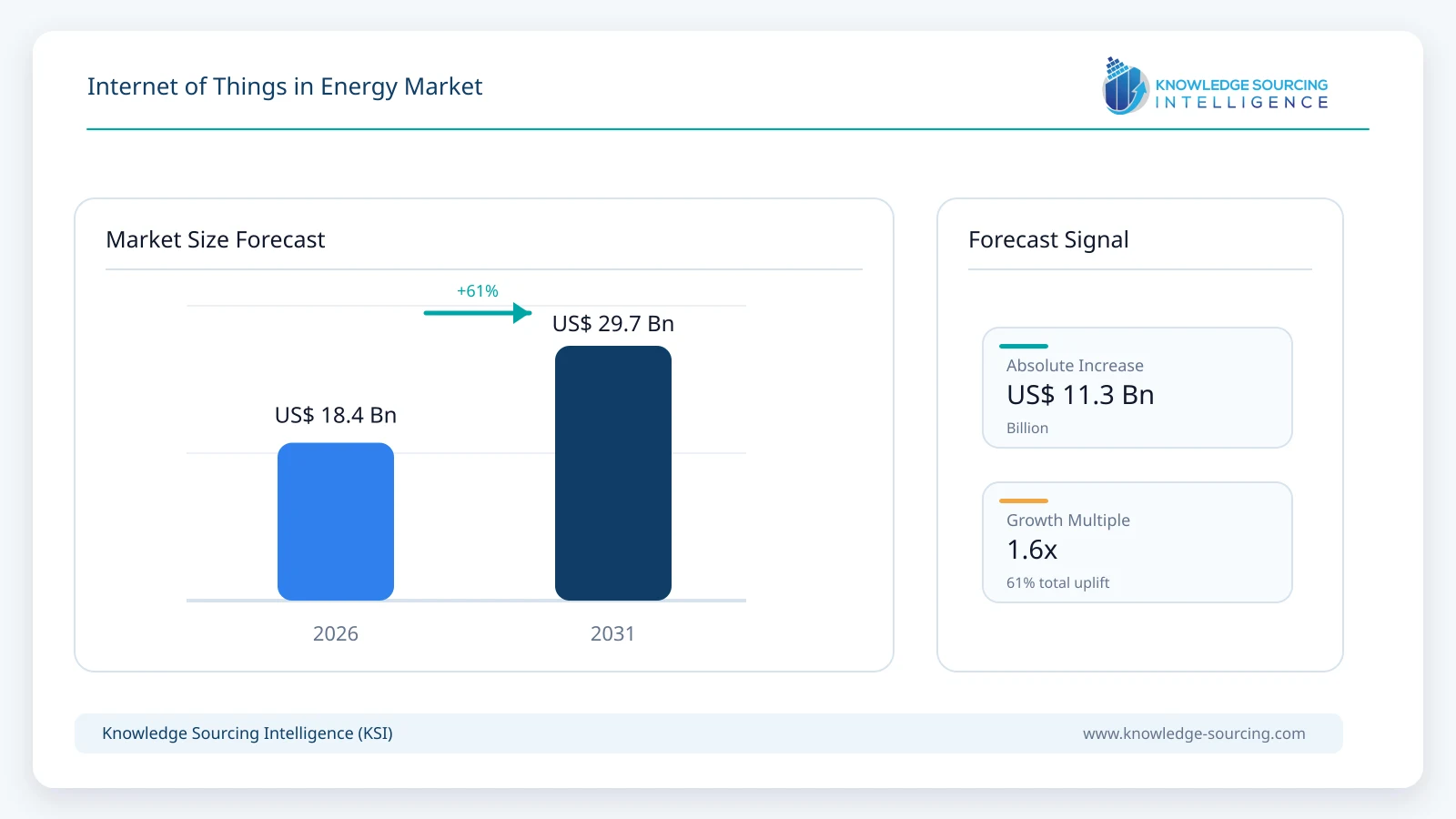
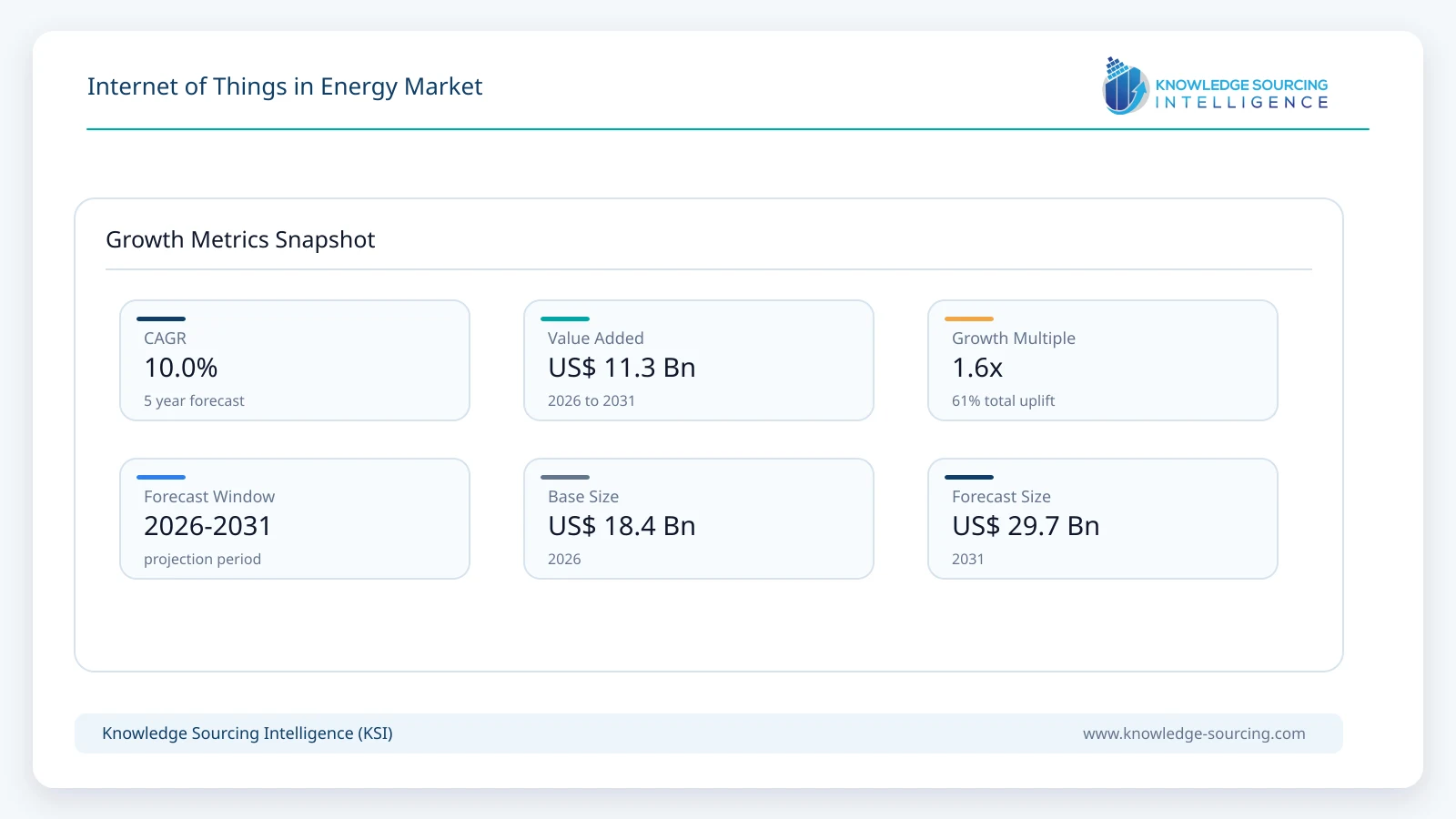
The Internet of Things in the energy market is forecast to grow at a CAGR of 10.0%, reaching USD 29.7 billion in 2031 from USD 18.4 billion in 2026.
Highlights:
- 1Energy companies are deploying sensors, smart meters, intelligent electronic devices (IEDs), communication gateways, and automation controls to monitor and control electricity infrastructure.
- 2As edge computing continues to grow, organizations such as energy companies will process operational information near the asset before transferring selected information to centralized or cloud platforms.
- 3Wind, solar, battery storage, and other distributed energy resources provide their output based on weather and operating conditions and need to be monitored constantly.
- 4There is an increased number of access points into energy infrastructure due to connecting operational equipment to communication networks.
The impact of IoT on energy infrastructure is in monitoring, controlling, maintaining, and optimizing, as traditional energy systems rely on regular maintenance visits and centralized operational controls. IoT-enabled infrastructure collects data from physical assets without a scheduled visit and pushes it to edge or cloud-based platforms.
The energy IoT ecosystem is primarily formed by a combination of sensors, smart meters, industrial gateways (IIoT), communication networks, edge devices, cloud platforms, and analytics software using digital twins and AI applications. These technologies help energy companies in monitoring asset health, prognosis of abnormalities, optimising energy flows, demand forecasting, and operational efficiency.
Electric utilities are among the biggest adoption centers, as modernization of transmission and distribution networks demands more visibility across substations, transformers, feeders, meters, distributed energy resources, and customer-side assets.
Further boosting IoT needs is the growth of renewable power. They are dispersed geographically, like solar and wind assets, and need constant monitoring of generation performance, weather conditions, equipment condition, power quality, and grid interaction.
A parallel IoT ecosystem is being built by the oil and gas industry around connected wells, pipelines, drilling equipment, pumps, compressors, storage facilities, and processing infrastructure. However, the ecosystem is not devoid of challenges, including cybersecurity, interoperability, legacy devices, data governance and connectivity concerns, and costs associated with deploying sensors on larger asset bases.
Market Dynamics
Market Drivers
Rise in grid digitalisation and smart-grid implementation: The connectivity of energy infrastructure is on the rise as utilities adopt new technologies throughout the utility system, including substations, transmission networks, distribution systems, meters and field equipment. The IoT sensors continuously provide information about voltage, current, temperature, vibration, equipment loading, and power quality, along with other operating conditions. The Grid Modernization Initiative of the DOE fosters the development of sophisticated sensing, communications, controls, and analytics that have the potential to enhance grid reliability, flexibility, and resilience. This is driving the demand for connected hardware, industrial communication systems, edge computing, and energy-management software.
Increasing Need for Predictive Maintenance: All energy assets like transformers, turbines, generators, compressors, pumps, pipelines, and switchgear must be maintained regularly to ensure that there are no unplanned outages. IoT sensors enable businesses to monitor aspects such as temperature, vibration, pressure, oil condition, acoustic signals, and other operating parameters. Analytics platforms can then detect anomalous patterns and enable predictive maintenance before equipment failure.
Expansion of Renewable Power Generation: Further demand for connected monitoring and control systems is being driven by growing deployment of wind and solar generation. Renewable assets are geographically dispersed collectively and evolve quite rapidly. Data on turbines, inverters, trackers, weather stations, batteries, transformers, and grid-interconnection equipment is made available to operators via IoT systems.
Smart Metering and AMI Growth: Smart meters are the making of one of the largest connected-device communities inside electricity networks. Advanced metering infrastructure (AMI) gives utilities detailed insights on everything from consumption to voltage, outages, and network conditions while enabling automated meter reading and other digital services. The EIA's electric utility data disaggregation confirms the massive penetration of AMI in the United States electricity sector. Thus, the rising deployment of AMI is boosting demand for connected hardware, communication platforms, meter-data management software, analytics, and cybersecurity.
Growing Requirement of Real-Time Energy Management: Energy companies have to balance demand with supply, and need real-time information coming from sources to optimise distributed resources, identify abnormal consumption, and better organisation of their operations. Energy management platforms use IoT-enabled connectivity to aggregate data from meters, sensors, building-management systems, distributed energy assets, and industrial equipment. EcoStruxure by Schneider Electric facilitates connection between operational technologies and IoT-enabled devices with the Analytics & Services layer, enabling energy management/operational efficiencies.
Market Restraints & Opportunities
Energy firms run infrastructure with a long life, and many legacy assets were not designed for IoT. Enabling legacy systems to interoperate with newer sensors, gateways, cloud platforms, and analytics often demands extra communications interfaces as well as cybersecurity controls.
Integration costs can be additionally accelerated by interoperability challenges with equipment acquired from different vendors. Attaching once-separate operational assets to enterprise networks and cloud platforms improves cyber coverage.
Large-scale IoT programs require the full stack – sensors, communication infrastructure, edge devices, software platforms, installation and system integration activities. In addition to cybersecurity services to protect your data from unwanted eyes, training your workforce, and maintaining long-term equipment.
The increasing amount of IoT data is opening up possibilities for AI-enabled path forecasting and digital twins. When used in conjunction with AI and digital twins, IoT data can help utilities simulate how equipment behaves, predict whether an emerging fault will become critical, time maintenance to minimize impacts, and make better use of the utility's existing assets.
Key Developments
March 2026: Nordic Semiconductor consolidated its low-power cellular-IoT portfolio with the addition of the nRF92 and nRF93 series, plus a boost to the existing nRF91 series at MWC 2026. Updated Nordic Semiconductor nRF92 integrated LTE-M/NB-IoT, satellite non-terrestrial-network connectivity, edge AI, GNSS, Wi-Fi locationing, and sensor co-processing.
January 2026: Afero partnered with Atmosic Technologies to deliver UltraSecure, UltraLong-Battery-Life IoT Products. The partnership integrated Afero's secure-by-design, end-to-end device-to-cloud platform and Secure Bridge software with Atmosic ultra-low-power Bluetooth Low Energy connectivity and computer chips.
Market Segmentation
The market is segmented by component, connectivity type, application, end user, and geography.
By Component: Hardware
Hardware is the predominant component in the Internet of Things in energy market because connected energy operations rely on physical devices to acquire, process, transmit, and manage operating data.
At the hardware level, there are sensors, smart meters, intelligent electronic devices (IEDs), industrial gateways, controllers, edge computers with embedded technologies to communicate via communication modules and networking equipment (UDP/IP/Modbus), as well as connected monitoring devices.
The Industrial IoT portfolio from Siemens pairs connected products or systems with edge and cloud software for unique use cases to provide the required operational data generated by industrial equipment. Similarly, Schneider Electric has a connected-product ecosystem based on IoT-enabled electrical and automation equipment integrated into its EcoStruxure architecture.
Additionally, the segment is shifting from individual sensors to intelligent, smart connected hardware that supports local processing and communications secured for remote configuration and interoperability with cloud-based analytics platforms.
By Application: Smart Grid Monitoring & Grid Management
Smart Grid Monitoring & Grid Management is a key application because utilities are demanding real-time visibility across generation, transmission, distribution, substations, distributed resources, and customer-side infrastructure.
IoT devices capture data on voltage, current, frequency, temperature, loading, power quality, equipment condition, as well as energy consumption continuously. In addition, the DOE Grid Modernization Initiative advances technologies to increase grid flexibility and resilience through advanced sensing, communications, controls, and analytics.
Cisco utility networking architecture also accommodates distribution automation, substation automation, AMI, DERs, and other connected utility applications. The segment is witnessing greater integration of IoT with edge computing and AI so that utilities can identify abnormal network conditions much faster and automate operational responses.
By End User: Electric Utilities
Electric utilities are the largest end-user segment, as electricity networks are a vast distributed infrastructure needing real-time monitoring and self-healing.
Utilities are rolling out the IoT into transformers, substations, transmission lines, distribution feeders, as well as smart meters and renewable-energy facilities, battery systems, and DER networks.
The EIA's utility data show that while AMI represents only a small portion of the smart grid landscape, it creates a vast connected ecosystem at the distribution system and customer interface in the U.S. The segment is also being integrated by grid modernization as utilities require clearer visibility governing renewable generation, EV charging, distributed energy resources, power-quality needs, and shifting load profiles.
Regional Analysis
North America Market Analysis
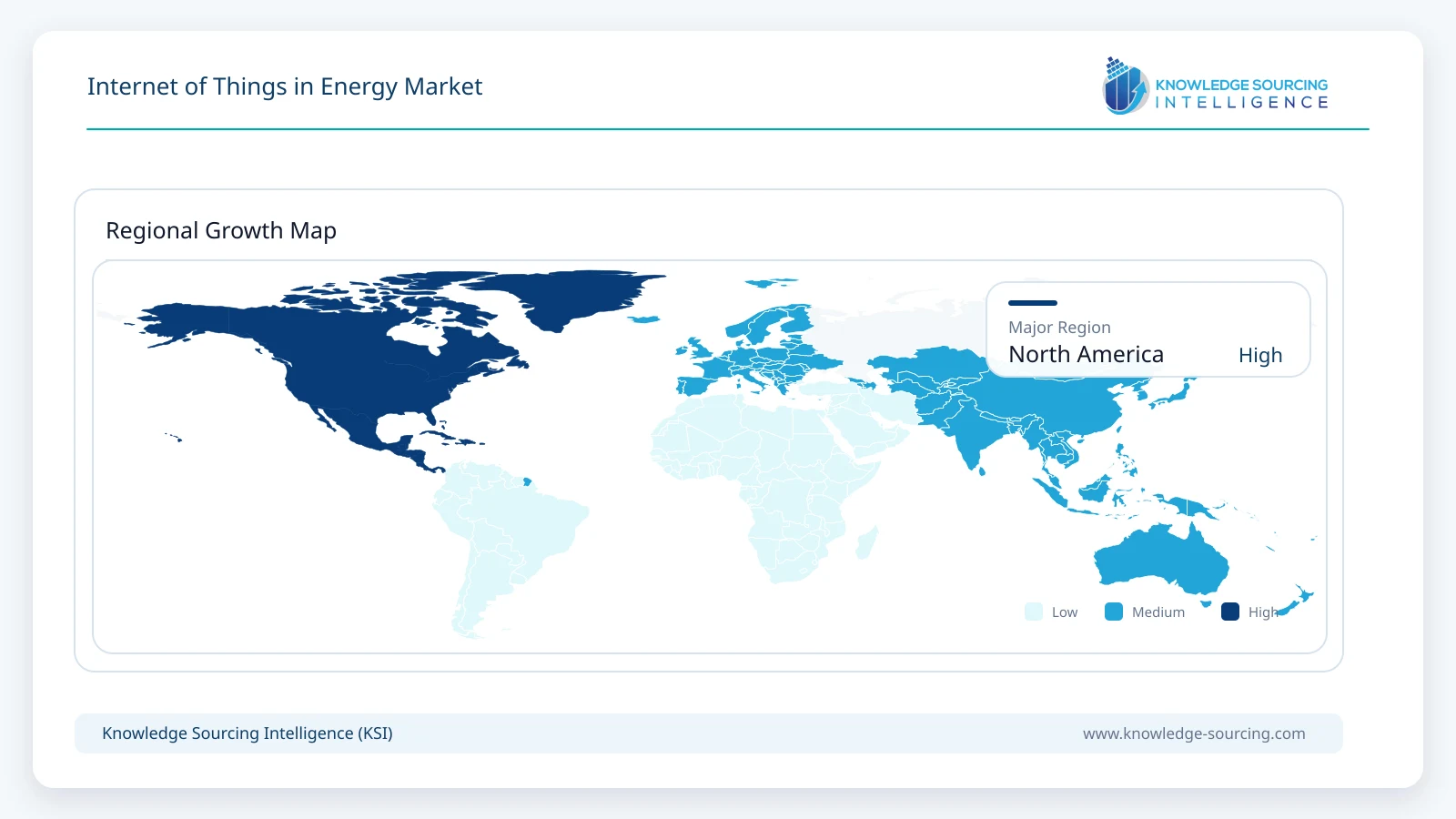
North America is a mature IoT-in-energy market with significant smart-metering, grid-automation, SCADA cloud, and data-analytics infrastructure already in place by utilities. The market is driven by modern grid programs supported by renewable integration, smart meter deployment, DER growth, and growing investments in grid resilience.
South America Market Analysis
In South America, the emergence of the IoT-in-energy market is driven by utilities upgrading grids, adding more renewable generation, and growing automation facilities. The largest opportunity in Brazil relates to its vast electricity grid, large existing hydro-generation fleet, and increasing amounts of wind & solar resources.
Europe Market Analysis
Europe has a substantial IoT-in-energy market with high-tech potential, full of smart meters, renewable growth, energy efficiency drives, and grid digitalization. Germany, the UK, France, Spain, Italy, and Nordic countries are building progressively digital electricity grids and connected infrastructure to support renewable generation and allow greater energy resource independence.
Middle East and Africa Market Analysis
Middle East & Africa development is driven by smart-city programs, renewables, digital utility modernization, and investment in water and electricity infrastructure. Connected energy-management and monitoring systems for various uses are expected to grow, especially in the UAE and Saudi Arabian markets, as smart-city development strategies grow in these regions and large-scale solar power plants emerge.
Asia Pacific Market Analysis
Asia Pacific is one of the fastest-developing IoT-in-energy markets as the region uniquely marries strong electricity-demand growth coupled with some of the world's largest-scale renewable deployment, broad industrialization, and a comprehensive modernization of grid activities. China has the biggest electricity system, a lot of renewable-generation capacity, heavy smart-grid investments, and a massive industrial IoT ecosystem.
List of Companies
Siemens AG
Schneider Electric
ABB
General Electric
Honeywell
Cisco
IBM
Microsoft
Amazon
PTC
Siemens AG
Siemens is a key player in energy IoT due to its offering of industrial automation, digitalization, edge computing, and asset-management portfolio. Its Industrial IoT ecosystem enables industrial assets to connect with the edge and cloud technologies, providing organizations an avenue to gather operational data and leverage analytics for asset performance and process optimization.
Schneider Electric
Schneider Electric has an obvious route to strong positioning in energy IoT, through its EcoStruxure architecture. EcoStruxure integrates connected products, edge control, and applications with analytics & services to help organizations connect electrical and industrial assets to digital management platforms.
ABB
ABB is entering the energy IoT space through ABB Ability, its brand of digital offering which connects electrical and industrial automation assets with monitoring, analytics, and services. ABB Ability enables remote asset monitoring at the device level, providing predictive maintenance and applications to optimize performance and decision-making in operation across energy & industrial use cases.
Analyst View
Over the next year, the Internet of Things in Energy market is moving from simple asset connection to embedded ecosystems connecting sensors, edge computing, cloud platforms, AI, and cybersecurity. The adoption is being accelerated by smart-grid modernization, renewable integration, and smart metering and predictive maintenance. Additionally, Utilities are the main supply center, and oil and gas and renewable plants are emerging in the application of IoT solutions.
Internet of Things in Energy Market Scope:
| Report Metric | Details |
|---|---|
| Total Market Size in 2026 | USD 18.4 billion |
| Total Market Size in 2031 | USD 29.7 billion |
| Forecast Unit | USD Billion |
| Growth Rate | 10.0% |
| Study Period | 2021 to 2031 |
| Historical Data | 2021 to 2024 |
| Base Year | 2025 |
| Forecast Period | 2026 – 2031 |
| Segmentation | Component, Connectivity Type, Application, End User, Geography |
| Companies |
|
Market Segmentation
By Component
Hardware
Software
Services
By Connectivity Type
Wired
Wireless
By Application
Smart Grid Monitoring & Grid Management
Energy Management Systems
Predictive Maintenance & Asset Performance Management
Smart Metering & AMI
Others
By End User
Electric Utilities
Oil & Gas
Renewable Power Plants
Others
By Geography
North America
USA
Canada
Mexico
South America
Brazil
Argentina
Others
Europe
United Kingdom
Germany
France
Others
Middle East and Africa
Saudi Arabia
UAE
Others
Asia Pacific
China
Japan
India
South Korea
Others
Table of Contents
1. EXECUTIVE SUMMARY
2. MARKET SNAPSHOT
2.1. Market Overview
2.2. Market Definition
2.3. Scope of the Study
2.4. Market Segmentation
3. MARKET DYNAMIC
3.1. Market Drivers
3.2. Market Restraints
3.3. Market Opportunities
3.4. Porter’s Five Forces Analysis
3.5. Industry Value Chain Analysis
4. BUSINESS LANDSCAPE
4.1. Regulatory and Cybersecurity Standards Landscape
4.2. Utility Cybersecurity Investment, Procurement and Pricing Analysis
4.3 Cybersecurity Vendor Ecosystem, Supply Chain and Third-Party Risk Analysis
4.4. Import/ Export Analysis
4.5. Strategic Recommendations
5. TECHNOLOGICAL OUTLOOK
5.1. OT/ICS, SCADA and Industrial Control System Security Technologies
5.2. Identity, Access Control, Data and Zero-Trust Security Technologies
5.3. Threat Intelligence, Security Analytics and AI-Enabled Cybersecurity Technologies
5.4. Cloud, Edge, DER and Next-Generation Utility Security Technologies
6. INTERNET OF THINGS IN ENERGY MARKET BY COMPONENT
6.1. Introduction
6.2. Hardware
6.3. Software
6.4. Services
7. INTERNET OF THINGS IN ENERGY MARKET BY CONNECTIVITY TYPE
7.1. Introduction
7.2. Wired
7.3. Wireless
8. INTERNET OF THINGS IN ENERGY MARKET BY APPLICATION
8.1. Introduction
8.2. Smart Grid Monitoring & Grid Management
8.3. Energy Management Systems
8.4. Predictive Maintenance & Asset Performance Management
8.5. Smart Metering & AMI
8.6. Others
9. INTERNET OF THINGS IN ENERGY MARKET BY END USER
9.1. Introduction
9.2. Electric Utilities
9.3. Oil & Gas
9.4. Renewable Power Plants
9.5. Others
10. INTERNET OF THINGS IN ENERGY MARKET BY GEOGRAPHY
10.1. Introduction
10.2. North America
10.2.1. USA
10.2.2. Canada
10.2.3. Mexico
10.3. South America
10.3.1. Brazil
10.3.2. Argentina
10.3.3. Others
10.4. Europe
10.4.1. United Kingdom
10.4.2. Germany
10.4.3. France
10.4.4. Others
10.5. Middle East and Africa
10.5.1. Saudi Arabia
10.5.2. UAE
10.5.3. Others
10.6. Asia Pacific
10.6.1. China
10.6.2. Japan
10.6.3. India
10.6.4. South Korea
10.6.5. Others
11. COMPETITIVE ENVIRONMENT AND ANALYSIS
11.1. Major Players and Strategy Analysis
11.2. Market Share Analysis
11.3. Mergers, Acquisitions, Agreements, and Collaborations
11.4. Competitive Dashboard
12. COMPANY PROFILES
12.1. Siemens AG
12.2. Schneider Electric
12.3. ABB
12.4. General Electric
12.5. Honeywell
12.6. Cisco
12.7. IBM
12.8. Microsoft
12.9. Amazon
12.10. PTC
13. APPENDIX
13.1. Currency
13.2. Assumptions
13.3. Base and Forecast Years Timeline
13.4. Key benefits for the stakeholders
13.5. Research Methodology
13.6. Abbreviations
Navigate
Trusted by the world's leading organizations











