
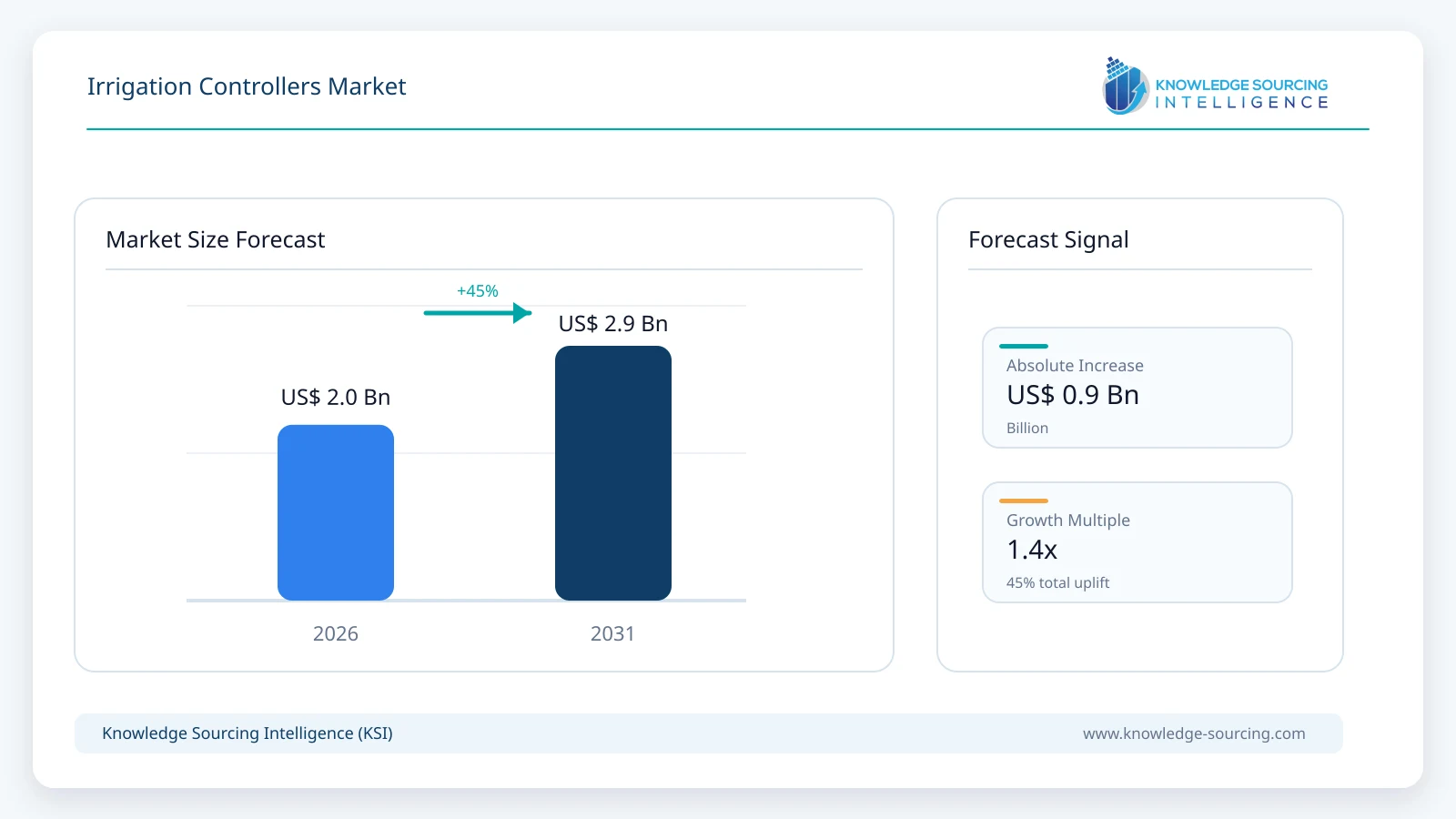
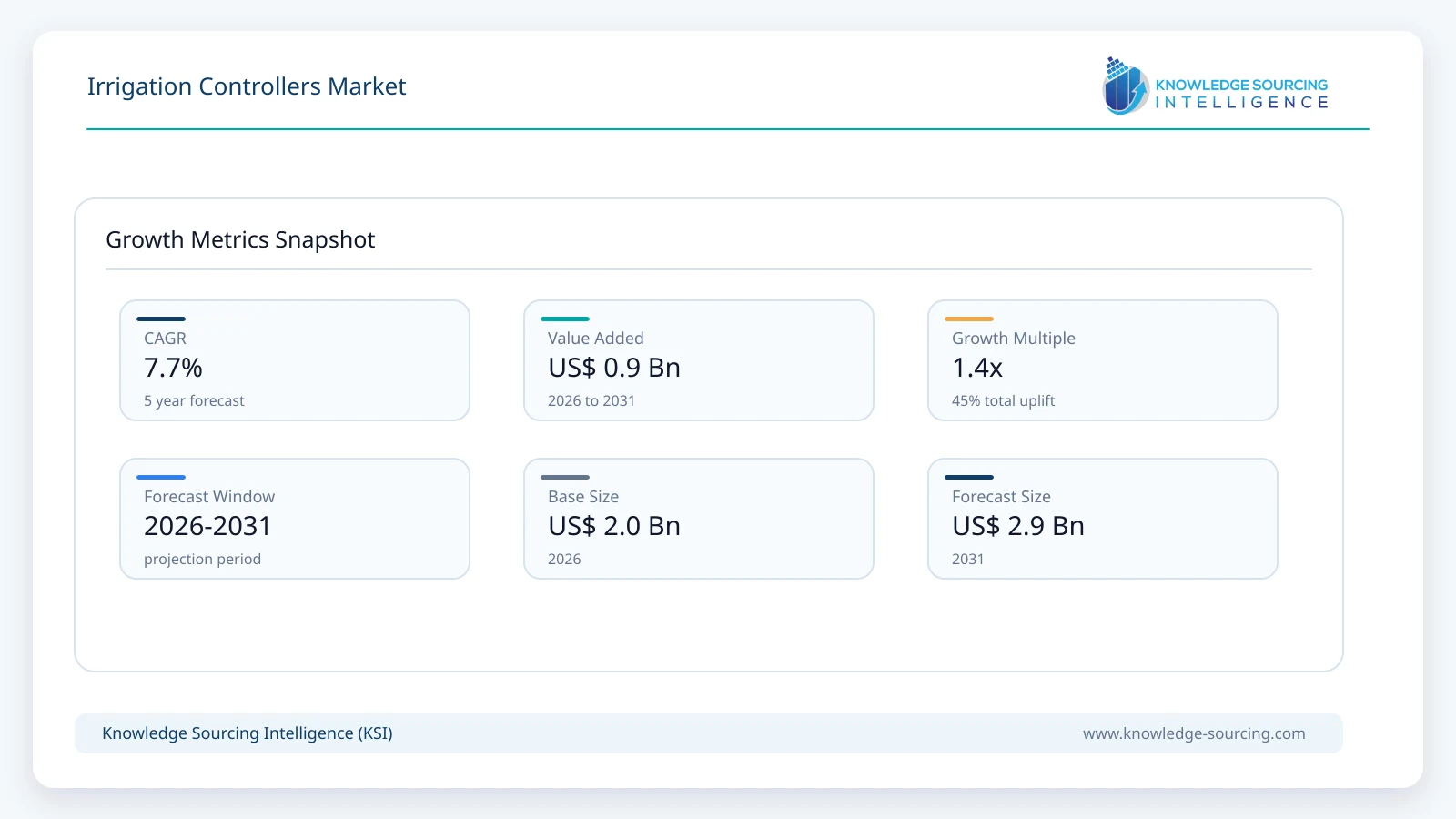
The irrigation controllers market is forecast to grow at a CAGR of 7.7%, reaching USD 2.87 billion in 2031 from USD 1.98 billion in 2026.
Highlights:
- 1Global water scarcity and 70% agricultural withdrawal drive a mandatory shift to smart controllers.
- 2EPA WaterSense + California MWELO 2025 create enforceable demand across North America.
- 3Rain Bird acquired Rachio in 2025, consolidating leadership in connected controllers.
- 4Weather-based and sensor-based units now dominate due to rebate eligibility and compliance.
- 5Non-agricultural segment (residential + turf) surpasses agriculture in mature markets.
- 6Utility rebates often cover 50-100% of the cost, making smart controllers cheaper than basic timers.
The irrigation controller sector has shifted from mechanical timers to connected, data-driven systems that respond to actual plant water needs. This transition is not optional; it is compelled by physical limits on freshwater availability and by regulations that penalize inefficiency. Controllers that once served as convenience features are now infrastructure tools for compliance, cost containment, and resource stewardship. The market, therefore, rewards devices that verifiably reduce consumption without requiring constant human oversight. Weather-based and sensor-based systems dominate because they alone meet the performance thresholds set by EPA WaterSense, SWAT protocols, and state-level ordinances. Demand is strongest where water costs or restrictions are highest, and weakest where supplies remain abundant or unmetered.
Irrigation Controllers Market Analysis:
Growth Drivers
Water scarcity operates as the primary demand driver and is no longer a regional phenomenon. UNESCO and UN-Water confirm that irrigation accounts for approximately 70% of global freshwater withdrawals, with inefficiency rates frequently exceeding 50% under conventional scheduling. Controllers that use real-time evapotranspiration data or soil moisture feedback eliminate the largest sources of waste: overwatering during cool periods, irrigation after rainfall, and uniform application across variable soil types. Every percentage point of efficiency gained translates directly into lower pumping costs for growers and lower tariff exposure for municipalities, creating immediate economic justification for upgrading.
Regulatory mandates convert latent need into actual purchases. The EPA WaterSense specification remains the single most influential standard worldwide because hundreds of U.S. utilities tie rebates to it. A WaterSense-labeled controller routinely qualifies for $100–$300 in direct incentives, often sufficient to offset the entire incremental cost over a basic timer. California's MWELO, strengthened in 2025, goes further by making compliant controllers mandatory rather than optional for landscape projects above the threshold size. Similar prescriptive requirements now exist in Arizona, Nevada, Texas, and Florida through local adaptations of the ordinance. In each case, the regulation does not merely encourage smart controllers, it creates a non-compliance penalty that makes traditional timers economically unviable.
Technological maturation has removed the remaining friction. Cellular and Wi-Fi connectivity is now standard rather than premium. Battery-powered soil moisture sensors operate reliably for 5–10 years. Cloud platforms deliver local evapotranspiration data with hyper-local accuracy. These advances mean that controllers can be installed in remote agricultural fields or urban medians without dedicated power or network infrastructure. The result is a sharp reduction in perceived risk, which has historically suppressed adoption more than device cost.
Finally, corporate consolidation and product integration are accelerating replacement cycles. Rain Bird's 2025 acquisition of Rachio brought a leading consumer brand under the same umbrella as professional-grade hardware, allowing utilities to offer a single rebate-eligible portfolio spanning residential to commercial agriculture. Similar cross-segment strategies from Hunter (Hydrawise platform) and Toro (Tempus Automation) ensure that specifiers encounter compliant, connected controllers as the default option.
Challenges and Opportunities
The dominant challenge remains upfront cost disparity. A premium weather-based controller with cellular connectivity costs 4–8 times more than a basic mechanical timer. In developing regions or in low-margin cropping systems, payback periods can exceed five years even with 30% water savings. Lack of reliable rural broadband and cellular coverage further complicates the deployment of cloud-dependent devices. Many growers in South America and South Asia continue to view controllers as unnecessary luxury rather than essential risk-management tools.
Supply chain concentration presents another risk. Over 60% of global printed circuit board assembly and sensor production occurs in East Asia. Any recurrence of pandemic-era disruptions or trade restrictions would constrain the availability of mid- to high-end controllers within months. Plastic housing costs track petroleum prices, adding volatility.
These challenges, however, define the largest opportunities. Manufacturers that develop robust offline-capable controllers with long-range LoRa or satellite backhaul can capture a share in precisely where cellular networks are weakest, large-scale agriculture in Brazil, India, and sub-Saharan Africa. Companies that bundle controllers into financed water-as-a-service packages eliminate the capital barrier entirely. Netafim and Lindsay Corporation already demonstrate success with this model in drip systems; extending it to controller hardware is the logical next step.
Raw Material and Pricing Analysis
Irrigation controllers are electronic devices whose bill of materials is dominated by microcontrollers, Wi-Fi/cellular modules, PCBs, sensors (capacitive soil moisture, tipping-bucket rain gauges), and UV-stabilized plastics. Semiconductor content has risen steadily as manufacturers add AI processing, voice compatibility, and multi-zone flow monitoring.
Post-2022, the semiconductor shortage that doubled lead times has largely resolved. By late 2025, spot prices for common ARM Cortex-M series chips used in controllers will have returned to 2019 levels. Memory and power management ICs remain occasionally constrained, but stockpiling by major players (Rain Bird, Hunter, Toro) has prevented retail price spikes.
Plastic resins (ABS, polycarbonate) correlate strongly with crude oil. The 2025 stabilization of oil between $70–$85 per barrel has kept housing costs predictable. Sensor pricing is the most favorable trend: capacitive soil moisture sensors that cost $18–$22 in 2020 now routinely sell for $8–$11 in volume, enabling manufacturers to add secondary sensors (flow, pressure) without a meaningful retail price increase.
Overall, controller pricing has therefore flattened or declined slightly in real terms since 2023. Average retail price for a professional-grade 12-zone weather-based controller sits at $450–$650, while residential smart models cluster at $250–$350. Rebates frequently reduce effective end-user cost below that of traditional timers.
Supply Chain Analysis
The supply chain remains bifurcated between high-volume commodity components (Asia-centric) and final assembly/branding (regionalized.
Key PCB and semiconductor fabrication occurs in China, Taiwan, and South Korea. Sensor production is more distributed: Israel (Galcon capacitive probes), USA (Irrometer, Decagon legacy lines), and increasingly India for cost-sensitive units.
Final assembly shows clear geographic patterns:
North America: Hunter, Toro, Rain Bird, Rachio (now Rain Bird), Weathermatic, HydroPoint – all maintain U.S. factories for professional and municipal products.
Israel: Netafim, Galcon, and multiple smaller players dominate high-end drip and controller integration.
China: Increasing private-label and OEM production for big-box retail channels, though premium brands avoid full dependency through multi-source strategies.
Logistical complexity is moderate compared to consumer electronics. The main vulnerabilities are port congestion (still occasional in 2025) and component allocation during peak spring demand. Most manufacturers now hold 4–6 months of safety stock for critical ICs, effectively insulating retail availability from short disruptions.
Government Regulations
Jurisdiction | Key Regulation / Agency | Market Impact Analysis |
|---|---|---|
United States | EPA WaterSense Specification (weather-based & soil moisture-based controllers) | Creates de facto national standard. Over 400 utilities tie rebates to WaterSense certification, driving 60–80% of residential and light commercial upgrades in participating districts. Non-certified controllers effectively excluded from incentive programs. |
California, USA | Model Water Efficient Landscape Ordinance (MWELO), updated January 2025 – California Department of Water Resources | Mandates ET or soil moisture-sensor controllers for virtually all new/rehabilitated landscapes ?500 sq ft. Direct enforceable demand; contractors stock only compliant models to avoid project delays and fines. |
Texas, USA | Municipal ordinances in San Antonio, Austin, Dallas requiring smart controllers for permits >1 acre | Rapidly expanding mandatory segment; municipal spec books now list only WaterSense or SWAT-tested devices. |
Australia | Water Efficiency Labelling and Standards Scheme (WELS) + state drought plans | Requires minimum star ratings; smart controllers routinely achieve 5–6 stars, qualifying for highest rebates and mandatory use in new developments. |
European Union | EU Water Framework Directive + national implementation plans (Germany, France, Spain) | Indirect but growing impact through subsidies for precision irrigation; controllers increasingly required to access CAP eco-scheme payments. |
India | Per Drop More Crop component of PMKSY (Pradhan Mantri Krishi Sinchayee Yojana) | Subsidies up to 55% for drip/sprinkler systems including controllers in targeted states; has driven mass adoption of basic sensor-based units in Gujarat, Maharashtra, Rajasthan. |
Irrigation Controllers Market Segment Analysis:
Weather-Based Controllers
Weather-based (evapotranspiration or ET) controllers remain the dominant smart controller category because they address the largest variable in irrigation demand, daily weather fluctuation, without requiring in-ground infrastructure. These devices receive local weather data via cellular, Wi-Fi, or on-site sensors and calculate theoretical water loss, then adjust runtimes accordingly. The segment commands premium pricing ($400–$800 for professional units) yet achieves the highest rebate eligibility and regulatory compliance.
Demand is strongest where weather is least predictable: the U.S. Southwest, Mediterranean Europe, southeast Australia, and increasingly the Indian monsoon belt. California's MWELO explicitly prioritizes ET controllers, making them the default specification for landscape contractors. Agricultural users favor them in pivot and linear-move systems where precise ET data prevents both under- and over-watering across large fields.
The 2025 consolidation wave has further strengthened the segment: Rain Bird–Rachio merger combines Rachio's superior cloud forecasting algorithms with Rain Bird's professional-grade hardware, creating controllers that routinely outperform older standalone ET models by 8–12% in water savings according to SWAT testing. This technical edge translates directly into higher rebate amounts from utilities that reward verified performance tiers.
Agriculture Application Segment
Agriculture remains the largest volume user of irrigation water globally and therefore the segment with the greatest absolute savings potential from controller deployment. Yet it has historically lagged residential adoption due to scale challenges, unreliable rural connectivity, and conservative equipment replacement cycles.
Three factors are now accelerating agricultural uptake in 2025:
Cellular coverage has reached >95% of U.S. and European farmland; satellite options (Starlink, OneWeb) fill remaining gaps at a viable cost.
Flow-sensing controllers that detect leaks or broken heads have moved from luxury to expected feature, saving growers thousands annually on pumping and yield loss.
Government programs increasingly tie subsidy payments to verifiable water-use efficiency, making controller installation a compliance checkbox rather than discretionary spend.
In high-value permanent crops (nuts, fruits, vineyards), smart controllers routinely achieve 25–40% reduction in applied water while maintaining or improving yields, according to long-term trials by the University of California Cooperative Extension and similar bodies. Large row-crop operations using center-pivot systems see slightly lower percentages (15–25%) but massive absolute volumes saved. The segment growth is therefore concentrated in California almonds, Spanish olives, Australian cotton, and Indian sugarcane regions, combining high water stress with high crop value.
Irrigation Controllers Market Geographical Analysis
United States Market Analysis
The U.S. remains the largest and most mature market, driven by a unique combination of chronic western droughts, high urban water tariffs, and the world's most developed rebate ecosystem. WaterSense-labeled controllers dominate; non-labeled products are effectively excluded from municipal procurement and incentive programs. California alone accounts for roughly 35% of national unit sales due to MWELO and the highest per-acre water costs. Texas and Florida follow, propelled by rapid population growth and aquifer depletion concerns.
Rebate programs have become highly sophisticated: many utilities now offer tiered incentives based on SWOT performance scores, pushing manufacturers toward continuous improvement. The Rain Bird–Rachio merger is expected to further consolidate the residential segment, where Rachio held the strongest market share among millennials and Gen Z homeowners, the demographic driving new single-family construction in Sun Belt states.
Brazil Market Analysis
Brazil possesses the world's largest renewable water resources, yet suffers acute regional scarcity in the Northeast and agricultural heartland during periodic droughts. Irrigation expanded rapidly in the Cerrado since 2015, with center-pivot systems dominating soybean and corn production.
Controller penetration remains low (<20%) but is rising fastest among large corporate farms adopting precision agriculture packages. Netafim and Lindsay Corporation maintain a strong local presence with Portuguese-language platforms and financing partnerships. Government credit lines (Moderfrota, ABC Program) increasingly favor equipment that demonstrates water-use efficiency, creating indirect but growing demand for sensor-based controllers that integrate with variable-rate irrigation.
Germany Market Analysis
Germany represents the most advanced European market for precision irrigation despite relatively abundant rainfall, driven by EU Common Agricultural Policy eco-schemes that pay farmers for verifiable resource efficiency. Controllers are bundled into digital farming platforms from John Deere, AGCO, and local integrators.
Demand concentrates in eastern states, converting from flood to sprinkler/drip systems, and in high-value horticulture (asparagus, berries).
German growers prioritize open-standard protocols (ISOBUS compatibility) and robust cybersecurity over the lowest price, favoring Hunter, Rain Bird, and Galcon professional lines. Cellular coverage is near-universal, and 5G rural rollout accelerates adoption of real-time ET controllers.
Saudi Arabia Market Analysis
Saudi Arabia operates under extreme water scarcity with virtually no renewable freshwater resources. The government has aggressively phased out wheat production and now subsidizes imported feed while pushing maximum efficiency on remaining high-value greenhouse and date production.
Netafim maintains a dominant position through decades of desalination-linked projects. Controllers are effectively mandatory under Saudi Irrigation Organization standards for new developments. Solar-powered, satellite-connected units are increasingly specified to eliminate grid dependency in remote farms. Demand growth remains strong as Vision 2030 targets a 50% reduction in agricultural water use from the 2016 baseline.
India Market Analysis
India's market is volume-driven rather than value-driven, with hundreds of millions of smallholder farmers. The Per Drop More Crop initiative has subsidized drip and sprinkler systems since 2015, increasingly including basic soil-moisture controllers in packages.
Penetration is highest in Maharashtra, Gujarat, and Rajasthan, where groundwater depletion is most severe. Domestic manufacturers dominate the low-cost segment (<$150 units), while Netafim, Jain Irrigation, and international brands serve corporate and export-oriented farms. Cellular IoT networks (Jio, Airtel) now reach most irrigated districts, enabling cloud-connected controllers at viable price points. Government targets aim for 50% of irrigated area under micro-irrigation by 2030, implying sustained double-digit controller growth.
Irrigation Controllers Market Competitive Environment and Analysis:
The competitive landscape consolidated further in 2025 with Rain Bird's acquisition of Rachio, creating a clear tier-one group: Rain Bird/Rachio, Hunter Industries, and The Toro Company. These three command superior utility relationships, the broadest rebate eligibility, and the strongest distribution in big-box retail (Home Depot, Lowe's).
Tier two comprises Israeli specialists (Netafim, Galcon) with unmatched drip integration expertise and Lindsay Corporation for large-scale pivot controls. Weathermatic, HydroPoint, and Calsense maintain strong regional footholds in municipal and commercial segments.
Key strategies observed in 2025–2026:
Rebate maximization: Every major player designs new models to exceed WaterSense and SWAT thresholds by widening margins, ensuring eligibility for highest incentive tiers.
Platform integration: Controllers increasingly serve as data hubs feeding John Deere Operations Center, Climate FieldView, or proprietary agronomic platforms.
Financing partnerships: Bundling controllers into equipment loans or water-as-a-service contracts to overcome capital constraints in developing markets.
Satellite connectivity options: Addressing rural cellular gaps; multiple vendors now certify Starlink or OneWeb compatibility.
Nelson Irrigation and Valmont Industries maintain niche strength in center-pivot integration but lack residential presence.
Overall, the market rewards scale, rebate access, and verifiable performance data. Smaller players survive only with unique geographic strength (Galcon in Israel) or niche focus (Calsense in California municipal retrofits).
The irrigation controller market in 2025 is a mature but still expanding category driven by non-discretionary forces: resource scarcity, regulatory mandates, and verifiable economic payback. Devices that demonstrate consistent 20–40% water savings while simplifying compliance will continue to displace traditional timers. The combination of EPA WaterSense standards, state-level ordinances, and utility rebates has created the world's most robust demand-pull mechanism for water-efficient technologies. Manufacturers that maintain rebate eligibility, supply chain resilience, and open integration standards will capture the majority of growth through the end of the decade.
Irrigation Controllers Market Key Developments:
August 2026: Orbia Netafim launched GrowSphere FLEX, a smart irrigation and fertigation controller designed to bring professional digital farming capabilities to smallholders and mid-sized farmers.
June 2026: The Toro Company launched its RXC Controller and Oasis irrigation software, providing scalable station capacity and automated runtime optimization for landscape irrigation.
April 2026: Rachio announced a free Zone Upgrade Kit with every Smart Sprinkler Controller purchase, combining its controller with nine Rain Bird rotary nozzles.
February 2026: Aiper began shipping the IrriSense 2, a 4-in-1 multi-zone smart irrigation system integrating irrigation control, sprinkler, valve, and nutrient-feeding functions.
Irrigation Controllers Market Scope:
| Report Metric | Details |
|---|---|
| Total Market Size in 2026 | USD 1.98 billion |
| Total Market Size in 2031 | USD 2.87 billion |
| Forecast Unit | Billion |
| Growth Rate | 7.7% |
| Study Period | 2021 to 2031 |
| Historical Data | 2021 to 2024 |
| Base Year | 2025 |
| Forecast Period | 2026 – 2031 |
| Segmentation | Type, Application, Irrigation Type, Geography |
| Companies |
|
Market Segmentation
By Type
By Application
By Irrigation Type
By Geography
Table of Contents
1. EXECUTIVE SUMMARY
2. MARKET SNAPSHOT
2.1. Market Overview
2.2. Market Definition
2.3. Scope of the Study
2.4. Market Segmentation
3. BUSINESS LANDSCAPE
3.1. Market Drivers
3.2. Market Restraints
3.3. Market Opportunities
3.4. Porter's Five Forces Analysis
3.5. Industry Value Chain Analysis
3.6. Policies and Regulations
3.7. Strategic Recommendations
4. TECHNOLOGICAL OUTLOOK
5. IRRIGATION CONTROLLERS MARKET BY TYPE
5.1. Introduction
5.2. Weather-Based Controllers
5.3. Soil Moisture-Based Controllers
6. IRRIGATION CONTROLLERS MARKET BY APPLICATION
6.1. Introduction
6.2. Agriculture
6.3. Non-Agriculture
7. IRRIGATION CONTROLLERS MARKET BY IRRIGATION TYPE
7.1. Introduction
7.2. Sprinkler Irrigation
7.3. Drip Irrigation
7.4. Others
8. IRRIGATION CONTROLLERS MARKET BY GEOGRAPHY
8.1. Introduction
8.2. North America
8.2.1. United States
8.2.2. Canada
8.2.3. Mexico
8.3. South America
8.3.1. Brazil
8.3.2. Argentina
8.3.3. Others
8.4. Europe
8.4.1. United Kingdom
8.4.2. Germany
8.4.3. France
8.4.4. Italy
8.4.5. Spain
8.4.6. Others
8.5. Middle East and Africa
8.5.1. Saudi Arabia
8.5.2. United Arab Emirates
8.5.3. Others
8.6. Asia Pacific
8.6.1. China
8.6.2. Japan
8.6.3. India
8.6.4. South Korea
8.6.5. Taiwan
8.6.6. Thailand
8.6.7. Indonesia
8.6.8. Others
9. COMPETITIVE ENVIRONMENT AND ANALYSIS
9.1. Major Players and Strategy Analysis
9.2. Market Share Analysis
9.3. Mergers, Acquisitions, Agreements, and Collaborations
9.4. Competitive Dashboard
10. COMPANY PROFILES
10.1. Galcon
10.2. HydroPoint Data Systems, Inc.
10.3. Rachio, Inc.
10.4. Valmont Industries, Inc.
10.5. The Toro Company
10.6. Hunter Industries
10.7. Netafim
10.8. Lindsay Corporation
10.9. Nelson Irrigation Corporation
10.10. Weathermatic
10.11. Calsense
11. RESEARCH METHODOLOGY
LIST OF FIGURES
LIST OF TABLES
Navigate
Trusted by the world's leading organizations











