
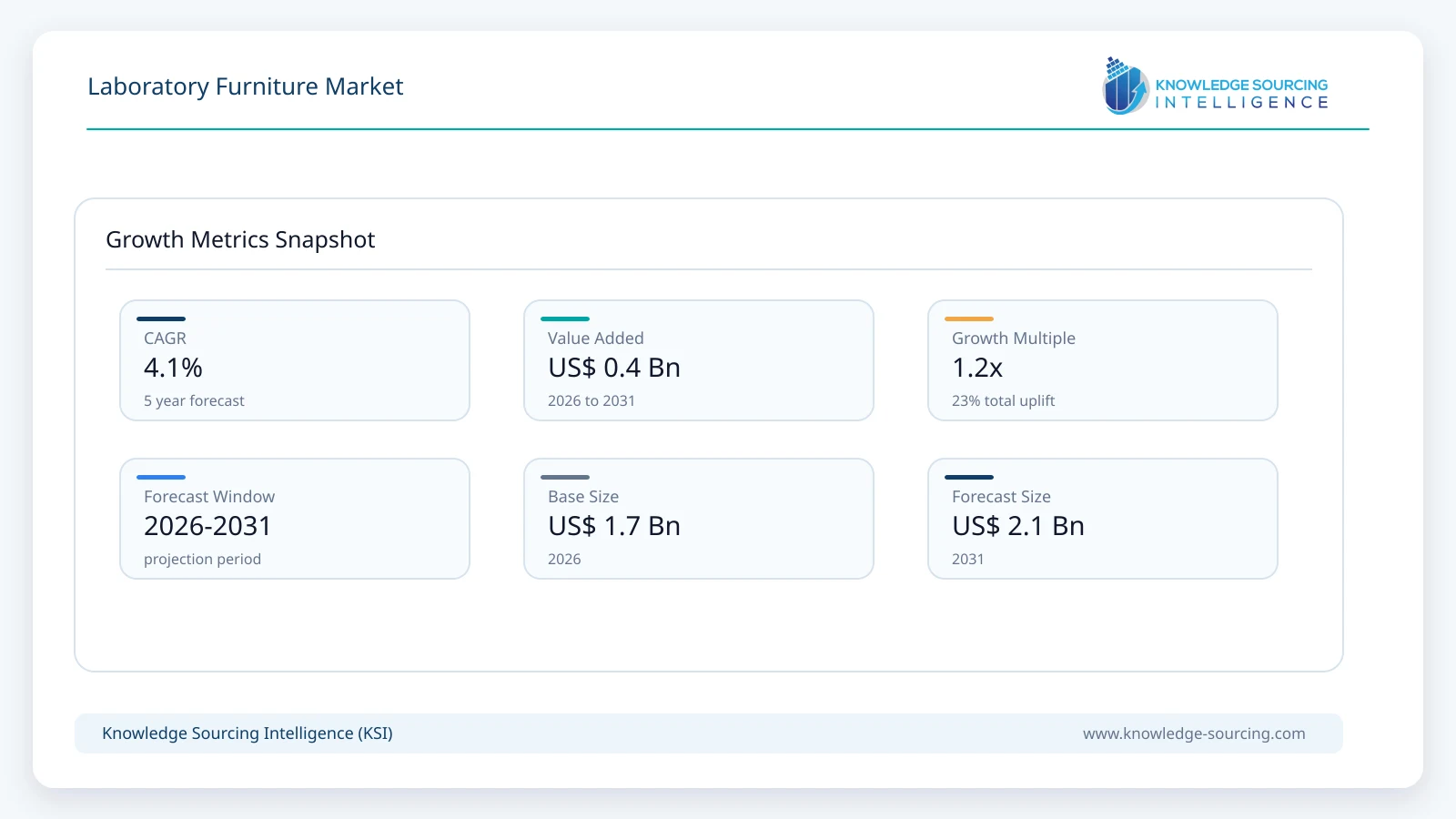
The Laboratory Furniture Market is expected to grow at a CAGR of 4.1%, reaching USD 2.06 billion by 2031 from USD 1.68 billion in 2026.
Highlights:
- 1Laboratory Benches account for approximately 29% of market value in 2026, making them the largest product category.
- 2Fume Hoods are projected to grow at approximately 5.8% annually through 2031, supported by safety, airflow and energy-efficiency requirements.
- 3Pharmaceutical Laboratories remain the largest end-user group, accounting for approximately 38% of 2026 market value.
- 4Government Laboratories are projected to record the strongest growth among major end-users as public R and D infrastructure and scientific facilities expand.
- 5Europe remains the largest regional market because of its established pharmaceutical, chemical, academic and research-infrastructure base.
- 6Asia Pacific records the strongest regional growth, supported particularly by rising R and D spending in China and expanding scientific infrastructure across India and Southeast Asia.
- 7Modular, movable and service-independent furniture is gaining importance because laboratories increasingly need to accommodate changing research programmes without complete refurbishment.
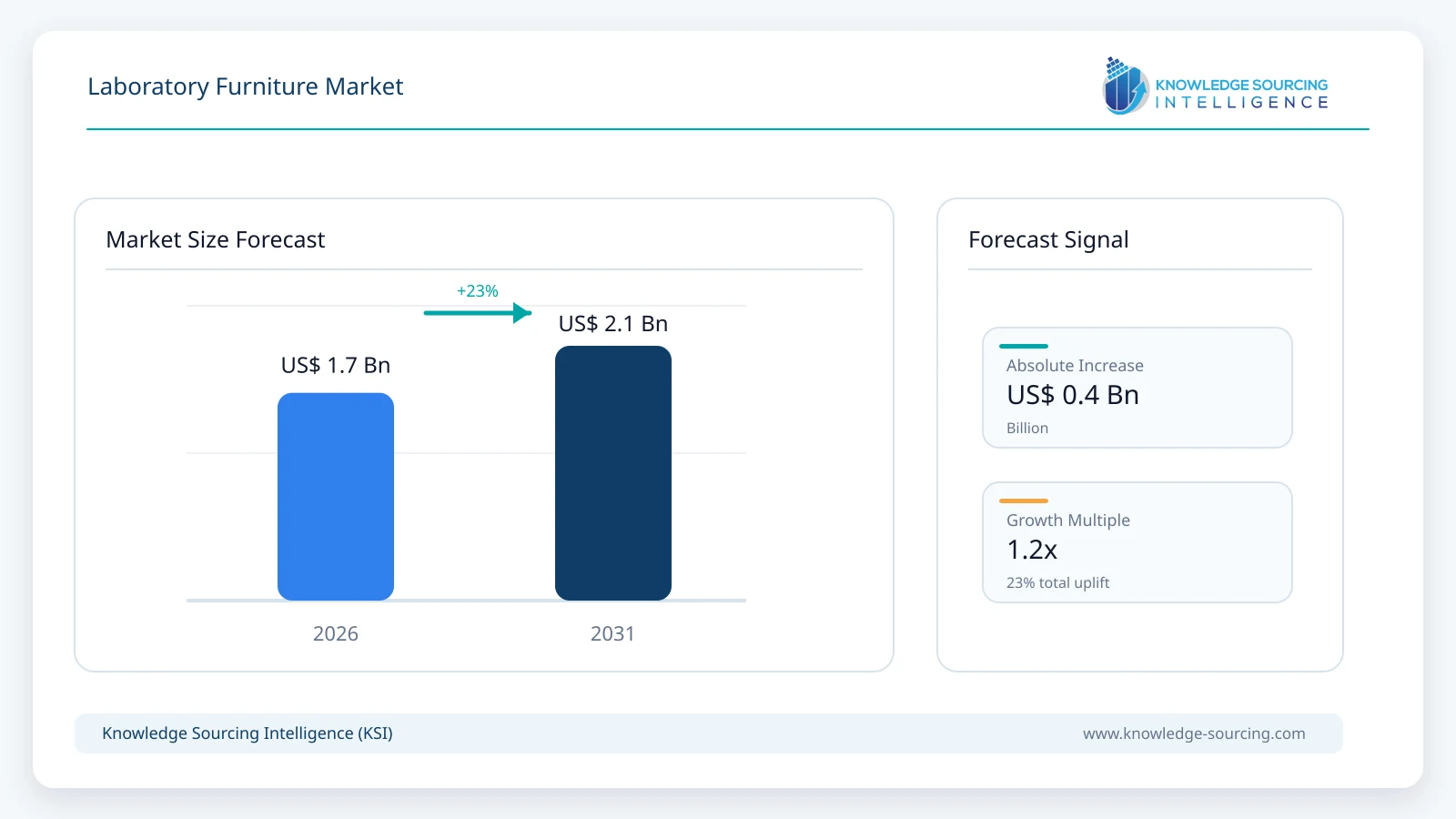
The market includes laboratory benches, storage cabinets, fume hoods, tables, laboratory service systems, stools and related furniture designed for scientific, pharmaceutical, industrial, government and educational laboratories. Growth is supported by continuing investment in research infrastructure, pharmaceutical R&D, academic laboratories and laboratory modernization, while safety, flexibility and energy efficiency are increasingly shaping furniture specifications rather than buyers selecting products primarily on initial cost.
Laboratory benches remain the largest furniture category because almost every wet, analytical, educational or industrial laboratory requires dedicated work surfaces capable of supporting instruments and routine experimental work. Modern benches increasingly use modular frames, replaceable worktops, movable storage and independent service systems so laboratories can be reconfigured when research programmes change. WALDNER, for example, offers bench configurations capable of supporting loads from 200 kg to 500 kg, while Kewaunee markets adaptable systems designed specifically for reuse, relocation and reconfiguration.
Fume hoods represent one of the fastest-growing categories as laboratories place greater emphasis on containment performance, ventilation efficiency and user protection. Newer products increasingly combine lower exhaust-air requirements with digital monitoring and ergonomic controls. WALDNER states that its Secuflow technology can reduce exhaust air requirements by up to 33%, while its 2026 Ventus osciJET launch focuses specifically on balancing safety with resource efficiency.
The wider demand environment remains supportive because research spending continues to rise across major scientific economies. China’s R&D expenditure reached CNY 3.93 trillion in 2025, increasing 8.1% from 2024, while basic research spending rose 11.1%. The U.S. National Science Foundation reported federal R&D and R&D-plant budget authority of USD 199.3 billion in FY2024, and Europe continues to support laboratory and research infrastructure through the Horizon Europe programme.
Market Growth Drivers and Trends
Research Infrastructure Investment Supports New Laboratory Capacity
Laboratory furniture demand is closely linked to investment in the scientific facilities in which that furniture is installed. Public laboratories, universities, pharmaceutical companies, biotechnology firms and industrial R&D centres require benches, cabinets, containment furniture and integrated utility systems when new facilities are constructed or existing laboratories are refurbished.
The scale of research investment remains substantial. The U.S. National Science Foundation reported federal budget authority for R&D and R&D plant at USD 199.3 billion in FY2024, including USD 47.2 billion associated with health R&D. Separately, the 41 federally funded R&D centres in the United States spent USD 31.8 billion on R&D in FY2025.
Europe is maintaining dedicated infrastructure programmes under Horizon Europe. The 2026 INFRATECH call carried an indicative budget of EUR 125 million for next-generation scientific instrumentation, tools, methods and digital solutions, while the INFRADEV programme had an indicative budget of EUR 87.9 million. These programmes are not direct laboratory-furniture subsidies, but they support the scientific infrastructure and research facilities that create downstream demand for laboratory fit-out and refurbishment.
Pharmaceutical R&D Requires Higher-Specification Laboratory Environments
Pharmaceutical laboratories represent a particularly important furniture customer because drug discovery, analytical chemistry, quality control and formulation activities require chemically resistant worktops, controlled storage, fume extraction and flexible instrument-support systems.
European pharmaceutical companies invest around EUR 55 billion annually in R&D, according to EFPIA’s 2026 industry assessment. The sector remains one of Europe’s most research-intensive industries, while competing investment in the United States and China continues to increase.
The relationship between pharmaceutical investment and laboratory furniture is not purely proportional because a large share of R&D spending goes to personnel, trials and scientific equipment. However, continued investment supports construction and modernization of laboratories that require specialized benches, storage, ventilation and utility infrastructure. Pharmaceutical customers also tend to demand higher specification and greater customization than basic teaching laboratories, increasing furniture value per fitted laboratory.
Modular Laboratory Design Reduces the Cost of Future Reconfiguration
Research environments change frequently as equipment is replaced, project teams expand or laboratories move from one experimental programme to another. Furniture fixed tightly to a specific workflow can become a constraint when the research programme changes, creating demand for modular benches, movable cabinets and utility systems that can be rearranged without rebuilding the entire room.
WALDNER describes its current laboratory furniture as a modular system that can be adapted as research requirements change, including movable bench structures and separately configured service systems. Kewaunee similarly markets laboratory furniture designed for reuse, reconfiguration and relocation.
This flexibility is becoming more commercially important because the useful life of a laboratory building is generally much longer than the research programme it initially houses. Furniture capable of being adapted instead of discarded can therefore reduce future refurbishment cost and material use, strengthening the business case for modular systems despite their potentially higher initial purchase price.
Energy Efficiency Is Changing Fume-Hood and Infrastructure Design
Fume hoods are among the most infrastructure-intensive elements of a laboratory because they require large quantities of conditioned air to be extracted safely from the building. Their operating cost is therefore linked not only to equipment price but also to ventilation and HVAC demand.
Manufacturers are responding through more efficient airflow systems and digital controls. WALDNER states that its Secuflow fume-hood technology can reduce exhaust-air requirements by up to 33%, while the company’s new Ventus osciJET platform introduced in March 2026 focuses on reducing resource consumption while maintaining containment performance.
The shift favours integrated suppliers capable of coordinating furniture, ventilation, controls and building services. Laboratory buyers increasingly assess lifecycle operating cost alongside purchase price, particularly in facilities containing dozens or hundreds of fume hoods.
Digital and Automated Laboratories Are Changing Furniture Requirements
Automation and digital laboratory systems are increasing the number of sensors, instruments and robotic workflows that furniture must support. Workstations increasingly require greater load capacity, flexible utility connections, cable management and the ability to integrate digital monitoring systems.
In July 2026, the U.S. National Science Foundation announced an inaugural USD 380 million investment across 20 teams to establish a national network of AI-enabled automated laboratories, alongside more than USD 20 million of philanthropic support.
WALDNER’s Laboratory Control Center similarly connects fume hoods and laboratory infrastructure to digital monitoring systems, illustrating how physical laboratory furniture is becoming more closely integrated with data and building-management systems.
Market Restraints
Laboratory Fit-Out Requires Significant Upfront Capital
Laboratory furniture forms only one portion of a larger facility investment that can also include HVAC, specialist ventilation, utilities, gas lines, electrical systems, containment equipment and scientific instrumentation. Customers therefore evaluate furniture spending within a larger construction budget rather than as an independent purchase.
This makes demand sensitive to project approval cycles. A university or pharmaceutical company may have a long-term requirement for new laboratory space but delay procurement when construction costs, financing or broader capital expenditure become uncertain.
High-specification fume hoods, chemically resistant casework and integrated utility systems are particularly exposed because they generally need to be designed into the building before installation.
Custom Engineering Can Lengthen Procurement and Installation
Laboratories differ significantly according to workflow, equipment, chemical exposure, utility requirements and applicable safety standards. Furniture that works effectively in a teaching chemistry laboratory may be unsuitable for pharmaceutical analysis, microbiology or advanced materials research.
Customization improves functionality but increases engineering and manufacturing lead time. Suppliers may need to coordinate with architects, mechanical contractors, electrical engineers and scientific users before production begins.
Standardized modular ranges such as WALDNER XPRESS are partly addressing this issue by combining defined configurations with faster manufacturing and installation.
Ventilated Furniture Adds Building-Level Operating Cost
Fume hoods and ventilated storage are connected to the building’s air-handling system, so the cost of operating them can significantly exceed their initial purchase cost over the life of the laboratory.
Facilities therefore need to balance containment performance against energy use. Retrofitting an older laboratory with new variable-air-volume controls or lower-flow hoods can improve efficiency, but the modernization itself requires capital and may involve temporary disruption.
This creates a relatively long replacement cycle, particularly where existing installations remain compliant and functional.
Material Selection Raises Product Cost
Laboratory work surfaces need to withstand chemicals, moisture, heat and mechanical wear that conventional office furniture is not designed to tolerate. Epoxy resin, polypropylene, stainless steel, phenolic material and specialist laminates can therefore carry higher material and fabrication costs.
WALDNER currently offers nine worktop materials selected according to chemical resistance and application requirements, while Kewaunee manufactures casework in steel, wood, laminate, polypropylene and other laboratory-grade materials.
Customers can reduce initial cost by selecting lower-specification materials, but doing so in an unsuitable application can increase maintenance or replacement requirements later.
Long Equipment Life Limits Replacement Frequency
High-quality laboratory furniture is designed to remain in service for many years. Cabinets and benches can also be moved, refinished or reconfigured during laboratory refurbishment rather than being replaced completely.
This is favourable from a sustainability perspective but reduces recurring replacement demand. The market therefore depends significantly on new laboratory construction, major renovation and changes in research requirements rather than on frequent furniture replacement.
Suppliers are responding by offering modernization services, retrofit controls and modular components that generate revenue from existing laboratories without requiring complete replacement.
Laboratory Furniture Market Segmentation Analysis
By Type
Laboratory Benches Remain the Largest Product Category
Laboratory Benches account for approximately 29% of market value in 2026 and represent the core physical workstation across most laboratory types. Their leading position reflects the breadth of applications rather than unusually high unit prices. Educational, pharmaceutical, industrial and government laboratories all require stable work surfaces capable of supporting instruments, experiments and routine analytical tasks.
The product itself is becoming increasingly modular. Modern bench systems allow cabinets to be added or repositioned independently, while mobile and cantilevered frames provide greater flexibility for changing research layouts. WALDNER currently offers five bench-frame configurations and specialized products capable of supporting loads of up to 500 kg, illustrating the increasing technical differentiation within what was historically a relatively basic furniture category.
Fume Hoods Record the Strongest Growth
Fume Hoods are projected to grow at approximately 5.8% annually through 2031, making them the fastest-growing major product category in the segmentation. Growth is supported by laboratory safety requirements, replacement of older constant-volume systems and the commercial value of lower-energy ventilation.
Innovation is increasingly concentrated around airflow management, controls and ergonomics rather than the enclosure alone. WALDNER’s Ventus osciJET and Labconco’s current containment portfolio illustrate the shift toward digitally monitored, lower-energy systems designed to maintain containment while reducing the operational burden placed on laboratory ventilation infrastructure.
By End-User
Pharmaceutical Laboratories Remain the Largest End-User
Pharmaceutical Laboratories account for approximately 38% of market value in 2026. Pharmaceutical R&D, analytical testing, formulation, quality control and microbiology facilities typically require chemically resistant work surfaces, high-quality storage, containment equipment and integrated utilities, resulting in greater furniture expenditure per laboratory than many basic educational facilities.
European pharmaceutical companies currently invest around EUR 55 billion annually in R&D, while pharmaceutical and biotechnology investment continues to expand in the United States and Asia.
This end-user group therefore remains the largest commercial opportunity even though demand is distributed among global pharmaceutical companies, contract research organizations, contract manufacturers and smaller biotechnology companies rather than concentrated in a single procurement channel.
Government Laboratories Record the Strongest Growth
Government Laboratories are projected to grow at approximately 5.4% annually through 2031, supported by national research programmes, public health laboratories, energy research, defence science and government-funded research institutes.
China’s government-affiliated research institutions spent CNY 423.16 billion on R&D in 2024, an increase of 9.7% from the previous year, while China’s total R&D expenditure increased further to CNY 3.93 trillion in 2025.
Public programmes in the United States and Europe similarly continue to fund scientific infrastructure, supporting demand for laboratory construction and modernization even though annual procurement can fluctuate with government budget cycles.
Geographical Outlook
Europe Remains the Largest Regional Market
Europe accounts for approximately 34% of global laboratory furniture value in 2026. The region combines a mature pharmaceutical and chemical industry with extensive university, government and research-infrastructure networks and a strong domestic laboratory-equipment manufacturing base.
The European pharmaceutical industry alone invests around EUR 55 billion annually in R&D, while Horizon Europe continues to fund research infrastructure, scientific instrumentation and shared research facilities.
Europe also hosts major laboratory-furniture suppliers including WALDNER, Köttermann, Burdinola and Renggli, supporting a sophisticated market for modular, energy-efficient and standards-driven laboratory environments.
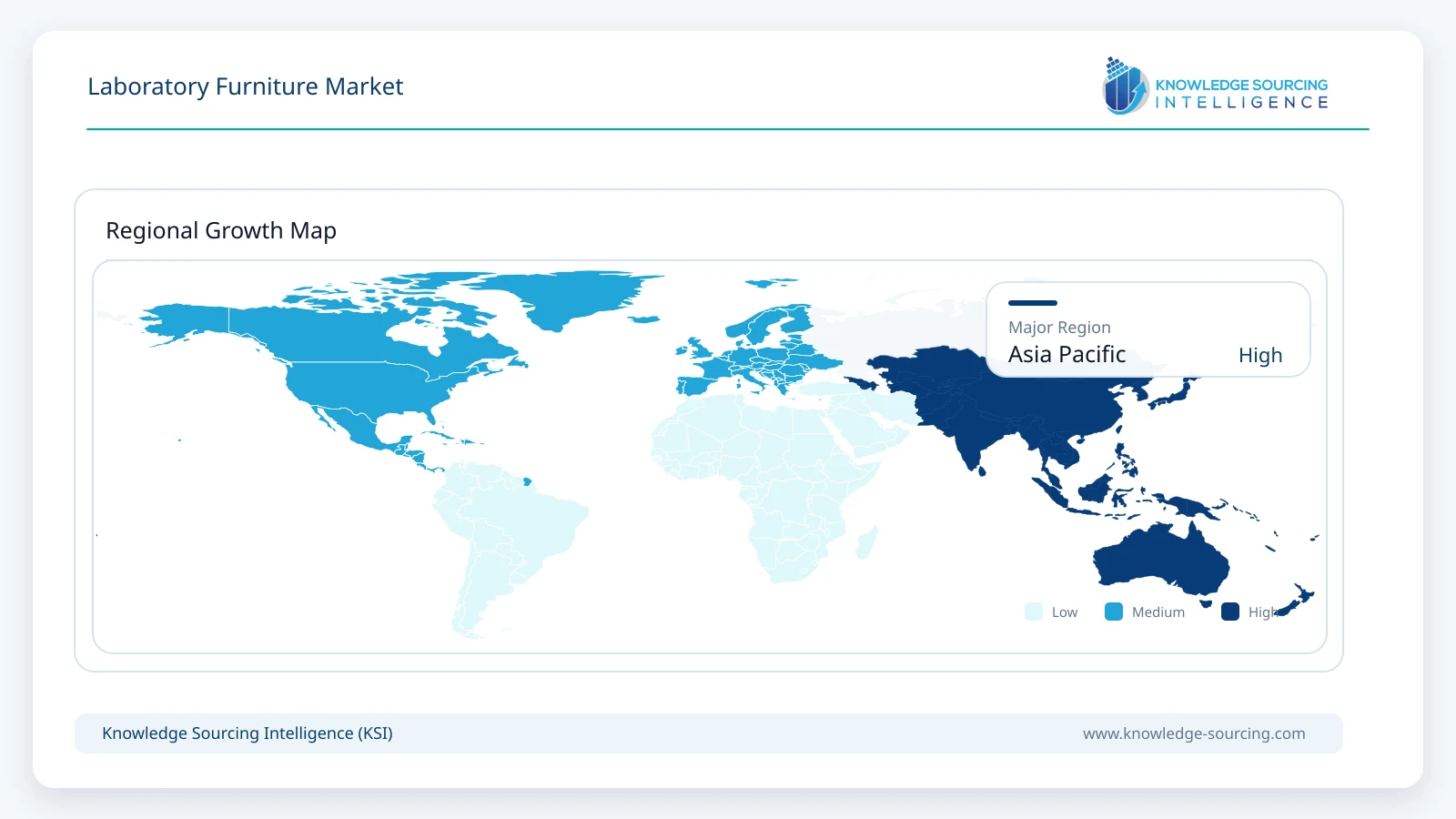
Asia Pacific Records the Strongest Regional Growth
Asia Pacific is projected to grow at approximately 5.8% annually through 2031, supported by increasing research investment, pharmaceutical production and higher-education infrastructure.
China’s R&D expenditure reached CNY 3.93 trillion in 2025, increasing 8.1% year on year, while the country’s R&D workforce reached an estimated 7.95 million full-time-equivalent person-years.
India and Southeast Asia add further demand from pharmaceuticals, contract research, chemicals and academic institutions, giving the region a larger pipeline of new laboratories than mature Western markets even though average furniture expenditure per facility remains lower in several countries.
Recent Developments
July 2026, the U.S. National Science Foundation announced an inaugural USD 380 million investment in 20 teams to establish a nationwide network of AI-enabled automated laboratories, supplemented by more than USD 20 million of philanthropic support. The programme illustrates how laboratory infrastructure is moving toward automation, digital instrumentation and reconfigurable research environments.
May 2026, NSF announced the USD 1.5 billion X-Labs initiative, intended to support new independent R&D organizations and platform technologies over the following decade.
May 2026, Mott Manufacturing reported its involvement in two projects recognized at the 2026 Lab Design Conference Design Excellence Awards, highlighting continued demand for high-specification, architecturally integrated laboratory environments.
March 2026, WALDNER introduced the Ventus osciJET generation of laboratory fume hoods at analytica 2026, emphasizing lower resource consumption, enhanced containment and integration with digital laboratory monitoring.
January 2026, Labconco added the Prism Class II Type A2 Biosafety Cabinet to its containment portfolio, positioning the product around safety, flexibility and ergonomics for academic and research laboratories.
Competitive Environment
The Laboratory Furniture Market is fragmented because furniture and laboratory fit-out are highly project dependent and local installation capability remains important. Large international manufacturers compete with regional specialists, architects and turnkey laboratory contractors rather than operating through the same highly concentrated structure seen in scientific instrumentation.
Kewaunee and WALDNER are among the broadest suppliers. Kewaunee provides adaptable furniture, casework, worktops and fume hoods and states that its international business has worked with more than 6,000 customers. WALDNER provides laboratory furniture, service modules, fume hoods, utility systems and complete laboratory planning and describes itself as a major global laboratory-furniture supplier.
Mott Manufacturing, Köttermann, Hamilton Laboratory Solutions, Burdinola and Labconco strengthen competition across modular furniture, casework, containment and specialist laboratory environments. Burdinola, for example, provides fume cupboards, benches, service systems and storage as part of integrated laboratory planning.
Competition through 2031 is likely to centre on modularity, energy performance, installation capability, chemical resistance and integration with building services. Furniture that can be reconfigured while retaining service connections creates greater lifecycle value than fixed casework, while suppliers capable of designing, manufacturing and commissioning complete laboratory environments can compete for a larger share of project expenditure.
Analyst View
The Laboratory Furniture Market is representing a relatively steady rather than high-growth equipment market. Growth is linked to the continuing expansion of global research infrastructure but moderated by the long useful life of laboratory furniture and the project-based nature of procurement.
The market is nevertheless becoming technically more sophisticated. Laboratory benches remain the largest category because they are fundamental to almost every research environment, while fume hoods grow faster as safety, digital monitoring and energy efficiency become greater purchasing priorities.
Pharmaceutical laboratories continue to account for the largest end-user value because their facilities require higher-specification materials and containment, while public research programmes support stronger growth in government laboratories. Regionally, Europe’s mature pharmaceutical and research base maintains its leading position, whereas Asia Pacific benefits from faster R&D spending and laboratory construction.
The strongest suppliers should therefore be those capable of selling laboratory adaptability rather than furniture alone. Modular benches, movable storage, integrated utility systems, digitally monitored containment and retrofit capability allow manufacturers to participate in both new construction and laboratory modernization while reducing customers’ future reconfiguration cost.
Laboratory Furniture Market Scope:
| Report Metric | Details |
|---|---|
| Total Market Size in 2026 | USD 1.68 billion |
| Total Market Size in 2031 | USD 2.06 billion |
| Forecast Unit | Billion |
| Growth Rate | 4.1% |
| Study Period | 2021 to 2031 |
| Historical Data | 2021 to 2024 |
| Base Year | 2025 |
| Forecast Period | 2026 – 2031 |
| Segmentation | Type, End-User, Geography |
| Companies |
|
| Customization Scope | 15% Free Customization included with purchase — Request Custom Breakdown → |
| Sample & Data Access | PDF Sample, Excel Databook & Analyst Briefing — Download Free Sample → |
Market Segmentation
By Type
Laboratory Storage Cabinet
Laboratory Bench
Fume Hood
Laboratory Stools & Chairs
Laboratory IPS
Laboratory Tables
Accessories
By End-User
School & College
Government Labs
Pharmaceutical Labs
Others
By Geography
North America
USA
Canada
Mexico
South America
Brazil
Argentina
Others
Europe
Germany
France
United Kingdom
Spain
Others
Middle East and Africa
Saudi Arabia
UAE
Others
Asia Pacific
China
India
Japan
South Korea
Indonesia
Thailand
Others
Table of Contents
1. EXECUTIVE SUMMARY
2. MARKET SNAPSHOT
2.1. Market Overview
2.2. Market Definition
2.3. Scope of the Study
2.4. Market Segmentation
3. BUSINESS LANDSCAPE
3.1. Market Drivers
3.2. Market Restraints
3.3. Market Opportunities
3.4. Porter’s Five Forces Analysis
3.5. Industry Value Chain Analysis
3.6. Policies and Regulations
3.7. Strategic Recommendations
4. TECHNOLOGICAL OUTLOOK
4.1. Modular and Reconfigurable Laboratory Systems
4.2. Digital Laboratory Infrastructure
4.3. Energy-Efficient Fume Hood Technology
4.4. Ergonomic and Height-Adjustable Workstations
4.5. Sustainable Laboratory Materials
5. LABORATORY FURNITURE MARKET BY TYPE
5.1. Introduction
5.2. Laboratory Storage Cabinet
5.3. Laboratory Bench
5.4. Fume Hood
5.5. Laboratory Stools & Chairs
5.6. Laboratory IPS
5.7. Laboratory Tables
5.8. Accessories
6. LABORATORY FURNITURE MARKET BY END-USER
6.1. Introduction
6.2. School & College
6.3. Government Labs
6.4. Pharmaceutical Labs
6.5. Others
7. LABORATORY FURNITURE MARKET BY GEOGRAPHY
7.1. Introduction
7.2. North America
7.2.1. USA
7.2.2. Canada
7.2.3. Mexico
7.3. South America
7.3.1. Brazil
7.3.2. Argentina
7.3.3. Others
7.4. Europe
7.4.1. Germany
7.4.2. France
7.4.3. United Kingdom
7.4.4. Spain
7.4.5. Others
7.5. Middle East and Africa
7.5.1. Saudi Arabia
7.5.2. UAE
7.5.3. Others
7.6. Asia Pacific
7.6.1. China
7.6.2. India
7.6.3. Japan
7.6.4. South Korea
7.6.5. Indonesia
7.6.6. Thailand
7.6.7. Others
8. COMPETITIVE ENVIRONMENT AND ANALYSIS
8.1. Major Players and Strategy Analysis
8.2. Market Share Analysis
8.3. Mergers, Acquisitions, Agreements and Collaborations
8.4. Competitive Dashboard
9. COMPANY PROFILES
9.1. Kewaunee Scientific Corporation
9.2. WALDNER Laboreinrichtungen SE & Co. KG
9.3. Mott Manufacturing Ltd.
9.4. Labconco Corporation
9.5. Köttermann GmbH
9.6. Hamilton Laboratory Solutions
9.7. Burdinola S. Coop.
9.8. PSA Laboratory Furniture LLC
9.9. Teclab
9.10. A.T. Villa, Inc.
9.11. Yamato Scientific Co., Ltd.
9.12. HEMCO Corporation
9.13. Renggli Laboratory Systems
9.14. Formaspace LP
9.15. LOC Scientific
9.16. LabGuard India Pvt. Ltd.
9.17. Genie Scientific
9.18. Air Master Systems Corp.
10. APPENDIX
10.1. Currency
10.2. Assumptions
10.3. Base and Forecast Years Timeline
10.4. Key Benefits for Stakeholders
10.5. Research Methodology
10.6. Abbreviations





Frequently asked questions
What is the projected market size and growth rate for the global Laboratory Furniture Market from 2026 to 2031?
The Laboratory Furniture Market is projected to grow from USD 1.68 billion in 2026 to USD 2.06 billion by 2031, demonstrating an approximate compound annual growth rate (CAGR) of 4.1%. This growth is supported by continuing investment in research infrastructure and laboratory modernization.
Which product categories are identified as the largest and fastest-growing within the Laboratory Furniture Market?
Laboratory benches account for approximately 29% of market value in 2026, making them the largest product category due to their essential role as dedicated work surfaces. Fume hoods are projected to be one of the fastest-growing categories, with an approximate annual growth rate of 5.8% through 2031, driven by increased emphasis on containment performance, ventilation efficiency, and user protection.
Which end-user segment holds the largest share in the Laboratory Furniture Market?
Pharmaceutical Laboratories remain the largest end-user group within the Laboratory Furniture Market, accounting for approximately 38% of the market value in 2026. This is primarily supported by ongoing investment in pharmaceutical R&D activities globally.
What key factors are increasingly shaping laboratory furniture specifications beyond initial cost?
Safety, flexibility, and energy efficiency are increasingly shaping laboratory furniture specifications, moving beyond initial cost as the primary purchasing driver. Modern designs incorporate modular frames, replaceable worktops, movable storage, and independent service systems for reconfigurability, alongside features like lower exhaust-air requirements and digital monitoring for efficiency.
How does global research spending influence the demand for laboratory furniture?
The wider demand environment is highly supportive, as research spending continues to rise across major scientific economies. For instance, China's R&D expenditure reached CNY 3.93 trillion in 2025, and the U.S. federal R&D budget authority was USD 199.3 billion in FY2024, with Europe also supporting infrastructure through the Horizon Europe programme, all contributing to increased demand for new and modernized laboratory facilities.
What innovations are key manufacturers introducing to meet evolving laboratory furniture needs?
Key manufacturers like WALDNER and Kewaunee are introducing innovations focused on adaptability and resource efficiency. WALDNER offers modular bench configurations capable of supporting heavy loads and Secuflow technology to reduce fume hood exhaust-air requirements by up to 33%, while Kewaunee markets adaptable systems designed for reuse, relocation, and reconfiguration, reflecting the market's shift towards versatile and sustainable solutions.
Cite this report
Knowledge Sourcing Intelligence. (Sep 2026). Laboratory Furniture Market - Strategic Insights and Forecasts (2026-2031). https://www.knowledge-sourcing.com/report/laboratory-furniture-market