
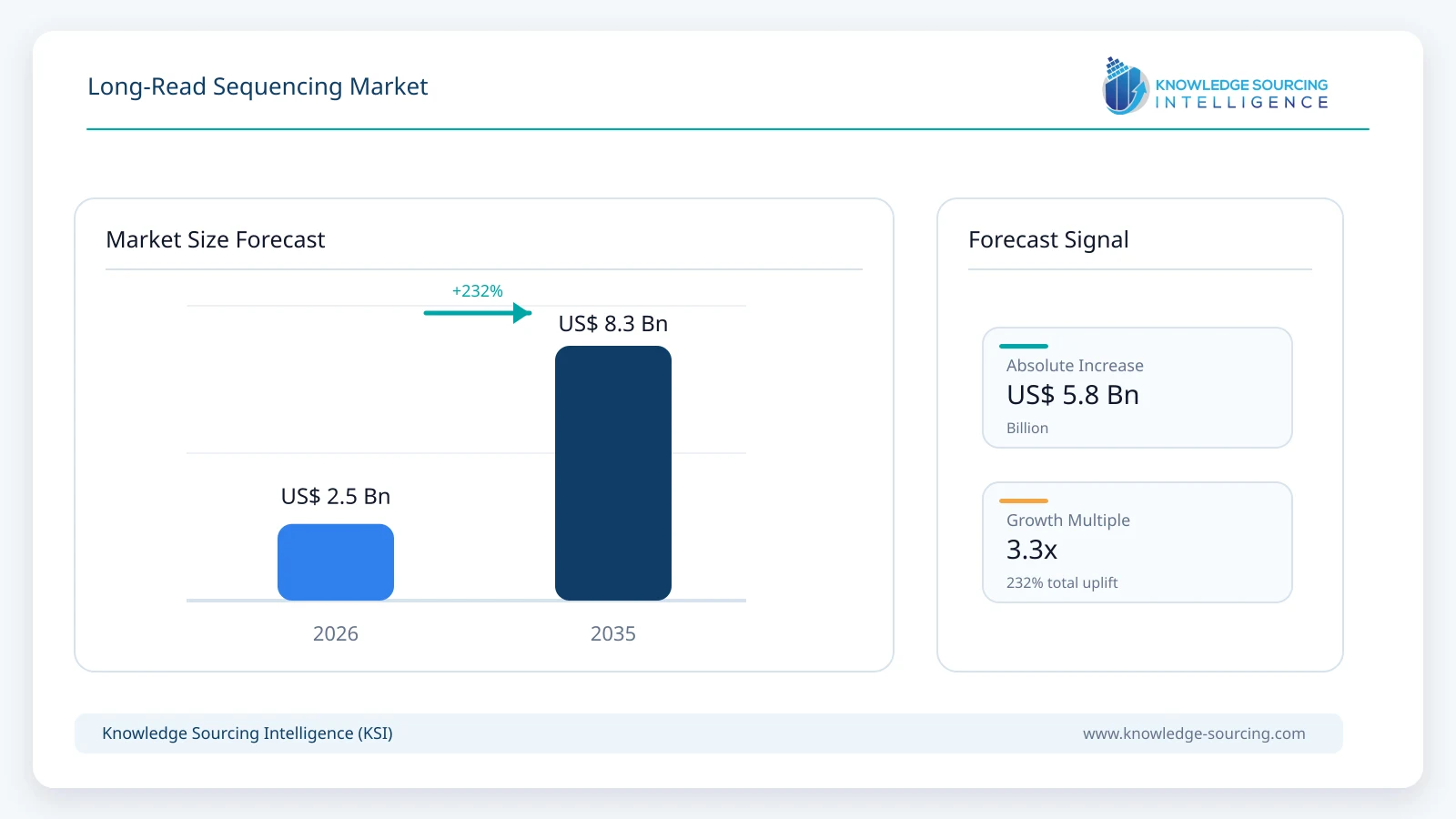
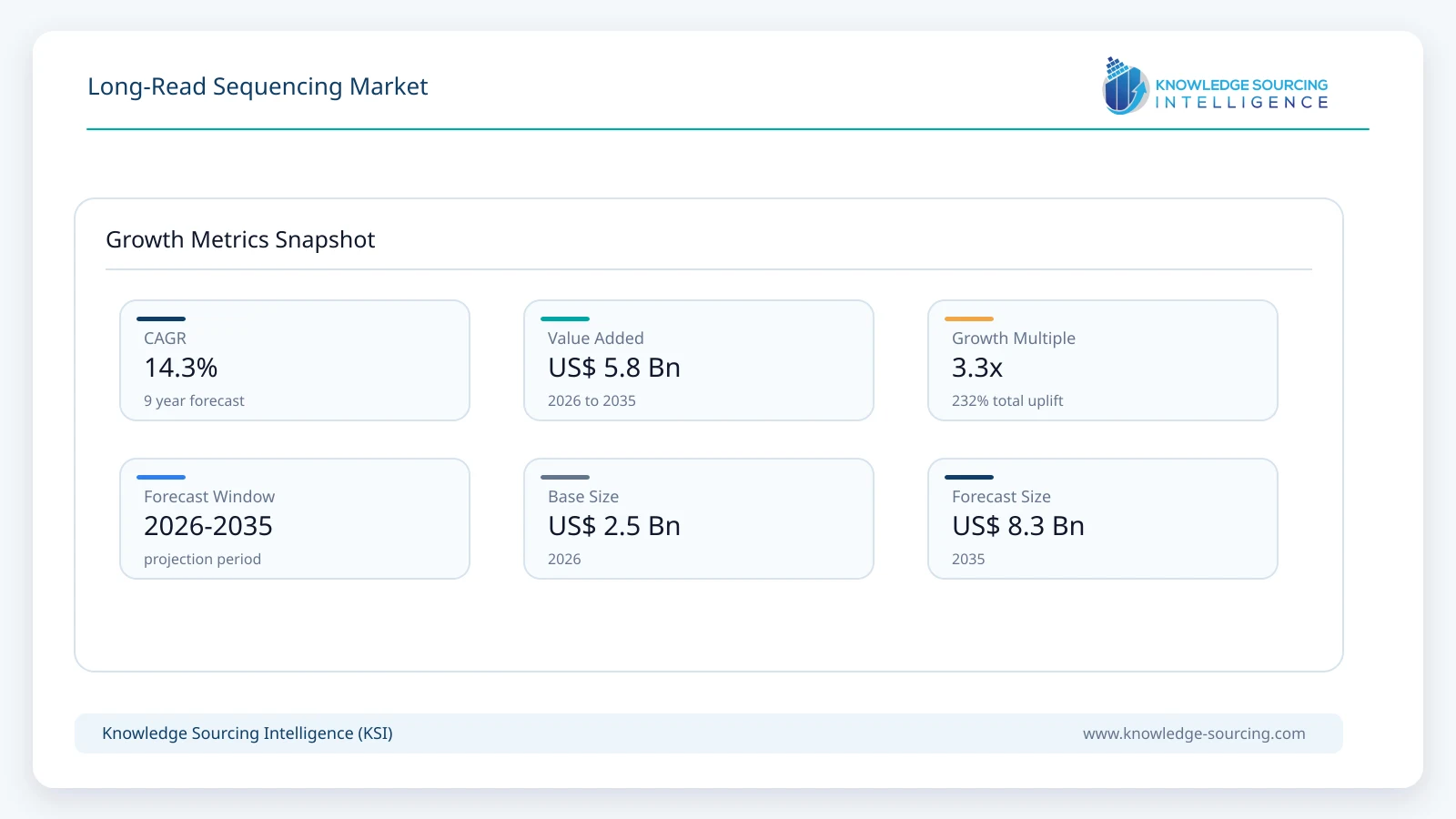
The Long-Read Sequencing Market is growing at a CAGR of 14.3% from USD 2.51 billion in 2026 to USD 8.34 billion in 2035.
Highlights:
- 1Growing demand for structural variant detection is increasing long-read sequencing adoption because conventional sequencing approaches often miss complex genomic alterations.
- 2Expansion of precision medicine initiatives is strengthening demand because detailed genomic characterization improves disease understanding and treatment selection.
- 3Increasing rare disease research activity is expanding utilization because many inherited disorders involve structural genomic abnormalities.
- 4Advances in sequencing accuracy are improving adoption because researchers require higher confidence in genomic interpretation.
Long-read sequencing enables direct analysis of extensive nucleotide sequences because longer reads preserve genomic context that shorter reads may fragment. This capability improves identification of structural rearrangements, repeat expansions, and complex genomic regions. Researchers are increasingly adopting long-read technologies because many biologically significant variations remain difficult to characterize using conventional sequencing methods. The resulting demand supports continued technology development and workflow expansion.
Precision medicine depends on comprehensive genomic understanding because therapeutic outcomes increasingly rely on accurate molecular characterization. This dependency increases demand for sequencing technologies capable of generating higher-resolution genomic insights. Healthcare institutions are expanding genomic research programs because disease mechanisms often involve structural variations that require advanced sequencing approaches. The resulting integration of long-read technologies strengthens their strategic importance.
Regulatory and clinical interest continues to expand because genomic evidence increasingly influences healthcare decisions. Laboratories are improving analytical capabilities as genomic datasets become more complex. This improvement increases demand for sophisticated bioinformatics and interpretation tools. The resulting ecosystem development supports broader adoption across research and healthcare environments.
Market Dynamics
Market Drivers
Rising Need for Structural Variant Detection: Structural genomic variation influences disease development because large insertions, deletions, inversions, and rearrangements affect biological function. Researchers are increasing adoption of long-read sequencing as conventional methods struggle to resolve these complex events. This limitation increases demand for technologies capable of generating longer contiguous reads. The resulting improvement in genomic resolution strengthens market growth.
Expansion of Precision Medicine Research: Precision medicine relies on comprehensive genomic characterization because disease mechanisms often extend beyond single nucleotide variants. Research organizations are increasing investments in advanced sequencing platforms as therapeutic development becomes more personalized. This investment increases demand for long-read sequencing technologies capable of resolving complex genomic features. The resulting integration into research workflows supports adoption.
Growth of Rare Disease Genomics: Rare disease diagnosis requires accurate genomic interpretation because many disorders involve difficult-to-detect genetic mechanisms. Healthcare institutions are expanding sequencing initiatives as diagnostic challenges remain significant. This expansion increases utilization of long-read technologies that improve variant resolution. The resulting enhancement in diagnostic capability strengthens market demand.
Increasing Genome Assembly Requirements: Reference genome development depends on long contiguous sequence information because fragmented assemblies reduce biological insight. Genomics programs are generating larger datasets as population-scale sequencing projects expand. This expansion increases demand for sequencing technologies capable of producing high-quality assemblies. The resulting emphasis on genomic completeness supports long-read sequencing adoption.
Market Restraints
Higher sequencing costs limit widespread clinical adoption because budget constraints influence technology selection.
Data analysis complexity increases operational requirements because long-read datasets require specialized computational workflows.
Limited reimbursement support restricts healthcare implementation because clinical coverage policies remain inconsistent.
Market Opportunities
Expansion into Clinical Diagnostics: Clinical genomics requires increasingly accurate genomic interpretation because treatment decisions depend on molecular evidence. Healthcare providers are evaluating long-read sequencing applications as evidence supporting clinical utility expands. This evaluation increases opportunities in rare disease and oncology diagnostics. The resulting transition creates new commercial pathways.
Growth of Epigenetic Analysis: Epigenetic modifications influence disease biology because gene regulation extends beyond DNA sequence alone. Researchers are expanding studies involving methylation and chromatin-related mechanisms as precision medicine advances. This expansion increases demand for sequencing technologies capable of directly detecting epigenetic signals. The resulting capability creates differentiated growth opportunities.
Development of Population Genomics Programs: Population genomics initiatives generate demand because comprehensive genome characterization improves understanding of disease risk and genetic diversity. Governments are increasing genomic investments as national healthcare strategies evolve. This increase expands opportunities for long-read sequencing platforms and analytical solutions. The resulting ecosystem growth supports market expansion.
AI-Enabled Genomic Interpretation: Genomic complexity creates interpretation challenges because large datasets require extensive analytical expertise. Organizations are adopting artificial intelligence tools as sequencing volumes continue increasing. This adoption improves analytical efficiency and supports broader implementation. The resulting workflow optimization strengthens long-term adoption.
Supply Chain Analysis
The long-read sequencing supply chain begins with suppliers of enzymes, nucleic acid processing materials, sequencing consumables, and specialized chemistry components because sequencing accuracy depends on reagent quality. Demand is increasing for high-performance consumables as sequencing throughput and accuracy continue improving. This requirement strengthens supplier importance within the value chain. The resulting emphasis on manufacturing consistency influences downstream workflow reliability.
Sample preparation providers occupy a critical position because long-read sequencing requires preservation of high-quality long nucleic acid fragments. Laboratories are increasing investment in optimized extraction and preparation workflows as genomic applications become more complex. This investment increases demand for specialized preparation technologies. The resulting improvement in sample integrity enhances sequencing performance.
Sequencing platform manufacturers form the core technology layer because instrument capability determines read length, throughput, and analytical quality. Research organizations are expanding sequencing utilization as demand for advanced genomic characterization grows. This expansion increases investment in hardware innovation and workflow automation. The resulting technology development supports broader adoption.
Bioinformatics providers complete the value chain because long-read datasets require specialized analytical tools. Institutions are investing in advanced computational infrastructure as sequencing complexity increases. This investment strengthens demand for software, cloud resources, and interpretation platforms. The resulting integration of sequencing and analytics enhances market scalability.
Government Regulations
Region | Regulation/Framework | Impact on Market |
United States | FDA oversight of genomic diagnostics | Supports analytical and clinical validation |
United States | CLIA laboratory standards | Ensures testing quality and reliability |
European Union | IVDR framework | Strengthens evidence requirements for diagnostics |
United Kingdom | NHS Genomic Medicine Service | Encourages genomic testing adoption |
Market Segmentation
By Technology
SMRT sequencing enables highly accurate long-read generation because sequencing occurs through direct observation of DNA synthesis events. Demand is increasing as researchers seek comprehensive structural variant analysis and high-quality genome assemblies. This requirement increases adoption across human genomics and disease research applications. Institutions are expanding utilization because improved read accuracy supports more reliable genomic interpretation. The resulting capability strengthens demand within advanced sequencing programs.
By Application
Human genomics represents a major application because comprehensive genome characterization requires accurate analysis of complex genomic regions. Researchers are expanding sequencing programs as disease association studies become increasingly sophisticated. This expansion increases demand for long-read sequencing platforms capable of resolving structural variation. The resulting improvement in genomic insight supports continued adoption.
Regional Analysis
North America
North America leads demand for long-read sequencing because precision medicine initiatives increasingly require comprehensive genomic characterization beyond conventional variant analysis. Research institutions are expanding adoption as structural variant detection and genome assembly projects become more important within disease research programs. This expansion increases demand for sequencing platforms capable of generating highly accurate long reads. Laboratories face pressure to improve genomic resolution because complex disease mechanisms often remain unresolved through short-read approaches. Organizations are investing in advanced sequencing infrastructure and computational resources to address these challenges. The resulting enhancement in genomic analysis capabilities strengthens long-read sequencing adoption across research and translational medicine applications.
Rare disease programs create additional demand because many inherited disorders involve structural genomic abnormalities that require advanced sequencing methods. Healthcare organizations are increasing genomic research investments as diagnostic limitations continue influencing patient outcomes. This increase strengthens demand for technologies capable of identifying previously undetectable variants. Academic medical centers continue integrating long-read sequencing because comprehensive genomic evidence supports more effective disease investigation. The resulting expansion of precision medicine research reinforces regional market leadership.
Biotechnology and pharmaceutical companies contribute to market growth because therapeutic development increasingly relies on detailed genomic characterization. Drug developers are expanding sequencing utilization as biomarker discovery and patient stratification become more important. This expansion strengthens demand for advanced sequencing workflows. The resulting integration of long-read technologies into drug development supports sustained market expansion.
Europe
Europe maintains strong long-read sequencing demand because genomic medicine initiatives increasingly emphasize comprehensive genomic analysis. Healthcare systems are expanding genomic research capabilities as precision medicine strategies continue evolving. This expansion increases demand for technologies capable of resolving structural variants and complex genomic regions. Research institutions face growing pressure to generate higher-quality genomic datasets because translational medicine programs require deeper molecular insights. Organizations are investing in long-read sequencing platforms to improve analytical accuracy. The resulting improvement in genomic resolution supports continued adoption across the region.
Population genomics projects continue strengthening demand because large-scale genomic studies require improved genome assembly and variant detection capabilities. Governments are supporting genomic research infrastructure as healthcare innovation becomes a strategic priority. This support increases utilization of advanced sequencing technologies. Academic collaborations are expanding because multinational genomic studies increasingly rely on harmonized sequencing approaches. The resulting integration of research resources strengthens long-read sequencing implementation.
Clinical genomics adoption remains gradual because healthcare systems require strong evidence supporting routine implementation. Researchers are generating additional clinical validation data as genomic medicine programs mature. This effort increases demand for sequencing technologies capable of demonstrating analytical value. The resulting evidence generation supports future clinical adoption opportunities.
Asia Pacific
Asia Pacific represents a rapidly developing market because governments increasingly prioritize genomic medicine and biotechnology innovation. National genomics initiatives are expanding as healthcare systems seek to improve disease understanding and precision medicine capabilities. This expansion increases demand for advanced sequencing technologies capable of delivering comprehensive genomic insights. Research organizations face growing expectations to generate locally relevant genomic datasets because population diversity influences disease characteristics. Institutions are investing in long-read sequencing infrastructure to address these requirements. The resulting increase in genomic research activity strengthens regional demand.
Population-scale sequencing projects create significant opportunities because large genomic datasets improve understanding of genetic diversity and disease susceptibility. Governments are increasing investments in sequencing infrastructure as biotechnology development becomes a strategic objective. This increase expands demand for long-read sequencing platforms and associated analytical tools. Domestic research organizations continue strengthening genomic capabilities because international competitiveness increasingly depends on innovation capacity. The resulting ecosystem expansion supports market growth.
Healthcare accessibility challenges remain because advanced genomic technologies require specialized infrastructure and expertise. Organizations are developing collaborative research frameworks as sequencing demand continues increasing. This development improves technology adoption and knowledge transfer. The resulting expansion of genomic capabilities strengthens long-term market potential.
Rest of the World
The Rest of the World market continues developing because genomic medicine increasingly influences healthcare modernization strategies. Governments are evaluating advanced sequencing technologies as healthcare systems seek improved diagnostic and research capabilities. This evaluation increases demand for long-read sequencing solutions capable of addressing complex genomic challenges. Research institutions face infrastructure limitations because advanced sequencing technologies require substantial technical resources. Organizations are prioritizing high-value genomic applications to maximize clinical and research impact. The resulting focus on targeted implementation supports gradual market expansion.
Rare disease research and infectious disease surveillance continue generating demand because genomic information improves disease characterization and response planning. Healthcare organizations are increasing interest in advanced sequencing methods as genomic medicine awareness expands. This increase strengthens demand for long-read technologies that provide deeper biological insights. International partnerships continue supporting adoption because expertise transfer remains essential in developing markets. The resulting collaboration enhances sequencing capabilities and analytical capacity.
Economic considerations influence purchasing decisions because healthcare budgets often constrain technology investments. Institutions are seeking sequencing platforms that balance performance and operational efficiency. This requirement increases emphasis on workflow optimization and resource utilization. The resulting focus on value-driven adoption supports sustainable market development.
Regulatory Landscape
Regulatory oversight influences long-read sequencing adoption because genomic information increasingly supports clinical decision-making and healthcare planning. Healthcare authorities require evidence of analytical reliability because inaccurate genomic interpretation may affect patient outcomes. This requirement increases demand for validated sequencing workflows and quality-controlled analytical systems. Technology providers are strengthening compliance frameworks as genomic testing applications continue expanding. The resulting emphasis on reliability supports broader acceptance of advanced sequencing technologies.
Data governance remains a critical regulatory consideration because genomic datasets contain highly sensitive personal information. Regulatory bodies are expanding privacy requirements as genomic databases continue growing in scale and complexity. This expansion increases demand for secure data management systems and controlled access frameworks. Research institutions are investing in governance infrastructure because regulatory compliance influences long-term sustainability. The resulting focus on responsible data stewardship strengthens trust in genomic research and healthcare applications.
International regulatory diversity continues creating operational complexity because different jurisdictions maintain distinct genomic testing requirements. Organizations are adapting technology deployment strategies as global adoption expands. This adaptation increases the importance of flexible compliance capabilities and standardized quality systems. The resulting regulatory evolution continues shaping commercialization strategies and technology development priorities.
Pipeline Analysis
Long-read sequencing increasingly supports therapeutic development because complex genomic mechanisms influence disease progression and treatment response. Pharmaceutical companies are expanding utilization as drug discovery programs require more comprehensive genomic characterization. This expansion increases demand for technologies capable of identifying structural variants and complex genomic rearrangements. Research organizations are generating larger genomic datasets because precision medicine initiatives depend on deeper biological insights. The resulting integration of advanced sequencing into therapeutic development strengthens long-term market demand.
Rare disease pipelines remain a major driver because many inherited disorders involve genomic alterations that are difficult to detect using conventional sequencing approaches. Researchers are increasing adoption of long-read technologies as diagnostic limitations continue affecting patient identification and clinical trial recruitment. This increase strengthens demand for platforms capable of resolving challenging genomic regions. Biotechnology companies continue investing in genomic research because improved molecular understanding supports more efficient therapy development. The resulting reliance on advanced sequencing reinforces market relevance.
Oncology and infectious disease research continue creating additional opportunities because genomic complexity influences both disease characterization and therapeutic strategy selection. Clinical researchers are incorporating long-read sequencing into study designs as comprehensive genomic information becomes increasingly valuable. This incorporation increases sequencing utilization throughout translational and clinical research environments. The resulting expansion of genomic applications supports sustained technology adoption.
Competitive Landscape
PacBio
PacBio remains strategically distinct because its HiFi sequencing technology combines long-read capability with high accuracy, addressing a critical limitation that previously constrained adoption of long-read platforms. Researchers increasingly require comprehensive genomic characterization because structural variants, repeat expansions, and complex genomic rearrangements influence disease biology. This requirement increases demand for highly accurate long-read sequencing solutions. Academic institutions and translational medicine programs are expanding utilization because improved read quality supports more reliable genomic interpretation. The resulting preference for high-confidence genomic data strengthens PacBio’s competitive position.
Demand is shifting toward complete genome analysis because precision medicine programs increasingly require deeper molecular insight. This shift increases reliance on sequencing platforms capable of resolving difficult genomic regions. PacBio continues advancing throughput and workflow efficiency to address growing sequencing volumes. The resulting combination of accuracy and long-read performance supports broader adoption across genomics, oncology, and rare disease research applications.
Oxford Nanopore Technologies
Oxford Nanopore Technologies remains strategically distinct because its nanopore-based sequencing platform enables real-time sequencing and highly flexible deployment models. Researchers increasingly seek rapid genomic insights because infectious disease surveillance and field-based sequencing applications require immediate data generation. This requirement increases demand for portable and scalable sequencing solutions. Laboratories are expanding adoption because real-time analysis improves responsiveness and operational flexibility. The resulting capability differentiates Oxford Nanopore within the long-read sequencing market.
Demand is increasing for direct nucleic acid analysis because researchers seek broader biological information beyond conventional sequence data. This demand increases interest in technologies capable of detecting epigenetic signals and RNA molecules directly. Oxford Nanopore continues expanding platform capabilities to address these evolving requirements. The resulting versatility strengthens its position across research, public health, and translational medicine environments.
Illumina
Illumina remains strategically distinct because of its extensive genomic ecosystem and strong relationships with research and clinical laboratories. Comprehensive genomic analysis increasingly requires integration between multiple sequencing technologies because researchers seek broader genomic coverage and deeper biological insight. This requirement increases demand for companies capable of supporting diverse sequencing workflows. Illumina is expanding genomic innovation initiatives to address emerging long-read sequencing opportunities. The resulting ecosystem strength supports continued relevance within advanced genomics.
Research organizations continue increasing genomic investments because disease characterization depends on high-quality sequencing data. This increase strengthens demand for integrated sequencing and analytical solutions. Illumina continues leveraging its installed base and informatics expertise to support evolving genomic requirements. The resulting ability to complement emerging sequencing approaches sustains market participation.
Thermo Fisher Scientific
Thermo Fisher Scientific remains strategically distinct because it combines genomic technologies with extensive laboratory infrastructure capabilities. Long-read sequencing adoption increasingly depends on workflow integration because genomic research environments require seamless coordination across multiple laboratory processes. This dependency increases demand for providers capable of supporting complete operational ecosystems. Laboratories are strengthening sequencing programs as precision medicine research continues expanding. The resulting growth supports Thermo Fisher’s role within advanced genomics workflows.
Demand is shifting toward scalable research infrastructure because genomic projects continue increasing in size and complexity. This shift increases the importance of integrated instrumentation, consumables, and support services. Thermo Fisher continues enhancing its life sciences portfolio to address evolving sequencing requirements. The resulting operational reach strengthens its competitive position within the broader sequencing market.
QIAGEN
QIAGEN remains strategically distinct because it integrates genomic sample preparation, molecular analysis, and bioinformatics capabilities. Long-read sequencing workflows depend on high-quality nucleic acid preparation because read length and analytical performance are directly influenced by sample integrity. Laboratories are increasing focus on workflow optimization as genomic applications become more demanding. This focus increases demand for reliable preparation and analytical solutions. The resulting requirement strengthens QIAGEN’s role within the sequencing value chain.
Demand for genomic interpretation continues increasing because long-read sequencing generates highly complex datasets. This increase strengthens the importance of advanced analytical platforms capable of supporting variant interpretation. QIAGEN continues expanding bioinformatics capabilities to address these challenges. The resulting integration of laboratory and computational expertise enhances competitive differentiation.
Agilent Technologies
Agilent Technologies remains strategically distinct because of its expertise in genomic sample preparation and target enrichment technologies. Long-read sequencing applications require preservation of high-molecular-weight nucleic acids because sequencing performance depends on fragment integrity. Research institutions are expanding investments in optimized preparation workflows as sequencing objectives become more complex. This expansion increases demand for technologies that improve sample quality. The resulting emphasis on workflow reliability supports Agilent’s market position.
Demand is increasing for advanced genomic research because disease investigations increasingly require comprehensive molecular characterization. This increase strengthens the need for preparation technologies capable of supporting high-quality sequencing outcomes. Agilent continues developing solutions aligned with evolving research requirements. The resulting focus on analytical consistency sustains long-term relevance within genomic research markets.
F. Hoffmann-La Roche Ltd.
Roche remains strategically distinct because it combines diagnostic expertise with strong pharmaceutical capabilities. Precision medicine programs increasingly require detailed genomic information because targeted therapies depend on accurate molecular characterization. Healthcare organizations are expanding genomic research efforts as treatment personalization becomes more important. This expansion increases demand for advanced sequencing technologies and associated analytical solutions. The resulting alignment between diagnostics and therapeutics supports Roche’s strategic position.
Demand is shifting toward integrated healthcare solutions because clinicians increasingly require comprehensive molecular evidence. This shift increases the value of organizations capable of connecting diagnostics and treatment strategies. Roche continues strengthening precision medicine initiatives to address these evolving needs. The resulting ecosystem approach enhances long-term competitiveness.
BGI Genomics
BGI Genomics remains strategically distinct because of its extensive sequencing infrastructure and involvement in large-scale genomics programs. Population genomics projects increasingly require comprehensive sequencing capabilities because disease research depends on diverse genomic datasets. Governments and research institutions are expanding sequencing initiatives as precision medicine programs mature. This expansion increases demand for scalable sequencing platforms and analytical resources. The resulting growth supports BGI’s operational strengths.
Demand is increasing for cost-efficient genomic research because large-scale sequencing projects require sustainable economic models. This increase strengthens interest in organizations capable of delivering high-volume sequencing services. BGI continues leveraging infrastructure scale and genomic expertise to address these requirements. The resulting combination of capacity and efficiency supports long-term market participation.
Key Developments
• July 2025, PacBio, a leading developer of high-quality, highly accurate sequencing solutions, announced it has joined the 1000 Genomes Long Read Sequencing Project, which will involve contributing long-read transcriptome data to one of the world’s most expansive human genomics initiatives.
Strategic Insights and Future Market Outlook
The future of the long-read sequencing market depends on the increasing need to resolve genomic complexity because many clinically relevant variations remain difficult to characterize through conventional sequencing approaches. Demand is shifting toward comprehensive genomic analysis as researchers seek deeper understanding of disease mechanisms. This shift increases reliance on technologies capable of accurately identifying structural variants, repeat expansions, and complex genomic rearrangements. Technology providers are improving sequencing accuracy and throughput to address expanding application requirements. The resulting advancement strengthens long-read sequencing adoption across research and emerging clinical settings.
Artificial intelligence is becoming increasingly important because long-read sequencing generates large and complex datasets that require advanced interpretation. Research organizations are incorporating machine learning tools as genomic analysis workflows continue expanding. This incorporation improves efficiency and supports broader utilization of sequencing technologies. Laboratories are seeking scalable analytical solutions because genomic project volumes continue increasing. The resulting integration of sequencing and computational intelligence accelerates market development.
Government-supported genomics programs continue creating long-term opportunities because healthcare systems increasingly recognize genomic information as a strategic healthcare resource. Public investments are expanding sequencing infrastructure as precision medicine initiatives mature. This expansion increases demand for sequencing platforms, bioinformatics tools, and data management systems. The resulting ecosystem growth supports continued innovation and technology adoption.
Long-read sequencing increasingly functions as an enabling technology for the next phase of genomic medicine. Demand continues expanding because researchers require more complete genomic information to address unresolved biological questions. Healthcare institutions are strengthening genomic capabilities because personalized healthcare depends on accurate molecular characterization. Technology developers continue improving workflow performance because broader adoption requires greater accessibility and efficiency. These interconnected changes position long-read sequencing as a foundational technology within future genomic research and precision healthcare frameworks.
The market continues evolving around the need to transform increasingly complex genomic data into clinically and scientifically meaningful insights. Demand is expanding because oncology, rare disease research, population genomics, infectious disease surveillance, and therapeutic development increasingly depend on comprehensive genomic characterization. This expansion creates opportunities for organizations capable of combining sequencing innovation, analytical expertise, and workflow efficiency. Companies that successfully address these requirements are likely to strengthen their competitive positions as genomic medicine continues moving toward broader global implementation.
Long-Read Sequencing Market Scope:
| Report Metric | Details |
|---|---|
| Total Market Size in 2026 | USD 2.51 billion |
| Total Market Size in 2035 | USD 8.34 billion |
| Forecast Unit | USD Billion |
| Growth Rate | 14.3% |
| Study Period | 2021 to 2035 |
| Historical Data | 2021 to 2024 |
| Base Year | 2025 |
| Forecast Period | 2026 – 2035 |
| Segmentation | Product & Service, Technology, Application, Geography |
| Companies |
|
Market Segmentation
Product & Service
Technology
Application
Geography
- North America
- South America
- Europe
- Middle East and Africa
- Asia Pacific
Table of Contents
1. EXECUTIVE SUMMARY
1.1 Market Snapshot
1.2 Key Findings
1.3 Analyst Insights
1.4 Strategic Recommendations
2. RESEARCH METHODOLOGY
2.1 Research Design
2.2 Data Collection Methodology
2.3 Market Size Estimation
2.4 Forecasting Model
2.5 Assumptions & Limitations
3. LONG-READ SEQUENCING MARKET OVERVIEW, SIZE & FORECAST
3.1 Market Definition & Scope
3.2 Industry Overview
3.3 Industry Evolution
3.4 Key Market Trends
3.5 Historical Market Size Analysis (2021–2025)
3.6 Market Forecast Analysis (2026–2035)
3.7 Clinical and Research Utility of Long-Read Sequencing
3.8 Evolution of Long-Read Sequencing Technologies
3.9 Genomic Research Ecosystem Overview
3.10 Sequencing Throughput and Testing Volume Analysis
3.11 Installed Base Analysis of Long-Read Sequencing Platforms
3.12 User Adoption Analysis
3.13 Structural Variant and Complex Genomics Testing Landscape
4. MARKET DYNAMICS
4.1 Market Drivers
4.2 Market Restraints
4.3 Market Opportunities
4.4 Market Challenges
5. INDUSTRY LANDSCAPE
5.1 Industry Value Chain Analysis
5.2 Pricing Analysis
5.3 Reimbursement Landscape
5.4 Stakeholder Ecosystem Analysis
5.5 Long-Read Sequencing Infrastructure Analysis
6. INNOVATION LANDSCAPE
6.1 Emerging Long-Read Sequencing Technologies
6.2 Product Innovation Analysis
6.3 Clinical Trial Analysis Utilizing Long-Read Sequencing
6.4 Pipeline Analysis of Long-Read Sequencing-Based Diagnostic Solutions
6.5 AI Integration in Genomic Data Interpretation
6.6 Multi-Omics Integration with Long-Read Sequencing
6.7 Technology Roadmap
7. REGULATORY LANDSCAPE
7.1 Regulatory Framework
7.2 Approval Pathways
7.3 Compliance Requirements
7.4 Genomic Data Privacy and Security Regulations
8. LONG-READ SEQUENCING MARKET LANDSCAPE ANALYSIS
8.1 Analysis by Product & Service Category
8.2 Analysis by Sequencing Technology
8.3 Analysis by Application
8.4 Analysis by End User Environment
8.5 Analysis by Sample Type
8.6 Analysis by Workflow
9. LONG-READ SEQUENCING MARKET SEGMENT ANALYSIS (2021–2035)
9.1 By Product & Service
9.1.1 Instruments
9.1.2 Consumables & Reagents
9.1.3 Sequencing Services
9.1.4 Bioinformatics & Data Analysis Services
9.2 By Technology
9.2.1 Single-Molecule Real-Time (SMRT) Sequencing
9.2.2 Nanopore Sequencing
9.3 By Application
9.3.1 Human Genomics Research
9.3.2 Rare Disease Diagnostics
9.3.3 Oncology
9.3.4 Infectious Disease Research
9.3.5 Agricultural & Plant Genomics
9.3.6 Microbial Genomics
9.4 By End User
9.4.1 Academic & Research Institutes
9.4.2 Hospitals & Diagnostic Laboratories
9.4.3 Pharmaceutical & Biotechnology Companies
9.4.4 Government & Public Health Organizations
10. LONG-READ SEQUENCING MARKET GEOGRAPHICAL ANALYSIS (2021–2035)
10.1 North America
10.2 Europe
10.3 Asia-Pacific
10.4 South America
10.5 Middle East & Africa
11. LONG-READ SEQUENCING MARKET COUNTRY ANALYSIS (2021–2035)
11.1 United States
11.2 Canada
11.3 Germany
11.4 United Kingdom
11.5 France
11.6 Netherlands
11.7 China
11.8 Japan
11.9 South Korea
11.10 India
11.11 Australia
11.12 Singapore
11.13 Brazil
11.14 Saudi Arabia
11.15 South Africa
12. COMPETITIVE LANDSCAPE
12.1 Market Share Analysis
12.2 Strategic Developments
12.3 Mergers & Acquisitions, Partnerships & Collaborations
12.4 Product Launches
12.5 Competitive Benchmarking Analysis
13. COMPANY PROFILES
13.1 Pacific Biosciences of California, Inc.
13.2 Oxford Nanopore Technologies plc
13.3 Illumina, Inc.
13.4 Thermo Fisher Scientific Inc.
13.5 QIAGEN N.V.
13.6 F. Hoffmann-La Roche Ltd.
13.7 Agilent Technologies, Inc.
13.8 Revvity, Inc.
13.9 BGI Genomics Co., Ltd.
13.10 Element Biosciences, Inc.
13.11 Singular Genomics Systems, Inc.
13.12 Bio-Rad Laboratories, Inc.
13.13 GeneDx Holdings Corp.
13.14 SOPHiA GENETICS SA
13.15 Fabric Genomics, Inc.
14. LONG-READ SEQUENCING MARKET COMMERCIAL FORECAST ANALYSIS
14.1 Instruments Forecast
14.2 Consumables & Reagents Forecast
14.3 Sequencing Services Forecast
14.4 Bioinformatics & Data Analysis Services Forecast
14.5 SMRT Sequencing Forecast
14.6 Nanopore Sequencing Forecast
14.7 Human Genomics Research Forecast
14.8 Rare Disease Diagnostics Forecast
14.9 Oncology Applications Forecast
15. INVESTMENT & FUNDING ANALYSIS
15.1 Venture Capital Trends
15.2 Government Funding
15.3 R&D Investments
15.4 Genomics Infrastructure Investments
15.5 Strategic Financing Activities
16. FUTURE OUTLOOK
16.1 Key Growth Opportunities
16.2 Future Industry Trends
16.3 Evolution of Long-Read Sequencing in Clinical Diagnostics
16.4 Future of Structural Variant Analysis and Genome Assembly
16.5 Impact of AI-Driven Genomics on Long-Read Sequencing Adoption
16.6 Long-Term Market Outlook (2035)
Navigate
Trusted by the world's leading organizations











