
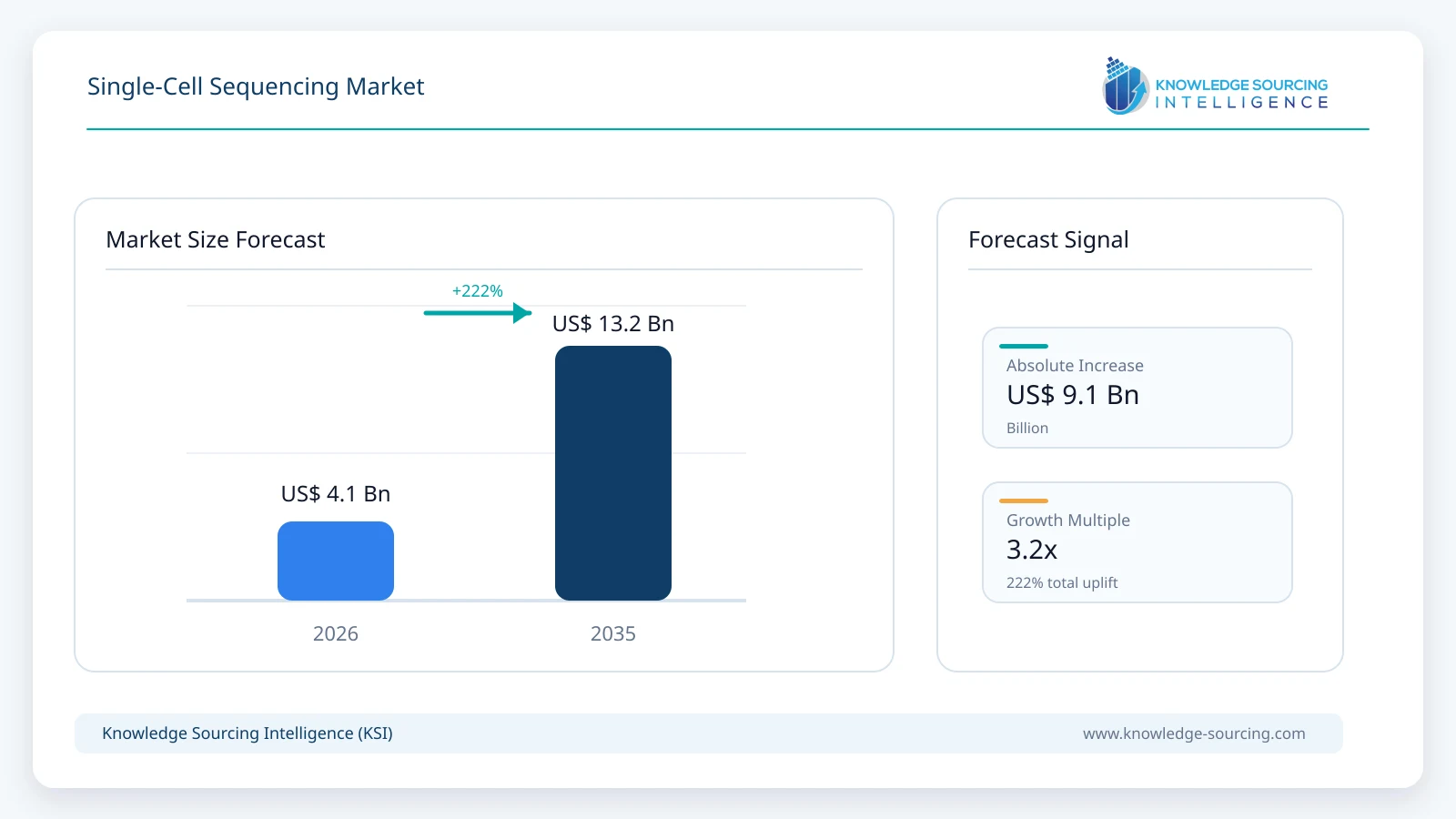
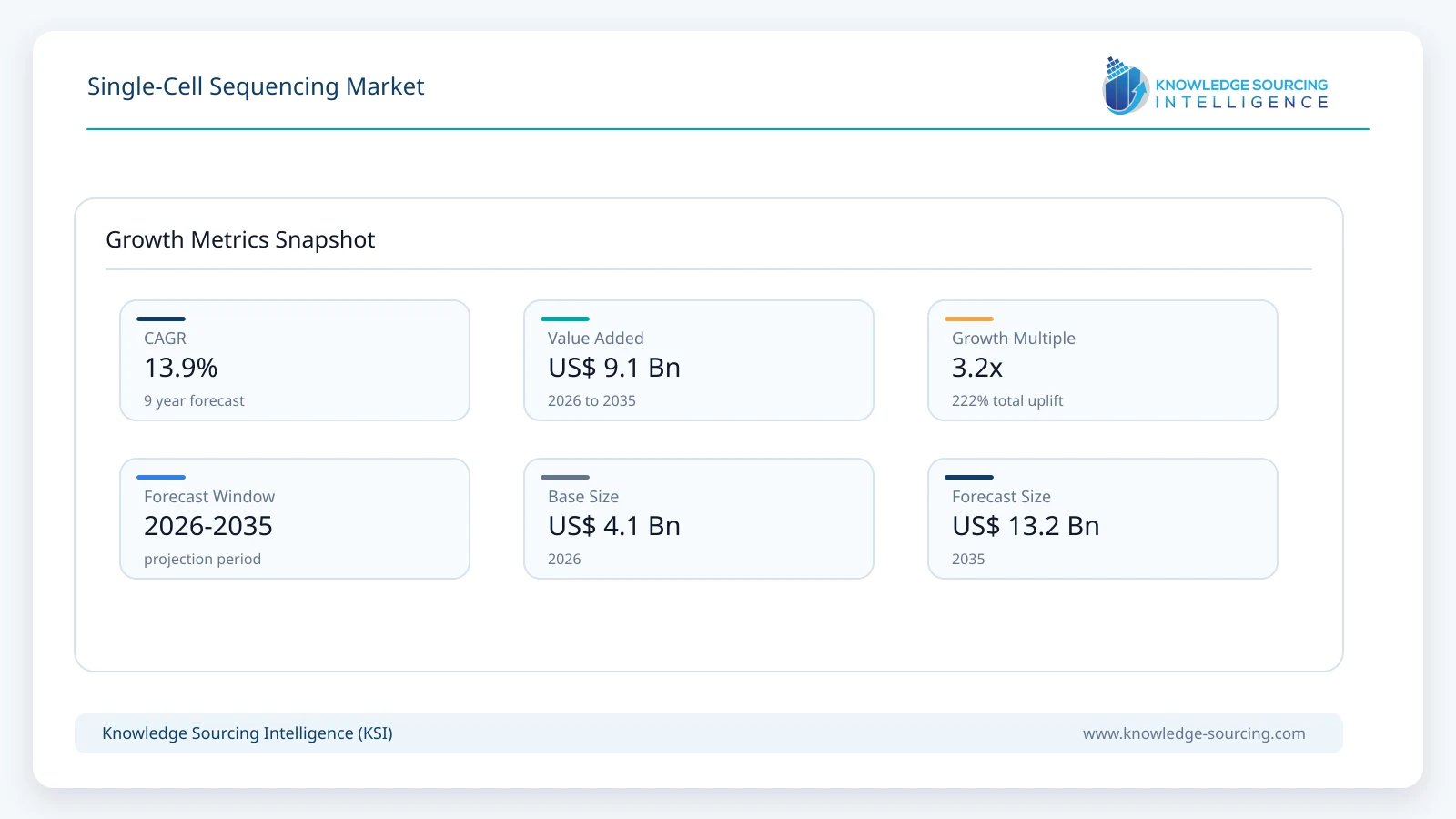
The Single-Cell sequencing Market is estimated to grow to USD 13.23 billion in 2035 at a CAGR of 13.9% from USD 4.11 billion in 2026.
Highlights:
- 1Increasing demand for cellular-level disease insights is expanding adoption because biological heterogeneity influences therapeutic outcomes.
- 2Growth of precision oncology research is strengthening utilization because tumor microenvironments require detailed cellular characterization.
- 3Expansion of immunology research is increasing demand because immune cell diversity influences disease progression and treatment response.
- 4Pharmaceutical companies are increasing investment because single-cell analysis improves target discovery and biomarker development.
Single-cell sequencing enables analysis of individual cellular behavior because biological systems often contain diverse cell populations with distinct functional characteristics. This capability improves understanding of disease progression and treatment response. Researchers are increasingly adopting single-cell technologies because cellular heterogeneity influences outcomes across multiple therapeutic areas. The resulting demand supports continued technology advancement and workflow expansion.
Precision medicine depends on deeper biological characterization because patient responses frequently vary according to cellular composition and molecular activity. This dependency increases demand for analytical approaches capable of identifying rare cellular populations and dynamic biological processes. Pharmaceutical companies are expanding utilization because drug development increasingly relies on precise biological understanding. The resulting integration into research pipelines strengthens market growth.
Regulatory interest in advanced molecular characterization continues to increase because healthcare innovation increasingly depends on robust biological evidence. Organizations are investing in scalable analytical platforms as dataset complexity continues expanding. This investment increases demand for bioinformatics infrastructure and computational tools. The resulting ecosystem development supports broader implementation across research environments.
Market Dynamics
Market Drivers
Expansion of Precision Oncology Research: Cancer biology depends on cellular diversity because tumor evolution and treatment resistance often originate from distinct cell populations. Researchers are increasing adoption of single-cell sequencing as oncology studies require deeper molecular characterization. This requirement increases demand for technologies capable of identifying rare cellular subpopulations. The resulting improvement in tumor profiling strengthens market growth.
Increasing Immunology Research Activity: Immune system function relies on diverse cellular populations because immune responses vary according to cell type and activation state. Research organizations are expanding single-cell analysis as immunotherapy development accelerates. This expansion increases demand for technologies capable of detailed immune profiling. The resulting integration into immunology research supports adoption.
Growth of Drug Discovery Programs: Drug development requires improved understanding of biological mechanisms because therapeutic success depends on accurate target identification. Pharmaceutical companies are increasing utilization of single-cell technologies as precision medicine strategies continue evolving. This increase strengthens demand for high-resolution molecular analysis. The resulting enhancement in biological insight supports market expansion.
Rising Demand for Cell Atlas Initiatives: Cell atlas projects depend on large-scale cellular characterization because comprehensive biological mapping requires detailed molecular data. Research institutions are generating larger datasets as collaborative genomics programs continue expanding. This expansion increases demand for scalable sequencing workflows. The resulting growth in cellular mapping initiatives strengthens market adoption.
Market Restraints
High workflow costs limit adoption because specialized instruments, reagents, and computational infrastructure increase operational expenses.
Data analysis complexity increases resource requirements because single-cell datasets demand advanced bioinformatics expertise.
Standardization challenges restrict broader implementation because experimental workflows and analytical methods continue evolving.
Market Opportunities
Expansion into Clinical Research: Clinical research increasingly requires cellular-level biological insights because treatment response variability often originates from cellular heterogeneity. Healthcare organizations are evaluating single-cell technologies as translational medicine programs expand. This evaluation increases opportunities for advanced sequencing platforms. The resulting integration supports future clinical adoption.
Growth of Cell and Gene Therapy Development: Cell-based therapies depend on detailed cellular characterization because therapeutic performance varies according to cell identity and function. Developers are increasing use of single-cell analysis as regenerative medicine programs expand. This increase strengthens demand for high-resolution molecular profiling technologies. The resulting opportunity supports long-term market growth.
Advancement of Spatial Biology Applications: Spatial biology requires integration of cellular and tissue-level information because biological function depends on cellular context. Researchers are expanding studies combining sequencing and spatial analysis as disease investigations become more sophisticated. This expansion increases demand for complementary single-cell technologies. The resulting convergence creates new application opportunities.
AI-Driven Biological Interpretation: Large-scale cellular datasets create interpretation challenges because biological complexity exceeds traditional analytical approaches. Organizations are adopting artificial intelligence tools as single-cell studies continue increasing in scale. This adoption improves analytical efficiency and biological insight generation. The resulting enhancement supports broader utilization.
Supply Chain Analysis
The single-cell sequencing supply chain begins with manufacturers of reagents, microfluidic components, enzymes, and laboratory consumables because cell isolation and sequencing performance depend on input quality. Demand is increasing for specialized consumables as analytical sensitivity requirements continue rising. This requirement strengthens the importance of reliable supply networks. The resulting emphasis on consistency influences downstream workflow performance.
Cell isolation and sample preparation providers occupy a critical position because individual cell capture determines analytical quality. Research organizations are increasing investments in advanced isolation technologies as study complexity expands. This investment increases demand for microfluidics and automation systems. The resulting improvement in workflow reproducibility strengthens market adoption.
Sequencing platform providers form the central technology layer because data generation quality influences biological interpretation. Institutions are expanding sequencing utilization as cellular research becomes increasingly sophisticated. This expansion increases demand for integrated sequencing workflows. The resulting technology development supports continued market growth.
Bioinformatics providers complete the value chain because single-cell datasets require advanced computational analysis before biological insights can be generated. Organizations are increasing investment in analytical software as dataset sizes continue growing. This increase strengthens demand for cloud infrastructure and visualization tools. The resulting integration of sequencing and analytics enhances scalability.
Government Regulations
Region | Regulation/Framework | Impact on Market |
United States | FDA oversight of genomic technologies | Supports analytical reliability and validation |
United States | NIH genomics research initiatives | Encourages advanced biological research |
European Union | GDPR and IVDR frameworks | Strengthen data governance and quality standards |
United Kingdom | NHS Genomic Medicine initiatives | Support genomics adoption |
Market Segmentation
By Product
Instruments form the foundation of single-cell sequencing workflows because cell isolation and library preparation depend on specialized technologies. Demand is increasing as researchers require higher throughput and improved reproducibility. This requirement increases adoption of automated systems capable of processing larger sample volumes. Institutions are expanding infrastructure investments because study complexity continues increasing. The resulting demand supports continued instrument adoption.
By Application
Oncology remains a major application because tumor biology depends on heterogeneous cellular populations. Researchers are increasing adoption of single-cell sequencing as precision oncology initiatives continue expanding. This increase strengthens demand for technologies capable of identifying treatment-resistant cellular subgroups. The resulting improvement in tumor characterization supports market growth.
Regional Analysis
North America
North America represents the largest demand center for single-cell sequencing because precision medicine research increasingly requires cellular-level biological insights. Academic institutions are expanding adoption as disease investigations move beyond population-level genomic analysis toward individual cellular characterization. This transition increases demand for technologies capable of identifying rare cell populations and molecular heterogeneity. Research organizations face growing pressure to improve therapeutic target discovery because drug development success increasingly depends on understanding cellular mechanisms. Institutions are investing in integrated sequencing and bioinformatics platforms to address these requirements. The resulting expansion of high-resolution biological research strengthens market adoption across oncology, immunology, and neuroscience applications.
Pharmaceutical companies contribute significantly to demand because biomarker development increasingly depends on understanding cellular diversity within disease environments. Drug developers are expanding single-cell studies as precision medicine strategies become more sophisticated. This expansion increases utilization of advanced sequencing workflows capable of generating comprehensive molecular datasets. Clinical research organizations continue integrating single-cell analysis because translational research requires stronger biological evidence. The resulting convergence of research and therapeutic development supports long-term market growth.
Government-funded genomics initiatives reinforce adoption because large-scale biological mapping programs require detailed cellular characterization. Research centers are generating increasingly complex datasets as collaborative projects continue expanding. This increase strengthens demand for scalable analytical infrastructure. The resulting ecosystem supports continued regional leadership.
Europe
Europe maintains strong demand for single-cell sequencing because biomedical research programs increasingly prioritize cellular heterogeneity studies. Research institutions are expanding sequencing activities as disease mechanisms become more dependent on understanding cell-specific biological behavior. This expansion increases demand for advanced analytical technologies capable of resolving complex cellular interactions. Scientists face challenges in interpreting diverse biological systems because traditional analytical methods often mask important cellular differences. Organizations are adopting single-cell sequencing to improve molecular resolution. The resulting enhancement in biological understanding supports broader utilization.
Translational medicine initiatives continue driving adoption because healthcare innovation increasingly depends on connecting laboratory discoveries with clinical applications. Research networks are increasing investments in advanced sequencing technologies as precision medicine programs mature. This increase strengthens demand for scalable single-cell platforms and computational tools. Pharmaceutical collaborations continue expanding because cellular insights improve therapeutic development efficiency. The resulting integration of research and healthcare innovation supports market growth.
Population health research creates additional demand because biological diversity influences disease susceptibility and treatment outcomes. Academic centers are expanding cellular profiling studies as large-scale biological databases continue developing. This expansion strengthens demand for sequencing and bioinformatics solutions. The resulting ecosystem development supports sustained adoption throughout the region.
Asia Pacific
Asia Pacific represents one of the fastest-growing regions because governments increasingly prioritize biotechnology innovation and precision medicine infrastructure. Research organizations are expanding single-cell sequencing adoption as national genomics programs seek deeper biological insights. This expansion increases demand for advanced sequencing technologies capable of supporting large-scale cellular studies. Institutions face increasing expectations to generate region-specific biological data because population diversity influences disease patterns. Organizations are investing in high-throughput analytical platforms to address these requirements. The resulting expansion of cellular research strengthens regional market development.
Biomedical innovation initiatives continue increasing sequencing demand because governments view genomics and cellular biology as strategic scientific priorities. Research centers are generating larger datasets as funding for advanced life sciences research expands. This increase strengthens demand for sequencing consumables, instruments, and computational resources. Biotechnology companies are strengthening research capabilities because cellular characterization improves therapeutic development opportunities. The resulting investment supports continued market growth.
Healthcare systems continue modernizing because precision medicine adoption requires advanced biological understanding. Research institutions are increasing collaboration across academic and industrial sectors as cellular research becomes increasingly interdisciplinary. This collaboration improves technology accessibility and scientific productivity. The resulting ecosystem expansion supports long-term adoption.
Rest of the World
The Rest of the World market continues developing because biomedical research capabilities are expanding across emerging healthcare and scientific environments. Governments are evaluating advanced genomic technologies as healthcare modernization strategies increasingly emphasize precision medicine. This evaluation increases demand for single-cell sequencing solutions capable of supporting disease research and biological discovery. Research institutions face infrastructure limitations because advanced sequencing technologies require specialized expertise and equipment. Organizations are prioritizing high-impact applications to maximize scientific value. The resulting targeted adoption supports gradual market expansion.
Oncology and infectious disease research generate substantial demand because healthcare systems increasingly require deeper biological insights to improve treatment strategies. Academic centers are increasing investment in advanced molecular analysis as global scientific collaboration expands. This increase strengthens demand for sequencing technologies and analytical software. International partnerships continue supporting technology adoption because expertise transfer remains critical for capability development. The resulting collaboration improves access to advanced sequencing methodologies.
Economic constraints continue influencing technology deployment because research budgets remain limited in many regions. Institutions are seeking efficient analytical solutions that balance scientific performance with operational affordability. This requirement increases focus on scalable sequencing workflows. The resulting emphasis on value-driven adoption supports sustainable market growth.
Regulatory Landscape
Regulatory oversight influences the single-cell sequencing market because advanced molecular research increasingly generates sensitive genomic and biological data. Research organizations require robust governance frameworks because data integrity and privacy directly affect scientific credibility. This requirement increases demand for secure data management systems and standardized analytical processes. Institutions are strengthening compliance programs as sequencing studies continue expanding in scale and complexity. The resulting emphasis on governance supports responsible technology adoption.
Data protection regulations continue evolving because large-scale biological datasets create privacy and ethical considerations. Regulatory bodies are strengthening oversight mechanisms as genomics research becomes increasingly interconnected. This evolution increases demand for secure storage, controlled access systems, and compliant analytical infrastructure. Organizations are investing in governance capabilities because international collaboration depends on regulatory alignment. The resulting focus on data stewardship supports continued research expansion.
Research standardization remains an important priority because reproducibility influences scientific and clinical utility. Regulatory agencies and scientific organizations are encouraging quality assurance frameworks as single-cell technologies become more widely adopted. This encouragement increases demand for validated workflows and analytical tools. The resulting emphasis on methodological consistency strengthens market confidence.
Pipeline Analysis
Single-cell sequencing increasingly supports therapeutic development because cellular heterogeneity influences disease progression and treatment response. Pharmaceutical companies are expanding utilization as target discovery programs require more precise biological characterization. This expansion increases demand for technologies capable of identifying disease-associated cellular populations. Research organizations are generating increasingly detailed molecular datasets because precision medicine strategies depend on understanding biological complexity. The resulting integration of single-cell analysis strengthens long-term market demand.
Oncology pipelines remain a major demand driver because tumor evolution depends on interactions among diverse cellular populations. Researchers are increasing adoption of single-cell technologies as conventional approaches fail to fully characterize treatment resistance mechanisms. This limitation increases demand for higher-resolution analytical methods. Drug developers continue investing in cellular profiling because biomarker discovery increasingly depends on identifying rare cellular subtypes. The resulting reliance on detailed biological information reinforces market growth.
Immunology and regenerative medicine programs continue creating new opportunities because therapeutic development increasingly requires understanding dynamic cellular processes. Clinical researchers are incorporating single-cell analysis into study designs as translational medicine programs expand. This incorporation increases sequencing utilization across multiple research stages. The resulting expansion of application areas supports sustained technology adoption.
Long-read sequencing increasingly supports therapeutic development because complex genomic mechanisms influence disease progression and treatment response. Pharmaceutical companies are expanding utilization as drug discovery programs require more comprehensive genomic characterization. This expansion increases demand for technologies capable of identifying structural variants and complex genomic rearrangements. Research organizations are generating larger genomic datasets because precision medicine initiatives depend on deeper biological insights. The resulting integration of advanced sequencing into therapeutic development strengthens long-term market demand.
Competitive Landscape
10x Genomics
10x Genomics remains strategically distinct because it pioneered scalable single-cell analysis workflows that combine cellular partitioning, library preparation, and downstream analytical capabilities within an integrated ecosystem. Researchers increasingly require higher-throughput cellular characterization because biological heterogeneity influences disease progression and therapeutic response. This requirement increases demand for technologies capable of analyzing thousands of individual cells within a single experiment. Academic institutions and pharmaceutical companies are expanding adoption because large-scale cellular datasets improve biological discovery. The resulting preference for comprehensive workflows strengthens the company’s market position.
Demand is shifting toward multiomic analysis because researchers increasingly seek simultaneous insights into gene expression, chromatin accessibility, and cellular interactions. This shift increases the importance of platforms capable of supporting complex biological investigations. The company is expanding capabilities in both single-cell and spatial biology applications to address evolving research requirements. The resulting integration of multiple analytical modalities supports continued leadership within advanced cellular research.
Illumina
Illumina remains strategically distinct because its sequencing infrastructure serves as a foundational component within many single-cell sequencing workflows. Cellular analysis increasingly depends on reliable sequencing performance because biological interpretation requires high-quality molecular data. Research organizations are expanding sequencing activities as single-cell studies continue increasing in complexity and scale. This expansion increases demand for sequencing platforms capable of supporting large datasets. The resulting dependence on sequencing infrastructure reinforces Illumina’s relevance within the market.
Demand is increasing for integrated analytical workflows because researchers seek efficient data generation and interpretation processes. This increase strengthens the value of organizations capable of combining sequencing technologies with bioinformatics capabilities. Illumina continues expanding genomic innovation initiatives that support advanced research applications. The resulting ecosystem approach enhances long-term competitiveness.
Thermo Fisher Scientific
Thermo Fisher Scientific remains strategically distinct because it integrates life sciences tools, laboratory infrastructure, and genomic technologies within a comprehensive research ecosystem. Single-cell sequencing workflows increasingly require coordination across multiple analytical stages because study complexity continues rising. This requirement increases demand for suppliers capable of supporting end-to-end research operations. Laboratories are expanding investments in cellular analysis as precision medicine initiatives accelerate. The resulting growth strengthens Thermo Fisher’s role within advanced research environments.
Demand is shifting toward scalable laboratory operations because large biological studies require greater efficiency and reproducibility. This shift increases the importance of integrated instrumentation and consumables. The company continues strengthening life sciences capabilities to support evolving sequencing requirements. The resulting operational breadth enhances its competitive position.
Bio-Rad Laboratories
Bio-Rad Laboratories remains strategically distinct because of its expertise in cell analysis, molecular biology, and life sciences research tools. Single-cell sequencing depends on reliable sample preparation and cellular characterization because workflow quality influences downstream biological interpretation. Research institutions are increasing demand for technologies that improve analytical consistency as cellular studies expand. This increase strengthens the importance of robust laboratory workflows. The resulting focus on reproducibility supports Bio-Rad’s market relevance.
Demand for advanced cellular research continues increasing because biological heterogeneity influences disease understanding and therapeutic development. This increase creates opportunities for technologies that enhance cell isolation and molecular analysis. Bio-Rad continues expanding capabilities supporting modern life sciences applications. The resulting alignment with research needs sustains long-term participation within the market.
QIAGEN
QIAGEN remains strategically distinct because it combines molecular sample preparation expertise with advanced bioinformatics and analytical capabilities. Single-cell sequencing workflows require high-quality nucleic acid processing because cellular material is often limited and sensitive to experimental variability. Laboratories are increasing focus on workflow optimization as analytical demands continue growing. This focus increases demand for reliable preparation technologies and computational tools. The resulting requirement strengthens QIAGEN’s position within the sequencing ecosystem.
Demand for biological interpretation is increasing because single-cell datasets continue expanding in size and complexity. This increase strengthens the importance of analytical platforms capable of converting molecular data into actionable insights. QIAGEN continues enhancing bioinformatics solutions to address these challenges. The resulting integration of laboratory and computational expertise improves competitive differentiation.
BD (Becton, Dickinson and Company)
BD remains strategically distinct because of its strong presence in cell sorting, flow cytometry, and cellular analysis technologies. Single-cell sequencing workflows increasingly depend on accurate cell isolation because biological insights rely on high-quality cellular inputs. Researchers are expanding demand for technologies that improve cellular selection and characterization. This expansion strengthens the role of advanced cell analysis systems within sequencing workflows. The resulting integration of cell biology and genomics supports BD’s market position.
Demand is increasing for more detailed immune and disease profiling because precision medicine research requires deeper understanding of cellular diversity. This increase creates opportunities for technologies that bridge cell analysis and molecular characterization. BD continues strengthening capabilities supporting advanced biological investigations. The resulting focus on cellular research supports continued relevance.
Parse Biosciences
Parse Biosciences remains strategically distinct because its combinatorial indexing approach supports highly scalable single-cell sequencing studies. Researchers increasingly require larger datasets because biological systems contain diverse cellular populations that require extensive characterization. This requirement increases demand for technologies capable of processing substantial numbers of individual cells efficiently. Academic and pharmaceutical organizations are expanding utilization because larger datasets improve statistical confidence and biological discovery. The resulting scalability strengthens Parse Biosciences’ competitive position.
Demand is shifting toward population-scale cellular studies because disease research increasingly requires broader biological representation. This shift increases the importance of cost-effective and scalable analytical workflows. The company continues expanding technological capabilities to address these evolving requirements. The resulting alignment with large-scale research initiatives supports long-term growth opportunities.
Takara Bio Inc.
Takara Bio remains strategically distinct because of its expertise in molecular biology reagents, library preparation technologies, and genomic research solutions. Single-cell sequencing performance depends on efficient library generation because analytical sensitivity relies on high-quality molecular inputs. Researchers are increasing investments in optimized workflow components as study complexity continues to increase. This increase strengthens demand for specialized reagents and preparation technologies. The resulting focus on workflow reliability supports Takara Bio’s role within the market.
Demand for advanced genomic research continues expanding because biological investigations increasingly require higher-resolution analytical methods. This expansion increases the importance of technologies capable of supporting consistent experimental outcomes. Takara Bio continues developing solutions aligned with evolving research requirements. The resulting emphasis on scientific reliability sustains long-term competitiveness.
Key Developments
In June 2026, Roche announced the launch of AXELIOS 1 based on the innovative SBX technology, with a unique combination of accuracy, speed, flexibility, scalability, and cost efficiency that addresses critical bottlenecks in genomics and potentially in clinical research.
In September 2025, CLISEQ Ltd., a translational diagnostics company spun out of Yeda, the commercial arm of the Weizmann Institute of Science, announced a translational research collaboration with 10x Genomics, Inc., a leader in single-cell and spatial biology and the Weizmann Institute.
Strategic Insights and Future Market Outlook
The future of the single-cell sequencing market depends on the increasing need to understand biological systems at cellular resolution because disease mechanisms often originate from heterogeneous cellular populations. Demand is shifting toward high-dimensional biological analysis as researchers seek more precise explanations for disease progression and treatment response. This shift increases reliance on technologies capable of generating comprehensive molecular profiles from individual cells. Technology providers are expanding throughput, automation, and analytical capabilities to address these evolving requirements. The resulting advancement strengthens adoption across research and translational medicine environments.
Artificial intelligence is becoming increasingly important because single-cell sequencing studies generate exceptionally large and complex datasets. Research organizations are integrating machine learning approaches as biological interpretation requirements continue expanding. This integration improves pattern recognition and accelerates discovery workflows. Scientists are seeking more efficient analytical methods because dataset complexity often exceeds traditional computational approaches. The resulting convergence of sequencing and artificial intelligence supports market development.
Multiomic and spatial biology technologies continue influencing market evolution because researchers increasingly require integrated views of cellular function and tissue organization. Organizations are expanding investments in complementary analytical platforms as biological investigations become more sophisticated. This expansion increases demand for technologies capable of connecting molecular information across multiple biological dimensions. The resulting ecosystem development supports continued innovation.
Single-cell sequencing increasingly functions as a core technology within precision medicine research because therapeutic development depends on understanding cellular diversity and biological complexity. Pharmaceutical companies continue expanding adoption because drug discovery increasingly requires identification of disease-relevant cellular populations. Academic institutions are strengthening investments because foundational biological research depends on detailed cellular characterization. Technology developers continue improving workflow accessibility because broader adoption requires greater scalability and reproducibility. These interconnected developments position single-cell sequencing as a foundational technology within future biomedical research and healthcare innovation.
The market continues evolving around the need to transform cellular heterogeneity into actionable biological insight. Demand is expanding because oncology, immunology, neurology, stem cell research, regenerative medicine, and therapeutic development increasingly depend on cellular-level understanding. This expansion creates opportunities for organizations capable of combining technological innovation, computational expertise, and workflow efficiency. Companies that successfully address these requirements are likely to strengthen their competitive positions as precision medicine and advanced biological research continue expanding globally.
Single-Cell Sequencing Market Scope:
| Report Metric | Details |
|---|---|
| Total Market Size in 2026 | USD 4.11 billion |
| Total Market Size in 2035 | USD 13.23 billion |
| Forecast Unit | USD Billion |
| Growth Rate | 13.9% |
| Study Period | 2021 to 2035 |
| Historical Data | 2021 to 2024 |
| Base Year | 2025 |
| Forecast Period | 2026 – 2035 |
| Segmentation | Product & Service, Sequencing Type, Application, Geography |
| Companies |
|
Market Segmentation
Product & Service
Sequencing Type
Application
Geography
- North America
- South America
- Europe
- Middle East and Africa
- Asia Pacific
Table of Contents
1. EXECUTIVE SUMMARY
1.1 Market Snapshot
1.2 Key Findings
1.3 Analyst Insights
1.4 Strategic Recommendations
2. RESEARCH METHODOLOGY
2.1 Research Design
2.2 Data Collection Methodology
2.3 Market Size Estimation
2.4 Forecasting Model
2.5 Assumptions & Limitations
3. SINGLE-CELL SEQUENCING MARKET OVERVIEW, SIZE & FORECAST
3.1 Market Definition & Scope
3.2 Industry Overview
3.3 Industry Evolution
3.4 Key Market Trends
3.5 Historical Market Size Analysis (2021–2025)
3.6 Market Forecast Analysis (2026–2035)
3.7 Single-Cell Omics Ecosystem Overview
3.8 Sequencing Workflow Overview
3.9 Testing Volume Analysis
3.10 User Adoption Analysis
3.11 Precision Medicine and Functional Genomics Landscape
3.12 Clinical and Research Applications Landscape
4. MARKET DYNAMICS
4.1 Market Drivers
4.2 Market Restraints
4.3 Market Opportunities
4.4 Market Challenges
5. INDUSTRY LANDSCAPE
5.1 Industry Value Chain Analysis
5.2 Pricing Analysis
5.3 Reimbursement Landscape
6. INNOVATION LANDSCAPE
6.1 Emerging Technologies in Single-Cell Sequencing
6.2 Product Innovation Analysis
6.3 Single-Cell Multi-Omics Advancements
6.4 Microfluidics and Cell Isolation Innovations
6.5 Spatial Biology Integration Trends
6.6 Clinical Trial Analysis
6.7 Pipeline Analysis
6.8 AI Integration in Single-Cell Data Analysis
6.9 Digital Health and Bioinformatics Integration
6.10 Technology Roadmap
7. REGULATORY LANDSCAPE
7.1 Regulatory Framework
7.2 Approval Pathways
7.3 Compliance Requirements
8. SINGLE-CELL SEQUENCING MARKET LANDSCAPE ANALYSIS
8.1 Analysis by Technology Platform
8.2 Analysis by Sequencing Type
8.3 Analysis by Omics Modality
8.4 Analysis by Cell Isolation Method
8.5 Analysis by Application
8.6 Analysis by Workflow Stage
8.7 Analysis by End User
9. SINGLE-CELL SEQUENCING MARKET SEGMENT ANALYSIS (2021–2035)
9.1 By Product & Service
9.1.1 Instruments
9.1.2 Reagents & Consumables
9.1.3 Software & Bioinformatics Solutions
9.1.4 Sequencing Services
9.2 By Sequencing Type
9.2.1 Single-Cell RNA Sequencing (scRNA-seq)
9.2.2 Single-Cell DNA Sequencing (scDNA-seq)
9.2.3 Single-Cell Epigenomics Sequencing
9.2.4 Single-Cell Multi-Omics Sequencing
9.3 By Cell Isolation Technology
9.3.1 Microfluidics-Based Isolation
9.3.2 Fluorescence-Activated Cell Sorting (FACS)
9.3.3 Magnetic-Activated Cell Sorting (MACS)
9.3.4 Laser Capture Microdissection
9.3.5 Other Isolation Technologies
9.4 By Application
9.4.1 Oncology
9.4.2 Immunology
9.4.3 Neurology
9.4.4 Stem Cell Research
9.4.5 Developmental Biology
9.4.6 Rare Disease Research
9.4.7 Infectious Disease Research
9.4.8 Other Applications
9.5 By End User
9.5.1 Academic & Research Institutes
9.5.2 Pharmaceutical & Biotechnology Companies
9.5.3 Hospitals & Clinical Laboratories
9.5.4 Contract Research Organizations (CROs)
9.5.5 Other End Users
10. SINGLE-CELL SEQUENCING MARKET GEOGRAPHICAL ANALYSIS (2021–2035)
10.1 North America
10.2 Europe
10.3 Asia-Pacific
10.4 South America
10.5 Middle East & Africa
11. SINGLE-CELL SEQUENCING MARKET COUNTRY ANALYSIS (2021–2035)
11.1 United States
11.2 Canada
11.3 Germany
11.4 United Kingdom
11.5 France
11.6 Switzerland
11.7 China
11.8 Japan
11.9 South Korea
11.10 India
11.11 Singapore
11.12 Australia
11.13 Brazil
11.14 Saudi Arabia
12. COMPETITIVE LANDSCAPE
12.1 Market Share Analysis
12.2 Strategic Developments
12.3 Mergers & Acquisitions, Partnerships & Collaborations
12.4 Product Launches
13. COMPANY PROFILES
13.1 10x Genomics, Inc.
13.2 Illumina, Inc.
13.3 Bio-Rad Laboratories, Inc.
13.4 Standard BioTools Inc.
13.5 Parse Biosciences, Inc.
13.6 Mission Bio, Inc.
13.7 Takara Bio Inc.
13.8 QIAGEN N.V.
13.9 Thermo Fisher Scientific Inc.
13.10 Oxford Nanopore Technologies plc
13.11 Pacific Biosciences of California, Inc.
13.12 Singleron Biotechnologies Co., Ltd.
13.13 Scale Biosciences, Inc.
13.14 BD (Becton, Dickinson and Company)
13.15 Dolomite Bio
14. SINGLE-CELL SEQUENCING MARKET COMMERCIAL FORECAST ANALYSIS
14.1 Forecast by Instruments
14.2 Forecast by Reagents & Consumables
14.3 Forecast by Software & Bioinformatics Solutions
14.4 Forecast by Sequencing Services
14.5 Forecast by Single-Cell RNA Sequencing Applications
14.6 Forecast by Single-Cell DNA Sequencing Applications
14.7 Forecast by Oncology Applications
14.8 Forecast by Immunology Applications
15. INVESTMENT & FUNDING ANALYSIS
15.1 Venture Capital Trends
15.2 Government Funding
15.3 R&D Investments
16. FUTURE OUTLOOK
16.1 Key Growth Opportunities
16.2 Future Industry Trends
Navigate
Trusted by the world's leading organizations











