
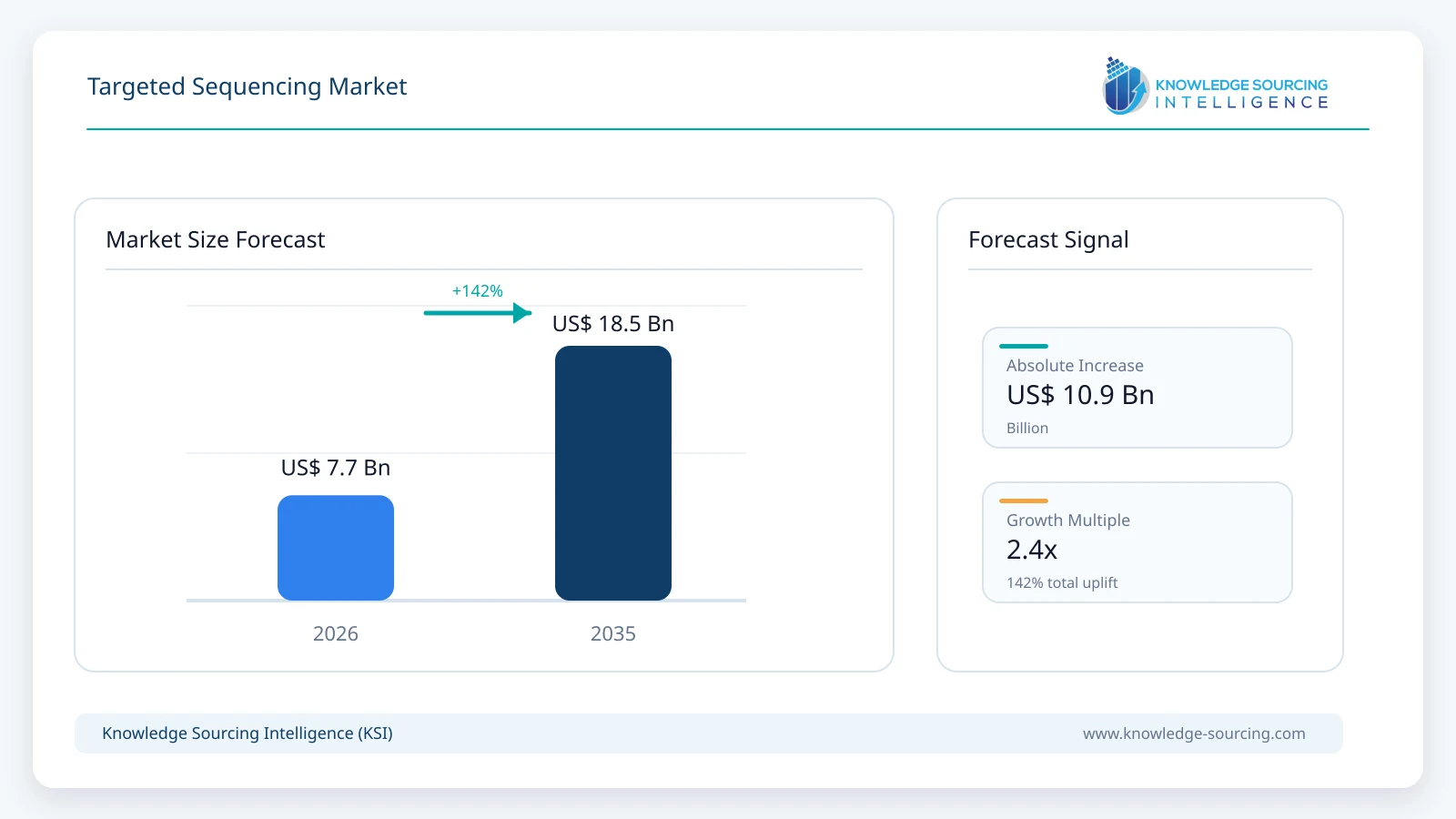
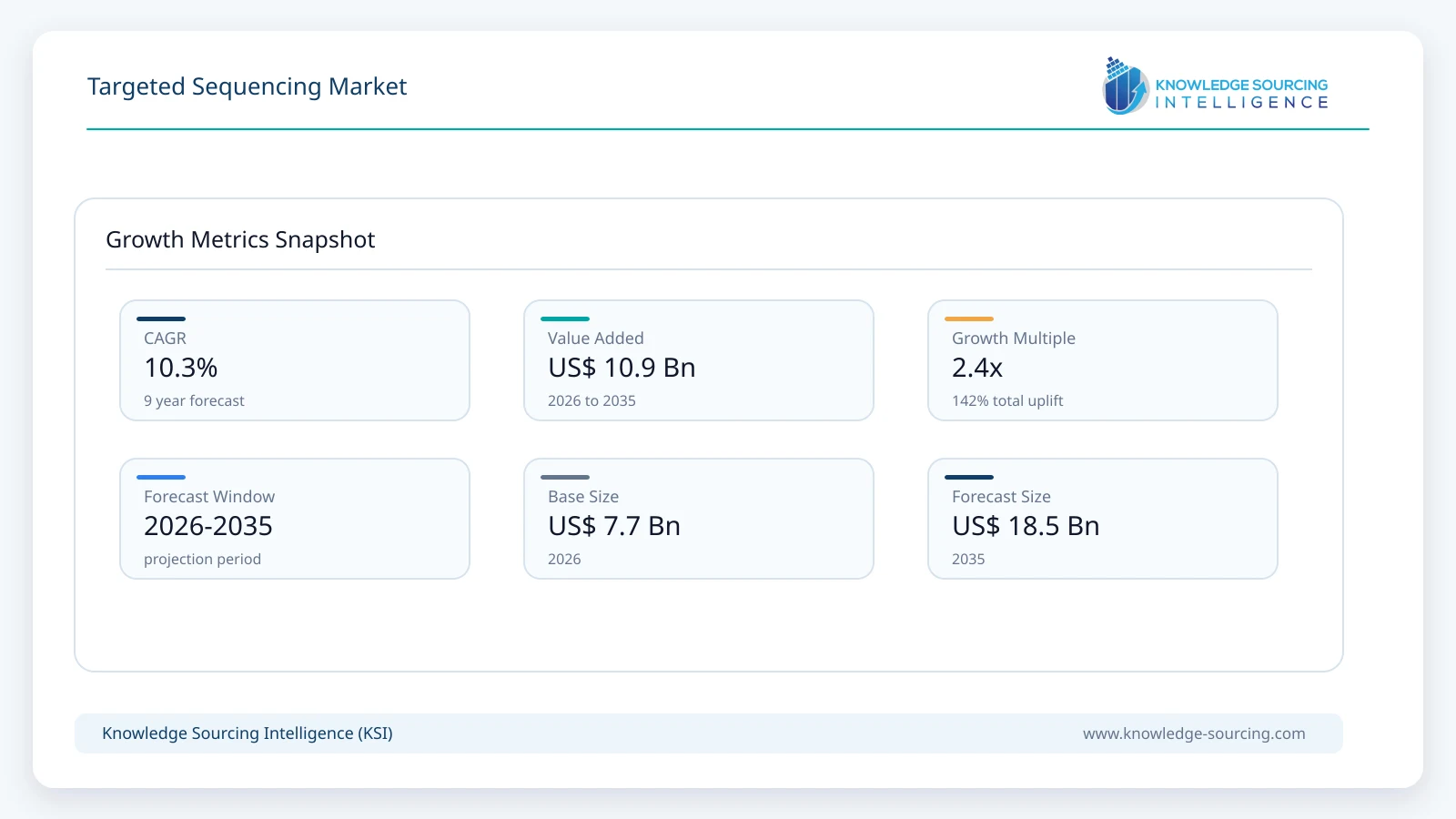
The Targeted sequencing market is growing at a CAGR of 10.3% from USD 7.66 billion in 2026 to USD 18.53 billion in 2035.
Highlights:
- 1Growing adoption of biomarker-guided therapies is increasing demand for targeted sequencing because treatment eligibility increasingly depends on genetic evidence.
- 2Expansion of precision oncology programs is strengthening utilization because cancer management requires identification of actionable mutations.
- 3Rising infectious disease surveillance efforts are increasing sequencing demand because pathogen characterization supports outbreak management.
- 4Clinical laboratories are expanding genomic testing capacity because healthcare systems require faster and more cost-effective molecular diagnostics.
Targeted sequencing enables selective analysis of disease-associated genomic regions because many clinical decisions depend on specific genetic alterations rather than complete genome characterization. This focus reduces sequencing requirements while maintaining clinical relevance. Healthcare providers are increasingly adopting targeted approaches because diagnostic turnaround time influences treatment decisions. The resulting emphasis on efficiency supports sustained demand for focused sequencing solutions.
Precision medicine depends on reliable biomarker identification because therapeutic effectiveness increasingly varies according to genetic profiles. This dependency increases demand for sequencing technologies capable of detecting actionable mutations with high sensitivity. Clinical laboratories are strengthening targeted sequencing capabilities because physicians require genomic evidence for treatment selection. The resulting integration of sequencing into clinical workflows supports broader market adoption.
Regulatory oversight remains important because sequencing results increasingly guide patient management decisions. Healthcare systems are expanding quality requirements as genomic testing becomes routine. This expansion increases demand for validated technologies and standardized analytical processes. The resulting focus on reliability strengthens the strategic importance of targeted sequencing within modern healthcare delivery.
Market Dynamics
Market Drivers
Expansion of Precision Oncology Programs: Precision oncology relies on molecular profiling because targeted therapies require identification of specific genomic alterations. Demand is increasing as oncology centers incorporate genomic testing into treatment pathways. This expansion increases utilization of targeted sequencing panels capable of detecting clinically actionable mutations. The resulting integration of sequencing into cancer care strengthens market demand.
Increasing Adoption of Companion Diagnostics: Companion diagnostics support treatment optimization because many therapies require biomarker confirmation before use. Healthcare providers are increasing genomic testing as targeted drug availability expands. This requirement increases demand for sequencing platforms capable of delivering accurate biomarker detection. The resulting alignment between diagnostics and therapeutics supports targeted sequencing adoption.
Growth of Rare Disease Testing: Rare disease diagnosis depends on identification of disease-associated genetic variants because many disorders lack clear clinical indicators. Healthcare systems are expanding genomic testing programs as diagnostic delays remain a significant challenge. This expansion increases demand for focused sequencing panels that enable efficient mutation detection. The resulting improvement in diagnostic efficiency supports market growth.
Rising Infectious Disease Surveillance: Pathogen monitoring requires rapid molecular characterization because emerging infectious threats demand timely intervention. Public health organizations are increasing sequencing utilization as genomic surveillance capabilities expand. This increase strengthens demand for targeted sequencing workflows capable of identifying specific pathogen markers. The resulting integration of genomics into surveillance programs supports long-term adoption.
Market Restraints
Variant interpretation challenges persist because clinical significance remains uncertain for many detected mutations.
Reimbursement inconsistencies limit adoption because coverage policies differ across healthcare systems and testing indications.
Data privacy requirements increase operational complexity because genomic information requires enhanced security and governance frameworks.
Market Opportunities
Expansion of Liquid Biopsy Applications: Liquid biopsy adoption depends on sensitive mutation detection because circulating biomarkers often exist at low concentrations. Healthcare providers are increasing interest in minimally invasive diagnostics as patient monitoring requirements expand. This shift increases demand for targeted sequencing solutions optimized for liquid biopsy workflows. The resulting adoption creates growth opportunities across oncology applications.
Development of Decentralized Genomic Testing: Healthcare access remains uneven because advanced genomic laboratories are concentrated in major healthcare centers. Organizations are expanding distributed testing models as sequencing workflows become more automated. This expansion increases demand for simplified targeted sequencing platforms. The resulting accessibility supports broader market penetration.
Growth of Pharmacogenomics: Drug response variability creates treatment uncertainty because genetic factors influence therapeutic outcomes. Healthcare providers are increasing interest in pharmacogenomic testing as personalized medicine adoption expands. This trend increases demand for targeted sequencing panels focused on clinically relevant genes. The resulting integration of pharmacogenomics creates new growth opportunities.
AI-Driven Variant Interpretation: Genomic data interpretation requires specialized expertise because variant classification remains complex. Laboratories are adopting artificial intelligence tools as sequencing volumes continue increasing. This adoption improves analytical efficiency and reporting consistency. The resulting enhancement supports wider implementation of targeted sequencing.
Supply Chain Analysis
The targeted sequencing supply chain begins with manufacturers of enzymes, oligonucleotides, probes, and laboratory reagents because assay performance depends on molecular input quality. Demand is increasing for specialized reagents as sequencing panels become more sophisticated. This requirement strengthens the role of suppliers capable of maintaining manufacturing consistency. The resulting emphasis on quality influences downstream workflow performance.
Target enrichment providers occupy a critical position because panel design determines sequencing specificity and sensitivity. Laboratories are seeking highly optimized panels as clinical applications require increasingly precise genomic analysis. This demand increases investment in enrichment technologies and probe development. The resulting focus on assay accuracy strengthens the importance of panel manufacturers.
Sequencing platform suppliers form the technological core because data generation capacity influences workflow efficiency and operational economics. Healthcare providers are expanding sequencing utilization as clinical demand continues increasing. This expansion encourages investment in automation and integrated workflow solutions. The resulting ecosystem development supports broader adoption of targeted sequencing.
Bioinformatics providers represent the final analytical layer because genomic data requires interpretation before clinical use. Laboratories are investing in advanced analytical systems as variant complexity increases. This investment strengthens demand for software, cloud infrastructure, and decision-support tools. The resulting integration of sequencing and informatics enhances market scalability.
Government Regulations
Region | Regulation/Framework | Market Impact |
United States | FDA oversight of molecular diagnostics | Supports quality and analytical validation requirements |
United States | CLIA laboratory standards | Governs laboratory testing quality |
European Union | In Vitro Diagnostic Regulation (IVDR) | Strengthens evidence and compliance requirements |
United Kingdom | NHS Genomic Medicine Service | Expands genomic testing adoption |
Market Segmentation
By Technology
Amplicon sequencing supports targeted mutation analysis because specific genomic regions can be amplified and analyzed with high sensitivity. Demand is increasing as oncology and infectious disease applications require detection of low-frequency variants. This requirement favors technologies capable of delivering rapid and cost-effective results. Laboratories are expanding utilization because focused analysis reduces data processing burdens. The resulting efficiency strengthens adoption across routine clinical applications.
By Application
Oncology represents the largest application segment because treatment selection increasingly depends on genomic evidence. Healthcare providers are expanding sequencing programs as targeted therapies continue entering clinical practice. This expansion increases demand for mutation detection panels and companion diagnostics. The resulting dependence on biomarker-driven treatment strategies strengthens sequencing utilization.
Regional Analysis
North America
North America represents the largest demand center for targeted sequencing because precision medicine adoption increasingly influences clinical decision-making. Healthcare providers are expanding genomic testing programs as oncology treatment pathways become more dependent on biomarker identification. This expansion increases demand for targeted sequencing assays capable of delivering clinically actionable results within shorter turnaround times. Clinical laboratories face pressure to support growing testing volumes while maintaining analytical accuracy. Organizations are investing in automation and integrated bioinformatics platforms to address operational complexity. The resulting improvement in workflow efficiency strengthens targeted sequencing adoption across hospitals, cancer centers, and reference laboratories.
Companion diagnostics create additional demand because regulatory approvals increasingly link therapeutic eligibility to specific genomic markers. Pharmaceutical companies are expanding biomarker-driven drug development programs as treatment personalization becomes a competitive necessity. This shift increases sequencing utilization throughout clinical trials and routine patient management. Healthcare systems continue integrating genomic medicine because molecular evidence supports more informed treatment decisions. The resulting alignment between diagnostics and therapeutics reinforces long-term market expansion.
Rare disease initiatives contribute to sustained demand because genomic testing improves diagnostic success rates. Academic medical centers are increasing sequencing utilization as research findings continue demonstrating clinical value. This increase strengthens demand for both targeted sequencing technologies and associated interpretation tools. The resulting ecosystem supports continued market leadership across the region.
Europe
Europe maintains strong targeted sequencing demand because healthcare systems increasingly emphasize personalized treatment approaches. National health programs are incorporating genomic diagnostics into patient care pathways as evidence supporting molecular medicine continues expanding. This incorporation increases demand for validated sequencing assays and standardized analytical workflows. Clinical laboratories face growing compliance expectations because regulatory frameworks require stronger evidence generation and quality management. Organizations are investing in validated sequencing solutions to satisfy evolving requirements. The resulting focus on regulatory alignment supports adoption of established targeted sequencing technologies.
Cancer genomics remains a significant demand driver because healthcare providers require molecular information for therapy selection. Oncology centers are increasing sequencing implementation as targeted therapies continue expanding across multiple cancer types. This increase strengthens demand for disease-specific sequencing panels capable of detecting actionable mutations. Research institutions continue generating genomic evidence because translational medicine initiatives require robust molecular datasets. The resulting integration of research and clinical practice supports long-term utilization.
Cross-border collaborations strengthen market development because genomic data sharing improves disease understanding. Institutions are expanding sequencing infrastructure as multinational research programs become increasingly common. This expansion supports demand for advanced sequencing platforms and bioinformatics systems. The resulting ecosystem encourages sustained market growth across Europe.
Asia Pacific
Asia Pacific represents one of the fastest-developing markets because healthcare modernization programs increasingly prioritize genomic medicine. Governments are expanding investments in biotechnology infrastructure as national healthcare strategies focus on precision medicine capabilities. This investment increases demand for sequencing platforms, target enrichment technologies, and genomic analysis solutions. Healthcare providers face growing pressure to improve diagnostic efficiency as patient populations continue expanding. Organizations are adopting targeted sequencing because focused genomic analysis provides clinically relevant information at lower operational costs. The resulting emphasis on cost-effective precision diagnostics supports rapid market expansion.
Population-scale genomics initiatives create additional demand because large datasets improve disease understanding and biomarker discovery. Research institutions are increasing sequencing activities as government funding supports genomic innovation. This increase strengthens demand for both clinical and research-focused sequencing solutions. Domestic technology providers are expanding capabilities because governments increasingly support local biotechnology development. The resulting competitive environment encourages broader adoption of sequencing technologies.
Healthcare accessibility remains uneven because advanced genomic services are concentrated in major urban centers. Organizations are developing decentralized testing models as demand expands beyond traditional research hubs. This development increases interest in simplified and scalable targeted sequencing workflows. The resulting expansion improves market penetration throughout the region.
Rest of the World
The Rest of the World market continues evolving because healthcare systems increasingly recognize the clinical value of genomic testing. Governments are evaluating precision medicine initiatives as healthcare modernization efforts focus on improving diagnostic outcomes. This evaluation increases demand for targeted sequencing services and technology partnerships. Healthcare providers face resource constraints because genomic infrastructure remains limited in many regions. Organizations are prioritizing focused sequencing applications where clinical utility is clearly established. The resulting concentration on high-value use cases supports gradual market expansion.
Oncology applications generate substantial demand because cancer incidence continues increasing across multiple countries. Healthcare institutions are introducing genomic testing programs as treatment selection becomes more dependent on molecular evidence. This introduction increases demand for targeted sequencing assays capable of supporting routine clinical decisions. International collaborations continue expanding because local expertise often remains limited. The resulting knowledge transfer strengthens sequencing adoption and laboratory capability development.
Economic considerations influence purchasing decisions because healthcare budgets vary significantly across emerging markets. Organizations are seeking efficient sequencing solutions that balance affordability with clinical performance. This requirement increases demand for scalable and cost-effective technologies. The resulting focus on operational value supports sustainable adoption across diverse healthcare environments.
Regulatory Landscape
Regulatory oversight shapes the targeted sequencing market because genomic test results increasingly influence treatment decisions and patient management strategies. Healthcare authorities require evidence of analytical validity because inaccurate genomic information may affect clinical outcomes. This requirement increases demand for validated assays and standardized laboratory procedures. Technology providers are strengthening compliance frameworks as regulatory expectations continue evolving. The resulting emphasis on quality supports confidence in sequencing-based diagnostics.
Data privacy requirements continue expanding because genomic information represents highly sensitive personal data. Regulatory bodies are strengthening governance frameworks as genomic databases continue growing. This expansion increases demand for secure data management systems and controlled access protocols. Laboratories are investing in cybersecurity and compliance infrastructure because regulatory adherence influences operational sustainability. The resulting focus on responsible genomic data management strengthens public trust in precision medicine initiatives.
International regulatory variation remains a challenge because different jurisdictions apply distinct diagnostic approval pathways. Organizations are adapting commercialization strategies as global sequencing adoption expands. This adaptation increases operational complexity while encouraging development of flexible compliance models. The resulting evolution continues influencing product development priorities and market access strategies.
Pipeline Analysis
Targeted sequencing plays an increasingly important role in therapeutic development because biomarker-driven treatment strategies require precise genomic characterization. Pharmaceutical companies are expanding genomic profiling throughout drug development programs as patient stratification becomes critical for clinical success. This expansion increases demand for sequencing assays capable of identifying disease-associated mutations. Research organizations are generating larger genomic datasets because precision medicine initiatives depend on detailed molecular insights. The resulting integration of genomics into therapeutic development supports sustained sequencing demand.
Precision oncology pipelines remain a primary driver because targeted therapies require reliable identification of actionable genetic alterations. Clinical researchers are incorporating sequencing-based biomarkers into trial designs as treatment development becomes increasingly personalized. This incorporation increases utilization of targeted sequencing technologies across multiple stages of drug development. Biotechnology companies are strengthening genomic research capabilities because molecular evidence improves development efficiency. The resulting reliance on genomic data reinforces the strategic importance of targeted sequencing.
Infectious disease research continues creating opportunities because genomic surveillance programs require rapid identification of pathogen-specific markers. Public health organizations are expanding sequencing utilization as outbreak preparedness becomes a strategic priority. This expansion increases demand for focused sequencing assays that enable efficient pathogen monitoring. The resulting growth in genomic surveillance strengthens long-term market relevance.
Competitive Landscape
Illumina
Illumina remains strategically distinct because it combines sequencing platform leadership with a comprehensive portfolio of targeted sequencing assays, reagents, and bioinformatics solutions. The company occupies a central position in the targeted sequencing ecosystem because clinical laboratories and research institutions increasingly rely on standardized workflows to support precision medicine initiatives. This dependence increases recurring demand for consumables and analytical software. Healthcare providers are expanding genomic testing because biomarker-driven treatment strategies require reliable mutation detection. The resulting increase in sequencing utilization strengthens Illumina’s installed-base advantage.
Demand is shifting toward integrated genomic workflows because laboratories seek operational efficiency and consistent analytical performance. This shift increases the importance of platforms capable of supporting sample preparation, sequencing, and interpretation within a unified environment. Illumina is expanding software and informatics capabilities to address these requirements. The resulting ecosystem approach improves customer retention and supports broader adoption of targeted sequencing technologies across oncology, rare disease testing, and translational research applications.
Thermo Fisher Scientific
Thermo Fisher Scientific remains strategically distinct because it integrates sequencing technologies with a broad laboratory infrastructure portfolio. This integration allows healthcare organizations to streamline procurement and workflow management. Laboratories are increasing adoption of comprehensive genomic solutions because operational efficiency influences technology selection. This requirement strengthens demand for sequencing systems that connect with existing laboratory environments. The resulting compatibility supports Thermo Fisher’s competitive position.
Precision medicine programs continue expanding because clinicians increasingly depend on genomic evidence for treatment decisions. This expansion increases utilization of targeted sequencing assays across clinical and research applications. The company is strengthening sequencing capabilities while leveraging its extensive life sciences network. The resulting combination of scale, technical support, and workflow integration enhances its role in the targeted sequencing market.
QIAGEN
QIAGEN remains strategically distinct because it combines molecular sample preparation expertise with advanced genomic analysis capabilities. Sequencing workflows depend on high-quality nucleic acid extraction because analytical accuracy begins with sample integrity. Laboratories are increasing focus on workflow reliability as clinical sequencing volumes continue rising. This focus increases demand for standardized preparation technologies and interpretation platforms. The resulting requirement strengthens QIAGEN’s position within targeted sequencing workflows.
Demand is shifting toward clinically actionable genomic insights because healthcare providers require efficient interpretation of sequencing results. This shift increases the importance of bioinformatics solutions capable of supporting clinical decision-making. QIAGEN is expanding analytical and digital capabilities to address interpretation challenges. The resulting integration of laboratory and informatics expertise strengthens its competitive differentiation.
Agilent Technologies
Agilent Technologies remains strategically distinct because of its strong position in target enrichment and genomic sample preparation technologies. Targeted sequencing depends on efficient enrichment because assay performance influences mutation detection accuracy. Laboratories are increasing demand for highly optimized enrichment workflows as clinical applications become more sophisticated. This increase strengthens the importance of Agilent’s technology portfolio. The resulting emphasis on analytical precision supports continued market relevance.
Research institutions continue expanding genomic investigations because precision medicine development requires robust molecular evidence. This expansion increases utilization of targeted sequencing workflows that balance coverage and efficiency. Agilent is advancing enrichment solutions that support both research and clinical requirements. The resulting alignment with evolving sequencing needs sustains long-term market participation.
F. Hoffmann-La Roche Ltd.
Roche remains strategically distinct because it combines diagnostic expertise with extensive pharmaceutical capabilities. Precision medicine depends on close integration between genomic testing and targeted therapeutics because treatment effectiveness increasingly relies on biomarker identification. Healthcare providers are expanding genomic testing programs as molecular profiling becomes central to oncology management. This expansion increases demand for clinically validated sequencing solutions. The resulting connection between diagnostics and therapeutics supports Roche’s strategic advantage.
Demand is shifting toward personalized treatment pathways because healthcare systems increasingly seek outcome-based care models. This shift increases the importance of genomic evidence within clinical decision-making. Roche is strengthening precision medicine initiatives that integrate diagnostic and therapeutic capabilities. The resulting ecosystem supports continued growth within targeted sequencing applications.
PacBio
PacBio remains strategically distinct because its long-read sequencing technologies complement conventional targeted sequencing approaches. Complex genomic regions create analytical challenges because structural variants and repetitive sequences may remain difficult to characterize using traditional methods. Researchers are increasing demand for complementary sequencing technologies as precision medicine applications become more sophisticated. This increase expands opportunities for long-read solutions within targeted genomic analysis. The resulting technological differentiation strengthens PacBio’s market relevance.
Genomic research continues advancing because disease characterization increasingly depends on deeper molecular insights. This progression increases utilization of technologies capable of resolving challenging genomic structures. PacBio is enhancing sequencing performance to support evolving research requirements. The resulting ability to complement targeted sequencing workflows supports continued adoption in specialized applications.
BGI Genomics
BGI Genomics remains strategically distinct because it combines large-scale sequencing capabilities with extensive experience in population genomics programs. National genomic initiatives generate substantial demand because governments increasingly recognize genomic data as a strategic healthcare resource. Research institutions are expanding sequencing projects as disease understanding becomes more dependent on molecular evidence. This expansion increases utilization of scalable genomic technologies. The resulting demand supports BGI’s operational strengths.
Healthcare providers are increasing adoption of genomic testing because precision medicine programs require broader access to sequencing services. This increase strengthens demand for cost-effective sequencing solutions and laboratory support capabilities. BGI continues leveraging large-scale operational infrastructure to address these requirements. The resulting combination of capacity and affordability supports long-term market participation.
Revvity
Revvity remains strategically distinct because it combines diagnostics expertise with genomic technologies supporting clinical and research applications. Healthcare systems increasingly prioritize earlier disease detection because preventive and precision medicine strategies depend on timely intervention. This priority increases demand for genomic testing solutions that integrate with broader diagnostic workflows. Laboratories are expanding molecular testing capabilities as genomic medicine adoption accelerates. The resulting demand strengthens Revvity’s role in targeted sequencing applications.
Demand is shifting toward integrated healthcare diagnostics because clinicians increasingly require comprehensive patient information. This shift increases the importance of genomic technologies capable of complementing existing diagnostic systems. Revvity is expanding its precision medicine portfolio to support these evolving needs. The resulting integration enhances its competitive position within the targeted sequencing market.
Strategic Insights and Future Market Outlook
The future of the targeted sequencing market depends on the continued expansion of precision medicine because healthcare providers increasingly require actionable genomic information rather than broad exploratory datasets. Demand is shifting toward focused sequencing approaches as clinicians seek faster results, lower analytical complexity, and stronger clinical relevance. This transition increases reliance on disease-specific panels capable of identifying actionable mutations with high confidence. Technology providers are responding by developing more integrated workflows that connect sequencing, interpretation, and reporting functions. The resulting evolution strengthens targeted sequencing as a routine component of clinical diagnostics.
Artificial intelligence is becoming increasingly important because sequencing volumes continue expanding while interpretation complexity remains high. Laboratories are incorporating automated analytical systems as genomic testing moves into mainstream healthcare settings. This incorporation improves efficiency and consistency while reducing operational burdens. Healthcare organizations are seeking scalable genomic solutions because patient demand for personalized care continues increasing. The resulting focus on workflow automation supports broader market adoption.
Government-supported genomics initiatives continue influencing market development because national healthcare systems increasingly recognize the value of molecular diagnostics. Public investments are expanding sequencing infrastructure as precision medicine strategies become long-term healthcare priorities. This expansion increases demand for sequencing platforms, enrichment technologies, and bioinformatics capabilities. The resulting ecosystem growth creates opportunities across the targeted sequencing value chain.
Targeted sequencing ultimately benefits from a structural shift toward evidence-based treatment selection. Healthcare providers increasingly depend on genomic information because therapeutic outcomes are becoming more dependent on molecular characteristics. Laboratories continue expanding sequencing capacity because demand for precision diagnostics remains strong. Technology developers keep improving workflow performance because healthcare systems require greater efficiency and reliability. These interconnected changes position targeted sequencing as a foundational technology within future precision medicine frameworks.
Targeted Sequencing Market Scope:
| Report Metric | Details |
|---|---|
| Total Market Size in 2026 | USD 7.66 billion |
| Total Market Size in 2035 | USD 18.53 billion |
| Forecast Unit | USD Billion |
| Growth Rate | 10.3% |
| Study Period | 2021 to 2035 |
| Historical Data | 2021 to 2024 |
| Base Year | 2025 |
| Forecast Period | 2026 – 2035 |
| Segmentation | Product & Service, Technology, End User, Geography |
| Companies |
|
Market Segmentation
Product & Service
Technology
End User
Geography
- North America
- South America
- Europe
- Middle East and Africa
- Asia Pacific
Table of Contents
1. EXECUTIVE SUMMARY
1.1 Market Snapshot
1.2 Key Findings
1.3 Analyst Insights
1.4 Strategic Recommendations
2. RESEARCH METHODOLOGY
2.1 Research Design
2.2 Data Collection Methodology
2.3 Market Size Estimation
2.4 Forecasting Model
2.5 Assumptions & Limitations
3. TARGETED SEQUENCING MARKET OVERVIEW, SIZE & FORECAST
3.1 Market Definition & Scope
3.2 Industry Overview
3.3 Industry Evolution
3.4 Key Market Trends
3.5 Historical Market Size Analysis (2021–2025)
3.6 Market Forecast Analysis (2026–2035)
3.7 Clinical Utility of Targeted Sequencing
3.8 Evolution of Target Enrichment Technologies
3.9 Precision Medicine Ecosystem Overview
3.10 Testing Volume Analysis
3.11 Installed Base Analysis of Sequencing Platforms
3.12 User Adoption Analysis
3.13 Biomarker Testing Landscape
4. MARKET DYNAMICS
4.1 Market Drivers
4.2 Market Restraints
4.3 Market Opportunities
4.4 Market Challenges
5. INDUSTRY LANDSCAPE
5.1 Industry Value Chain Analysis
5.2 Pricing Analysis
5.3 Reimbursement Landscape
5.4 Stakeholder Ecosystem Analysis
5.5 Molecular Diagnostics Infrastructure Analysis
6. INNOVATION LANDSCAPE
6.1 Emerging Target Enrichment Technologies
6.2 Product Innovation Analysis
6.3 Clinical Trial Analysis Utilizing Targeted Sequencing
6.4 Pipeline Analysis of Targeted Sequencing-Based Diagnostic Solutions
6.5 AI Integration in Variant Interpretation
6.6 Companion Diagnostics Development Landscape
6.7 Technology Roadmap
7. REGULATORY LANDSCAPE
7.1 Regulatory Framework
7.2 Approval Pathways
7.3 Compliance Requirements
7.4 Companion Diagnostic Regulatory Environment
8. TARGETED SEQUENCING MARKET LANDSCAPE ANALYSIS
8.1 Analysis by Product & Service Category
8.2 Analysis by Target Enrichment Technology
8.3 Analysis by Clinical Application
8.4 Analysis by End User Environment
8.5 Analysis by Gene Panel Complexity
8.6 Analysis by Sample Type
9. TARGETED SEQUENCING MARKET SEGMENT ANALYSIS (2021–2035)
9.1 By Product & Service
9.1.1 Instruments
9.1.2 Consumables & Reagents
9.1.3 Sequencing Services
9.1.4 Bioinformatics & Data Analysis Services
9.2 By Technology
9.2.1 Amplicon-Based Sequencing
9.2.2 Hybridization Capture-Based Sequencing
9.3 By Application
9.3.1 Oncology
9.3.2 Hereditary Disease Testing
9.3.3 Reproductive Health Testing
9.3.4 Infectious Disease Testing
9.3.5 Pharmacogenomics
9.4 By End User
9.4.1 Hospitals & Diagnostic Laboratories
9.4.2 Academic & Research Institutes
9.4.3 Pharmaceutical & Biotechnology Companies
10. TARGETED SEQUENCING MARKET GEOGRAPHICAL ANALYSIS (2021–2035)
10.1 North America
10.2 Europe
10.3 Asia-Pacific
10.4 South America
10.5 Middle East & Africa
11. TARGETED SEQUENCING MARKET COUNTRY ANALYSIS (2021–2035)
11.1 United States
11.2 Canada
11.3 Germany
11.4 United Kingdom
11.5 France
11.6 Italy
11.7 Spain
11.8 China
11.9 Japan
11.10 South Korea
11.11 India
11.12 Australia
11.13 Brazil
11.14 Saudi Arabia
11.15 United Arab Emirates
12. COMPETITIVE LANDSCAPE
12.1 Market Share Analysis
12.2 Strategic Developments
12.3 Mergers & Acquisitions, Partnerships & Collaborations
12.4 Product Launches
12.5 Competitive Benchmarking Analysis
13. COMPANY PROFILES
13.1 Illumina, Inc.
13.2 Thermo Fisher Scientific Inc.
13.3 QIAGEN N.V.
13.4 F. Hoffmann-La Roche Ltd.
13.5 Agilent Technologies, Inc.
13.6 Guardant Health, Inc.
13.7 Natera, Inc.
13.8 Exact Sciences Corporation
13.9 BGI Genomics Co., Ltd.
13.10 SOPHiA GENETICS SA
13.11 NeoGenomics Laboratories, Inc.
13.12 Personalis, Inc.
13.13 Adaptive Biotechnologies Corporation
13.14 Invitae (where applicable commercially)
13.15 GeneDx Holdings Corp.
14. TARGETED SEQUENCING MARKET COMMERCIAL FORECAST ANALYSIS
14.1 Instruments Forecast
14.2 Consumables & Reagents Forecast
14.3 Sequencing Services Forecast
14.4 Bioinformatics & Data Analysis Services Forecast
14.5 Amplicon-Based Sequencing Forecast
14.6 Hybridization Capture-Based Sequencing Forecast
14.7 Oncology Applications Forecast
14.8 Hereditary Disease Testing Forecast
15. INVESTMENT & FUNDING ANALYSIS
15.1 Venture Capital Trends
15.2 Government Funding
15.3 R&D Investments
15.4 Precision Medicine Infrastructure Investments
15.5 Strategic Financing Activities
16. FUTURE OUTLOOK
16.1 Key Growth Opportunities
16.2 Future Industry Trends
16.3 Evolution of Companion Diagnostics and Precision Oncology
16.4 Future of Biomarker-Driven Testing
16.5 Impact of AI-Driven Genomic Interpretation on Market Growth
16.6 Long-Term Market Outlook (2035)
Navigate
Trusted by the world's leading organizations











