
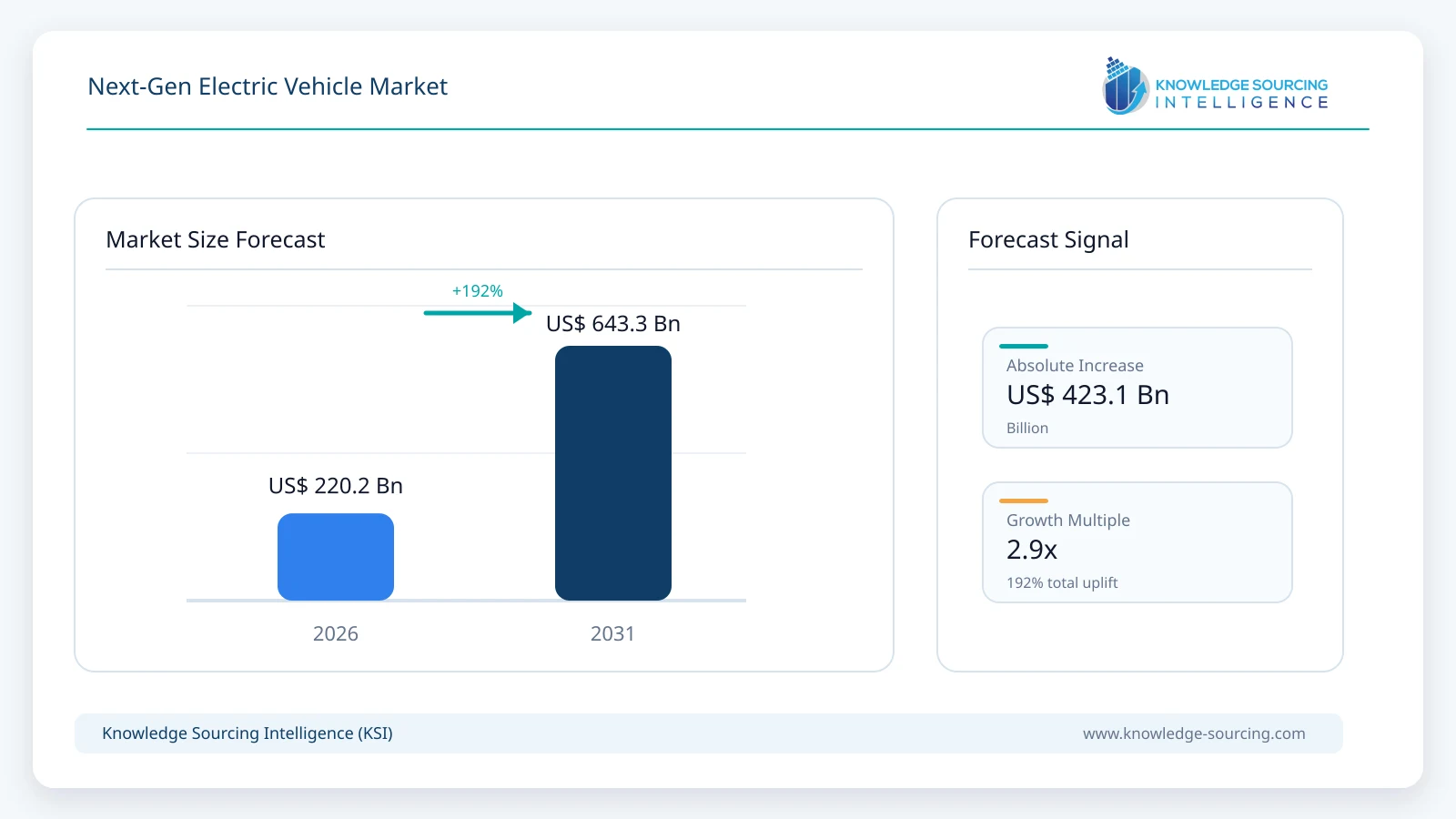
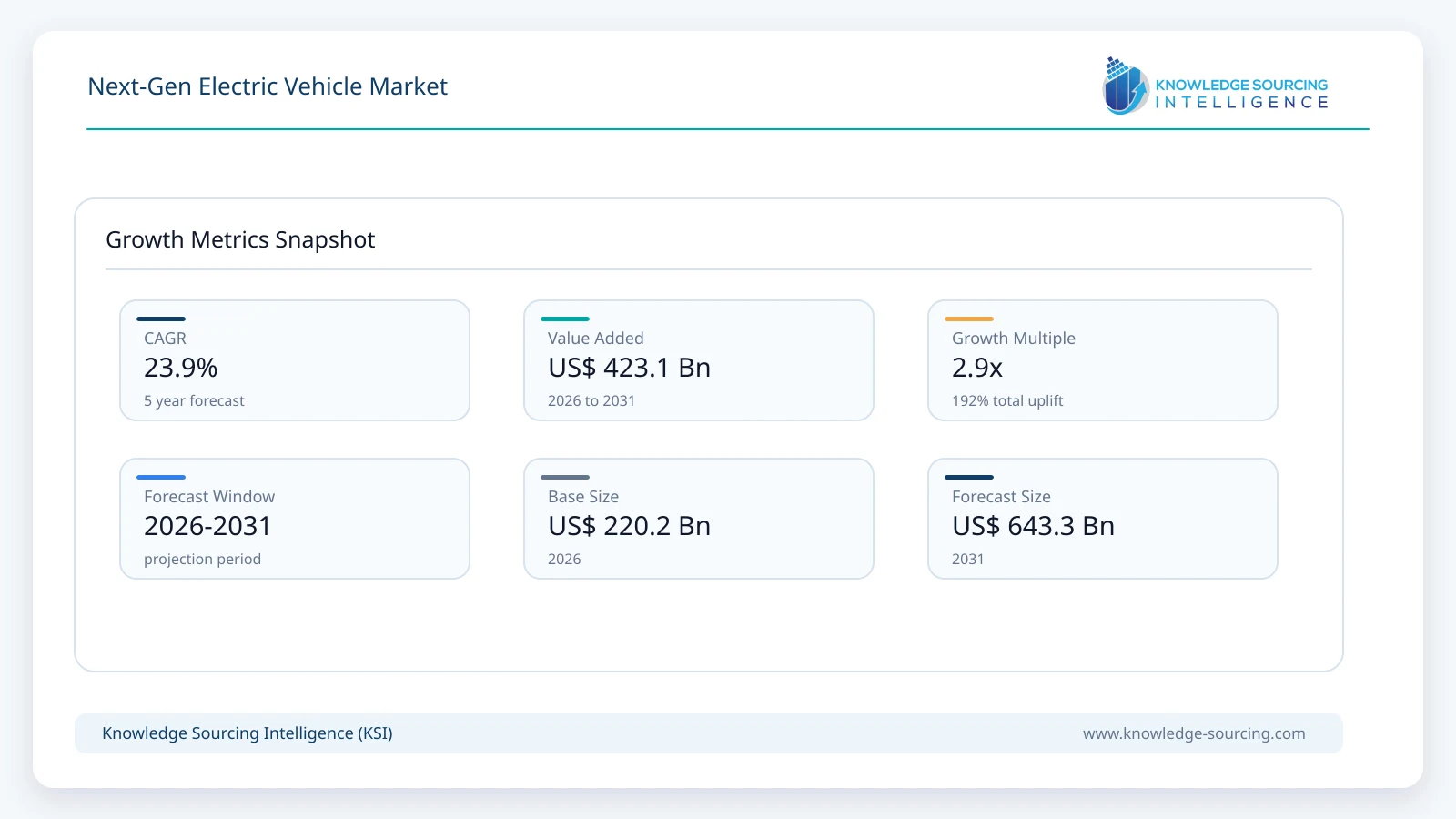
The Next-Gen Electric Vehicle Market is anticipated to surge from USD 220.2 billion in 2026 to USD 643.3 billion by 2031, advancing at a 23.9% CAGR during the forecast period.
Highlights:
- 1Vehicle electrification has entered a higher-volume phaseGlobal electric car sales exceeded 20 million units in 2025, making electric vehicles approximately one-quarter of new global car sales.
- 2Passenger vehicles remain commercially importantPassenger cars represent the largest concentration of global EV manufacturing capacity, battery demand, model launches, and consumer purchasing activity, while commercial fleets are becoming increasingly relevant for high-utilization applications.
- 3Asia Pacific remains the principal demand and manufacturing centerChina combines high EV penetration, large domestic production, extensive supplier capacity, and strong policy support, while India, Japan, and South Korea provide additional demand and technology opportunities.
- 4Battery economics are becoming a primary competitive variableLithium-ion remains dominant, but sodium-ion, solid-state, lithium-sulfur, and other chemistries are being evaluated according to cost, energy density, safety, raw-material availability, and application requirements.
- 5Regulation increasingly influences product planningEuropean CO2 standards, battery sustainability requirements, Chinese purchase-tax and trade-in measures, and changing North American incentive structures affect model availability, production location, pricing, and procurement decisions.
- 6Competition is shifting toward integrated vehicle economicsAutomakers are competing through localized production, platform scale, battery sourcing, charging ecosystems, flexible powertrain portfolios, financing, and software-enabled vehicle functionality rather than vehicle specifications alone.
The Next-Gen Electric Vehicle Market covers the development, production, sale, and deployment of electric and electrified road vehicles that incorporate newer propulsion architectures, battery systems, charging capabilities, energy-management technologies, and vehicle platforms. The scope includes passenger vehicles, commercial vehicles, two-wheelers, three-wheelers, and electric buses across battery-electric, plug-in hybrid, hybrid, and fuel-cell configurations. From a technology perspective, the market also encompasses lithium-ion batteries and emerging chemistries such as solid-state, sodium-ion, lithium-sulfur, and other battery technologies moving toward commercial application.
The market has moved beyond a narrow substitution of internal-combustion vehicles. Vehicle manufacturers now compete across energy efficiency, range, charging speed, battery durability, software functionality, manufacturing cost, financing terms, after-sales support, and compliance with regional emissions requirements. This broadening of the purchasing decision is changing how automakers allocate capital and how fleet operators evaluate vehicle economics.
Global electric car sales exceeded 20 million units in 2025, with electric vehicles representing approximately one-quarter of new car sales worldwide, according to the International Energy Agency. China accounted for more than half of annual car sales with electric vehicles in 2025, while Europe recorded strong growth and the United States remained more sensitive to changes in policy and incentives.
The commercial importance of the Next-Gen Electric Vehicle Market therefore extends across the automotive value chain. Vehicle manufacturers require scalable platforms and localized production. Battery suppliers must secure minerals, cell capacity, recycling channels, and chemistry-specific manufacturing capabilities. Charging providers need to match infrastructure investment with vehicle utilization. Fleet operators are assessing vehicles through total cost of ownership rather than purchase price alone, while governments are using emissions standards, industrial policy, purchase incentives, and infrastructure programs to influence adoption.
Demand is no longer uniform across vehicle categories. Passenger-vehicle buyers typically place greater emphasis on purchase price, driving range, charging convenience, safety, cabin features, resale expectations, and brand reputation. Commercial operators place greater weight on utilization rates, payload, charging downtime, route predictability, battery warranty, maintenance cost, and financing. Two- and three-wheeler buyers in emerging markets are more sensitive to upfront affordability and daily operating economics. These differences create distinct adoption curves even when vehicles share underlying battery technology.
Battery economics remain central to market development. Global demand for batteries used in electric vehicles exceeded 950 GWh in 2024, rising by roughly one-quarter from the previous year, with electric cars accounting for most demand. Battery demand from electric trucks also expanded considerably, increasing the importance of higher-capacity packs, charging infrastructure, thermal management, and durable cell chemistry.
The next stage of the market is consequently being shaped by cost engineering. Manufacturers are seeking lower-cost battery packs without sacrificing range, safety, or warranty performance. Lithium-ion technology remains the commercial foundation, while sodium-ion batteries may address applications where cost and resource availability outweigh maximum energy density. Solid-state and lithium-sulfur technologies remain strategically relevant because improvements in energy density and safety could alter vehicle architecture, although their commercial scale and economics remain important execution questions.
Charging infrastructure represents another commercial layer. A vehicle can achieve competitive specifications on paper but remain difficult to operate if charging access is unreliable or poorly matched to driving patterns. Passenger vehicles require a combination of home, workplace, public, and fast-charging infrastructure. Fleet operators need depot charging, energy-management systems, route planning, and increasingly predictable access to high-power charging. The economics of infrastructure therefore influence vehicle procurement decisions directly.
Electric mobility also creates a growing connection between transport and electricity systems. The IEA estimates that the global EV fleet consumed approximately 180 TWh of electricity in 2024 and projects electricity demand from EVs to rise substantially as the fleet expands. Under its Stated Policies Scenario, EV electricity consumption could reach approximately 780 TWh by 2030. This increases the importance of managed charging, grid capacity, renewable-energy integration, and vehicle-to-grid technologies.
The Next-Gen Electric Vehicle Market is forecast to grow over 2026–2031. No market size or CAGR has been supplied in the input data; therefore, this report description does not introduce an unsupported market valuation or growth rate.
Market Drivers
Lower Total Cost of Ownership Is Expanding the Addressable Buyer Base
The economic case for electric vehicles increasingly depends on lifetime operating cost rather than sticker price. Electric drivetrains have fewer moving components than conventional powertrains, reducing several routine maintenance requirements. Electricity can also cost less than liquid fuel per kilometre in markets where tariffs are favorable and vehicles achieve high utilization.
This economic relationship is particularly relevant to fleet operators. Delivery companies, ride-hailing businesses, municipal fleets, logistics providers, and other commercial users can accumulate substantial fuel and maintenance expenses because vehicles operate for longer hours and cover greater distances than private cars. A vehicle with a higher purchase price can therefore become commercially attractive when energy and maintenance savings are sufficiently large.
Buyer requirements differ by application. A delivery fleet may prioritize predictable depot charging and battery durability over maximum range, while an intercity operator may require fast charging and greater energy capacity. Manufacturers are responding by developing multiple battery capacities, body configurations, and charging systems rather than relying on one universal EV specification.
The commercial implication is a widening market beyond early adopters. As operating-cost evidence accumulates, procurement decisions can increasingly be supported by fleet-level financial models. This favors manufacturers that can demonstrate battery durability, warranty coverage, residual-value support, and dependable service networks.
Regulatory Pressure Is Reshaping Vehicle Product Planning
Vehicle emissions rules are creating a structural demand mechanism that operates independently of consumer preferences. In Europe, Regulation (EU) 2019/631 and subsequent amendments establish progressively stricter fleet CO2 requirements, including a 100% reduction target for new passenger cars and vans from 2035. For 2025–2029, the EU fleet-wide targets are 93.6 g CO2/km for cars and 153.9 g CO2/km for vans.
Such requirements affect manufacturers at the portfolio level. Automakers must manage fleet-average emissions rather than treating each vehicle as an isolated product. This encourages investment in BEVs, PHEVs, HEVs, efficiency improvements, and other lower-emission configurations according to regional compliance economics.
Regulatory requirements also influence procurement by businesses. Corporate fleets operating under sustainability targets may favor lower-emission vehicles even when the immediate financial return is not the only purchasing criterion. Municipal and public-sector procurement can reinforce this effect where emissions standards are incorporated into tender specifications.
For manufacturers, compliance increasingly determines where models are launched, how quickly electric variants reach the market, and which vehicle classes receive investment. Regulation therefore functions as both a demand catalyst and a product-development constraint.
Battery Cost, Scale, and Technology Improvement Are Broadening Vehicle Economics
Battery packs remain one of the most important cost components in electric vehicles. Manufacturing scale, chemistry selection, cell format, pack architecture, thermal management, and material prices all affect vehicle economics.
The expansion of global battery demand is encouraging manufacturers and suppliers to pursue higher factory utilization and greater supply-chain integration. At the same time, the emergence of alternative chemistries gives automakers additional tools for matching battery characteristics to vehicle requirements.
Lithium-ion batteries remain the primary commercial technology because of established manufacturing capacity and a mature supply chain. However, sodium-ion technology may become relevant for lower-cost vehicles and applications where energy density requirements are less demanding. Solid-state batteries remain strategically important for potential improvements in energy density and safety, while lithium-sulfur technology could address different performance requirements if durability and manufacturing challenges are resolved.
For buyers, battery technology matters through range, charging time, degradation, warranty, replacement cost, vehicle weight, and resale value. Consequently, battery innovation affects demand even when customers do not directly select a chemistry.
Government-Supported Vehicle Replacement Programs Stimulate Near-Term Demand
Vehicle replacement policies can accelerate EV adoption by reducing the effective purchase price of new vehicles while removing older, less efficient vehicles from the fleet. China provides a clear example. In 2025, its national vehicle trade-in program offered a subsidy of RMB 20,000 for eligible consumers scrapping qualifying older vehicles and purchasing new energy passenger vehicles.
The program created a direct link between replacement timing and EV purchasing. By May 2025, more than 10 million applications for auto trade-in subsidies had been submitted, and new energy vehicles represented more than half of trade-ins during the year.
These programs influence more than individual purchases. They provide manufacturers with demand visibility, encourage dealers to manage replacement cycles, support used-vehicle circulation, and increase the utilization of domestic manufacturing capacity.
The effect is strongest when incentives are combined with product affordability and an established charging network. Subsidies alone cannot compensate indefinitely for poor vehicle economics, limited infrastructure, or inadequate model availability.
Fleet Electrification Is Creating New Commercial Demand
Commercial vehicles offer a distinct route for EV adoption because fleet economics can be measured against defined routes, mileage, energy consumption, and maintenance schedules. Delivery vans, buses, municipal vehicles, and selected medium- and heavy-duty trucks can therefore be evaluated using operational data rather than consumer perceptions.
High daily utilization can increase the value of electricity and maintenance savings. However, it also makes charging downtime more costly. Fleet buyers consequently require charging capacity that matches operating schedules, battery warranties aligned with intensive use, and service networks capable of minimizing vehicle downtime.
The IEA reported that electric heavy-freight truck sales in China more than tripled in 2025 to above 200,000 units, demonstrating how quickly electrification can move in commercial applications where vehicle economics and policy conditions align.
Market Restraints and Challenges
High Upfront Vehicle Prices Continue to Limit Mass Adoption in Price-Sensitive Markets
Even when lifetime ownership costs are favorable, the initial purchase price can remain decisive for households and small businesses. Battery packs, advanced electronics, safety systems, and new vehicle platforms can increase manufacturing costs relative to established internal-combustion vehicles.
This issue is especially important in emerging economies where consumers rely heavily on financing and have limited access to low-cost credit. A lower monthly operating cost does not fully offset a large upfront payment if financing conditions are restrictive.
Manufacturers can mitigate the issue through smaller battery packs, localized production, lower-cost platforms, financing programs, battery leasing or swapping models, and greater use of cost-efficient chemistries. However, cost reductions must not compromise safety, warranty performance, or perceived vehicle quality.
Charging Infrastructure Gaps Can Restrict Vehicle Utilization
Charging availability remains uneven across markets and vehicle categories. Urban passenger vehicles can often rely on home or workplace charging, but apartment residents and long-distance drivers face different constraints. Commercial operators require dependable high-power infrastructure at depots or along established routes.
Infrastructure investment also involves grid connection costs, permitting, land availability, electricity tariffs, and utilization risk. A charging station can be technically viable but financially weak if vehicle density remains low.
For manufacturers, this creates a coordination problem. Vehicle sales can be limited by insufficient charging infrastructure, while charging investment can be delayed until a sufficient number of vehicles is deployed. Partnerships among automakers, utilities, charging operators, fleet owners, and governments are therefore important for reducing this mismatch.
Battery Supply Chains Remain Exposed to Material and Geographic Concentration
Battery production depends on minerals and processed materials whose supply chains can be geographically concentrated. Lithium, nickel, cobalt, graphite, copper, and other materials influence cell cost and manufacturing security.
The issue affects automakers, battery manufacturers, governments, and fleet buyers. Supply disruptions can alter vehicle pricing or production schedules, while geopolitical restrictions can encourage manufacturers to localize production and diversify suppliers.
Chemistry diversification offers one mitigation path. LFP and sodium-ion technologies can reduce dependence on particular materials, while recycling can recover valuable metals from retired batteries. The European Union is also establishing increasingly specific recycling and material-recovery requirements, strengthening the commercial role of secondary materials.
Residual Value and Battery Degradation Create Financing Uncertainty
The resale value of an EV depends on battery health, vehicle software support, warranty status, charging capability, and the pace of new model development. Rapid improvements in range or charging can reduce the perceived attractiveness of older vehicles.
This uncertainty affects leasing companies, banks, fleet operators, and private consumers. If lenders or lessors assign conservative residual values, monthly payments can increase and reduce EV affordability.
Manufacturers can reduce the risk through longer battery warranties, battery-health certification, software support commitments, standardized diagnostics, and stronger second-life or recycling channels. Reliable used-EV valuation will become more important as the installed fleet ages.
Policy Volatility Can Distort Procurement Decisions
EV demand can react strongly to changes in purchase incentives, tax credits, emissions rules, import duties, and local manufacturing requirements. The United States illustrates this sensitivity: the Internal Revenue Service states that the federal New Clean Vehicle Credit, Previously-Owned Clean Vehicle Credit, and Qualified Commercial Clean Vehicle Credit are unavailable for vehicles acquired after September 30, 2025, subject to the applicable transition provisions.
Changes of this nature affect consumers, dealers, fleet operators, and automakers differently. Buyers may accelerate purchases before a deadline, while manufacturers may reassess production allocation or pricing.
Companies therefore require scenario-based planning rather than assuming that current incentives will remain unchanged throughout the forecast period.
Major Segment Analysis
Passenger Vehicles
Passenger vehicles represent the most commercially important segment because they combine the largest consumer base with extensive model availability, substantial battery demand, high manufacturing investment, and direct exposure to government emissions policies.
The purchasing decision in this segment is becoming more complex. Price remains important, but buyers also compare real-world range, charging access, warranty, safety, vehicle size, cabin technology, financing cost, insurance, resale value, and brand reputation. In mature EV markets, consumers have more model choices, increasing pressure on manufacturers to differentiate beyond simply offering an electric drivetrain.
China demonstrates the effect of scale and competition. Electric vehicles accounted for more than half of annual car sales in 2025, supported by intense domestic competition, attractive pricing, and a broad model portfolio. This creates a demanding commercial benchmark for manufacturers entering or expanding in the segment.
Europe presents a different purchasing environment. Regulation creates strong manufacturer incentives to reduce fleet emissions, while consumers remain sensitive to vehicle affordability. The European Commission notes that zero-emission vehicles accounted for 14.5% of new car registrations in the EU plus Norway and Iceland in 2024, with the share increasing during 2025.
In North America, purchasing behavior is more heterogeneous. Consumers continue to evaluate electric vehicles against large SUVs, pickup trucks, hybrids, and conventional vehicles. This makes vehicle size, range, charging access, incentives, and local production particularly important.
The passenger-vehicle segment is therefore likely to remain the primary testing ground for next-generation battery technology and scalable vehicle platforms. Manufacturers that can reduce battery cost while preserving range and charging performance will have greater pricing flexibility. Those that cannot achieve competitive economics may need to rely more heavily on hybrids or other electrified configurations.
Regional Analysis
North America
North American demand combines consumer passenger vehicles with substantial commercial and fleet applications. Buyers generally place strong emphasis on vehicle size, range, charging convenience, towing or payload capability, and brand reputation.
Policy conditions have become less predictable, increasing the importance of product economics independent of incentives. The termination of major federal clean-vehicle credits for vehicles acquired after September 30, 2025 creates a different demand environment from the one manufacturers faced during the earlier incentive period.
Local production remains commercially important because manufacturers seek to manage trade exposure, qualify for regional requirements, shorten supply chains, and respond to local customer preferences. Canada and Mexico also contribute to the regional automotive manufacturing network.
Europe
Europe remains a major EV market because regulatory requirements create sustained pressure to reduce fleet emissions. The EU's 2035 zero-emission target for new cars and vans provides a long-term direction for product development, while intermediate targets influence purchasing and production decisions during 2026–2031.
Buyers remain price-conscious, making affordable compact EVs and efficient charging solutions commercially important. Fleet procurement also supports demand where companies face emissions targets or urban access restrictions.
Battery regulation adds another layer. European requirements increasingly cover recycling efficiency, material recovery, sustainability, and battery-related information. This raises compliance costs but also creates incentives for localized recycling and secondary-material supply chains.
Asia Pacific
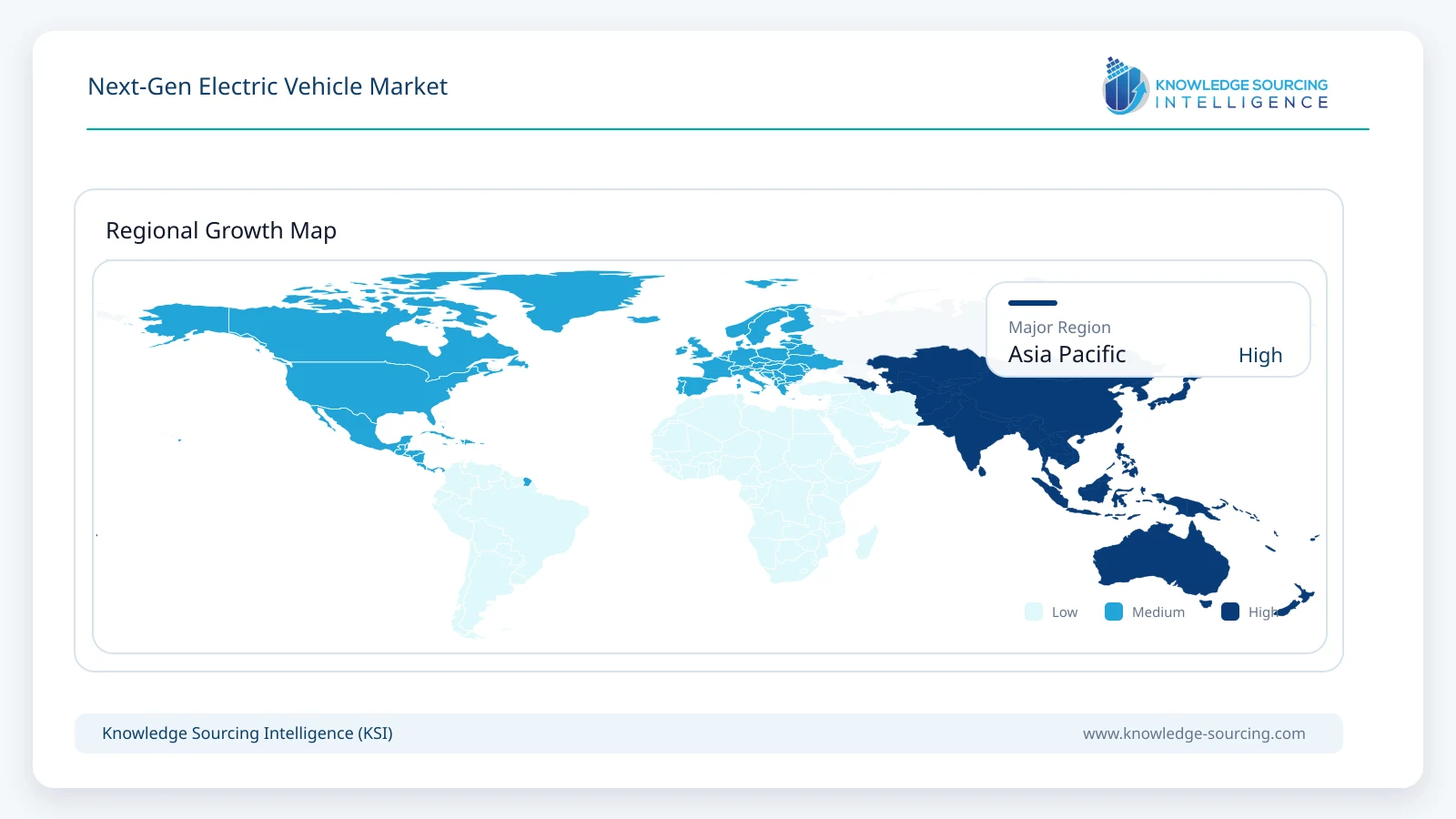
Asia Pacific is the central manufacturing and consumption region for the Next-Gen Electric Vehicle Market. China is the dominant market by sales and manufacturing scale, while Japan and South Korea remain important automotive and battery technology centers. India represents a distinct opportunity because electric adoption is advancing particularly in two- and three-wheelers, buses, and selected commercial applications.
China's trade-in programs have provided a direct demand stimulus. Government data indicate that new energy vehicles represented nearly 60% of automobile trade-ins in 2025, while six out of ten passenger vehicles sold in the country were new energy vehicles by year-end.
India's policy approach differs. The PM E-DRIVE scheme places particular emphasis on electric two- and three-wheelers, buses, trucks, and charging infrastructure. The IEA notes that India's electric two- and three-wheelers already have comparatively high electrification because of favorable total-cost-of-ownership economics.
South Korea and Japan contribute advanced battery, vehicle, electronics, and fuel-cell capabilities. Australia offers a different demand profile, with long travel distances and regional infrastructure considerations affecting EV selection.
Middle East and Africa
Adoption across the Middle East and Africa remains uneven because income levels, charging infrastructure, fuel prices, import structures, and government policy vary substantially.
The Gulf markets provide opportunities for premium EVs, fleet electrification, public-sector procurement, and charging infrastructure. High purchasing power can support premium models, while urban concentration can simplify charging deployment.
South Africa represents an important automotive manufacturing base but faces affordability and infrastructure constraints. Across many African markets, two- and three-wheelers may offer more practical electrification opportunities than passenger cars because of lower vehicle costs and high utilization in commercial mobility.
The region's commercial opportunity therefore depends less on a single mass-market trajectory and more on localized use cases, charging investment, fleet procurement, and policy support.
South America
Brazil represents the principal opportunity within South America because of its large automotive market, established manufacturing base, and growing consumer interest in electrified vehicles. Argentina and other markets offer smaller but potentially relevant opportunities tied to urban mobility and fleet replacement.
Infrastructure availability, import costs, local production economics, financing conditions, and currency volatility influence vehicle affordability. Hybrid configurations may remain commercially relevant where charging networks are less developed.
For manufacturers, regional strategies need to account for local industrial policy and the economics of importing finished vehicles versus producing or assembling locally.
Competitive Landscape
The competitive structure includes established global automakers with different strengths in scale, technology, geographic reach, manufacturing footprint, and powertrain strategy. The companies covered in this market are Tesla, Inc.; BYD Company Limited; Volkswagen AG; Toyota Motor Corporation; Hyundai Motor Group; General Motors Company; Ford Motor Company; BMW Group; Mercedes-Benz Group AG; and Stellantis N.V.
Competition is increasingly organized around several interconnected dimensions rather than a single vehicle specification. Battery cost is one dimension, but platform flexibility, manufacturing scale, software capability, charging access, supply-chain security, and local production can be equally important.
Tesla, Inc. and BYD Company Limited represent strong competitive references in battery-electric vehicle scale and integrated EV ecosystems. Volkswagen AG, BMW Group, Mercedes-Benz Group AG, and Stellantis N.V. bring established European manufacturing and distribution networks, while General Motors Company and Ford Motor Company maintain significant North American production and fleet relationships.
Toyota Motor Corporation's position differs because of its long-standing multi-powertrain strategy, including hybrids and fuel-cell vehicles. Hyundai Motor Group similarly maintains a broad electrification portfolio spanning BEVs, HEVs, PHEVs, and FCEVs. This diversification provides flexibility where consumer adoption differs by region.
Competitive positioning is also becoming more localized. Hyundai's 2025 results show the commercial value of maintaining several electrified powertrains: its global electrified vehicle sales approached one million units, with HEVs representing a particularly large share.
Partnerships and ecosystem development will remain important because no automaker can independently control every element of the EV value chain. Battery sourcing, charging networks, recycling, software, energy management, and local manufacturing increasingly influence the total customer proposition.
Geographic expansion is consequently being pursued alongside product expansion. Manufacturers need local production where tariffs, regulations, incentives, and customer preferences justify the capital commitment. At the same time, global platforms can reduce development costs by sharing architectures, motors, batteries, electronics, and software across vehicle classes.
Recent Developments
June 2026: BYD officially presented its latest next-generation electric vehicle lineup, including the e-Vali electric van making its UK show debut at Company Car in Action 2026, highlighting expanded commercial EV offerings and advanced electrification technologies.
June 2026: Mercedes-Benz officially commenced series production of its next-generation high-performance axial-flux electric motor at the Berlin-Marienfelde plant, supporting future Mercedes-AMG electric vehicles with higher power density, efficiency, and compact drivetrain architecture.
April 2026: BYD officially unveiled the all-new Sealion 08 battery-electric and plug-in hybrid SUV at the 2026 Beijing Auto Show, showcasing its next-generation Ocean Series platform, Blade Battery technology, and advanced electrified powertrain options.
March 2026: Xiaomi officially launched the new-generation SU7 sedan in China, beginning immediate customer deliveries with upgraded V6s Plus motors, higher-voltage architecture, longer driving range, and enhanced intelligent vehicle capabilities.
January 2026: China renewed its national auto trade-in subsidy program for 2026, with eligible consumers purchasing new vehicles after scrapping qualifying older vehicles able to receive subsidies capped at RMB 20,000. Commercial relevance: Continued replacement support provides a direct demand mechanism for new energy vehicles and improves demand visibility for manufacturers and dealers.
July 2025: The European Commission introduced rules establishing methods for calculating and verifying recycling efficiency and material recovery from waste batteries, with specific requirements covering lithium and critical materials. Commercial relevance: Battery recyclers and vehicle manufacturers face clearer material-recovery obligations, increasing the importance of battery traceability, recycling capacity, and secondary raw-material supply.
Regulatory and Policy Environment
Regulation is a fundamental commercial variable in the Next-Gen Electric Vehicle Market because vehicle manufacturers make multiyear product and factory investments while regulatory requirements can change model economics within much shorter periods.
The European Union has established one of the clearest long-term frameworks. Regulation (EU) 2019/631 sets fleet-wide CO2 performance standards for passenger cars and vans, with a 0 g CO2/km target from 2035. Manufacturers must therefore manage fleet-average emissions and allocate product development resources toward low- and zero-emission vehicles.
Battery regulation is also becoming more influential. Regulation (EU) 2023/1542 establishes requirements related to battery sustainability, safety, labeling, recycling, material recovery, and recycled content. From 2025 onward, requirements progressively affect the economics and compliance processes surrounding batteries placed on the European market.
China combines industrial policy with consumer incentives. The country reduced vehicle purchase tax for new energy vehicles in 2026–2027 rather than continuing the full exemption that applied during 2024–2025. The policy covers BEVs, PHEVs including extended-range vehicles, and qualifying fuel-cell vehicles. Trade-in programs add another demand mechanism by reducing the effective cost of replacing older vehicles.
India's PM E-DRIVE policy illustrates a more targeted approach. Rather than concentrating solely on passenger cars, policy support emphasizes electric two- and three-wheelers, buses, trucks, and charging infrastructure. This aligns incentives with segments where operating economics can support faster adoption.
The North American regulatory environment requires careful monitoring because federal incentives can materially influence vehicle affordability and production economics. In the United States, the IRS confirms that several federal clean-vehicle credits are unavailable for vehicles acquired after September 30, 2025, subject to the applicable transition rules.
Across jurisdictions, compliance is also expanding from vehicle emissions to batteries, sourcing, recycling, manufacturing location, and lifecycle impacts. Manufacturers therefore need regulatory capabilities spanning the complete vehicle and battery value chain.
Outlook and Strategic Implications
The 2026–2031 period is likely to be defined by the movement from EV adoption driven primarily by policy and early-adopter demand toward purchasing decisions increasingly determined by vehicle economics and product competitiveness.
Investment priorities will shift toward platforms that can support several vehicle classes and powertrain configurations while reducing component complexity. Battery capacity will remain important, but manufacturers will increasingly optimize the entire vehicle for energy efficiency. A smaller battery combined with efficient power electronics, thermal management, aerodynamic design, and faster charging can deliver a competitive ownership proposition without maximizing battery size.
Procurement trends will also become more data-driven. Fleet operators will compare energy cost, downtime, battery degradation, residual value, maintenance, charging infrastructure, and financing over the full operating period. Suppliers that can provide reliable operational data and service guarantees may gain an advantage even when their initial vehicle price is not the lowest.
Battery technology will diversify according to application. Lithium-ion technology is expected to remain the commercial base, while sodium-ion may gain relevance in cost-sensitive vehicles. Solid-state batteries could become important if manufacturers overcome production scale, durability, yield, and cost barriers. Lithium-sulfur and other chemistries will remain strategic development areas rather than universal replacements.
Charging will increasingly be treated as part of vehicle procurement. Passenger-vehicle customers need convenient home and public charging, while commercial fleets require high utilization of depot assets. The commercial value of fast charging will therefore depend on electricity tariffs, grid capacity, vehicle utilization, and the cost of downtime.
Vehicle-to-grid and vehicle-to-home capabilities may create additional value where electricity markets and regulations support bidirectional charging. Hyundai Motor Group, for example, expanded V2G and V2H initiatives in 2025 across Korea, Europe, and the United States. Such systems can eventually allow vehicles to function as flexible energy assets, although commercial adoption depends on compatible chargers, grid rules, battery warranties, and customer compensation mechanisms.
Geographic competition will remain closely linked to manufacturing economics. China is likely to retain a major position because of its large domestic market, supplier depth, battery manufacturing scale, and strong EV penetration. Europe will remain policy-driven but highly sensitive to vehicle affordability. North America will require flexible strategies because incentives, tariffs, local manufacturing requirements, and consumer preferences can vary significantly. India and other emerging markets will offer attractive opportunities where two-wheelers, three-wheelers, buses, and commercial vehicles provide better economics than private passenger cars.
The principal strategic risk is not a lack of technological options. It is the possibility that manufacturers invest in the wrong combination of technology, capacity, geography, or vehicle format. A battery technology may offer superior laboratory performance but fail to achieve manufacturing economics. A factory may have adequate capacity but operate below utilization if demand shifts between powertrain types. A vehicle may meet technical specifications but remain commercially weak because charging access or financing is inadequate.
Supply-chain resilience will therefore remain a core investment consideration. Manufacturers are likely to diversify battery sourcing, increase regional production, secure critical materials, develop recycling partnerships, and reduce exposure to single-source components. European battery recycling rules demonstrate how regulation can accelerate this transition by creating clearer requirements for material recovery.
Competitive advantage will increasingly come from integration. Automakers that coordinate vehicle platforms, battery systems, manufacturing, charging, software, financing, after-sales services, and recycling can manage the customer proposition more effectively than companies that optimize only the vehicle itself.
The strategic opportunity for suppliers is equally broad. Battery developers can target specific applications rather than competing solely on maximum energy density. Charging companies can focus on fleet-specific infrastructure and energy management. Component manufacturers can develop higher-efficiency motors, inverters, thermal systems, and power electronics. Recycling companies can establish access to future battery feedstock before retired EV volumes become substantial.
For investors and corporate decision-makers, the most important indicators through 2031 will therefore include EV penetration by vehicle class, battery pack costs, charging utilization, fleet total cost of ownership, manufacturing capacity utilization, policy durability, battery material prices, regional production localization, and the pace at which emerging battery chemistries move from pilot production to commercial volumes.
The Next-Gen Electric Vehicle Market should consequently be assessed as an interconnected automotive, energy, infrastructure, and industrial ecosystem. The companies best positioned for the 2026–2031 period will be those capable of matching technology choices to regional demand, controlling vehicle economics, maintaining supply security, and adapting product portfolios as regulation and customer preferences diverge across markets.
Next-Gen Electric Vehicle Market Scope
| Report Metric | Details |
|---|---|
| Total Market Size in 2026 | USD 220.2 billion |
| Total Market Size in 2031 | USD 643.3 billion |
| Forecast Unit | Billion |
| Growth Rate | 23.9% |
| Study Period | 2021 to 2031 |
| Historical Data | 2021 to 2024 |
| Base Year | 2025 |
| Forecast Period | 2026 – 2031 |
| Segmentation | Vehicle Type, Propulsion Type, Battery Technology, Geography |
| Companies |
|
Market Segmentation
By Vehicle Type
By Propulsion Type
By Battery Technology
By Geography
Table of Contents
1. EXECUTIVE SUMMARY
2. MARKET SNAPSHOT
2.1. Market Overview
2.2. Market Definition
2.3. Scope of the Study
2.4. Market Segmentation
3. BUSINESS LANDSCAPE
3.1. Market Drivers
3.2. Market Restraints
3.3. Market Opportunities
3.4. Porter’s Five Forces Analysis
3.5. Industry Value Chain Analysis
3.6. Policies and Regulations
3.7. Strategic Recommendations
4. TECHNOLOGICAL OUTLOOK
4.1. Advanced Battery Technologies
4.2. Battery Management Systems (BMS)
4.3. Fast Charging and Ultra-Fast Charging Technologies
4.4. Vehicle-to-Grid (V2G) Technology
4.5. Autonomous and Connected Vehicle Technologies
5. NEXT-GEN ELECTRIC VEHICLE MARKET BY VEHICLE TYPE
5.1. Introduction
5.2. Passenger Vehicles
5.3. Commercial Vehicles
5.4. Two-Wheelers
5.5. Three-Wheelers
5.6. Electric Buses
6. NEXT-GEN ELECTRIC VEHICLE MARKET BY PROPULSION TYPE
6.1. Introduction
6.2. Battery Electric Vehicles (BEVs)
6.3. Plug-in Hybrid Electric Vehicles (PHEVs)
6.4. Hybrid Electric Vehicles (HEVs)
6.5. Fuel Cell Electric Vehicles (FCEVs)
7. NEXT-GEN ELECTRIC VEHICLE MARKET BY BATTERY TECHNOLOGY
7.1. Introduction
7.2. Lithium-Ion Batteries
7.3. Solid-State Batteries
7.4. Sodium-Ion Batteries
7.5. Lithium-Sulfur Batteries
7.6. Other Emerging Battery Technologies
8. NEXT-GEN ELECTRIC VEHICLE MARKET BY GEOGRAPHY
8.1. Introduction
8.2. North America
8.2.1. By Vehicle Type
8.2.2. By Propulsion Type
8.2.3. By Battery Technology
8.2.4. By Country
8.2.4.1. United States
8.2.4.2. Canada
8.2.4.3. Mexico
8.3. South America
8.3.1. By Vehicle Type
8.3.2. By Propulsion Type
8.3.3. By Battery Technology
8.3.4. By Country
8.3.4.1. Brazil
8.3.4.2. Argentina
8.3.4.3. Others
8.4. Europe
8.4.1. By Vehicle Type
8.4.2. By Propulsion Type
8.4.3. By Battery Technology
8.4.4. By Country
8.4.4.1. Germany
8.4.4.2. France
8.4.4.3. United Kingdom
8.4.4.4. Italy
8.4.4.5. Spain
8.4.4.6. Others
8.5. Middle East and Africa
8.5.1. By Vehicle Type
8.5.2. By Propulsion Type
8.5.3. By Battery Technology
8.5.4. By Country
8.5.4.1. United Arab Emirates
8.5.4.2. Saudi Arabia
8.5.4.3. South Africa
8.5.4.4. Others
8.6. Asia Pacific
8.6.1. By Vehicle Type
8.6.2. By Propulsion Type
8.6.3. By Battery Technology
8.6.4. By Country
8.6.4.1. China
8.6.4.2. Japan
8.6.4.3. South Korea
8.6.4.4. India
8.6.4.5. Australia
8.6.4.6. Others
9. COMPETITIVE ENVIRONMENT AND ANALYSIS
9.1. Major Players and Strategy Analysis
9.2. Market Share Analysis
9.3. Mergers, Acquisitions, Agreements, and Collaborations
9.4. Competitive Dashboard
10. COMPANY PROFILES
10.1. Tesla, Inc.
10.2. BYD Company Limited
10.3. Volkswagen AG
10.4. Toyota Motor Corporation
10.5. Hyundai Motor Group
10.6. General Motors Company
10.7. Ford Motor Company
10.8. BMW Group
10.9. Mercedes-Benz Group AG
10.10. Stellantis N.V.
11. APPENDIX
11.1. Currency
11.2. Assumptions
11.3. Base and Forecast Years Timeline
11.4. Key Benefits for Stakeholders
11.5. Research Methodology
11.6. Abbreviations
Navigate
Trusted by the world's leading organizations











