
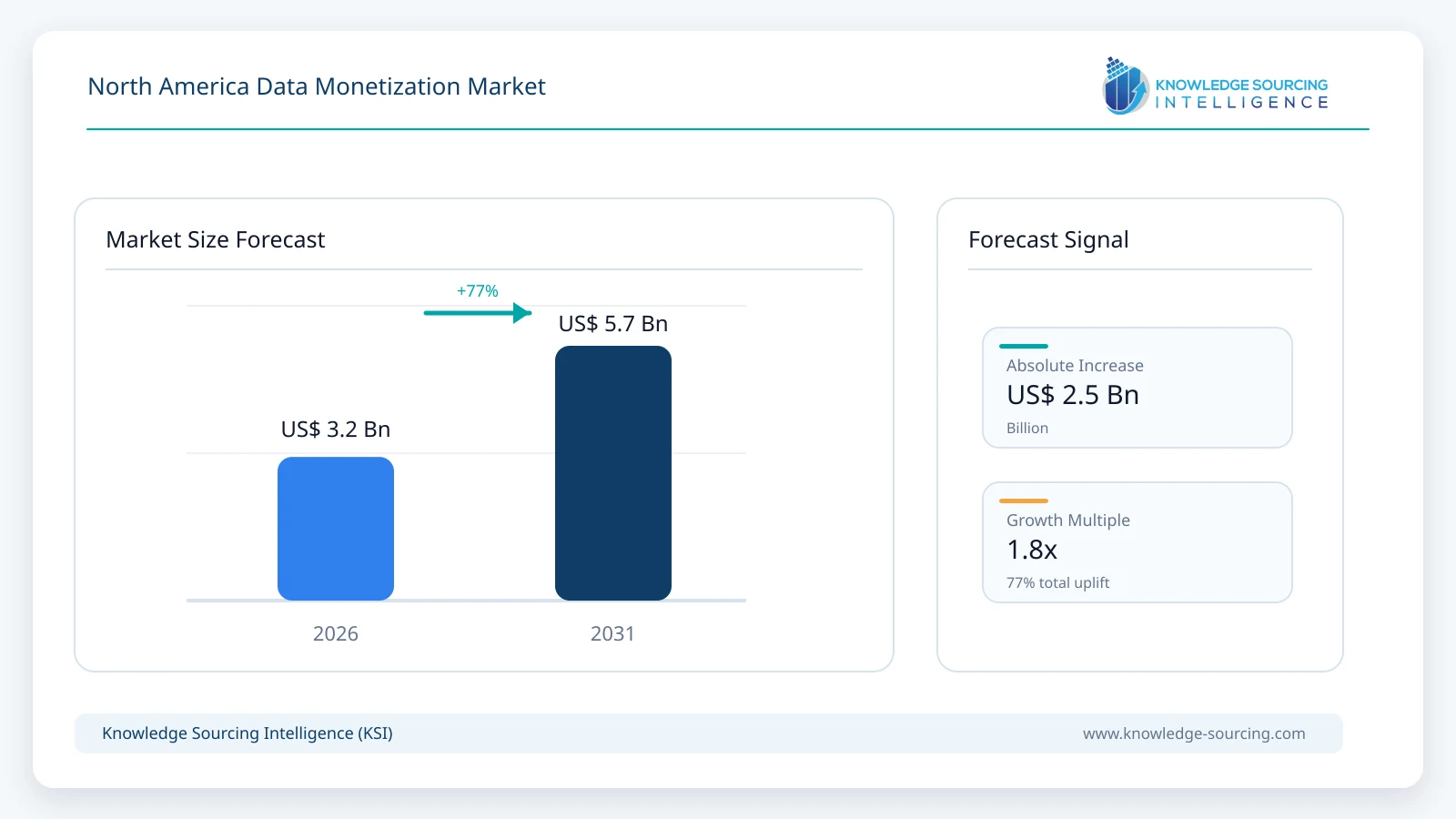
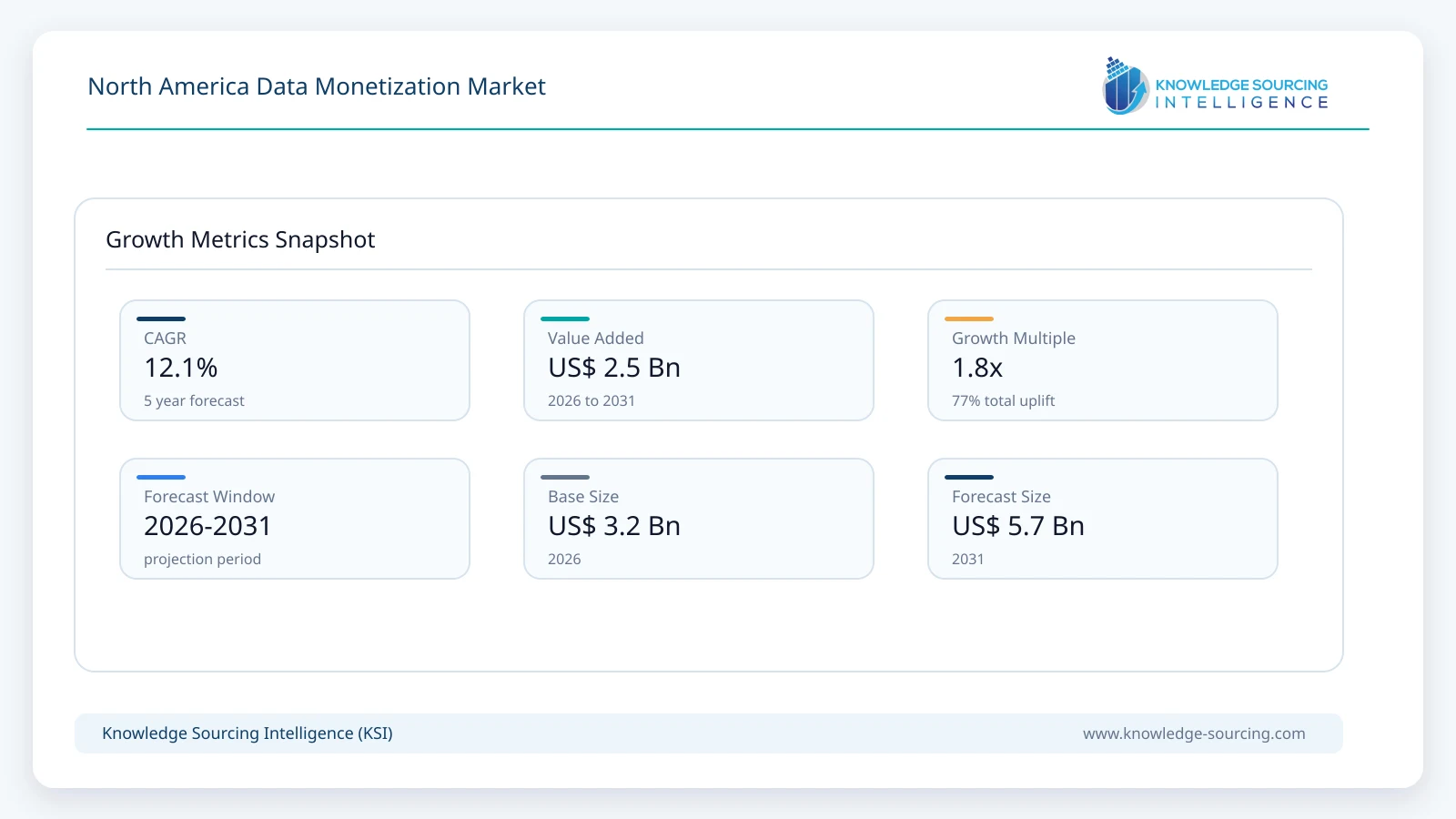
North America Data Monetization Market is anticipated to grow at a CAGR of 12.1%, increasing to USD 5.71 billion in 2031 from USD 3.22 billion in 2026.
Highlights:
- 1Data monetization is shifting from standalone analytics toward embedded, AI-enabled revenue generation across enterprise ecosystems.
- 2Cloud-native data platforms and governance frameworks are becoming central purchasing criteria for enterprise buyers.
- 3Financial services, retail, telecommunications, and healthcare continue to account for a large share of commercial deployments.
- 4Regulatory requirements for privacy, consent, and cross-border data handling are influencing platform architecture and investment decisions.
- 5Enterprise demand increasingly favors integrated solutions combining data management, AI, security, and governance capabilities.
Enterprise purchasing decisions increasingly prioritize interoperability, security, regulatory compliance, scalability, and integration with existing cloud and business applications. Large organizations continue to invest in enterprise-wide data platforms that support multiple business functions, while small and medium-sized enterprises (SMEs) increasingly adopt cloud-based services to reduce infrastructure costs and accelerate implementation. Technology providers are responding by expanding AI-enabled analytics, automated data cataloging, governance capabilities, and industry-specific solutions that shorten deployment cycles and improve business outcomes.
Commercial activity remains concentrated in the United States, supported by extensive cloud infrastructure, mature digital ecosystems, and widespread enterprise AI adoption. Canada continues to strengthen investment in digital innovation and responsible AI governance, while Mexico benefits from expanding digital commerce, manufacturing modernization, and cloud adoption across enterprise sectors.
Growing enterprise investment in AI has further increased the commercial value of governed, high-quality data. Company disclosures from Microsoft, Google, IBM, Oracle, SAP, and Amazon Web Services consistently identify trusted enterprise data, cloud platforms, and AI integration as strategic priorities for customer investment, reinforcing the close relationship between data management and monetization across North American industries.
Key Market Indicators
Indicator | Latest Evidence | Commercial Meaning |
Enterprise AI adoption in U.S. businesses | 17–23% (2025–2026) | Increasing AI adoption raises demand for high-quality, monetizable enterprise data. |
Global cloud infrastructure investment by hyperscale providers | Continuing multi-billion-dollar annual investments (2025–2026) | Expanding cloud capacity supports enterprise-scale data monetization platforms. |
Microsoft annual AI and cloud infrastructure investment | Approximately US$80 billion planned for FY2025 | Infrastructure expansion reflects growing enterprise demand for AI-ready data environments. |
U.S. digital economy contribution | More than 10% of U.S. GDP (latest BEA estimates) | A mature digital economy provides a large commercial base for enterprise data monetization initiatives. |
Market Drivers
Enterprise AI adoption is increasing the demand for governed and high-quality datasets.
Generative AI deployment has shifted enterprise priorities from collecting data to improving data quality, governance, accessibility, and lifecycle management. Organizations increasingly recognize that AI performance depends on trusted enterprise information rather than model capability alone. Microsoft's annual reports and AI infrastructure investments, together with Google Cloud, IBM, Oracle, and SAP product strategies, demonstrate continued investment in unified data platforms designed to support enterprise AI workloads. Buyers increasingly evaluate monetization solutions according to metadata management, governance controls, security, and compatibility with existing enterprise software. As AI deployment expands across finance, healthcare, manufacturing, and retail, demand continues to shift toward platforms capable of converting operational data into measurable commercial value.
Expansion of cloud-native enterprise platforms is changing purchasing behavior.
Organizations are replacing fragmented on-premises data environments with cloud-based architectures that enable centralized governance, scalable analytics, and cross-functional data sharing. According to official disclosures from Amazon Web Services, Microsoft, Oracle, SAP, and Salesforce, enterprise customers increasingly seek integrated environments that combine storage, analytics, AI services, application integration, and security within a single ecosystem. Cloud deployment also reduces implementation complexity for organizations expanding data-driven business models across multiple locations. This purchasing preference has encouraged vendors to strengthen platform interoperability while expanding managed services that simplify migration and long-term administration for enterprise customers.
Industry-specific digital transformation is creating measurable commercial demand.
Financial institutions increasingly monetize transaction data for fraud detection, customer segmentation, and risk assessment. Retailers use consumer purchasing data to improve pricing strategies and inventory planning. Telecommunications operators analyze network and subscriber information to optimize service offerings, while manufacturers combine operational technology and industrial IoT data to improve asset utilization and predictive maintenance. Official investor materials from IBM, Accenture, SAP, and Microsoft show continued investment in industry-specific AI, analytics, and cloud offerings that address these commercial requirements. Rather than purchasing standalone analytics tools, organizations increasingly seek integrated business platforms capable of generating operational and revenue benefits across multiple departments.
Market Restraints and Challenges
Data governance requirements increase implementation complexity and project timelines.
Enterprise data monetization depends on consistent governance across multiple business systems, data owners, and regulatory environments. Organizations frequently encounter inconsistent data quality, fragmented legacy infrastructure, and varying governance practices that delay implementation. NIST guidance and company disclosures from IBM, Microsoft, and SAP emphasize that governance, metadata management, access controls, and lifecycle management remain essential prerequisites for scalable AI and analytics deployment. Large organizations often require phased implementation programs extending across several business units before commercial benefits become fully measurable.
Privacy regulations continue to influence product design and commercial deployment.
The regulatory environment across North America continues to evolve through state privacy legislation in the United States, Canada's privacy modernization efforts, and Mexico's data protection framework. Vendors must support consent management, auditability, encryption, data residency, and secure information sharing across multiple jurisdictions. Compliance obligations increase implementation costs for suppliers while extending procurement evaluations among highly regulated industries such as healthcare, financial services, and government. Technology providers increasingly embed governance and compliance capabilities directly into their platforms to reduce customer implementation risk and accelerate enterprise adoption.
Shortage of enterprise data management expertise limits deployment speed.
Although organizations continue investing in AI and analytics, successful monetization requires experienced professionals capable of integrating data engineering, governance, cybersecurity, cloud architecture, and business strategy. Enterprise transformation projects frequently involve multiple legacy systems and organizational functions, increasing implementation complexity. Consulting firms such as Accenture and technology suppliers including Microsoft and IBM continue expanding professional services and partner ecosystems because customers increasingly require implementation support rather than software alone. This skills gap particularly affects mid-sized enterprises that possess valuable operational data but limited internal technical resources to commercialize those assets effectively.
Major Segment Analysis
Solutions
Solutions represent the most commercially important offering because organizations increasingly require integrated software platforms capable of collecting, governing, analyzing, and commercializing enterprise data across multiple business functions. Rather than purchasing isolated analytics applications, enterprise buyers favor platforms combining data integration, AI, governance, visualization, security, and application connectivity within a unified architecture. This approach reduces operational complexity while improving consistency across business units.
Demand is strongest among large enterprises operating complex digital environments where customer information, operational data, financial records, and external datasets must be managed through common governance standards. Purchasing decisions increasingly emphasize scalability, cloud compatibility, regulatory compliance, API integration, and AI readiness instead of standalone reporting capability. Technology providers compete by expanding automation, embedded AI services, industry-specific templates, and interoperability with enterprise software ecosystems. Service offerings remain important for implementation and optimization, but software platforms continue to capture the greatest commercial attention because they establish the foundation upon which long-term data monetization strategies are built.
Regional Analysis
Country | Primary Demand Drivers | Principal Constraints |
United States | Enterprise AI adoption, hyperscale cloud infrastructure, financial services digitization, mature software ecosystem | Complex state-level privacy regulations, legacy system integration, cybersecurity requirements |
Canada | Responsible AI adoption, cloud modernization, public-sector digital investment, financial services transformation | Data sovereignty requirements, skills shortages, relatively smaller enterprise base |
Mexico | Manufacturing digitalization, expanding e-commerce, nearshoring investment, cloud adoption among enterprises | Uneven digital infrastructure, cybersecurity maturity, limited specialist workforce |
The United States represents the largest commercial opportunity within North America because it concentrates hyperscale cloud providers, enterprise software vendors, financial institutions, and digitally mature industries. According to the U.S. Census Bureau, business adoption of artificial intelligence continued to expand during 2025 and 2026, increasing demand for trusted enterprise data that can support AI applications, customer intelligence, fraud detection, and operational optimization. The country's advanced cloud infrastructure and broad enterprise software adoption encourage organizations to invest in platforms that combine governance, analytics, and AI rather than standalone data management tools. Financial services, healthcare, retail, telecommunications, and manufacturing continue to account for a substantial share of enterprise deployments, while evolving state privacy legislation requires vendors to incorporate stronger governance and compliance capabilities into their offerings. These conditions favor suppliers capable of delivering scalable platforms supported by consulting, integration, and managed services. The United States also remains the primary destination for infrastructure investment by Microsoft, Google, Amazon Web Services, Oracle, IBM, and Salesforce, reinforcing its position as the region's technology development center.
Canada continues to strengthen its position through sustained investment in digital transformation, cloud computing, and responsible artificial intelligence. Federal initiatives supporting digital innovation, together with the country's well-developed banking, telecommunications, healthcare, and public-sector institutions, continue to generate demand for enterprise data platforms capable of supporting regulatory compliance and secure information sharing. Canadian organizations generally emphasize governance, privacy protection, and hybrid cloud deployment when selecting data monetization solutions, reflecting both regulatory expectations and enterprise risk management priorities. Although the overall enterprise base is smaller than that of the United States, demand remains commercially attractive because buyers typically pursue long-term digital modernization programs requiring integration, consulting, and managed services alongside software platforms.
Mexico is emerging as an increasingly relevant market as manufacturing modernization, digital commerce, financial inclusion, and nearshoring continue to accelerate enterprise technology investment. Export-oriented manufacturers are expanding the use of industrial data, connected production systems, and analytics to improve operational efficiency and supply-chain visibility. Financial institutions and retailers are similarly investing in customer analytics and cloud platforms to support digital service delivery. Adoption remains uneven across smaller enterprises because infrastructure quality, cybersecurity capabilities, and availability of specialized technical talent vary across industries and regions. Even so, continued cloud investment by multinational technology providers and increasing integration with North American manufacturing supply chains are expected to strengthen long-term demand for enterprise data monetization solutions.
Competitive Landscape
Competition is characterized by a combination of global enterprise software providers, cloud platform operators, consulting firms, and integrated technology vendors. Microsoft Corporation, Google LLC, Amazon Web Services (AWS), Oracle Corporation, SAP, IBM, Salesforce, and Accenture compete through broad cloud ecosystems that combine data management, AI, analytics, cybersecurity, governance, and application integration rather than individual software products. Enterprise buyers increasingly favor vendors capable of supporting end-to-end implementation, ongoing optimization, and regulatory compliance across complex business environments.
Competitive differentiation increasingly depends on AI capabilities, cloud scalability, industry-specific solutions, and integration with existing enterprise software. Accenture strengthens its market position through consulting and implementation services, while hyperscale cloud providers continue expanding infrastructure capacity and AI platforms. SAP, Oracle, IBM, and Salesforce focus on integrating operational data with business applications to improve customer value and support enterprise-wide decision-making. High switching costs, extensive software ecosystems, and long-term enterprise contracts create barriers for smaller providers, encouraging partnerships, acquisitions, and continuous investment in platform capabilities.
Recent Developments
June 2026: Snowflake reported that Marketplace partners generated more than $100 million in gross bookings during the first half of 2026, demonstrating accelerating commercialization of data products and applications.
May 2026: ServiceNow launched Context Engine, Autonomous Data Analytics, and Workflow Data Fabric, enabling governed enterprise data discovery, integration, analytics, and reusable data assets for autonomous AI workflows.
March 2026: Oracle announced the availability of its AI Data Platform for U.S. federal agencies, enabling secure data unification and AI-ready information across government applications, workflows, and critical datasets.
Regulatory and Policy Environment
Privacy regulation continues to shape enterprise purchasing decisions across North America. In the United States, organizations increasingly design data monetization strategies around evolving state privacy laws, sector-specific regulations, and guidance from the National Institute of Standards and Technology (NIST) on AI risk management and cybersecurity. Compliance requirements related to consent management, auditability, encryption, identity management, and secure data sharing have become standard procurement criteria, particularly within financial services, healthcare, and government.
Canada maintains a strong policy focus on responsible AI development, privacy protection, and secure digital infrastructure. Regulatory initiatives encourage organizations to strengthen governance practices before expanding AI-enabled commercial applications. Mexico's regulatory framework similarly emphasizes protection of personal information while supporting broader digital transformation across public and private sectors. Collectively, these regulatory developments are encouraging vendors to embed governance, policy automation, security controls, and compliance reporting directly into enterprise data monetization platforms instead of treating them as optional features.
Outlook and Strategic Implications
Enterprise demand is expected to shift toward integrated platforms capable of combining governance, AI, analytics, and business applications within unified cloud environments. Organizations increasingly view trusted data as a strategic business asset supporting operational efficiency, customer engagement, product innovation, and AI deployment rather than simply an information management function. Vendors that can demonstrate measurable business outcomes alongside regulatory compliance and cybersecurity capabilities are likely to strengthen their competitive position during the forecast period.
Strategic priorities across the value chain include:
Technology providers: Expand AI-ready data platforms, governance automation, and industry-specific solutions while strengthening interoperability across enterprise software ecosystems.
Enterprise buyers: Prioritize scalable architectures, data quality, cybersecurity, and regulatory compliance to maximize long-term returns from AI and analytics investments.
System integrators and service providers: Increase consulting, migration, and managed services that address enterprise skills shortages and accelerate implementation.
Investors: Monitor cloud infrastructure expansion, enterprise AI adoption, and software ecosystem development as indicators of sustained commercial demand.
Policymakers and regulators: Continue balancing innovation with privacy, cybersecurity, and responsible AI governance to support long-term digital economic growth across North America.
North America Data Monetization Market Scope:
| Report Metric | Details |
|---|---|
| Total Market Size in 2026 | USD 3.22 billion |
| Total Market Size in 2031 | USD 5.71 billion |
| Forecast Unit | Billion |
| Growth Rate | 12.1% |
| Study Period | 2021 to 2031 |
| Historical Data | 2021 to 2024 |
| Base Year | 2025 |
| Forecast Period | 2026 – 2031 |
| Segmentation | Offering, Deployment Model, Enterprise Size, End-User Industry, Country |
| Companies |
|
Market Segmentation
By Offering
Solution
Services
By Deployment Model
On-Premises
Cloud
By Enterprise Size
SMEs
Large Enterprises
By End-User Industry
BFSI
Retail and E-commerce
Manufacturing
Telecommunications and IT
Healthcare and Life Sciences
Government and Public Sector
Media and Entertainment
Automotive
Energy and Utilities
Others
By Country
U.S.
Canada
Mexico
Table of Contents
1. INTRODUCTION
1.1. Market Overview
1.3. Market Definition
1.4. Market Segmentation
2. RESEARCH METHODOLOGY
2.1. Research Data
2.2. Assumptions
3. EXECUTIVE SUMMARY
3.1. Research Highlights
4. MARKET DYNAMICS
4.1. Market Drivers
4.2. Market Restraints
4.3. Porter's Five Forces Analysis
4.3.1. Bargaining Power of Suppliers
4.3.2. Bargaining Power of Buyers
4.3.3. Threat of Substitutes
4.3.4. The Threat of New Entrants
4.3.5. Competitive Rivalry in Industry
4.4. Industry Value Chain Analysis
5. NORTH AMERICA DATA MONETIZATION MARKET BY OFFERING
5.1. Introduction
5.2. Solution
5.3. Services
6. NORTH AMERICA DATA MONETIZATION MARKET BY DEPLOYMENT MODEL
6.1. Introduction
6.2. On-Premises
6.3. Cloud
7. NORTH AMERICA DATA MONETIZATION MARKET BY ENTERPRISE SIZE
7.1. Introduction
7.2. SMEs
7.3. Large Enterprises
8. NORTH AMERICA DATA MONETIZATION MARKET BY END-USER INDUSTRY
8.1. Introduction
8.2. BFSI
8.3. Retail and E-commerce
8.4. Manufacturing
8.5. Telecommunications and IT
8.6. Healthcare and Life Sciences
8.7. Government and Public Sector
8.8. Media and Entertainment
8.9. Automotive
8.10. Energy and Utilities
8.11. Others
9. NORTH AMERICA DATA MONETIZATION MARKET BY COUNTRY
9.1. Introduction
9.2. U.S.
9.3. Canada
9.4. Mexico
10. COMPETITIVE ENVIRONMENT AND ANALYSIS
10.1. Major Players and Strategy Analysis
10.2. Emerging Players and Market Lucrativeness
10.3. Mergers, Acquisitions, Agreements, and Collaborations
10.4. Vendor Competitiveness Matrix
11. COMPANY PROFILES
11.1. Accenture
11.2. SAP
11.3. Google LLC
11.4. IBM
11.5. Microsoft Corporation
11.6. Oracle Corporation
11.7. Amazon Web Services (AWS)
11.8. Salesforce, Inc.
Navigate
Trusted by the world's leading organizations











