
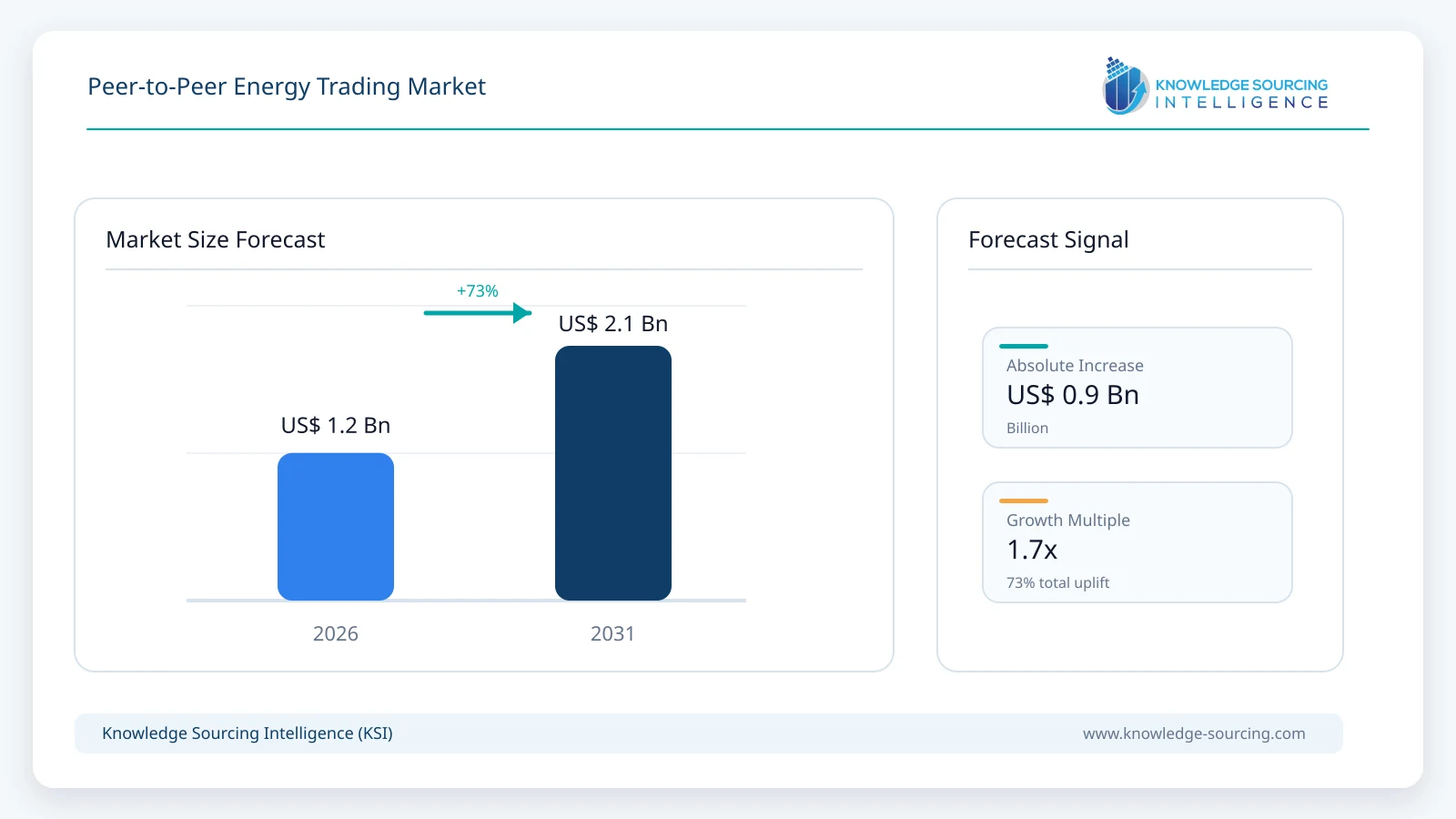
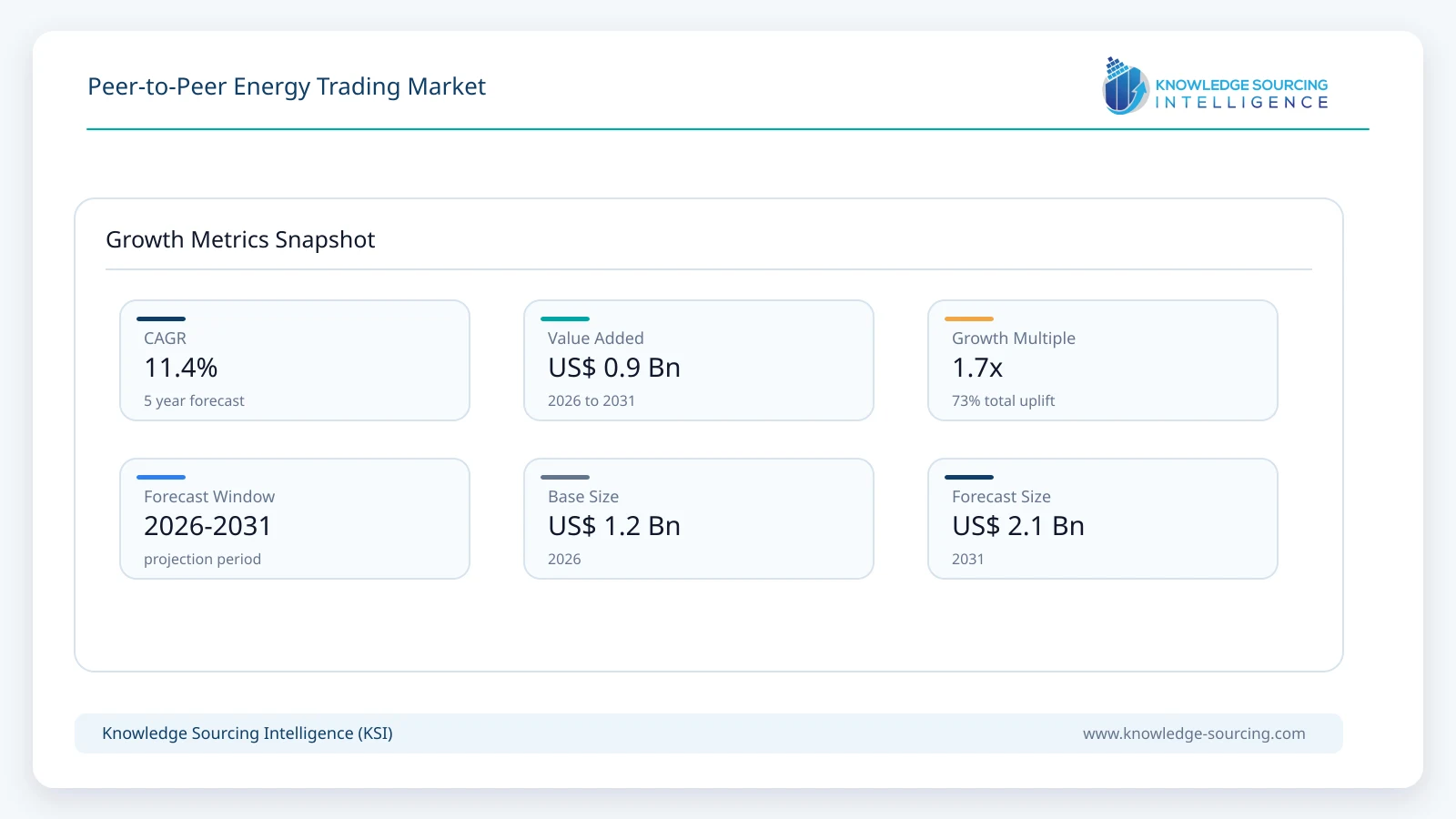
The Peer-to-Peer Energy Trading Market is forecast to grow at a CAGR of 11.4%, reaching USD 2.14 billion in 2031 from USD 1.24 billion in 2026.
Highlights:
- 1With the ability for individual households and businesses to become electricity prosumers, solar energy has emerged as the preferred trading source for P2P transactions, where surplus generation can be offered in real-time from rooftop and small-scale PV systems.
- 2Users participating in distributed-ledger technologies can capture transactions and automate pre-defined settlement rules.
- 3The potential role that community energy systems are likely to contribute to market growth because multiple consumers can share locally produced renewable electricity and coordinate generation, storage, and consumption within a defined network.
- 4P2P platforms are being integrated with smart meters, batteries, EV chargers, and even distributed solar and demand-response systems so that energy transactions can be a component of larger grid-balancing and flexibility approaches.
Peer-to-peer energy trading is revolutionizing the traditional electricity supply chain by allowing greater participation in electricity sales from consumers and prosumers. Rather than a system where electricity flows solely from centralized generators through utilities to end users, distributed solar, wind, batteries, EVs, and flexible loads engage in localized exchanges of electrons enabled by digital marketplaces and energy-management platforms.
There are multiple interplaying layers that constitute the market ecosystem. Physical infrastructure, another pillar of distribution and generation, is facilitative in nature, containing the likes of physical assets like distributed generation systems and devices, as well as utilities and corporate equipment such as smart meters, batteries, and inverters. The digital layer incorporates all of the energy-trading platforms, forecasting systems, automated bidding mechanisms, blockchain or distributed-ledger infrastructure, smart contracts, billing systems, and settlement applications.
In the absence of storage, renewable generation in electricity markets is variable and local distribution networks have limited capacity; thus, P2P trading platforms are increasingly required to match generation and consumption as close to real time. Accordingly, digital platforms make trading or dispatch decisions by aggregating generation forecasts and consumption profiles with electricity price, battery availability, and grid constraints.
The commercialization of P2P energy trading is still largely limited by regulatory frameworks. In markets where electricity trading is typically limited to licensed utilities or retailers, peer-to-peer (P2P) platforms tend to work via pilots, community-energy structures, aggregators, or regulated electricity provider partnerships. In contrast, P2P models would be better suited to energy communities and prosumer-friendly jurisdictions with dynamic pricing and distributed-energy markets.
Peer-to-Peer Energy Trading Market Key Highlights
Market Dynamics
Market Drivers
Increase in Virtual Solar Plant and Prosumer Involvement: Distributed renewable generation is being deployed faster than expected, which continually increases the population of electricity producers eligible for inclusion in P2P energy markets. Rooftop solar enables domestic, commercial, and small-scale power generation installations to generate electricity locally and potentially sell surplus power to others. This is transforming consumers from being passive electricity buyers to actual prosumers, individuals who consume and also produce electricity. This opens up new avenues for electronic platforms to create an online marketplace matching overproduction with nearer demand for electricity.
Growth of Smart Meters and Digital Electric Property: Smart Meters provide the necessary measurement and communications infrastructure to determine the amount of electricity a participant generates, consumes, imports, or exports. Thus, advanced metering infrastructure is an essential enabler of P2P trading. Digital meters have the potential to provide interval-based consumption information, enabling platforms to match supply and demand for electricity much more accurately than can be done with old-fashioned monthly billing systems. Automated settlement, dynamic pricing, demand forecasting, and consumer-level energy optimization can also be backed by smart-meter data.
Rise of Distributed Energy Resources and Battery Storage: The deployment of more and more batteries will extend the P2P trading beyond instantaneous solar-surplus transactions. A prosumer can store the excess renewable electricity generated during times of low demand and then sell or use it when demand increases, thereby reducing their total consumption. The integration of batteries will also allow P2P platforms to control different DERs as adjustable resources. Platforms can potentially calculate when to use electricity locally, store it, sell it to another participant, or even export it to the wider grid.
Supportive Energy-Community and Decentralization Policies: Various economic and government policies supporting renewable-energy communities, prosumers, distributed generation, and consumer participation are also providing opportunities for P2P models. Decentralized trading relies on regulatory frameworks that permit consumers to generate, share, sell, or otherwise engage with electricity markets.
Market Restraints & Opportunities
The most significant restraint is the regulatory complexity of electricity trading. In many countries that still heavily regulate electricity distribution, licenses are required for direct sales of electricity between consumers, and either custom metering arrangements or parastatal involvement will be needed to manage the energy contract.
The opportunity is moving away from siloed DER technology and toward seamlessly integrated solutions that feature open APIs, interoperable energy platforms, data models standardized for particular use cases, and software that can integrate multiple types of DERs via a single native interface. Businesses that can tap into this possibility and connect the physical grids with peer-to-peer trading platforms quickly, therefore, solve a key friction point within the market.
Similar to other market, P2P markets need a large enough distributed generation and consumer volume to function correctly. Areas where the penetration rate of rooftop solar, smart meters, or distributed storage is low may have insufficient liquidity for a sustainable local marketplace.
Key Developments
March 2026: Powerledger launched a more efficient technology, Transactive Lite, which enables peer-to-peer trading based on non-real-time smart-meter data. It allowed for transparent tracking of energy flow, matching generation to demand end?to?end based on the market, carbon accounting, emissions reporting, and blockchain-backed records of transactions on Solana.
February 2026: Delhi announced a six-month pilot for peer-to-peer solar-energy trading after getting a permit from the Delhi Electricity Regulatory Commission. Consumers were able to buy and sell excess rooftop-solar electricity through an online marketplace, including for transactions both within distribution areas and across Delhi-Uttar Pradesh linkages in the pilot.
Market Segmentation
The market is segmented by platform type, source type, application, end user, and geography.
By Source Type: Solar Energy
The solar energy source is expected to hold a dominant position in the P2P energy trading market. Rooftop and distributed PV installations are considered the best available source of small-scale renewable generation for prosumers. With solar PV, households and commercial facilities can generate local electricity for use on the premises and from community energy projects, where consumers can sell surplus production.
P2P platforms are more frequently planning to use solar generation in combination with smart meters or battery storage to help maximize the effective utilization of local generation. At times of high solar output, excess electricity can be shared with nearby neighbours or stored for later use instead of being exported to the wider grid.
Powerledger built an energy-market infrastructure based on the blockchain for facilitating transparent energy transactions and tracking them. Additionally, SunContract enables direct participation of electricity producers and consumers via a digital energy platform.
Lowering distributed-energy technology costs, growing rooftop PV capacity, expanding prosumer participation, and increasing availability of smart-meter infrastructure are contributing to growth in this segment.
By Application: Community Energy Systems
Based on the applications, community energy systems will be portrayed as one of the vibrant application sections. In community-based P2P systems, a participant in need of energy can use surplus electricity from another participant belonging to the same nuclear community or local network. This can help meet local demand through local renewable generation and make less use of centralized electricity supply.
Smart-managing meters, renewable generation forecasts, the availability of batteries, and by whom precisely electricity is produced close by, or by its recipients. This builds an operating model from which P2P trading can be nested in community-wide energy governance.
Powerledger links to this part of the segment since they use their blockchain infrastructure for transactions and traceability of digital energy. It is expected to increase as both governments and utilities increasingly endorse energy communities, distributed renewable generation, and local flexibility mechanisms.
By End User: Residential
The residential sector will likely have a major uptake as homes connect more rooftop solar, batteries, smart meters, and EV chargers. Such technologies are enabling residential consumers, who are referred to as prosumers, to generate, store, consume, and potentially trade electricity.
In addition, a residential P2P platform allows the household with surplus solar generation to sell or designate electricity to another participating household within certain electricity-market regulations and network arrangements.
Battery storage increases residential flexibility even more because households will be able to store excess electricity generated at solar-production times for use or trading later. EVs and bidirectional charging could provide yet another flexible energy resource in the residential trading ecosystem.
As a result of this trend, the increase in residential distributed generation, along with smart-home technology and dynamic electricity pricing, is broadening P2P energy platforms' addressable user base.
Regional Analysis
North America Market Analysis
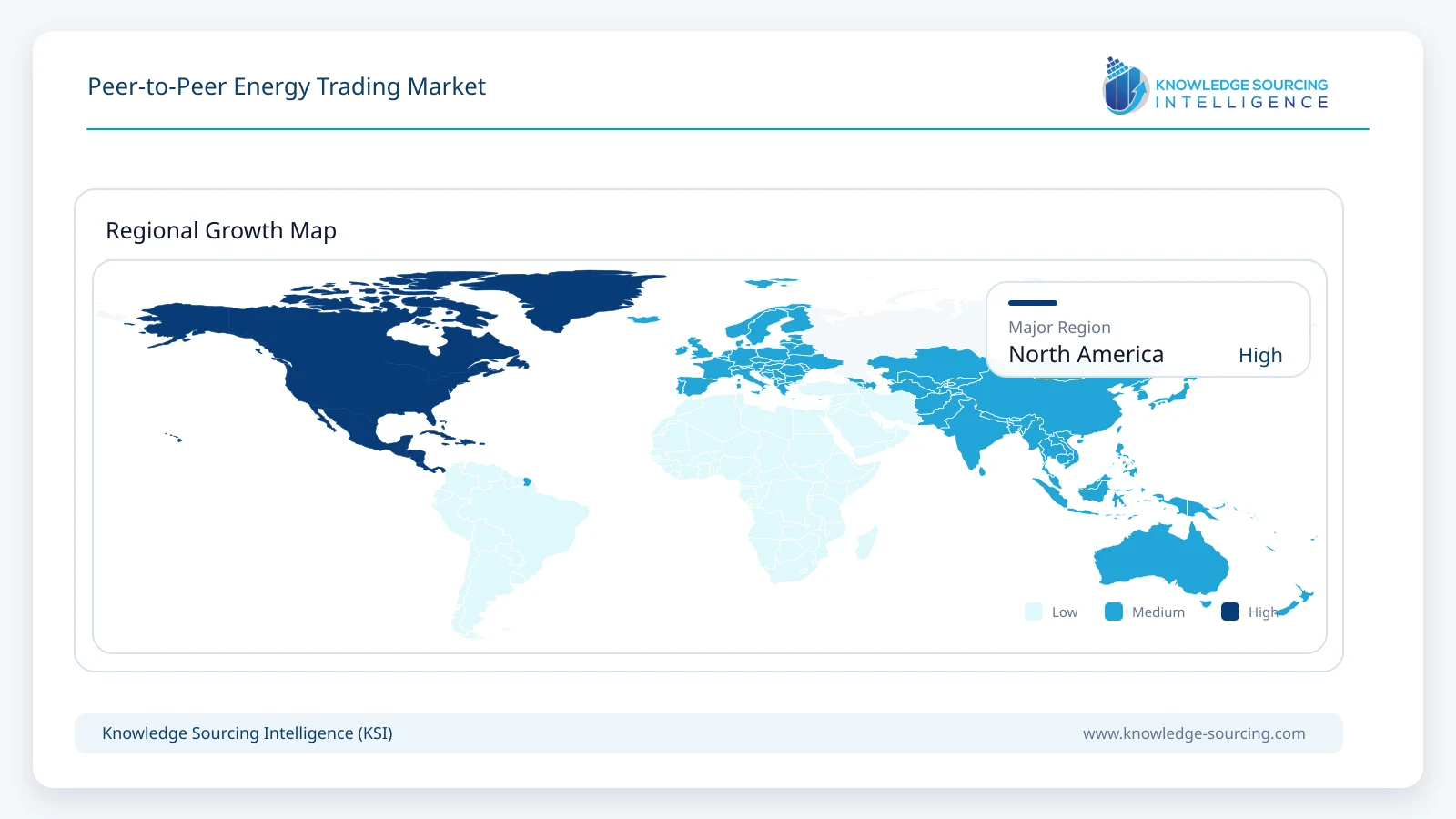
North America is emerging as a major P2P energy-trading market due to the large installed base of distributed solar, batteries, smart meters, EVs, and electricity-management technologies in the region. The US electricity-market structures are characterized by high diversity across states and utility territories, creating a diversity of opportunities.
South America Market Analysis
In South America, the rapidly increasing distributed solar deployment sees further moves being made on P2P energy-trading possibilities, and growing interest in decentralized electricity systems. Brazil represents the largest potential market in the region with its large electricity system, expanding distributed solar base, and growing share of participation by distributed generators.
Europe Market Analysis
Europe has become one of the most advanced regions for the P2P energy trading market by including energy communities, consumer participation, distributed renewables, and electricity-market digitalization in its energy-policy frameworks. P2P models exist in many countries such as Germany, the Netherlands, and Spain, with community-energy and distributed-generation initiatives easily evolving into P2P models.
Middle East and Africa Market Analysis
The Middle East and Africa market is growing from a relatively small base; distributed solar and decentralized electricity systems represent a multi-billion-dollar opportunity with long-term development potential over the coming decades. The region offers significant solar resources worldwide, leading to a requirement for an ideal solution for distributed PV systems.
Asia Pacific Market Analysis
Asia Pacific will be the main growth region due to its enormous electricity demand, an ever-expanding distributed solar marketplace, rising deployment of smart meters, and fast digitalization of power methods. Australia has long been a key market for experimentation in distributed energy and local energy trading.
List of Companies
Powerledger
SunContract
LO3 Energy
Electrify.Asia
Grid Singularity
Energy Web
Prosume
Greeneum Network
Omega Grid
Powerledger
Powerledger is a leading player in the P2P energy-trading ecosystem with a blockchain focus. Through its technology, it provides end-to-end digital tracking and transaction management of energy and associated environmental commodities.
SunContract
SunContract is a blockchain energy marketplace that connects consumers and electricity producers across the globe. Its platform is prioritizing direct market participation in electricity and showing how contract terms can be expressed digitally to execute renewable-energy trades.
LO3 Energy
LO3 Energy has been working on localized energy markets and aggregated distributed energy resources. This has made it relevant to community-energy and microgrid applications, as its technology development has centered around local electricity transactions and the coordination of distributed generation with consumers.
Analyst View
The P2P energy trading market is evolving from pilot blockchain-based electricity exchanges to complete local energy-management platforms which integrate distributed solar, batteries, EVs, smart meters, demand response and automated settlement. While solar-led residential and community energy systems will remain the primary entry points, regulatory approval and interoperability are likely to boost the shift of P2P trading from pilot projects toward large-scale commercial markets.
Peer-to-Peer Energy Trading Market Scope:
| Report Metric | Details |
|---|---|
| Total Market Size in 2026 | USD 1.24 billion |
| Total Market Size in 2031 | USD 2.14 billion |
| Forecast Unit | USD Billion |
| Growth Rate | 11.4% |
| Study Period | 2021 to 2031 |
| Historical Data | 2021 to 2024 |
| Base Year | 2025 |
| Forecast Period | 2026 – 2031 |
| Segmentation | Platform Type, Energy Source, Application, End User, Geography |
| Companies |
|
Market Segmentation
By Platform Type
Blockchain-Based
Centralized
Others
By Energy Source
Solar Energy
Wind Energy
Others
By Application
Community Energy Systems
Smart Grid Integration
Renewable Energy Trading
Others
By End User
Residential
Commercial
Industrial
By Geography
North America
USA
Canada
Mexico
South America
Brazil
Argentina
Others
Europe
United Kingdom
Germany
France
Others
Middle East and Africa
Saudi Arabia
UAE
Others
Asia Pacific
China
Japan
India
South Korea
Others
Table of Contents
1. EXECUTIVE SUMMARY
2. MARKET SNAPSHOT
2.1. Market Overview
2.2. Market Definition
2.3. Scope of the Study
2.4. Market Segmentation
3. MARKET DYNAMIC
3.1. Market Drivers
3.2. Market Restraints
3.3. Market Opportunities
3.4. Porter’s Five Forces Analysis
3.5. Industry Value Chain Analysis
4. BUSINESS LANDSCAPE
4.1. Regulatory and Energy-Sharing Framework Landscape
4.2. P2P Energy Trading Business Models, Pricing and Revenue Analysis
4.3. Distributed Energy Resource, Renewable Energy and Energy Community Demand Analysis
4.4. Strategic Recommendations
5. TECHNOLOGICAL OUTLOOK
5.1. Blockchain, Distributed Ledger and Smart Contract Technologies
5.2. Smart Metering, IoT and Real-Time Energy Measurement Technologies
5.3. AI, Forecasting, Automated Bidding and Energy-Matching Technologies
5.4. Distributed Optimization, Local Energy Market and Grid-Integrated Trading Technologies
6. PEER-TO-PEER ENERGY TRADING MARKET BY PLATFORM TYPE
6.1. Introduction
6.2. Blockchain-Based
6.3. Centralized
6.4. Others
7. PEER-TO-PEER ENERGY TRADING MARKET BY ENERGY SOURCE
7.1. Introduction
7.2. Solar Energy
7.3. Wind Energy
7.4. Others
8. PEER-TO-PEER ENERGY TRADING MARKET BY APPLICATION
8.1. Introduction
8.2. Community Energy Systems
8.3. Smart Grid Integration
8.4. Renewable Energy Trading
8.4. Others
9. PEER-TO-PEER ENERGY TRADING MARKET BY END USER
9.1. Introduction
9.2. Residential
9.3. Commercial
9.4. Industrial
10. PEER-TO-PEER ENERGY TRADING MARKET BY GEOGRAPHY
10.1. Introduction
10.2. North America
10.2.1. USA
10.2.2. Canada
10.2.3. Mexico
10.3. South America
10.3.1. Brazil
10.3.2. Argentina
10.3.3. Others
10.4. Europe
10.4.1. United Kingdom
10.4.2. Germany
10.4.3. France
10.4.4. Others
10.5. Middle East and Africa
10.5.1. Saudi Arabia
10.5.2. UAE
10.5.3. Others
10.6. Asia Pacific
10.6.1. China
10.6.2. Japan
10.6.3. India
10.6.4. South Korea
10.6.5. Others
11. COMPETITIVE ENVIRONMENT AND ANALYSIS
11.1. Major Players and Strategy Analysis
11.2. Market Share Analysis
11.3. Mergers, Acquisitions, Agreements, and Collaborations
11.4. Competitive Dashboard
12. COMPANY PROFILES
12.1. Powerledger
12.2. SunContract
12.3. LO3 Energy
12.4. ElectrifyAsia
12.5. Grid Singularity
12.6. Energy Web
12.7. Prosume
12.8. Greeneum Network
12.9. Omega Grid
13. APPENDIX
13.1. Currency
13.2. Assumptions
13.3. Base and Forecast Years Timeline
13.4. Key benefits for the stakeholders
13.5. Research Methodology
13.6. Abbreviations
Navigate
Trusted by the world's leading organizations











