
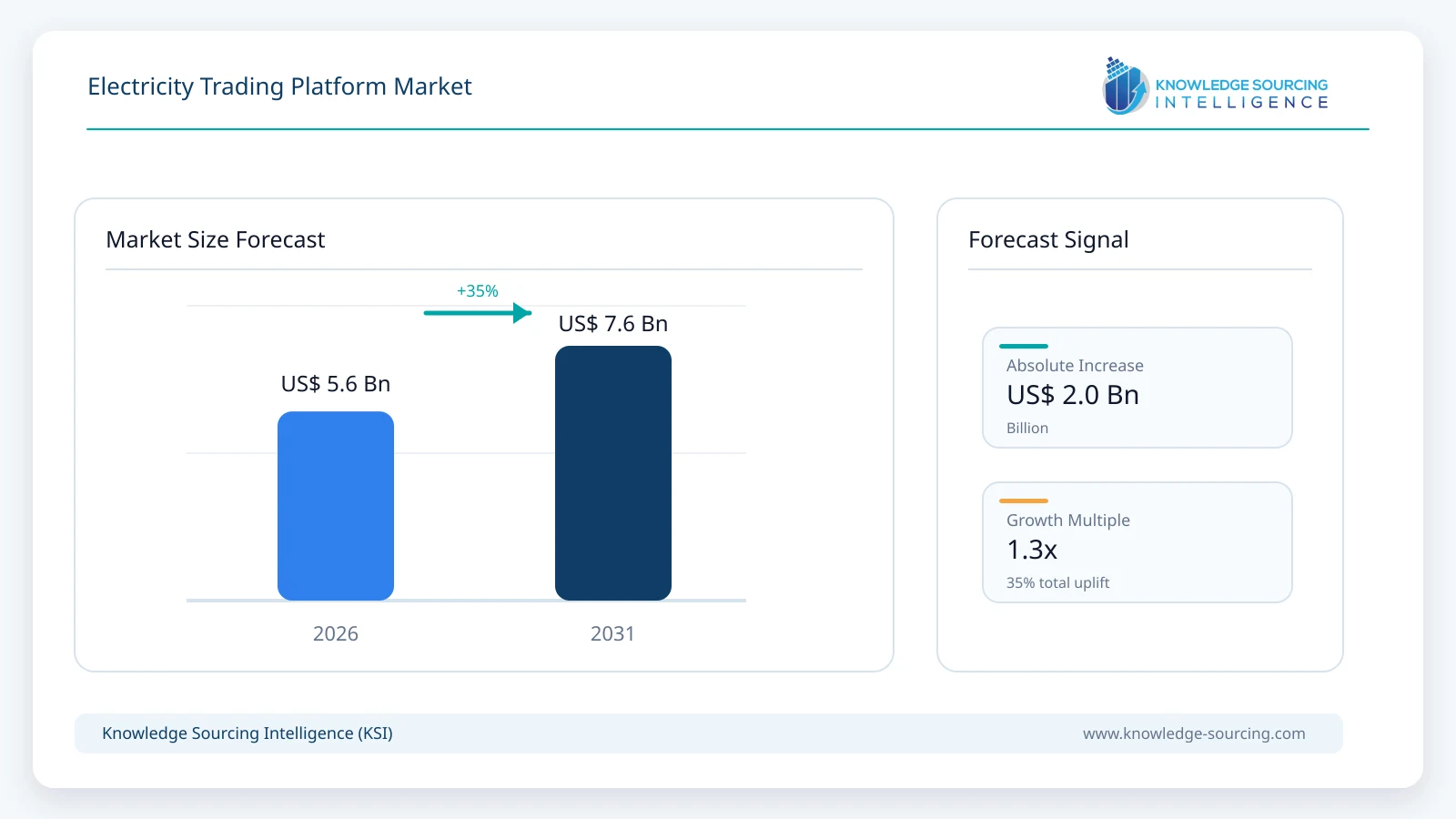
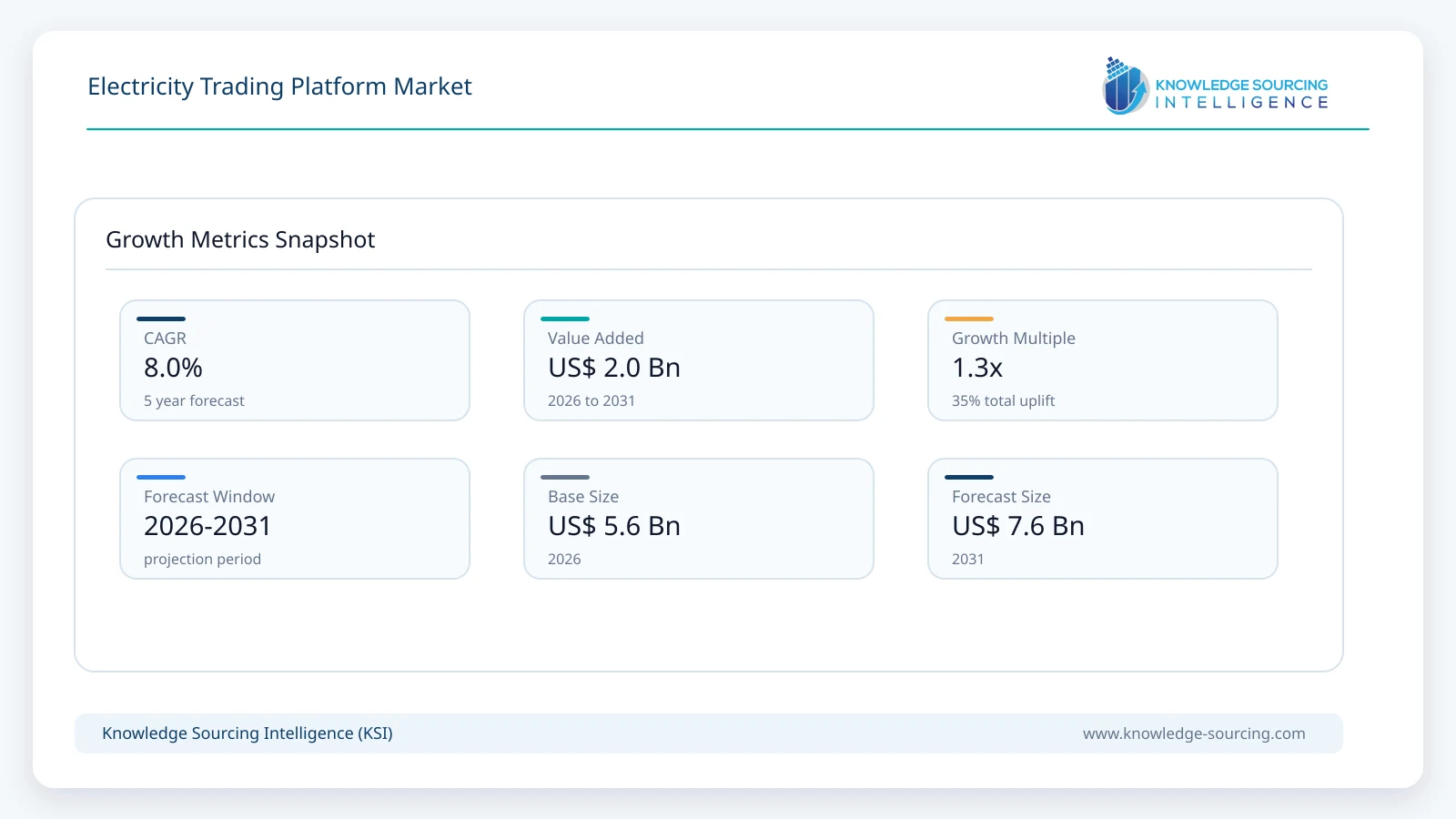
The Electricity Trading Platform Market is forecast to grow at a CAGR of 8.0%, reaching USD 7.57 billion in 2031 from USD 5.62 billion in 2026.
Highlights:
- 1Standardized, central bidding mechanisms, price discovery, scheduling, and settlement processes are necessary for key cross-market sectors such as organized wholesale electricity markets where centralized platforms remain the dominant model.
- 2Many financial electricity trading platforms are required that allow for futures, forwards, options, along with swaps, mark-to-market valuation, as well as exposure and collateral management alongside counterparty risk.
- 3Automated forecasting, price prediction, optimization, and algorithmic bidding have become the tools of choice for risk-taking energy traders looking to react quickly to volatile renewable generation or rapidly changing wholesale electricity prices.
- 4Cloud deployment and APIs enable trading platforms to interface with exchanges, market data, forecasting tools, enterprise resource planning (ERP) systems, risk-management applications, and settlement systems without keeping every technology component in-house.
The electricity trading platform market provides software and digital infrastructure that enables participants to conduct energy-market transactions via electronic platforms for optimal execution and control of transaction processes. They tie the trading desks to market exchanges, transmission and distribution systems, generation portfolios that will earn revenues when dispatching into lower-price zones or hours, and forecasting tools to predict prices, weather conditions, and net loads. Risk-management systems for the integrated front/middle/back-office capability required in well-ordered futures markets as new settlement applications are developed, and financial systems.
Unlike most traditional commodities, the supply and demand of electricity must be nearly perfectly balanced at all times, which is driving further integration across the market ecosystem. This need is also heightened by renewable generation, the output of which may vary rapidly with weather conditions.
Moreover, modern electricity trading platforms include real-time data from the market reports as well as automated bidding, price forecasting, generation forecasting, congestion information, portfolio optimization tools and risk calculations, and completely automated scheduling. These functions empower market users to decide in the day-ahead, intraday (ID), balancing, and ancillary-service markets.
Increased exchange of electricity with natural gas, LNG, crude oil, and refined-products trading is also driving demand for multi-commodity platforms. Energy firms now need a consolidated view of physical contracts, financial positions, logistics, market risk and settlement – across multiple commodities.
The deployment in the cloud has become significant due to the need for limitless computing power by trading organizations owing to high volume of market data and algorithmic computations. Nevertheless, such mission-critical trading operations still rely on hybrid architectures since certain market participants demand greater cybersecurity, lower latency, system resilience, and control over the key items in the trading infrastructure.
Electricity Trading Platform Market Key Highlights
Market Dynamics
Market Drivers
Greater Variability in Wholesale Electricity Prices: Electricity markets are featuring more price volatility due to changing fuel costs, variable renewable generation, weather patterns, grid and transmission constraints, and demand changes in a highly integrated power system. It is this volatility that amplifies the need for trading platforms that can monitor markets all the time and help identify opportunities for trading across day-ahead, intraday, balancing, and financial markets. Traders need up-to-date info that they can act upon if market surroundings alter.
Renewable power generation is one of the fastest-evolving sectors: As the share of wind and solar power increases, electricity trading is becoming more complicated because renewable generation is dependent on weather. This leads to large supply changes in much shorter increments. The trading platforms tend to have weather forecasts, renewables-generation forecast, availability of plants, and demand forecasts, as well as more models for market prices. These capabilities empower just-in-time bidding optimization and limit imbalance exposure for the participants.
Expansion of Managed Electricity Marketplaces: Electricity-market liberalization is increasing the number of players that can trade power directly. Independent power producers, renewable developers, aggregators, retailers, industrial consumers, and even utilities and trading companies are more heavily engaged in wholesale markets. This drives the requirement for platforms that can manage market registration, bids, contracts, nominations and scheduling, settlements & compliance requirements.
Growing Adoption of Algorithmic and Automated Trading: The electricity market produces huge amounts of time-sensitive information. As traders have to analyze several markets at the same time, involving generation assets, weather variables, congestion, and price curves, ad hoc tracking can get unmanageable. Algorithmic trading platforms rely on predefined strategies, statistical models, machine learning, optimization algorithms, and automated execution to identify and capture market opportunities.
Market Restraints & Opportunities
Electricity trading platforms should connect to exchanges, market operators, transmission systems, ERP systems, a forecasting platform, and the data sources from the settlement system and financial institutions, in addition to internal databases. This raises the cost and time required for implementation due to the nature of complex integration requirements.
Trading platforms deal with commercially sensitive information, financial positions, customer data, and market transactions. Thus, cybersecurity incidents can hit the bottom line as well as enterprises both operationally and reputationally.
The real opportunity comes from configurable platforms that can utilize the modular market connectors and APIs to interface with different rules in the markets. These types of systems are designed for international energy companies and enable them to work across different electricity markets with no need to create separate platforms in each jurisdiction.
Modern trading platforms need large amounts of market, weather, generation, transmission, consumption, and financial data. It also needs advanced computing infrastructure to process this information in real time. This is continuing to generate a case for AI-driven prediction, cloud computing, high-performance analytics, and automated data pipelines.
Key Developments
March 2026: GNA Energy announced the launch of GNAi, an AI-enabled intelligence layer to India’s electricity market at the Bharat Electricity Summit 2026. It included real-time market data, analytics, price intelligence, and decision support for generators, distribution companies, and large consumers.
Market Segmentation
The market is segmented by platform type, trading type, application, end user, and geography.
By Platform Type: Centralized
The centralized platform segment is expected to retain a major share due to its dependence on centralized market structures for bid submission, price discovery, dispatch, scheduling, clearing, and settlement.
Centralized platforms bring a common operating environment with standard market rules where various market participants are able to submit bids and offers. This architecture is especially crucial for any exchange, independent system operator, transmission system operator, utility, and large energy trader.
The trend is towards more complex electricity markets, which has motivated centralized platforms to integrate real-time market data with automated bid optimization algorithms and bidding strategies. Bidding strategies incorporate renewable-generation power forecasts, congestion analysis, and portfolio optimization, and automatically schedule the settlement process in such a way that manual intervention is kept as low as possible, creating an end-to-end trader workflow automation.
ION's Allegro, which supports energy and commodity trading operations, and Brady's multifaceted approach to the rapidly evolving world of trading solutions deliver energy trading solutions that address trading, risk, and operational requirements across the multiple segments of the dynamic energy markets. Such solutions are examples of a trend towards centralized platforms that link trading with risk and settlement operations.
By Trading Type: Physical Energy Trading
The segment of the industry focused on physical energy trading is a key component of the electricity trading market since all electricity transactions ultimately require physical generation, delivery, scheduling, balancing, and settlement activities and associated logistics.
Physical trading platforms help participants to manage power purchase agreements, bilateral contracts, exchange transactions, nominations, position reports, generation positions, plant availability, and delivery obligations.
The increasing penetration of renewable generation is making physical trading more complex as traders must constantly rebalance positions based on actual rather than forecast generation. It is especially important for wind and solar portfolios, when a gap between the forecasted and actual production is associated with imbalance costs.
Energy One offers a portfolio of software that covers energy-market operations and trading, and Fendahl International is in the business of designing software that helps to support commodity trading operations with its energy-trading and risk-management offerings. These are examples of the progressing combination of physical contracts, scheduling and trading, and risk management functions on the same platform.
Additionally, physical trading platforms are seen coupling more closely with forecasting systems and automated market interfaces, allowing participants to adjust positions faster as generation and demand conditions change.
By Application: Power & Electricity
By application, the power and electricity segment is expected to remain the largest application segment owing to the fact that electricity is the key commodity traded via these platforms.
The electricity trading platform is a multi-functional transaction support platform that includes distribution and concurrent expansion of bilateral transactions, exchange transactions, day-ahead market, intraday market, balancing market and ancillary-service market, as well as financial hedging.
As the share of renewable power gradually increases, demand for short-term trading and intraday position management is also growing. Increasingly, traders are being forced to respond to power generation changes, weather forecasts, and shifts in demand.
The energy and commodity trading platform of Molecule Software offers a wide range of functionality to manage the entire energy trading operation, including physical and financial transactions. Volue provides energy-market software and analytics to power-market participants.
Moreover, the segment is moving toward platforms that integrate trading with forecasting, optimization, risk management, and settlement rather than maintaining these functions as siloed systems.
Regional Analysis
North America Market Analysis
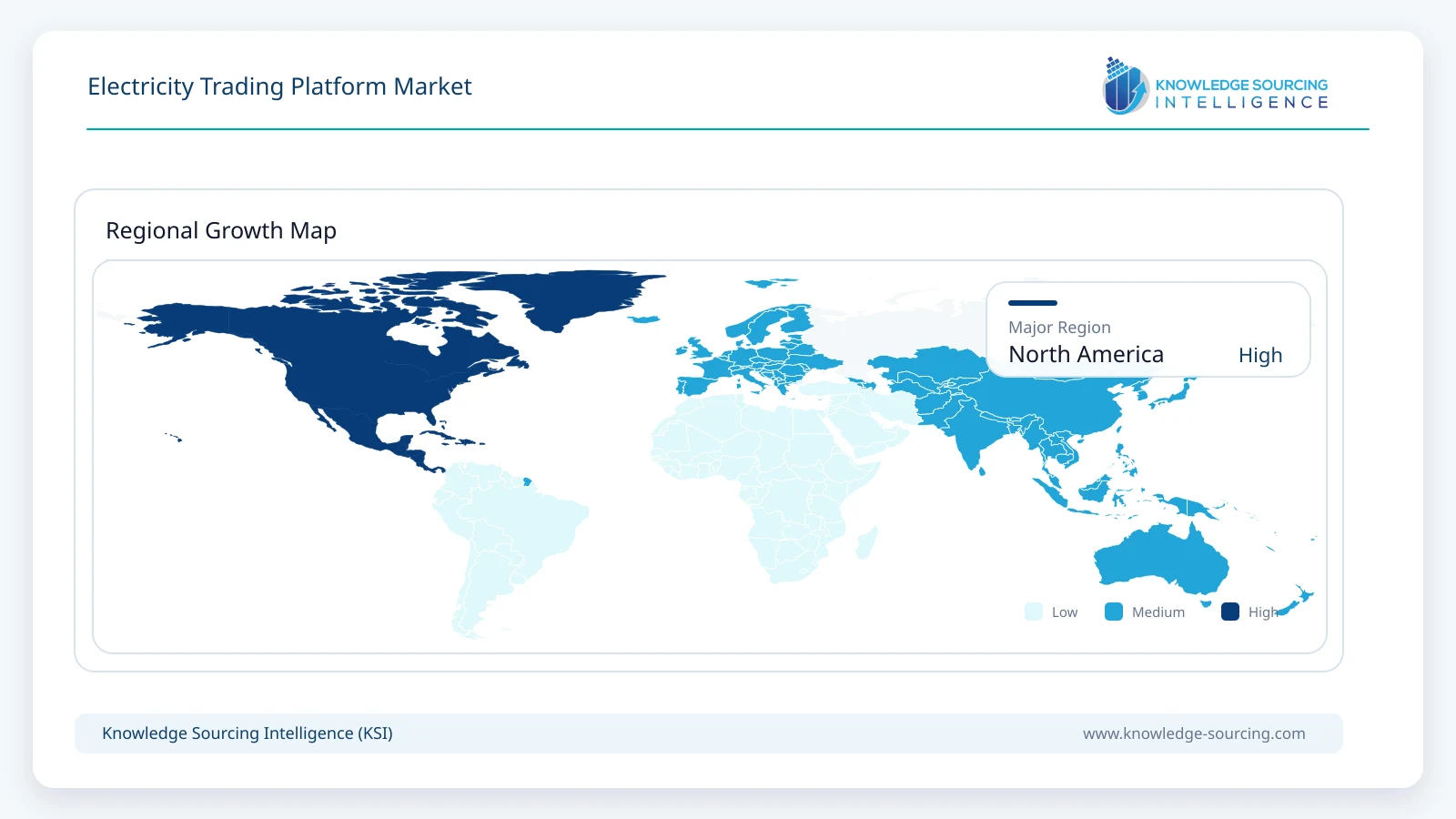
North America has a mature electricity trading platform market, backed by organized wholesale markets, independent system operators, utilities, generators, retailers, and energy-trading firms. There are multiple, competing regional electricity-market structures in the United States markets run by PJM, ERCOT, CAISO, MISO, NYISO, and ISO New England.
South America Market Analysis
South America is an attractive emerging market due to electricity-market modernisation and scale-up of renewable-energy technologies. Brazil is the largest because it has a massive electricity system, a lengthy hydropower foundation, and growing wind and solar technology presence in a more subtle electricity-market setting.
Europe Market Analysis
Europe is further ahead in the electricity trading market, with advanced wholesale markets, cross-border electricity trading, market coupling, high penetrations of renewables, and active participation from utilities and energy traders. The electricity trading platforms need to deal with multi-market character, cross-border transmission capacity, intraday trading, balance market, and more complex renewable-generation portfolios.
Middle East and Africa Market Analysis
The Middle East and Africa market is moving forward with electricity-sector modernization, renewable-energy-flavored investments, and digitalization of utilities and energy companies. Saudi Arabia and the UAE continue to fund mega-scale renewable-energy projects while reforming their electricity grids.
Asia Pacific Market Analysis
Asia Pacific is projected to grow the most due to rising electricity demand, renewable-energy deployment, electricity-market liberalization and digitalisation of utility operations. Australia's well-developed wholesale electricity market combined with a high penetration of wind and solar generation creates extensive demand for real-time trading, forecasting, portfolio optimization and automated bidding technologies.
List of Companies
Fendahl International
Inatech
Brady Technologies Limited
Molecule Software, Inc.
ION
Energy One
Murex S.A.S
d-fine GmbH
TMX Group
Volue
Fendahl International
Fendahl International provides technology for the commodity trading and risk management of energy and commodity markets. It offers a suite of solutions that are useful in supporting trading, contract management, risk analysis, and settlement activities, making it applicable to electricity trading companies operating either physical or financial positions.
Inatech
Inatech develops software solutions for energy and commodity trading and management in the sector of energy, gas and food. It has the capabilities on its platform to handle trading, scheduling, risk management, and operational processes and is used by energy companies to manage their complex commodity portfolios.
Brady Technologies Limited
Brady Technologies is an energy and commodity trading software covering trading, risk management, and related workflows. It caters to electricity-market players who need integrated transaction management and risk insights.
Analyst View
Electricity trading identifies three important trends, with net zero targets increasing the need for integrated, automated, and multi-commodity electricity trading environments as renewable penetration, price volatility, market participation, and cross-market complexity are on the rise in international markets. Centralized platforms will remain the backbone of organized electricity markets, while cloud computing, AI forecasting, algorithmic bidding, and API-based integration will continue to differentiate among them. Physical power trading will continue as the operational base while financial trading and risk-management capabilities will increasingly be part of the same technology environment.
Electricity Trading Platform Market Scope:
| Report Metric | Details |
|---|---|
| Total Market Size in 2026 | USD 5.62 billion |
| Total Market Size in 2031 | USD 7.57 billion |
| Forecast Unit | USD Billion |
| Growth Rate | 8.0% |
| Study Period | 2021 to 2031 |
| Historical Data | 2021 to 2024 |
| Base Year | 2025 |
| Forecast Period | 2026 – 2031 |
| Segmentation | Platform Type, Trading Type, Application, End User, Geography |
| Companies |
|
Market Segmentation
By Platform Type
Centralized
Decentralized
By Trading Type
Physical Energy Trading
Financial Energy Trading
By Application
Power & Electricity
Natural Gas & LNG
Crude Oil & Refined Products
Others
By End User
Residential
Commercial
Industrial
By Geography
North America
USA
Canada
Mexico
South America
Brazil
Argentina
Others
Europe
United Kingdom
Germany
France
Others
Middle East and Africa
Saudi Arabia
UAE
Others
Asia Pacific
China
Japan
India
South Korea
Others
Table of Contents
1. EXECUTIVE SUMMARY
2. MARKET SNAPSHOT
2.1. Market Overview
2.2. Market Definition
2.3. Scope of the Study
2.4. Market Segmentation
3. MARKET DYNAMIC
3.1. Market Drivers
3.2. Market Restraints
3.3. Market Opportunities
3.4. Porter’s Five Forces Analysis
3.5. Industry Value Chain Analysis
4. BUSINESS LANDSCAPE
4.1. Electricity Market Regulation and Licensing Landscape
4.2. Electricity Trading Volume, Liquidity, Price Volatility and Market Participation Analysis
4.3. Power Exchange, Market Operator and Trading Platform Infrastructure Analysis
4.4. Strategic Recommendations
5. TECHNOLOGICAL OUTLOOK
5.1. Advanced Market-Clearing, Price Discovery and Market-Coupling Technologies
5.2. Real-Time Trading, Algorithmic Trading and AI-Based Trading Technologies
5.3. Renewable Energy, Flexibility and Distributed-Energy Trading Technologies
5.4. Cloud, API, Data-Streaming and Interoperable Trading-Platform Technologies
6. ELECTRICITY TRADING PLATFORM MARKET BY PLATFORM TYPE
6.1. Introduction
6.3. Centralized
6.4. Decentralized
7. ELECTRICITY TRADING PLATFORM MARKET BY TRADING TYPE
7.1. Introduction
7.2. Physical Energy Trading
7.3. Financial Energy Trading
8. ELECTRICITY TRADING PLATFORM MARKET BY APPLICATION
8.1. Introduction
8.2. Power & Electricity
8.3. Natural Gas & LNG
8.4.Crude Oil & Refined Products
8.5. Others
9. ELECTRICITY TRADING PLATFORM MARKET BY END USER
9.1. Introduction
9.2. Residential
9.3. Commercial
9.4. Industrial
10. ELECTRICITY TRADING PLATFORM MARKET BY GEOGRAPHY
10.1. Introduction
10.2. North America
10.2.1. USA
10.2.2. Canada
10.2.3. Mexico
10.3. South America
10.3.1. Brazil
10.3.2. Argentina
10.3.3. Others
10.4. Europe
10.4.1. United Kingdom
10.4.2. Germany
10.4.3. France
10.4.4. Others
10.5. Middle East and Africa
10.5.1. Saudi Arabia
10.5.2. UAE
10.5.3. Others
10.6. Asia Pacific
10.6.1. China
10.6.2. Japan
10.6.3. India
10.6.4. South Korea
10.6.5. Others
11. COMPETITIVE ENVIRONMENT AND ANALYSIS
11.1. Major Players and Strategy Analysis
11.2. Market Share Analysis
11.3. Mergers, Acquisitions, Agreements, and Collaborations
11.4. Competitive Dashboard
12. COMPANY PROFILES
12.1. Fendahl International
12.2. Inatech
12.3. Brady Technologies Limited
12.4. Molecule Software, Inc
12.5. ION
12.6. Energy One
12.7. MUREX S.A.S
12.8. d-fine GmbH
12.9. TMX Group
12.10. Volue
13. APPENDIX
13.1. Currency
13.2. Assumptions
13.3. Base and Forecast Years Timeline
13.4. Key benefits for the stakeholders
13.5. Research Methodology
13.6. Abbreviations
Navigate
Trusted by the world's leading organizations











