
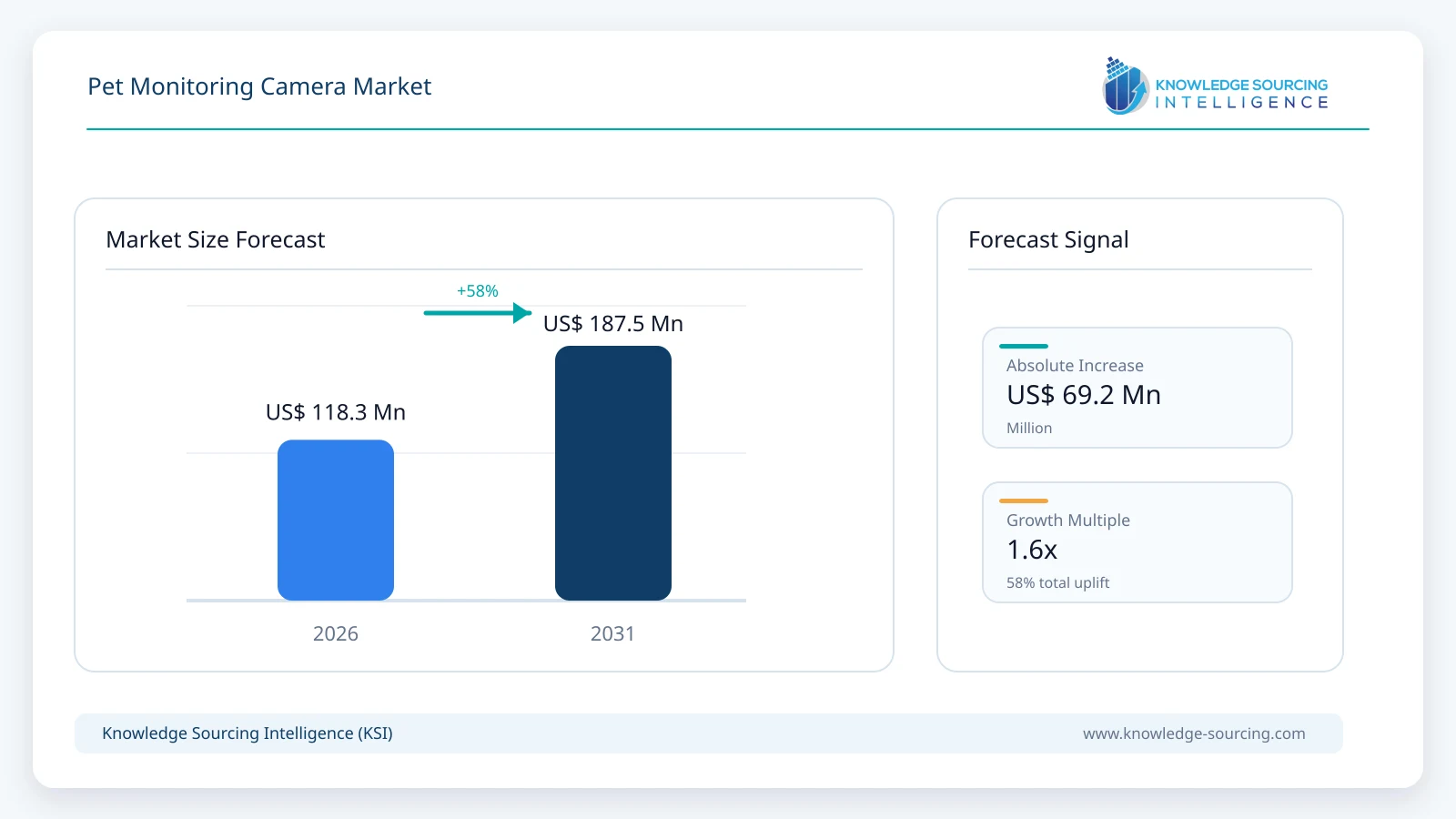
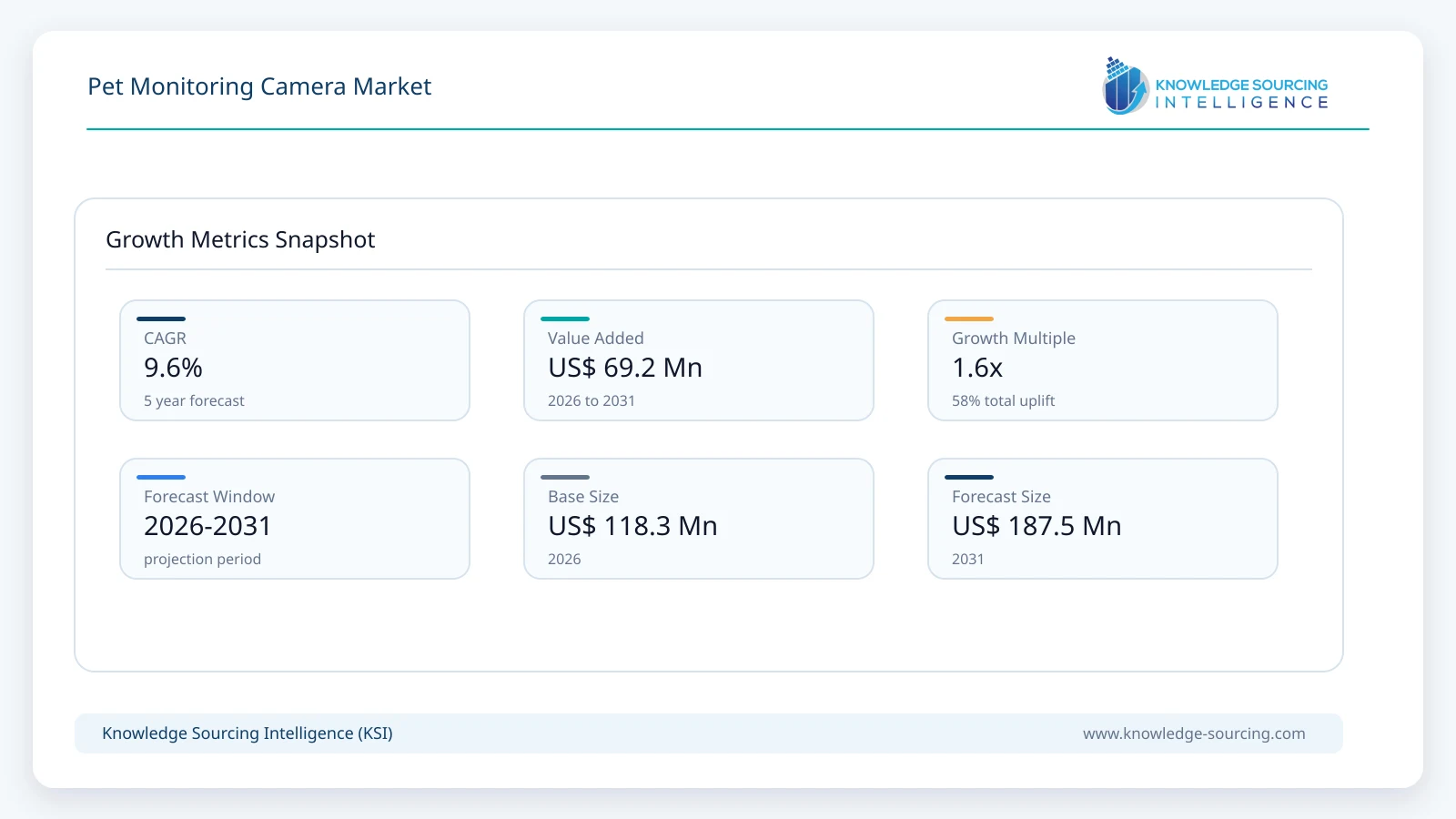
The Global Pet Monitoring Camera market is forecast to grow at a CAGR of 9.6%, reaching USD 187.5 million in 2031 from USD 118.3 million in 2026.
Highlights:
- 1Pet ownership supports recurring demand for remote monitoring and connected pet-care devices.
- 2Two-way video is shifting cameras from observation tools toward interactive pet-care systems.
- 3Privacy, cybersecurity, storage, and subscription costs increasingly influence camera purchasing decisions.
- 4Online channels support product comparison, subscription conversion, reviews, and direct manufacturer relationships.
- 5North America provides a mature customer base with high spending on connected pet care.
- 6Asia Pacific offers expansion potential as urban pet ownership and digital retail access increase.
Market Overview
The U.S. provides a useful demand indicator. The American Pet Products Association reported that 71 million U.S. households owned at least one dog in 2025, equal to 53% of households. APPA also reported that U.S. pet-industry spending reached $158 billion in 2025. These figures do not measure camera adoption, but they show the size of the addressable pet-care spending base and the continued importance of pet-related household purchases.
Purchasing decisions are shifting beyond image quality. Buyers compare two-way communication, night vision, viewing angle, pet recognition, motion tracking, storage options, app reliability, installation, subscription fees, and data protection. This creates room for differentiated products, but it also raises development and support costs. Products that use cloud services must maintain reliable connectivity and protect video and audio data, while local-storage models compete on privacy and recurring-cost savings.
Commercial demand is distributed across direct-to-consumer sales, online marketplaces, electronics retailers, pet-specialty stores, veterinary and professional-care settings, and other business users. Pet owners remain the principal customer group, while boarding facilities, veterinary practices, shelters, and professional caregivers can require multi-camera coverage, longer recording periods, user access controls, and dependable operation. The market therefore combines consumer electronics economics with pet-care purchasing behavior.
Key Market Indicators
Indicator | Latest Evidence | Commercial Meaning |
U.S. dog-owning households | 71 million, 2025 | Establishes a large addressable base for connected dog-care products. |
U.S. households owning dogs | 53%, 2025 | Indicates broad household penetration of the primary pet category served by cameras. |
U.S. pet-industry spending | $158 billion, 2025 | Shows the scale of household spending supporting premium and connected pet-care products. |
UK pet dogs | 11.1 million, 2025 | Provides evidence of a large European installed pet base. |
UK pet cats | 10.5 million, 2025 | Supports demand for camera functions suited to indoor and independent pets. |
EU connected-product cybersecurity law | Cyber Resilience Act adopted, 2024 | Raises security and compliance obligations for connected products, including home cameras. |
Market Drivers
Large and increasingly service-oriented pet-care spending. U.S. pet ownership provides a broad customer base for products that extend care beyond feeding and veterinary services. APPA reported 71 million dog-owning households in 2025, while veterinary care represented 29% of dog-owner spending. Cameras can fit into this broader care model by allowing owners to observe behavior, check routines, and identify situations that may require intervention. The commercial opportunity is stronger when cameras connect with alerts, health services, treats, or subscriptions rather than relying only on video hardware.
Demand for remote supervision during owner absence. Urban households, travel, work schedules, and periods away from home create a practical need to check pets remotely. The value proposition is particularly clear for dogs and cats that spend part of the day without direct supervision. Two-way audio adds an intervention function, while motion tracking and alerts reduce the need for continuous viewing. Manufacturers are responding by combining video with pet recognition, activity detection, night vision, and automated notifications, moving the product from passive recording toward active monitoring.
Expansion of interactive camera functions. Product development is increasing the number of tasks a pet camera can perform. Furbo's Furbo Mini 360°, introduced in September 2025, combines 2K video, 360-degree rotation, pet tracking, AI functions, and treat tossing. eufy's D605 similarly combines video monitoring, two-way interaction, motion tracking, and treat dispensing, while its local 16GB storage reduces dependence on cloud storage. These features increase the potential value per device and give suppliers more ways to differentiate products beyond resolution.
Growth of connected pet-care ecosystems. Camera manufacturers increasingly connect monitoring with software and related services. Petcube's platform combines camera functions with smart alerts and veterinary support, while its product range links cameras with other pet-care devices. This model creates recurring revenue through subscriptions and increases customer retention because the camera becomes part of a broader service relationship. Suppliers can also use software updates to add functions after purchase, extending product value without requiring immediate hardware replacement.
Market Restraints and Challenges
Privacy and cybersecurity exposure. Pet cameras record inside private homes and can capture conversations, visitors, children, and other sensitive activity. The Federal Trade Commission's action against Ring showed the commercial consequences of weak access controls and cybersecurity practices in connected cameras. The FTC alleged that employees and contractors accessed customer videos improperly and that security weaknesses allowed unauthorized users to take control of accounts and cameras. Pet-camera suppliers therefore face higher expectations for authentication, encryption, access management, vulnerability handling, and transparent data practices.
Subscription fatigue and price sensitivity. Advanced functions often depend on cloud storage, AI alerts, longer video histories, or premium services. Buyers may accept an upfront camera price but resist recurring fees when basic monitoring can be obtained from lower-cost security cameras. eufy's D605 illustrates the competing approach by offering local 16GB storage without a mandatory subscription. Suppliers must balance recurring service revenue with the risk that subscription costs reduce conversion, increase customer churn, or encourage buyers to select simpler products.
Dependence on reliable connectivity and software performance. Cloud-based cameras require stable internet connections, responsive mobile applications, and dependable server infrastructure. A technically capable camera can still produce poor customer outcomes when notifications arrive late, video streams fail, or application updates create compatibility problems. These requirements increase support costs and place software quality alongside optical performance in purchasing decisions. Suppliers serving professional facilities also face higher expectations for uptime, user permissions, multi-camera management, and longer product support periods.
Compliance costs for connected products. Product-security rules are increasing the obligations placed on camera manufacturers, importers, and distributors. The UK's consumer connectable-product regime has required applicable products to meet baseline security requirements since April 2024. In Europe, the Cyber Resilience Act establishes cybersecurity requirements across the design, development, production, and market supply of products with digital elements, explicitly including connected home cameras. Compliance can raise testing, documentation, software-support, and vulnerability-management costs, particularly for smaller suppliers.
Major Segment Analysis
Two-Way Audio/Video
Two-Way Audio/Video represents a commercially important segment because it changes the camera from a viewing device into an interaction tool. Owners can speak to pets, hear sounds from the home, and respond to situations without being physically present. This function is relevant to dogs and cats that spend time alone, while professional caregivers can use it for remote observation and communication during routine care.
Purchasing decisions depend on audio clarity, connection stability, microphone and speaker performance, application response time, camera positioning, and night operation. Two-way communication also supports higher-value products when combined with alerts, tracking, treat dispensing, or subscription services. Petcube's cameras incorporate two-way audio alongside monitoring functions, while eufy's D605 combines communication with tracking and treat delivery.
The segment faces competition from general indoor security cameras that already provide two-way communication. Pet-focused suppliers therefore need differentiated software, pet recognition, interaction functions, or service features to justify higher prices.
Regional Analysis
Region | Main Demand Signal | Principal Constraint |
North America | Large pet-owning household base and high pet spending | Privacy, subscription costs, and intense product competition |
Europe | Large dog and cat populations with stronger connected-product rules | Cybersecurity compliance and data protection |
Asia Pacific | Expanding urban pet ownership and digital commerce | Uneven purchasing power and regulatory differences |
Middle East and Africa | Growth in premium pet services in selected urban markets | Smaller addressable markets and distribution gaps |
North America offers the most established commercial environment. APPA reported 71 million U.S. dog-owning households in 2025, while total U.S. pet-industry spending reached $158 billion. This supports demand for premium monitoring, subscriptions, and connected services, although buyers remain selective about recurring costs.
Europe combines a sizeable pet base with tighter privacy and product-security expectations. The UK had an estimated 11.1 million pet dogs and 10.5 million pet cats in 2025. EU cybersecurity rules also directly cover connected home cameras, increasing the importance of secure product design and long-term software support.
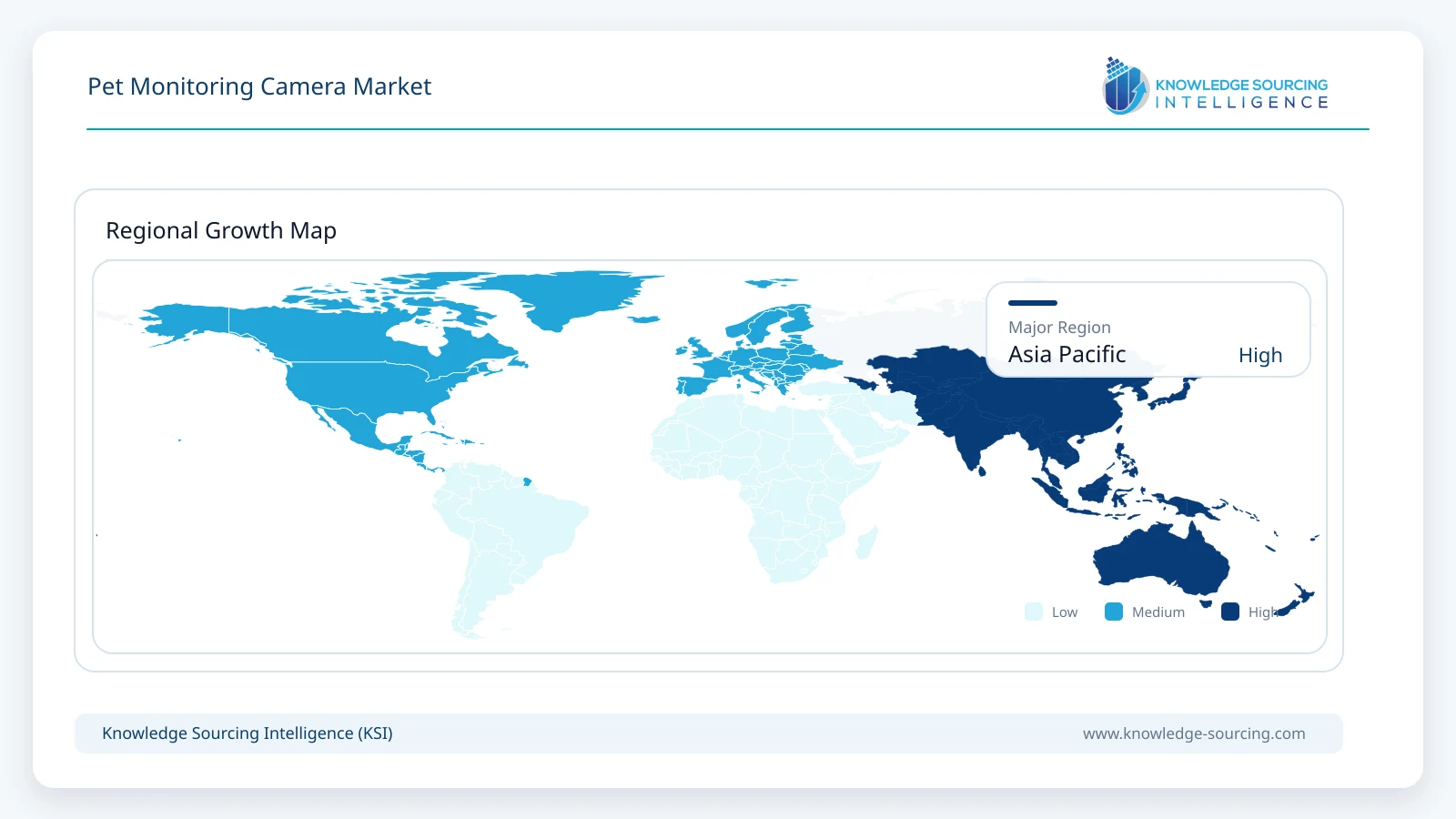
Asia Pacific offers a broader expansion opportunity as urban consumers adopt connected home products and online purchasing becomes more accessible. Japan recorded 2025 pedigree registrations led by toy poodles, Chihuahuas, and dachshunds, illustrating continued demand for companion-animal products, although pedigree registrations do not represent the full pet population. China also shows growing demand for professional pet-care services, particularly among urban consumers.
Middle East and Africa remain more selective markets. Demand is concentrated in higher-income urban areas, where premium pet services and imported connected devices are more accessible. Distribution, after-sales support, and product pricing can limit wider penetration.
Competitive Landscape
The market combines specialist pet-camera suppliers with broader smart-camera manufacturers. Furbo, Petcube, eufy, Wyze, EZVIZ, SpotCam, Motorola, Zmodo, and Vimtag compete across different combinations of video quality, two-way communication, AI detection, storage, pricing, and smart-home compatibility.
Specialists such as Furbo and Petcube differentiate through pet-specific functions and service ecosystems. Furbo has expanded from basic remote viewing toward AI-supported monitoring, tracking, and treat interaction. Petcube links cameras with veterinary and pet-care services, increasing the potential for recurring revenue.
Broader smart-camera suppliers compete through manufacturing scale, hardware capability, local storage, application ecosystems, and price. eufy's D605 emphasizes local storage and no mandatory subscription, while its newer camera range combines high-resolution video, pet detection, tracking, and smart-home integration.
Competition will increasingly depend on software reliability, privacy controls, product support, and the ability to deliver useful pet-specific alerts rather than simply higher camera resolution.
Recent Developments
July 2026: LIMPID acquired PetPeotalk, adding vision-AI capabilities trained on 350 million video records and Dogibogi’s pet-camera behavior analysis to its Kinfora AI pet-healthcare platform for pet owners.
January 2026: uCloudlink unveiled PetCam at CES, introducing a 25-gram wearable camera offering first-person and third-person monitoring, behavioral insights, and integration within its PetPogo ecosystem for remote care.
September 2025: Furbo introduced the Furbo Mini 360°, combining 2K video, 360-degree rotation, pet tracking, AI functions, and treat tossing. The launch shows how specialist suppliers are adding interactive features to raise product value.
June 2025: Petlibro launched Scout Smart Camera, adding AI-powered multi-pet recognition, behavior tracking, personalized highlights, daily summaries, live alerts, and real-time pet selfies through its app worldwide for owners.
Regulatory and Policy Environment
Connected pet cameras fall within broader consumer IoT, privacy, cybersecurity, and product-safety frameworks. In the UK, the Product Security and Telecommunications Infrastructure regime has applied to consumer connectable products since April 29, 2024. Manufacturers must meet baseline security obligations, including restrictions on weak default passwords and requirements for reporting security issues and communicating support periods.
European suppliers face additional data-protection considerations. European Data Protection Board guidance states that the household exemption under the GDPR is interpreted narrowly when home cameras capture public areas or another person's property. Commercial users such as boarding facilities, veterinary practices, and professional caregivers cannot assume the same treatment as individuals using cameras strictly for household purposes.
The EU Cyber Resilience Act also establishes cybersecurity requirements for products with digital elements, including connected home cameras. Compliance affects product design, vulnerability management, documentation, testing, and lifecycle support. Suppliers entering regulated markets must therefore treat cybersecurity as a product-development and market-access requirement rather than an optional software feature.
Outlook and Strategic Implications
Pet monitoring cameras are moving toward a broader connected-care model in which video is the foundation for alerts, interaction, behavior monitoring, and paid services. The strongest commercial propositions are likely to combine useful pet-specific functions with dependable applications and clear privacy controls. Resolution alone provides limited differentiation as general-purpose indoor cameras continue to improve.
Suppliers will need to manage two competing customer expectations. Buyers want more AI, longer recording, better tracking, and richer interaction, but they also want simple pricing, secure data handling, and reliable products. Local storage, on-device processing, privacy modes, and transparent subscription structures can therefore become important purchase factors alongside video quality.
During 2026-2031, competitive advantage should increasingly depend on software support, pet-specific analytics, ecosystem integration, and channel reach. Manufacturers targeting professional pet-care users will also need stronger multi-user controls, longer support periods, and dependable operation. For consumer suppliers, online distribution can accelerate product discovery and direct customer relationships, while offline channels remain useful where buyers require demonstrations, technical advice, or immediate product availability.
Regulatory compliance will raise the cost of market entry, but it can also strengthen differentiation for suppliers that build security into product design. Companies that combine secure connected hardware with practical pet-care functions and controlled recurring-service costs will be better positioned to capture higher-value demand across mature and emerging markets.
Pet Monitoring Camera Market Scope:
| Report Metric | Details |
|---|---|
| Total Market Size in 2026 | USD 118.3 million |
| Total Market Size in 2031 | USD 187.5 million |
| Forecast Unit | Million |
| Growth Rate | 9.6% |
| Study Period | 2021 to 2031 |
| Historical Data | 2021 to 2024 |
| Base Year | 2025 |
| Forecast Period | 2026 – 2031 |
| Segmentation | Video Functionality, End-User, Distribution Channel, Geography |
| Companies |
|
Market Segmentation
By Video Functionality
One-Way Audio/Video
Two-Way Audio/Video
Interactive Video Functionality
By End-User
Pet Owners
Pet Boarding and Daycare Facilities
Veterinary Clinics and Hospitals
Pet Shelters and Rescue Organizations
Professional Pet Care Providers
Others
By Distribution Channel
Online
Offline
By Geography
North America
United States
Canada
Mexico
South America
Brazil
Argentina
Others
Europe
UK
Germany
France
Italy
Spain
Others
Middle East and Africa
Saudi Arabia
UAE
Israel
Others
Asia Pacific
China
Japan
South Korea
India
Indonesia
Thailand
Taiwan
Others
Table of Contents
1. INTRODUCTION
1.1. Market Overview
1.2. Market Definition
1.3. Scope of the Study
1.4. Market Segmentation
1.5. Currency
1.6. Assumptions
1.7. Base and Forecast Years Timeline
1.8. Key Benefits to the Stakeholder
2. RESEARCH METHODOLOGY
2.1. Research Design
2.2. Research Processes
3. EXECUTIVE SUMMARY
3.1. Key Findings
3.2. Analyst View
4. MARKET DYNAMICS
4.1. Market Drivers
4.2. Market Restraints
4.3. Porter’s Five Forces Analysis
4.3.1. Bargaining Power of Suppliers
4.3.2. Bargaining Power of Buyers
4.3.3. Threat of New Entrants
4.3.4. Threat of Substitutes
4.3.5. Competitive Rivalry in the Industry
4.4. Industry Value Chain Analysis
4.5. Analyst View
5. PET MONITORING CAMERA MARKET, BY VIDEO FUNCTIONALITY
5.1. Introduction
5.2. One-Way Audio/Video
5.3. Two-Way Audio/Video
5.4. Interactive Video Functionality
6. PET MONITORING CAMERA MARKET, BY END-USER
6.1. Introduction
6.2. Pet Owners
6.3. Pet Boarding and Daycare Facilities
6.4. Veterinary Clinics and Hospitals
6.5. Pet Shelters and Rescue Organizations
6.6. Professional Pet Care Providers
6.7. Others
7. PET MONITORING CAMERA MARKET, BY DISTRIBUTION CHANNEL
7.1. Introduction
7.2. Online
7.3. Offline
8. PET MONITORING CAMERA MARKET, BY GEOGRAPHY
8.1. Introduction
8.2. North America
8.2.1. By Video Functionality
8.2.2. By End-User
8.2.3. By Distribution Channel
8.2.4. By Country
8.2.4.1. United States
8.2.4.1.1. Market Trends and Opportunities
8.2.4.1.2. Growth Prospects
8.2.4.2. Canada
8.2.4.2.1. Market Trends and Opportunities
8.2.4.2.2. Growth Prospects
8.2.4.3. Mexico
8.2.4.3.1. Market Trends and Opportunities
8.2.4.3.2. Growth Prospects
8.3. South America
8.3.1. By Video Functionality
8.3.2. By End-User
8.3.3. By Distribution Channel
8.3.4. By Country
8.3.4.1. Brazil
8.3.4.1.1. Market Trends and Opportunities
8.3.4.1.2. Growth Prospects
8.3.4.2. Argentina
8.3.4.2.1. Market Trends and Opportunities
8.3.4.2.2. Growth Prospects
8.3.4.3. Others
8.3.4.3.1. Market Trends and Opportunities
8.3.4.3.2. Growth Prospects
8.4. Europe
8.4.1. By Video Functionality
8.4.2. By End-User
8.4.3. By Distribution Channel
8.4.4. By Country
8.4.4.1. UK
8.4.4.1.1. Market Trends and Opportunities
8.4.4.1.2. Growth Prospects
8.4.4.2. Germany
8.4.4.2.1. Market Trends and Opportunities
8.4.4.2.2. Growth Prospects
8.4.4.3. France
8.4.4.3.1. Market Trends and Opportunities
8.4.4.3.2. Growth Prospects
8.4.4.4. Italy
8.4.4.4.1. Market Trends and Opportunities
8.4.4.4.2. Growth Prospects
8.4.4.5. Spain
8.4.4.5.1. Market Trends and Opportunities
8.4.4.5.2. Growth Prospects
8.4.4.6. Others
8.4.4.6.1. Market Trends and Opportunities
8.4.4.6.2. Growth Prospects
8.5. Middle East and Africa
8.5.1. By Video Functionality
8.5.2. By End-User
8.5.3. By Distribution Channel
8.5.4. By Country
8.5.4.1. Saudi Arabia
8.5.4.1.1. Market Trends and Opportunities
8.5.4.1.2. Growth Prospects
8.5.4.2. UAE
8.5.4.2.1. Market Trends and Opportunities
8.5.4.2.2. Growth Prospects
8.5.4.3. Israel
8.5.4.3.1. Market Trends and Opportunities
8.5.4.3.2. Growth Prospects
8.5.4.4. Others
8.5.4.4.1. Market Trends and Opportunities
8.5.4.4.2. Growth Prospects
8.6. Asia Pacific
8.6.1. By Video Functionality
8.6.2. By End-User
8.6.3. By Distribution Channel
8.6.4. By Country
8.6.4.1. China
8.6.4.1.1. Market Trends and Opportunities
8.6.4.1.2. Growth Prospects
8.6.4.2. Japan
8.6.4.2.1. Market Trends and Opportunities
8.6.4.2.2. Growth Prospects
8.6.4.3. South Korea
8.6.4.3.1. Market Trends and Opportunities
8.6.4.3.2. Growth Prospects
8.6.4.4. India
8.6.4.4.1. Market Trends and Opportunities
8.6.4.4.2. Growth Prospects
8.6.4.5. Indonesia
8.6.4.5.1. Market Trends and Opportunities
8.6.4.5.2. Growth Prospects
8.6.4.6. Thailand
8.6.4.6.1. Market Trends and Opportunities
8.6.4.6.2. Growth Prospects
8.6.4.7. Taiwan
8.6.4.7.1. Market Trends and Opportunities
8.6.4.7.2. Growth Prospects
8.6.4.8. Others
8.6.4.8.1. Market Trends and Opportunities
8.6.4.8.2. Growth Prospects
9. COMPETITIVE ENVIRONMENT AND ANALYSIS
9.1. Major Players and Strategy Analysis
9.2. Market Share Analysis
9.3. Mergers, Acquisitions, Agreements, and Collaborations
9.4. Competitive Dashboard
10. COMPANY PROFILES
10.1. Furbo
10.2. PetChatz LLC
10.3. Petcube Inc
10.4. Wyze Labs, Inc
10.5. HANGZHOU HIKVISION DIGITAL TECHNOLOGY CO., LTD. (EZVIZ Inc.)
10.6. SpotCam Co., Ltd.
10.7. Motorola Mobility LLC
10.8. Zmodo Technology Corp. Ltd
10.9. eufy / Anker Innovations
10.10. Vimtag Technology Co., Ltd.
LIST OF FIGURES
LIST OF TABLES
Navigate
Trusted by the world's leading organizations











