
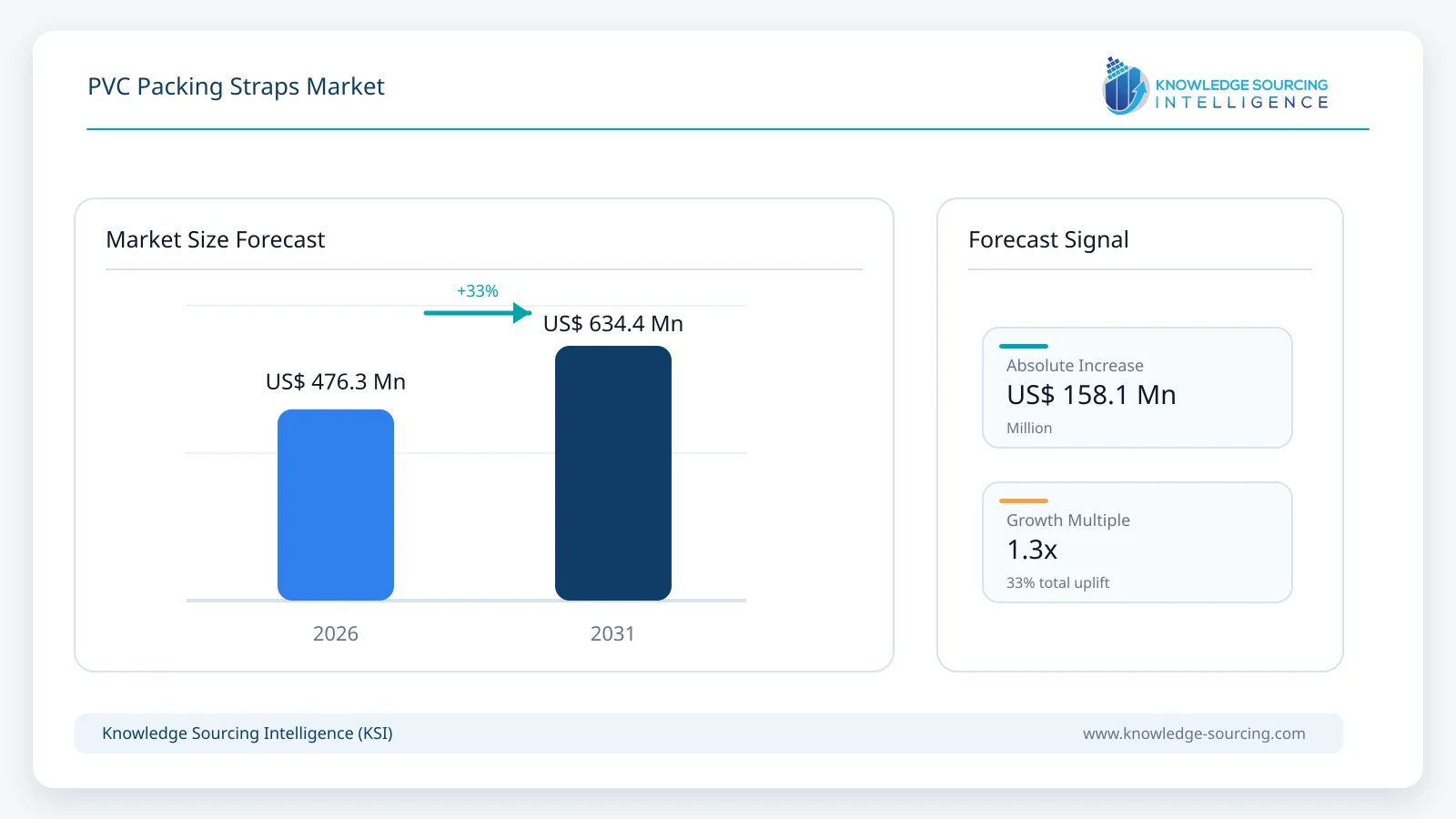
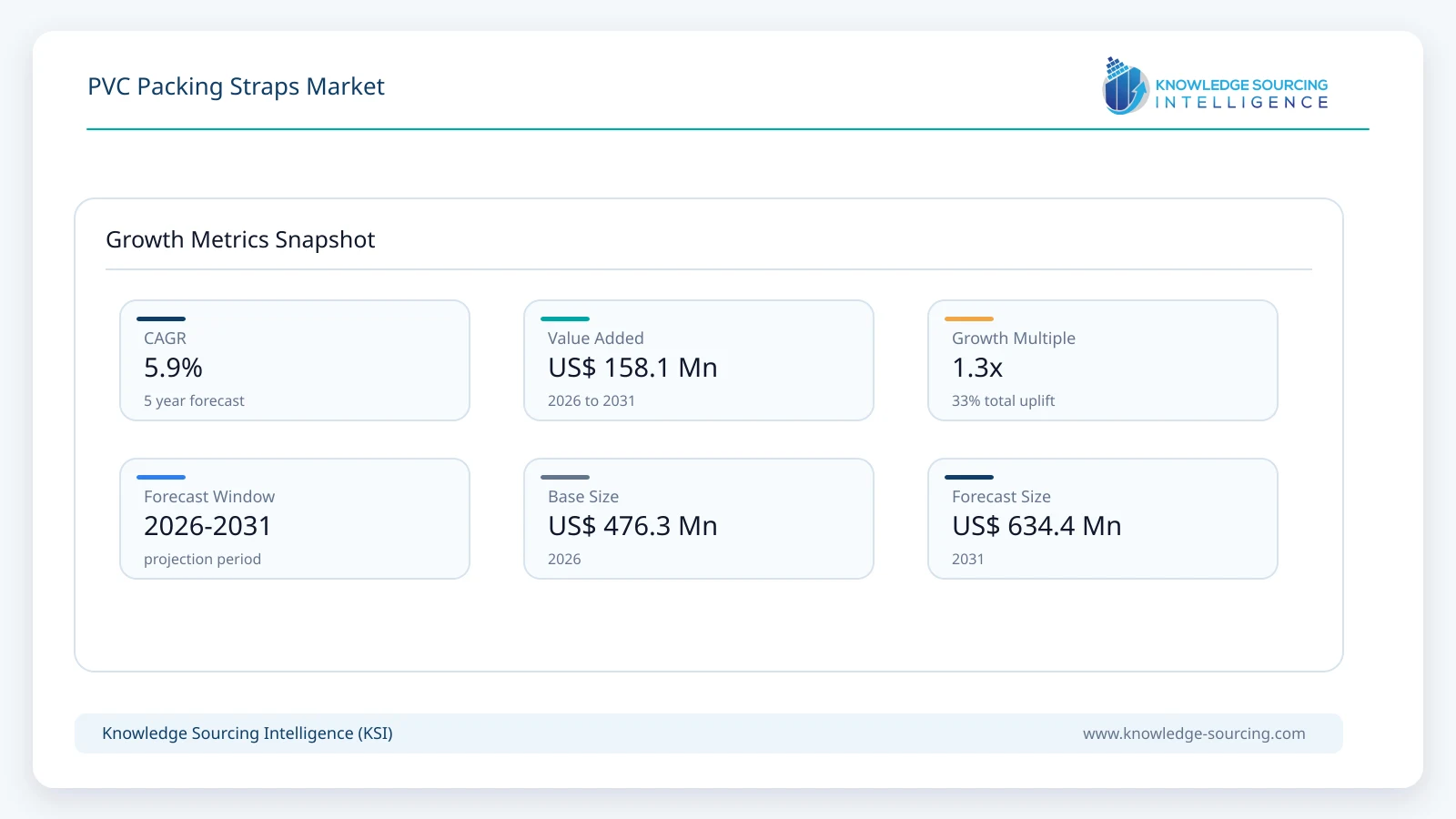
The PVC packing straps market is forecast to grow at a CAGR of 5.9%, reaching USD 634.4 million in 2031 from USD 476.3 million in 2026.
Highlights:
- 10.5 mm to 0.75 mm straps account for approximately 41% of global market value in 2026, equivalent to about USD 195.3 million, supported by broad use in general industrial and secondary packaging.
- 2E-commerce accounts for approximately 24% of market value in 2026, equivalent to around USD 114.3 million, driven by warehousing, carton consolidation and fulfillment activity.
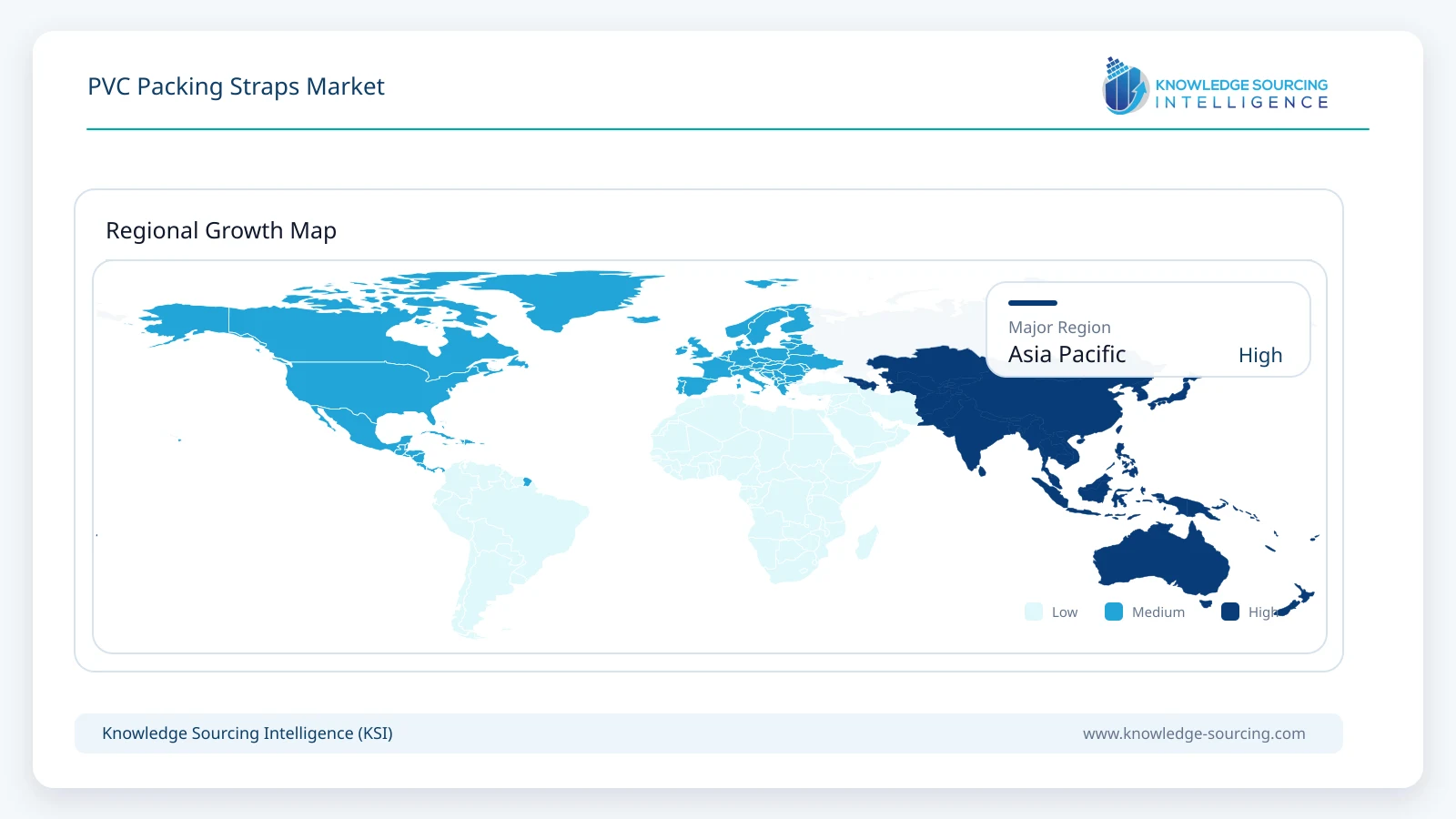
- 3Asia Pacific represents approximately 39% of global market value in 2026, equivalent to about USD 185.8 million, reflecting the region’s large manufacturing and export base.
- 4PVC strap demand remains concentrated in manual and semi-automatic packaging applications where flexibility, local availability and cost remain important purchasing criteria.
- 5Competition from polypropylene and PET is the principal structural restraint as automated strapping systems increasingly standardize around these materials.
- 6Recycling, material traceability and packaging circularity requirements are becoming more important supplier-qualification criteria through 2031.
Market Overview
PVC packing straps are extruded polyvinyl chloride bands used to secure cartons, bundles, packaged products and selected palletized loads during storage and transportation. The study covers PVC as the principal strapping material and excludes polypropylene, PET/polyester, steel, textile and composite strapping. PVC-coated steel straps and products in which PVC is merely a coating are also outside the core market.
Commercial PVC strap specifications vary considerably between suppliers. Gold Plast currently markets PVC packaging straps around 0.5-0.6 mm thick with a stated breaking strength of 300 kgf, while Blue Packaging offers PVC strapping rolls with a 0.5 mm specification and widths reaching 25-32 mm. S.K. Packaging markets 0.8 mm PVC strapping, while Yash Packaging supplies substantially thicker PVC strap for more demanding applications. This breadth confirms that the market extends from relatively light bundling to more robust industrial packaging, although performance overlaps with PP and PET as load requirements increase.
The market is substantially more fragmented than the international PP and PET strapping industry. Many PVC products are manufactured or distributed by regional packaging-material businesses rather than large vertically integrated global strap producers. AVR Industries, for example, lists PVC strap rolls within a broader range of industrial packaging materials, while suppliers including Anjali Enterprises, Gold Plast and Al Mureed maintain PVC straps alongside films, tapes, PET straps and other packaging consumables.
This fragmented structure affects how competition should be interpreted. Large global companies such as Mosca, FROMM, Teufelberger, Signode, Cyklop and PAC Strapping remain highly relevant to PVC because their PP and PET products, tools and automated systems compete directly for the same industrial load-containment applications. Teufelberger’s current portfolio, for example, is explicitly structured around PP and PET. The strategic pressure on PVC therefore comes not only from competing PVC suppliers but from the broader shift in strapping technology toward PP and PET systems.
Market Trends
PVC Strap Supply Remains More Regional Than the Broader Strapping Industry
PVC packing straps retain a comparatively regional manufacturing and distribution structure. Current supplier evidence is particularly visible across India, the Middle East and parts of Europe, where packaging-material companies provide PVC strap alongside tape, stretch film, protective packaging and strapping tools. AVR Industries operates two production units in India and lists PVC strap rolls as part of its packaging range, while suppliers such as Gold Plast, S.K. Packaging, Anjali Enterprises and Yash Packaging offer PVC products in multiple specifications. In the UAE, Al Mureed supplies PVC straps in several widths and roll weights for pallet-strapping applications, while Duboxx distributes PP/PVC packaging strap through its packaging-material network.
This structure supports smaller industrial customers that buy relatively modest quantities and value local availability, but it also limits standardization. Larger buyers increasingly require documented tensile performance, dimensional tolerances and predictable running behavior, which favors suppliers capable of moving beyond commodity roll sales toward more controlled product specifications.
Machine Compatibility Is Becoming More Important
Semi-automatic and automated packaging systems place tighter demands on strap width, thickness, straightness, surface finish and coil winding. Even though the most advanced automated strapping systems predominantly use PP and PET, the same direction affects PVC suppliers serving semi-automatic or application-specific equipment. Inconsistent strap dimensions can cause feeding problems, poor sealing and equipment stoppages, increasing the total operating cost for the packaging user.
This trend raises the competitive threshold for PVC manufacturers. Price remains important in fragmented regional markets, but industrial customers increasingly compare strap suppliers on process reliability rather than cost per kilogram alone. Companies able to supply consistent extrusion, winding and documented technical characteristics are consequently better positioned for recurring industrial business.
PVC Circularity Is Becoming More Relevant to Packaging Procurement
PVC recycling infrastructure continues to develop, particularly in Europe. VinylPlus reported 765,972 tonnes of PVC waste recycled in 2025, an increase of 5.7% from the previous year, while PVC converters registered more than 508,000 tonnes of recycled PVC uptake. The figures cover the wider PVC value chain rather than strapping alone, but they demonstrate that PVC increasingly operates within measurable collection, traceability and recycling systems.
For strapping suppliers, the challenge is collection. Individual straps are relatively lightweight and can become mixed with other warehouse and packaging waste. Commercial opportunities therefore favor clearer material identification, segregated waste handling and systems capable of directing used PVC packaging materials toward appropriate recycling channels.
Segment Analysis
By Thickness: 0.5 mm to 0.75 mm
The 0.5 mm to 0.75 mm range represents the most commercially versatile section of the PVC packing strap market. It provides sufficient material strength for carton reinforcement, bundling and numerous light-to-medium industrial packaging applications without the additional material consumption associated with heavier-gauge straps. Current commercial products support this positioning. Gold Plast lists PVC strapping around 0.5-0.6 mm, while Royal Tools & Hardware Mart supplies a 0.5 mm PVC strap for packaging applications.
The segment also benefits from the economics of manual and semi-manual packaging. Buyers using PVC are frequently regional manufacturers, warehouses, wholesalers, and smaller industrial operations rather than highly automated multinational plants. In such environments, a medium-gauge strap provides an effective compromise between cost, flexibility, and securing performance. Thicker PVC remains relevant for heavier bundles, but those applications encounter substantially stronger competition from PET, composite and steel strapping.
By End User: E-Commerce
E-commerce demand for PVC straps is concentrated upstream of the individual consumer parcel. Distribution centers and sellers use strapping to consolidate cartons, secure grouped shipments, reinforce packages, and stabilize goods moving between production locations, fulfillment centers, and regional distribution facilities. The underlying opportunity therefore comes from warehouse throughput and secondary packaging rather than assuming every delivered parcel requires strapping.
High-volume fulfillment also places greater emphasis on packaging speed and damage reduction. As facilities automate handling, suppliers must deliver more consistent strap dimensions and reliable performance. PVC retains opportunities in manual and semi-automatic operations, particularly among smaller fulfillment businesses and regional distribution networks, while PP competes strongly in high-speed automated carton strapping. The future of the PVC segment consequently depends on maintaining a cost and performance position in applications that do not require the highest throughput or retained tension.
By Geography: Asia Pacific
Asia Pacific represents the principal demand environment for PVC packing straps because the region combines the world’s largest manufacturing base with extensive export-oriented production, intra-regional trade and large populations of small and medium-sized manufacturers. UNIDO reported that Asia and the Pacific recorded the strongest regional manufacturing growth in the first quarter of 2026, while the WTO expects Asia to remain the fastest-growing merchandise export region under its 2026 baseline scenario.
China is important through the scale of its manufacturing and plastic-conversion industries, while India supports a particularly visible base of PVC strap manufacturers and packaging distributors. Japan, South Korea, Taiwan and Southeast Asia provide additional demand through electronics, automotive, machinery and consumer-goods production. The region also experiences intense competition from inexpensive PP and PET straps, requiring PVC suppliers to compete through application suitability, established distribution and price rather than relying only on broader packaging-market growth.
Market Drivers
Growth in Manufacturing and Movement of Finished Goods
PVC strap demand is ultimately tied to physical goods requiring bundling, consolidation and load stabilization. Global manufacturing production increased by 1.2% quarter over quarter in the first quarter of 2026, while manufacturing exports increased by 3.5%, according to UNIDO. Asia Pacific led regional manufacturing growth despite geopolitical and trade uncertainty.
This creates recurring consumption of packaging materials across electronics, food products, industrial components, consumer goods and machinery. PVC does not capture all incremental strapping demand because PP and PET remain powerful substitutes, but growing manufacturing throughput enlarges the overall pool of packaging activity in which PVC suppliers compete.
Expansion of Warehousing and Distribution Networks
Modern supply chains create multiple packaging events between factory production and final consumption. Goods can be bundled at production plants, redistributed at central warehouses, separated into regional shipments, and reconsolidated before final delivery. Each additional handling stage increases the importance of load integrity and secondary packaging.
PVC straps remain suited to operations that require inexpensive manual or semi-manual bundling. This is especially relevant to smaller warehouses, distributors and manufacturing businesses where investing in highly automated strapping systems may not provide sufficient economic return. Regional suppliers able to maintain ready inventory across common widths and thicknesses can therefore compete effectively despite the growing sophistication of the wider packaging industry.
Continued Need for Flexible and Moisture-Resistant Strapping
PVC is flexible and moisture-resistant, allowing it to retain utility in warehouses and transportation environments where packages may be exposed to humidity or variable handling conditions. Direct supplier offerings show PVC straps being sold for carton sealing, packaging, pallet strapping, and industrial bundling.
The commercial advantage is application-dependent. PVC does not match the retained tension of high-strength PET for many demanding loads, but it can provide adequate performance at a lower level of mechanical requirement. This positions it between simple tape-based bundling and heavier industrial load-securing systems.
Growth of Asia-Based Export Manufacturing
The WTO reported that Asia contributed 71% of total merchandise-trade growth in 2025 and forecasts Asia to remain the fastest-growing export region in its 2026 baseline outlook.
This matters for PVC straps because export shipments experience repeated loading, unloading, warehousing and transport stages. Electronics, appliances, automotive components, light machinery and consumer goods therefore generate substantial secondary-packaging requirements. India additionally has a sizable local supplier ecosystem, helping keep PVC straps commercially accessible even as global integrated strapping companies concentrate increasingly on PP and PET.
Fragmented Distribution Keeps PVC Accessible to SMEs
PVC packing straps can be sourced through packaging-material distributors that also sell tape, stretch film, protective packaging and manual tools. This differs from equipment-intensive strapping systems where users may be tied more closely to a machine supplier.
The resulting distribution structure is important for small and medium-sized companies because they can purchase relatively small quantities, replace rolls without major qualification procedures and source compatible consumables locally. Commercial listings from India and the UAE show PVC straps available through distributors in multiple widths, thicknesses and roll sizes, reinforcing the role of regional availability in maintaining demand.
Market Restraints
PP and PET Continue to Take Applications from PVC
Material substitution represents the most important structural restraint. Major international strapping producers increasingly concentrate on polypropylene and PET. Teufelberger’s current product portfolio is based on PP and PET, with PP positioned for light-to-medium packages and PET for more demanding industrial loads. PET provides higher retained tension and is widely promoted as an alternative to steel in appropriate applications.
PVC therefore faces pressure at both ends of the performance spectrum. PP competes aggressively in low-cost carton strapping, while PET captures applications requiring higher strength and tension retention. PVC must retain applications where its flexibility, price, existing user familiarity or particular handling characteristics remain advantageous.
Automation Increasingly Favors Established PP/PET Systems
Large international packaging companies combine consumables with automatic strapping machines, hand tools, maintenance and integrated end-of-line systems. The installed equipment base frequently determines which polymer a customer continues buying over many years.
As factories move from manual packaging toward high-speed automated cells, PVC suppliers face a disadvantage because modern machine-grade consumable ecosystems are dominated by PP and PET. The restraint is therefore not simply material performance. It is also the installed base of machinery, tooling and service networks that reinforces competing polymers.
Packaging Regulation Raises Circularity Requirements
The EU Packaging and Packaging Waste Regulation began applying on 12 August 2026. It establishes progressively stronger requirements for recyclability, packaging minimization and recycled content, including requirements for plastic packaging from 2030.
These rules do not prohibit PVC strapping, but they increase the need for producers and buyers to demonstrate how packaging materials can be identified, collected and recycled. PVC straps mixed into heterogeneous warehouse waste streams can be difficult to recover economically. Suppliers that cannot document composition or provide a credible recycling pathway may therefore face greater procurement resistance from large European and multinational customers.
PVC Resin Economics Remain Volatile
The PVC resin market continues to experience global overcapacity and pricing pressure. Formosa Plastics reported that mainland Chinese PVC capacity increased from 29.51 million tonnes in 2024 to 30.88 million tonnes in 2025, while the company expects global PVC capacity to remain substantially above demand through 2026.
Low resin prices can benefit strap converters by reducing feedstock costs, but persistent oversupply also creates unpredictable pricing, pressure on producer margins and potential plant rationalization. Energy, chlorine and ethylene economics add another layer of volatility, particularly in Europe. Smaller strap producers have limited ability to hedge these movements and can experience margin compression when finished-product prices adjust more slowly than input costs.
Inconsistent Product Specifications Limit Large-Customer Qualification
PVC straps sold through fragmented regional markets vary widely in width, thickness, hardness, breaking strength and labeling. Commercially available products range from approximately 0.5 mm to 2 mm or more, while some listings use the term PVC for coated or mixed-material straps rather than homogeneous PVC products.
This complicates supplier qualification. Large manufacturers need consistent tensile properties and dimensions, particularly when straps pass through mechanical tensioning or sealing equipment. Companies that cannot provide technical data, repeatable production and quality documentation are therefore largely confined to price-sensitive manual applications.
Regional Outlook
Asia Pacific
Asia Pacific remains the largest regional market through 2031. China supplies the region with a large plastics-processing and manufacturing base, while India combines rising industrial activity with a highly fragmented packaging-material supplier network. Japan, South Korea and Taiwan provide higher-value demand from electronics and precision manufacturing, and Southeast Asian markets benefit from expanding consumer-goods and export production.
The region’s advantage is scale, but competition is intense. Low-cost PP strap is widely available, and PET continues to expand in heavier-load applications. PVC suppliers therefore compete most effectively in localized applications where price, flexibility and existing procurement relationships matter.
North America
North America has extensive industrial distribution, warehouse infrastructure and automated packaging operations. These characteristics create substantial overall demand for strapping but also strengthen PP and PET because large packaging companies have established equipment-consumable ecosystems around those materials.
PVC opportunities remain more selective, centered on manual packaging, regional distribution and users with established PVC specifications. Distribution consolidation also matters. Veritiv’s May 2026 acquisition of Quick Pak added a company that distributes strapping, films, tapes, equipment and parts to manufacturing, food and beverage and distribution customers.
Europe
European demand is increasingly shaped by regulation and circular-material requirements. The PPWR now applies across the EU, while the regional PVC industry continues expanding recycling and traceability programs. VinylPlus reported that the European PVC value chain recycled more than 765,000 tonnes in 2025 and has retained a target of using at least one million tonnes of recycled PVC annually in new products by 2030.
PVC strap suppliers operating in Europe will therefore compete not only on strength and price but also on material traceability, recyclable design and integration into collection systems. This creates a higher compliance burden but also provides an opportunity for technically documented PVC products.
South America
Brazil represents the region’s largest opportunity due to food processing, consumer-goods manufacturing, automotive production and industrial distribution. Argentina and other markets contribute additional demand, although economic volatility can affect manufacturing activity, polymer imports and packaging investment.
PVC straps are most relevant where local distributors can provide economical material for routine bundling. Larger export-oriented plants are more likely to compare PVC directly with PP and PET according to machine compatibility and load-security requirements.
Middle East and Africa
The Middle East combines expanding logistics infrastructure with food distribution, industrial diversification and construction-related supply chains. The UAE has an established packaging-distribution base, with companies such as Al Mureed and Duboxx currently listing PVC or PP/PVC strap products.
Saudi Arabia’s manufacturing and logistics development creates additional opportunities, while African demand remains fragmented and import dependent. Distributor relationships and inventory availability are especially important because many countries lack large domestic plastic-strapping manufacturing bases.
Competitive Landscape
The PVC packing straps market is more fragmented than the mainstream global PP and PET strapping industry. Direct PVC supply is concentrated among regional packaging converters and distributors, particularly in Asian and Middle Eastern markets. Companies such as AVR Industries, Gold Plast, Blue Packaging, S.K. Packaging, Yash Packaging and Anjali Enterprises demonstrate the continued commercial availability of dedicated PVC strap products.
A second competitive group consists of international strapping-system companies including Signode, Mosca, Cyklop, FROMM, Teufelberger, PAC Strapping, LINDER and others. Their strategic importance comes primarily from their ability to move users toward alternative plastic straps, integrated machinery and service-supported packaging systems. They should therefore be assessed as direct competitive pressure on PVC even where current product portfolios emphasize PP and PET.
Competition among direct PVC suppliers focuses on width and thickness availability, breaking strength, price, roll length, local inventory and customization. Industrial buyers increasingly value consistency because dimensional variation becomes more costly when straps are mechanically tensioned or applied. Larger packaging distributors additionally compete through their ability to supply straps alongside film, tape, machinery, tools, protective packaging and after-sales service.
The market is therefore expected to remain fragmented. Regional suppliers retain strong positions in price-sensitive manual applications, while integrated packaging companies exert increasing influence as customers automate their end-of-line operations.
Recent Developments
August 21, 2026: INEOS Inovyn agreed to acquire the UK’s remaining ethylene dichloride production assets at Runcorn from Vynova Runcorn Limited. EDC is a core upstream intermediate for PVC production, making the transaction relevant to European chlor-vinyl supply-chain resilience.
August 12, 2026: Regulation (EU) 2025/40 on packaging and packaging waste began applying across the European Union, introducing immediate limits on harmful substances like PFAS in food-contact packaging while phased targets for recyclability and recycled plastic content apply progressively toward 2030.
June 18, 2026: VinylPlus formally launched its revised VinylPlus 2030 Commitment following a mid-term review, maintaining a target of at least one million tonnes of recycled PVC being used annually in new products by 2030 and strengthening its focus on circularity and life-cycle performance.
May 27, 2026: Landen Strapping announced a new 22,000-square-foot Southern California facility to expand its packaging automation and industrial strapping operations, illustrating continued investment in automated load-securing systems that influence material competition across the strapping industry.
May 22, 2026: VinylPlus reported that 765,972 tonnes of PVC waste were recycled during 2025, up 5.7% year over year, while more than 508,000 tonnes of recycled PVC uptake was registered by converters.
May 12, 2026: Veritiv acquired Quick Pak and Stickel Packaging Supply. Quick Pak distributes strapping, films, packaging equipment, parts and tapes to manufacturing, food and beverage and distribution customers, expanding Veritiv’s industrial-packaging reach in the United States.
Market Outlook
The PVC packing straps market is expected to remain positive but structurally different from that of the broader plastic-strapping industry.
The strongest demand conditions remain in Asia Pacific, where manufacturing, electronics, consumer-goods production and export activity create a large addressable base for secondary packaging. India and other emerging manufacturing economies also support PVC through fragmented local distribution, allowing smaller manufacturers to source straps economically without becoming dependent on integrated packaging-system providers.
The principal strategic challenge is substitution. PP is entrenched in light and automated carton strapping, while PET continues moving into medium- and heavy-duty industrial loads. PVC is therefore unlikely to become the dominant material in modern automated strapping. Its growth depends instead on protecting applications where flexibility, availability, acceptable load performance and established user practices continue to support the material.
Sustainability requirements will become more important through the forecast period. European rules are moving toward mandatory recyclability and recycled-content requirements, while the PVC value chain is developing larger recycling and traceability systems. PVC strap producers able to improve material identification, recycled-content use and end-of-life collection will be better placed to serve large industrial customers than suppliers competing only on price.
The market consequently remains commercially viable through 2031, but growth will increasingly favor suppliers that combine competitive conversion economics with consistent product specifications, documented material composition and reliable regional distribution.
PVC Packing Straps Market Scope:
| Report Metric | Details |
|---|---|
| Total Market Size in 2026 | USD 476.3 million |
| Total Market Size in 2031 | USD 634.4 million |
| Forecast Unit | USD Million |
| Growth Rate | 5.9% |
| Study Period | 2021 to 2031 |
| Historical Data | 2021 to 2024 |
| Base Year | 2025 |
| Forecast Period | 2026 – 2031 |
| Segmentation | Thickness, End-User, Geography |
| Companies |
|
Market Segmentation
By Thickness
Below 0.5 mm
0.5 mm to 0.75 mm
0.76 mm to 1 mm
Above 1 mm
By End-User
Food and Beverages
Pharmaceuticals
Electrical and Electronics
Automotive
E-Commerce
Others
By Geography
North America
United States
Canada
Mexico
South America
Brazil
Argentina
Others
Europe
United Kingdom
Germany
France
Italy
Spain
Others
Middle East and Africa
Saudi Arabia
UAE
South Africa
Others
Asia Pacific
China
India
Japan
South Korea
Taiwan
Thailand
Indonesia
Others
Table of Contents
1. INTRODUCTION
1.1. Market Overview
1.2. Market Definition
1.3. Revenue Inclusion and Exclusion Criteria
1.4. Scope of the Study
1.5. PVC Packing Straps versus PP, PET and Steel Strapping
1.6. Market Segmentation
1.7. Currency
1.8. Assumptions
1.9. Base and Forecast Years
2. RESEARCH METHODOLOGY
3. EXECUTIVE SUMMARY
3.1. Key Findings
3.2. PVC Packing Straps Market Size, 2026-2031
3.3. Thickness Outlook
3.4. End-User Outlook
3.5. Regional Opportunity Summary
4. MARKET DYNAMICS
4.1. Market Drivers
4.1.1. Growth in Manufacturing and Movement of Finished Goods
4.1.2. Expansion of Warehousing and Distribution Networks
4.1.3. Continued Need for Flexible and Moisture-Resistant Strapping
4.1.4. Growth of Asia-Based Export Manufacturing
4.1.5. Fragmented Distribution and SME Packaging Demand
4.2. Market Restraints
4.2.1. PP and PET Substitution
4.2.2. Automation Favoring Established PP/PET Systems
4.2.3. Packaging Recycling and Circularity Requirements
4.2.4. PVC Resin Price and Supply Volatility
4.2.5. Product Specification and Qualification Challenges
4.3. Market Opportunities
4.4. Porter’s Five Forces Analysis
4.5. Industry Value Chain Analysis
4.6. PVC Resin-to-Strap Conversion Economics
5. PVC PACKING STRAPS MARKET BY THICKNESS
5.1. Below 0.5 mm
5.2. 0.5 mm to 0.75 mm
5.3. 0.76 mm to 1 mm
5.4. Above 1 mm
6. PVC PACKING STRAPS MARKET BY END-USER
6.1. Food and Beverages
6.2. Pharmaceuticals
6.3. Electrical and Electronics
6.4. Automotive
6.5. E-Commerce
6.6. Others
7. PVC PACKING STRAPS MARKET BY GEOGRAPHY
7.1. North America
7.1.1. United States
7.1.2. Canada
7.1.3. Mexico
7.2. South America
7.2.1. Brazil
7.2.2. Argentina
7.2.3. Others
7.3. Europe
7.3.1. United Kingdom
7.3.2. Germany
7.3.3. France
7.3.4. Italy
7.3.5. Spain
7.3.6. Others
7.4. Middle East and Africa
7.4.1. Saudi Arabia
7.4.2. UAE
7.4.3. South Africa
7.4.4. Others
7.5. Asia Pacific
7.5.1. China
7.5.2. India
7.5.3. Japan
7.5.4. South Korea
7.5.5. Taiwan
7.5.6. Thailand
7.5.7. Indonesia
7.5.8. Others
8. COMPETITIVE ENVIRONMENT AND ANALYSIS
8.1. Major Players and Strategy Analysis
8.2. PVC Strap Supplier Landscape
8.3. Competition from PP and PET Strapping
8.4. Mergers, Acquisitions, Agreements and Collaborations
8.5. Competitive Dashboard
9. COMPANY PROFILES
9.1. Cyklop International
9.2. FROMM Group
9.3. DuBose Strapping, Inc.
9.4. LINDER GmbH
9.5. Polychem Corporation
9.6. Mosca GmbH
9.7. Crown Holdings, Inc.
9.8. PAC Strapping Products, Inc.
9.9. Teufelberger Holding AG
9.10. StraPack Corporation
9.11. Samuel Packaging Systems Group
9.12. AVR Industries Private Limited
9.13. Gold Plast
9.14. Blue Packaging
9.15. S. K. Packaging
9.16. Yash Packaging
9.17. Anjali Enterprises
9.18. M. Power Pack
9.19. Vinsha Enterprises
9.20. Jay Ess Traders
9.21. Lily Packagings (P) Ltd.
9.22. Al Mureed Building Materials Trading Co. LLC
9.23. Duboxx Packaging LLC
9.24. TEPACK
9.25. FLR Packaging Consulting
10. APPENDIX
Navigate
Trusted by the world's leading organizations











