
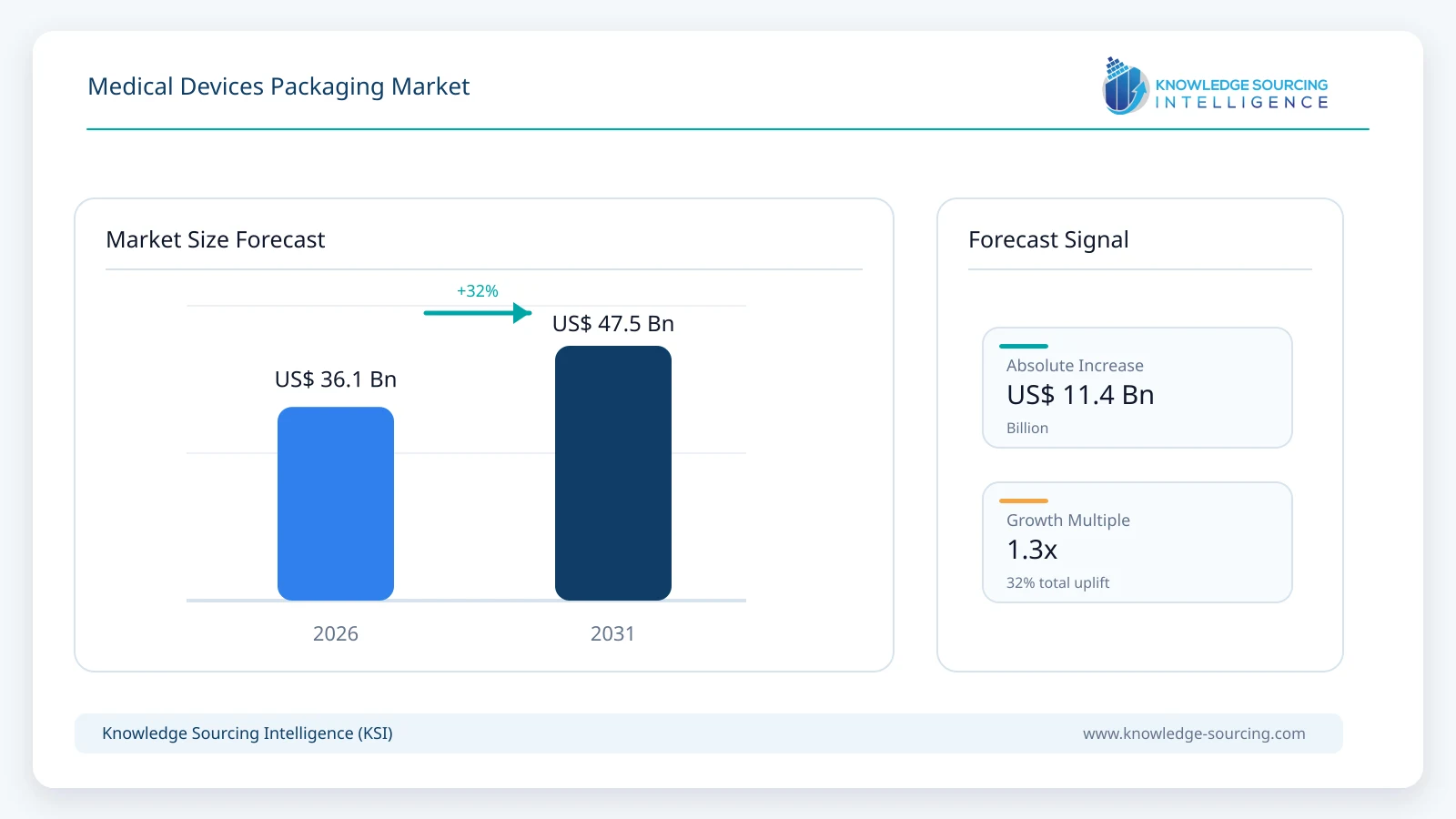
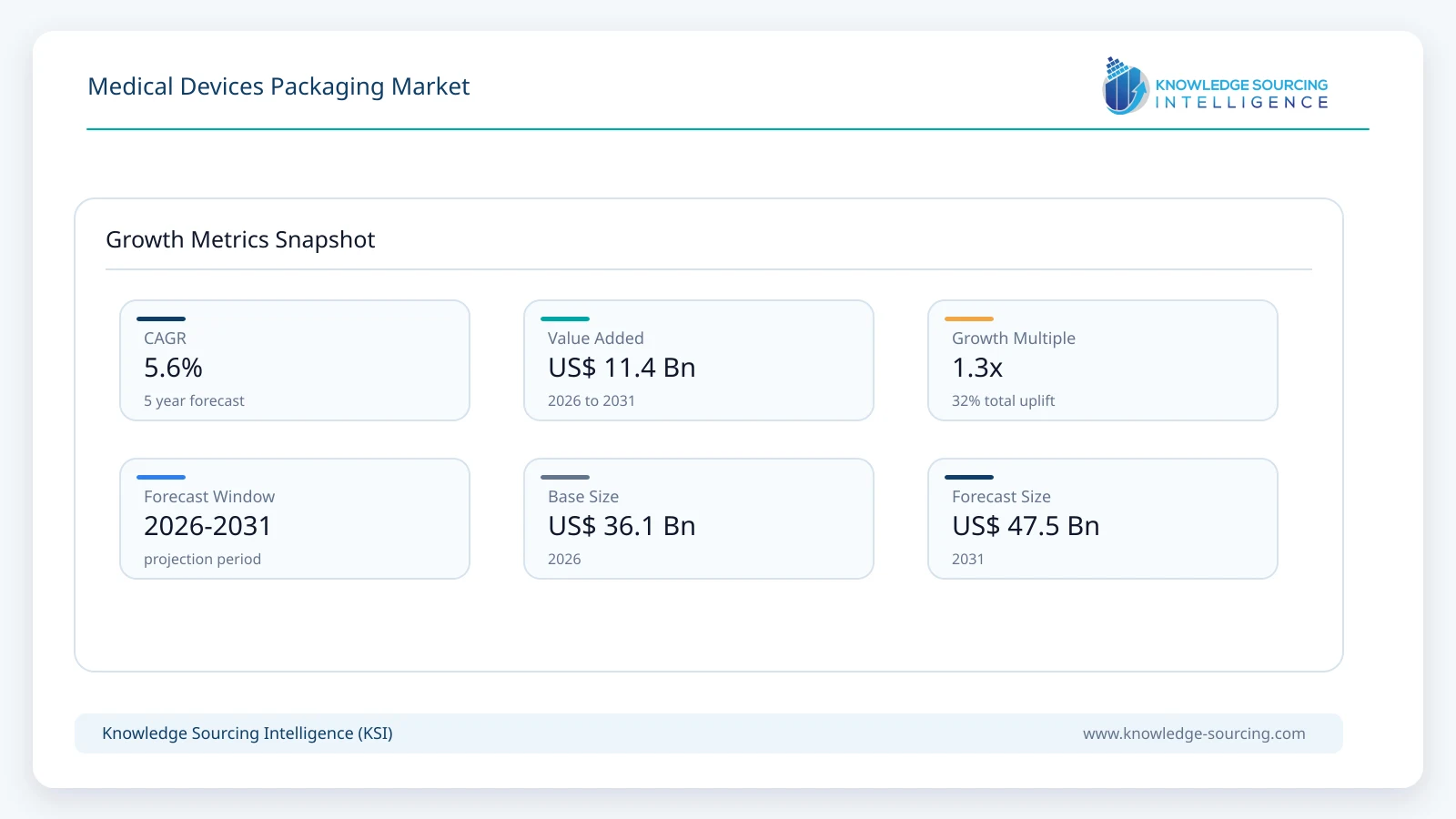
The global medical devices packaging market is estimated at USD 36.1 billion in 2026 and is projected to reach USD 47.5 billion by 2031, representing a CAGR of 5.6% throughout the forecast period.
Highlights:
- 1Global market value reaches USD 47.5 billion by 2031 from USD 36.1 billion.
- 2Sterile barrier packaging represents about 66% of 2026 medical-device packaging demand.
- 3Pouches, trays and rollstock remain core formats for single-use and implantable devices.
- 4Asia Pacific gains share as medtech manufacturing capacity expands across regional production hubs.
- 5Recyclability advances, but patient safety and validated performance remain non-negotiable design priorities.
Medical device packaging is unusually specification-driven because the package is part of the validated product system. For terminally sterilized devices, the sterile barrier must allow the intended sterilization process, preserve package integrity through distribution and shelf life, prevent microbial ingress, and permit aseptic presentation at the point of use. The U.S. FDA recognizes ISO 11607-1 and ISO 11607-2, including the 2023 amendments, covering materials, sterile barrier systems and validation of forming, sealing and assembly processes. This regulatory dependence gives packaging suppliers with cleanroom manufacturing, material science, validation support and global quality systems an advantage over general-purpose packaging converters.
Underlying demand is linked closely to the scale and complexity of the global medical technology industry. MedTech Europe estimates the European medical technology market at about EUR 170 billion in 2024, equivalent to 26.4% of the world market, while the United States accounts for 46.4%. Europe alone contains more than 38,000 medtech companies. The packaging model therefore reflects device production and consumption by region, the share of sterile and single-use products, package complexity, cleanroom conversion requirements and the higher packaging intensity of implantable, minimally invasive and procedure-based devices relative to large reusable capital equipment.
The market is also being reshaped by sustainability requirements. Medical device manufacturers want lower material use, mono-material structures, recycled or renewable feedstocks and easier end-of-life handling, but changes are slower than in food and consumer packaging because a material change can trigger package validation, sterilization compatibility work and regulatory documentation. The result is a market where sustainability creates incremental value for engineered materials and redesigned packages, rather than immediate wholesale substitution of established sterile-barrier structures.
Market Drivers
Expansion of single-use and minimally invasive medical devices
Single-use devices, catheters, guidewires, procedure kits, wound-care products and minimally invasive instruments create recurring packaging demand because each item or kit requires controlled protection and, in many cases, a validated sterile barrier. Medical device manufacturers increasingly outsource portions of package design, prototyping, cleanroom converting and validation support to specialist suppliers. This expands the addressable value beyond commodity film or paper and supports demand for pre-made pouches, die-cut lids, thermoformed trays, mounting cards, header bags and custom multi-component systems.
Sterility and regulatory validation requirements
Regulatory requirements remain one of the strongest structural drivers. ISO 11607 defines requirements for packaging materials, sterile barrier systems and validated forming, sealing and assembly processes for terminally sterilized devices, and the FDA recognizes both parts of the standard. Device manufacturers therefore place a premium on package integrity, seal consistency, microbial barrier performance, sterilization compatibility, traceability and documented process control. These requirements raise switching costs and support longer supplier relationships once a package system has been validated.
Geographic expansion of medtech manufacturing
Medical device production is becoming more geographically distributed, increasing demand for local or regionally redundant packaging supply. Amcor expanded healthcare packaging capability in India in June 2026, while Nelipak opened a new Asia-Pacific technical development center in Singapore in March 2026 and is adding a sterile-barrier packaging facility in Costa Rica. TekniPlex Healthcare opened a 200,000-square-foot barrier-protection facility in Wisconsin in 2025. These investments reflect customer demand for shorter lead times, regional technical support and business-continuity options close to major medtech manufacturing clusters.
Sustainable material redesign and downgauging
Medical packaging suppliers are increasing investment in lighter-gauge films, recyclable structures and renewable-attribution materials while attempting to preserve validated performance. DuPont's Tyvek with Renewable Attribution is being adopted by Olympus beginning in 2026 across more than 100 single-use endotherapeutic device categories. Amcor, Coveris and other suppliers are commercializing recycle-ready or mono-material structures, while rigid-tray producers are focusing on downgauging and recyclable PET-based systems. Adoption remains application-specific because sustainability improvements cannot compromise microbial barrier, puncture resistance, seal strength or sterilization compatibility.
Market Restraints
Long validation cycles slow material substitution and increase the cost of packaging redesign.
Sterilization compatibility limits the use of some recycled, bio-based and mono-material structures.
Medical-grade resin, Tyvek, foil and specialty coating costs can pressure converter margins.
Consolidation among packaging suppliers may reduce qualified-source redundancy for some device manufacturers.
Global Medical Devices Packaging Market Segment Analysis
By Packaging Format
Pouches and bags represent the largest individual package-format category because they are used across catheters, guidewires, sutures, tubing sets, wound-care products, small implants, procedure kits and diagnostic consumables. Thermoformed trays are particularly important for rigid, sharp, high-value or implantable devices where orientation and physical protection are critical. Rollstock, lidding and wraps support high-volume form-fill-seal operations and hospital sterilization, while cartons and boxes remain important as protective and secondary packaging. Over the forecast period, pouches and rollstock should benefit from high-volume single-use devices, while trays retain higher value per pack in orthopedic, cardiovascular and other complex applications.
By Material
Plastics and medical-grade films form the largest material family because polyethylene, PET, PETG, nylon, polypropylene and multilayer structures are widely used in pouches, forming films, lidding and rigid trays. Tyvek and other nonwovens occupy a strategically important position in breathable sterile barrier systems because of their microbial barrier, puncture resistance and broad sterilization compatibility. Medical paper remains widely used where cost, breathability and clean peel are suitable, while foil and high-barrier laminates serve moisture-, oxygen- or light-sensitive devices and combination products. Material growth is increasingly determined by validation performance and sustainability redesign rather than resin cost alone.
By Sterility Requirement
Sterile barrier packaging is estimated at approximately USD 23.8 billion in 2026 and is expected to expand faster than non-sterile protective packaging through 2031. The segment is supported by recurring demand from single-use devices, implants, surgical instruments, wound-care products and procedure kits that must remain sterile until the point of use. Non-sterile packaging remains substantial for diagnostic equipment, durable and reusable devices, accessories, components and secondary protective packaging. The distinction is commercially important because sterile systems require materially higher testing, validation, quality-control and cleanroom conversion intensity.
By Device Category
Surgical and minimally invasive devices account for a large share of packaging demand because of their high unit volumes and frequent requirement for sterile pouches, trays and lids. Implantable orthopedic and cardiovascular devices contribute disproportionately to packaging value per unit because package protection, double-barrier configurations and rigid trays are common. Diagnostic and IVD devices are another important segment, spanning test consumables, collection products and cartridges. Drug-delivery devices and other disposable products provide additional growth as home care and self-administration expand.
Geographical Outlook
North America
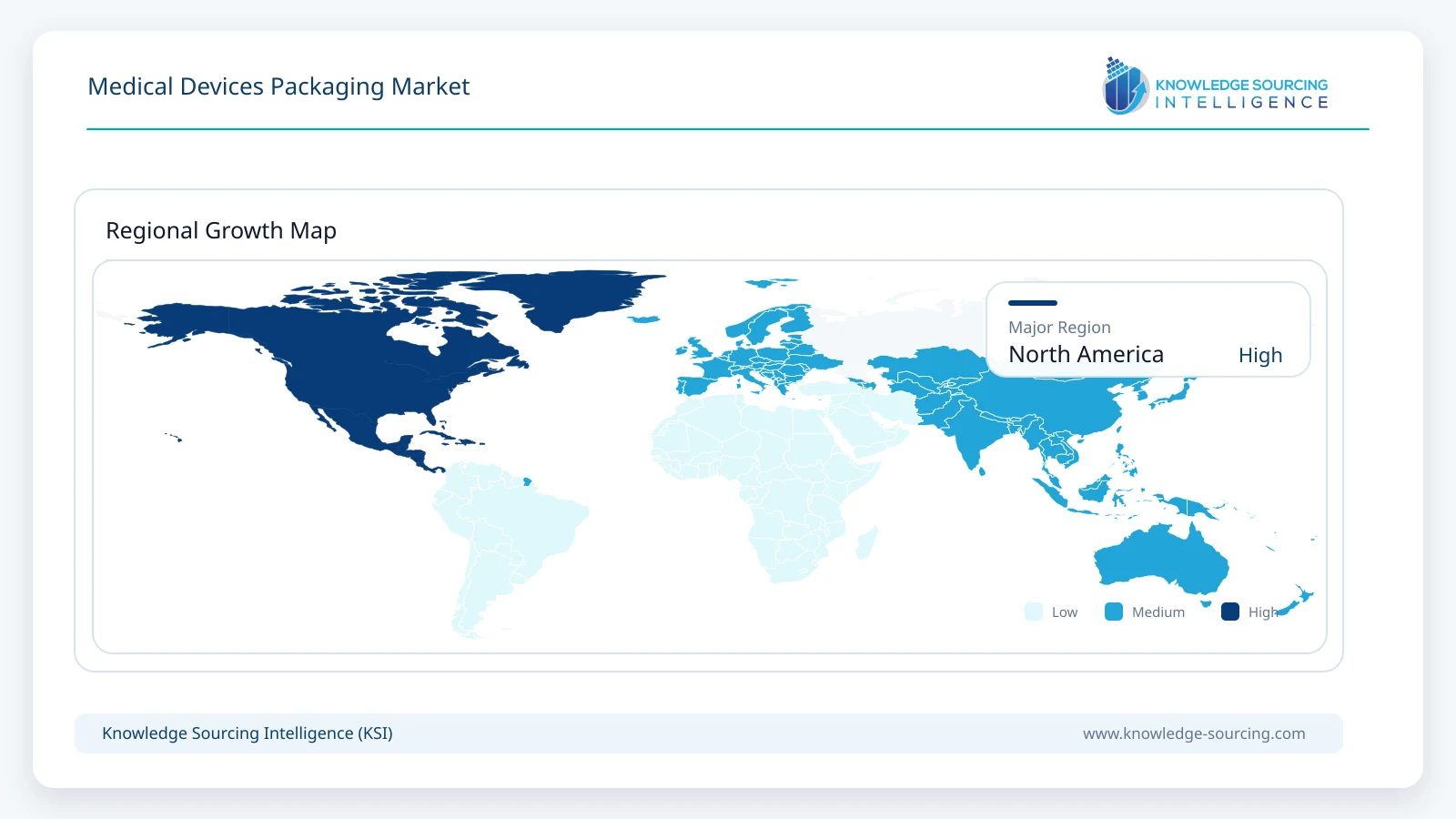
North America is estimated to remain the largest regional market in 2026, supported by the United States' position as the world's largest medical technology market and by a dense base of device OEMs, contract manufacturers, packaging converters and sterilization providers. The region benefits from high usage of single-use devices and advanced surgical products, but packaging suppliers also face strong customer pressure on sustainability and supply-chain redundancy. Amcor, Oliver Healthcare Packaging, TekniPlex, Prent, Technipaq, Beacon Converters and other specialist suppliers maintain significant North American capabilities.
Europe
Europe remains a major medical device packaging market because of its approximately EUR 170 billion medtech sector, strong device manufacturing base and stringent MDR/IVDR compliance environment. Germany, France, the United Kingdom, Italy, Switzerland, Ireland and the Nordic countries support substantial device and packaging activity. The region is also an early adopter of recyclable and resource-efficient packaging concepts because of broader EU packaging policy and corporate sustainability targets. STERIMED, Wipak, Coveris, SÜDPACK MEDICA and other suppliers maintain specialized European sterile-packaging portfolios.
Asia Pacific
Asia Pacific is expected to be the fastest-growing major region as medical-device manufacturing, healthcare access and domestic device demand expand across China, India, Southeast Asia and selected export hubs. Packaging suppliers are localizing capacity and engineering support to reduce lead times and support global OEMs. Amcor's 2026 Indian healthcare-packaging expansion and Nelipak's 2026 Singapore technical center illustrate the shift toward regionalized supply. Japan and South Korea remain important high-specification markets, while India and Southeast Asia offer stronger incremental manufacturing growth.
Other Regions
Latin America, the Middle East and Africa form smaller but increasingly relevant markets. Costa Rica and Puerto Rico are important medical-device manufacturing hubs serving North American supply chains, encouraging packaging suppliers to add local cleanroom thermoforming and sterile-barrier capacity. Brazil and Mexico also support significant device and healthcare manufacturing. In the Middle East and Africa, demand is more import-dependent but rises alongside healthcare infrastructure, local device assembly and hospital investment.
Competitive Environment
Competition is divided among global packaging groups, healthcare-focused specialist converters, sterile-barrier material suppliers and rigid thermoforming companies. Scale matters for global supply continuity, but qualification history, cleanroom capability, ISO 13485 systems, material science, package engineering and validation support are equally important. Amcor strengthened its healthcare scale by completing its combination with Berry Global in April 2025, which brought Berry's healthcare packaging operations into Amcor. Specialist suppliers such as Oliver Healthcare Packaging, Nelipak, TekniPlex Healthcare, STERIMED and Wipak compete through deep sterile-barrier expertise, while Prent and other thermoformers are strong in rigid device trays.
The market is also seeing capacity investment rather than only acquisition-led growth. TekniPlex opened a new flagship barrier-protection facility in Wisconsin in June 2025. Nelipak has expanded in Costa Rica and Asia Pacific, while Amcor added healthcare packaging capacity in India in 2026. These projects indicate that suppliers expect continued growth in local medical-device manufacturing and are prioritizing regional redundancy, cleanroom conversion and technical-development services.
Recent Developments
June 2026: Amcor expanded healthcare packaging production at its Sira facility in Karnataka, India.
March 2026: Nelipak opened an Asia-Pacific technical development center for sterile-barrier packaging in Singapore.
2026: Olympus began adopting DuPont Tyvek with Renewable Attribution across 100-plus device categories.
June 2025: TekniPlex Healthcare commenced production at its new Wisconsin barrier-protection facility.
April 2025: Amcor completed its all-stock combination with Berry Global, consolidating healthcare packaging operations.
Market Outlook
Medical device packaging should grow steadily through 2031, with value growth modestly outpacing underlying device-unit growth because of increasing package complexity, regionalization, validation services and sustainability-driven material redesign. Sterile barrier packaging remains the central value pool, supported by single-use devices, minimally invasive procedures, implants and procedural kits. The strongest suppliers will combine cleanroom converting, regulatory understanding, package testing, material innovation and regional manufacturing redundancy rather than competing on substrate price alone.
Sustainability will influence material selection, but the transition will remain cautious. Unlike consumer packaging, medical packaging cannot be changed rapidly without assessing sterilization, seal integrity, aging, distribution and regulatory impact. This favors solutions that can reduce carbon footprint or improve recyclability while fitting existing validated processes. Over the forecast period, mono-material films, renewable-attribution feedstocks, downgauged rigid trays and fiber-based secondary packaging should gain traction, but established Tyvek, medical paper, multilayer film and high-barrier structures will remain critical where performance requirements justify their use.
Global Medical Devices Packaging Market Scope:
| Report Metric | Details |
|---|---|
| Total Market Size in 2026 | USD 36.1 billion |
| Total Market Size in 2031 | USD 47.5 billion |
| Forecast Unit | Billion |
| Growth Rate | 5.6% |
| Study Period | 2021 to 2031 |
| Historical Data | 2021 to 2024 |
| Base Year | 2025 |
| Forecast Period | 2026 – 2031 |
| Segmentation | Packaging Format, Material, Sterility Requirement, Device Category, Geography |
| Companies |
|
Market Segmentation
By Packaging Format
Pouches and Bags
Trays
Clamshells and Blisters
Boxes and Cartons
Rollstock, Lids and Wraps
Other Formats
By Material
Plastics and Medical-Grade Films
Paper and Paperboard
Tyvek and Other Nonwovens
Foil and High-Barrier Laminates
Other Materials
By Sterility Requirement
Sterile Barrier Packaging
Non-Sterile and Protective Packaging
By Device Category
Surgical and Minimally Invasive Devices
Implantable and Orthopedic Devices
Diagnostic and IVD Devices
Drug-Delivery and Single-Use Devices
Other Medical Devices
By Geography
North America
United States
Canada
Mexico
South America
Brazil
Argentina
Other South American Markets
Europe
Germany
United Kingdom
France
Italy
Spain
Other European Markets
Middle East and Africa
Saudi Arabia
UAE
South Africa
Other Middle East and African Markets
Asia Pacific
China
India
Japan
South Korea
Southeast Asia
Other Asia Pacific Markets
Table of Contents
1. INTRODUCTION
1.1 Market Overview
1.2 Market Definition and Scope
1.3 Market Segmentation
1.4 Currency and Units
1.5 Base Year and Forecast Period
2. RESEARCH METHODOLOGY
3. EXECUTIVE SUMMARY
3.1 Key Research Highlights
4. MARKET DYNAMICS
4.1 Market Drivers
4.1.1 Expansion of Single-Use and Minimally Invasive Medical Devices
4.1.2 Sterility and Regulatory Validation Requirements
4.1.3 Geographic Expansion of Medtech Manufacturing
4.1.4 Sustainable Material Redesign and Downgauging
4.2 Market Restraints
4.2.1 Long Validation and Requalification Cycles
4.2.2 Sterilization Compatibility Constraints
4.2.3 Medical-Grade Material Cost Volatility
4.2.4 Qualified-Supplier Concentration
4.3 Market Opportunities
4.3.1 Recycle-Ready Sterile Barrier Structures
4.3.2 Regionalized Cleanroom Converting Capacity
4.3.3 Packaging Engineering and Validation Services
4.4 Industry Value Chain Analysis
5. MEDICAL DEVICES PACKAGING MARKET, BY PACKAGING FORMAT
5.1 Introduction
5.2 Pouches and Bags
5.3 Trays
5.4 Clamshells and Blisters
5.5 Boxes and Cartons
5.6 Rollstock, Lids and Wraps
5.7 Other Formats
6. MEDICAL DEVICES PACKAGING MARKET, BY MATERIAL
6.1 Introduction
6.2 Plastics and Medical-Grade Films
6.3 Paper and Paperboard
6.4 Tyvek and Other Nonwovens
6.5 Foil and High-Barrier Laminates
6.6 Other Materials
7. MEDICAL DEVICES PACKAGING MARKET, BY STERILITY REQUIREMENT
7.1 Introduction
7.2 Sterile Barrier Packaging
7.3 Non-Sterile and Protective Packaging
8. MEDICAL DEVICES PACKAGING MARKET, BY DEVICE CATEGORY
8.1 Surgical and Minimally Invasive Devices
8.2 Implantable and Orthopedic Devices
8.3 Diagnostic and IVD Devices
8.4 Drug-Delivery and Single-Use Devices
8.5 Other Medical Devices
9. MEDICAL DEVICES PACKAGING MARKET, BY GEOGRAPHY
9.1 North America
9.1.1 United States
9.1.2 Canada
9.1.3 Mexico
9.2 South America
9.2.1 Brazil
9.2.2 Argentina
9.2.3 Other South American Markets
9.3 Europe
9.3.1 Germany
9.3.2 United Kingdom
9.3.3 France
9.3.4 Italy
9.3.5 Spain
9.3.6 Other European Markets
9.4 Middle East and Africa
9.4.1 Saudi Arabia
9.4.2 UAE
9.4.3 South Africa
9.4.4 Other Middle East and African Markets
9.5 Asia Pacific
9.5.1 China
9.5.2 India
9.5.3 Japan
9.5.4 South Korea
9.5.5 Southeast Asia
9.5.6 Other Asia Pacific Markets
10. COMPETITIVE ENVIRONMENT AND ANALYSIS
10.1 Competitive Positioning
10.2 Product and Material Strategy
10.3 Capacity Expansion, Mergers and Acquisitions
10.4 Competitive Dashboard
11. COMPANY PROFILES
11.1 Amcor plc
11.2 DuPont de Nemours, Inc.
11.3 Oliver Healthcare Packaging
11.4 Nelipak Corporation
11.5 TekniPlex Healthcare
11.6 ProAmpac
11.7 STERIMED
11.8 Wipak Group
11.9 Coveris
11.10 Klöckner Pentaplast (kp)
11.11 Prent Corporation
11.12 Technipaq, Inc.
11.13 Beacon Converters, Inc.
11.14 PPC Flex
11.15 SÜDPACK MEDICA AG
12. RECENT DEVELOPMENTS
13. MARKET OUTLOOK
14. APPENDIX
Navigate
Trusted by the world's leading organizations











