
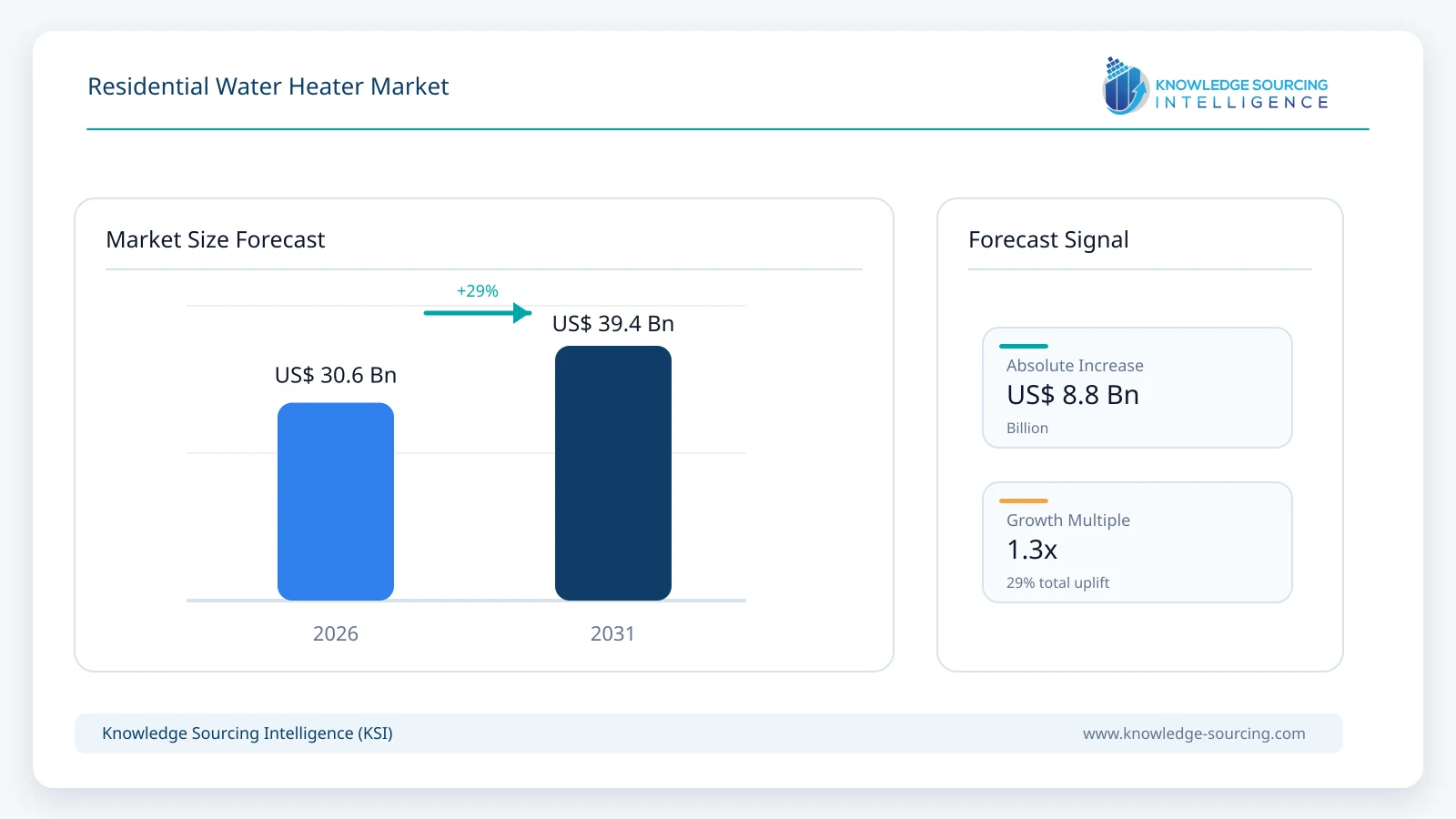
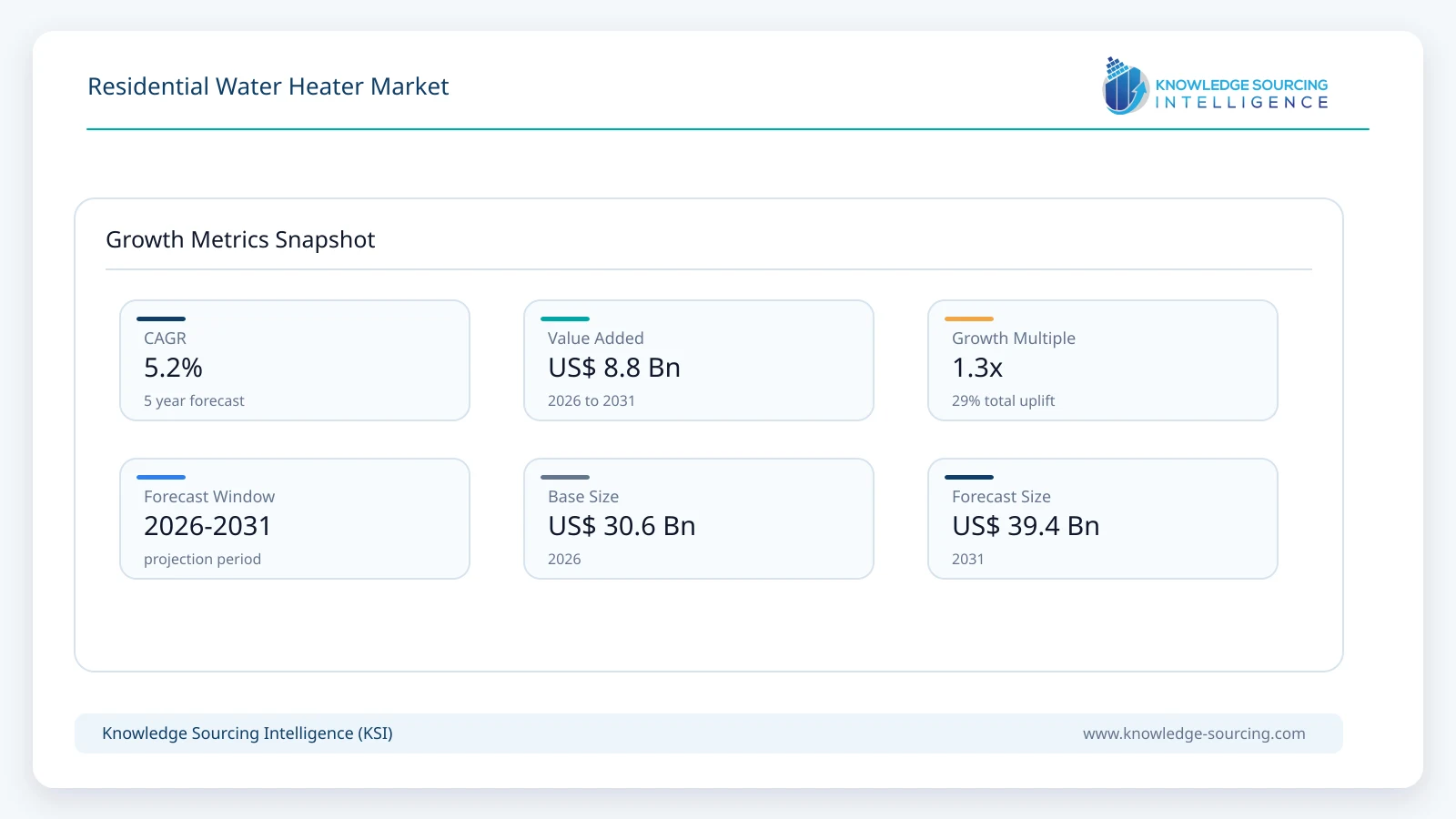
The Residential Water Heater Market is projected to expand at a CAGR of 5.2%, increasing from USD 30.6 billion in 2026 to USD 39.4 billion by 2031.
Highlights:
- 1Global residential water heater revenue is projected to reach USD 39.4 billion by 2031.
- 2Replacement demand remains the principal revenue base across mature North American, European and Japanese markets.
- 3Heat-pump water heaters are gaining share as efficiency standards and household electrification strengthen.
- 4Tankless systems continue to expand where compact installation and high hot-water output are prioritized.
- 5Asia Pacific remains the largest regional market, led by China, India, Japan and South Korea.
- 6Smart controls, demand-response capability and connected diagnostics are becoming mainstream product differentiators.
Market Overview
Tank, tankless, solar, and hybrid/heat-pump water heaters represent the principal residential technology groups, while electricity, natural gas, and solar remain important energy-source categories. Demand is strongly influenced by replacement cycles because residential water heaters typically remain installed for many years, creating a substantial installed base that generates recurring demand as tanks corrode, efficiency declines, or household requirements change. New construction adds incremental demand, while replacement activity and shifting product preferences continue to influence overall market dynamics.
The technology mix is changing. Standard electric storage systems retain broad global availability and low upfront cost, but heat-pump models are improving operating economics and increasingly qualify for energy-efficiency incentives or regulatory support. Rheem markets residential hybrid heat-pump models with efficiency several times higher than standard electric systems, while Navien's NWP500 series reaches Uniform Energy Factor ratings above 4.0 and includes Wi-Fi connectivity and demand-response capability. Tankless gas systems remain important in North America, Japan, and parts of Asia because they provide continuous hot-water output and avoid storage losses, while solar water heating retains stronger relevance in high-solar-resource markets and locations where electricity or gas costs favor thermal collection.
Market Trends
Heat-pump water heaters are moving from a niche efficiency product toward mainstream replacement
The most important technology shift is the increasing commercial viability of heat-pump water heaters. Manufacturers are expanding model ranges, installation flexibility, and control features to make heat-pump units easier replacements for conventional electric or gas systems. Rheem offers both 120-volt and 240-volt residential options, while Navien's NWP500 family combines high UEF ratings, stainless-steel tanks, built-in Wi-Fi and demand-response compatibility. Noritz has identified expansion of heat-pump water-heater sales as a FY2026 initiative in Australia and is also strengthening environmentally friendly water-heating products in Japan. These developments broaden the addressable market beyond new-build homes because manufacturers are increasingly targeting retrofit applications.
Connected controls are becoming part of the product rather than a premium accessory
Connectivity is spreading across both tank and tankless systems as manufacturers add remote temperature control, diagnostics, leak detection, demand-response capability, and energy-use monitoring. The value proposition is strongest where utilities use time-of-use tariffs or demand-response programs because connected heaters can shift heating cycles without materially affecting household comfort. Navien's current heat-pump portfolio includes built-in Wi-Fi and EcoPort demand-response functionality, while major North American and Asian suppliers increasingly integrate app-based control and fault diagnostics. These features also strengthen installer and service relationships by allowing faster fault identification and remote system monitoring.
Market Drivers
Efficiency regulations and household energy costs are accelerating product replacement
Higher efficiency standards are changing which products can be sold and improving the economics of replacing older units with heat-pump, condensing, and other high-efficiency systems. The United States Department of Energy continues to tighten water-heating efficiency requirements, and manufacturers are redesigning portfolios around compliant technologies. Household operating cost is equally important because water heating can account for a meaningful share of home energy consumption. Products that reduce annual electricity or gas use can justify higher purchase prices over their operating life, particularly in markets with elevated utility tariffs or incentive programs. This supports value growth even where total replacement unit volumes are comparatively stable.
Urbanization and rising appliance penetration support growth across emerging residential markets
New household formation and improving household infrastructure remain important demand drivers across India, Southeast Asia, parts of China, Latin America and the Middle East. As access to piped water, bathrooms and reliable electricity expands, households are more likely to install dedicated water-heating equipment rather than rely on manual or shared heating methods. The commercial opportunity differs by country: compact electric storage and instantaneous models are common in dense Asian housing, solar systems benefit from strong irradiation and supportive economics in selected markets, and gas systems retain strong positions where pipeline infrastructure is well developed. Rising middle-class appliance ownership therefore increases both unit penetration and replacement demand over time.
Market Restraint
High upfront cost and installation requirements slow the transition to higher-efficiency systems
The primary restraint is the initial cost and installation complexity associated with premium technologies. Heat-pump water heaters can reduce operating expense but generally cost more upfront than basic resistance-electric models and may require sufficient indoor air volume, condensate drainage, and electrical upgrades. Condensing gas and tankless systems can require venting, gas-line or condensate modifications, while solar systems involve roof space, climate suitability and higher installation cost. These requirements can slow replacement decisions in price-sensitive households even when lifecycle economics are favorable. The market therefore continues to support a broad mix of conventional and high-efficiency products rather than shifting uniformly toward one technology.
Segment Analysis
By Type - Tank Water Heater
Tank water heaters remain the largest type and are estimated to generate approximately USD 12.7 billion in 2026. Their position reflects the enormous installed base of electric and gas storage systems, straightforward replacement economics, and broad availability across residential construction channels. Conventional tanks face efficiency pressure in developed markets, but the format itself is not disappearing because heat-pump technology is increasingly incorporated into storage-based designs. This allows the tank segment to retain relevance while the internal heating technology changes. Tankless products are growing faster in several markets, but their higher installed cost and infrastructure requirements prevent a uniform substitution of storage systems.
By Source - Electricity
Electricity is projected to expand at approximately 6.2% annually through 2031, supported by conventional electric storage, instantaneous electric and rapidly growing heat-pump water heaters. Electrification policy, improved heat-pump performance and the ability to pair electric water heating with rooftop solar strengthen the long-term position of electricity relative to direct fossil-fuel heating. The segment is particularly important in Asia Pacific and Europe, while North American growth is being supported by hybrid heat-pump replacements. Natural gas remains a major source because of the installed base of tank and tankless systems and will continue to be preferred in homes with strong gas infrastructure and high hot-water demand.
By Application - Bathing
Bathing remains the dominant residential application and is estimated to account for approximately 63% of global market revenue in 2026. The segment represents the largest daily hot-water requirement in most households and determines water-heater sizing, recovery time and peak-demand performance. Product differentiation therefore increasingly focuses on maintaining hot-water availability without materially increasing household energy use. Tankless and hybrid systems benefit where users prioritize continuous supply or higher efficiency, while conventional storage models retain strong adoption because they are familiar to installers and provide predictable hot-water availability. Cleaning and washing applications remain important but generally contribute a smaller share of dedicated water-heater demand.
By Geography - Asia Pacific
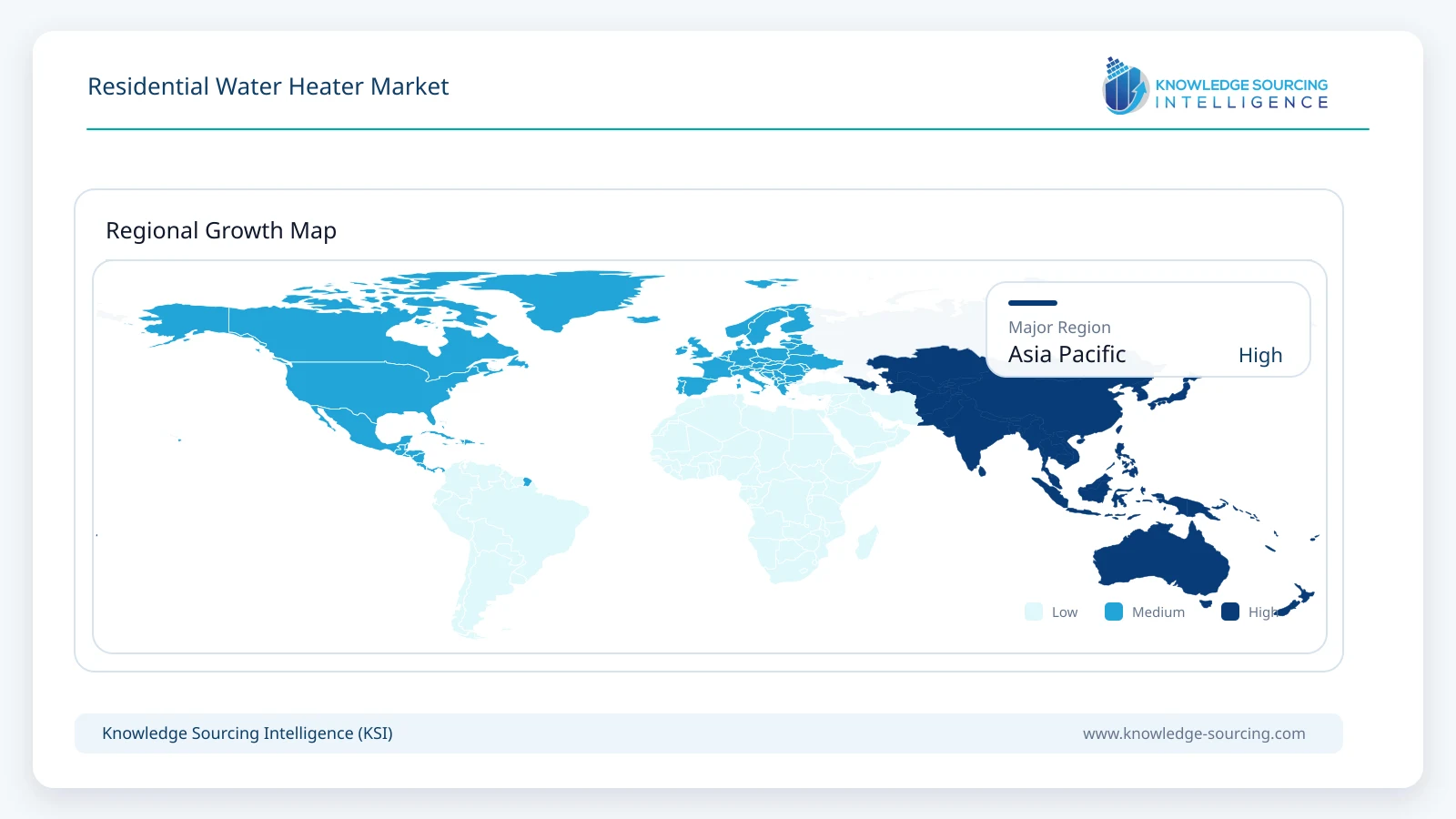
Asia Pacific is projected to reach approximately USD 17.3 billion by 2031, retaining the largest regional position. The region combines China's large installed appliance base, India's expanding household penetration, Japan's advanced gas and hybrid water-heating industry, and growing residential appliance ownership across Southeast Asia. Product preferences vary substantially: Japan has a strong installed base of high-efficiency gas and hybrid systems, India uses electric storage, instantaneous and solar products, while China remains a major market for electric and gas water heating despite softer housing conditions. North America provides a high-value replacement market, while Europe is being reshaped by electrification and heat-pump adoption.
Competitive Environment
The market is fragmented globally but concentrated within individual countries and distribution channels. A. O. Smith, Rheem, Rinnai, Ariston Group, Bosch Home Comfort, Noritz and Navien maintain broad product or geographic positions, while Haier, Midea and other Asian appliance manufacturers compete strongly in China and emerging markets. Specialist manufacturers including STIEBEL ELTRON, Bradford White and Vaillant Group hold strong positions in selected technologies or regions. Competition is shifting toward energy efficiency, connected controls, ease of installation, product reliability and installer relationships rather than basic heating capacity alone.
Technology strategy differs by manufacturer. Rheem and Navien have expanded heat-pump portfolios in North America, Rinnai and Noritz retain strong tankless and gas-water-heating positions while broadening electrified products, and Ariston combines electric storage, heat-pump and gas technologies across a large international footprint. A. O. Smith continues to compete across gas, electric, tankless and heat-pump water heaters and reported relatively flat North American residential industry volumes in 2025, underscoring that revenue growth in mature markets increasingly depends on price, mix and higher-efficiency products.
Recent Developments
September 2026: Navien's NXW700 dual-fuel hybrid heat-pump water heater won the 2026 Integrated Home Competition Grand Prize; commercial release is planned for early 2027.
September 2026: Navien received a 2026 FacilitiesNet Vision Award for its NWP500 heat-pump water heater, highlighting the growing commercial visibility of high-efficiency residential water heating.
February 2026: Rinnai showcased its next-generation residential water-heating portfolio at IBS 2026, emphasizing high-efficiency natural-gas, propane and electric solutions for smart homes.
February 2026: Noritz outlined FY2026 initiatives under its "V-Plan 26" medium-term management plan to expand sales of environmentally friendly, high-value-added water-heating products in Japan and leverage rising electrification demand, including heat-pump water heaters, in Australia and other overseas markets.
June 2025: Navien began shipping the NWP500 heat-pump water-heater series in the United States and Canada, with UEF ratings up to approximately 4.05 and integrated smart controls.
Residential Water Heater Market Scope:
| Report Metric | Details |
|---|---|
| Total Market Size in 2026 | USD 30.6 billion |
| Total Market Size in 2031 | USD 39.4 billion |
| Forecast Unit | Billion |
| Growth Rate | 5.2% |
| Study Period | 2021 to 2031 |
| Historical Data | 2021 to 2024 |
| Base Year | 2025 |
| Forecast Period | 2026 – 2031 |
| Segmentation | Type, Source, Application, Geography |
| Companies |
|
Market Segmentation
By Type
Tank Water Heater
Tankless Water Heater
Solar Water Heater
Hybrid Water Heater
Others
By Source
Electricity
Natural Gas
Solar Energy
Others
By Application
Bathing
Cleaning & Washing
By Geography
North America
USA
Canada
Mexico
South America
Brazil
Argentina
Others
Europe
Germany
France
United Kingdom
Spain
Italy
Others
Middle East and Africa
Saudi Arabia
UAE
South Africa
Others
Asia Pacific
China
India
Japan
South Korea
Indonesia
Thailand
Others
Table of Contents
1. EXECUTIVE SUMMARY
2. MARKET SNAPSHOT
2.1. Market Overview
2.2. Market Definition
2.3. Scope of the Study
2.4. Market Segmentation
3. BUSINESS LANDSCAPE
3.1. Market Drivers
3.1.1. Efficiency Regulation and Household Energy Costs Are Accelerating Product Replacement
3.1.2. Urbanization and Rising Appliance Penetration Support Growth Across Emerging Residential Markets
3.2. Market Restraint
3.2.1. High Upfront Cost and Installation Requirements Slow the Transition to Higher-Efficiency Systems
3.3. Market Opportunities
3.4. Porter's Five Forces Analysis
3.5. Industry Value Chain Analysis
3.6. Policies and Regulations
3.7. Strategic Recommendations
4. TECHNOLOGICAL OUTLOOK
4.1. Heat-Pump Water Heating
4.2. Condensing and Tankless Systems
4.3. Connected Controls and Demand Response
5. RESIDENTIAL WATER HEATER MARKET BY TYPE
5.1. Introduction
5.2. Tank Water Heater
5.3. Tankless Water Heater
5.4. Solar Water Heater
5.5. Hybrid Water Heater
5.6. Others
6. RESIDENTIAL WATER HEATER MARKET BY SOURCE
6.1. Introduction
6.2. Electricity
6.3. Natural Gas
6.4. Solar Energy
6.5. Others
7. RESIDENTIAL WATER HEATER MARKET BY APPLICATION
7.1. Introduction
7.2. Bathing
7.3. Cleaning & Washing
8. RESIDENTIAL WATER HEATER MARKET BY GEOGRAPHY
8.1. Introduction
8.2. North America
8.2.1. USA
8.2.2. Canada
8.2.3. Mexico
8.3. South America
8.3.1. Brazil
8.3.2. Argentina
8.3.3. Others
8.4. Europe
8.4.1. Germany
8.4.2. France
8.4.3. United Kingdom
8.4.4. Spain
8.4.5. Italy
8.4.6. Others
8.5. Middle East and Africa
8.5.1. Saudi Arabia
8.5.2. UAE
8.5.3. South Africa
8.5.4. Others
8.6. Asia Pacific
8.6.1. China
8.6.2. India
8.6.3. Japan
8.6.4. South Korea
8.6.5. Indonesia
8.6.6. Thailand
8.6.7. Others
9. COMPETITIVE ENVIRONMENT AND ANALYSIS
9.1. Major Players and Strategy Analysis
9.2. Market Share Analysis
9.3. Mergers, Acquisitions, Agreements and Collaborations
9.4. Competitive Dashboard
10. COMPANY PROFILES
10.1. A. O. Smith Corporation
10.2. Rheem Manufacturing Company
10.3. Rinnai Corporation
10.4. Ariston Group
10.5. Bosch Home Comfort
10.6. Noritz Corporation
10.7. Navien, Inc.
10.8. Haier Smart Home Co., Ltd.
10.9. Midea Group
10.10. STIEBEL ELTRON GmbH & Co. KG
10.11. Bradford White Corporation
10.12. Vaillant Group
10.13. Viessmann Climate Solutions
10.14. Panasonic Corporation
10.15. Havells India Limited
10.16. Bajaj Electricals Limited
11. APPENDIX
11.1. Currency
11.2. Assumptions
11.3. Base and Forecast Years Timeline
11.4. Key Benefits for Stakeholders
11.5. Research Methodology
11.6. Abbreviations
LIST OF FIGURES
LIST OF TABLES
Navigate
Trusted by the world's leading organizations











