
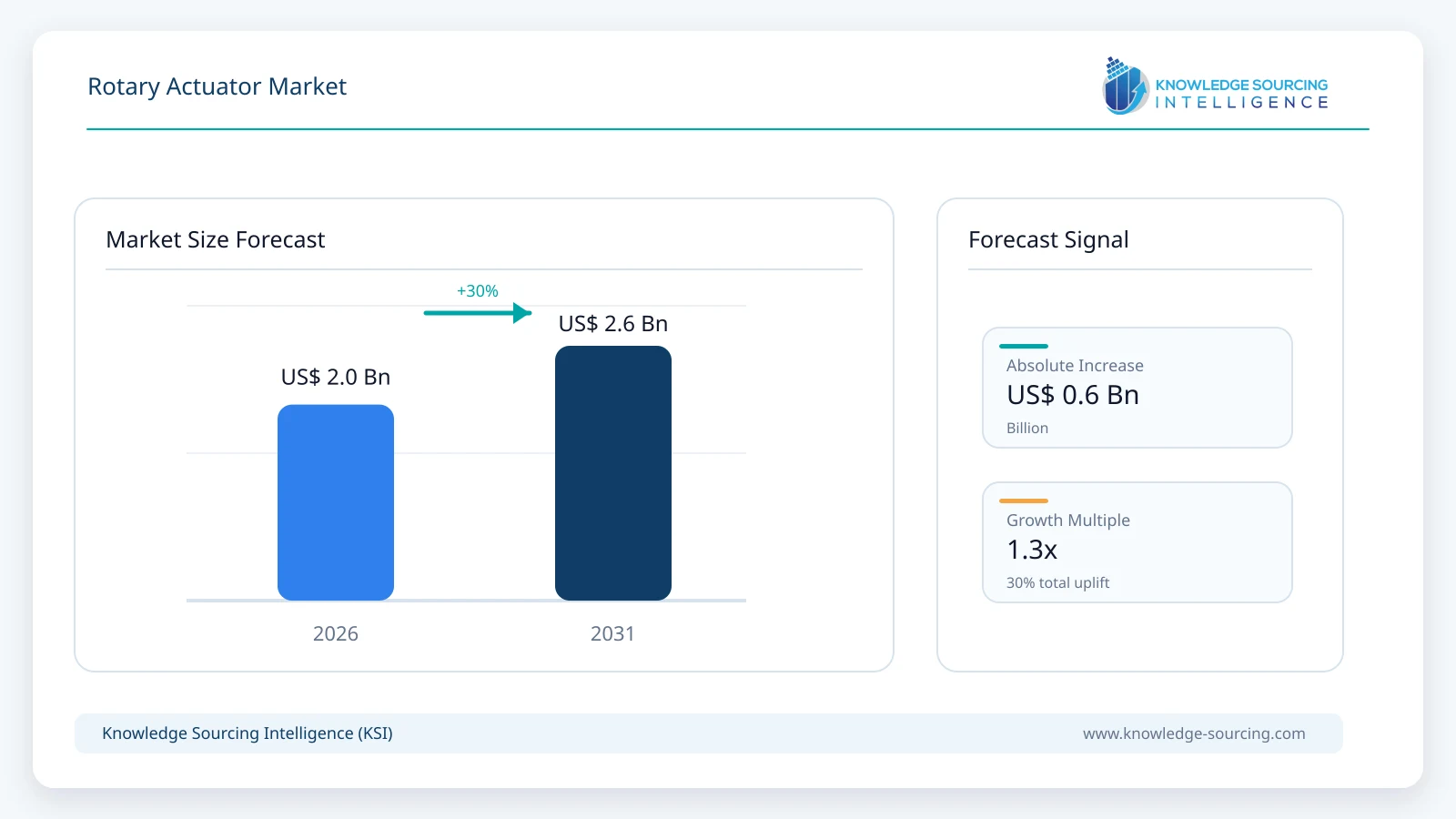
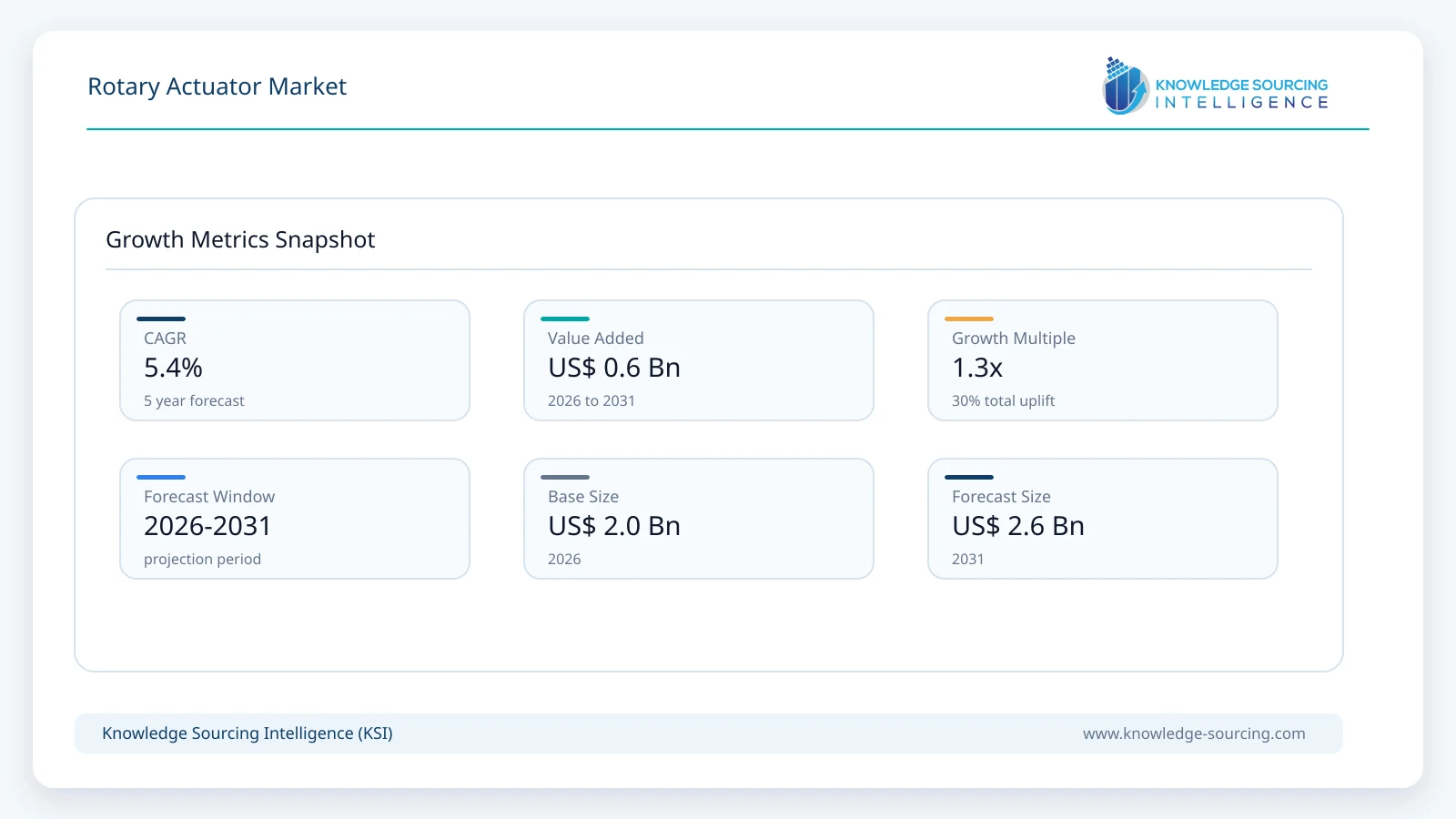
The global Rotary Actuator market is forecast to grow at a CAGR of 5.4%, reaching USD 2.6 billion in 2031 from USD 2.0 billion in 2026.
Highlights:
- 1Growing industrial automation is increasing demand for electric rotary actuators that provide accurate positioning, repeatable movement, and integration with digital motion-control systems.
- 2Manufacturers are adopting rotary actuators in robotics, automated material handling, packaging, and assembly operations to improve throughput and reduce manual intervention.
- 3Aerospace, defense, energy, and marine applications are supporting demand for reliable rotary motion systems designed for demanding operating conditions.
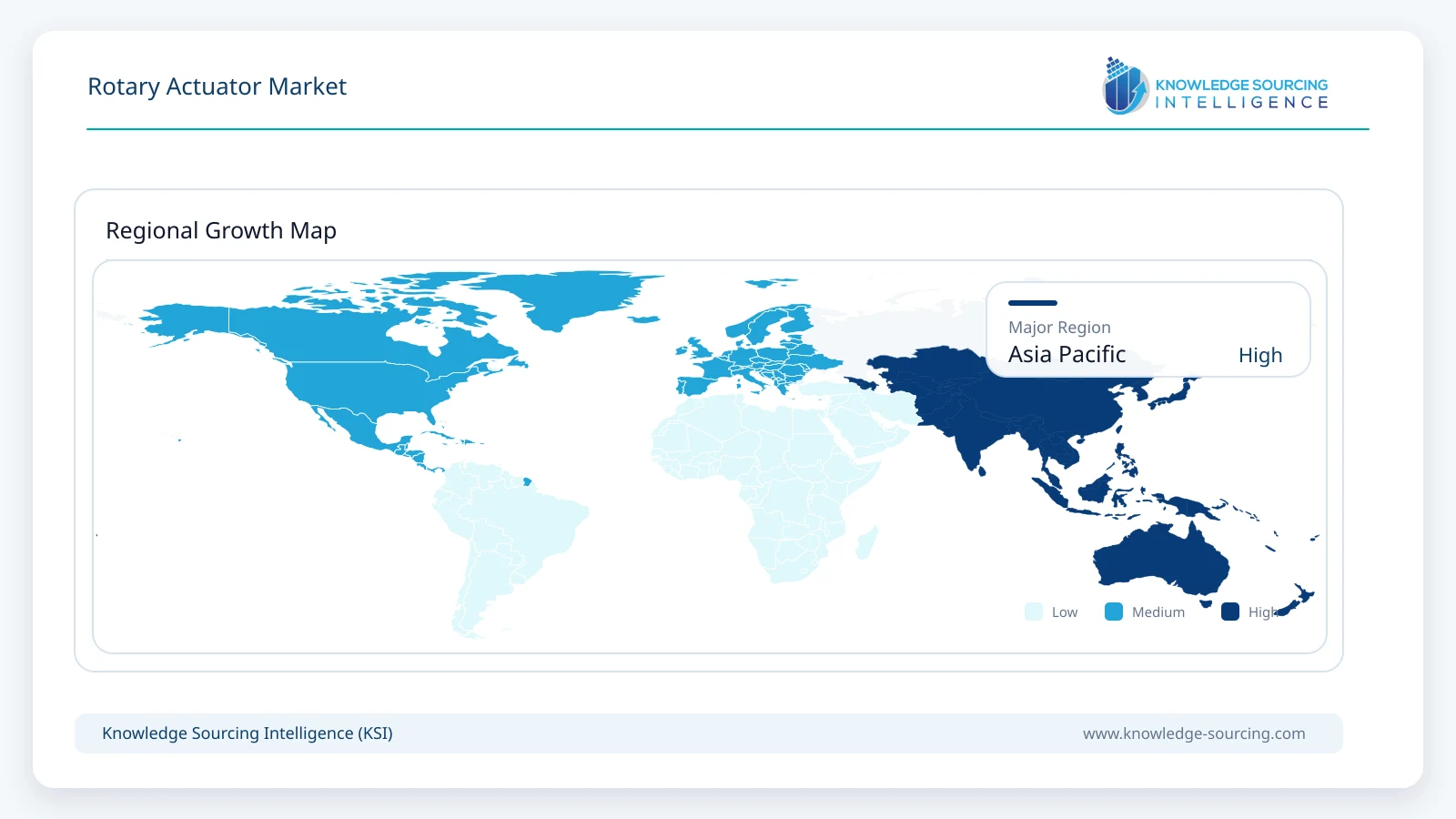
- 4Asia Pacific is emerging as a major demand center because of its industrial manufacturing base, expanding robotics installations, and large shipbuilding industry.
A rotary actuator is a mechanical device that converts an energy source into controlled rotational movement or torque. Depending on its design, it can produce continuous rotation or a limited angular movement. Rotary actuators are used to position robotic joints, operate industrial valves, rotate machine fixtures, control steering mechanisms, and move components in automated production systems. Common designs include electric, pneumatic, hydraulic, and manual actuators, with the appropriate configuration determined by the required torque, angular displacement, operating speed, precision, and environmental conditions.
The global rotary actuator market is supported by the increasing use of automation across manufacturing, logistics, energy, transportation, and process industries. As production systems become more flexible, manufacturers require motion-control components that can perform repeatable movements, accommodate changing production requirements, and communicate with programmable logic controllers and industrial networks. Electric rotary actuators are particularly relevant where accurate positioning, programmable motion profiles, and reduced dependence on compressed air or hydraulic infrastructure are important.
Demand also comes from applications outside conventional factory automation. Rotary actuators can operate valves and dampers in industrial facilities, adjust mechanisms in agricultural equipment, control selected aircraft subsystems, and support marine machinery. However, these applications have different performance requirements. An actuator intended for a high-cycle packaging machine may prioritize speed and repeatability, whereas an actuator used in an industrial valve may require high torque, environmental protection, and dependable operation over long service intervals.
The market's growth therefore depends on more than the number of actuators installed. Buyers also consider total cost of ownership, energy consumption, maintenance access, control-system compatibility, safety requirements, and the cost of integrating actuators into existing machinery. These factors are encouraging manufacturers to develop compact, connected, and application-specific motion-control solutions.
Rotary Actuator Market Overview & Scope
The rotary actuator market is segmented by type, application, end-user, and region. The following segmentation describes the principal product categories and demand areas covered in the market analysis.
Type: The market is segmented into manual rotary actuators, electric rotary actuators, fluid-powered rotary actuators, and other types. Fluid-powered products include pneumatic and hydraulic designs. Electric rotary actuators are positioned for applications requiring programmable positioning, repeatability, and integration with automated control systems.
Application: The market includes material handling equipment, robotics, farming equipment, steering systems, and other applications. Material handling and robotics are important demand areas because both depend on coordinated movement, accurate positioning, and repeatable machine cycles.
End-user: The market serves oil and gas, mining, aerospace and defense, marine, agriculture, manufacturing, logistics, and other industries. Demand varies according to operating loads, safety requirements, environmental exposure, maintenance practices, and the degree of automation in each industry.
Region: The market is divided into North America, South America, Europe, the Middle East and Africa, and Asia Pacific. Asia Pacific benefits from its industrial manufacturing and shipbuilding base, while North America and Europe offer opportunities through advanced automation, established engineering industries, and modernization of industrial equipment.
For market evaluation, rotary actuators should be distinguished from rotary motors, gearboxes, rotary encoders, and linear actuators. A rotary motor produces rotational motion, while a rotary actuator is generally designed to deliver controlled angular movement or torque as part of a mechanical system. Some products integrate a motor, gearing, encoder, and controller into a single unit. This integration can reduce installation complexity, although the exact configuration and performance depend on the product.
The market estimate of USD 2.0 billion in 2026 and forecast of USD 2.6 billion in 2031 represent the supplied report assumptions. The implied growth rate is approximately 5.4% annually, subject to rounding. These values should be interpreted as market estimates rather than government-reported statistics, since government datasets generally track industrial production, energy use, manufacturing, or robotics rather than the complete global rotary actuator market.
Top Trends Shaping the Rotary Actuator Market
Rising Demand for Automation and Robotics
Industrial automation is a central trend shaping the rotary actuator market. Manufacturers in automotive, electronics, food processing, pharmaceuticals, packaging, and general machinery are introducing automated equipment to improve production consistency, increase throughput, and reduce repetitive manual tasks. Rotary actuators provide the controlled angular motion required by robotic joints, rotary indexing tables, pick-and-place systems, inspection equipment, grippers, and automated assembly fixtures.
Robotics adoption provides a measurable indicator of the wider industrial automation environment. According to the International Federation of Robotics (IFR), its World Robotics 2025 report recorded 542,000 industrial robot installations worldwide in 2024. This was more than twice the annual installation volume recorded a decade earlier. Asia accounted for 74% of new installations, Europe for 16%, and the Americas for 9%.
These figures do not measure rotary actuator sales directly. They nevertheless demonstrate the scale of the industrial equipment base in which actuators may be used. Each robot's configuration determines its actual actuator requirements, and not every robot joint uses a standalone rotary actuator. Integrated servo motors and geared drive systems are common alternatives. The opportunity for actuator manufacturers is therefore strongest when products satisfy specific requirements for torque, accuracy, size, duty cycle, and controller compatibility.
Another important development is the shift toward flexible manufacturing. Rather than designing production lines for a single product, manufacturers increasingly seek equipment that can accommodate different product dimensions, production batches, and process sequences. Programmable rotary actuators can support this flexibility by storing position settings and executing repeatable movements. Hollow-shaft designs may also simplify machine construction by allowing cables, tubes, or other components to pass through the center of a rotating assembly.
Growth in Aerospace and Defense Applications
Aerospace and defense applications create demand for rotary actuators that can meet stringent reliability, weight, packaging, and environmental requirements. Depending on the system design, actuators may be used in selected flight-control mechanisms, antenna positioning, access panels, unmanned aircraft equipment, ground-support systems, and other aerospace or defense mechanisms. These applications may require specialized qualification, redundancy, position feedback, and resistance to vibration or temperature variation.
Commercial aerospace, defense modernization, and unmanned-system development can expand the addressable market for specialized motion-control components. However, procurement cycles are often long, and aerospace equipment must meet the relevant certification and qualification requirements. Manufacturers cannot assume that an industrial actuator can be transferred directly into an aircraft or defense platform without additional engineering and validation.
Electric actuation is attracting interest in applications where precise control and reduced dependence on centralized hydraulic infrastructure offer system-level advantages. Nevertheless, hydraulic actuation remains relevant where high force density and established system architectures are important. The selection between electric, hydraulic, and pneumatic designs depends on the specific application rather than a universal preference for one technology.
Increasing Integration of Smart Motion-Control Systems
Actuator selection increasingly involves evaluating the complete motion-control system instead of the mechanical component alone. Encoders, integrated drivers, network interfaces, condition-monitoring functions, and programmable controllers can help equipment builders improve commissioning, diagnose faults, and coordinate multiple axes. Closed-loop designs can compare commanded motion with measured position and respond when the system deviates from its intended operating condition.
Digital connectivity is particularly valuable in high-cycle production environments. Position feedback can help identify missed steps, unexpected movement, or changes in machine behavior. When combined with suitable monitoring software, operating data may support condition-based maintenance. These capabilities do not eliminate mechanical wear or guarantee predictive-maintenance accuracy, but they can provide additional information for maintenance planning.
Compact actuator assemblies are also gaining relevance as manufacturers seek to reduce equipment footprint. Integrated motors, gearheads, encoders, and controllers can simplify mechanical design and reduce the number of separate components. Hollow rotary actuators are especially useful in applications requiring cable routing through a rotating table or compact machine assembly.
Energy Efficiency and Reduced Maintenance Requirements
Energy efficiency is an important consideration in industrial equipment procurement. Electric rotary actuators can provide programmable motion, controlled acceleration, and position holding, depending on the motor and drive architecture. In suitable applications, these features can reduce the need for continuously operating pneumatic systems or complex hydraulic infrastructure. Actual savings depend on load, operating frequency, duty cycle, system losses, and the energy consumption of the wider machine.
Maintenance considerations also influence technology selection. Pneumatic systems may require air preparation and leak management, while hydraulic systems can require fluid management, seals, and attention to contamination. Electric actuators avoid hydraulic fluid in the actuation mechanism but still require appropriate inspection of bearings, gears, couplings, electrical connections, and feedback components. Total lifecycle cost is therefore a more useful comparison than purchase price alone.
Expanding Shipbuilding and Marine Equipment Demand
Marine equipment manufacturers use rotary actuation in selected valve-control, steering, machinery, and positioning systems. Shipbuilding activity can therefore provide a supporting demand indicator, although the effect on the rotary actuator market depends on the equipment installed on each vessel and the extent of domestic component sourcing.
China's shipbuilding industry provides a significant example of this industrial demand environment. According to a February 2026 report published on the Chinese government's official portal, China's shipbuilding output reached 53.69 million deadweight tonnes in 2025, up 11.4% year over year and representing 56.1% of global output. The report also recorded 107.82 million deadweight tonnes in new orders and 274.42 million deadweight tonnes in orders on hand at the end of 2025.
These figures illustrate the scale of China's shipbuilding sector, rather than directly measuring actuator demand. For actuator suppliers, opportunities arise through marine-equipment manufacturers, shipyard supply chains, industrial valve suppliers, and system integrators. Marine products may need corrosion resistance, vibration tolerance, environmental sealing, and compliance with the requirements of the relevant vessel or equipment classification.
Rotary Actuator Market Growth Drivers
Drivers
Increasing adoption across end-user industries: The expansion of automated manufacturing, industrial processing, energy production, and logistics is increasing the need for controlled mechanical movement. Rotary actuators can improve repeatability in production equipment and provide controlled operation in systems where manual movement would be inconsistent or inefficient. Their adoption is strongest when they offer a clear operational benefit, such as better positioning, improved cycle time, simpler integration, or lower lifecycle cost.
Oil and gas operations provide another potential demand area. Rotary actuators can be integrated into industrial valve systems and other mechanisms that require controlled rotation. The choice of actuator depends on valve torque, pressure conditions, process-fluid characteristics, required operating speed, hazardous-area classification, and safety requirements. In critical installations, the actuator may also need fail-safe functionality or a defined response to power loss.
Recent official U.S. energy data illustrates the scale of this industrial environment. The U.S. Energy Information Administration (EIA) reported on March 31, 2026, that U.S. crude oil production averaged a record 13.6 million barrels per day in 2025, an increase of approximately 3% from 2024. The EIA also reported that production gains continued despite fewer active rigs and wells drilled, reflecting improvements in operational efficiency.
High production levels can support investment in extraction, processing, pipeline, and industrial infrastructure. However, crude oil production should be treated as an indirect demand indicator, not as proof of increased rotary actuator purchases. Investment budgets, project approvals, equipment specifications, and the share of electrically or fluid-powered actuation in individual installations determine the actual market impact.
Increasing use of robotic farming: Agricultural automation offers opportunities for compact, reliable actuation systems. Modern agricultural equipment can incorporate controlled rotary movement in steering mechanisms, implement positioning, seed-handling equipment, robotic grippers, and selected harvesting systems. As equipment manufacturers introduce more automated functions, they need components capable of operating under vibration, dust, moisture, temperature changes, and repetitive mechanical loads.
Electric actuation can support programmable adjustments and integration with electronic control systems. Yet agricultural equipment presents distinctive design challenges. Outdoor exposure, shock loads, limited maintenance access, and seasonal operating patterns must be considered when choosing a product. Sealing, connector protection, corrosion resistance, and ease of replacement can be as important as angular accuracy.
Robotic farming is not limited to autonomous vehicles. It also includes automated implements, crop-handling equipment, controlled dispensing mechanisms, and machines designed for repetitive agricultural tasks. The market opportunity depends on the extent to which manufacturers adopt rotary actuation instead of alternative motor, hydraulic, or mechanical arrangements.
Expansion of shipping activity: Growing shipbuilding output can support demand for industrial actuators used in marine machinery, control valves, positioning systems, and selected steering applications. Rotary actuators are not necessarily installed in every subsystem, so the strongest opportunities are found in applications where a defined angular movement or rotary torque is required.
China's 2025 shipbuilding output and order backlog, reported by its government in February 2026, indicate substantial activity in the vessel-construction sector. This can create opportunities for suppliers of marine-grade motion-control equipment, especially where new vessel designs incorporate automated machinery and remotely operated systems. Actual demand will depend on ship type, equipment configuration, procurement arrangements, and applicable marine standards.
Replacement of legacy motion-control equipment: Industrial plants often operate machinery that was installed before modern digital controls became common. During upgrades, equipment owners may replace pneumatic or hydraulic components with electric alternatives when doing so improves controllability, reduces system complexity, or supports new automation functions. Retrofit opportunities are especially relevant when manufacturers want to modernize selected machine functions without replacing an entire production line.
Replacement decisions must account for torque, speed, mounting dimensions, duty cycle, electrical supply, controller compatibility, safety functions, and environmental conditions. An electric actuator is not automatically a drop-in replacement for a fluid-powered unit. Engineering validation and system-level testing remain necessary.
Market Restraints
High initial investment and integration costs: Precision rotary actuators may require dedicated controllers, feedback devices, power electronics, and engineering work. The total cost can become significant when several axes must operate together or when existing machinery requires extensive modification. Small manufacturers may delay automation investment when the expected productivity gains do not justify the initial expense.
Performance limitations under demanding loads: Rotary actuators differ substantially in torque capacity, angular range, speed, positioning accuracy, and thermal performance. Applications involving shock loads, high inertia, frequent reversals, or continuous operation may require larger or more expensive products. Incorrect sizing can result in overheating, reduced accuracy, premature wear, or system downtime.
Competition from alternative technologies: Hydraulic actuators can provide high force and torque density, while pneumatic actuators can offer relatively simple and economical movement for basic industrial tasks. Servo motors, gearmotors, and integrated robotic joints can also perform functions that might otherwise use a standalone rotary actuator. Buyers select among these options according to system requirements, not solely on actuator category.
Environmental and reliability requirements: Dust, moisture, chemicals, vibration, extreme temperatures, and corrosive atmospheres can increase the cost of designing and maintaining an actuator system. Applications in marine, mining, food processing, and energy infrastructure may require enhanced protection, specialized materials, or additional testing. These requirements can lengthen qualification cycles and restrict the number of suitable suppliers.
Rotary Actuator Market Segment Analysis
Electric Rotary Actuators
The electric rotary actuator segment is positioned to benefit from the expansion of precision automation and digitally controlled machinery. Electric systems can be configured with stepper motors, servo motors, gearheads, encoders, and electronic drivers to achieve different levels of torque, positioning accuracy, and dynamic response. Integrated products can simplify machine construction by combining several motion-control elements in one assembly.
One important use case is rotary indexing. In an indexing system, a fixture, table, or workpiece rotates to predefined positions for assembly, inspection, machining, dispensing, or packaging. The actuator must deliver the required torque while maintaining positioning repeatability and controlling vibration during acceleration and deceleration. Hollow-shaft designs may also simplify the routing of electrical cables, pneumatic tubes, or other services through the center of a rotating table.
Electric actuators are also relevant to robotic systems that require coordinated motion across multiple axes. Integrated feedback can help controllers monitor the position of the motor or output mechanism, depending on sensor placement and product design. This is important because motor-shaft position does not always represent the exact position of the final mechanical output, particularly where gear backlash, structural compliance, or mechanical wear is present.
Industrial networking is another factor supporting the segment. Compatibility with common automation networks can simplify integration into larger production systems. However, network support varies by product, and manufacturers must verify the required protocols, control architecture, and safety functions before purchasing equipment.
Despite these advantages, electric rotary actuators are not appropriate for every application. High-load systems may require specialized gearing or alternative actuation technologies. Their performance also depends on the selected motor, drive, power supply, thermal design, and mechanical transmission. Consequently, market growth will depend on manufacturers offering application-specific solutions rather than relying on electrification alone.
Material Handling Equipment
Material handling is an important application segment because industrial and logistics operations increasingly use automated equipment to move, position, orient, sort, and transfer products. Rotary actuators can support the angular movements required by diverters, robotic grippers, transfer units, palletizing equipment, indexing tables, and selected conveyor mechanisms.
The growth of industrial robotics provides supporting evidence for the wider automation opportunity. The IFR's 2025 industrial robotics release reported 542,000 new robot installations globally in 2024 and an operational stock of approximately 4.664 million industrial robots. These statistics show that automated equipment is an established part of modern manufacturing, although the share of installed robots using standalone rotary actuators cannot be derived from the figures.
Material handling applications place considerable emphasis on cycle time, repeatability, load capacity, and uptime. A rotary actuator may need to execute thousands of movements per shift while maintaining consistent positioning. In distribution centers and automated warehouses, it may operate as part of a broader system that includes conveyors, sensors, programmable controllers, robotic arms, and warehouse-management software.
Demand is also influenced by the need for production flexibility. Manufacturers increasingly handle multiple product sizes and packaging formats on the same line. Programmable motion can reduce the mechanical adjustments required when changing between products, provided the equipment has been designed to support such changes.
However, rotary actuators are only one component of a material handling system. Their performance must be assessed alongside the gripper, gearbox, mounting structure, control software, sensors, and safety equipment. Reliability depends on the complete assembly and its operating conditions.
Rotary Actuator Market Regional Analysis
Asia Pacific
Asia Pacific is positioned as a major regional market because of its extensive manufacturing base, electronics production, automotive supply chains, industrial equipment sector, and growing use of robotics. China, Japan, South Korea, and India have different industrial structures, but all offer opportunities for motion-control equipment in selected manufacturing and infrastructure applications.
China is particularly important to the regional outlook. According to the National Bureau of Statistics of China, the country's industrial statistics for 2025 recorded output of 773,000 industrial robots, an increase of 28% year over year. This is a national production figure, not a count of rotary actuators or a direct measure of robot installations. Nevertheless, it indicates the scale and growth of China's industrial robotics manufacturing ecosystem.
The region's shipbuilding industry also supports the wider industrial demand environment. China's official government reporting recorded 53.69 million deadweight tonnes of shipbuilding output in 2025. Shipyards and marine-equipment suppliers can create opportunities for industrial actuators used in qualifying valve, positioning, and machinery applications.
Japan and South Korea offer established automation, automotive, shipbuilding, and precision-engineering industries. India presents opportunities through manufacturing expansion, infrastructure development, industrial modernization, and the adoption of automated equipment. Across the region, the pace of actuator demand will depend on capital expenditure, local component supply, automation intensity, and the specifications selected by equipment manufacturers.
North America
North America benefits from established aerospace, automotive, energy, food processing, warehousing, and industrial automation sectors. Manufacturers are investing in equipment that can improve production consistency, support labor-intensive operations, and integrate with existing digital infrastructure. Rotary actuators can serve these applications where controlled angular movement is required.
The United States has a substantial energy-production base. The EIA reported that average U.S. crude oil production reached 13.6 million barrels per day in 2025, setting a new annual record. This activity can support demand for industrial equipment used in energy extraction and processing, although actuator procurement depends on individual projects and engineering specifications.
North American manufacturers also have opportunities in factory modernization. Existing plants may upgrade selected machines with programmable actuators, electronic feedback, and network-compatible controllers rather than replace entire production lines. The business case depends on the expected improvements in uptime, throughput, maintenance, and product quality.
Europe
Europe has a mature industrial automation ecosystem spanning automotive manufacturing, machinery, packaging, pharmaceuticals, aerospace, and industrial processing. Demand for rotary actuators is supported by precision-engineering requirements, equipment modernization, and the integration of robotics into production operations.
The region's established robotics base provides useful context. The IFR's World Robotics 2025 report attributed 16% of global new industrial robot installations in 2024 to Europe. Although this share does not directly represent rotary actuator demand, it highlights the importance of the region in industrial automation.
European buyers often evaluate actuator products against requirements for energy efficiency, machinery safety, serviceability, and integration with established automation architectures. Suppliers that offer technical documentation, lifecycle support, and compatible control interfaces may be better positioned to serve these industrial customers.
South America
South America's rotary actuator market is supported by mining, agriculture, food processing, energy infrastructure, and industrial equipment demand. Mining operations may require actuators in selected process-control and material handling applications, while agricultural equipment manufacturers can use rotary motion systems in automated machinery and implement positioning.
Market development may be uneven because capital expenditure, import costs, industrial investment, and access to technical service vary between countries and sectors. Suppliers can address these challenges through distributor networks, locally available maintenance support, and products that are compatible with existing machinery.
Middle East and Africa
The Middle East and Africa present opportunities across oil and gas, water infrastructure, mining, industrial processing, marine facilities, and infrastructure projects. Rotary actuators can be used in qualifying valve systems, industrial machinery, and automated handling equipment where dependable movement and environmental protection are essential.
In energy and process industries, actuator selection is influenced by torque requirements, operating pressure, temperature, hazardous-area classification, corrosion resistance, and the required response during power loss. Procurement can also depend on project financing, maintenance infrastructure, technical qualification, and the availability of replacement components.
Across both regions, long-term opportunities are linked to industrial diversification and infrastructure investment. However, these opportunities should not be interpreted as uniform growth across all countries or actuator categories. Local project pipelines and application-specific equipment requirements remain important determinants of demand.
Rotary Actuator Market Key Developments
The following developments are based on official company announcements published in 2026. They illustrate advances in precision motion control, compact drive technology, and industrial robotics that are relevant to the rotary actuator market. They are not all direct rotary actuator launches.
October 6, 2026: Multi-axis motion-control expansion. Oriental Motor announced new two-axis and four-axis EtherCAT-compatible CVD Series stepper motor drivers, expanding configuration options for coordinated motion-control systems. The announcement is relevant to automation equipment requiring synchronized movement across multiple axes.
September 17, 2026: Compact motors with electromagnetic brakes. Oriental Motor expanded its ?STEP AZ Series with 28 mm frame-size motors equipped with electromagnetic brakes. The development addresses compact motion applications where controlled stopping and holding are important design considerations.
September 2, 2026: Industrial robotics training. Oriental Motor introduced an industrial training robot designed to support hands-on robotics training and simulation. The announcement reflects continued investment in robotics education and the skills needed to deploy automated motion-control systems.
August 24, 2026: Mobile robot control. Oriental Motor introduced the MVC01 mobile robot controller for automated guided vehicles and autonomous mobile robots. The product supports the development of mobile automation systems used in industrial transport and material handling.
August 5, 2026: Miniature motors with position feedback. Oriental Motor expanded its PKP Series with 13 mm frame-size stepper motors featuring integrated encoders. The company announced standard and harmonic-geared versions, supporting compact precision-positioning applications, including robotic hands and equipment for semiconductor transfer.
January 7, 2026: Stainless-steel brushless motor for washdown environments. Oriental Motor introduced its first stainless-steel brushless DC motor compatible with BLE2 Series drivers. The company specified IP67/IP69K protection and a corrosion-resistant construction for demanding washdown applications. This is a motor development, rather than a rotary actuator launch.
These announcements demonstrate continuing innovation across the motion-control ecosystem. They should be interpreted as evidence of relevant product development, not proof of a specific increase in rotary actuator sales. A direct rotary actuator launch should be included in a separate product-development claim only when the manufacturer's announcement explicitly identifies the product as a rotary actuator.
Rotary Actuator Market Competitive Outlook
Competition in the rotary actuator market is influenced by product performance, engineering capability, application coverage, distribution, and lifecycle support. Manufacturers compete across several dimensions, including torque density, positioning accuracy, operating speed, mechanical stiffness, repeatability, environmental protection, and ease of integration with automation controllers.
Electric-actuator suppliers may differentiate their offerings through integrated motors, compact gearheads, hollow-shaft designs, encoder feedback, and industrial-network compatibility. Fluid-powered actuator suppliers can compete through high torque, robust mechanical construction, and suitability for applications that already use pneumatic or hydraulic infrastructure. The most appropriate technology depends on the intended application and the cost of the complete system.
Product reliability is particularly important for industrial customers. Actuator failure can interrupt a production line, affect product quality, or require unplanned maintenance. Buyers therefore consider expected service life, spare-parts availability, technical support, commissioning requirements, and compatibility with existing machine components. In highly regulated applications, qualification documentation and traceability can also affect purchasing decisions.
Another competitive factor is customization. Equipment manufacturers may require particular mounting dimensions, shaft configurations, torque ranges, communication interfaces, or environmental ratings. Suppliers that can meet these requirements while maintaining consistent quality and dependable delivery may gain an advantage in specialized applications.
As automation becomes more connected, the ability to supply a complete motion-control solution may become increasingly important. Nevertheless, integration should not be treated as a substitute for mechanical performance. A digitally connected actuator must still meet the required load, speed, positioning, thermal, and safety specifications.
Rotary Actuator Market Outlook
The rotary actuator market is expected to benefit from the continued adoption of industrial automation, robotics, programmable machinery, and digitally controlled equipment. Material handling and precision manufacturing offer opportunities for electric rotary actuators, while energy, marine, and heavy industrial applications continue to require products engineered for demanding operating conditions.
Official industrial statistics support the broader demand context. Global industrial robot installations reached 542,000 units in 2024, according to the IFR's 2025 report. China's industrial robot production increased by 28% in 2025, according to its National Bureau of Statistics. China's shipbuilding output also increased during 2025, while U.S. crude oil production reached a record annual average of 13.6 million barrels per day. These indicators demonstrate activity across industries that may use actuation systems, but they do not independently validate the rotary actuator market's estimated value or forecast growth rate.
Over the forecast period, manufacturers are likely to focus on compact designs, repeatable positioning, improved feedback, simplified installation, and better compatibility with industrial control systems. Demand will also depend on total lifecycle cost, equipment investment, replacement cycles, and competition from alternative motion technologies.
Based on the supplied forecast, the global rotary actuator market is projected to increase from USD 2.0 billion in 2026 to USD 2.6 billion in 2031, at a CAGR of 5.4%. The outlook reflects the report's assumptions about industrial automation and end-user demand. Actual performance will depend on the pace of capital investment, technology adoption, product pricing, and the extent to which rotary actuators are selected over alternative solutions.
Rotary Actuator Market Scope
| Report Metric | Details |
|---|---|
| Total Market Size in 2026 | USD 2.0 billion |
| Total Market Size in 2031 | USD 2.6 billion |
| Forecast Unit | Billion |
| Growth Rate | 5.4% |
| Study Period | 2021 to 2031 |
| Historical Data | 2021 to 2024 |
| Base Year | 2025 |
| Forecast Period | 2026 – 2031 |
| Segmentation | Type, Application, End-User, Geography |
| Companies |
|
| Customization Scope | 15% Free Customization included with purchase — Request Custom Breakdown → |
| Sample & Data Access | PDF Sample, Excel Databook & Analyst Briefing — Download Free Sample → |
Market Segmentation
By Type
Manual Rotary Actuator
Electric Rotary Actuator
Fluid Powered Rotary Actuator
Others
By Application
Material Handling Equipment
Robotics
Farming Equipment
Steering System
Others
By End-user
Oil & Gas
Mining
Aerospace & Defense
Marine
Agriculture
Others
By Geography
North America
USA
Canada
Mexico
South America
Brazil
Argentina
Others
Europe
Germany
France
United Kingdom
Spain
Others
Middle East and Africa
Saudi Arabia
UAE
Israel
Others
Asia Pacific
China
Japan
India
South Korea
Indonesia
Taiwan
Others
Table of Contents
1. EXECUTIVE SUMMARY 
2. MARKET SNAPSHOT
2.1. Market Overview
2.2. Market Definition
2.3. Scope of the Study
2.4. Market Segmentation
3. BUSINESS LANDSCAPE 
3.1. Market Drivers
3.2. Market Restraints
3.3. Market Opportunities
3.4. Porter’s Five Forces Analysis
3.5. Industry Value Chain Analysis
3.6. Policies and Regulations
3.7. Strategic Recommendations
4. TECHNOLOGICAL ADVANCEMENTS
5. ROTARY ACTUATOR MARKET BY TYPE
5.1. Introduction
5.2. Manual Rotary Actuator
5.3. Electric Rotary Actuator
5.4. Fluid Powered Rotary Actuator
5.5. Others
6. ROTARY ACTUATOR MARKET BY APPLICATION
6.1. Introduction
6.2. Material Handling Equipment
6.3. Robotics
6.4. Farming Equipment
6.5. Steering System
6.6. Others
7. ROTARY ACTUATOR MARKET BY END-USER
7.1. Introduction
7.2. Oil & Gas
7.3. Mining
7.4. Aerospace & Defense
7.5. Marine
7.6. Agriculture
7.7. Others
8. ROTARY ACTUATOR MARKET BY GEOGRAPHY
8.1. Introduction
8.2. North America
8.2.1. By Type
8.2.2. By Application
8.2.3. By End-User
8.2.4. By Country
8.2.4.1. USA
8.2.4.2. Canada
8.2.4.3. Mexico
8.3. South America
8.3.1. By Type
8.3.2. By Application
8.3.3. By End-User
8.3.4. By Country
8.3.4.1. Brazil
8.3.4.2. Argentina
8.3.4.3. Others
8.4. Europe
8.4.1. By Type
8.4.2. By Application
8.4.3. By End-User
8.4.4. By Country
8.4.4.1. United Kingdom
8.4.4.2. Germany
8.4.4.3. France
8.4.4.4. Spain
8.4.4.5. Others
8.5. Middle East and Africa
8.5.1. By Type
8.5.2. By Application
8.5.3. By End-User
8.5.4. By Country
8.5.4.1. Saudi Arabia
8.5.4.2. UAE
8.5.4.3. Others
8.6. Asia Pacific
8.6.1. By Type
8.6.2. By Application
8.6.3. By End-User
8.6.4. By Country
8.6.4.1. China
8.6.4.2. Japan
8.6.4.3. India
8.6.4.4. South Korea
8.6.4.5. Taiwan
8.6.4.6. Others
9. COMPETITIVE ENVIRONMENT AND ANALYSIS
9.1. Major Players and Strategy Analysis
9.2. Market Share Analysis
9.3. Mergers, Acquisitions, Agreements, and Collaborations
9.4. Competitive Dashboard
10. COMPANY PROFILES
10.1. AMETEK.Inc.
10.2. Eckart GmbH
10.3. Electromech Technologies
10.4. Emerson Electric Co
10.5. HKS Dreh-Antriebe GmbH
10.6. Rotomation Inc.
10.7. SMC Corporation
10.8. The Kerry Company Inc
10.9. Moog Inc.
10.10. Parker Hannifin Corp.
10.11. ABB
10.12. ITT Inc
10.13. Oriental Motor
10.14. Kongsberg Automotive
11. APPENDIX
11.1. Currency
11.2. Assumptions
11.3. Base and Forecast Years Timeline
11.4. Key benefits for the stakeholders
11.5. Research Methodology
11.6. Abbreviations





Frequently asked questions
What is the projected market size of the Rotary Actuator Market by 2031?
The Rotary Actuator Market is forecast to reach USD 2.6 billion by 2031.
What is the forecasted CAGR for the Rotary Actuator Market?
The Rotary Actuator Market is forecast to grow at a CAGR of 5.4% (2026-2031).
Which rotary actuator type segment is growing fastest?
Electric rotary actuators are predicted to be the fastest-growing market share.
Which application segment holds significant market share?
Material handling equipment segment is expected to have significant market share.
Which region is rapidly driving rotary actuator demand?
Asia Pacific is rapidly driving demand through industrial manufacturing and shipbuilding.
What are the primary growth drivers for rotary actuators?
Automation, precise motion control, and robotics integration are key drivers.
Cite this report
Knowledge Sourcing Intelligence. (Oct 2026). Rotary Actuator Market - Strategic Insights and Forecasts (2026-2031). https://www.knowledge-sourcing.com/report/rotary-actuator-market