
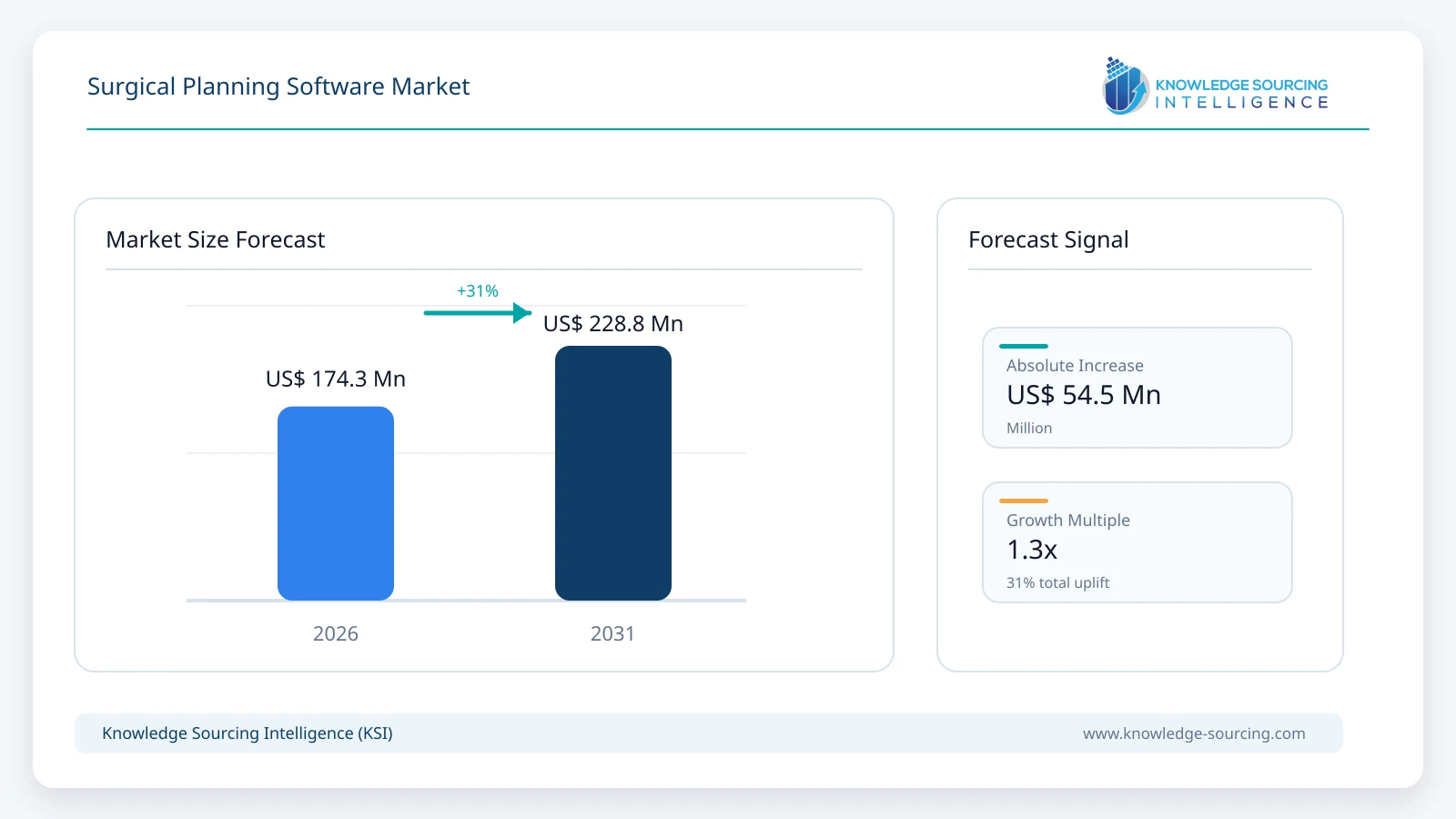
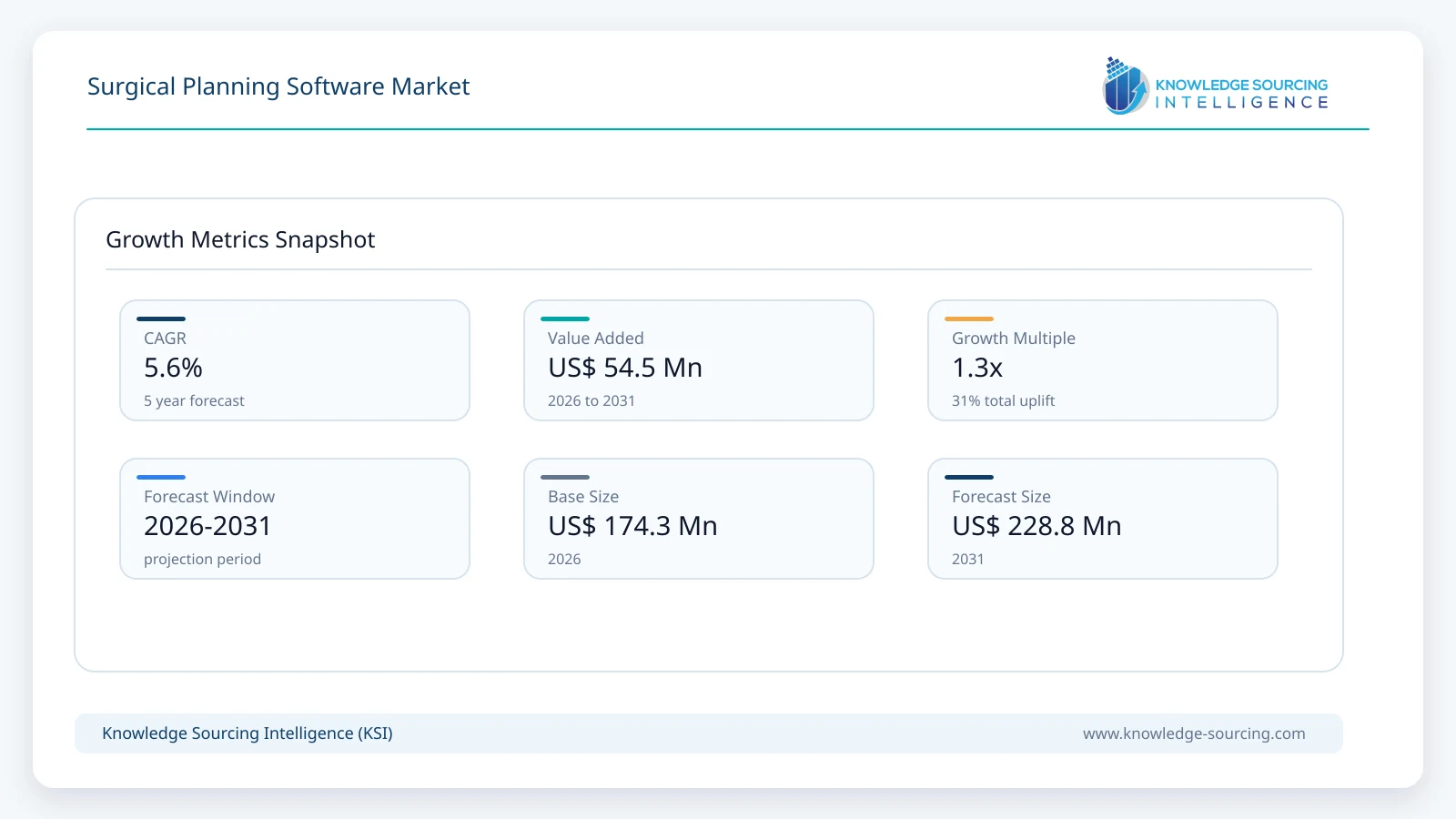
The Surgical Planning Software Market is forecast to grow at a CAGR of 5.6%, reaching USD 228.8 million in 2031 from USD 174.3 million in 2026.
Highlights:
- 1Orthopedic applications remain commercially importantJoint replacement, trauma, deformity correction, and revision procedures create direct demand for templating, implant positioning, alignment assessment, and patient-specific planning.
- 2Cloud deployment is gaining commercial relevanceBrowser-based planning can reduce local installation requirements and support distributed clinical workflows, although data governance remains a major procurement consideration.
- 33D planning is expanding beyond orthopedicsCardiovascular, neurosurgical, cranio-maxillofacial, oncology, and other complex procedures are creating additional applications for anatomical modeling and simulation.
- 4AI is being embedded into workflow-intensive tasksAutomated landmark detection, segmentation, measurements, and implant selection are becoming important differentiation points, particularly in orthopedic applications.
- 5Regulation is becoming more consequentialFDA software guidance and EU medical-device requirements increasingly influence development, validation, cybersecurity, clinical evidence, and commercialization decisions.
- 6Competition is moving toward ecosystem integrationVendors increasingly connect planning with implants, robotics, imaging, navigation, mixed reality, and postoperative analytics rather than selling planning as an isolated application.
The Surgical Planning Software Market comprises software platforms used to convert patient-specific clinical and imaging data into structured surgical plans before, during, or after operative procedures. Depending on the application, these systems can support anatomical visualization, implant templating, surgical simulation, measurement, instrument positioning, patient-specific guide design, postoperative comparison, and documentation. The market includes dedicated planning applications as well as software integrated with imaging, navigation, robotics, implant, and hospital information systems.
Commercial demand is closely connected to the increasing complexity of surgical procedures and the need to make decisions before a patient enters the operating room. Surgical teams increasingly require more than conventional two-dimensional radiographs when anatomy is distorted by trauma, deformity, revision surgery, tumors, or complex implant requirements. Planning software converts CT, MRI, X-ray, CBCT, and other imaging information into measurements and three-dimensional representations that can support procedure-specific decisions.
Orthopedic surgery represents an important commercial application because planning software can be directly linked with implant selection, component positioning, alignment assessment, robotic surgery, and patient-specific instrumentation. Stryker, for example, connects its Blueprint planning platform with shoulder arthroplasty workflows, while Zimmer Biomet integrates planning capabilities into its ROSA robotic ecosystem.
The commercial value proposition therefore differs from conventional clinical software. Hospitals are not purchasing planning applications only for visualization. Procurement decisions increasingly consider whether software can reduce manual planning time, connect with existing PACS infrastructure, support implant libraries, maintain audit trails, improve operating-room preparation, and integrate with navigation or robotic platforms. Cybersecurity, regulatory status, interoperability, and vendor support have also become purchasing criteria.
The market structure includes large medical technology companies with established implant, imaging, navigation, and robotic businesses, specialist surgical-planning vendors, and software companies focused on 3D visualization or patient-specific manufacturing. This creates several routes to market. A supplier can sell software directly to hospitals, bundle planning capabilities with implants or robotic platforms, integrate with imaging equipment, or provide cloud-based planning services.
Deployment economics are also changing. On-premise systems remain relevant where hospitals require local control over clinical data, established workstation infrastructure, or integration with legacy applications. Cloud-based planning creates a different economic model by reducing local installation requirements and enabling distributed access. mediCAD, for example, offers browser-based planning alongside on-premise applications, demonstrating the coexistence of both models within orthopedic workflows.
The shift toward centralized software platforms is also influencing purchasing behavior. Hospitals increasingly prefer solutions that connect imaging, planning, implant selection, intraoperative execution, and postoperative assessment rather than isolated applications. Materialise reported in its 2025 annual report that its software business was progressing toward a cloud-based subscription model, while its medical business had surpassed 700,000 cumulative patients treated with its solutions.
Another important demand factor is the increasing use of patient-specific digital workflows. Surgical planning software can serve as the digital link between diagnostic imaging and customized surgical guides, implants, 3D anatomical models, and robotic or navigation systems. FDA classifications explicitly recognize surgical planning software for neurological stereotactic procedures and software-supported cranial surgical planning, illustrating that planning applications can themselves fall within regulated medical-device categories.
Consequently, market revenues are influenced by software licensing, subscriptions, implementation services, planning services, upgrades, integration, and bundled medical technology offerings. Suppliers with broader clinical ecosystems can capture value beyond the software license by connecting planning to implants, navigation, robotics, imaging, or manufacturing.
Market Drivers
Increasing complexity of orthopedic and reconstructive procedures
Complex orthopedic cases create a strong economic rationale for digital planning because surgical decisions frequently depend on anatomical measurements, implant geometry, alignment, and correction targets. Revision arthroplasty and deformity cases are particularly demanding because previous implants, bone loss, altered anatomy, and soft-tissue conditions can complicate conventional templating.
Hospitals purchasing planning software therefore prioritize accuracy, repeatability, implant-library breadth, and workflow integration. Software vendors respond by expanding three-dimensional planning, automated measurements, implant databases, and connections with robotic systems.
Stryker's Blueprint platform illustrates this commercial model. The company positions the software around patient-specific shoulder anatomy, implant evaluation, three-dimensional measurements, and transfer of the preoperative plan into surgery.
The commercial implication is important: planning software can become part of the procedural workflow rather than an optional visualization tool. This increases switching costs once surgeons and hospitals establish standardized planning protocols.
Integration of planning with robotic and image-guided surgery
Planning software increasingly functions as the first stage of a broader digital surgical workflow. Robotic and navigation systems require accurate preoperative information to define targets, implant positions, alignment objectives, or surgical boundaries.
Zimmer Biomet's ROSA Knee ecosystem demonstrates this convergence. Its OptimiZe Planning functionality creates customized surgical plans while connecting planning with tracking, alignment, intraoperative decisions, and ZBEdge analytics.
This integration changes buyer behavior. Hospitals evaluating planning software increasingly assess compatibility with existing robotic and navigation platforms. Suppliers that already own a large installed base of surgical technology have an advantage because planning functionality can be incorporated into broader capital-equipment or procedural contracts.
Increasing adoption of 3D anatomical modeling
Three-dimensional modeling provides additional information where conventional two-dimensional imaging may not adequately communicate spatial relationships. It is particularly relevant for complex anatomy, cranio-maxillofacial reconstruction, congenital heart conditions, oncology, and difficult orthopedic cases.
Materialise identified broader adoption of 3D planning and point-of-care applications across specialties in 2025, including cardiovascular, neurosurgical, oncology, and orthopedic use cases.
The commercial mechanism extends beyond software. A digital plan can support 3D-printed anatomical models, surgical guides, and patient-specific implants. This creates opportunities for suppliers to combine software revenue with manufacturing and clinical-service revenue.
Automation of repetitive planning activities
Manual identification of anatomical landmarks, measurements, segmentation, implant templating, and plan preparation can consume specialist clinical time. Automation addresses this cost directly.
mediCAD's 2026 release, for example, introduced AI-supported landmark detection and automated workflow features. The company reported that segmentation and implant placement could be completed in approximately one minute compared with around two and a half minutes previously in its cited workflow.
For hospitals, the commercial value lies in reducing planning workload and improving consistency rather than simply adding an AI feature. Vendors that can demonstrate reliable automation while preserving surgeon control are better positioned in procurement discussions.
Expansion of cloud-based clinical workflows
Cloud deployment can reduce the need for local software installation and facilitate access across departments and locations. This is particularly relevant for hospital networks, multi-site specialty groups, and manufacturers that support planning services remotely.
mediCAD's browser-based platform illustrates this model, allowing planning through a web interface while connecting with clinical workflows. The company also announced a 2025 cooperation with CIC Clinics Group involving its cloud-based planning solution.
The resulting market opportunity is not simply a shift from desktop to browser software. Cloud deployment can support subscription pricing, centralized updates, remote planning services, and enterprise-level administration.
Market Restraints and Challenges
Regulatory and validation requirements
Surgical planning software can become subject to medical-device regulation when its intended use affects clinical decisions or surgical procedures. The FDA classifies certain neurological surgical planning software as Class II medical devices requiring 510(k) review.
This increases development costs because suppliers must establish appropriate validation, documentation, risk management, cybersecurity controls, and clinical performance evidence. Changes to algorithms or software functionality can also create regulatory implications.
For smaller vendors, these requirements can extend product-development cycles and increase the cost of entering new countries.
Data security and interoperability constraints
Planning software relies heavily on patient imaging and clinical information. Integration with PACS, radiology systems, electronic health records, robotic systems, and implant databases can therefore become technically demanding.
Hospitals also assess cybersecurity risk before approving software connected to clinical networks. Zimmer Biomet reported maintaining ISO 27001 certification for its surgery planning ecosystem and incorporating cybersecurity into its enterprise risk-management framework.
Suppliers must consequently invest in secure architecture, access controls, data encryption, software updates, and interoperability. These requirements increase operating costs but are increasingly necessary for enterprise procurement.
Dependence on imaging quality and clinical workflow
Planning software cannot compensate fully for inadequate source data. Poor CT resolution, imaging artifacts, incomplete scans, inconsistent protocols, or inaccurate segmentation can reduce the reliability of a surgical plan.
This creates dependencies between imaging equipment manufacturers, hospitals, radiology departments, and software vendors. Suppliers increasingly address the issue through imaging protocols, automated segmentation, artifact reduction, and direct PACS connectivity.
Cost and evidence requirements
Hospitals face competing capital and operating-budget priorities. A planning platform must therefore demonstrate measurable clinical or operational value to secure enterprise adoption.
Buyers increasingly examine planning time, workflow efficiency, implant utilization, operating-room preparation, integration costs, and clinical evidence. Software that requires substantial training or separate infrastructure can face slower adoption despite strong technical capabilities.
Fragmented workflows and user preferences
Surgeons often have established planning methods and preferences. A platform that changes familiar workflows without delivering obvious benefits can face resistance.
Vendors therefore need intuitive interfaces, configurable workflows, training, technical support, and compatibility with existing clinical systems. The commercial challenge is to introduce automation without removing clinician control.
Major Segment Analysis:
Pre-Operative Planning
Pre-operative planning is the commercially important segment because it sits directly between diagnostic imaging and surgical execution.
The segment encompasses software used to assess anatomy, measure deformities, simulate procedures, evaluate implant options, determine positioning, and establish surgical objectives before an operation. It is particularly valuable in orthopedic arthroplasty, trauma, spinal procedures, neurosurgery, dental and maxillofacial reconstruction, and complex cardiovascular interventions.
The buyer proposition is straightforward: decisions made before surgery can reduce uncertainty during the procedure. Surgeons can evaluate anatomy and potential implant configurations before entering the operating room rather than making every decision intraoperatively.
Orthopedic applications provide especially clear commercial pathways. Planning can be linked to implant libraries, patient-specific instrumentation, robotics, navigation, and surgical technique. Stryker's Blueprint platform provides three-dimensional shoulder planning and implant evaluation, while Zimmer Biomet's ROSA ecosystem connects customized planning with intraoperative tracking and analytics.
Buyer requirements increasingly extend beyond visualization. Hospitals expect accurate measurements, automated landmark detection, comprehensive implant libraries, PACS connectivity, plan documentation, data security, and compatibility with existing surgical technology.
The segment also benefits from increasing use of 3D anatomical modeling. Materialise reported continued expansion of 3D planning applications across specialties and highlighted point-of-care workflows in hospitals.
Competition within pre-operative planning therefore occurs at several levels. Specialist software suppliers compete on workflow depth and flexibility, while medical-device companies can bundle planning with implants or robotic platforms. Imaging companies can connect planning functionality with diagnostic workstations, while 3D technology companies can link planning to patient-specific manufacturing.
The commercial importance of this segment should increase as hospitals seek more standardized surgical workflows. However, adoption will depend on the ability to demonstrate measurable value and integrate planning into established clinical processes.
Regional Analysis
North America
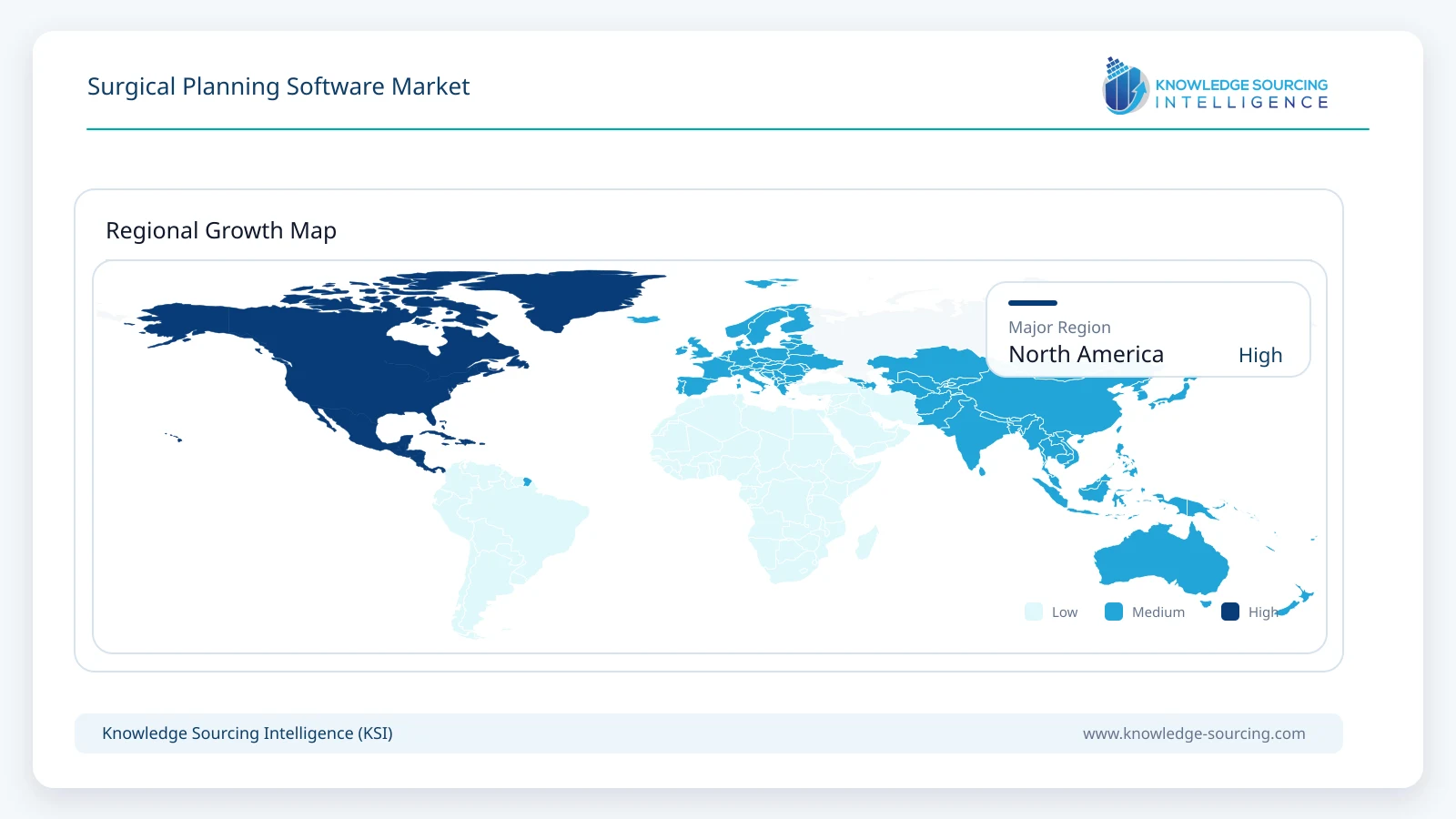
North America represents a major commercial market because of its established medical-device industry, high surgical technology expenditure, advanced hospital infrastructure, and substantial installed base of imaging, robotics, and navigation systems.
The United States is particularly important because the FDA maintains specific classifications for surgical planning software. The agency's classification database identifies neurological surgical planning software as a Class II device subject to 510(k) review.
Recent regulatory activity also demonstrates continued product development. FDA records show a 2025 510(k) submission and January 2026 clearance for Precision AI's shoulder arthroplasty planning system, while Stryker's Prophecy Incompass Surgical Planning System received a June 2026 clearance.
Hospitals in the region increasingly evaluate software alongside robotics, implants, imaging, and enterprise IT requirements. Canada represents an additional opportunity as suppliers obtain market authorization and expand regional distribution. Mexico offers longer-term opportunity as private healthcare infrastructure and specialist surgical capabilities develop, although price sensitivity and infrastructure differences can constrain adoption.
Europe
Europe combines sophisticated medical-device manufacturing with a more demanding regulatory environment. The EU Medical Device Regulation and related guidance influence software classification, clinical evaluation, cybersecurity, quality systems, and post-market obligations.
The European Commission's Medical Device Coordination Group issued updated guidance during 2025 covering software classification and the interaction between medical-device software and the Artificial Intelligence Act.
EUDAMED requirements also became more important in 2026, with the first four modules becoming mandatory from May 28, 2026.
Germany, France, and the United Kingdom remain commercially relevant because of established healthcare systems and specialist medical technology capabilities. European buyers generally place considerable emphasis on clinical evidence, cybersecurity, interoperability, data protection, and regulatory documentation.
Asia Pacific
Asia Pacific offers a broad opportunity because of expanding healthcare infrastructure, rising surgical volumes, development of specialty hospitals, and growing adoption of medical imaging and 3D technologies.
China and Japan provide substantial technology and healthcare ecosystems, while India and South Korea offer expanding private healthcare and specialist surgical capacity. Southeast Asian markets such as Indonesia and Thailand present additional opportunities as hospitals build advanced surgical capabilities.
Materialise's 2025 APAC hospital forum highlighted applications involving orthopedic surgery, cardiovascular care, pediatric specialties, oral and maxillofacial surgery, and point-of-care 3D planning.
The region is not homogeneous. Japan and South Korea generally support higher technology adoption, while emerging markets remain more sensitive to software pricing, infrastructure, training, and reimbursement. Local partnerships and regional implementation capabilities can therefore be important for suppliers.
Middle East & Africa
The Middle East offers opportunities through investment in tertiary hospitals, specialist healthcare centers, medical tourism infrastructure, and advanced surgical technology. Saudi Arabia and the UAE are particularly relevant for high-end hospital projects and specialist procedures.
Israel contributes through its technology-intensive healthcare ecosystem and medical-device development capabilities.
The principal constraints across parts of the region include unequal healthcare infrastructure, limited specialist availability, procurement cycles, and dependence on imported medical technology. Vendors with local implementation and clinical-support capabilities can therefore gain an advantage over suppliers offering software without sufficient training or integration services.
South America
Brazil represents the principal commercial market in South America because of its healthcare scale, private hospital networks, and specialist surgical services. Argentina provides a smaller but technically relevant market, while other countries offer selective opportunities around private hospitals and specialist centers.
Price remains a major procurement consideration. Software suppliers must balance advanced functionality with local affordability and provide implementation support suited to hospitals with varying IT infrastructure.
Competitive Landscape
The competitive structure includes large medical technology companies, specialist planning-software developers, imaging companies, and companies combining software with implants, robotics, navigation, or manufacturing.
The supplied competitive set comprises Stryker Corporation, Zimmer Biomet Holdings, Inc., Medtronic plc, Materialise NV, Brainlab AG, mediCAD Hectec GmbH, GE HealthCare, Renishaw plc, Canon Medical Systems Corporation, and Smith+Nephew plc.
Competition is increasingly based on workflow ownership rather than software functionality alone. Stryker can connect planning with orthopedic implants and surgical technologies, while Zimmer Biomet connects planning with robotic surgery and analytics.
Specialist companies compete through planning depth and software flexibility. mediCAD, for example, combines 2D, 3D, web, and mixed-reality offerings and maintains extensive orthopedic implant databases.
Materialise occupies a different position by linking medical image processing, virtual planning, patient-specific solutions, and manufacturing. Its 2025 annual report also points toward greater use of cloud-based software models.
Imaging companies such as GE HealthCare and Canon Medical Systems can compete through the connection between image acquisition, visualization, treatment planning, and intervention. GE HealthCare, for example, markets CT and CBCT capabilities supporting treatment and surgical planning.
Smith+Nephew has expanded its planning proposition through CORIOGRAPH, while its broader surgical portfolio provides a route for integrating software into orthopedic procedures.
The competitive environment is therefore likely to favor suppliers that can provide a reliable clinical workflow, broad device compatibility, strong regulatory credentials, secure data architecture, and meaningful clinical evidence.
Recent Developments
June 2026: Medtronic launched GAiTEWAY™, a cloud-based software platform connecting AI-driven surgical planning, intraoperative technologies and postoperative analytics across its AiBLE™ ecosystem for spine surgery.
April 2026: Medtronic reported initial clinical cases using Stealth AXiS™, demonstrating integration of AI-driven surgical planning, advanced navigation and intraoperative intelligence within its connected neurosurgical technology ecosystem.
March 2026: Materialise published its work on advanced 3D surface modeling for surgical planning, emphasizing interactive anatomical models, surgical simulation, precise measurements, and integration of CT and MRI data. The development supports wider use of 3D planning beyond conventional templating.
October 2025: Smith+Nephew launched CORIOGRAPH Pre-Op Planning and Modeling Services for total shoulder arthroplasty in the United States, completing its CORIOGRAPH planning-services portfolio across shoulder, knee, and hip procedures. The launch expands software-supported planning within orthopedic implant workflows.
Regulatory and Policy Environment
Regulation is an important market determinant because software can qualify as a medical device when its intended purpose influences diagnosis, treatment, surgical planning, or clinical decision-making.
In the United States, FDA oversight depends on intended use and device classification. The FDA's guidance navigator provides developers with pathways covering software validation, premarket submissions, cybersecurity, artificial intelligence, off-the-shelf software, and software modifications.
The agency also issued final cybersecurity guidance in June 2025 and final recommendations concerning predetermined change-control plans for AI-enabled device software in August 2025. These developments are commercially relevant because surgical planning systems increasingly incorporate AI-based segmentation, landmark identification, image analysis, and automated planning.
The European Union applies the Medical Device Regulation framework to relevant software products. The European Commission's guidance includes specific documents covering medical-device software qualification, classification, clinical evaluation, cybersecurity, and software distribution through online platforms.
EUDAMED also became more consequential in 2026. The European Commission states that the first four EUDAMED modules became mandatory from May 28, 2026, increasing administrative requirements for manufacturers and other economic operators.
For suppliers, regulatory compliance increasingly extends beyond initial authorization. Cybersecurity, software updates, clinical performance, quality management, data protection, post-market surveillance, and change management all influence the total cost of maintaining a commercial product.
Regulatory requirements can therefore favor established suppliers with dedicated quality and regulatory organizations. Smaller developers can still compete, but they may need partnerships, specialized regulatory support, or narrower indications to manage compliance costs.
Outlook and Strategic Implications
Over the 2026–2031 period, the Surgical Planning Software Market is likely to be shaped less by standalone visualization and more by integration with the broader surgical technology stack.
The first investment priority will be workflow integration. Hospitals will increasingly evaluate whether planning software connects directly with PACS, imaging systems, robotic platforms, navigation systems, implant databases, and postoperative analytics. Vendors that require separate data transfers or manual duplication of information will face greater procurement friction.
The second priority will be automation with clinician oversight. AI-supported segmentation, landmark detection, measurements, implant selection, and plan generation can reduce repetitive work. However, hospitals will require transparency, validation, user controls, and appropriate regulatory documentation before allowing automated outputs to influence surgical decisions.
The third priority will be cloud infrastructure. Cloud-based systems can support centralized administration, remote planning, subscription pricing, multi-site access, and continuous software updates. Yet adoption will depend on hospital policies concerning patient data, cybersecurity, connectivity, and local regulatory requirements.
The fourth priority will be procedure-specific ecosystems. Orthopedic planning is likely to remain commercially attractive because software can be directly connected with implant sales and robotic systems. Suppliers may therefore increasingly use planning platforms as the digital interface connecting surgeons with their broader procedural portfolios.
The fifth priority will be expansion into complex specialties. Cardiovascular, neurosurgical, oncology, cranio-maxillofacial, dental, and reconstructive applications can create additional demand where anatomy is difficult to interpret using conventional imaging alone. Materialise's work across cardiovascular, oncology, neurosurgical, and cranio-maxillofacial applications illustrates the breadth of this opportunity.
Competitive differentiation will increasingly depend on evidence. Hospitals will want suppliers to demonstrate improvements in planning efficiency, reproducibility, workflow integration, clinical decision support, and resource utilization. Technical sophistication without measurable operational value will be less persuasive in enterprise procurement.
The market will also face several risks. Regulatory requirements can increase development costs. Cybersecurity incidents can undermine confidence in connected clinical systems. AI errors can create clinical and reputational exposure. Fragmented hospital IT infrastructure can delay implementation. Budget constraints may also push hospitals toward solutions bundled with existing implant, robotics, or imaging contracts.
For suppliers, the strongest strategic opportunities lie in combining software with established clinical workflows. Implant manufacturers can integrate planning into procedural ecosystems. Imaging companies can extend from image acquisition toward treatment planning. Specialist software vendors can differentiate through interoperability and clinical depth. 3D technology providers can connect planning with patient-specific manufacturing.
Overall, procurement decisions through 2031 are likely to favor software that delivers a complete and traceable pathway from patient imaging to surgical execution and postoperative assessment. The central commercial question will shift from whether a hospital needs surgical planning software to which platform can integrate planning most effectively into the hospital's existing clinical and economic workflow.
Surgical Planning Software Market Scope
| Report Metric | Details |
|---|---|
| Total Market Size in 2026 | USD 174.3 million |
| Total Market Size in 2031 | USD 228.8 million |
| Forecast Unit | Million |
| Growth Rate | 5.6% |
| Study Period | 2021 to 2031 |
| Historical Data | 2021 to 2024 |
| Base Year | 2025 |
| Forecast Period | 2026 – 2031 |
| Segmentation | Planning Type, Deployment, Surgery Type, End-User, Geography |
| Companies |
|
Market Segmentation
By Planning Type
By Deployment
By Surgery Type
By End-user
By Geography
Table of Contents
1. EXECUTIVE SUMMARY
2. MARKET SNAPSHOT
2.1. Market Overview
2.2. Market Definition
2.3. Scope of the Study
2.4. Market Segmentation
3. BUSINESS LANDSCAPE
3.1. Market Drivers
3.2. Market Restraints
3.3. Market Opportunities
3.4. Porter’s Five Forces Analysis
3.5. Industry Value Chain Analysis
3.6. Policies and Regulations
3.7. Strategic Recommendations
4. TECHNOLOGICAL OUTLOOK
4.1. Introduction
4.2. 3D Visualization and Modeling
4.3. Artificial Intelligence and Machine Learning
4.4. Image-Guided Surgical Planning
4.5. Virtual and Augmented Reality
4.6. Cloud-Based Surgical Planning
4.7. Integration with Medical Imaging and Healthcare IT Systems
5. SURGICAL PLANNING SOFTWARE MARKET BY PLANNING TYPE
5.1. Introduction
5.2. Pre-Operative
5.3. Post-Operative
6. SURGICAL PLANNING SOFTWARE MARKET BY DEPLOYMENT
6.1. Introduction
6.2. Cloud
6.3. On-Premise
7. SURGICAL PLANNING SOFTWARE MARKET BY SURGERY TYPE
7.1. Introduction
7.2. Orthopedic Surgery
7.3. Cardiovascular Surgery
7.4. Neurosurgery
7.5. Dental & Orthodontics
7.6. Others
8. SURGICAL PLANNING SOFTWARE MARKET BY END-USER
8.1. Introduction
8.2. Hospitals
8.3. Ambulatory Surgical Centers
8.4. Specialty Clinics
9. SURGICAL PLANNING SOFTWARE MARKET BY GEOGRAPHY
9.1. Introduction
9.2. North America
9.2.1. United States
9.2.2. Canada
9.2.3. Mexico
9.3. South America
9.3.1. Brazil
9.3.2. Argentina
9.3.3. Others
9.4. Europe
9.4.1. Germany
9.4.2. France
9.4.3. United Kingdom
9.4.4. Spain
9.4.5. Others
9.5. Middle East and Africa
9.5.1. Saudi Arabia
9.5.2. UAE
9.5.3. Israel
9.5.4. Others
9.6. Asia-Pacific
9.6.1. China
9.6.2. India
9.6.3. Japan
9.6.4. South Korea
9.6.5. Indonesia
9.6.6. Thailand
9.6.7. Others
10. COMPETITIVE ENVIRONMENT AND ANALYSIS
10.1. Major Players and Strategy Analysis
10.2. Market Share Analysis
10.3. Mergers, Acquisitions, Agreements, and Collaborations
10.4. Competitive Dashboard
11. COMPANY PROFILES
11.1. Stryker Corporation
11.2. Zimmer Biomet Holdings, Inc.
11.3. Medtronic plc
11.4. Materialise NV
11.5. Brainlab AG
11.6. mediCAD Hectec GmbH
11.7. GE HealthCare
11.8. Renishaw plc
11.9. Canon Medical Systems Corporation
11.10. Smith+Nephew plc
12. APPENDIX
12.1. Currency
12.2. Assumptions
12.3. Base and Forecast Years Timeline
12.4. Key Benefits for Stakeholders
12.5. Research Methodology
12.6. Abbreviations
LIST OF FIGURES
LIST OF TABLES
Navigate
Trusted by the world's leading organizations











