
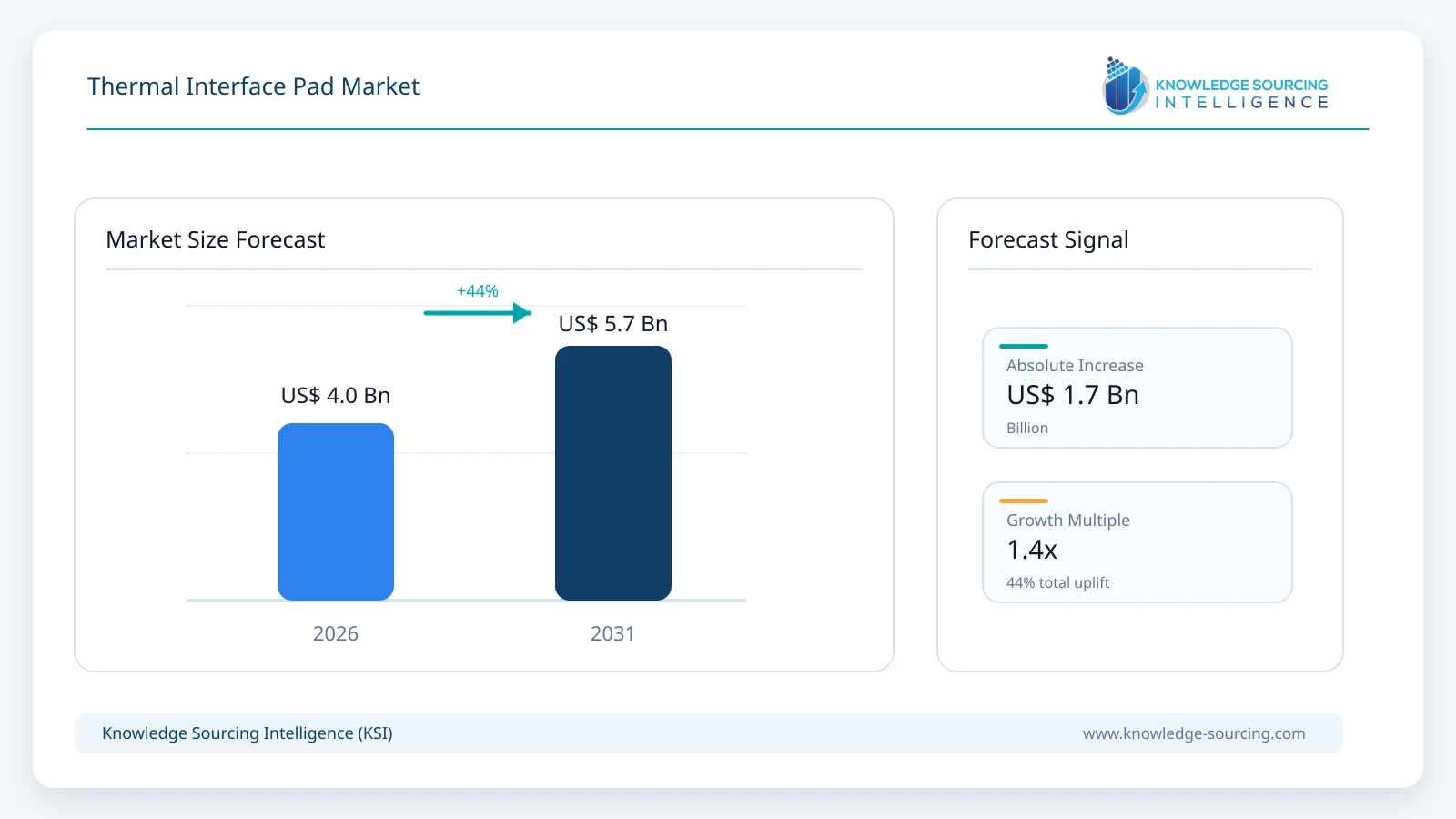
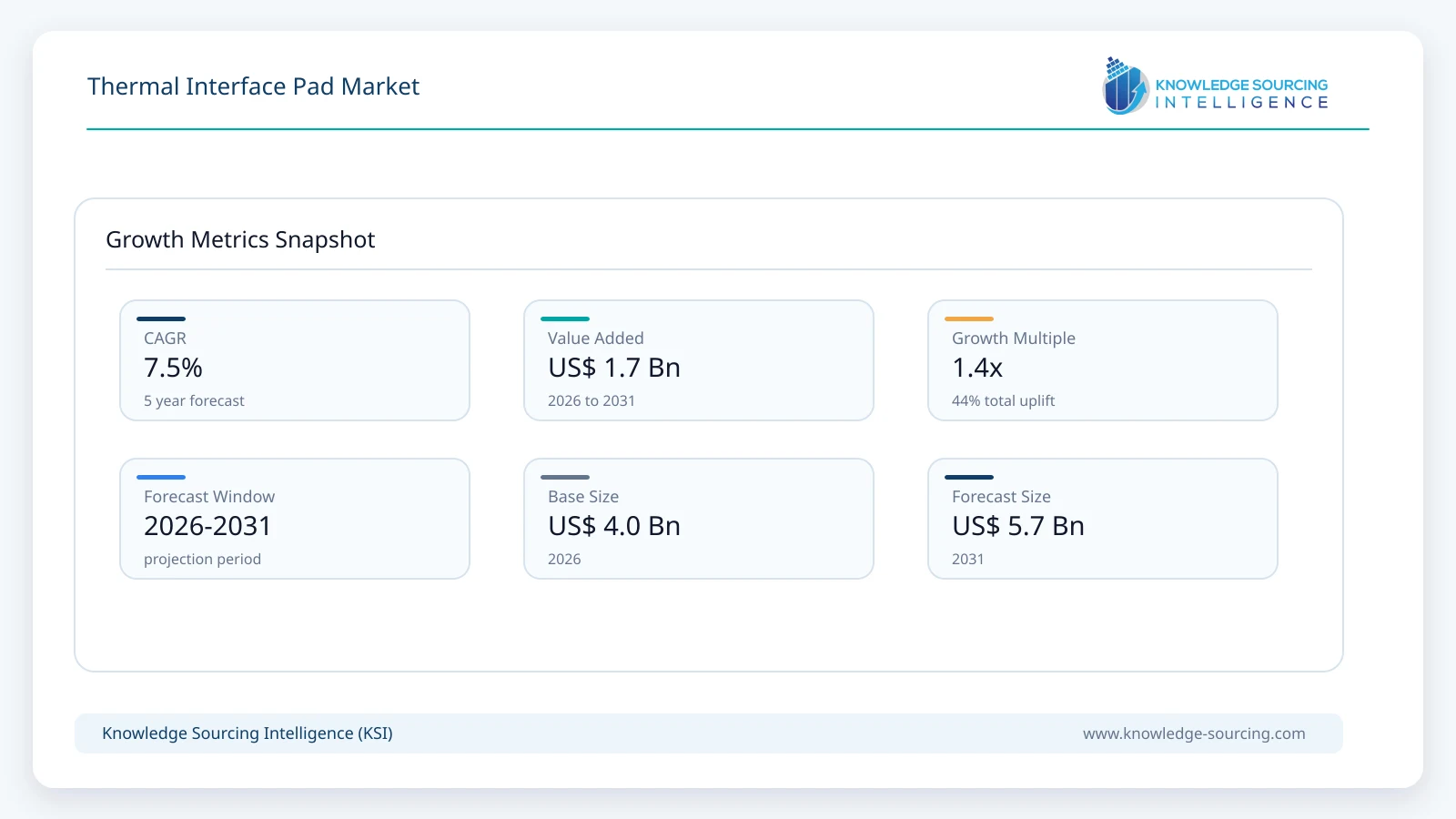
The global thermal interface pad market is estimated at USD 3.95 billion in 2026 and is projected to reach USD 5.67 billion by 2031, growing at a CAGR of approximately 7.5% during the forecast period.
Highlights:
- 1Silicone-based pads account for approximately 63% of global thermal interface pad revenue in 2026.
- 2Pads rated above 6 W/mK are projected to grow at approximately 10.7% annually through 2031.
- 3Consumer electronics and computing generate about USD 1.22 billion of global market value in 2026.
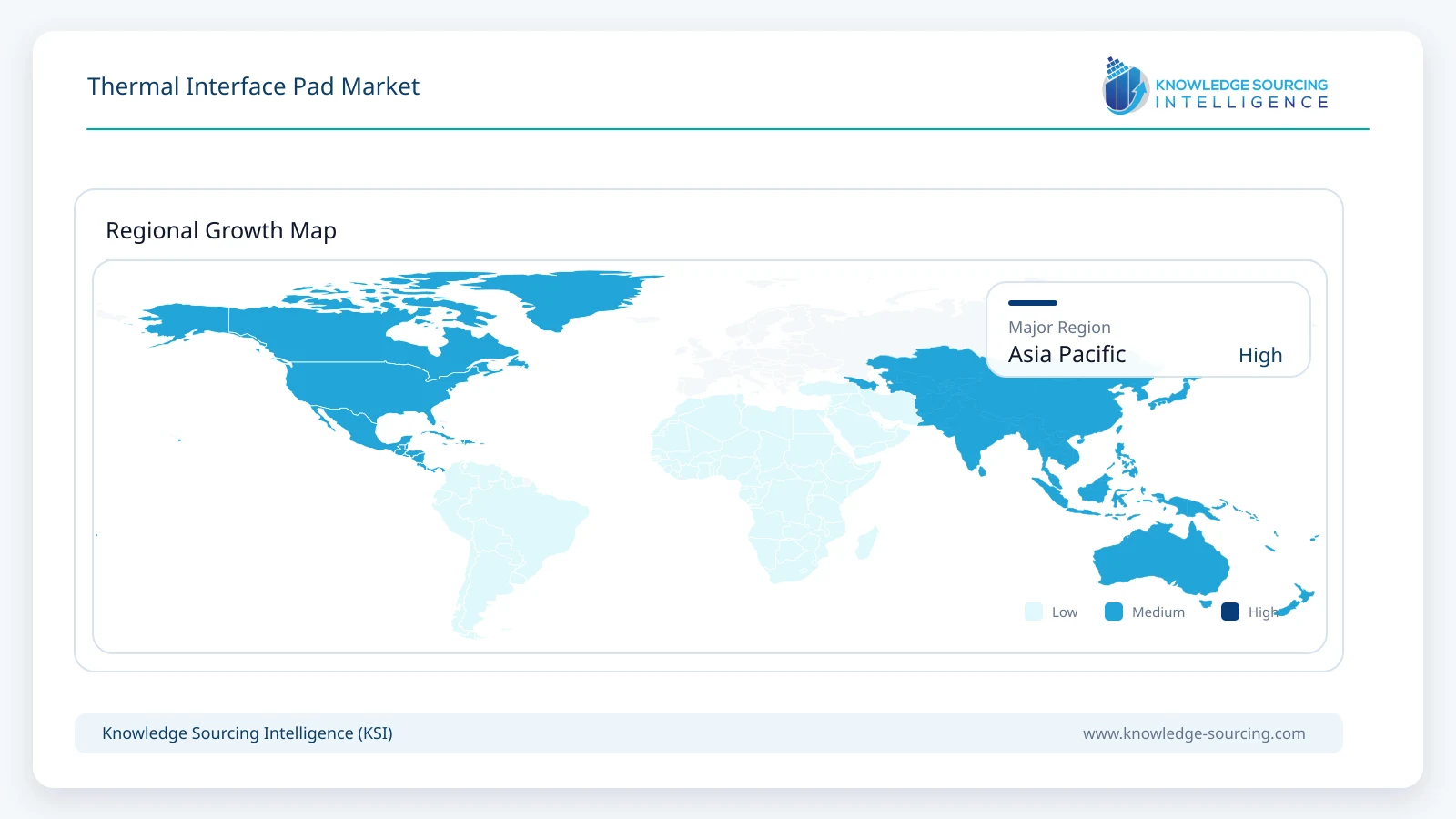
- 4Asia Pacific accounts for approximately 46% of global thermal interface pad revenue in 2026.
- 5AI servers and EV power electronics are shifting demand toward higher conductivity at lower compression force.
- 6Silicone-free and phase-change materials are expanding where contamination, outgassing or pump-out risk is critical.
Thermal interface pads are engineered to replace insulating air at the contact surface between a heat source and a cooling structure. Conventional gap pads use a soft polymer matrix loaded with thermally conductive ceramic or mineral fillers so the material can conform to uneven surfaces while remaining electrically insulating. Commercial products span wide ranges of thickness, hardness and conductivity because design requirements differ sharply between a smartphone, a server accelerator, an EV inverter and an industrial control cabinet. Henkel, for example, offers Bergquist GAP PAD grades from below 1 W/mK to 12 W/mK, while Parker Chomerics offers THERM-A-GAP products covering low-hardness pads, reboundable materials and high-performance grades up to 12 W/mK. Qnity's Laird portfolio adds silicone and non-silicone gap fillers targeted at high-power electronics.
The market is narrower than the broader thermal interface materials industry. Liquid greases, dispensable gels, two-part gap fillers, thermal adhesives and pastes compete for the same thermal-management functions but are not counted here unless supplied as a pre-formed pad or sheet. Pads are favored where manufacturers value controlled thickness, clean handling, reworkability and predictable placement without dispensing equipment. Liquid materials can be more attractive when geometry is complex, automated dispensing is required or a single formulation needs to replace several pad thicknesses. Selection therefore depends on thermal impedance, gap size, compression load, dielectric performance, operating temperature, rework requirements and long-term reliability rather than thermal conductivity alone.
Market Trends
High-conductivity pads are being engineered to remain soft enough for fragile high-power electronics
Increasing filler loading can improve bulk thermal conductivity but can also raise hardness and assembly stress, creating a design trade-off around fragile packages, warped boards and uneven stack-ups. Suppliers are responding with formulations that combine higher conductivity with lower modulus and better surface wetting. Qnity's Laird Tflex SF16 is a non-silicone thermoplastic gap filler rated at 16 W/mK with low hardness for AI data-center, automotive and consumer-electronics applications. Henkel offers Bergquist GAP PAD TGP 12000ULM at 12 W/mK with an ultra-low-modulus construction, while Parker Chomerics has expanded its range with low-compression products such as THERM-A-GAP PAD 70TP and higher-conductivity 8 W/mK and 12 W/mK variants. The commercial focus is therefore moving from conductivity as an isolated specification toward thermal resistance under realistic assembly pressure.
Silicone-free and phase-change pads are widening the usable application envelope
Silicone remains the dominant binder because it provides conformability, temperature stability and mature manufacturing economics, but selected electronics environments cannot tolerate silicone oil migration, outgassing or contamination. Henkel positions Bergquist GAP PAD TGP 2200SF for silicone-sensitive industrial electronics, and Qnity has expanded its non-silicone Tflex family for high-density electronic assemblies. At thinner interfaces, phase-change pads provide a different route: the material softens near operating temperature and wets the mating surfaces, reducing contact resistance while avoiding the pump-out behavior associated with some greases. Solstice Advanced Materials markets PTM7950 and the newer PTM6880 for AI server CPUs and GPUs, EV inverters, telecom equipment and IGBT modules. These technologies do not replace conventional thick gap pads, but they expand pad-format demand into interfaces that previously favored paste or grease.
Market Drivers
AI infrastructure and advanced computing are increasing thermal load per electronic assembly
The AI build-out is increasing the number of power-dense processors, memory stacks, optical transceivers and power-conversion components that require engineered heat paths. The International Energy Agency projects global data-center electricity consumption to rise from roughly 415 TWh in 2024 to around 945 TWh by 2030, with AI-optimized data-center demand growing much faster than conventional server demand. SEMI also forecasts global semiconductor manufacturing equipment sales of USD 165.9 billion in 2026, up 23.2% year on year, driven by AI-related leading-edge logic, high-bandwidth memory and advanced packaging investment. Thermal pads do not scale directly with electricity use or fab spending, but higher compute density raises thermal design requirements across servers, networking hardware, storage, power supplies and semiconductor test systems. This is shifting purchasing toward higher-value low-impedance and low-compression materials rather than only increasing square-meter consumption.
Electric vehicles and power electronics create a second high-growth demand pool
Power electronics in electric vehicles require reliable heat transfer across inverters, onboard chargers, DC-DC converters, battery-control electronics and other modules that experience vibration, thermal cycling and large temperature gradients. Nearly 22 million electric cars were produced globally in 2025, more than 25% above the previous year, according to the International Energy Agency. Thermal pads are used where designers need electrical isolation, controlled gap thickness and mechanical compliance between semiconductor devices, housings and cooling plates. Henkel identifies e-mobility among the target applications for multiple Bergquist pad grades, while Solstice positions phase-change materials for EV inverters and onboard chargers. Growth is also supported by stationary energy storage, industrial drives and renewable-energy power conversion, where similar IGBT, MOSFET and module-level thermal challenges apply.
Market Restraint
Performance trade-offs and competition from dispensable TIMs limit pad adoption in some assemblies
Thermal pads cannot optimize every interface simultaneously. Higher ceramic loading can improve conductivity but may increase stiffness, while softer formulations may require greater thickness and therefore higher bulk thermal resistance. Large stack-up tolerances favor thick conformable pads, whereas direct-die and high-performance processor interfaces usually require extremely thin bond lines. Pads can also create material waste when complex shapes are die-cut from sheets. In high-volume manufacturing, single-part gels and two-part dispensable gap fillers can automate application, fill irregular three-dimensional gaps and reduce the number of stocked pad thicknesses. Parker Chomerics explicitly positions gels and dispensable gap fillers as alternatives for applications where a single material can replace multiple pad sizes, while Henkel offers both pad and liquid thermal systems. This substitution pressure limits pad growth in applications where automated dispensing and geometry flexibility outweigh reworkability and pre-formed handling.
Thermal Interface Pad Market Segment Analysis
By Material Type
Silicone-Based Pads
Silicone-based products remain the largest material category and are projected to generate approximately USD 3.42 billion in market revenue by 2031. Their scale comes from a broad balance of softness, electrical insulation, temperature stability, formulation flexibility and established qualification across electronics, telecom, automotive and industrial applications. Henkel, Parker Chomerics, Fujipoly, Shin-Etsu and other suppliers maintain wide silicone-pad portfolios spanning multiple thicknesses and conductivity levels. The segment is expected to grow more slowly than silicone-free and phase-change formats because contamination-sensitive optical, precision industrial and semiconductor applications increasingly specify alternative chemistries. Even so, silicone remains difficult to displace in thick-gap and shock-damping applications where compliant mechanical behavior is as important as heat transfer.
By Thermal Conductivity
Above 6 W/mK
High-conductivity pads rated above 6 W/mK are projected to reach approximately USD 1.45 billion by 2031. Demand is being pulled by AI accelerators, high-power CPUs, high-density optical modules, EV power electronics and compact industrial converters where the available interface area is limited and component heat flux is rising. Product portfolios now extend beyond the 3-5 W/mK range that historically covered many mainstream electronics assemblies. Henkel markets 7, 10 and 12 W/mK Bergquist GAP PAD grades, Parker Chomerics offers 7-12 W/mK THERM-A-GAP products, and Qnity has introduced a 16 W/mK non-silicone pad. Lower-conductivity pads remain important for cost-sensitive consumer, control and enclosure applications, but the revenue mix is moving upward because high-performance grades carry higher unit value as well as faster demand growth.
By End User
Data Centers and Telecommunications
Data centers and telecommunications are projected to grow at approximately 10.4% annually between 2026 and 2031, faster than the overall market. The segment includes servers, AI accelerators, switches, routers, optical transceivers, storage systems, telecom base stations and associated power-conversion hardware. Higher processor and memory density increases local heat flux, while faster optical links add heat at pluggable and co-packaged interfaces. The International Energy Agency expects AI-optimized data-center electricity use to rise sharply through 2030, and material suppliers are explicitly targeting these systems with high-conductivity pads, phase-change materials and low-outgassing formulations. Consumer electronics and conventional computing remain larger in current revenue, but data-center and telecom applications are shifting the product mix toward premium materials with tighter reliability and compression requirements.
By Geography
Asia Pacific
Asia Pacific is projected to reach approximately USD 2.71 billion in thermal interface pad revenue by 2031. The region combines the largest electronics and semiconductor manufacturing base with major EV, battery, telecom-equipment and industrial automation industries.
China, Taiwan, South Korea and Japan account for substantial production of servers, networking equipment, consumer devices, power semiconductors and electric vehicles, while India and Southeast Asia are expanding electronics assembly and data-center investment. The supplier base is also deep, including Shin-Etsu, Fujipoly, Panasonic Industry, T-Global, LiPOLY and multiple Chinese thermal-management manufacturers. North America remains strategically important through AI data centers, semiconductor design and advanced electronics, while Europe contributes through automotive power electronics, industrial automation and high-reliability engineering applications.
Competitive Environment
The market combines diversified materials companies, specialist thermal-management suppliers and precision converters. Henkel has one of the broadest pre-formed portfolios through Bergquist GAP PAD, SIL PAD and phase-change products. Qnity competes through Laird thermal interface materials and is investing in thermal-management R&D for AI, high-performance computing and advanced electronics. Parker Hannifin's Chomerics division offers a wide conductivity range plus custom die-cutting and related gels and phase-change materials. Solstice Advanced Materials is differentiated in thin phase-change interfaces through PTM7950 and PTM6880, while Fujipoly, Shin-Etsu, KERAFOL, Saint-Gobain, T-Global and LiPOLY provide strong positions in silicone, ceramic-filled and specialty pad technologies.
Competition increasingly centers on the full application window rather than a single W/mK specification. Customers evaluate thermal impedance under pressure, hardness, rebound, dielectric strength, flame behavior, oil bleed, outgassing, surface tack, thickness tolerance and long-term cycling. Suppliers that can offer die-cut conversion, rapid prototyping and application engineering are advantaged because pad geometry is often customized to the end device. At the same time, leading vendors maintain both pad and dispensable TIM portfolios so they can retain the account even when an OEM changes the assembly process. This makes portfolio breadth and customer co-development increasingly important as AI, automotive and industrial systems move to more complex cooling architectures.
Recent Developments
August 2026: Qnity showcased thermal-management materials alongside advanced semiconductor and packaging solutions at SEMICON Taiwan 2026, emphasizing its system-level materials platform for AI-driven electronics.
March 2026: Qnity expanded the Laird thermal-interface portfolio with Tflex SF16, a 16 W/mK non-silicone gap filler designed for AI data centers, automotive electronics and other high-power applications.
November 2025: Qnity expanded Laird Technologies' Cleveland thermal and EMI R&D center to accelerate material development for AI, high-performance computing, automotive and advanced electronics.
October 2025: Henkel announced next-generation electronics solutions for Productronica 2025, including a versatile portfolio of Thermal Interface Materials (TIMs) featuring high-performing liquid 1K pre-cured gels, 2K curable gap fillers, and phase-change materials designed to meet diverse application needs across the data and telecom sector.
October 2025: Henkel commercialized Loctite TCF 14001, a 14.5 W/mK liquid gap filler for 800G and 1.6T optical transceivers, highlighting the competitive shift toward automated liquid TIMs in high-power data-center hardware.
Thermal Interface Pad Market Scope:
| Report Metric | Details |
|---|---|
| Total Market Size in 2026 | USD 3.95 billion |
| Total Market Size in 2031 | USD 5.67 billion |
| Forecast Unit | Billlion |
| Growth Rate | 7.5% |
| Study Period | 2021 to 2031 |
| Historical Data | 2021 to 2024 |
| Base Year | 2025 |
| Forecast Period | 2026 – 2031 |
| Segmentation | Type, Product Type, End-User, Geography |
| Companies |
|
Market Segmentation
BY MATERIAL TYPE
Silicone-Based Pads
Silicone-Free Polymer Pads
Phase-Change Pads
Graphite and Hybrid Pads
Others
BY THERMAL CONDUCTIVITY
Below 3 W/mK
3 to 6 W/mK
Above 6 W/mK
BY END USER
Consumer Electronics and Computing
Data Centers and Telecommunications
Automotive and Electric Vehicles
Industrial and Power Electronics
Medical and Aerospace Electronics
Others
BY GEOGRAPHY
North America
USA
Canada
Mexico
South America
Brazil
Argentina
Others
Europe
Germany
France
United Kingdom
Spain
Italy
Others
Middle East and Africa
Saudi Arabia
UAE
Israel
Others
Asia Pacific
China
Japan
India
South Korea
Taiwan
Thailand
Others
Table of Contents
1. EXECUTIVE SUMMARY
2. MARKET SNAPSHOT
2.1. Market Overview
2.2. Market Definition
2.3. Market Segmentation
3. BUSINESS LANDSCAPE
3.1. Market Drivers
3.1.1. AI Infrastructure and Advanced Computing Are Increasing Thermal Load per Electronic Assembly
3.1.2. Electric Vehicles and Power Electronics Create a Second High-Growth Demand Pool
3.2. Market Restraint
3.2.1. Performance Trade-Offs and Competition From Dispensable TIMs Limit Pad Adoption in Some Assemblies
3.3. Market Opportunities
3.4. Porter's Five Forces Analysis
3.5. Industry Value Chain Analysis
3.6. Policies and Regulations
3.7. Strategic Recommendations
4. TECHNOLOGICAL OUTLOOK
4.1. High-Conductivity Low-Modulus Gap Pads
4.2. Silicone-Free Thermal Interface Pads
4.3. Phase-Change Pad Materials
4.4. Die-Cut and Automated Placement Technologies
5. THERMAL INTERFACE PAD MARKET BY MATERIAL TYPE
5.1. Introduction
5.2. Silicone-Based Pads
5.3. Silicone-Free Polymer Pads
5.4. Phase-Change Pads
5.5. Graphite and Hybrid Pads
5.6. Others
6. THERMAL INTERFACE PAD MARKET BY THERMAL CONDUCTIVITY
6.1. Introduction
6.2. Below 3 W/mK
6.3. 3 to 6 W/mK
6.4. Above 6 W/mK
7. THERMAL INTERFACE PAD MARKET BY END USER
7.1. Introduction
7.2. Consumer Electronics and Computing
7.3. Data Centers and Telecommunications
7.4. Automotive and Electric Vehicles
7.5. Industrial and Power Electronics
7.6. Medical and Aerospace Electronics
7.7. Others
8. THERMAL INTERFACE PAD MARKET BY GEOGRAPHY
8.1. Introduction
8.2. North America
8.2.1. USA
8.2.2. Canada
8.2.3. Mexico
8.3. South America
8.3.1. Brazil
8.3.2. Argentina
8.3.3. Others
8.4. Europe
8.4.1. Germany
8.4.2. France
8.4.3. United Kingdom
8.4.4. Spain
8.4.5. Italy
8.4.6. Others
8.5. Middle East and Africa
8.5.1. Saudi Arabia
8.5.2. UAE
8.5.3. Israel
8.5.4. Others
8.6. Asia Pacific
8.6.1. China
8.6.2. Japan
8.6.3. India
8.6.4. South Korea
8.6.5. Taiwan
8.6.6. Thailand
8.6.7. Others
9. COMPETITIVE ENVIRONMENT AND ANALYSIS
9.1. Major Players and Strategy Analysis
9.2. Market Share Analysis
9.3. Mergers, Acquisitions, Agreements and Collaborations
9.4. Competitive Dashboard
10. COMPANY PROFILES
10.1. Henkel AG & Co. KGaA (Bergquist)
10.2. Qnity Electronics, Inc. (Laird)
10.3. Parker Hannifin Corporation (Chomerics)
10.4. 3M Company
10.5. Solstice Advanced Materials
10.6. Shin-Etsu Chemical Co., Ltd.
10.7. Fujipoly / KITAGAWA INDUSTRIES Co., Ltd.
10.8. Boyd Corporation
10.9. KERAFOL Keramische Folien GmbH & Co. KG
10.10. Saint-Gobain
10.11. Panasonic Industry Co., Ltd.
10.12. T-Global Technology Co., Ltd.
10.13. LiPOLY Technology Co., Ltd.
10.14. Stockwell Elastomerics, Inc.
10.15. KCC Corporation
11. APPENDIX
11.1. Currency
11.2. Assumptions
11.3. Base and Forecast Years Timeline
11.4. Key Benefits for Stakeholders
11.5. Research Methodology
11.6. Abbreviations
Navigate
Trusted by the world's leading organizations











