
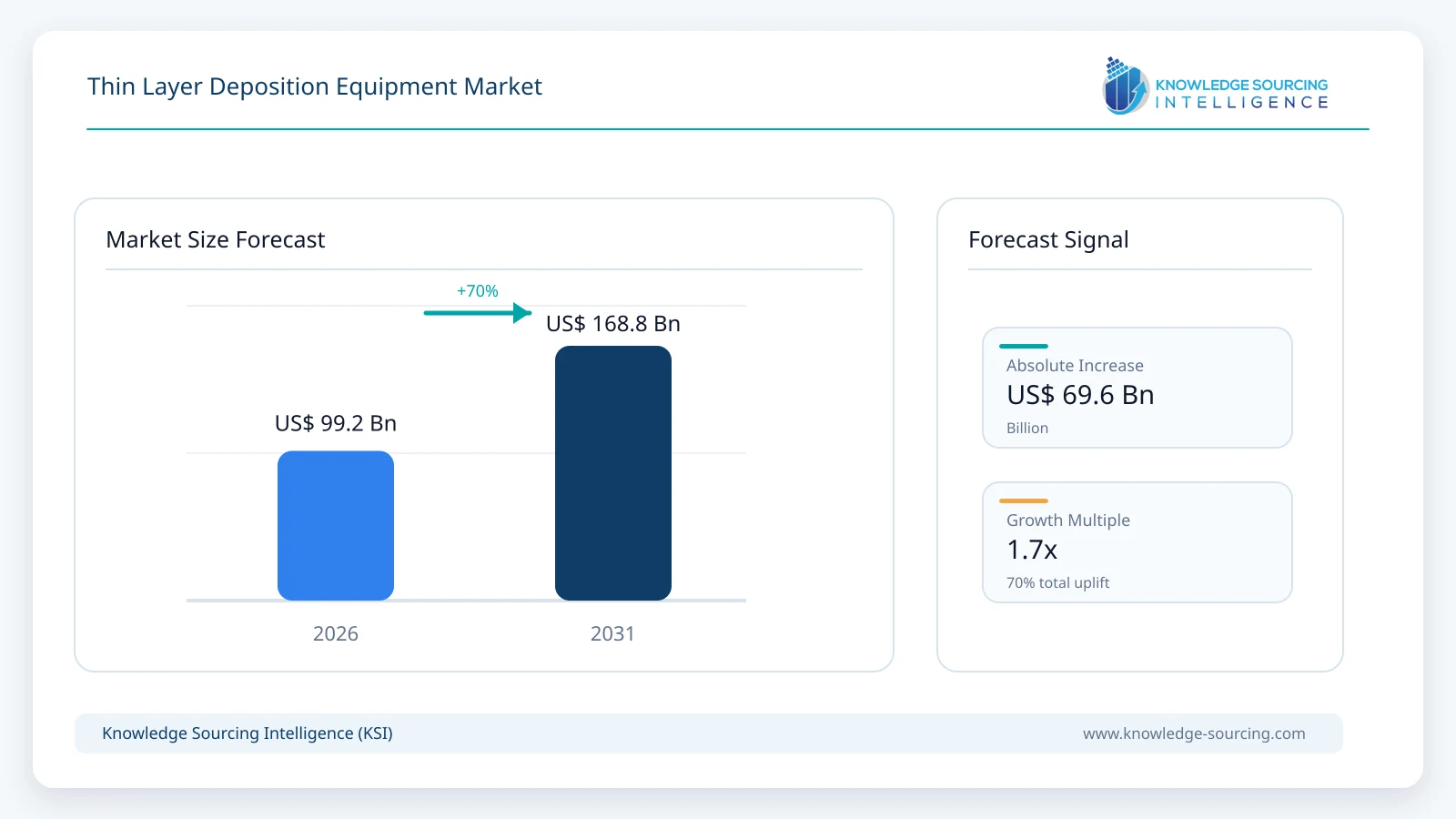
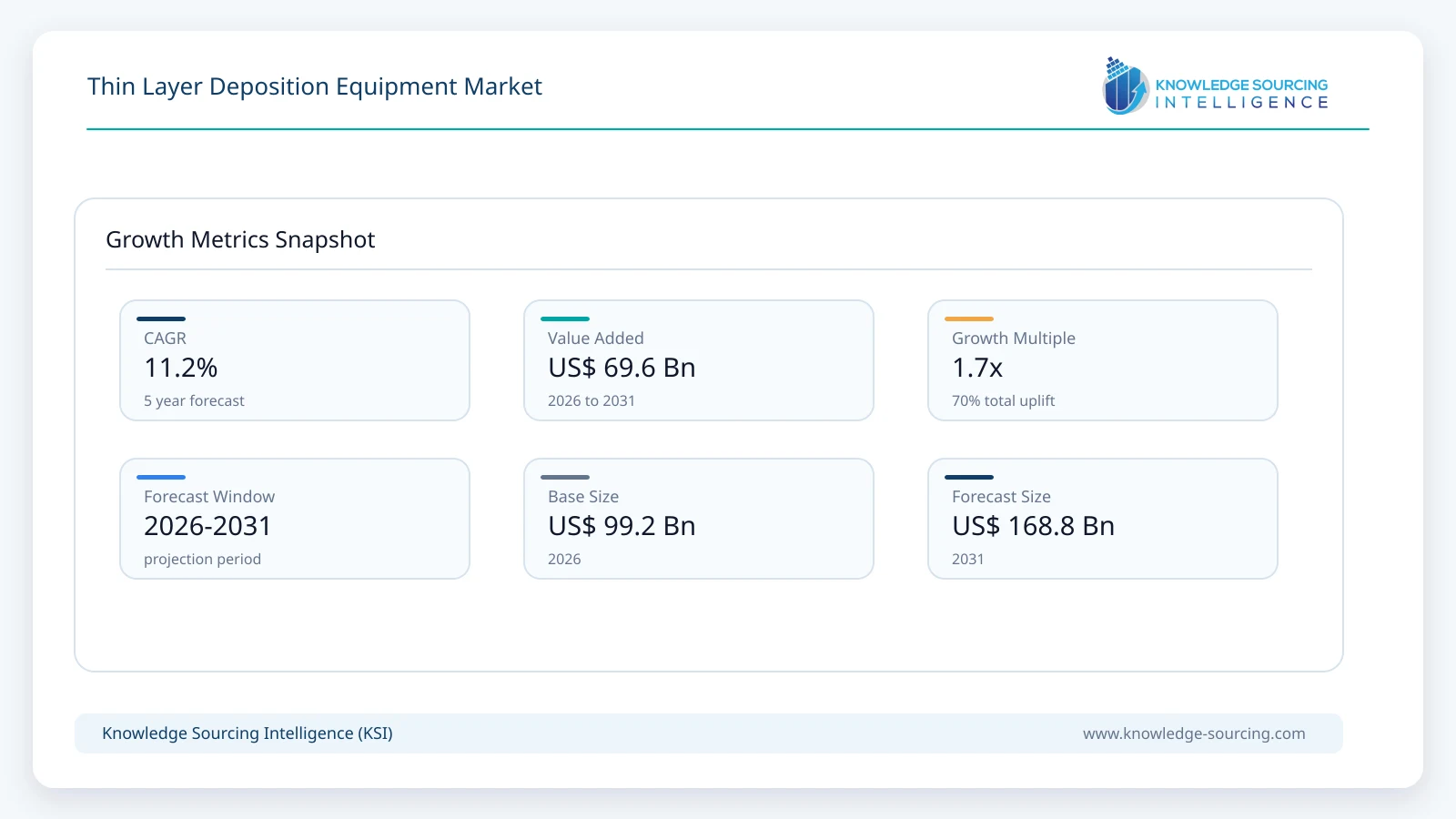
The Thin Layer Deposition Equipment market is set to reach USD 168.79 billion in 2031, growing at a CAGR of 11.2% between 2026 and 2031, from USD 99.17 billion in 2026.
Highlights:
- 1Continuous innovation in chemical vapor deposition and physical vapor deposition technologies facilitates the production of high-quality thin films for emerging microelectronic applications across various industries.
- 2Growing emphasis on atomic layer deposition processes supports conformal coating requirements essential for complex three-dimensional semiconductor architectures and memory devices.
- 3Integration of advanced thin layer deposition systems into solar cell manufacturing enhances efficiency and durability of photovoltaic modules used in renewable energy generation.
- 4Development of eco-friendly deposition equipment prioritizes reduced chemical usage and lower energy consumption to align with global sustainability goals in industrial production.
The Thin Layer Deposition Equipment Market encompasses equipment and systems used to deposit controlled thin films and coatings onto substrates through processes such as Physical Vapor Deposition (PVD), Chemical Vapor Deposition (CVD), Plasma-Enhanced Chemical Vapor Deposition (PECVD), and Atomic Layer Deposition (ALD). These technologies are used across semiconductor and IC fabrication, optoelectronics, solar cells and photovoltaics, medical devices, data storage, and other advanced manufacturing applications.
In the United States, export controls rather than industrial subsidy are the dominant policy lever on deposition equipment right now. BIS has announced controls on 24 types of semiconductor manufacturing equipment and 3 types of software tools for developing or producing semiconductors. These equipment controls explicitly target deposition tools, along with etching, lithography, ion implantation, annealing, metrology, and cleaning equipment. These measures aim to hinder China's ability to produce advanced-node chips.
BIS has paired that equipment-control tightening with an enforcement push rather than relief. The agency opened 2026 with an enforcement surge targeting chip exports to China, converting long-running investigations, most involving shipments that reached China's SMIC, into major penalty cases, including a settlement with Applied Materials.
Separately, on chip-level exports (distinct from equipment), the U.S. has moved toward flexibility rather than restriction. A January 2026 final rule replaced the prior presumption-of-denial standard for advanced AI chips such as the H200 with case-by-case licensing to China and Macau, though reexports and transfers to Macau or other sensitive destinations still default to presumption of denial.
In the European Union, the policy response has moved from research funding toward broader industrial and demand-side measures. On June 3, 2026, the European Commission adopted a proposal for Chips Act 2.0, introducing measures intended to further boost the EU chips industry, reduce strategic dependencies, and support advanced chip production in the bloc.
Suppliers are responding to sustained AI-driven capex with a wave of new deposition-tool launches. Applied Materials announced in April 2026 that it introduced two chipmaking systems built to deposit metals and dielectrics with atomic-level precision for gate-all-around (GAA) transistors at 2nm and beyond, addressing the more than 500 process steps such structures require.
Overall, the pattern across regulators and suppliers points in a more fragmented direction than a single global trend. U.S. export controls are becoming increasingly strict regarding deposition equipment headed to China, even though export licensing loosens for chips within the US is becoming lenient. Meanwhile, the EU's Chips Act 2.0 shifts Europe's support toward demand and permitting rather than manufacturing subsidy alone. Additionally, suppliers are competing to ship atomic-scale-precision deposition tools for GAA transistors, high-layer 3D NAND, and HBM packaging, instead of relying on a uniform global regulatory approach.
Market Drivers
Increasing Demand for High-Performance Electronic Devices
Governments and industry bodies across the world's largest chip markets are tracking a surge in demand for high-performance electronics, AI accelerators, advanced memory, and next-generation computing devices, even as the scale of that surge varies sharply by product segment. This demand is a direct driver of the Thin Layer Deposition Equipment market, since chipmakers use CVD, PVD, and ALD tools to build the atomic-precision film stacks that GAA transistors, high-layer 3D NAND, and HBM memory require to hit performance and yield targets, without which the AI buildout can't scale.
The Semiconductor Industry Association reported that global chip sales reached $110.5 billion in April 2026, a 93.9% increase year-over-year, and endorsed a WSTS forecast projecting annual global sales will grow 90% to $1.5 trillion for the full year 2026, with 2027 sales projected to exceed $1.9 trillion.
SIA's 2025 product breakdown highlights continued growth across key semiconductor product categories, with logic and memory devices representing significant areas of demand. The expansion of these segments is supporting semiconductor manufacturers' investments in advanced manufacturing processes, including thin-film deposition technologies required for increasingly complex device structures.
SIA and Deloitte project this demand will keep compounding: government and industry are expected to invest more than $4 trillion cumulatively in new data center infrastructure through 2028, of which $2.8 trillion is projected to go toward semiconductors, with annual chip revenue tied to AI data centers alone potentially reaching more than $1.2 trillion by 2028.
Equipment suppliers are converting this demand directly into new deposition tool launches. For instance, Applied Materials introduced two chipmaking systems built to deposit metals and dielectrics with atomic-level precision for gate-all-around (GAA) transistors at 2nm and beyond. The launch emphasizes the fact that these advanced structures require more than 500 process steps to keep up with the rapid growth of global AI infrastructure.
Applied Materials pointed to the same driver in June 2026, introducing new epitaxy, CMP, deposition, and eBeam metrology systems specifically for DRAM fabs and advanced packaging steps like HBM stacking, which the company tied directly to building the 3D chip architectures behind cutting-edge AI chips.
Each region's demand signal points toward the same technology need. Record SIA sales growth in logic and memory, the SIA-Deloitte $2.8 trillion semiconductor infrastructure forecast, and Applied Materials' back-to-back 2026 tool launches are all independently reinforcing chipmakers' need for higher-precision deposition equipment. Suppliers are converting that pressure into new platform launches, product segment by product segment rather than through a single uniform demand driver.
Major Segment Analysis
Semiconductor and IC Fabrication
By Application, the thin layer deposition equipment market is segmented into semiconductor & IC fabrication, medical devices, optoelectronics, solar cells & photovoltaics, data storage, and others. Semiconductor & IC fabrication will account for a major share owing to high advanced chip production.
Ongoing investment in the miniaturization of electronics has positively impacted demand for deposition tools such as ALD and CVD. The semiconductor & IC Fabrication segment is projected to grow at a steady rate, fueled by rising demand for advanced chips.
The ongoing electronics miniaturization has shifted chip architecture to GAA (Gate-All-Around) featuring a 3D structure and nanosheet. Such transition is expected to drive the adoption of thin layer deposition tools, such as ALD and CVD, which provide sequential surface reactions for atomic-level precision.
Growing AI transition and development of next-generation devices supporting automation escalates the requirement for advanced-level chips and nodes, which bolsters the market trajectory for thin layer deposition equipment that offers microscopic conducting for wafers.
Continued investment in fabrication plants followed by implementation of policies like the “CHIPS and Science Act” in the USA, China’s “Big Fund” and EU’s “European Chip Act” reinforces the semiconductor ecosystem in such major regional markets, which amplify the market opportunity.
Companies like Beneq have formed collaborations that leverage ALD solutions for improving microchannel plate (MCP) technology. Likewise, market players like Lam Research Corporation have invested in production-oriented pulse laser deposition (PLD) tools for next-generation MEMS-based microphones. Such innovations have established a new market framework.
According to the World Semiconductor Trade Statistics (WSTS), global semiconductor sales reached USD 796 billion in 2025, with projections for 2026 and 2027 reaching USD 1,511 billion and USD 1,914 billion. Such a significant rise in global sales outlines growth in thin-layer deposition equipment deployment.
Regional Analysis
North America: the US
Ongoing development in power electronics fueled by improved data center efficiency followed by the rising EV transition has accelerated the requirement for thin-film power devices in the United States, which has supported the growth opportunities for thin-layer deposition equipment.
Collaborations supporting the establishment of R&D centers for the development of next-generation semiconductor packaging technologies in the USA have further augmented the market demand for thin layer deposition tools.
Policies like the “CHIPS and Science Act” have enabled US-Based chip makers to expand their domestic production, thereby improving R&D spending. According to the Semiconductor Industry Association, in 2025, the R&D spending of US chip makers reached USD 76.8 billion, representing a 10.3% growth over the preceding year’s R&D spending.
The US energy sector is witnessing a significant transformation with thin-film technologies finding their way in solar photovoltaics. Hence, investment by the U.S. Department of Energy’s LPO to bolster utility-scale solar projects is anticipated to drive the use of absorber layers, which will positively impact the adoption of CVD/PVD tools.
Rapid AI integration has transformed the technological outlook of the USA, with the “AI Action Plan” supporting advanced chip development, which will drive the usage of atomic layer deposition (ALD).
Presence of key market players such as Applied Materials Science Inc., which has partnered with global chip manufacturers like Samsung to establish their fabrication unit in the USA, has improved the market competitiveness.
Companies like Oxford Instruments Inc have partnered with institutions like NYU to leverage the latter’s PlasmaPro ASP ALD system for superconducting quantum applications.
Company Profiles
Applied Materials follows a technology-led, integrated materials-engineering strategy in the thin layer deposition equipment market, focusing on advanced semiconductor manufacturing, where increasingly complex 3D structures require precise, conformal, and ultra-thin films. The company maintains a broad deposition portfolio spanning atomic layer deposition (ALD), chemical vapor deposition (CVD), physical vapor deposition (PVD) and related materials-engineering processes, allowing it to address multiple deposition steps within advanced logic and memory fabrication.
Its strategy emphasizes developing deposition solutions for 2nm-and-beyond logic, 3D NAND, DRAM and AI-oriented chips, while integrating deposition with complementary etch and materials-modification technologies to improve process control, yield and productivity.
Recent Developments
June 2026: Applied Materials introduced Centris Spectral SiN ALD, using microwave plasma technology to deliver uniform silicon nitride films in deep 3D structures, supporting advanced logic and 3D NAND scaling for AI.
May 2026: Applied Materials agreed to acquire ASMPT’s NEXX business, adding large-area advanced packaging deposition equipment and panel-level technologies for larger AI accelerators, chiplets, HBM and 3D packaging at scale for manufacturers.
April 2026: Applied Materials introduced Trillium ALD and Precision Selective Nitride PECVD systems for angstrom-era logic, enabling atomic-scale gate-stack deposition and selective nitride placement in 2nm-and-beyond GAA transistors used by leading manufacturers.
Thin Layer Deposition Equipment Market Scope:
| Report Metric | Details |
|---|---|
| Total Market Size in 2026 | USD 99.17 billion |
| Total Market Size in 2031 | USD 168.79 billion |
| Forecast Unit | Billion |
| Growth Rate | 11.2% |
| Study Period | 2021 to 2031 |
| Historical Data | 2021 to 2024 |
| Base Year | 2025 |
| Forecast Period | 2026 – 2031 |
| Segmentation | Type, Material, Application, End-User, Geography |
| Companies |
|
Market Segmentation
By Type (2021-2031)
By Material (2021-2031)
By Application (2021-2031)
By End-user (2021-2031)
By Geography (2021-2031)
Table of Contents
1. EXECUTIVE SUMMARY
2. MARKET SNAPSHOT
2.1. Market Overview
2.2. Market Definition
2.3. Scope of the Study
2.4. Market Segmentation
3. MARKET DYNAMICS
3.1. Market Drivers
3.2. Market Restraints
3.3. Market Opportunities
3.4. Porter’s Five Forces Analysis
3.5. Industry Value Chain Analysis
4. BUSINESS LANDSCAPE
4.1. Regulatory and Standards Landscape
4.2. Raw Material Analysis
4.3. Pricing Analysis
4.4. Import/Export Analysis
4.5. Strategic Recommendation
5. TECHNOLOGICAL OUTLOOK
5.1. Advanced Thin Layer Deposition Technologies
5.2. Atomic Layer Deposition and Advanced CVD Technologies
5.3. PVD and Advanced Sputtering Technologies
5.4. AI-Driven Smart Manufacturing and Advanced Process Control
6. THIN LAYER DEPOSITION EQUIPMENT MARKET BY TYPE (2021-2031)
6.1. Introduction
6.2. Physical Vapor Deposition (PVD)
6.3. Chemical Vapor Deposition (CVD)
6.3.1. Plasma-Enhanced Chemical Vapor Deposition (PECVD)
6.3.2. Others
6.4. Atomic Layer Deposition (ALD)
7. THIN LAYER DEPOSITION EQUIPMENT MARKET BY MATERIAL (2021-2031)
7.1. Introduction
7.2. Metals
7.3. Oxides & Nitrides
7.4. Others
8. THIN LAYER DEPOSITION EQUIPMENT MARKET BY APPLICATION (2021-2031)
8.1. Introduction
8.2. Semiconductor & IC Fabrication
8.3. Medical Devices
8.4. Optoelectronics
8.5. Solar Cells & Photovoltaics
8.6. Data Storage
8.7. Others
9. THIN LAYER DEPOSITION EQUIPMENT MARKET BY END-USER (2021-2031)
9.1. Introduction
9.2. Electronics & Semiconductors
9.3. Medical & Healthcare
9.4. Energy & Power
9.5. Aerospace
9.6. Automotive
9.7. Others
10. THIN LAYER DEPOSITION EQUIPMENT MARKET BY GEOGRAPHY (2021-2031)
10.1. Introduction
10.2. North America
10.2.1. By Type
10.2.2. By Material
10.2.3. By Application
10.2.4. By End-User
10.2.5. By Country
10.2.5.1. USA
10.2.5.2. Canada
10.2.5.3. Mexico
10.3. South America
10.3.1. By Type
10.3.2. By Material
10.3.3. By Application
10.3.4. By End-User
10.3.5. By Country
10.3.5.1. Brazil
10.3.5.2. Argentina
10.3.5.3. Others
10.4. Europe
10.4.1. By Type
10.4.2. By Material
10.4.3. By Application
10.4.4. By End-User
10.4.5. By Country
10.4.5.1. United Kingdom
10.4.5.2. Germany
10.4.5.3. France
10.4.5.4. Spain
10.4.5.5. Others
10.5. Middle East and Africa
10.5.1. By Type
10.5.2. By Material
10.5.3. By Application
10.5.4. By End-User
10.5.5. By Country
10.5.5.1. Saudi Arabia
10.5.5.2. UAE
10.5.5.3. Others
10.6. Asia Pacific
10.6.1. By Type
10.6.2. By Material
10.6.3. By Application
10.6.4. By End-User
10.6.5. By Country
10.6.5.1. China
10.6.5.2. India
10.6.5.3. Japan
10.6.5.4. South Korea
10.6.5.5. Australia
10.6.5.6. Others
11. COMPETITIVE ENVIRONMENT AND ANALYSIS
11.1. Major Players and Strategy Analysis
11.2. Market Share Analysis
11.3. Mergers, Acquisitions, Agreements, and Collaborations
11.4. Competitive Dashboard
12. COMPANY PROFILES
12.1. Applied Materials, Inc.
12.2. Lam Research Corporation
12.3. ASM International N.V.
12.4. Tokyo Electron Limited
12.5. Canon ANELVA Corporation
12.6. ULVAC, Inc.
12.7. Veeco Instruments Inc.
12.8. Oxford Instruments plc
12.9. Beneq
12.10. Kenosistec Srl
12.11. CVD Equipment Corporation
12.12. Angstrom Engineering Inc.
12.13. SAMCO Inc.
13. RESEARCH METHODOLOGY
14. LIST OF FIGURES
15. LIST OF TABLES
Navigate
Trusted by the world's leading organizations











