
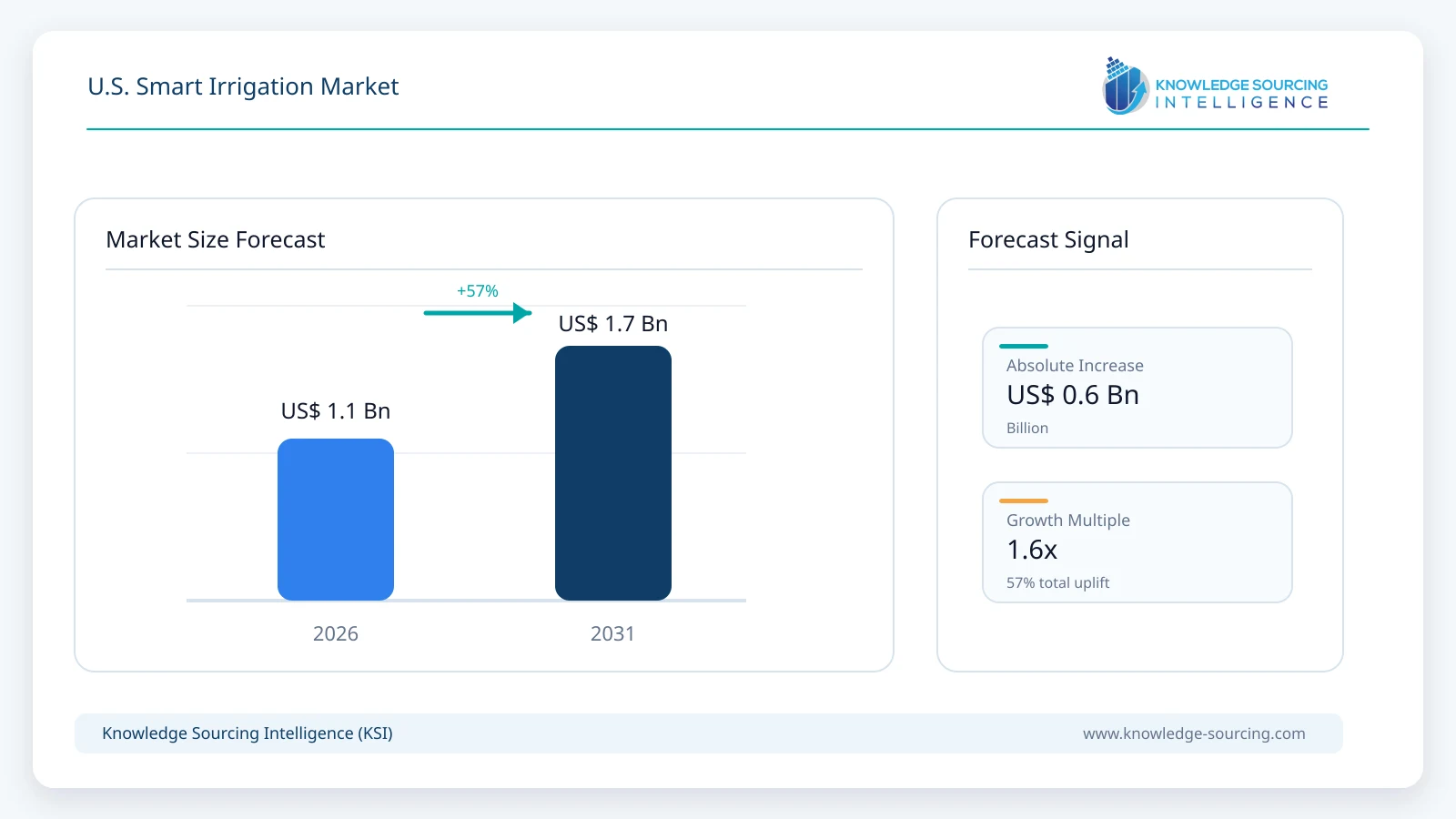
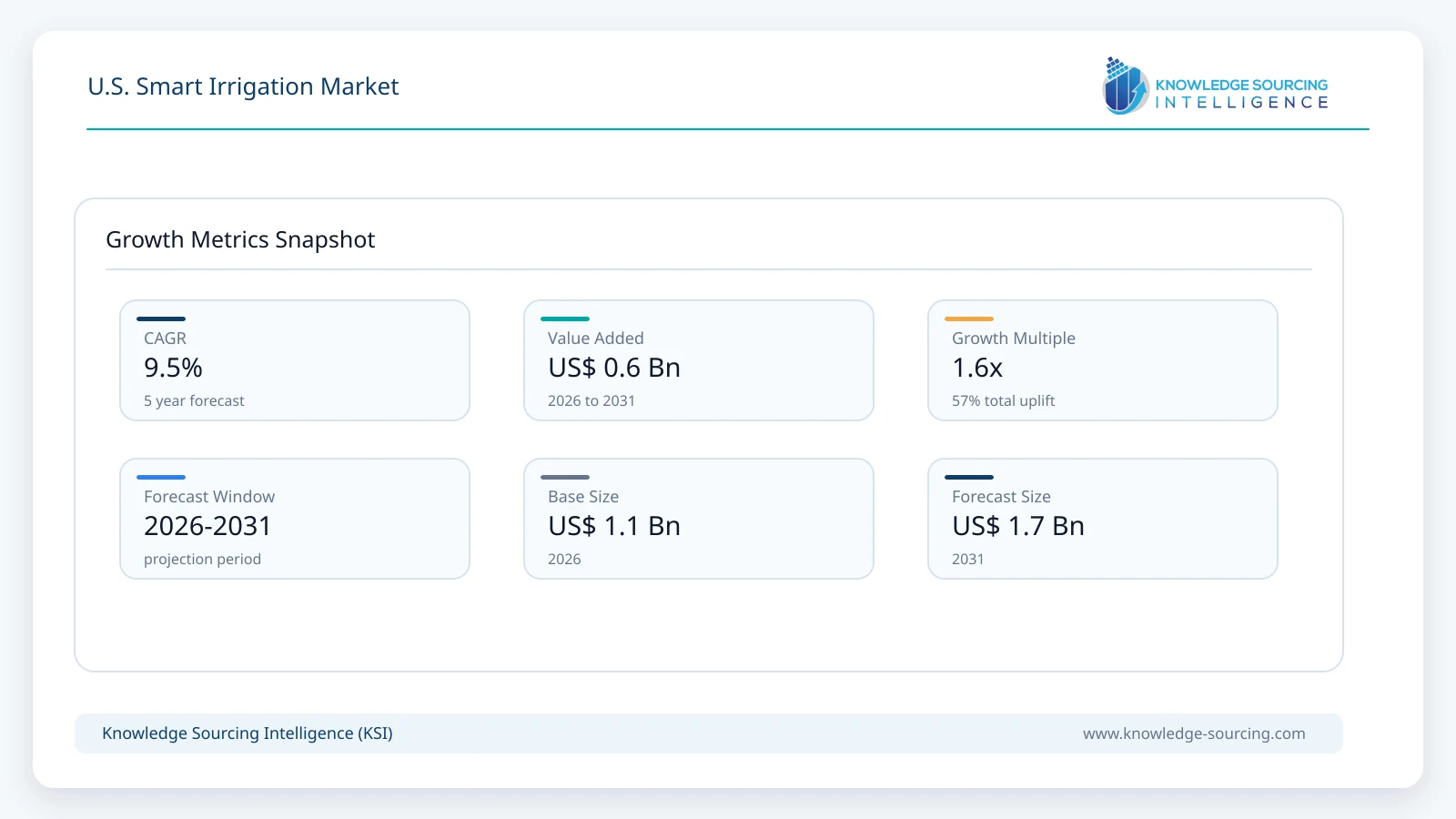
The U.S. Smart Irrigation Market is estimated to grow at a CAGR of 9.5%, moving from USD 1.10 billion in 2026 to USD 1.73 billion in 2031.
Highlights:
- 1Smart controllers account for approximately 34% of U.S. smart-irrigation revenue in 2026.
- 2Non-agricultural applications generate approximately USD 0.61 billion of market value in 2026.
- 3The Western United States contributes approximately 39% of national smart-irrigation revenue in 2026.
- 4Only 27,831 U.S. irrigating farms reported using soil-moisture sensing devices in the 2023 USDA survey.
- 5More than 28 million U.S. homes have in-ground sprinkler systems, creating a large controller retrofit pool.
- 6Rain Bird acquired Rachio in October 2025, combining professional irrigation hardware with connected residential control.
Smart irrigation is the digital control layer applied to irrigation infrastructure. A sprinkler, drip or center-pivot system becomes smart when field or landscape information is used to change irrigation timing, duration, zone-level application or flow automatically or through remote decision support. The relevant technologies include weather-based controllers, soil-moisture sensors, plant and climate sensors, flow meters, connected pump and valve controls, cellular or low-power field telemetry, variable-rate irrigation, cloud dashboards and software that converts weather, soil and crop data into irrigation recommendations. Conventional irrigation equipment without connected intelligence is outside the smart irrigation market; only the smart-control, monitoring and automation value is included.
The addressable U.S. installed base is large. USDA's 2023 Irrigation and Water Management Survey counted 212,714 irrigating farms managing 53.1 million irrigated acres and applying 81.0 million acre-feet of water. Farmers spent USD 3.0 billion on irrigation equipment, facilities, land improvements and computer technology during the year, while energy used for pumping cost another USD 3.3 billion. Those figures describe the broader irrigation economy rather than the smart-irrigation market, but they establish a substantial annual investment pool within which connected controls can gain share. Sprinkler systems covered 30.8 million irrigated acres, creating a particularly relevant base for remote pivot management, variable-rate application and pressure or flow monitoring.
Digital penetration remains far from complete. USDA reported that 27,831 irrigating farms used soil-moisture sensing devices in 2023, equal to roughly 13% of irrigating farms. Only 5,282 reported plant-moisture sensing, 17,533 used commercial or government irrigation-scheduling services and 1,627 used computer simulation models. These categories can overlap and do not map one-for-one to product revenue, but collectively they show that irrigation decision-making is still frequently based on crop observation, soil feel, calendars or water availability rather than continuous digital measurement. That gap is central to the forecast because future market growth can come from retrofitting existing irrigation infrastructure rather than requiring an expansion in total irrigated acreage.
The non-agricultural opportunity is also material. EPA estimates that more than 28 million U.S. homes have in-ground sprinkler systems that traditionally operate through clock-based controllers. WaterSense-labeled weather-based and soil-moisture-based controllers adjust irrigation to weather or actual soil conditions, and EPA estimates that replacement with a WaterSense-labeled controller can save an average home up to 15,000 gallons of water annually. Commercial landscapes, municipalities, campuses, hotels, sports facilities and golf courses extend the same economic logic to larger systems where centralized scheduling, leak detection and flow alarms can reduce both water and labor costs. This broad landscape base explains why non-agricultural demand remains slightly larger than agricultural smart-irrigation revenue even though farms account for the largest individual high-value system deployments.
Market Trends
Smart Irrigation Is Moving From Standalone Controllers to Connected Water-Management Platforms
The product architecture is shifting from isolated controllers toward platforms that combine control, monitoring, alerts and analytics. In agricultural irrigation, Valley's AgSense 365 consolidates remote irrigation management and can monitor and control equipment across brands, while Lindsay's FieldNET NextGen provides map-centered monitoring and system control. Reinke's ReinCloud follows the same direction with remote control, real-time status and alerts. In landscape irrigation, enterprise systems combine weather data, flow monitoring, station-level diagnostics and centralized portfolio management across multiple properties. The commercial implication is an expanding recurring software and service layer around hardware that historically generated mostly one-time equipment revenue. Buyers increasingly evaluate whether systems can integrate existing assets, support mobile access and provide actionable water-use information rather than simply whether a controller can turn zones on and off.
Soil and Crop Sensing Are Becoming More Practical for Mid-Sized Farms
Sensor economics are improving as hardware becomes easier to install and data interpretation moves into cloud platforms. CropX expanded its portfolio in April 2026 with a multi-depth Apex sensor measuring volumetric water content, temperature and salinity across the root zone. Its U.S. case studies show sensors being used by family farms and regional irrigation dealers rather than only large specialty-crop operations. One Colorado farm reported reducing irrigation by roughly one-third after adopting sensor-based decision support with the Colorado Ag Water Alliance. These case studies are not national averages, but they illustrate how sensor packages can be sold as operational tools rather than research instruments. Adoption remains relatively low at the national level, which leaves meaningful room for penetration where pumping energy, water restrictions or high-value crops make the payback easier to demonstrate.
Residential and Commercial Irrigation Are Consolidating Around App-Based Control
Connected residential watering is moving deeper into established irrigation channels. Rain Bird's October 2025 acquisition of Rachio combined one of the largest professional irrigation brands with a widely adopted cloud-connected residential controller platform. Husqvarna has also expanded from residential Orbit and B-hyve products into professional irrigation after acquiring ETwater from Rivulis in 2024 and bringing ETwater's intelligent software together with Hydro-Rain hardware and B-hyve technology under the Husqvarna professional irrigation offering in 2025. These transactions indicate that smart irrigation is becoming a core feature of mainstream irrigation portfolios rather than a standalone consumer-electronics niche. The strategic value lies in pairing installed hardware channels and contractor relationships with software, weather data and connected user interfaces.
Flow Monitoring and Fault Detection Are Becoming More Valuable as Water Prices Rise
Smart irrigation increasingly includes verification of whether water actually moved as intended. Flow monitoring can identify broken lines, stuck valves, leaks, pump problems or unexpected use that a schedule-only controller would miss. USDA reported that 36% of irrigation wells had flow meters in 2023, demonstrating that measurement is already established but far from universal. Commercial landscape platforms similarly use flow data and automatic alerts to identify abnormal consumption across large portfolios. This shifts the value proposition from scheduling alone toward operational assurance. For farms, early detection can prevent crop stress and pumping waste; for commercial users, it can reduce high water bills and property damage. As systems become more connected, the ability to combine controller commands with actual measured flow should become a standard feature in higher-value installations.
Market Drivers
Water Scarcity and Pumping Economics Increase the Value of Precision Control
Water scarcity is most commercially important in the western and southwestern United States, but the efficiency case extends across irrigated agriculture. California, Nebraska, Arkansas, Texas and Idaho together accounted for about half of U.S. irrigated acreage in 2023, while California alone applied 22.6 million acre-feet of irrigation water. Groundwater supplied 54% of water applied to open fields nationally, and farmers spent USD 3.3 billion on pumping energy. Smart irrigation can therefore create value through two channels: reducing unnecessary water application and reducing the energy required to pump that water. The payback is strongest where wells are deep, energy costs are high, allocations are constrained or crops are valuable enough that under-irrigation also carries substantial economic risk.
A Large Retrofit Base Allows Growth Without Expanding Irrigated Acreage
The U.S. smart-irrigation market does not depend on total irrigated acres increasing. USDA reported that irrigated acreage actually declined from 55.9 million acres in 2018 to 53.1 million in 2023. The growth opportunity comes instead from upgrading the installed base. Existing pivots can add connected panels and telemetry, farms can add soil or flow sensors, and conventional landscape controllers can be replaced with weather-based or soil-moisture systems. EPA's estimate of more than 28 million homes with in-ground sprinkler systems demonstrates the scale of the residential replacement pool, while large commercial and municipal landscapes offer higher-value multi-controller opportunities. This installed-base dynamic supports sustained technology growth even when the underlying physical irrigation market is mature.
WaterSense, State Rules and Utility Rebates Reduce Adoption Friction
Public policy is increasingly tied to measurable water efficiency rather than simple conservation messaging. EPA WaterSense provides national performance specifications for weather-based and soil-moisture-based irrigation controllers, giving utilities and buyers a common certification reference. California's updated Model Water Efficient Landscape Ordinance became effective in January 2025 and governs water-efficient landscape design, installation and management for covered new and renovated landscapes. Local programs add direct financial incentives: Scottsdale, Arizona, for example, offers a 2026-2027 residential rebate covering the cost of a WaterSense smart irrigation controller up to USD 250. The amount and eligibility vary by utility, but these programs reduce upfront cost and normalize smart controllers as standard water-efficiency investments.
Market Restraint
Farm Income Cycles and Fragmented ROI Slow Agricultural Adoption
Smart irrigation is exposed to agricultural capital cycles even when its long-term water-saving logic is strong. Lindsay reported an 11% year-over-year decline in North America irrigation revenue in its fiscal third quarter of 2026, citing persistent weakness in commodity markets and tempered farmer sentiment. Valmont has similarly experienced uneven North American agriculture demand even as it continues to invest in precision irrigation. Growers often prioritize replacement of failed pumps, pivots or wells before optional digital upgrades when cash flow is constrained. Smaller farms may also lack staff time to calibrate sensors or interpret data, and wireless connectivity can remain uneven in rural areas. These constraints favor products that retrofit existing equipment, demonstrate a short payback period and require limited additional labor rather than systems that demand a complete infrastructure replacement.
Segment Analysis
By Component - Smart Controllers
Smart controllers are the largest component category because they form the decision and execution point for both landscape and agricultural systems. The category spans residential Wi-Fi controllers, commercial multi-site controllers, smart pivot panels and retrofit control modules. Smart controllers account for approximately 34% of U.S. smart-irrigation revenue in 2026. By 2031, controller revenue is projected to approach USD 0.56 billion as replacement demand expands and connected control becomes embedded in a higher share of new irrigation installations. The category's share gradually moderates because sensors, software and monitoring services grow faster, but controllers remain the central hardware layer through which weather, soil, flow and user instructions are translated into irrigation actions.
By System Type - Sensor-Based and Hybrid Systems
Sensor-based and hybrid irrigation systems are expected to grow at approximately 10.6% annually between 2026 and 2031, slightly faster than the overall market. These systems combine local soil, flow, plant or weather measurements with automated controls rather than relying solely on remote weather feeds. Agricultural users benefit where soil variability makes field-average scheduling less reliable, while high-value landscapes use sensors and flow monitoring to reduce overwatering and identify failures. USDA's relatively low 2023 adoption of soil-moisture sensing shows that the category still has significant penetration potential. Weather-based systems remain highly important in residential and commercial landscapes because they require less field hardware and are easier to retrofit across large installed controller bases.
By Application - Non-Agricultural Irrigation
Non-agricultural irrigation remains the largest application group, supported by residential lawns, commercial landscapes, campuses, municipalities, sports turf and golf courses. Its advantage is the large installed controller base and the ability to demonstrate water savings without depending on crop economics. The segment generates approximately USD 0.61 billion in 2026, while agriculture accounts for the balance and is projected to grow somewhat faster through 2031 as soil sensing, remote pivot management and variable-rate irrigation gain adoption. Commercial and government users also create attractive recurring opportunities because centralized platforms can manage dozens or hundreds of sites and attach software, connectivity and monitoring services to each controller.
By Region - Western United States
The Western United States is the largest regional market because it combines severe water constraints, high irrigated acreage, large specialty-crop economies and mature landscape-conservation programs. California is particularly important across agricultural sensing, weather-based landscape control, commercial property management and utility rebate activity, while Arizona and other arid states provide strong residential and municipal water-efficiency incentives. The region accounts for approximately 39% of U.S. smart-irrigation revenue in 2026 and is projected to reach roughly USD 0.64 billion by 2031. The Midwest remains a major agricultural technology market through center-pivot irrigation in Nebraska, Kansas and surrounding states, while the South contributes through Texas, Arkansas, Florida and large residential landscape markets.
Technology Outlook
AI-Assisted Scheduling and Decision Support
AI is entering irrigation primarily as an analytics layer rather than as a replacement for established agronomic rules. Systems increasingly combine weather forecasts, evapotranspiration, soil data, crop stage, historical use and equipment status to recommend or automatically modify irrigation. The commercial value depends on whether these models improve decisions under variable field conditions, not on the AI label itself. Vineyard imaging, soil-profile interpretation and anomaly detection are early areas of adoption because they can translate data into specific irrigation actions. Human oversight remains important, particularly where water rights, disease risk or crop quality require growers to balance multiple objectives.
Multi-Depth Soil Sensors and Lower-Power Connectivity
Field sensors are becoming more capable while connectivity options expand beyond farm Wi-Fi. Multi-depth probes can measure moisture across the root zone, while cellular and low-power networks allow devices to operate across large fields with limited infrastructure. The next adoption step is denser sensor placement at lower cost so that farms can capture meaningful soil variability without creating an unmanageable maintenance burden. Sensors that integrate directly with irrigation platforms and dealer support networks should have an advantage because growers generally want decisions rather than raw data streams.
Variable-Rate Irrigation and Connected Pivot Control
Mechanized irrigation is moving toward zone-level application and remote operation. Valley's AgSense 365 supports remote monitoring and can work with variable-rate irrigation, while Lindsay's FieldNET and Reinke's ReinCloud extend connected control across center-pivot systems. Valley also introduced a small-field center pivot in February 2026 with optional AgSense integration, expanding connected mechanized irrigation into fields up to about 60 acres where conventional large pivots may be less suitable. These platforms can reduce field visits, automate start-stop decisions and support prescriptions based on soil or topography, which raises the digital value attached to existing mechanical irrigation equipment.
Flow Analytics, Leak Detection and Portfolio Management
For commercial landscapes and municipalities, the most valuable software functions increasingly sit above individual watering schedules. Centralized platforms can compare water use across properties, identify high-flow events, flag broken valves and document conservation performance. Cellular-connected systems reduce dependence on local Wi-Fi and simplify portfolio deployment. This creates an addressable recurring-service market because customers may pay for connectivity, cloud access and analytics in addition to hardware. Over time, smart irrigation is likely to converge with broader building and water-management systems, especially for campuses, hospitality, retail estates and municipal park networks.
Competitive Environment
The U.S. market combines established irrigation manufacturers, agricultural equipment suppliers, specialist digital platforms and sensor companies. Rain Bird, The Toro Company and Hunter Industries have deep contractor and landscape channels, while Rain Bird's acquisition of Rachio adds a strong connected-home platform. Husqvarna has built a broader professional irrigation position around Orbit, Hydro-Rain, B-hyve and ETwater. HydroPoint, Calsense and Weathermatic focus more heavily on commercial and institutional water management, where centralized control and reporting are important. In agriculture, Valmont's Valley/AgSense, Lindsay's FieldNET and Reinke's ReinCloud compete around remote pivot control, while Netafim, Rivulis and CropX address precision water application through drip, fertigation, sensors and agronomy software.
Competitive advantage is increasingly determined by installed-base compatibility and software usability rather than hardware specification alone. A retrofit device that can connect an existing pivot, controller or valve network has a lower adoption barrier than a system requiring complete replacement. Dealer and contractor networks are therefore strategically important because irrigation equipment must be installed, maintained and supported locally. The same logic explains recent consolidation: acquiring a software platform can be more efficient than building a new connected user base from scratch. Rain Bird's Rachio acquisition and Husqvarna's ETwater strategy both pair established irrigation distribution with digital control technology.
Agricultural suppliers face a different constraint: smart technology must generate value during periods of weak farm income as well as strong commodity cycles. Lindsay's 2026 North America irrigation weakness shows that equipment markets can soften even while the long-term precision-agriculture thesis remains intact. Suppliers that can attach recurring software and remote management to the existing fleet may therefore be more resilient than those dependent only on new equipment shipments. The market should continue to support both premium integrated platforms and lower-cost sensor or retrofit options, with the winning model varying by crop value, field size, water cost and user sophistication.
Recent Developments
May 2026: CropX published a Colorado deployment where soil sensors and agronomic support reduced irrigation by roughly one-third on a 400-acre farm.
April 2026: CropX added the Apex multi-depth soil sensor to its platform for higher-resolution root-zone moisture, temperature and salinity measurement.
March 2026: Valley marked the first year of AgSense 365, its consolidated remote irrigation-management platform introduced in 2025.
February 2026: Valley introduced a small-field center pivot for North America with optional AgSense digital monitoring and control.
October 2025: Rain Bird acquired Rachio, adding Rachio cloud-connected controllers to its residential and professional irrigation portfolio.
Market Outlook
The U.S. smart irrigation market is expected to expand faster than the physical irrigated-acre base because most growth comes from upgrading existing systems rather than adding new irrigated land. The market increases from USD 1.10 billion in 2026 to USD 1.73 billion in 2031. Growth is more moderate initially as North American farm-equipment demand remains soft in 2026, then strengthens as connected control and sensor attachment rise across existing pivots, drip systems and landscape controllers. Controller replacement, utility rebates and a growing software and monitoring layer support expansion through 2031.
Agriculture offers the strongest long-run penetration opportunity because USDA data show that digital irrigation-decision tools are still used by a minority of irrigating farms. Adoption should concentrate first in higher-value crops, water-constrained basins and mechanized-irrigation regions where remote control or variable-rate application can reduce labor and pumping cost. Landscape irrigation should remain the larger near-term revenue pool because the U.S. has a very large residential and commercial installed base and because WaterSense specifications, utility rebates and state water-efficiency rules simplify the purchase decision. Software and services should gradually take a larger share of value as customers manage multiple controllers and sensors through common cloud platforms.
The principal downside risk is that water-efficiency technology remains discretionary when farm income or construction activity weakens. Another risk is fragmentation: sensors, controllers and software from different suppliers do not always integrate smoothly, which can raise installation and support costs. The upside case comes from stronger drought restrictions, broader utility rebates, lower sensor cost and more standardized interoperability. Over the forecast period, smart irrigation is likely to become less of a separate product category and more of the expected control layer attached to professional irrigation systems.
U.S. Smart Irrigation Market Scope
| Report Metric | Details |
|---|---|
| Total Market Size in 2026 | USD 1.10 billion |
| Total Market Size in 2031 | USD 1.73 billion |
| Forecast Unit | Billion |
| Growth Rate | 9.5% |
| Study Period | 2021 to 2031 |
| Historical Data | 2021 to 2024 |
| Base Year | 2025 |
| Forecast Period | 2026 – 2031 |
| Segmentation | Component, System Type, Application, Region |
| Companies |
|
Market Segmentation
By Component
Smart Controllers
Sensors and Monitoring Systems
Flow and Pressure Monitoring
Automated Valves and Actuators
Software and Services
By System Type
Weather-Based Systems
Sensor-Based Systems
Hybrid Weather-and-Sensor Systems
By Application
Agriculture
Open-Field and Mechanized Irrigation
Orchards, Vineyards and Specialty Crops
Greenhouse and Protected Agriculture
Non-Agricultural
Residential Landscapes
Commercial and Institutional Landscapes
Municipal Parks and Public Spaces
Golf Courses and Sports Turf
By Region
West
Midwest
South
Northeast
Table of Contents
1. EXECUTIVE SUMMARY
2. MARKET SNAPSHOT
2.1. Market Overview
2.2. Market Definition
2.3. Scope of the Study
2.4. Market Segmentation
3. BUSINESS LANDSCAPE
3.1. Market Drivers
3.1.1. Water Scarcity and Pumping Economics Increase the Value of Precision Control
3.1.2. A Large Retrofit Base Allows Growth Without Expanding Irrigated Acreage
3.1.3. WaterSense, State Rules and Utility Rebates Reduce Adoption Friction
3.2. Market Restraint
3.2.1. Farm Income Cycles and Fragmented ROI Slow Agricultural Adoption
3.3. Market Opportunities
3.4. Porter's Five Forces Analysis
3.5. Industry Value Chain Analysis
3.6. Policies and Regulations
3.7. Strategic Recommendations
4. TECHNOLOGICAL OUTLOOK
4.1. AI-Assisted Scheduling and Decision Support
4.2. Multi-Depth Soil Sensors and Lower-Power Connectivity
4.3. Variable-Rate Irrigation and Connected Pivot Control
4.4. Flow Analytics, Leak Detection and Portfolio Management
5. U.S. SMART IRRIGATION MARKET BY COMPONENT
5.1. Introduction
5.2. Smart Controllers
5.3. Sensors and Monitoring Systems
5.4. Flow and Pressure Monitoring
5.5. Automated Valves and Actuators
5.6. Software and Services
6. U.S. SMART IRRIGATION MARKET BY SYSTEM TYPE
6.1. Introduction
6.2. Weather-Based Systems
6.3. Sensor-Based Systems
6.4. Hybrid Weather-and-Sensor Systems
7. U.S. SMART IRRIGATION MARKET BY APPLICATION
7.1. Introduction
7.2. Agriculture
7.2.1. Open-Field and Mechanized Irrigation
7.2.2. Orchards, Vineyards and Specialty Crops
7.2.3. Greenhouse and Protected Agriculture
7.3. Non-Agricultural
7.3.1. Residential Landscapes
7.3.2. Commercial and Institutional Landscapes
7.3.3. Municipal Parks and Public Spaces
7.3.4. Golf Courses and Sports Turf
8. U.S. SMART IRRIGATION MARKET BY REGION
8.1. Introduction
8.2. West
8.3. Midwest
8.4. South
8.5. Northeast
9. COMPETITIVE ENVIRONMENT AND ANALYSIS
9.1. Major Players and Strategy Analysis
9.2. Agricultural Smart-Irrigation Platforms
9.3. Residential and Commercial Controller Competition
9.4. Sensor and Software Competition
9.5. Mergers, Acquisitions, Agreements and Collaborations
9.6. Competitive Dashboard
10. COMPANY PROFILES
10.1. The Toro Company
10.2. Rain Bird Corporation
10.3. Hunter Industries, Inc.
10.4. Husqvarna Group (Orbit, Hydro-Rain, ETwater)
10.5. HydroPoint Data Systems, Inc.
10.6. Valmont Industries, Inc.
10.7. Lindsay Corporation
10.8. Reinke Manufacturing Co., Inc.
10.9. Netafim USA
10.10. Rivulis Irrigation
10.11. CropX Technologies Ltd.
10.12. Calsense
10.13. Weathermatic
10.14. Nelson Irrigation Corporation
10.15. IRROMETER Company, Inc.
10.16. METER Group, Inc. USA
10.17. Irrigreen, Inc.
10.18. WiseConn Engineering, Inc.
11. APPENDIX
11.1. Currency
11.2. Assumptions
11.3. Base and Forecast Years Timeline
11.4. Key Benefits for Stakeholders
11.5. Research Methodology
11.6. Abbreviations
Navigate
Trusted by the world's leading organizations











