
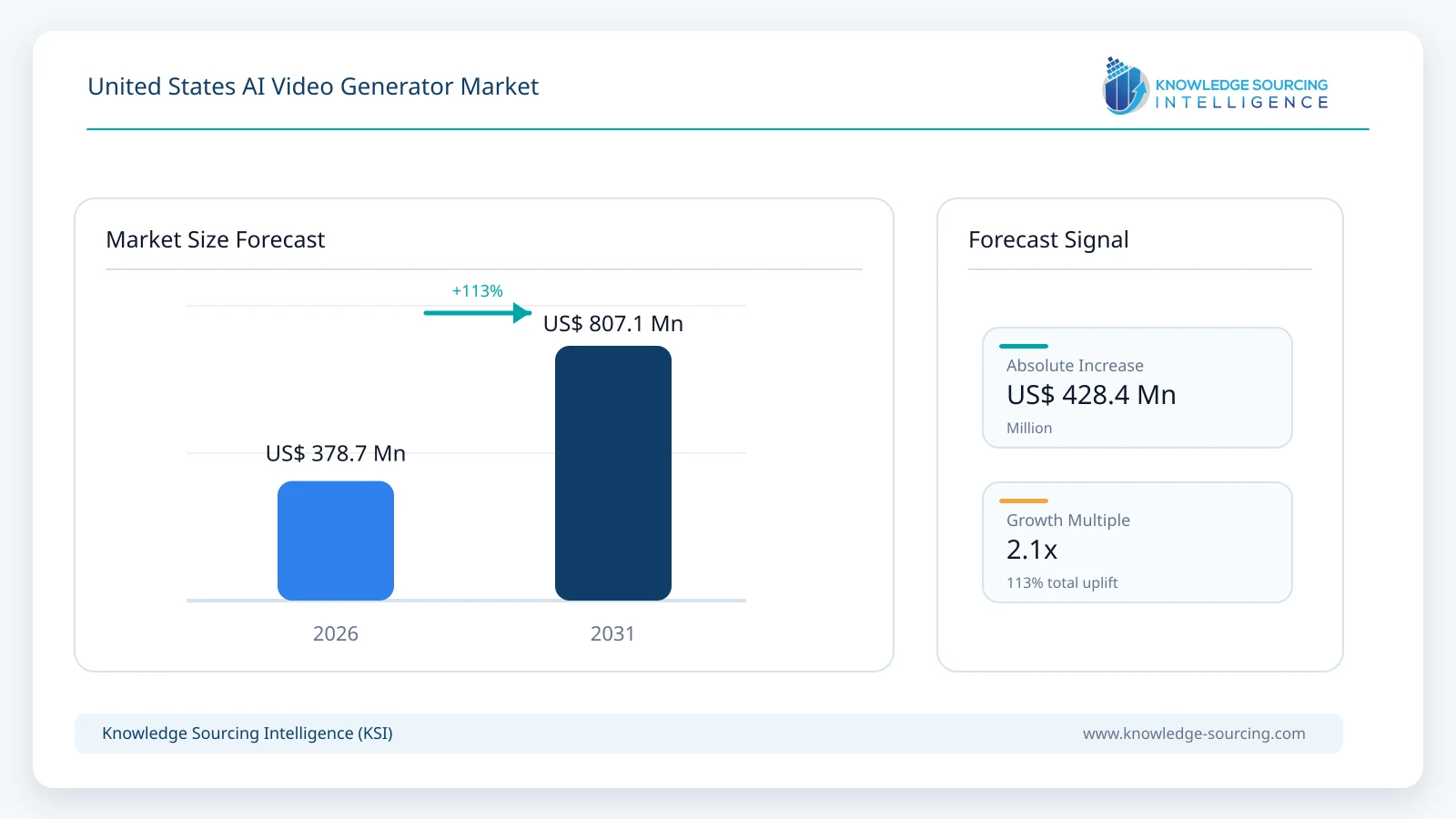
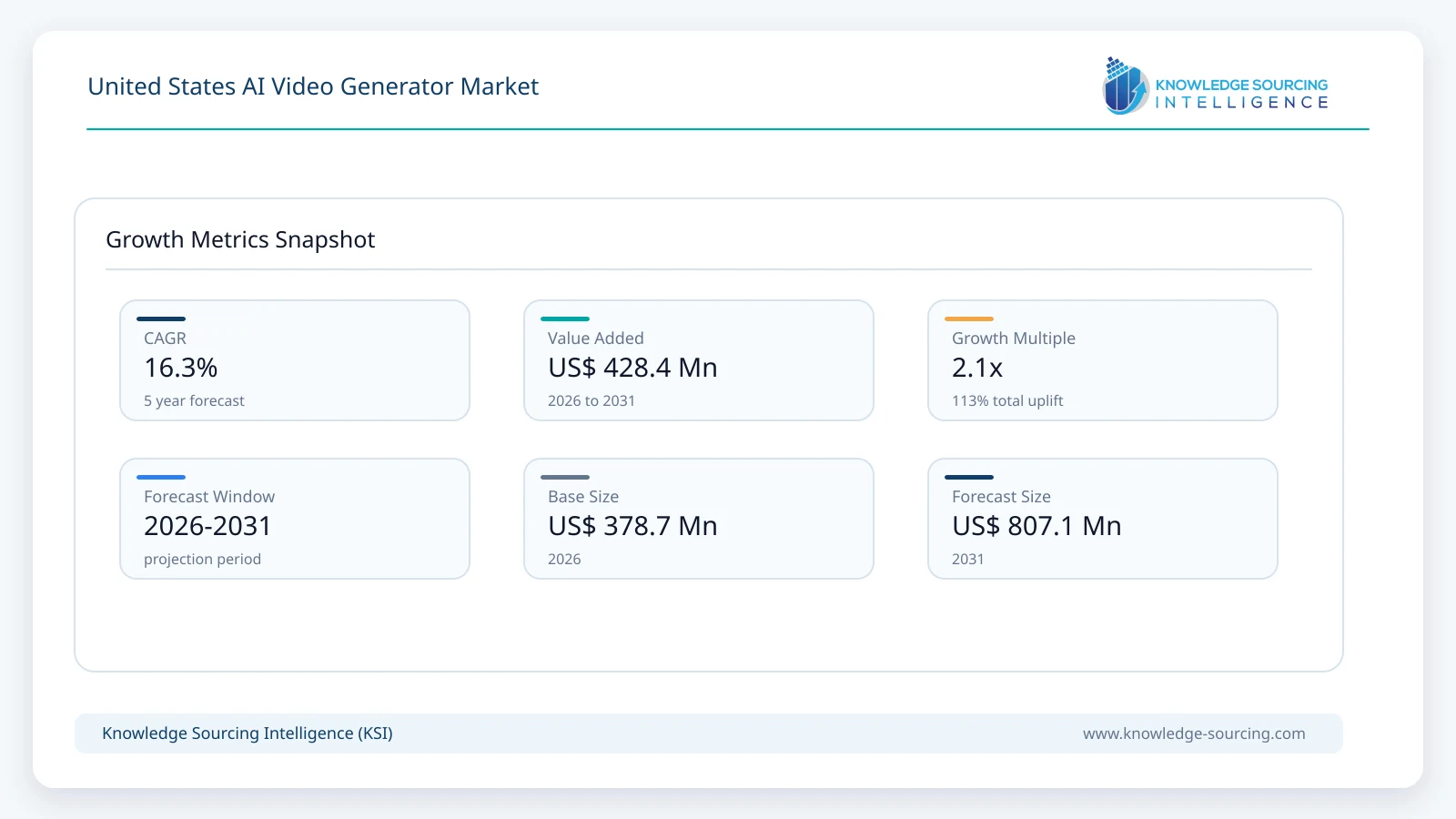
The US AI Video Generator Market is forecast to grow at a CAGR of 16.34%, reaching USD 807.10 million in 2031 from USD 378.70 million in 2026.
Highlights:
- 1Rising enterprise demand for scalable content production is accelerating procurement of AI-powered video generation platforms.
- 2Marketing and advertising remains the largest commercial application because of continuous demand for personalized digital campaigns.
- 3Large enterprises account for substantial spending owing to multi-department deployment and integration with existing enterprise software ecosystems.
- 4Text-to-video technology continues to attract investment as language models improve script generation and creative automation.
- 5Federal attention toward AI governance and transparency is encouraging vendors to strengthen security, content authenticity, and compliance capabilities.
- 6Competition increasingly centers on enterprise integration, multilingual capabilities, workflow automation, and commercial licensing flexibility.
The United States AI video generator market comprises software platforms and related services that use artificial intelligence to create, edit, localize, or enhance video content from text prompts, images, existing videos, presentations, or structured business data. These solutions combine large language models, computer vision, speech synthesis, digital avatars, motion generation, and automated editing capabilities to reduce production time while expanding content personalization. Demand spans enterprise communication, advertising, education, media production, online retail, and internal corporate training, where organizations require faster content creation without proportionately increasing production budgets.
Commercial demand is being shaped by the growing volume of digital content consumed across websites, connected television, social media, mobile applications, and enterprise collaboration platforms. Marketing departments, educational institutions, media publishers, software companies, healthcare organizations, financial institutions, and retailers are adopting AI-generated video to improve customer engagement while shortening campaign development cycles. Procurement decisions increasingly emphasize multilingual output, enterprise-grade security, brand consistency, editing flexibility, API integration, and compliance with corporate governance policies rather than standalone video generation capabilities.
The United States remains one of the largest adopters of generative AI technologies due to its mature cloud infrastructure, high enterprise software spending, extensive digital advertising ecosystem, and concentration of AI developers. Businesses are shifting from pilot deployments toward organization-wide implementation as AI-generated video becomes integrated into customer support, product demonstrations, onboarding materials, investor communications, compliance training, and personalized marketing campaigns. Buyers also seek measurable improvements in content production efficiency, lower outsourcing costs, and improved return on marketing expenditure.
Enterprise purchasing patterns differ by organization size. Large enterprises typically procure AI video generation platforms through annual software agreements integrated with content management systems, customer relationship management platforms, productivity suites, and cloud services. Small and medium enterprises (SMEs) tend to adopt subscription-based platforms that minimize technical complexity while providing templates, avatar libraries, multilingual voiceovers, and automated editing functions. Ease of deployment and predictable operating costs remain decisive purchasing considerations for smaller organizations.
The supplier ecosystem includes platform developers, cloud infrastructure providers, AI model developers, creative software vendors, and implementation partners. Competition extends beyond video generation quality to workflow automation, enterprise governance, collaboration capabilities, and integration with existing business software. Vendors are also investing in proprietary foundation models, synthetic voice technologies, and digital human capabilities to differentiate offerings in enterprise procurement processes.
Growing enterprise familiarity with generative AI is encouraging broader experimentation across departments. Organizations that initially deployed AI for marketing are expanding usage into sales enablement, knowledge management, customer education, and employee communications. This diversification of use cases broadens addressable demand while increasing expectations for reliability, factual accuracy, intellectual property safeguards, and transparent AI governance.
Market Drivers
Expansion of Enterprise Content Production Requirements
Organizations are producing substantially higher volumes of digital content across websites, streaming platforms, social media, internal communications, and customer support channels. Traditional production workflows often struggle to meet growing publishing frequency without increasing creative staffing or outsourcing expenditures.
Corporate buyers therefore seek AI video generation platforms capable of automating scripting, editing, localization, and voice synthesis. Vendors are responding by expanding template libraries, workflow automation, and collaboration tools that reduce production timelines while maintaining brand consistency. This improves operational efficiency and supports recurring subscription revenue.
Growth in Personalized Marketing Campaigns
Digital advertising strategies increasingly rely on audience segmentation, localized messaging, and campaign personalization. Marketing teams require multiple versions of promotional videos tailored to geography, language, demographics, and purchasing behavior.
AI video generation enables businesses to produce numerous customized variants without proportionally increasing production costs. Suppliers continue developing automated avatar creation, multilingual voice cloning, and campaign management capabilities that improve scalability while supporting higher customer engagement across digital channels.
Rising Adoption of AI in Corporate Learning
Organizations continue investing in workforce development as technologies, regulations, and operational procedures evolve. Human resources and learning departments require frequent updates to onboarding materials, compliance modules, product education, and technical training.
AI-generated instructional videos shorten development cycles while enabling rapid revision whenever policies or procedures change. Enterprise customers increasingly value centralized content management, multilingual delivery, accessibility features, and analytics that measure employee engagement and course completion.
Improvements in Cloud Computing and Generative AI Infrastructure
High-performance cloud computing, specialized AI accelerators, and foundation models have substantially improved video generation quality while reducing production time. Businesses can deploy sophisticated AI capabilities without maintaining dedicated computing infrastructure.
Software providers continue enhancing application programming interfaces (APIs), enterprise security features, and scalable cloud deployment models. These improvements reduce implementation barriers and encourage broader commercial adoption across industries.
Market Restraints and Challenges
Intellectual Property and Copyright Uncertainty
Organizations remain cautious about potential copyright disputes involving AI-generated images, voices, scripts, and training datasets. Legal uncertainty affects procurement decisions, particularly among media companies, publishers, and advertising agencies.
Suppliers are responding through commercial licensing agreements, improved content attribution, customer indemnification policies, and greater transparency regarding model training sources. These measures improve buyer confidence but also increase compliance costs.
Enterprise Data Security Concerns
Many organizations generate confidential training materials, financial communications, customer information, and proprietary business content. Uploading sensitive information to AI platforms raises concerns regarding data protection and unauthorized model training.
Enterprise customers increasingly require private cloud deployment, encryption, identity management integration, and contractual data governance commitments before approving procurement. Vendors unable to satisfy these requirements may face slower enterprise adoption.
Quality Assurance and Brand Reputation Risks
Although AI-generated videos have improved considerably, inconsistencies in factual accuracy, visual realism, pronunciation, or cultural appropriateness may still occur. Organizations producing regulated or customer-facing communications require human review before publication.
This additional validation reduces some anticipated productivity gains and increases implementation complexity. Vendors continue improving editing controls, human review workflows, and quality assurance features to address these concerns.
Regulatory Evolution
Federal and state discussions regarding AI transparency, synthetic media disclosure, privacy protection, and consumer safeguards continue to evolve. Organizations deploying AI-generated content must monitor changing compliance obligations across jurisdictions.
Software providers therefore invest in watermarking technologies, content authentication, audit logging, and governance capabilities that help enterprise customers demonstrate responsible AI usage.
Major Segment Analysis
Marketing and Advertising
Marketing and advertising represents the most commercially significant application within the United States AI video generator market because organizations continuously require fresh visual content across multiple digital channels. Brands now manage campaigns spanning social media, streaming services, websites, mobile applications, retail platforms, and email marketing, creating sustained demand for rapid content production.
Marketing departments prioritize platforms capable of generating localized advertisements, promotional explainers, personalized customer messages, product demonstrations, and social media videos with minimal production effort. Buyers also value multilingual support, automated subtitle generation, avatar-based presentations, and integration with marketing automation software.
Competition within this segment extends beyond video quality. Enterprise customers increasingly evaluate analytics capabilities, campaign scalability, workflow integration, brand asset management, and collaboration tools that connect marketing, legal, and creative teams. Vendors offering secure enterprise deployment, commercial licensing flexibility, and extensive automation features are better positioned to secure long-term subscription agreements.
Revenue generation benefits from recurring enterprise software subscriptions, premium AI processing, additional language packages, digital avatar libraries, API usage, and professional implementation services. As marketing departments continue shifting budgets toward measurable digital engagement, AI-generated video is becoming an operational tool rather than an experimental technology.
Competitive Landscape
Competition within the United States AI video generator market combines specialized AI software providers with broader creative technology companies expanding generative AI capabilities into established content ecosystems. Suppliers compete through software functionality, generation quality, enterprise scalability, pricing flexibility, workflow automation, and integration with productivity applications rather than solely on video rendering performance.
Product differentiation increasingly depends on realistic digital avatars, multilingual voice synthesis, presentation automation, collaborative editing environments, API accessibility, enterprise governance, and deployment flexibility. Strategic partnerships with cloud infrastructure providers, enterprise software vendors, educational technology companies, and digital marketing platforms strengthen customer acquisition opportunities.
The competitive environment also reflects continuous investment in proprietary AI models, infrastructure optimization, synthetic media quality, and enterprise security capabilities. Companies operating in this market include Synthesia Ltd., VEED.IO, Rephrase.ai, Lumen5 Technologies Ltd., Colossyan Inc., Canva Pty Ltd., Pictory, OpenAI, Wondershare Technology Co., Ltd. (Filmora), Fliki, Creatify AI, HeyGen, SundaySky, and InVideo.
Recent Developments
June 2026: Runway expanded its collaboration with Lionsgate, broadening the deployment of Runway's generative AI video technologies to support studio production workflows and accelerate AI-powered content creation across entertainment projects.
April 2026: Adobe introduced major Firefly Video Editor enhancements, adding new AI-powered video creation capabilities and support for Kling 3.0 and Kling 3.0 Omni models, further strengthening enterprise-grade AI video production workflows.
Regulatory and Policy Environment
The regulatory environment is evolving alongside wider enterprise deployment of generative AI. Federal agencies continue promoting responsible AI development through governance frameworks emphasizing transparency, security, accountability, and risk management. Guidance from the National Institute of Standards and Technology (NIST), particularly the AI Risk Management Framework, influences procurement practices among both public and private sector organizations by encouraging structured approaches to AI risk assessment and governance.
Organizations generating AI-based video content must also comply with applicable intellectual property laws, consumer protection requirements, privacy regulations, and accessibility obligations where relevant. Enterprise procurement increasingly includes contractual requirements covering data ownership, auditability, cybersecurity, model transparency, and restrictions on secondary use of customer data.
Government agencies and regulated industries are placing greater emphasis on documentation, human oversight, and content authenticity. Vendors that demonstrate alignment with recognized governance frameworks and maintain strong security certifications are likely to strengthen their competitive position in enterprise purchasing decisions.
Outlook and Strategic Implications
The United States AI video generator market is expected to progress from isolated departmental deployments toward enterprise-wide implementation across marketing, education, customer service, compliance, sales enablement, and internal communications. Procurement decisions will increasingly prioritize operational reliability, workflow integration, governance capabilities, and measurable productivity improvements over standalone creative features.
Investment is expected to focus on higher-quality video generation, improved digital human realism, multilingual communication, real-time personalization, API connectivity, and secure enterprise deployment models. Buyers are also likely to favor platforms capable of integrating with existing cloud infrastructure, collaboration software, customer relationship management systems, and learning management platforms.
Competitive positioning will depend on balancing innovation with responsible AI governance. Vendors that provide transparent licensing, enterprise-grade security, scalable deployment options, and consistent output quality are expected to strengthen long-term customer relationships. At the same time, evolving copyright considerations, synthetic media regulation, and enterprise risk management requirements will remain important strategic variables influencing purchasing decisions over the next five years.
United States AI Video Generator Market Scope
| Report Metric | Details |
|---|---|
| Total Market Size in 2026 | USD 378.70 million |
| Total Market Size in 2031 | USD 807.10 million |
| Forecast Unit | Million |
| Growth Rate | 16.34% |
| Study Period | 2021 to 2031 |
| Historical Data | 2021 to 2024 |
| Base Year | 2025 |
| Forecast Period | 2026 – 2031 |
| Segmentation | Component, Input Type, Enterprise Size, Application |
| Companies |
|
Market Segmentation
By Component
By Input Type
By Enterprise Size
By Application
Table of Contents
1. EXECUTIVE SUMMARY
2. MARKET SNAPSHOT
2.1. Market Overview
2.2. Market Definition
2.3. Scope of the Study
2.4. Market Segmentation
3. BUSINESS LANDSCAPE
3.1. Market Drivers
3.2. Market Restraints
3.3. Market Opportunities
3.4. Porter's Five Forces Analysis
3.5. Industry Value Chain Analysis
3.6. Policies and Regulations
3.7. Strategic Recommendations
4. TECHNOLOGICAL OUTLOOK
4.1. AI and Machine Learning Technologies
4.2. Generative AI Models for Video Creation
4.3. AI Avatar and Voice Synthesis Technologies
4.4. Future Technology Trends
5. UNITED STATES AI VIDEO GENERATOR MARKET BY COMPONENT
5.1. Introduction
5.2. Solutions
5.3. Services
6. UNITED STATES AI VIDEO GENERATOR MARKET BY INPUT TYPE
6.1. Introduction
6.2. Text-to-Video
6.3. Image-to-Video
6.4. Video-to-Video
6.5. Presentation-to-Video
7. UNITED STATES AI VIDEO GENERATOR MARKET BY ENTERPRISE SIZE
7.1. Introduction
7.2. Small and Medium Enterprises (SMEs)
7.3. Large Enterprises
8. UNITED STATES AI VIDEO GENERATOR MARKET BY APPLICATION
8.1. Introduction
8.2. Marketing and Advertising
8.3. Education and E-learning
8.4. Media and Entertainment
8.5. E-commerce
8.6. Corporate Training
8.7. Others
9. COMPETITIVE ENVIRONMENT AND ANALYSIS
9.1. Major Players and Strategy Analysis
9.2. Market Share Analysis
9.3. Mergers, Acquisitions, Agreements, and Collaborations
9.4. Competitive Dashboard
10. COMPANY PROFILES
10.1. Synthesia Ltd.
10.2. VEED.IO
10.3. Rephrase.ai
10.4. Lumen5 Technologies Ltd.
10.5. Colossyan Inc.
10.6. Canva Pty Ltd.
10.7. Pictory
10.8. OpenAI
10.9. Wondershare Technology Co., Ltd. (Filmora)
10.10. Fliki
10.11. Creatify AI
10.12. HeyGen
10.13. SundaySky
10.14. InVideo
11. APPENDIX
11.1. Currency
11.2. Assumptions
11.3. Base and Forecast Years Timeline
11.4. Key Benefits for Stakeholders
11.5. Research Methodology
11.6. Abbreviations
LIST OF FIGURES
LIST OF TABLES
Navigate
Trusted by the world's leading organizations











