
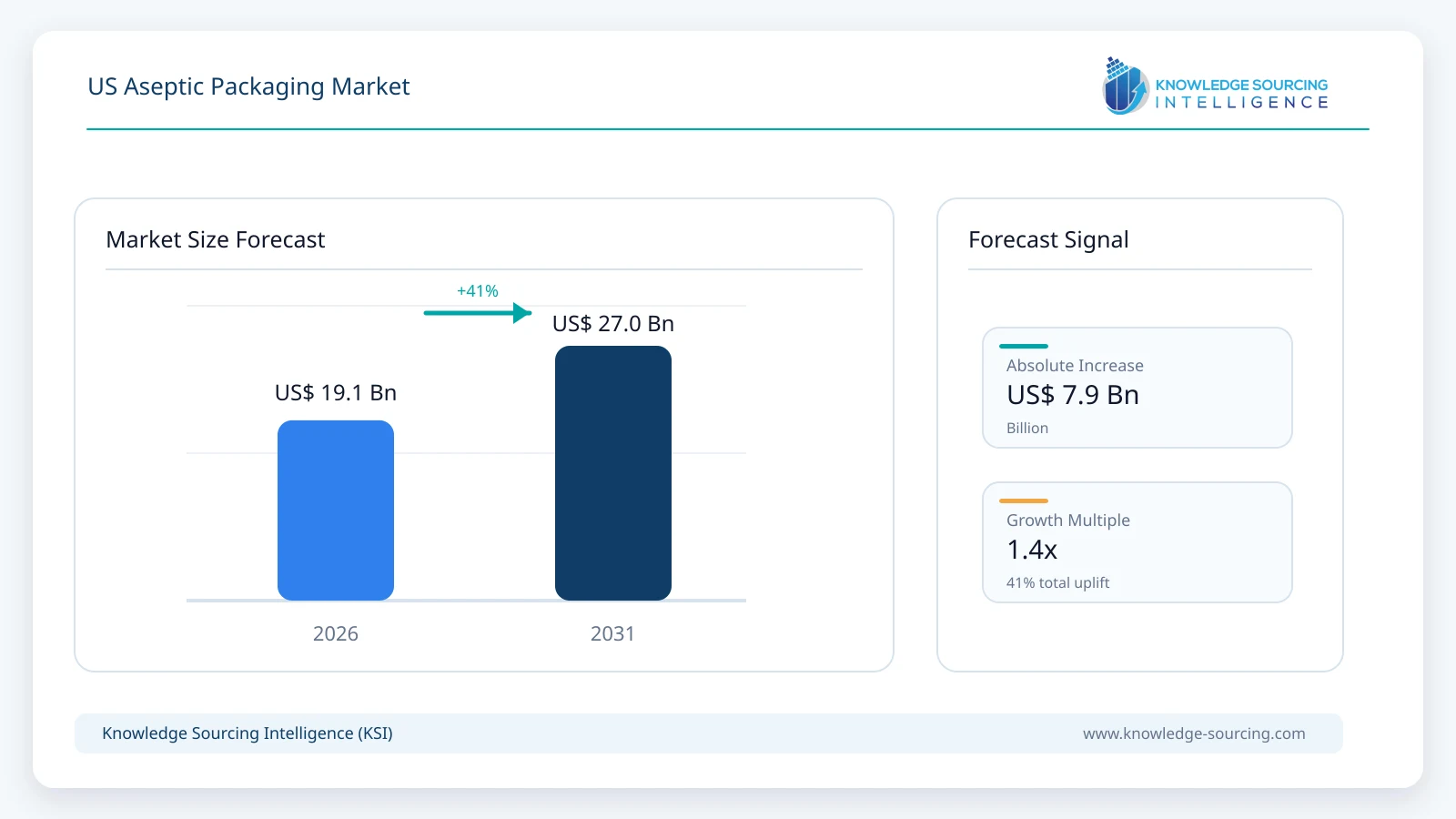
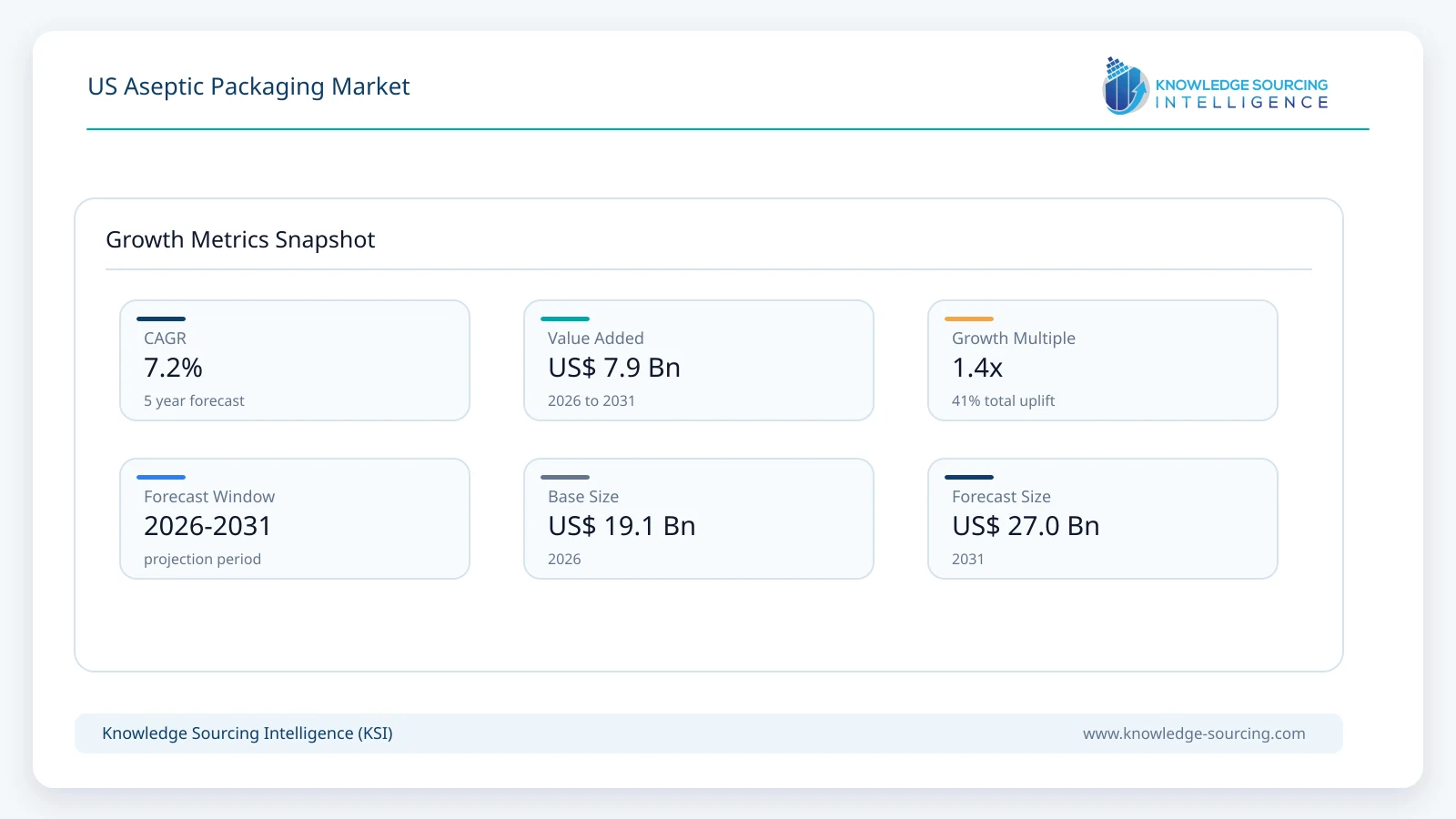
The United States aseptic packaging market is forecast to grow from approximately USD 19.1 billion in 2026 to USD 27.0 billion in 2031 at a CAGR of approximately 7.2%.
Highlights:
- 1Paper-based structures account for approximately 38% of U.S. aseptic packaging market value in 2026, supported by widespread use of aseptic beverage and food cartons.
- 2Cartons and boxes represent approximately 34% of market value in 2026, supported by dairy, plant-based beverages, juice, nutritional drinks and shelf-stable liquid foods.
- 3Beverage packaging accounts for approximately 42% of market value in 2026 and remains the largest application across dairy, plant-based, juice, coffee and nutritional beverages.
- 4Pharmaceutical and healthcare packaging is projected to record the fastest application-level growth at approximately 8.8% annually through 2031 as biologics and injectable therapies increase demand for sterile primary containers.
- 5Tetra Pak’s Denton converting operation has reached capacity of approximately 9.6 billion packages annually, illustrating the scale of U.S. and North American aseptic-carton demand.
Report Overview
The market covers packaging materials, containers and associated sterile packaging formats used to protect commercially sterile food and beverages and sterile pharmaceutical products. Major formats include aseptic cartons, bottles, bag-in-box systems, pouches, vials, ampoules and prefillable syringes. The market excludes conventional non-sterile packaging where aseptic processing, sterile filling or commercial sterility is not required.
Aseptic packaging provides manufacturers with the ability to sterilize a product and package separately before filling and sealing under controlled conditions. USDA describes aseptic packaging as a process in which a sterile food product is filled into a sterilized package and sealed within a hygienic environment, allowing products such as milk, juices, soups, broths, soy beverages, liquid eggs, cream and tea to remain shelf stable without refrigeration before opening. FDA recognizes several commercial aseptic systems in the United States, including web-fed paperboard, preformed paperboard, plastic cups, thermoform-fill-seal systems and bag-in-box configurations.
The U.S. supply base is also expanding. Tetra Pak reported that its Denton, Texas converting facility reached annual production capacity of 9.6 billion packages following recent investment, while SIG announced in April 2026 that it plans to double capacity at its Querétaro plant from 1.5 billion to 3 billion packages annually by 2028, with approximately 30% of current output serving the United States and Canada. These investments demonstrate continued demand for regionally produced aseptic packaging materials despite the maturity of the U.S. packaging industry.
The U.S. market combines two distinct but increasingly important aseptic-packaging ecosystems. Food and beverage applications are dominated by cartons, flexible bag-in-box systems, pouches and selected plastic bottles designed to maintain commercial sterility while enabling ambient distribution. Pharmaceutical applications rely more heavily on glass and polymer vials, ampoules, syringes, closures and container systems that must maintain sterility throughout manufacturing, storage and administration. FDA requires food processors using aseptic systems for low-acid foods to file scheduled processes covering the packaging system and its critical factors, while sterile pharmaceutical manufacturers operate under CGMP requirements governing aseptic processing, environmental control and container closure integrity.
Food and beverage packaging remains the larger volume market, particularly for products where extended shelf life can reduce dependence on chilled distribution. Aseptic cartons can enable unopened products to remain stable for many months, while bag-in-box systems are used extensively in foodservice for dairy products, coffee creamers, beverage concentrates, sauces and other liquid foods. SIG states that its aseptic bag-in-box technology can provide unopened shelf life of up to one year and product evacuation above 99% in many applications, supporting both product-waste reduction and efficient distribution.
Pharmaceutical demand is structurally different but increasingly important in value terms. Prefillable syringes, vials and sterile closure systems are required for biologics, vaccines, GLP-1 drugs and other injectable therapies where contamination cannot be tolerated. SCHOTT Pharma is investing USD 371 million in a new North Carolina plant scheduled to begin operations in 2027, with the company aiming to triple its contribution of glass and polymer syringes to the U.S. market by 2030.
Market Trends
Larger and More Diverse Aseptic Beverage Formats Are Entering the U.S. Market
Aseptic packaging is extending beyond traditional single-serve juice and shelf-stable milk into larger family-size formats, nutritional beverages, ready-to-drink coffee and premium dairy products. In June 2026, Tetra Pak introduced a 48 oz Tetra Brik Aseptic Edge carton for the United States and Canada, expanding its aseptic portfolio into a larger format intended for dairy, juice, plant-based drinks and ready-to-drink coffee. The package is manufactured in Denton, Texas and is designed to combine extended shelf life with improved palletization and distribution efficiency. This development reflects a broader shift in which brands are using aseptic packaging not only to achieve ambient stability but also to differentiate through larger sizes, reclosability, printing and shelf appearance. The expanding range of sizes increases the addressable market because manufacturers can use aseptic platforms across single-serve, household and foodservice channels rather than limiting the technology to selected shelf-stable products.
Aseptic Packaging Is Moving Toward Lower-Aluminium and Higher-Fiber Structures
Environmental performance is becoming an increasingly important design consideration because conventional aseptic cartons combine paperboard, polymers and thin aluminium barriers, creating technical challenges during recycling. Packaging companies are consequently developing alternative barrier structures with greater renewable content and lower aluminium use. Tetra Pak announced an industry-first one-litre aseptic carton with a paper-based barrier in April 2026, reporting that the redesigned structure can reduce the carbon footprint of the package by up to 50% compared with the conventional alternative. Although the initial commercial introduction occurred outside the United States, the development is strategically relevant to the U.S. market because Tetra Pak is already expanding its North American carton capacity and recycling infrastructure. SIG is pursuing a similar direction through lower-material and renewable-content carton structures. As sustainability becomes more closely integrated into procurement decisions, material innovation is likely to shift value toward barrier coatings, specialty polymers and fiber-based structures capable of maintaining sterility without conventional multilayer configurations.
Pharmaceutical Aseptic Packaging Is Moving Toward Prefillable Delivery Systems
Growth in injectable therapies is shifting part of pharmaceutical packaging demand from conventional empty vials toward prefillable syringes and more integrated container-delivery systems. SCHOTT Pharma’s planned USD 371 million North Carolina facility will manufacture both glass and polymer prefillable syringes for mRNA, GLP-1 and other injectable medicines and is expected to begin operations in 2027. West Pharmaceutical Services launched the Synchrony S1 prefillable syringe system commercially in January 2026, with configurations covering biologics and vaccines. The trend reflects a broader industry requirement for packaging systems that can reduce handling steps, improve dose accuracy and maintain drug-container compatibility during increasingly complex storage and distribution conditions. FDA’s continued emphasis on container closure integrity for sterile pharmaceuticals reinforces the requirement for systems that can maintain sterility throughout the product lifecycle rather than simply during filling operations.
Market Drivers
Growth of Shelf-Stable Dairy, Plant-Based and Functional Beverages
The principal food-and-beverage driver is the expanding range of products that benefit from long shelf life without continuous refrigeration. USDA identifies milk, juice, soy beverages, whipping cream, tea, soups and other liquid foods among established aseptic applications, while commercial suppliers are increasingly targeting ready-to-drink coffee, nutritional beverages and plant-based products. Tetra Pak’s 2026 launch of a 48 oz aseptic carton specifically targets premium dairy, juice, plant-based beverages and ready-to-drink coffee, while its 2025 Pack Expo portfolio included both larger and smaller aseptic formats alongside new high-speed filling lines. The economic advantage is particularly relevant where brands can avoid refrigerated storage before opening, extend distribution distances and reduce spoilage. Aseptic systems therefore create value not only through packaging sales but also by allowing manufacturers to launch formulations and distribution models that would be more difficult to support using conventional chilled packaging.
Domestic Investment in Aseptic Production and Packaging Capacity
Capacity investment is providing manufacturers with greater access to locally produced packaging materials and technical support. Tetra Pak’s Denton facility has increased converting capacity to approximately 9.6 billion packages annually, while the company broke ground in March 2026 on an expanded Product Development Center that will include 12,000 square feet of production-development space and a 3,000-square-foot Customer Innovation Center when it opens in 2027. SIG is simultaneously expanding its Querétaro plant, which serves U.S. customers, from 1.5 billion to 3 billion sleeves annually by 2028. The company intends to relocate selected processes currently performed in Europe closer to North American customers, reducing lead times and strengthening regional supply flexibility. These investments lower logistical dependence on imported packaging materials and allow packaging suppliers to work more closely with brands during product development, filling-line qualification and commercial scaling.
Expansion of Injectable Biologics and High-Value Therapies
Injectable medicines create a separate growth engine for aseptic pharmaceutical packaging because many biologics cannot be terminally sterilized after filling and therefore require validated aseptic manufacturing and high-integrity container closure systems. FDA’s guidance requires manufacturers of sterile drug products to control microbial contamination and validate aseptic operations, while container closure systems must provide protection against contamination throughout storage and use. Investment by packaging suppliers demonstrates the scale of expected demand. SCHOTT Pharma’s North Carolina facility is designed specifically to serve mRNA, GLP-1 and other injectable therapies and is expected to enable the company to triple its U.S. supply contribution for glass and polymer syringes by 2030. West is also commercializing integrated prefillable syringe systems for biologics and vaccines. These applications carry higher packaging value per unit than conventional food formats and support above-market growth in the pharmaceutical segment.
Market Restraints
High Capital and Validation Requirements for Aseptic Filling
Aseptic packaging requires considerably more than purchasing a container. Food manufacturers must integrate sterilization, filling, sealing, environmental control and process validation, while pharmaceutical producers must maintain even stricter sterile-manufacturing environments and conduct process simulation studies. FDA requires low-acid aseptic food processors to file scheduled processes covering packaging systems and critical operating factors, and deviations from those factors require formal control. Pharmaceutical operations face additional environmental-monitoring, process-validation and container-integrity requirements. FDA notes that manufacturers of sterile drugs produced by aseptic processing cannot rely solely on ISO cleanroom classification when qualifying facilities and generally expects media-fill validation to represent each production shift. These technical requirements create substantial investment in filling machinery, sterile utilities, maintenance and trained personnel, making conversion economically difficult for smaller processors or products with limited production volumes.
Multilayer Packaging Creates Recycling Complexity
Many aseptic packages achieve long shelf life through combinations of paperboard, polyethylene, aluminium and barrier materials. USDA describes a traditional aseptic carton as approximately 70% paper, 24% polyethylene and 6% aluminium, with each layer contributing structural, sealing or barrier performance. This combination provides strong product protection but creates a more complex recycling pathway than single-material packaging. Suppliers are investing in improved collection and material recovery, but recycling availability remains uneven across U.S. municipalities. Tetra Pak has supported expansion of carton-recycling infrastructure, including a California facility expected to process approximately 1.5 million pounds of carton material per month. The challenge is encouraging development of lower-impact materials without reducing oxygen, moisture and light barriers that make aseptic packaging commercially valuable. Sustainability requirements can therefore increase material-development costs and complicate packaging conversion decisions.
United States Aseptic Packaging Market Segment Analysis
By Packaging Material
Paper
Paper is the largest packaging-material category, supported primarily by aseptic cartons used for dairy, juice, plant-based beverages, nutritional drinks, soups and liquid food products. The segment is projected to reach approximately USD 9.8 billion by 2031. Its growth is increasingly linked to improved barrier performance and higher renewable content rather than simple expansion in conventional paperboard structures. Traditional aseptic cartons use paperboard for structural rigidity together with polymer and aluminium layers for sealing and protection, while suppliers are developing barrier alternatives that reduce dependence on aluminium. Tetra Pak’s 2026 paper-based-barrier development demonstrates the direction of material innovation, while the company’s U.S. converting operations provide annual capacity of approximately 9.6 billion packs. Paper-based aseptic formats benefit from efficient palletization, low package weight and strong branding surfaces, maintaining the category’s leading position despite competition from plastic bottles and flexible pouches.
By Product
Cartons and Boxes
Cartons and boxes represent the largest product category and are projected to reach approximately USD 9.1 billion by 2031. The segment benefits from extensive use across shelf-stable milk, dairy alternatives, juice, nutritional beverages and other liquid foods. Tetra Pak and SIG maintain large installed bases of filling systems in North America, creating recurring demand for proprietary packaging materials once filling equipment is deployed. Tetra Pak’s 2026 U.S. launch of the 48 oz Tetra Brik Aseptic Edge expands the format into larger family-size applications, while SIG continues to add small-volume and differentiated carton capabilities through its North American supply network. Cartons also provide favourable distribution economics because unfilled material can be transported flat and filled near production sites, while rectangular finished packs provide high pallet and shelf-space efficiency. Future segment growth is expected to depend increasingly on differentiated sizes, closures, digital printing and lower-carbon barrier structures.
By Application
Beverage Packaging
Beverages represent the largest application and are projected to reach approximately USD 11.4 billion by 2031. Demand extends across milk, dairy alternatives, juice, coffee, tea, functional drinks, nutritional beverages and other shelf-stable liquid products. Aseptic processing is particularly valuable for beverages because it allows manufacturers to achieve long unopened shelf life without relying on refrigeration or high preservative levels. SIG states that its aseptic cartons and pouches can maintain taste, texture, colour and nutritional content for up to one year in selected applications, while Tetra Pak continues to expand package sizes and filling equipment aimed specifically at beverage producers. Growth is increasingly being supported by functional nutrition and ready-to-drink formats where consumers expect portability and extended shelf life. Pharmaceutical and healthcare packaging grows faster from a smaller base, but beverage applications remain the largest market through 2031 because of their substantially higher packaging volumes.
Competitive Environment and Analysis
The United States market combines global aseptic-carton specialists, flexible-packaging companies and pharmaceutical-container manufacturers. Tetra Pak maintains one of the strongest positions in food and beverage aseptic packaging through its installed filling-equipment base, Denton converting operation and broad carton portfolio. SIG competes across aseptic cartons, bag-in-box systems and spouted pouches and is expanding North American capacity to support U.S. customers. Amcor participates through flexible and healthcare packaging, while Smurfit Westrock, Elopak, Ecolean, Goglio and ProAmpac compete across selected food and beverage packaging applications. Pharmaceutical aseptic packaging has a different supplier base led by companies including SCHOTT Pharma, Gerresheimer, West Pharmaceutical Services and Corning, with competition centered on vials, syringes, cartridges, closures and high-performance drug-containment systems.
Competitive advantage increasingly depends on providing a complete system rather than packaging material alone. Tetra Pak and SIG supply filling equipment, packaging material, digital services and technical support, creating recurring packaging-material demand once customers adopt their platforms. SIG produced approximately 54 billion packages globally in 2025 and had 1,448 aseptic carton filling machines installed worldwide at year-end, illustrating the importance of the installed equipment base to packaging demand. Pharmaceutical suppliers follow a similar logic through qualification and container compatibility: once a drug has been validated with a particular vial, stopper or syringe platform, switching suppliers can require substantial testing and regulatory documentation.
Market Share Analysis
The U.S. aseptic packaging market is concentrated within individual packaging technologies but fragmented when food, beverage and pharmaceutical applications are considered together. Tetra Pak and SIG have the strongest integrated positions in aseptic beverage cartons, with Tetra Pak supported by domestic converting capacity and SIG by regional manufacturing in Mexico and established bag-in-box and pouch capabilities. SIG’s Querétaro expansion will increase plant capacity to 3 billion sleeves annually, strengthening its ability to serve U.S. and Canadian customers.
The pharmaceutical portion is more distributed across specialized suppliers. SCHOTT Pharma, West Pharmaceutical Services, Gerresheimer and Corning compete across glass vials, polymer containers, syringes and sterile drug-delivery components rather than traditional beverage cartons. SCHOTT Pharma’s planned U.S. syringe capacity expansion demonstrates how pharmaceutical suppliers are localizing manufacturing to capture growing injectable-drug demand. Overall market share therefore varies materially by product category, with no single company controlling the full U.S. aseptic packaging market.
Recent Developments
June 2026: Tetra Pak launched a new 48 oz Tetra Brik Aseptic Edge carton in the U.S. and Canada for dairy, juice, plant-based beverages and ready-to-drink coffee.
April 2026: SIG announced plans to double production capacity at its Querétaro North American packaging plant from 1.5 billion to 3 billion packages annually by 2028.
March 2026: Tetra Pak broke ground on an expanded Product Development Center in Denton, Texas, including 12,000 square feet of development space and a 3,000-square-foot Customer Innovation Center scheduled to open in 2027.
January 2026: West Pharmaceutical Services made its Synchrony S1 prefillable syringe platform commercially available for biologics and vaccine applications.
2025: SIG supported Petite Palates in launching what the company described as the first shelf-stable baby meals in the United States using SIG aseptic spouted pouches.
June 2025: Cayuga Milk Ingredients opened a new consumer-products operation as part of a USD 270 million New York expansion incorporating Tetra Pak packaging for aseptic and extended-shelf-life dairy products.
Market Outlook
Beverage packaging remains the largest application, supported by shelf-stable dairy, plant-based beverages, ready-to-drink coffee, nutritional products and juices. Cartons continue to represent the largest product category, while paper-based structures remain the leading material segment due to the scale of aseptic beverage-carton consumption. Growth within these established categories increasingly comes from larger package sizes, improved closures, premium printing, lower-carbon barrier technologies and expansion into products that historically relied on refrigerated distribution.
Pharmaceutical and healthcare applications are expected to grow faster than the overall market as biologics, GLP-1 medicines, mRNA products and other injectable therapies increase requirements for sterile vials, syringes and container closure systems. Investment by SCHOTT Pharma and other suppliers indicates a continued shift toward domestic production of high-value sterile packaging components. Food and beverage packaging remains much larger by unit volume, but pharmaceutical packaging contributes increasing value because of tighter quality requirements and more complex materials.
The competitive structure will increasingly favour suppliers capable of integrating packaging materials, filling systems, technical services and product-development support. Tetra Pak and SIG benefit from large installed filling-equipment bases that generate recurring consumables demand, while specialist pharmaceutical suppliers benefit from lengthy qualification and regulatory processes that create relatively durable customer relationships. Through 2031, the principal technology challenge will be maintaining sterile barrier performance while reducing material intensity and improving recyclability, particularly in multilayer cartons and flexible structures.
US Aseptic Packaging Market Scope:
| Report Metric | Details |
|---|---|
| Total Market Size in 2026 | USD 19.1 billion in 2026 |
| Total Market Size in 2031 | USD 27.0 billion in 2031 |
| Forecast Unit | Billion |
| Growth Rate | CAGR: 7.2% |
| Study Period | 2021 to 2031 |
| Historical Data | 2021 to 2024 |
| Base Year | 2025 |
| Forecast Period | 2026 – 2031 |
| Segmentation | Packaging Material, Product, Application, United States |
| Companies |
|
Market Segmentation
BY PACKAGING MATERIAL
Paper
Plastic
Glass
Metal
BY PRODUCT
Bottles
Cartons and Boxes
Bags
Pouches
Ampoules
Syringes
Vials
Cans
Others
BY APPLICATION
Food Packaging
Beverage Packaging
Pharmaceutical and Healthcare Packaging
Others
COMPETITIVE ENVIRONMENT AND ANALYSIS
Major Players and Strategy Analysis
Market Share Analysis
Mergers, Acquisitions, Agreements, and Collaborations
Competitive Dashboard
Table of Contents
able of Contents
1. INTRODUCTION
1.1. Market Overview
1.2. Market Definition
1.3. Scope of the Study
1.4. Market Segmentation
1.5. Currency
1.6. Assumptions
1.7. Base and Forecast Years
1.8. Key Benefits to Stakeholders
2. RESEARCH METHODOLOGY
2.1. Research Design
2.2. Secondary Research
2.3. Primary Research
2.4. Market Estimation
2.5. Segment Modelling
2.6. Data Triangulation and Validation
3. EXECUTIVE SUMMARY
3.1. Key Findings
3.2. United States Aseptic Packaging Market Size, 2026-2031
3.3. Packaging Material Outlook
3.4. Product Outlook
3.5. Application Outlook
4. MARKET DYNAMICS
4.1. Market Drivers
4.1.1. Growth of Shelf-Stable Dairy, Plant-Based and Functional Beverages
4.1.2. Domestic Investment in Aseptic Production and Packaging Capacity
4.1.3. Expansion of Injectable Biologics and High-Value Therapies
4.2. Market Restraints
4.2.1. High Capital and Validation Requirements for Aseptic Filling
4.2.2. Multilayer Packaging and Recycling Complexity
4.3. Porter’s Five Forces Analysis
4.4. Industry Value Chain Analysis
4.5. Regulatory Environment
4.6. Raw Material and Supply Chain Analysis
5. UNITED STATES ASEPTIC PACKAGING MARKET BY PACKAGING MATERIAL
5.1. Introduction
5.2. Paper
5.3. Plastic
5.4. Glass
5.5. Metal
6. UNITED STATES ASEPTIC PACKAGING MARKET BY PRODUCT
6.1. Introduction
6.2. Bottles
6.3. Cartons and Boxes
6.4. Bags
6.5. Pouches
6.6. Ampoules
6.7. Syringes
6.8. Vials
6.9. Cans
6.10. Others
7. UNITED STATES ASEPTIC PACKAGING MARKET BY APPLICATION
7.1. Introduction
7.2. Food Packaging
7.3. Beverage Packaging
7.4. Pharmaceutical and Healthcare Packaging
7.5. Others
8. COMPETITIVE ENVIRONMENT AND ANALYSIS
8.1. Major Players and Strategy Analysis
8.2. Market Share Analysis
8.3. Mergers, Acquisitions, Agreements, and Collaborations
8.4. Competitive Dashboard
9. COMPANY PROFILES
9.1. Tetra Pak International S.A.
9.2. SIG Group AG
9.3. Amcor plc
9.4. Smurfit Westrock plc
9.5. Elopak ASA
9.6. SCHOTT Pharma AG & Co. KGaA
9.7. Gerresheimer AG
9.8. West Pharmaceutical Services, Inc.
9.9. Corning Incorporated
9.10. Becton, Dickinson and Company
9.11. Ecolean AB
9.12. Goglio S.p.A.
9.13. ProAmpac LLC
9.14. Winpak Ltd.
9.15. AptarGroup, Inc.
10. APPENDIX
Navigate
Trusted by the world's leading organizations











