
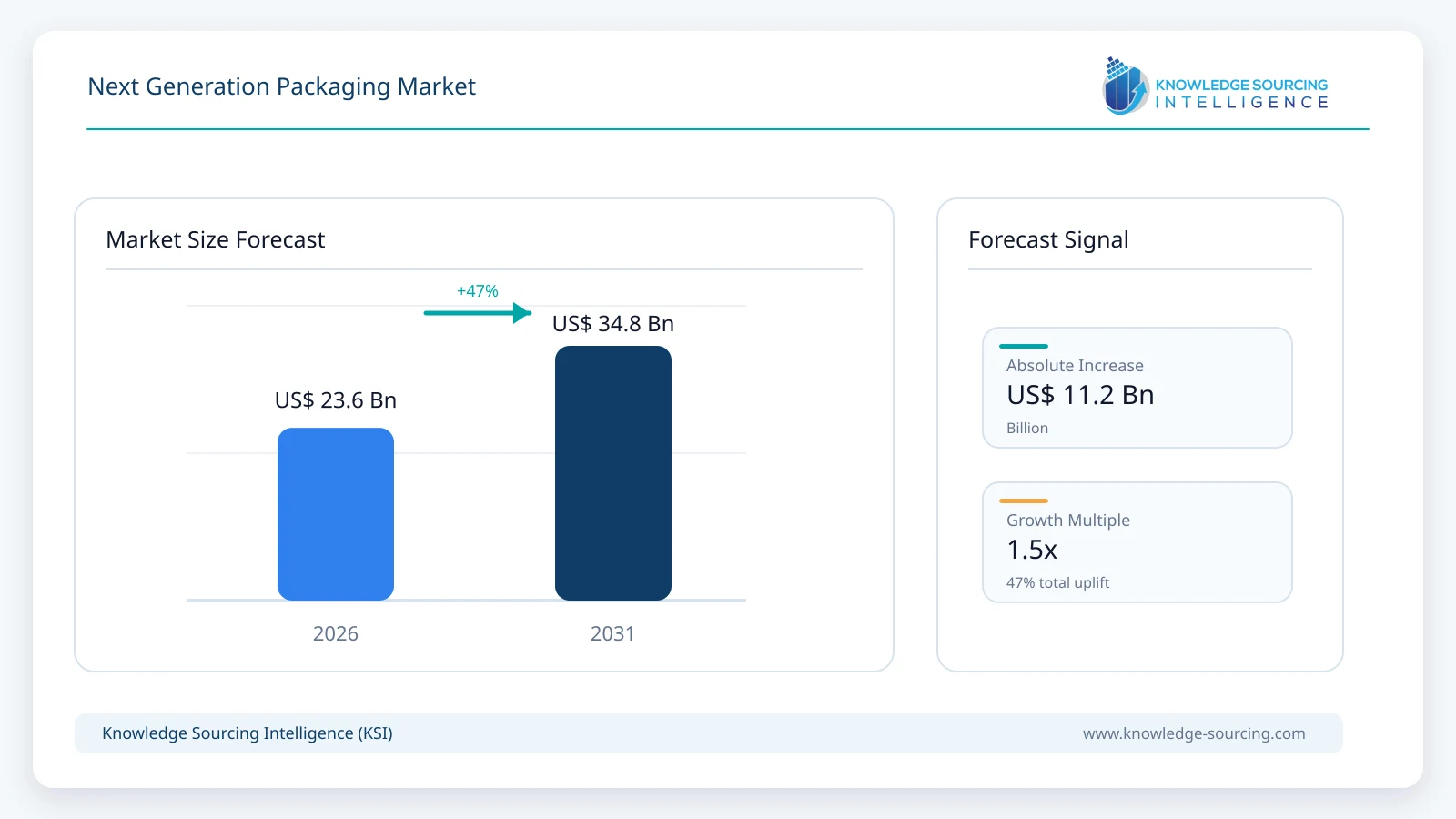
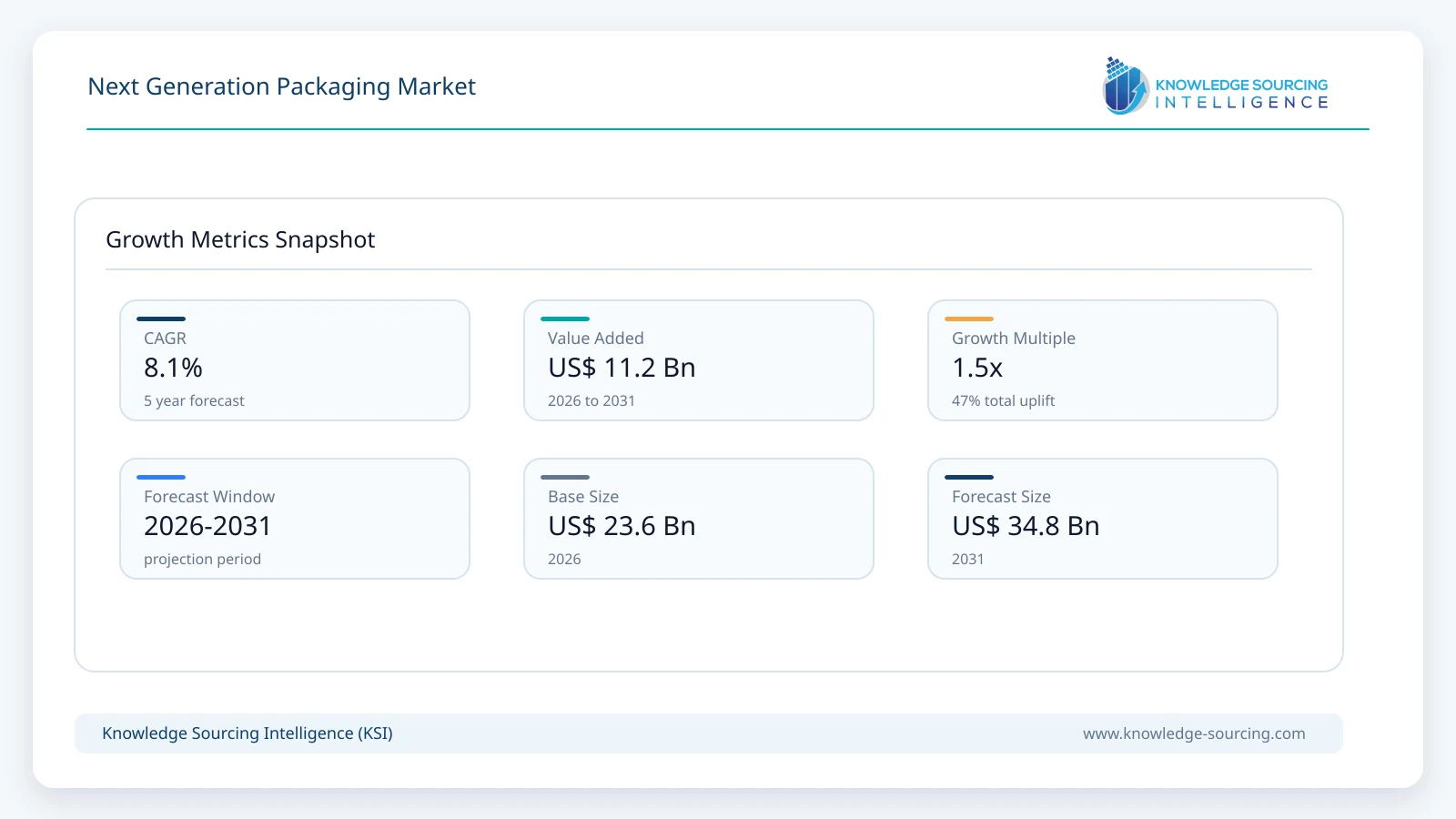
The global next-generation packaging market is estimated at USD 23.60 billion in 2026 and is projected to reach USD 34.80 billion by 2031, growing at a CAGR of 8.1% over 2026-2031.
Highlights:
- 1Intelligent packaging represents approximately 62% of global next-generation packaging revenue in 2026.
- 2RFID expansion is moving from apparel into fresh food, logistics, and reusable packaging.
- 3Active moisture and oxygen management remains critical for pharmaceuticals and sensitive packaged foods.
- 4Serialized digital identities support authentication, traceability, recalls, engagement, and regulatory compliance.
- 5Asia Pacific is gaining smart-label manufacturing capacity alongside rapid modern-retail and logistics growth.
This functional definition excludes the much larger sustainable-packaging and flexible-packaging markets. Growth is being driven by food-waste reduction, cold-chain integrity, pharmaceutical stability, item-level traceability, authentication, inventory automation, and the transition from static barcodes toward digital product identities. The market combines high-volume smart labels with specialized active-material systems, creating different economics across food, healthcare, logistics, and consumer applications.
Market Drivers
RFID is expanding into higher-complexity packaged categories
Item-level RFID has moved beyond apparel into food, logistics, reusable containers, pharmaceuticals, and broader consumer goods. Avery Dennison opened its first RFID inlay production facility in India in April 2025, collaborated with Walmart on RFID-enabled freshness applications in October 2025, and launched the AD IdentiFresh inlay series for bakery, meat, deli, and produce in February 2026. These developments illustrate both geographic capacity expansion and movement into moisture-rich, temperature-sensitive categories that historically presented technical challenges for RFID labels.
Active protection extends shelf life and protects sensitive products
Active packaging remains commercially important where passive barrier materials alone cannot provide sufficient protection. Aptar Active Material Science, Multisorb, Sanner, Mitsubishi Gas Chemical, and other specialists supply oxygen-control, moisture-management, desiccant, and atmosphere-management technologies. Sanner continues to commercialize integrated desiccant pharmaceutical packaging, while Aptar supplies active packaging solutions for food, pharmaceutical, and healthcare applications. These systems create measurable value by reducing moisture or oxygen exposure, protecting product stability, and lowering spoilage or quality loss.
Digital regulation and supply-chain visibility strengthen connected packaging
Brands and regulators increasingly require serialization, traceability, authenticity, and product-level data. RFID, NFC, QR-linked digital identities, tamper evidence, and temperature indicators allow packaging to participate directly in supply-chain control. The economic case is strongest where better inventory accuracy, reduced shrink, fewer write-offs, faster recalls, and product authentication can offset incremental label or sensor cost. The rise of reusable packaging also creates demand for durable digital identifiers that survive multiple circulation cycles.
Market Restraints
Incremental tag, sensor, or active-material cost remains material in low-margin packaged goods.
RFID and connected-packaging deployments require reader infrastructure, software integration, and data governance.
Recycling compatibility can become more complex when electronics, multilayers, or active agents are added.
Technology fragmentation and interoperability requirements can slow multi-country or multi-retailer deployments.
Global Next-Generation Packaging Segment Analysis
By Technology
Intelligent packaging is expected to grow at approximately 9.3% annually through 2031, led by RFID, NFC, serialized digital identities, temperature indicators, and sensor-enabled labels. Active packaging grows more steadily, with oxygen scavengers and moisture-control systems retaining strong positions in food, pharmaceuticals, diagnostics, and medical-device packaging. The distinction is increasingly blurred as some packages combine product-protection functions with digital identification and condition monitoring, but the revenue model remains different between high-volume smart labels and specialized active materials.
By Application
Food and beverages form the largest application because freshness, shelf life, inventory rotation, and waste reduction have direct economic value. Pharmaceuticals and healthcare represent a high-value segment for desiccants, oxygen control, temperature indicators, authentication, and serialization. Logistics and cold-chain applications use smart labels, time-temperature indicators, and reusable-asset tracking. Personal care, consumer products, industrial goods, and returnable packaging contribute additional demand where traceability, engagement, counterfeit protection, or circularity justify added functionality.
Regional Analysis
North America has a large installed base of RFID and connected-packaging deployments and remains an important commercialization market for fresh-food and retail applications. Europe combines active-packaging expertise with regulatory pressure on traceability, food waste, and packaging sustainability.
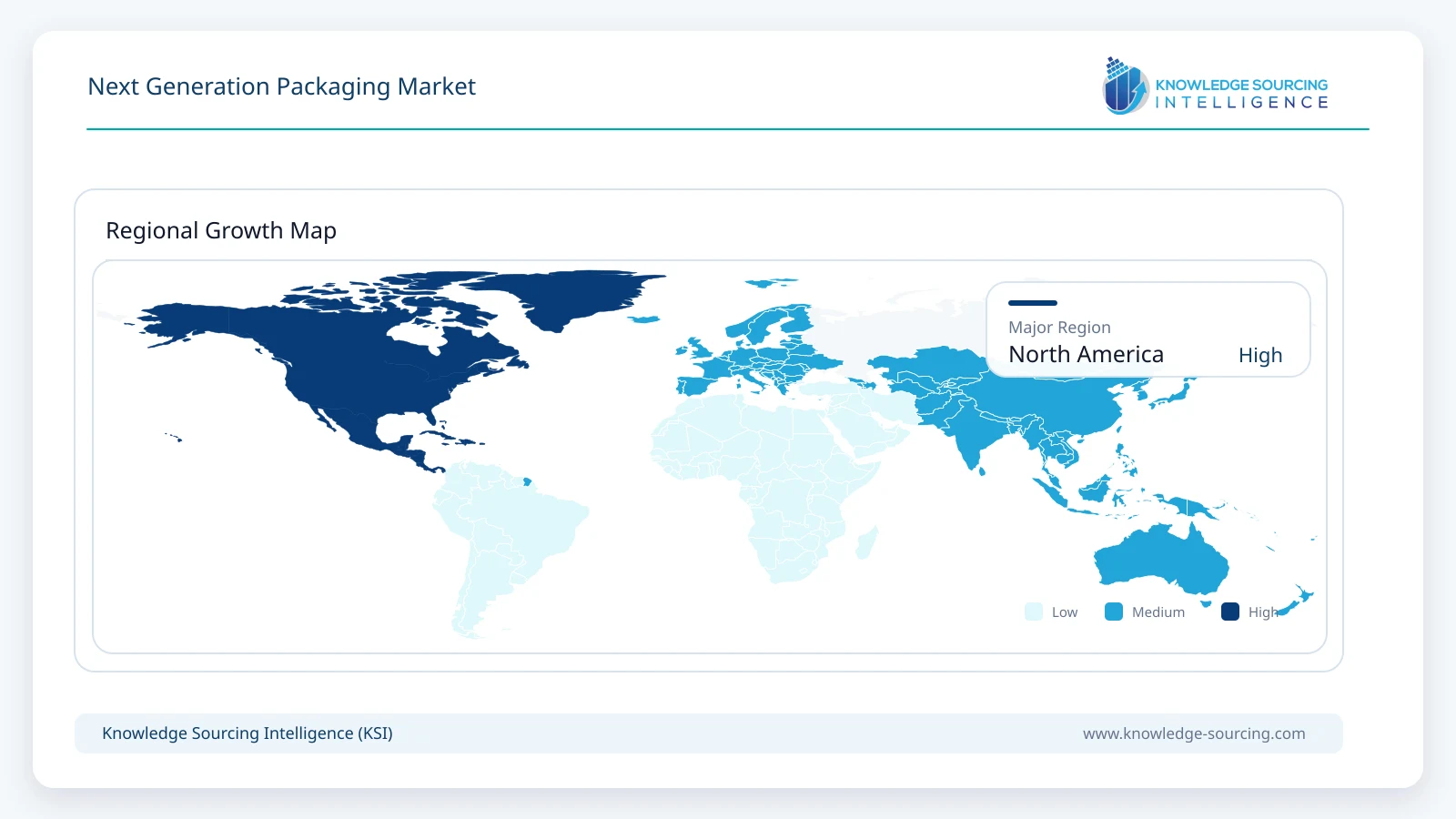
Asia Pacific is the fastest-growing region, supported by manufacturing scale, modern retail, e-commerce logistics, pharmaceutical production, and new RFID capacity in India and China. Latin America and the Middle East and Africa are developing selectively through export-oriented food, pharmaceutical, and cold-chain applications.
Competitive Environment
Competition spans global packaging converters, label and identification specialists, and active-material companies. Amcor, Tetra Pak, Huhtamaki, Mondi, Smurfit Westrock, and Sealed Air integrate advanced functionality into broader packaging portfolios. Avery Dennison and CCL Industries are major smart-label and identification participants. Aptar Active Material Science, Mitsubishi Gas Chemical, Multisorb, and Sanner specialize in active protection, while Timestrip, Insignia Technologies, and SpotSee focus on condition and freshness indicators. WestRock and Smurfit Kappa now operate as Smurfit Westrock, and Berry Global became part of Amcor following their 2025 combination.
Recent Developments
August 2026: Avery Dennison launched AD Fusion, enabling label converters to adopt pre-inserted RFID inlays with lower specialized-capital requirements.
February 2026: Avery Dennison launched AD IdentiFresh RFID inlays for bakery, meat, deli, and produce applications.
February 2026: Avery Dennison announced large-scale integration of flexible NFC integrated circuits into its intelligent-label portfolio.
October 2025: Walmart and Avery Dennison announced an RFID freshness initiative for meat, bakery, and deli departments.
May 2025: Sanner introduced an updated TabTec CR packaging solution with integrated desiccant functionality for oral solid-dose products.
April 2025: Avery Dennison opened its first India-based RFID inlay and label production facility in Pune.
Market Outlook
Next-generation packaging is expected to become increasingly data-enabled through 2031. The highest growth will occur where packaging can produce measurable operating value rather than simply add novelty: inventory accuracy, freshness management, cold-chain assurance, product authentication, compliance, shelf-life extension, and reusable-asset tracking. Active protection will remain essential in sensitive food and healthcare categories, while intelligent labels will scale rapidly as unit costs decline and reader infrastructure becomes more common. Successful suppliers will combine functional performance with recyclability, interoperability, and deployable software or data ecosystems.
Global Next-Generation Packaging Scope:
Market Segmentation
By Technology
Active Packaging
Oxygen Scavengers
Moisture Control and Desiccants
Antimicrobial and Ethylene Control
Other Atmosphere-Management Systems
Intelligent Packaging
RFID and NFC
Serialized QR and Digital Identity
Time-Temperature and Freshness Indicators
Sensors and Connected Packaging
By Application
Food and Beverages
Pharmaceuticals and Healthcare
Logistics and Cold Chain
Personal Care and Consumer Goods
Industrial and Other Applications
By Geography
North America
South America
Europe
Middle East and Africa
Asia Pacific
Table of Contents
1. INTRODUCTION
1.1 Market Definition and Functional Scope
1.2 Exclusions from Conventional and Sustainable Packaging
2. RESEARCH METHODOLOGY
2.1 Market Estimation and Validation
3. EXECUTIVE SUMMARY
4. MARKET DYNAMICS
4.1 Drivers
4.2 Restraints
4.3 Opportunities
4.4 Regulatory and Technology Trends
5. NEXT-GENERATION PACKAGING MARKET BY TECHNOLOGY
5.1 Active Packaging
5.1.1 Oxygen Scavengers
5.1.2 Moisture Control and Desiccants
5.1.3 Antimicrobial and Ethylene Control
5.1.4 Other Atmosphere-Management Systems
5.2 Intelligent Packaging
5.2.1 RFID and NFC
5.2.2 Serialized QR and Digital Identity
5.2.3 Time-Temperature and Freshness Indicators
5.2.4 Sensors and Connected Packaging
6. NEXT-GENERATION PACKAGING MARKET BY APPLICATION
6.1 Food and Beverages
6.2 Pharmaceuticals and Healthcare
6.3 Logistics and Cold Chain
6.4 Personal Care and Consumer Goods
6.5 Industrial and Other Applications
7. NEXT-GENERATION PACKAGING MARKET BY GEOGRAPHY
7.1 North America
7.2 South America
7.3 Europe
7.4 Middle East and Africa
7.5 Asia Pacific
8. COMPETITIVE ENVIRONMENT
9. COMPANY PROFILES
9.1 Amcor plc
9.2 Avery Dennison Corporation
9.3 CCL Industries Inc.
9.4 AptarGroup, Inc.
9.5 Sealed Air Corporation
9.6 Tetra Pak International S.A.
9.7 Huhtamaki Oyj
9.8 Mondi plc
9.9 SpotSee
9.10 Smurfit Westrock plc
9.11 Mitsubishi Gas Chemical Company, Inc.
9.12 Multisorb (Parker Hannifin)
9.13 Sanner GmbH
9.14 Timestrip UK Ltd.
9.15 Insignia Technologies Ltd.
Navigate
Trusted by the world's leading organizations











