
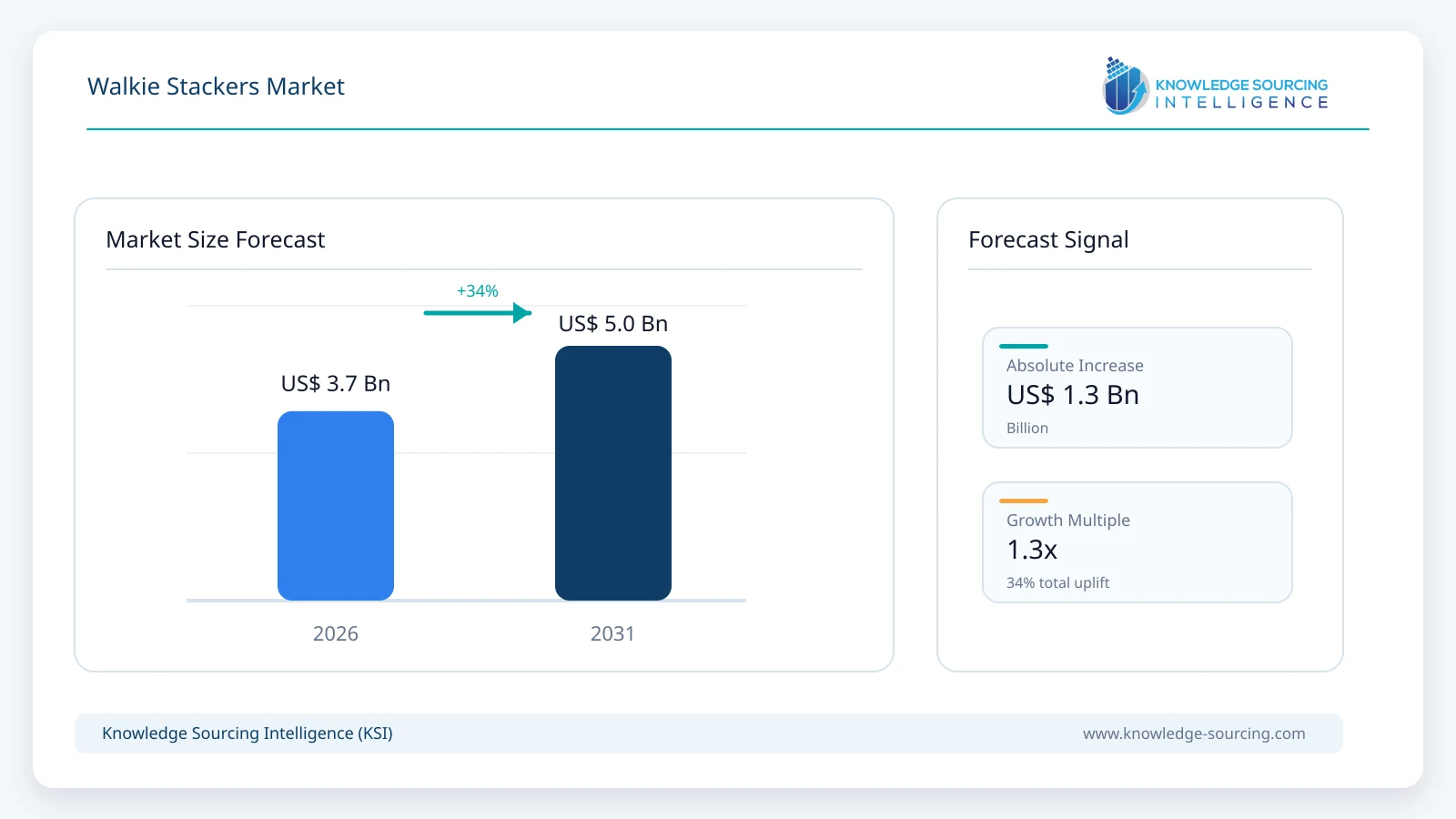
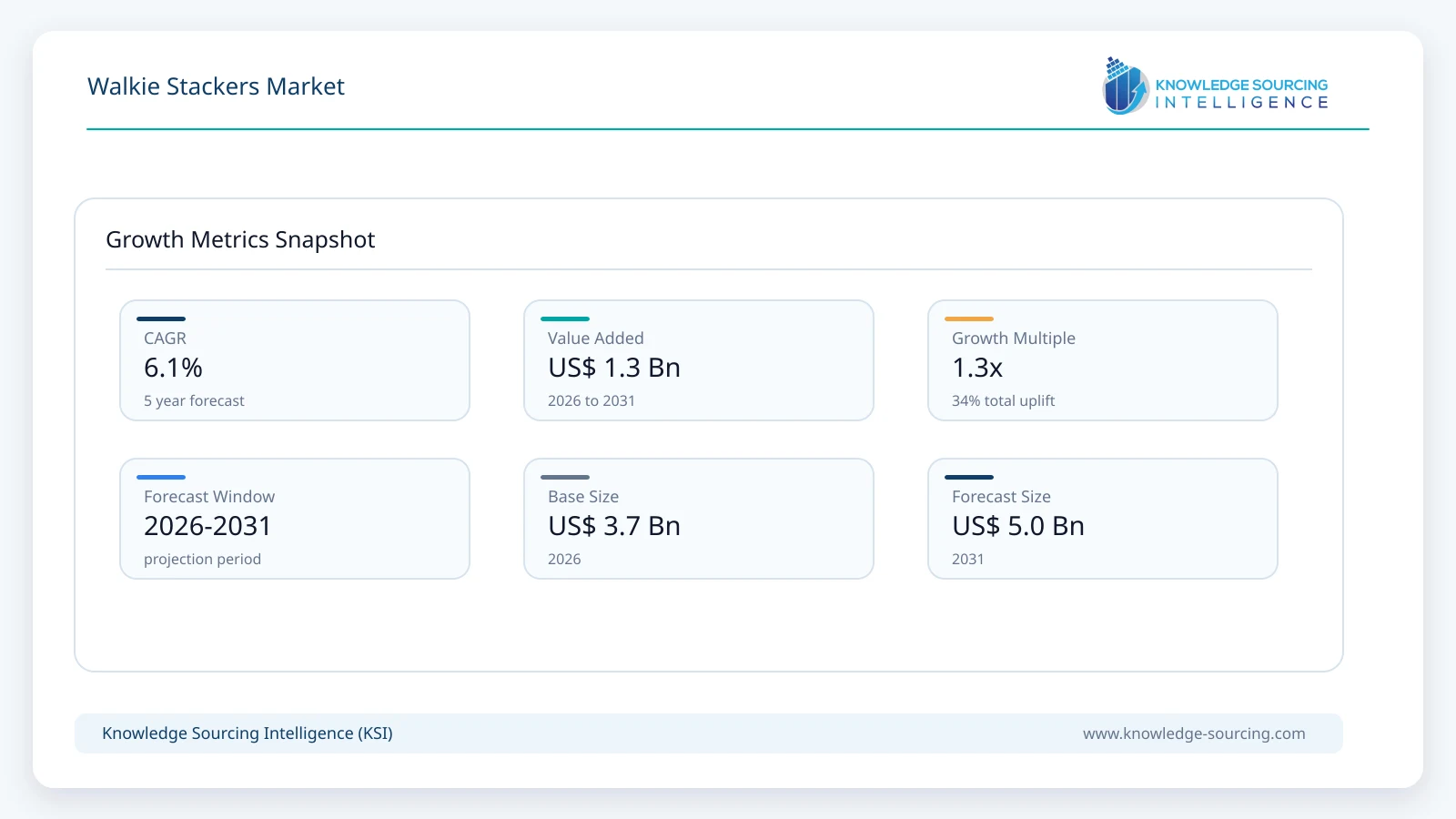
The Walkie Stackers Market is projected to expand at a CAGR of 6.1%, reaching USD 5.03 billion in 2031 from USD 3.74 billion in 2026.
Highlights:
- 1Electric-powered models account for approximately 89% of global walkie stacker revenue in 2026.
- 2Walkie straddle stackers represent approximately 31% of global market revenue in 2026.
- 3Warehousing and logistics demand is projected to grow at approximately 6.6% annually through 2031.
- 4Asia Pacific accounts for approximately 39% of global walkie stacker revenue in 2026.
- 5Connected diagnostics, compact designs and improved ergonomics increasingly shape product differentiation.
Walkie stackers occupy a distinct position between manual pallet-handling equipment and larger rider-operated forklifts. Current products range from compact light-duty stackers used in retail and small warehouses to industrial straddle, reach and counterbalanced models capable of handling heavier loads and higher racking. Toyota Material Handling, for example, offers walkie stackers from approximately 2,000 to 4,000 lb capacities across standard, straddle and reach configurations, while Raymond, Crown, Hyster and Yale maintain similarly broad electric stacker portfolios for confined warehouse environments.
The market is gaining from continued investment in warehouse equipment, but the value trajectory differs from the broader automation market. KION noted that worldwide warehouse-truck orders grew strongly in 2025, driven in part by exceptional demand for entry-level models. At the same time, the company emphasized that average warehouse-truck prices are materially lower than counterbalance forklift prices, meaning strong unit growth does not translate one-for-one into market-value growth. This dynamic is becoming more pronounced as Chinese suppliers expand globally with lithium-ion equipment at aggressive price points and international manufacturers respond with simplified mid-tech product lines and broader dealer coverage.
Market Trends
Lithium-ion power is moving into entry-level stackers. Lithium-ion batteries are no longer confined to premium warehouse trucks. Jungheinrich introduced its compact EJC 1i pedestrian stacker series with a 100% lithium-ion architecture, while Toyota’s Tora-Max walkie stacker uses a 24V lithium-ion battery with an integrated charger. Raymond expanded the trend in 2025 with three lithium-ion walkie stackers spanning straddle, reach and counterbalanced configurations, and Big Joe followed in 2026 with its WS25-40 high-performance lithium-ion stacker. Integrated charging, opportunity charging and lower routine battery maintenance make the technology particularly attractive for small and medium facilities that do not operate dedicated battery rooms.
Mid-tech competition is reshaping product and channel strategy. The faster-growing part of the global industrial-truck market is increasingly price-sensitive. Jungheinrich estimates the global industrial-truck market at about 2.2 million units in 2024 and has highlighted rapid expansion by Chinese manufacturers in domestic and export markets. Its 2025 strategic partnership with EP Equipment, which produced close to 300,000 machines in 2024, reflects how established suppliers are responding by adding lower-cost warehouse equipment and expanding dealer and e-commerce channels. For walkie stackers, this raises competitive pressure on premium brands while improving access to lithium-ion and electric equipment for smaller users in Asia, Latin America and parts of Europe.
Market Drivers
Dense warehouse layouts increase the value of compact vertical handling. Walkie stackers are well suited to facilities where pallet movements are relatively short but operators need to place loads above floor level. Their narrow chassis, low turning radius and lower acquisition cost compared with rider forklifts make them practical for back-of-store storage, light manufacturing, staging zones and smaller distribution centers. Current products from Crown, Toyota, Linde, Hyster and Yale are explicitly designed for confined spaces and low- to medium-height racking, allowing operators to combine transport and stacking functions without dedicating floor area to larger trucks. As businesses increase storage density and use smaller urban or regional fulfillment locations, this operating profile supports replacement and first-time purchases.
Labor productivity and ergonomic handling support replacement of manual equipment. Material handling operations continue to seek productivity gains without requiring additional skilled forklift operators for every movement. Powered walkie stackers reduce the physical effort associated with moving and positioning palletized loads while retaining simple pedestrian operation. Manufacturers are adding electric steering, creep-speed control, proportional lifting, operator-access controls, diagnostics and safety systems that make the equipment easier to deploy across mixed-experience workforces. For facilities currently relying on manual stackers or pallet trucks plus separate lifting equipment, an electric walkie stacker can consolidate tasks and improve cycle consistency, particularly where utilization is too low to justify a larger rider truck.
Market Restraint
Walkie stackers have a narrower duty envelope than rider and reach trucks. The same compact design that makes walkie stackers effective in small spaces limits their suitability for high-throughput warehouses. Pedestrian operating speeds are lower, long travel distances increase operator fatigue, and maximum lift height and residual capacity are generally below those available from dedicated reach trucks or larger counterbalanced forklifts. In facilities with intensive multi-shift operations, tall racking or long transport routes, users often move to platform stackers, rider stackers, reach trucks or automated equipment. This caps the addressable market at the upper end of warehouse throughput and means walkie stackers compete most effectively where maneuverability, flexibility and acquisition cost are more important than maximum speed or lift performance.
Segment Analysis
By Power Type - Electric Powered. Electric-powered stackers account for approximately 89% of global walkie stacker revenue in 2026 and are projected to generate about USD 4.55 billion by 2031. The category includes basic electric drive-and-lift models as well as higher-capacity straddle, reach and counterbalanced trucks. Lithium-ion adoption is increasing fastest in entry-level and mid-duty products because integrated charging removes much of the infrastructure burden associated with traditional industrial batteries. Manual models remain relevant for low-frequency applications and very small facilities, but their lower selling prices and narrower productivity benefits limit their contribution to market revenue.
By Type - Walkie Straddle Stacker. Walkie straddle stackers account for approximately 31% of global walkie stacker revenue in 2026. The segment remains one of the largest configuration groups because adjustable or fixed outriggers allow these units to work with a wide variety of pallet and skid formats while maintaining stability in tight aisles. Their versatility makes them common in general warehousing, manufacturing supply areas and retail distribution. The segment is expected to add roughly USD 0.44 billion of annual revenue between 2026 and 2031 rather than growing through a dramatic change in market share. Higher-capacity models and lithium-ion variants support value growth, while walkie reach and counterbalanced stackers expand faster in applications requiring greater pallet access flexibility.
By End User - Warehousing and Logistics. Warehousing and logistics remain the largest demand pool and are projected to expand at approximately 6.6% annually through 2031, reaching about USD 2.87 billion in market revenue by 2031. The segment includes third-party logistics facilities, regional distribution centers, fulfillment operations and general storage sites where pallet transport distances are short enough for pedestrian operation. Walkie stackers are particularly useful as secondary equipment around staging areas, docks, reserve storage and low-throughput aisles where deploying a full-size forklift would be inefficient. Retail and e-commerce operations grow somewhat faster from a smaller base as compact fulfillment locations increase their use of powered material-handling equipment.
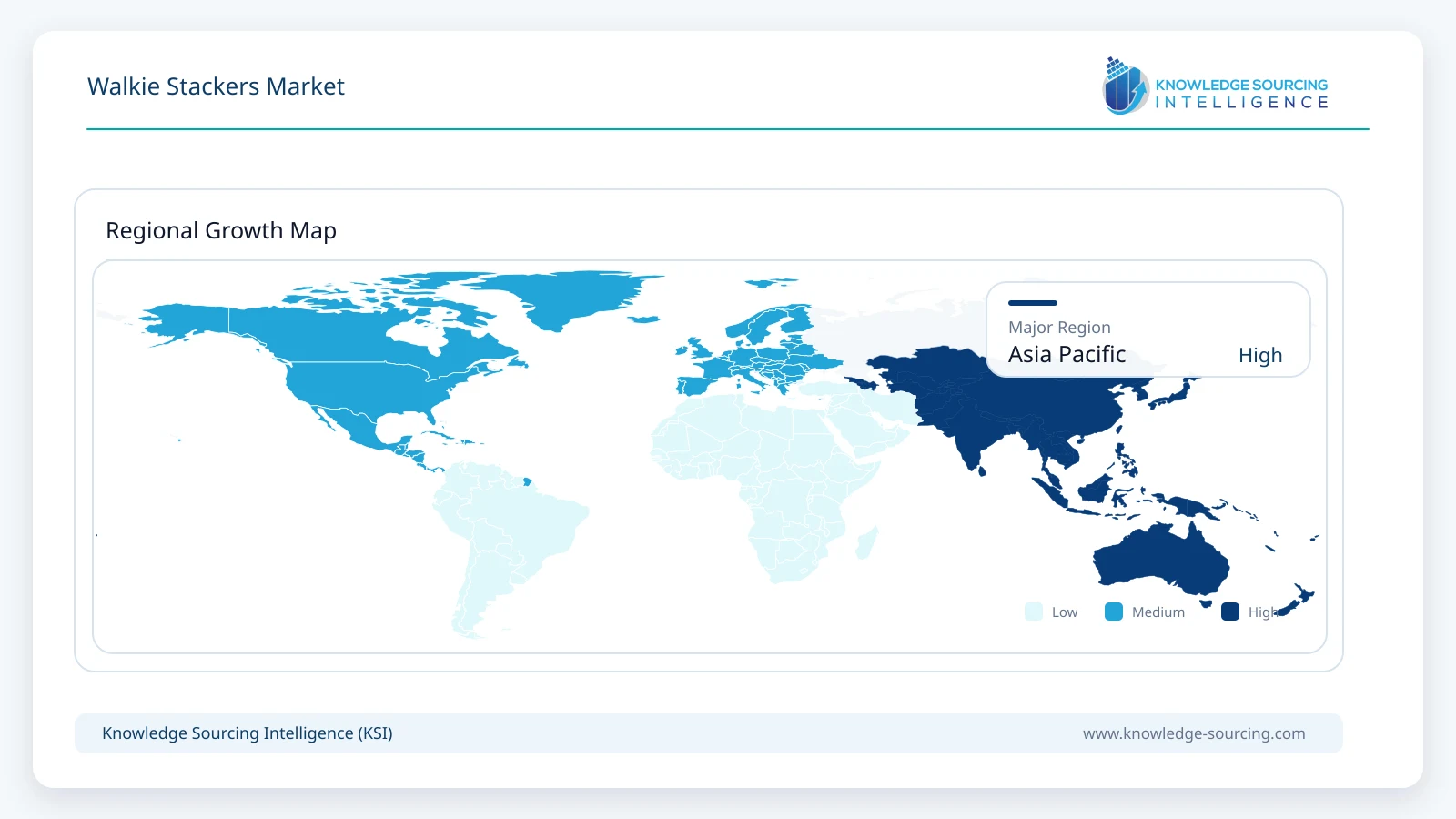
By Geography - Asia Pacific. Asia Pacific accounts for approximately 39% of global walkie stacker revenue in 2026 and is projected to approach USD 2.17 billion by 2031. The region combines the largest manufacturing base for lower-cost warehouse trucks with rapidly expanding logistics and industrial demand. China is particularly important because domestic manufacturers have increased both production scale and exports of electric warehouse equipment, intensifying competition across value and mid-tech segments. North America and Europe remain substantial premium markets with strong installed fleets and replacement demand, while South America and the Middle East expand from smaller bases as warehouse infrastructure modernizes.
Competitive Environment
The competitive landscape spans global full-line forklift manufacturers, warehouse-equipment specialists and lower-cost Asian suppliers. Toyota Material Handling, Crown Equipment, Jungheinrich, KION Group brands, Hyster-Yale and Mitsubishi Logisnext compete through broad product ranges, dealer coverage, service capability and fleet relationships. EP Equipment, Hangcha, Anhui Heli and Noblelift are increasingly influential in entry-level and mid-tech electric equipment, where lithium-ion power, simplified specifications and aggressive pricing are expanding international reach.
Product differentiation is concentrated around maneuverability, residual load capacity, battery uptime, operator ergonomics, maintenance access and digital fleet connectivity rather than radical changes in basic truck architecture. Raymond’s 2025 launch of new heavy-duty lithium-ion stackers with optional iWAREHOUSE connectivity illustrates the movement toward smarter compact equipment, while the Jungheinrich-EP partnership shows that portfolio breadth and cost position are becoming equally important. Regional and specialist suppliers continue to compete effectively where local service, short lead times or application-specific configurations matter more than global scale.
Recent Developments
February 2026 - Big Joe Forklifts launched the WS25-40 high-performance lithium-ion walkie straddle stacker, with capacities from 2,500 to 4,000 lb and a compact design aimed at narrow warehouse and production spaces.
August 2025 - The Raymond Corporation launched the 6310 Walkie Straddle Stacker, 6410 Walkie Reach Stacker and 6510 Walkie Counterbalanced Stacker, all using lithium-ion power and offering optional integration with its iWAREHOUSE platform.
May 2025 - Jungheinrich and EP Equipment announced a strategic partnership to expand electric warehouse and mid-tech product coverage, with EP supporting the new AntOn by Jungheinrich value-focused portfolio.
Walkie Stackers Market Scope
| Report Metric | Details |
|---|---|
| Total Market Size in 2026 | USD 3.74 billion |
| Total Market Size in 2031 | USD 5.03 billion |
| Forecast Unit | Billion |
| Growth Rate | 6.1% |
| Study Period | 2021 to 2031 |
| Historical Data | 2021 to 2024 |
| Base Year | 2025 |
| Forecast Period | 2026 – 2031 |
| Segmentation | Power Type, Type, End User, Geography |
| Companies |
|
Market Segmentation
By Power Type
Manual Powered
Electric Powered
By Type
Walkie Straddle Stacker
Walkie Reach Stacker
Standard Walkie Stacker
Walkie Counterbalanced Stacker
Others
By End User
Warehousing and Logistics
Manufacturing
Retail and E-Commerce
Food and Beverage
Pharmaceuticals and Healthcare
Others
By Geography
North America
USA
Canada
Mexico
South America
Brazil
Argentina
Others
Europe
Germany
United Kingdom
France
Italy
Spain
Netherlands
Others
Middle East and Africa
Saudi Arabia
UAE
South Africa
Others
Asia Pacific
China
Japan
South Korea
India
Australia
Indonesia
Others
Table of Contents
1. EXECUTIVE SUMMARY
1.1. Market Overview
1.2. Key Findings
1.3. Market Opportunities
2. MARKET SNAPSHOT
2.1. Market Definition
2.2. Market Segmentation
2.3. Market Size and Forecast
3. BUSINESS LANDSCAPE
3.1. Market Drivers
3.1.1. Dense Warehouse Layouts Increase Demand for Compact Vertical Handling
3.1.2. Labor Productivity and Ergonomic Handling Support Equipment Replacement
3.2. Market Restraint
3.2.1. Narrower Duty Envelope Than Rider and Reach Trucks
3.3. Market Opportunities
3.4. Porter's Five Forces Analysis
3.5. Industry Value Chain Analysis
3.6. Safety and Regulatory Environment
3.7. Strategic Recommendations
4. MARKET TRENDS
4.1. Lithium-Ion Power Moves Into Entry-Level Stackers
4.2. Mid-Tech Competition Reshapes Product and Channel Strategy
4.3. Connected Diagnostics and Fleet Visibility
5. WALKIE STACKERS MARKET BY POWER TYPE
5.1. Introduction
5.2. Manual Powered
5.3. Electric Powered
6. WALKIE STACKERS MARKET BY TYPE
6.1. Introduction
6.2. Walkie Straddle Stacker
6.3. Walkie Reach Stacker
6.4. Standard Walkie Stacker
6.5. Walkie Counterbalanced Stacker
6.6. Others
7. WALKIE STACKERS MARKET BY END USER
7.1. Introduction
7.2. Warehousing and Logistics
7.3. Manufacturing
7.4. Retail and E-Commerce
7.5. Food and Beverage
7.6. Pharmaceuticals and Healthcare
7.7. Others
8. WALKIE STACKERS MARKET BY GEOGRAPHY
8.1. Introduction
8.2. North America
8.2.1. USA
8.2.2. Canada
8.2.3. Mexico
8.3. South America
8.3.1. Brazil
8.3.2. Argentina
8.3.3. Others
8.4. Europe
8.4.1. Germany
8.4.2. United Kingdom
8.4.3. France
8.4.4. Italy
8.4.5. Spain
8.4.6. Netherlands
8.4.7. Others
8.5. Middle East and Africa
8.5.1. Saudi Arabia
8.5.2. UAE
8.5.3. South Africa
8.5.4. Others
8.6. Asia Pacific
8.6.1. China
8.6.2. Japan
8.6.3. South Korea
8.6.4. India
8.6.5. Australia
8.6.6. Indonesia
8.6.7. Others
9. COMPETITIVE ENVIRONMENT AND ANALYSIS
9.1. Major Players and Strategy Analysis
9.2. Market Share Analysis
9.3. Mergers, Acquisitions, Agreements and Collaborations
9.4. Competitive Dashboard
10. COMPANY PROFILES
10.1. Toyota Material Handling
10.2. Crown Equipment Corporation
10.3. Jungheinrich AG
10.4. KION Group AG (Linde Material Handling and STILL)
10.5. Hyster-Yale, Inc.
10.6. Mitsubishi Logisnext Co., Ltd.
10.7. EP Equipment Co., Ltd.
10.8. Hangcha Group Co., Ltd.
10.9. Anhui Heli Co., Ltd.
10.10. Noblelift Intelligent Equipment Co., Ltd.
10.11. Clark Material Handling Company
10.12. Doosan Bobcat Inc.
10.13. Hyundai Material Handling
10.14. Big Joe Forklifts
10.15. Pramac
10.16. EKKO Material Handling Equipment
10.17. Logitrans A/S
11. APPENDIX
11.1. Currency
11.2. Assumptions
11.3. Base and Forecast Years Timeline
11.4. Key Benefits for Stakeholders
11.5. Research Methodology
11.6. Abbreviations
Navigate
Trusted by the world's leading organizations











