
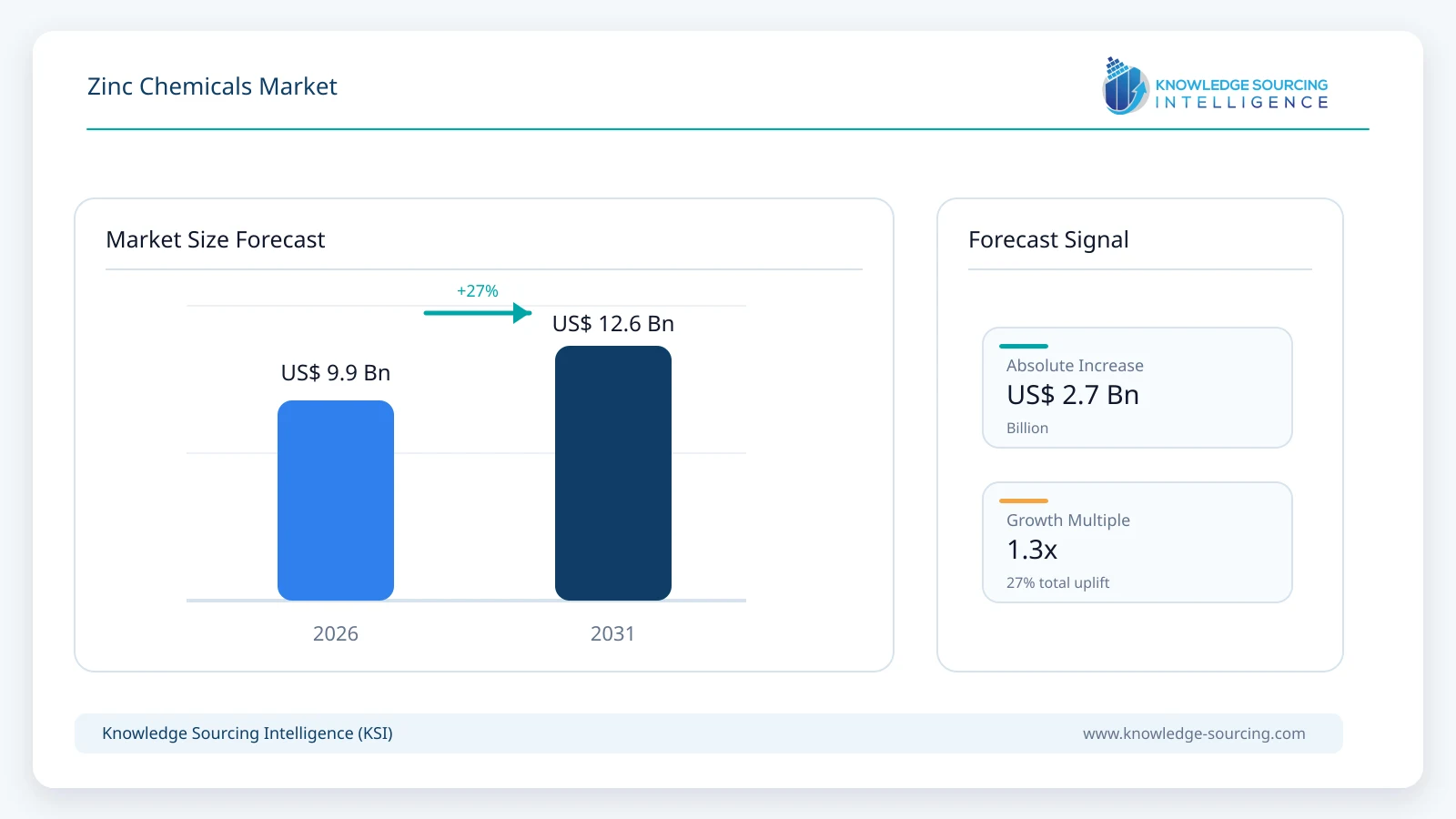
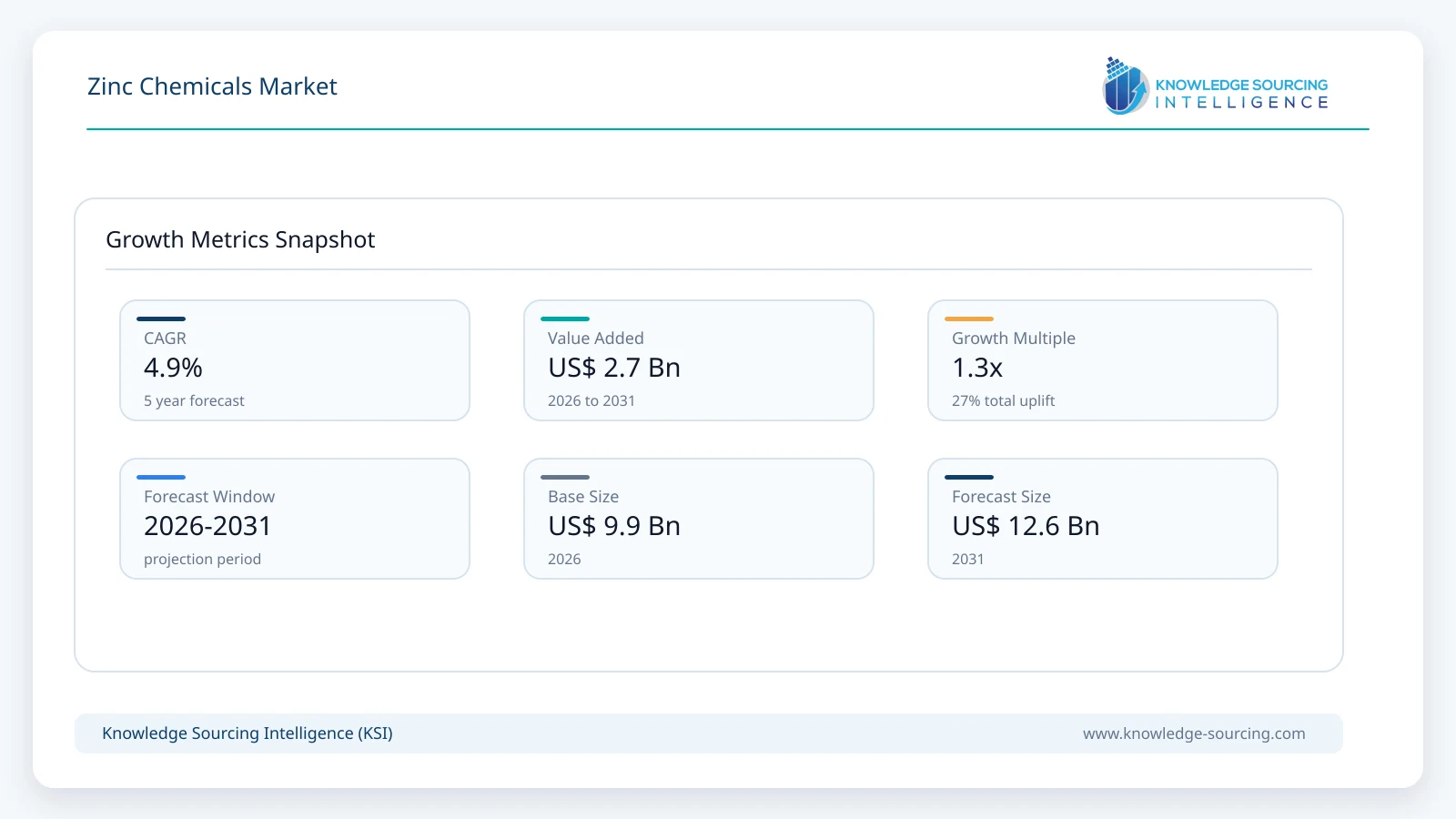
The zinc chemicals market is forecast to grow at a CAGR of 4.9%, reaching USD 12.6 billion in 2031 from USD 9.9 billion in 2026.
Highlights:
- 1Zinc oxide accounts for approximately 54% of market value in 2026, remaining the largest zinc chemical because of its extensive use in rubber, tires, ceramics, pharmaceuticals, coatings and specialty chemicals.
- 2Rubber compounding accounts for approximately 31% of market demand in 2026, led by zinc oxide consumption as a vulcanization activator in tire and industrial rubber production.
- 3Zinc sulphate is among the faster-growing major product categories through 2031, supported by agricultural micronutrients and animal nutrition.
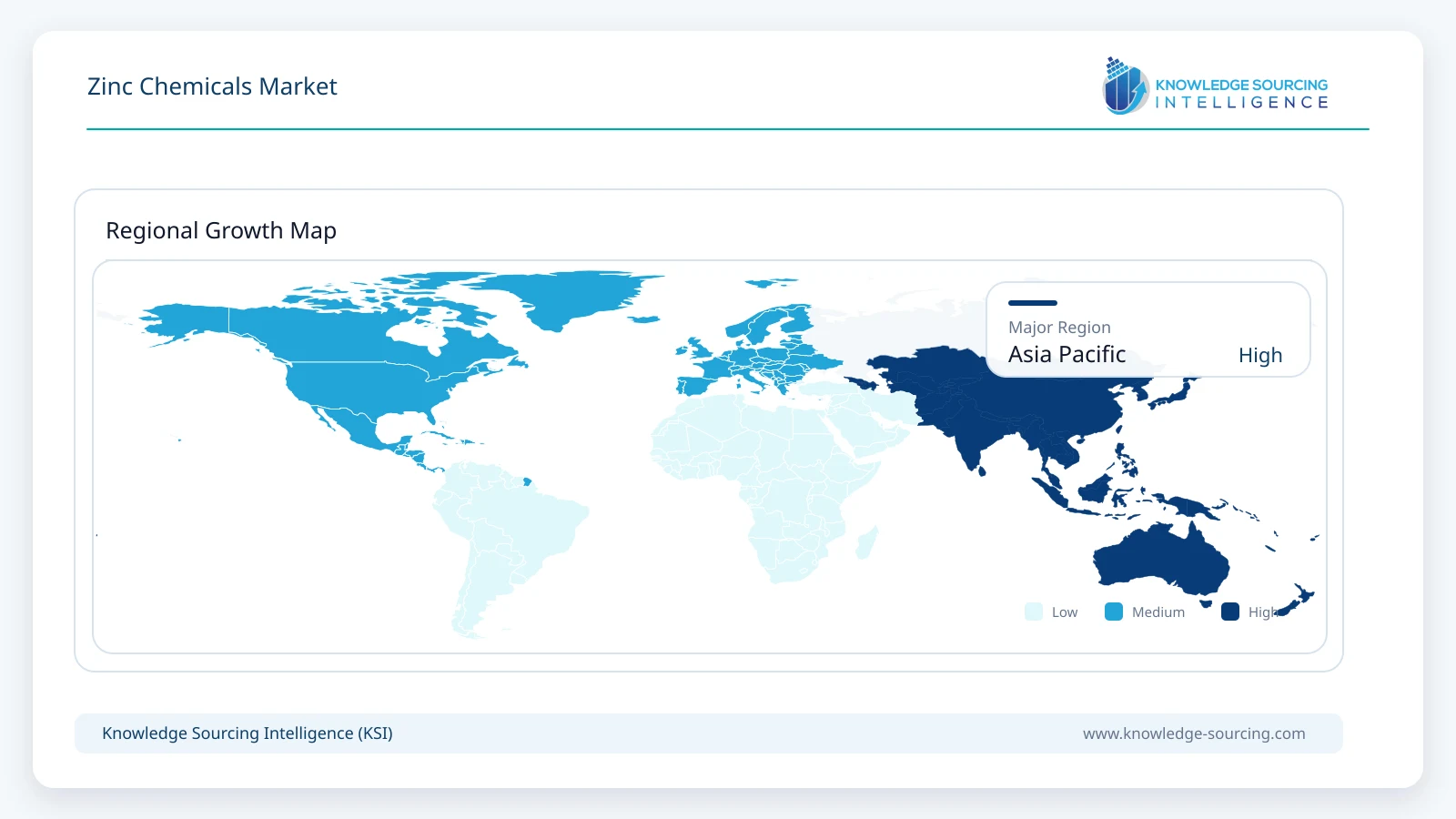
- 4Asia Pacific accounts for approximately 47% of global market value in 2026, reflecting the concentration of tire, rubber, agricultural and industrial manufacturing activity.
- 5Recycling is becoming commercially more important, with major producers increasingly using zinc-bearing industrial residues and secondary feedstocks.
Zinc chemicals comprise zinc-based inorganic and specialty compounds used as functional ingredients in industrial, agricultural and regulated applications. The commercial scope includes zinc oxide, zinc sulphate, zinc carbonate, zinc chloride and other zinc salts and compounds such as zinc borate, zinc bromide, zinc acetate, zinc nitrate and specialty zinc derivatives. Refined zinc metal, galvanizing zinc, brass alloys and other predominantly metallic applications are excluded.
The scale of the underlying zinc industry provides an important boundary check for the market. The International Zinc Association describes zinc as an approximately USD 50 billion annual market, while the U.S. Geological Survey notes that roughly three-quarters of zinc use is associated with metallic applications and the remaining portion is consumed as zinc compounds, principally across rubber, chemicals, paints and agriculture. Global production and consumption therefore provide sufficient feedstock volume to support a zinc chemicals market of approximately USD 10 billion without requiring the inclusion of galvanizing or zinc-alloy revenues.
Zinc oxide is the most widely used zinc compound. EverZinc alone has more than 75,000 tonnes per year of zinc oxide capacity in Europe, while Rubamin reports total zinc-compound capacity of approximately 50,000 tonnes per year across multiple technologies. These are only two producers within a geographically fragmented global manufacturing base. EverZinc also states that more than 40% of the zinc units processed in parts of its zinc oxide operations originate from secondary sources, illustrating the increasing role of recycling in production economics.
Market Trends
• The Market Is Shifting Toward Application-Specific Zinc Oxide Grades
Zinc oxide is no longer sold only as a standardized industrial powder. Manufacturers increasingly differentiate products by surface area, particle size, purity, morphology, heavy-metal content and physical presentation. This allows suppliers to target specific rubber, pharmaceutical, electronic, cosmetic and catalyst applications.
Hakusui Tech, for example, supplies conventional, pharmaceutical, conductive, heat-dissipation, antibacterial and nanoparticle zinc oxide grades from operations serving Japan, China and Thailand. GRILLO similarly offers industrial, pharmaceutical and high-purity specialist zinc oxides, while Brüggemann focuses on active zinc oxides and zinc carbonates with tailored surface and performance characteristics. Higher-value specialization therefore increasingly differentiates suppliers from commodity producers.
• Circular Feedstock Is Becoming a Competitive Input Rather Than Only a Sustainability Metric
Secondary zinc-bearing materials are becoming more important as producers seek to reduce primary metal exposure and improve the environmental profile of zinc compounds. EverZinc processes substantial quantities of secondary zinc material, while Rubamin processes zinc dross and ash and currently reports approximately 50,000 tonnes per year of zinc-compound capacity.
Zinc Nacional similarly operates a circular model based on recovery of steel-industry by-products and production of zinc oxide and zinc sulphate. In August 2026, the company stated that its operations recover steelmaking by-products generated by the Mexican steel industry and convert them back into zinc compounds used across agriculture, automotive, coatings and ceramics.
• Agricultural Zinc Chemistry Is Moving Toward More Controlled Product Quality
Zinc deficiency affects more than 50% of the world’s agricultural soils, according to the International Zinc Association. Zinc fertilizers are used to improve crop productivity and nutritional quality, making zinc sulphate and selected zinc oxide products important agricultural micronutrients.
Product quality is becoming more formalized. The IZA Zinc Fertilizer Quality Seal sets zinc-content requirements and impurity thresholds for zinc oxide and zinc sulphate fertilizers, including limits for arsenic, cadmium, chromium, mercury and lead. This increases the importance of feedstock control and chemical purification and reduces the competitiveness of inconsistent low-grade material in regulated agricultural applications.
• Zinc Chemicals Are Expanding Into Energy and Advanced Materials
Traditional rubber and agricultural applications continue to dominate market value, but zinc compounds are finding additional uses in batteries, catalysts, electronics and thermal-management systems. TIB Chemicals offers zinc chloride and zinc bromide products for battery and industrial applications, while Hakusui supplies zinc oxide grades for conductive materials, varistors, thermal management and electronic applications. GRILLO also identifies zinc oxide as a feedstock for catalysts, adsorbents and rechargeable zinc-based energy systems.
These applications remain smaller than conventional tire and agricultural demand, but they are commercially significant because they require tighter specifications and generally offer greater value addition per tonne.
Segment Analysis
• By Type: Zinc Oxide
Zinc oxide accounts for approximately 54% of market value in 2026 and remains the largest product category. The International Zinc Association identifies zinc oxide as the most widely used zinc compound, with applications in tires, animal nutrition, ceramics, coatings, plastics, pharmaceuticals and chemical manufacturing.
Rubber remains its principal large-volume application. Zinc oxide activates sulphur vulcanization and influences elasticity, resilience, aging performance and mechanical properties. Specialty grades additionally serve pharmaceuticals, cosmetics, electronics and catalysts. The product’s importance is reinforced by the scale and geographic spread of suppliers including EverZinc, Zochem, Hakusui Tech, Zinc Nacional, Rubamin, GRILLO and Brüggemann.
Zinc sulphate forms the second major product pool and is particularly important in fertilizers, animal feed, mining and water treatment. Zinc chloride serves galvanizing fluxes, chemical synthesis, batteries and industrial processes, while zinc carbonate and other specialized derivatives address smaller technical and regulated applications.
• By Application: Rubber Compounding
Rubber compounding accounts for approximately 31% of global market demand in 2026, making it the largest application category. The International Zinc Association identifies tire manufacturing as one of the primary uses of zinc oxide, and Hakusui Tech similarly identifies tire and rubber as its major zinc oxide end market.
The demand base remains substantial. Global motor vehicle production increased from 92.7 million vehicles in 2024 to 96.4 million in 2025, according to OICA. While tire replacement demand is not determined solely by new-vehicle output, a growing global vehicle fleet and continuing vehicle production provide a durable consumption base for zinc oxide used in tire and technical rubber compounds.
Agriculture is the next strategically important demand pool, particularly for zinc sulphate. Chemicals, ceramics, paints and coatings, food and pharmaceuticals, textiles and animal nutrition create additional diversification.
Market Drivers
• Structural Zinc Oxide Demand From Tires and Industrial Rubber
Zinc oxide performs a specific technical function in vulcanization that is difficult to remove entirely without changing rubber chemistry and performance. This supports recurring demand from tire producers even when automotive production fluctuates.
Manufacturers are nevertheless seeking to reduce zinc loading where possible because of environmental concerns. This creates demand for high-activity grades that can provide the required curing performance at lower dosage. The resulting shift favors technically differentiated zinc oxide rather than simply increasing commodity volume.
• Agricultural Micronutrient Deficiency Supports Zinc Sulphate Consumption
Widespread zinc-deficient soils create a structural agricultural application. Zinc sulphate monohydrate and heptahydrate are used in soil, foliar and fertilizer formulations, while zinc oxide can also serve agricultural and animal-feed applications.
The opportunity is strongest in regions attempting to increase yields without proportionally increasing cultivated acreage. Asia, Latin America and parts of Africa therefore provide meaningful long-term demand for agricultural zinc chemistry.
• Specialty and Regulated Applications Increase Value Per Tonne
Pharmaceutical, cosmetic, feed and high-specification chemical customers impose tighter limits on impurities and physical properties than commodity industrial buyers. GRILLO offers pharmaceutical zinc oxide with purity of at least 99%, while EverZinc produces GMP zinc oxide covered by pharmaceutical certification.
These applications are smaller in volume than tire manufacturing but increase the value of high-purity manufacturing assets and create customer qualification barriers that support supplier retention.
Market Restraints
• Zinc Feedstock Prices Directly Influence Producer Margins
Zinc metal is the principal feedstock for French-process zinc oxide and several other zinc compounds. U.S. Geological Survey data show the North American zinc price averaged approximately 149 cents per pound in 2025, while U.S. apparent refined zinc consumption was about 820,000 tonnes and refined zinc imports reached approximately 600,000 tonnes.
Changes in zinc metal prices can therefore affect working capital and margins, particularly when producers cannot pass input-cost movements through to customers immediately.
• Energy, Emission and Environmental Compliance Costs Are Increasing
Zinc chemical production involves thermal, chemical and material-handling processes that require dust control, emissions management and safe storage. GRILLO stated in September 2026 that energy-intensive operating conditions had placed significant strain on the company and announced a restructuring supported by more than EUR 100 million of investment in sulfur chemistry, zinc chemistry and zinc-based resource-protection businesses.
Zinc Nacional’s 2026 environmental agreement in Mexico similarly includes enclosed material-storage infrastructure, additional paved areas, inventory reductions and process relocation initiatives. These developments demonstrate that environmental compliance can directly influence operating expenditure and production strategy.
Regional Outlook
• Asia Pacific
Asia Pacific accounts for approximately 47% of global market value in 2026 and remains the largest production and consumption region. China is the world’s largest zinc-producing country and hosts substantial tire, rubber, ceramics, chemicals and manufacturing capacity, while India combines a large agricultural micronutrient opportunity with expanding automotive and industrial production.
The region also contains established specialty producers. Hakusui Tech manufactures zinc oxide through facilities serving Japan, China and Thailand, while Rubamin operates a broad zinc-compound portfolio from India. Asian producers compete strongly in commodity markets but are increasingly developing higher-purity and application-specific grades.
• North America
North America remains an important specialty and industrial market, particularly for rubber, chemicals, animal nutrition and regulated applications. The U.S. is materially dependent on imported refined zinc feedstock. USGS estimated U.S. refined zinc consumption of 820,000 tonnes in 2025 against domestic refined production of only approximately 220,000 tonnes.
This makes feedstock security commercially relevant for U.S. zinc chemical producers. EverZinc has a major North American operating footprint following its earlier combination with U.S. Zinc, while Zinc Nacional supplies zinc oxide and zinc sulphate from Mexico into regional markets.
Europe remains particularly important for specialty grades, pharmaceuticals, catalysts and high environmental standards, while South America and the Middle East and Africa provide agricultural and industrial growth opportunities.
Competitive Landscape
The zinc chemicals industry remains fragmented, with global specialists competing alongside regional compound manufacturers and integrated recyclers. EverZinc has one of the broadest international footprints, with specialty zinc products manufactured across North America, Europe and Asia. Zochem remains an important North American zinc oxide specialist, while Zinc Nacional produces zinc oxide and zinc sulphate and combines manufacturing with zinc-bearing material recycling.
Rubamin operates a diversified zinc compound portfolio that includes zinc oxides, zinc sulphate, zinc carbonate and zinc borate. Hakusui Tech specializes in conventional and advanced zinc oxide grades for rubber, electronics, pharmaceutical and functional-material applications. TIB Chemicals produces zinc chloride, zinc carbonate and multiple specialty zinc salts, while GRILLO Zinc Powder and L. Brüggemann maintain strong positions in high-purity and specialty zinc oxide.
The competitive emphasis is increasingly moving toward purity, particle engineering, recycled feedstock, customer certification and application support rather than commodity capacity alone.
Recent Developments
September 2026: GRILLO announced a transformation program including more than EUR 100 million of investment in zinc chemistry, sulfur chemistry and zinc-based resource-protection businesses.
January 2026: Zinc Nacional signed an environmental responsibility agreement with PROFEPA and outlined additional enclosed storage, paved areas and process-management investments at its San Nicolás operation.
December 2025: Cerberus Capital Management affiliates completed the acquisition of EverZinc and provided additional capital intended to support infrastructure, innovation and global growth.
October 2025: TIB Chemicals completed the integration of the Mineral Research & Development business acquired from Venator Chemicals, creating TIB Zinc Chemicals LLC in the United States and expanding its zinc chloride and flux portfolio.
Market Outlook
The zinc chemicals market is forecast to increase from USD 9.9 billion in 2026 to USD 12.6 billion in 2031, representing a CAGR of 4.9%. Growth is expected to remain steady rather than explosive because mature rubber, ceramics and coatings markets account for a large proportion of existing consumption.
Zinc oxide remains the largest product category through 2031, but zinc sulphate and specialty salts gain value through agriculture, animal nutrition and higher-specification industrial uses. Rubber compounding remains the largest application, while agricultural micronutrients and specialty chemistry provide relatively faster growth.
Competitive advantage increasingly depends on the ability to secure zinc feedstock, use recycled material without sacrificing purity, manufacture specialized grades and meet demanding regulatory specifications. Producers serving pharmaceutical, feed, agricultural, electronic and specialty chemical applications are therefore positioned to capture a larger proportion of incremental market value than suppliers competing solely on commodity volume.
Zinc Chemicals Market Scope:
| Report Metric | Details |
|---|---|
| Total Market Size in 2026 | USD 9.9 billion |
| Total Market Size in 2031 | USD 12.6 billion |
| Forecast Unit | Billion |
| Growth Rate | 4.9% |
| Study Period | 2021 to 2031 |
| Historical Data | 2021 to 2024 |
| Base Year | 2025 |
| Forecast Period | 2026 – 2031 |
| Segmentation | Type, Application, Geography |
| Companies |
|
Market Segmentation
By Type
Zinc Oxide
Zinc Sulphate
Zinc Carbonate
Zinc Chloride
Other Zinc Compounds
By Application
Rubber Compounding
Agriculture
Glass and Ceramics
Paints and Coatings
Chemicals
Food, Feed and Pharmaceuticals
Textiles
Others
By Geography
North America
United States
Canada
Mexico
South America
Brazil
Argentina
Others
Europe
Germany
United Kingdom
France
Spain
Italy
Others
Middle East and Africa
Saudi Arabia
UAE
South Africa
Others
Asia Pacific
China
India
Japan
South Korea
Taiwan
Thailand
Indonesia
Others
Table of Contents
1. INTRODUCTION
1.1. Market Overview
1.2. Market Definition and Scope
1.3. Revenue Inclusion and Exclusion Criteria
1.4. Market Segmentation
1.5. Currency
1.6. Assumptions
1.7. Base and Forecast Years
2. RESEARCH METHODOLOGY
2.1. Research Design
2.2. Secondary Research
2.3. Primary Research
2.4. Zinc Feedstock and Compound Volume Analysis
2.5. Producer Capacity and Product-Mix Analysis
2.6. Segment Modelling
2.7. Data Triangulation and Validation
3. EXECUTIVE SUMMARY
3.1. Key Findings
3.2. Zinc Chemicals Market Size, 2026-2031
3.3. Type Outlook
3.4. Application Outlook
3.5. Regional Opportunity Summary
4. MARKET DYNAMICS
4.1. Market Drivers
4.1.1. Sustained Demand From Tires and Industrial Rubber
4.1.2. Agricultural Micronutrient Requirements
4.1.3. Expansion of Specialty and Regulated Zinc Applications
4.2. Market Restraints
4.2.1. Zinc Feedstock Price Volatility
4.2.2. Environmental and Energy Compliance Costs
4.3. Market Opportunities
4.4. Porter’s Five Forces Analysis
4.5. Industry Value Chain Analysis
4.6. Zinc Feedstock and Recycling Dynamics
4.7. Product Quality and Regulatory Requirements
5. TECHNOLOGY AND PRODUCT OUTLOOK
5.1. French-Process Zinc Oxide
5.2. Direct/American-Process Zinc Oxide
5.3. Wet-Chemical and Active Zinc Oxide
5.4. High-Purity and Pharmaceutical Grades
5.5. Recycled Zinc Feedstocks
5.6. Nano and Functional Zinc Materials
6. ZINC CHEMICALS MARKET BY TYPE
6.1. Introduction
6.2. Zinc Oxide
6.3. Zinc Sulphate
6.4. Zinc Carbonate
6.5. Zinc Chloride
6.6. Other Zinc Compounds
7. ZINC CHEMICALS MARKET BY APPLICATION
7.1. Introduction
7.2. Rubber Compounding
7.3. Agriculture
7.4. Glass and Ceramics
7.5. Paints and Coatings
7.6. Chemicals
7.7. Food, Feed and Pharmaceuticals
7.8. Textiles
7.9. Others
8. ZINC CHEMICALS MARKET BY GEOGRAPHY
8.1. North America
8.1.1. By Type
8.1.2. By Application
8.1.3. United States
8.1.4. Canada
8.1.5. Mexico
8.2. South America
8.2.1. Brazil
8.2.2. Argentina
8.2.3. Others
8.3. Europe
8.3.1. Germany
8.3.2. United Kingdom
8.3.3. France
8.3.4. Spain
8.3.5. Italy
8.3.6. Others
8.4. Middle East and Africa
8.4.1. Saudi Arabia
8.4.2. UAE
8.4.3. South Africa
8.4.4. Others
8.5. Asia Pacific
8.5.1. China
8.5.2. India
8.5.3. Japan
8.5.4. South Korea
8.5.5. Taiwan
8.5.6. Thailand
8.5.7. Indonesia
8.5.8. Others
9. COMPETITIVE ENVIRONMENT AND ANALYSIS
9.1. Major Players and Strategy Analysis
9.2. Zinc Oxide Capacity and Technology Positioning
9.3. Zinc Sulphate and Agricultural Product Positioning
9.4. High-Purity and Regulated Grades
9.5. Recycling and Secondary Feedstock Capabilities
9.6. Geographic Manufacturing Footprint
9.7. Mergers, Acquisitions and Investments
9.8. Competitive Dashboard
10. COMPANY PROFILES
10.1. EverZinc
10.2. Zochem Inc.
10.3. Zinc Nacional
10.4. Rubamin
10.5. Hakusui Tech
10.6. TIB Chemicals AG
10.7. GRILLO Zinc Powder GmbH
10.8. L. Brüggemann GmbH & Co. KG
10.9. Pan-Continental Chemical Co., Ltd.
10.10. Weifang Longda Zinc Industry Co., Ltd.
11. APPENDIX
11.1. Market Definition and Scope
11.2. Currency and Conversion Assumptions
11.3. Base Year and Forecast Period
11.4. Market Estimation Approach
11.5. Primary and Secondary Research Framework
11.6. Segment Reconciliation
11.7. Data Triangulation and Validation
11.8. Abbreviations
Navigate
Trusted by the world's leading organizations











