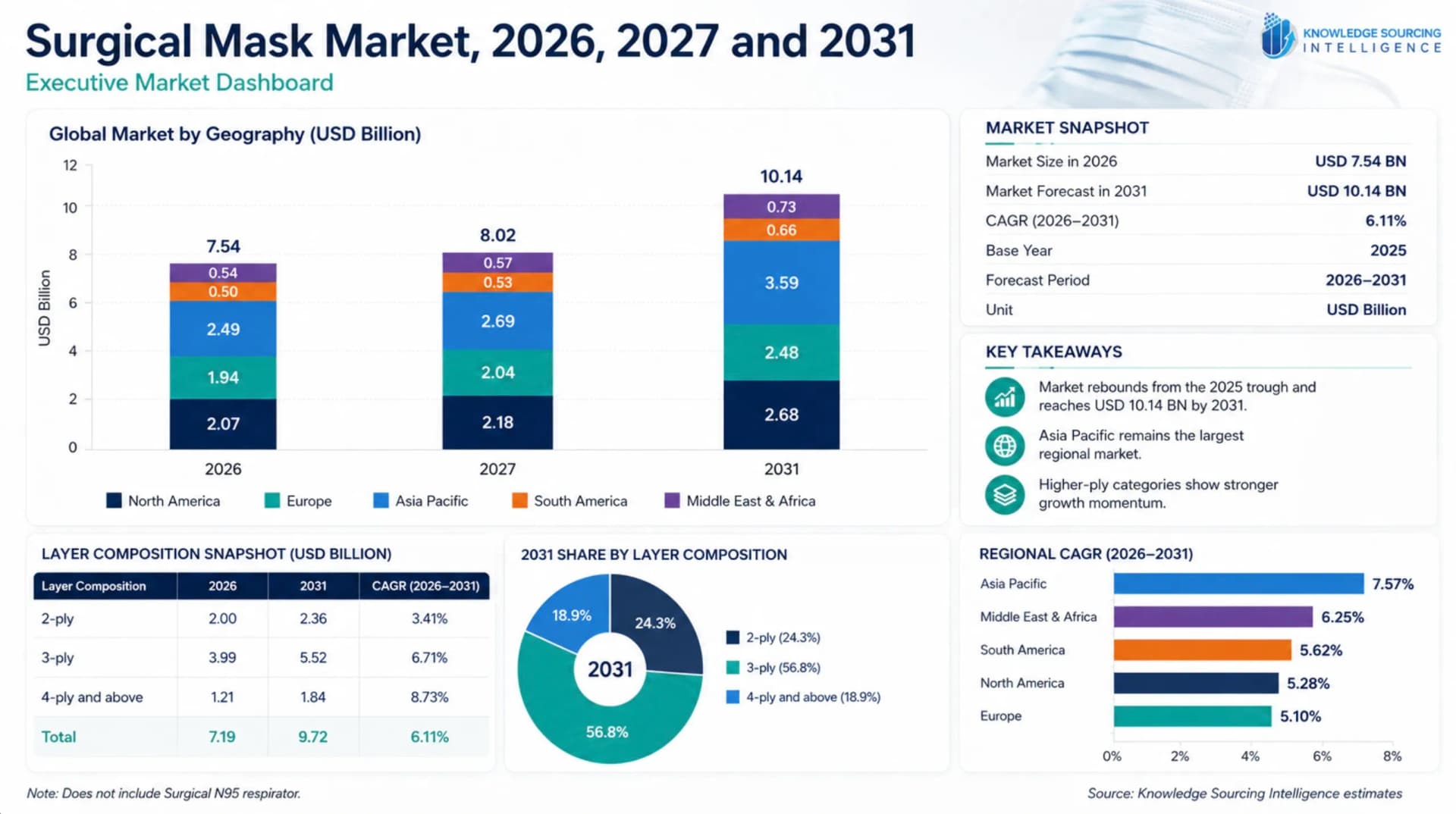
The surgical mask market is shifting from pandemic-driven demand toward sustainable healthcare-led growth. Asia Pacific remains the largest regional market, supported by healthcare infrastructure, patient volumes, manufacturing capacity, and infection-control spending. Rising demand for higher-barrier masks, regulatory compliance, filtration performance, comfort, quality consistency, and sustainable materials is shaping competition.
The surgical mask market is transitioning from the exceptional pandemic-driven demand cycle toward a more normalized healthcare-led growth pattern. Based on Knowledge Sourcing Intelligence (KSI) estimates, the global market declined from USD 10.40 billion in 2021 to USD 7.19 billion in 2025, before recovering to USD 7.54 billion in 2026 and reaching USD 10.14 billion by 2031, representing a 6.11% CAGR during 2026-2031.
Surgical Mask Market Highlights
The global surgical mask market is projected to grow at a 6.11% CAGR between 2026 and 2031, with market value increasing from USD 7.54 billion to USD 10.14 billion.
The sharp decline between 2021 and 2025 reflects normalization after exceptional pandemic-related procurement and inventory accumulation.
Asia Pacific is the largest regional market, accounting for approximately 33.1% of the global market in 2026 and is expected to increase its share to around 35% by 2031.
This growth is also supported by expanding healthcare infrastructure, large patient volumes, manufacturing capacity, and increasing infection-control expenditure.
North America remains a significant market, although its growth rate remains below the global average.
Europe is projected to expand at a comparatively moderate 5.10% CAGR, reflecting a mature healthcare procurement environment and relatively stable institutional demand.
3-ply surgical masks remain the core product category and will grow at a 6.71% CAGR between 2026 and 2031.
4-ply and above masks are the fastest-growing layer segment, expanding at 8.73% CAGR, indicating increasing demand for higher barrier protection and premium clinical-use products.
Regulatory standards and hospital procurement specifications are becoming increasingly important competitive factors, shifting differentiation toward validated filtration performance, comfort, quality consistency, and sustainable materials.
Surgical Mask Market Developments
Month & Year | Company / Organization | Latest Development |
January 2026 | Beatles Medical Supplies | The FDA cleared the company's disposable surgical face masks covering ASTM Level 2 and Level 3 configurations, supporting continued availability of higher-performance surgical mask products in the U.S. healthcare market. |
2026 | ASTM International | ASTM published F2100-26, Standard Specification for Medical Face Masks, continuing the evolution of performance requirements governing medical mask filtration, fluid resistance and related characteristics. |
September 2025 | Vitacore Industries | Vitacore received FDA clearance for disposable surgical face masks intended to protect healthcare workers and patients from microorganisms, body fluids and particulate material. |
July 2025 | ASTM / Medical Mask Manufacturers | The U.S. market transitioned toward ASTM F2100-23 requirements, including revised particulate-filtration testing requirements, prompting manufacturers to update testing and compliance processes. |
May 2025 | O&M Halyard | FDA documentation covered Halyard's FLUIDSHIELD Level 3 surgical and procedure masks, including additional material configurations while maintaining their intended infection-control and fluid-barrier applications. |
Have questions?
More Infographics & Data
AI-Based Cancer Screening Market Regional Split, 2026, 2027 and 2031
North America continues to dominate the market due to strong healthcare infrastructure, favorable regulatory support, and increasing adoption of AI-powered radiology systems. Europe is emphasizing compliance-driven AI integration, while Asia Pacific is emerging as the fastest-growing region because of expanding healthcare digitization and growing cancer screening initiatives. Companies are focusing on scalable AI-driven imaging, automated workflow optimization, and precision diagnostics to strengthen their market position.
Global UAV Battery Market Analysis, 2026
The global UAV battery market is being influenced by the increasing use of unmanned vehicles in defence, civil aviation, infrastructure inspection, agriculture, and emergency response. Governments are incorporating UAVs into their national airspace systems and public sector operations, thereby creating a demand for high-performance energy storage solutions.
Email Security Market Share Analysis, By Solution Type, 2025, 2026 and 2031
The email security market over the next five years is undergoing a transition from signature-based, perimeter-led protection (spam + antivirus) toward a data-centric, intelligence-driven security architecture. The DLP and encryption solutions are gaining strategic importance, while legacy layers continue to accelerate volume-driven growth. This is increasingly tied to data protection, compliance, and insider risk mitigation, reshaping segment contribution over time.