Infographics and DataApril 23, 20262 min read

Email Security Market Share Analysis, By Solution Type, 2025, 2026 and 2031

Executive Brief & Strategic Takeaways

The email security market over the next five years is undergoing a transition from signature-based, perimeter-led protection (spam + antivirus) toward a data-centric, intelligence-driven security architecture. The DLP and encryption solutions are gaining strategic importance, while legacy layers continue to accelerate volume-driven growth. This is increasingly tied to data protection, compliance, and insider risk mitigation, reshaping segment contribution over time.
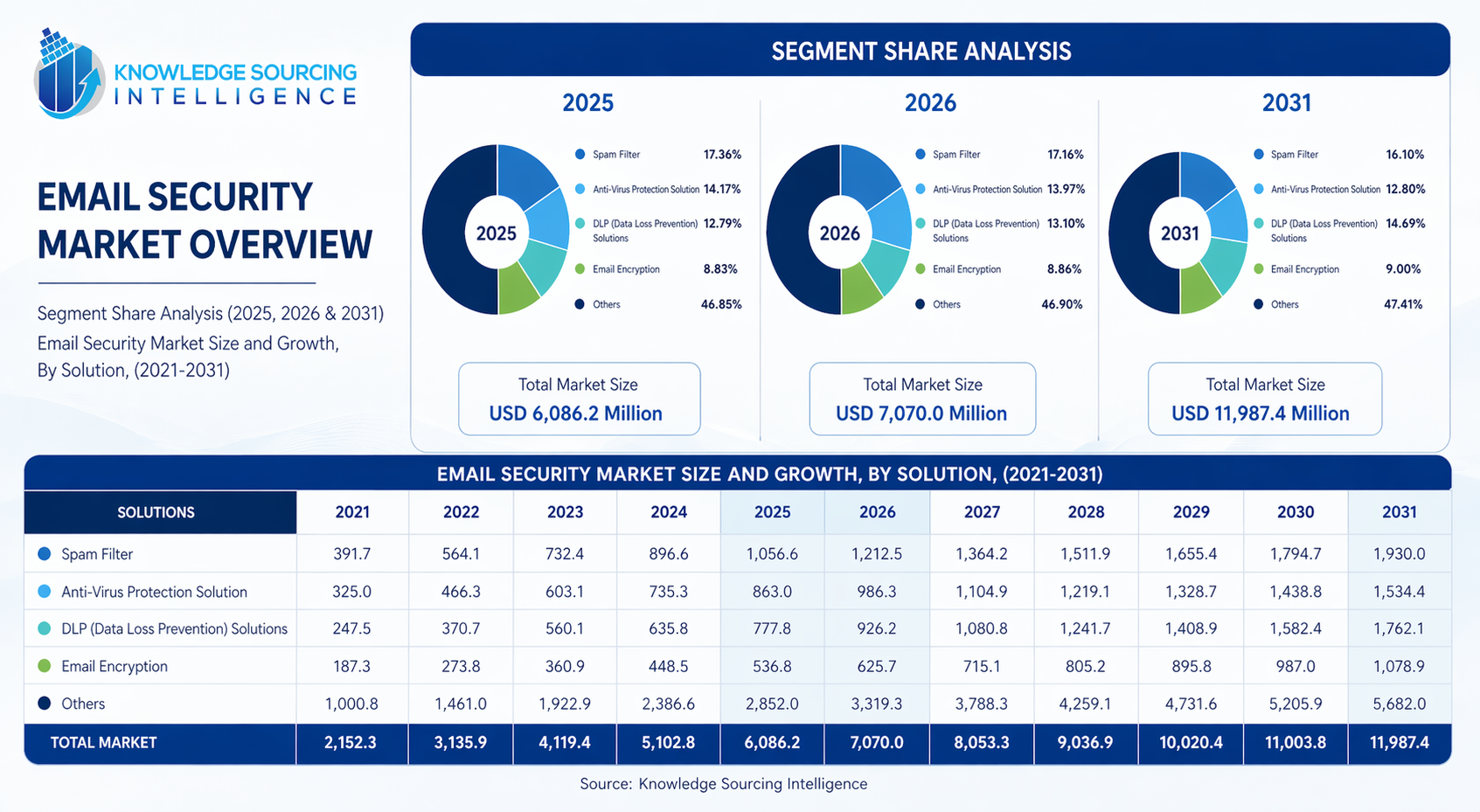
Email Security Market Share, By Solution, 2025, 2026 and 2031Spam Filter segment (~17% to ~16%) is showing maturity but remains foundational to growth

Spam filtering continues to be a volume-heavy but innovation-light segment.

  • Declining share reflects commoditization and its integration into broader platforms

  • AI/ML-based filtering is improving detection, but pricing power remains limited

  • Still critical as a first-line defense layer, especially for small and medium sized companies

  • The growth is more tied to email traffic explosion rather than pricing or innovation

Anti-Virus Protection (~14% to ~12–13%) segment is witnessing modest decline as threats have evolved beyond malware

Traditional antivirus solutions are losing relative share due to shift from file-based malware to identity and social engineering attacks.

  • Modern threats (phishing, BEC, zero-day exploits) continue to bypass signature-based detection

  • Endpoint and email convergence is reducing relevance of standalone anti-virus solutions

  • Vendors are repositioning toward EDR/XDR integration

  • The segment remains relevant but no longer a primary growth driver

DLP (Data Loss Prevention) (~13% to ~15%) is the fastest growing segment

DLP is emerging as a core pillar of enterprise email security, driven by compliance and data governance.

  • Increasing adoption due to GDPR, HIPAA, DPDP (India), and enterprise data localization norms

  • Growth is being driven by:

    • Surging case of accidental data leaks and insider threats

    • The new era of remote/hybrid work environments

    • Solutions being offered by cloud companies such as (Microsoft 365, Google Workspace)

  • Integration with CASB and Zero Trust frameworks is also accelerating the adoption of these solutions

  • Transition being observed from rule-based solutions to behavior analytics-driven DLP

Email Encryption (~8 to ~ 9%) remains niche but critical for regulated industries

Encryption continues to be compliance-driven rather than volume-driven.

  • Strong adoption is being observed across following industries:

    • BFSI

    • Government & defense

    • Healthcare

  • This robust growth tied to strict regulatory enforcement

  • Increasing shift is being observed toward:

    • Automated encryption triggers

    • Policy-based encryption embedded in workflows

  • Limited share due to usability challenges and operational friction

Strategic Takeaways

  • Platform vendors will dominate as enterprises consolidate security stacks

  • DLP is the most important segment to watch for future share gains

  • Legacy layers (Spam + AV) will remain essential but commoditized

  • Regulation + cloud adoption = primary demand catalysts

  • The market is evolving into a policy-driven, identity-aware, and data-sensitive security ecosystem

Custom Strategic Research

Need specialized data cuts or competitive intelligence?

Our analyst team provides bespoke market sizing, supplier audits, and country-level feasibility reports tailored to your enterprise roadmap.

Speak With an Industry Analyst →
Associated Market Research

Email Security Market - Strategic Insights and Forecasts (2026-2031)

The global email security market is experiencing steady growth during the forecast period, driven by the increasing frequency and sophistication of email-based cyberattacks. Email remains one of the primary vectors for phishing, ransomware, spoofing, and business email compromise (BEC) attacks, making it a critical focus area within enterprise cybersecurity strategies. Organizations across industries are investing heavily in advanced threat protection, AI-driven detection, and cloud-native security solutions to safeguard sensitive data and maintain business continuity. The growing adoption of cloud email platforms such as Microsoft 365 and Google Workspace has further accelerated demand for API-based and integrated email security solutions.Strong digital transformation trends and the expansion of remote and hybrid work models also support market growth. A large global workforce relies heavily on email for communication, collaboration, and data exchange, significantly increasing the attack surface for cybercriminals. As enterprises digitize operations and migrate workloads to the cloud, securing email communication becomes essential to prevent financial losses and reputational damage. Additionally, small and medium enterprises (SMEs) are increasingly adopting subscription-based and managed email security services, further broadening the market’s customer base.However, the market faces certain restraints, including high implementation costs for advanced solutions, complexity in integrating security systems with legacy IT infrastructure, and shortages of skilled cybersecurity professionals. Concerns regarding data privacy, especially in cloud-based deployments, and the occurrence of false positives affecting business communication also present operational challenges. Regulatory bodies and data protection authorities worldwide enforce strict cybersecurity and privacy compliance standards, requiring organizations to implement encryption, monitoring, and data loss prevention (DLP) measures, which influence market dynamics.

Ask an Industry Analyst

Have questions regarding this briefing or market projections? Inquire with our sector lead.

Additional Market Research Reports

Market ReportSep 4, 2026

Power-to-X Market Size, Share & Growth Forecast (2026-2031)

This Power-to-X market is fueled by the demand to transform excess renewable electricity into storable, transportable and sector-flexible energy carriers to bridge the gap between times when wind and solar energy is produced and when industry, transport and heating actually requires it. Power-to-X is a collection of electrolysis and downstream synthesis processes that convert electricity into hydrogen, synthetic fuel or chemical feedstock for decarbonizing sectors which are hard to abate by direct electrification, such as aviation, maritime shipping, and heavy industry.Policy frameworks are becoming more and more explicit growth catalysts. The European Commission's Renewable Energy Directive III implementation roadmap is driving up the use of renewable hydrogen in refining and transportation, thus raising the demand for electrolyzers and future power purchase agreements, and International Maritime Organisation (IMO) greenhouse gas reduction standards are changing the way low-carbon marine fuel is purchased by shipping companies. If the U.S. market is expanding at a lower rate than the EAP market then it is doing so due to federal incentive-driven growth, as the Hydrogen Shot is beginning to drive growth in the United States and there are broader commitments to net zero in the U.S. as well.A structurally significant development is the introduction of a dual-demand dynamic in which defense-industrial procurement of modular e-fuel production for military energy security is starting to overlap with the commercial e-fuel scaling ambition, thus creating a national-security procurement pathway in addition to the climate-policy demand historically driving the market.

Explore Report
Market ReportSep 4, 2026

Fermentative Hydrogen Production Market Size, Share & Growth Forecast (2026-2031)

The global Fermentative Hydrogen Production market is being driven by the emergence of dark and photo-fermentation as the most commercially advanced pathways within the broader biological hydrogen production landscape. Fermentative hydrogen production uses anaerobic and photosynthetic bacteria to convert organic substrates, food waste, agricultural residues, wastewater sludge, and industrial organic effluents into hydrogen gas, offering a production route that pairs naturally with existing anaerobic digestion and wastewater treatment infrastructure and simultaneously addresses organic waste management alongside clean fuel generation.Dark fermentation has become the leading pathway within biological hydrogen production specifically because it does not require light input, allowing it to run continuously using standard anaerobic digestion equipment and organic waste streams that are already being collected and processed at municipal and industrial waste facilities. Photo-fermentation, frequently deployed as a complementary second-stage process, uses photosynthetic bacteria to extract additional hydrogen yield from the organic acids left over after dark fermentation, allowing operators to sequence both pathways within a single integrated system to maximize hydrogen output from a given feedstock volume.Research and pilot-scale investment in fermentative hydrogen production has accelerated as nanocatalyst-enhanced dark fermentation, genome-resolved microbial engineering, and hybrid dark-photo fermentation systems have demonstrated measurable yield improvements, narrowing the historical cost and efficiency gap between fermentative hydrogen and both conventional grey hydrogen and electrolysis-based green hydrogen.

Explore Report
Market ReportSep 4, 2026

Biological Hydrogen Production Market Size, Share & Growth Forecast (2026-2031)

The global Biological Hydrogen Production market is being fuelled by the need for a truly carbon-neutral route to hydrogen that isn't reliant on fossil fuels (like for grey hydrogen and blue hydrogen) or requires significant electricity consumption (like green hydrogen based on electrolysis). Biohydrogen, also known as biological hydrogen, is a type of hydrogen production that involves the use of microorganisms, bacteria, cyanobacteria and microalgae, and produces hydrogen gas from organic waste, biomass or sunlight via dark fermentation, photo-fermentation and biophotolysis, which can address organic waste streams and provide a clean-burning fuel.The government's hydrogen strategies are growing increasingly clear on the need to diversify the production portfolio, and not exclusively rely on electrolysis. EU Hydrogen Strategy and U.S. Inflation Reduction Act's hydrogen production tax credit are directing funds towards scalable low-carbon hydrogen pathways, with the U.S. and EU announcing large-scale hydrogen hubs across the region in 2025, providing an opportunity to incorporate biohydrogen into future hydrogen supply chains alongside electrolysis and other hydrogen production methods, while offering a complementary technology in the broader hydrogen transition.The rapid industrialization, high amount of organic waste generated, intensive government roadmap for hydrogen, and continued investment in research and development in Asia-Pacific have made the region a clear leader regarding hydrogen deployment, while the cost-effectiveness and scalability of hydrogen production by dark fermentation have made it the primary process in the region compared to photo-fermentation and biophotolysis.

Explore Report