North America continues to dominate the market due to strong healthcare infrastructure, favorable regulatory support, and increasing adoption of AI-powered radiology systems. Europe is emphasizing compliance-driven AI integration, while Asia Pacific is emerging as the fastest-growing region because of expanding healthcare digitization and growing cancer screening initiatives. Companies are focusing on scalable AI-driven imaging, automated workflow optimization, and precision diagnostics to strengthen their market position.
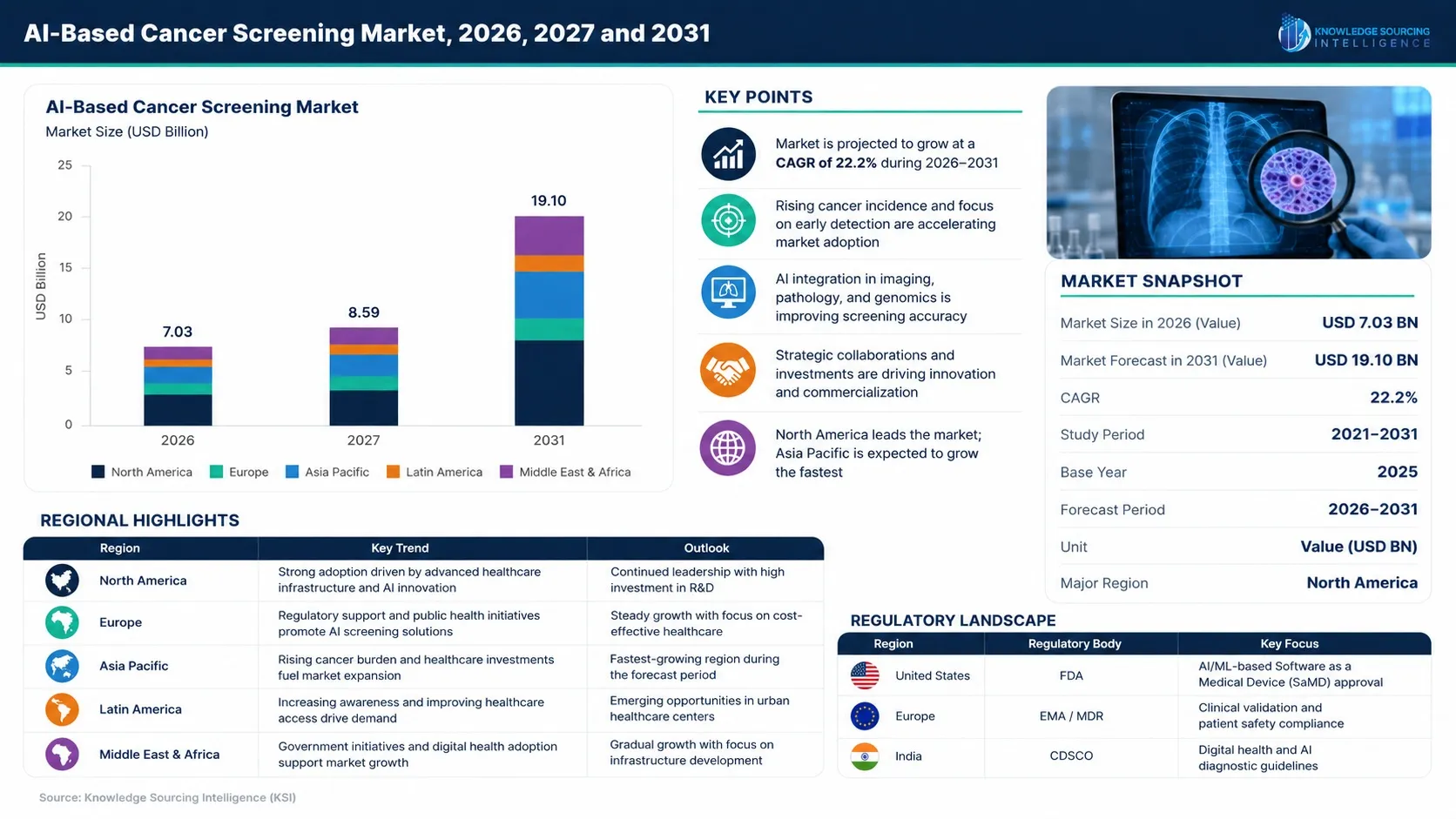
The global AI-based cancer screening market is witnessing rapid advancements as healthcare providers increasingly integrate artificial intelligence into imaging diagnostics, digital pathology, and molecular screening platforms. Growing cancer prevalence, rising demand for early detection, and improvements in machine learning algorithms are accelerating adoption across hospitals and diagnostic centers. AI-enabled screening tools are improving diagnostic precision, reducing radiologist workload, and supporting faster clinical decision-making. The market is projected to expand significantly through 2031, driven by investments in multi-cancer detection technologies, cloud-based diagnostic platforms, and AI-assisted imaging workflows.
AI-Based Cancer Screening Market Key Points
The global AI-based cancer screening market is projected to grow at a CAGR of 22.2% between 2026 and 2031, driven by increasing adoption of AI-assisted diagnostics across imaging and pathology workflows.
AI-powered breast cancer screening solutions are gaining rapid traction as healthcare providers seek faster scan interpretation, improved reproducibility, and higher diagnostic accuracy in dense breast imaging.
Multi-cancer early detection (MCED) platforms are emerging as a major innovation area, enabling simultaneous detection of multiple cancers using AI, genomic analysis, and liquid biopsy technologies.
North America remains the leading regional market due to strong regulatory support, high healthcare digitization, and rising investment in AI-enabled oncology infrastructure.
Asia Pacific is expected to witness the fastest growth owing to rising cancer incidence, expanding healthcare infrastructure, and increasing government support for AI-based healthcare technologies.
Strategic collaborations between healthcare institutions and technology providers are accelerating AI integration in radiation oncology, predictive diagnostics, and workflow automation.
AI-enabled imaging tools are helping healthcare providers address radiologist shortages by improving workflow efficiency, reducing reading times, and supporting earlier cancer detection.
Digital pathology adoption is increasing rapidly as companies develop AI platforms capable of detecting cancer across multiple organs and tissue types using large-scale pathology datasets.
Personalized cancer screening is becoming a major trend, with AI models analyzing patient-specific imaging and clinical data to optimize screening intervals and risk-based diagnostics.
AI-driven pancreatic cancer detection models developed by Mayo Clinic demonstrated the ability to identify cancer signals up to three years before clinical diagnosis using routine CT scans.
AI-Based Cancer Screening Market Developments
Month & Year | Company | Latest Development |
|---|---|---|
April 2026 | Mayo Clinic | Mayo Clinic validated its REDMOD AI model capable of detecting pancreatic cancer up to three years before diagnosis using routine CT scans and multi-institution clinical datasets. |
December 2025 | Siemens Healthineers | Siemens Healthineers introduced Optiq AI imaging technology at RSNA 2025, enabling AI-powered live image denoising for improved low-dose image-guided oncology procedures. |
November 2025 | Radiological Society of North America | RSNA 2025 highlighted the largest clinical radiology AI showcase globally, with over 660 exhibitors presenting advanced AI-enabled imaging and cancer diagnostics technologies. |
March 2025 | GE HealthCare | GE HealthCare launched Invenia ABUS Premium with Verisound AI and AI Assistant to improve dense breast cancer screening accuracy and accelerate imaging workflows. |
March 2025 | GE HealthCare | GE HealthCare received FDA Premarket Approval for its AI-driven Invenia ABUS Premium platform designed for faster and reproducible supplemental breast screening procedures. |
Have questions?
More Infographics & Data
Surgical Mask Market Size and Forecast, 2026-2031
The surgical mask market is shifting from pandemic-driven demand toward sustainable healthcare-led growth. Asia Pacific remains the largest regional market, supported by healthcare infrastructure, patient volumes, manufacturing capacity, and infection-control spending. Rising demand for higher-barrier masks, regulatory compliance, filtration performance, comfort, quality consistency, and sustainable materials is shaping competition.
Global UAV Battery Market Analysis, 2026
The global UAV battery market is being influenced by the increasing use of unmanned vehicles in defence, civil aviation, infrastructure inspection, agriculture, and emergency response. Governments are incorporating UAVs into their national airspace systems and public sector operations, thereby creating a demand for high-performance energy storage solutions.
Email Security Market Share Analysis, By Solution Type, 2025, 2026 and 2031
The email security market over the next five years is undergoing a transition from signature-based, perimeter-led protection (spam + antivirus) toward a data-centric, intelligence-driven security architecture. The DLP and encryption solutions are gaining strategic importance, while legacy layers continue to accelerate volume-driven growth. This is increasingly tied to data protection, compliance, and insider risk mitigation, reshaping segment contribution over time.