
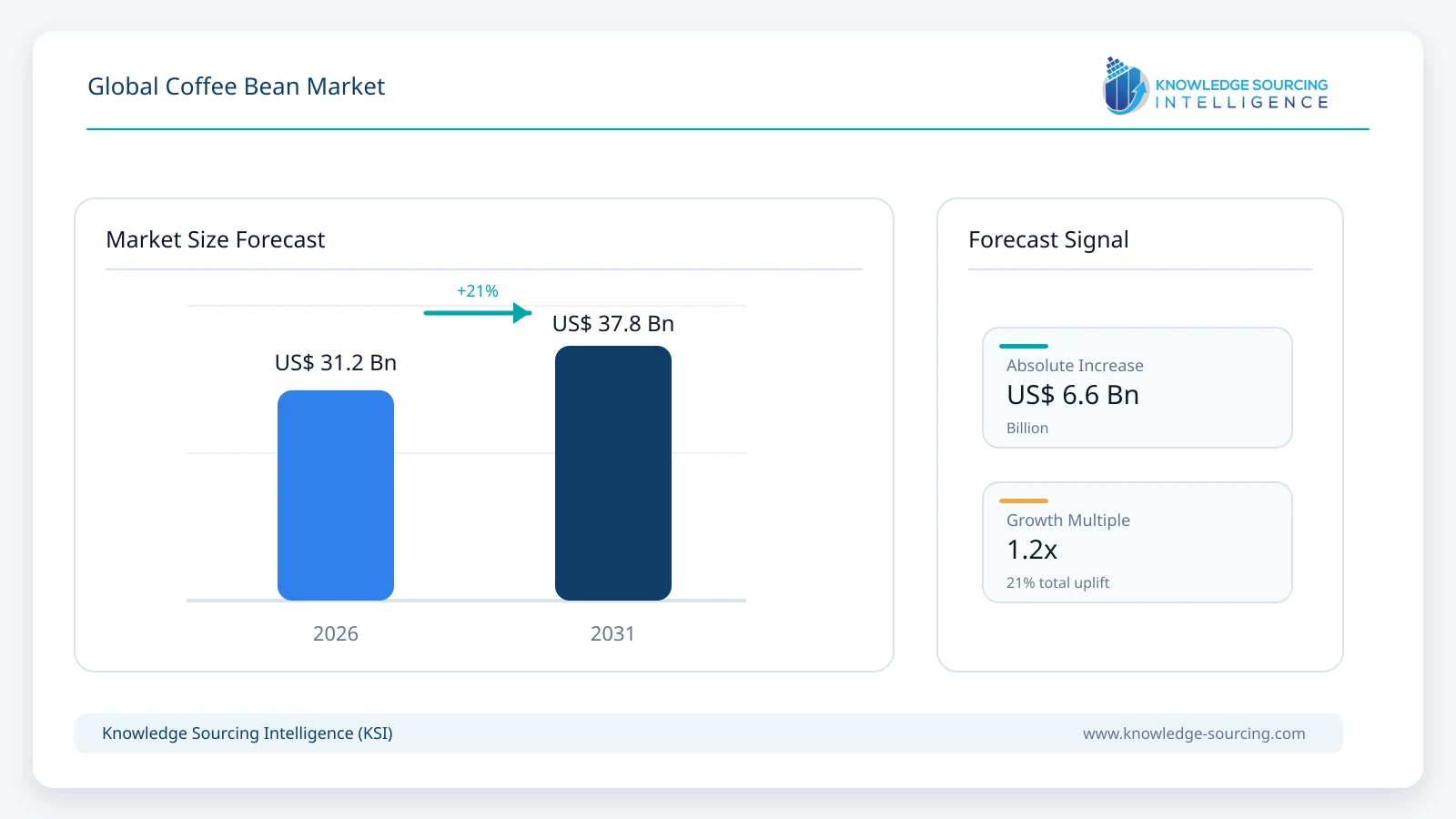
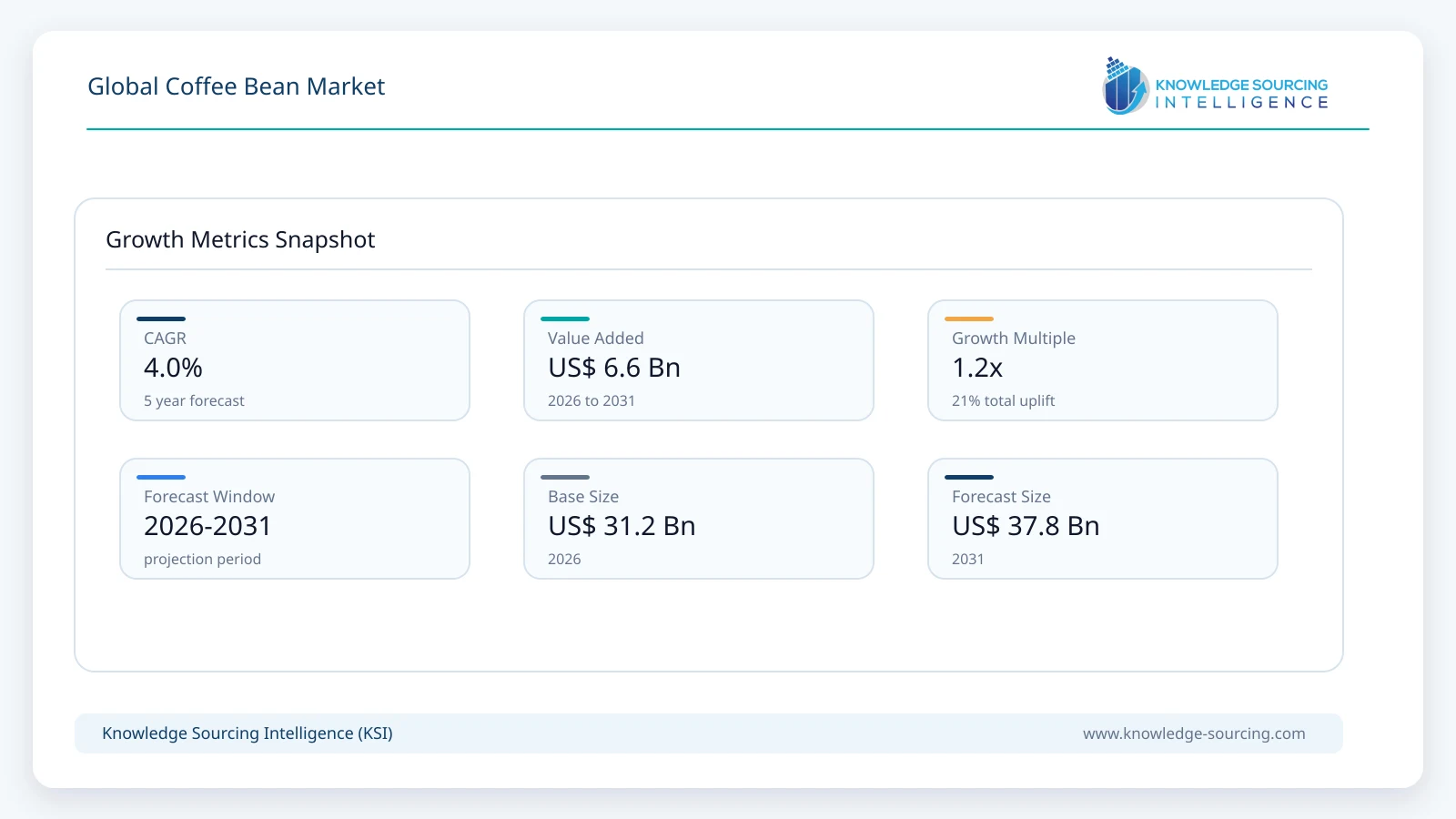
The global coffee bean market is projected to grow at a CAGR of 3.9%, reaching USD 37.8 billion by 2031 from USD 31.2 billion in 2026.
Highlights:
- 1Arabica accounts for approximately 63% of the global coffee bean market in 2026, supported by its established position in specialty coffee, premium blends, whole-bean retail and café applications.
- 2Global coffee production is forecast at a record 178.8 million 60-kilogram bags in 2025/26, compared with consumption of 173.9 million bags.
- 3Global coffee bean exports are forecast at 123.8 million bags in 2025/26, while ending stocks are expected to fall for a fifth consecutive year to just 20.1 million bags.
- 4Brazil’s May 2026 crop estimate reached 66.7 million bags, including 45.8 million bags of Arabica, following improved weather, positive biennial production and higher productivity.
- 5Vietnam is estimated to produce 31.7 million bags in 2025/26, of which 30.5 million bags are Robusta, reinforcing its importance to global soluble coffee and blend supply.
- 6Europe sourced approximately 3.3 million tonnes of green coffee in 2024, with Germany alone importing 1.16 million tonnes.
Coffee Bean Market Overview
Coffee beans form the agricultural and commercial foundation of the global coffee industry and primarily comprise Arabica and Robusta varieties supplied to roasters, soluble coffee manufacturers, food and beverage companies, retailers and foodservice operators. The commercial market extends from farming and primary processing through milling, exporting, international trading, warehousing and procurement by downstream roasters. Demand remains comparatively resilient despite significant movements in crop output and coffee prices. USDA forecasts global production at a record 178.8 million 60-kilogram bags in 2025/26, an increase of 3.5 million bags from the previous year, while consumption is expected to reach a record 173.9 million bags. World bean exports are forecast at 123.8 million bags, but ending stocks are expected to decline to 20.1 million bags, leaving the market relatively sensitive to weather conditions and crop revisions in the principal producing countries.
The supply base remains concentrated. Brazil is the largest overall producer and supplies substantial volumes of both Arabica and Conilon, Vietnam dominates global Robusta production, and Colombia and Ethiopia remain important Arabica origins. Indonesia, Uganda, Honduras, India and Peru provide additional supply across different quality grades and harvest periods. The International Coffee Organization reported that its Composite Indicator Price averaged 287.29 US cents per pound in August 2026, almost unchanged from July but still reflecting tight near-term Arabica availability and continuing sensitivity to Brazilian weather. World coffee exports reached 12.23 million bags in July 2026, compared with 11.84 million bags in July 2025.
Commercial differentiation is increasing alongside these supply developments. Mainstream coffee continues to require high-volume commercial beans, while specialty and premium markets place greater emphasis on country, region, farm, variety, altitude, processing method and sensory performance. This is increasing the value of traceability and quality consistency throughout the supply chain and creating greater differentiation between beans that were historically traded primarily by broad origin and grade.
Major Market Drivers
Expanding Global Coffee Consumption
Global coffee consumption continues to increase despite sustained periods of elevated green coffee prices. USDA forecasts consumption at a record 173.9 million bags in 2025/26, with demand growth increasingly supported by Asian markets alongside established European and North American consumption. Europe and North America continue to support substantial roasting and foodservice industries, while China, India, Southeast Asia and the Middle East are developing through organized coffee chains, independent cafés, convenience retail and premium at-home preparation. Consumption is also spreading across a larger range of formats. Traditional roasted and ground coffee remains central to the market, but whole-bean products, capsules, soluble coffee, cold coffee and ready-to-drink beverages are widening consumption occasions and increasing the range of bean specifications required by downstream manufacturers.
The scale of mature coffee markets remains substantial. Germany alone consumes approximately 4.79 kilograms of roasted coffee per person annually, while the Netherlands reaches about 6.49 kilograms per person. Germany is also home to Europe’s second-largest branded coffee-shop market after the United Kingdom. Large roasters therefore need substantial multi-origin procurement programs to maintain consistent blends, while specialty roasters require smaller lots differentiated by provenance and cup quality.
Specialty and Premium Coffee Is Increasing Bean-Level Differentiation
Specialty coffee is increasing the commercial value attached directly to the characteristics of individual beans. Country, region, farm, altitude, variety and processing technique are now routinely used to position higher-value whole-bean and roasted products, while consumer interest in espresso preparation, pour-over brewing and freshly ground coffee makes bean characteristics more visible in the purchasing decision. This favors Arabica because of its widespread use in specialty coffee and premium blends, but it is also encouraging quality improvement among selected Robusta suppliers.
The development influences agricultural and post-harvest investment because higher-value buyers generally require more consistent cherry selection, fermentation, drying, storage and traceability. Specialty roasters also tend to require more detailed producer and processing information than large commodity blends. Producers capable of maintaining quality across successive harvests can establish longer commercial relationships with importers and roasters, while origin recognition can provide differentiation beyond conventional commodity pricing.
Europe illustrates the scale of the quality-oriented market. CBI estimates that 22.7% of European green coffee imports in 2024 were Rainforest Alliance certified, up from 20.1% in 2023, while Switzerland imported approximately 369,000 tonnes and Germany around 174,000 tonnes of Rainforest Alliance-certified green coffee. Certification is not equivalent to specialty quality, but the volumes demonstrate the extent to which sustainability and sourcing attributes are becoming embedded in commercial coffee procurement.
Increasing Robusta Availability Is Supporting Blend and Soluble Coffee Demand
Robusta availability is improving following stronger production in Vietnam, Indonesia and Brazil. USDA FAS estimates Vietnam’s 2025/26 coffee crop at 31.7 million bags, including 30.5 million bags of Robusta, and forecasts production increasing further to 32.5 million bags in 2026/27, of which 31.4 million bags are expected to be Robusta. Average Robusta yields are forecast to increase from 2.90 tonnes per hectare in 2025/26 to 2.93 tonnes per hectare in 2026/27.
Indonesia provides another important source of recovering supply. USDA FAS revised its 2025/26 Indonesian production estimate to 12.5 million bags, approximately 18% above the previous season, after yields improved in major lowland Robusta areas. Smallholders account for the majority of Indonesian coffee production, while southern Sumatra remains the country’s principal Robusta-producing region. Brazil is simultaneously expanding Conilon output, with Conab estimating 20.9 million bags in 2026.
Greater Robusta availability provides roasters with additional flexibility when Arabica prices remain elevated. Robusta is widely used in soluble coffee, mainstream blends and espresso because of its strong extraction characteristics, body, crema and higher caffeine content. Improvements in cultivation and post-harvest handling are also supporting higher-quality Robusta offerings suitable for selected premium applications.
Traceability Requirements Are Reshaping International Procurement
Coffee procurement is becoming more data-intensive as sustainability commitments and regulations increase the amount of information buyers require about production locations and agricultural practices. The European Union Deforestation Regulation remains particularly important because coffee is one of its covered commodities. The European Commission confirmed in July 2026 that the regulation is due to begin applying by the end of December 2026 and updated the product scope and digital tools used for due diligence submissions.
The requirement has substantial implications for coffee because supply chains frequently include thousands of smallholder farms feeding into cooperatives, mills, exporters and international traders. Companies need systems capable of connecting shipments with farm-level geographic information while maintaining documentation through processing and export. Several large industry participants are responding collectively. In April 2026, JDE Peet’s, Louis Dreyfus Company, Sucden, Neumann Kaffee Gruppe, Touton, Sucafina and Tchibo launched the Coffee Canopy Partnership, which aims to build an openly accessible map of global coffee production using satellite data. Its East African pilot covers Ethiopia, Tanzania, Kenya, Uganda, Burundi and Rwanda across approximately 1.2 million square kilometres.
Major Market Restraints
Weather Volatility Continues to Affect Coffee Supply
Coffee yields depend heavily on rainfall, temperature, flowering conditions and harvest weather, while production is concentrated in regions increasingly exposed to climate variability. Brazil demonstrates the resulting volatility. Conab’s second 2026 crop survey increased its production estimate to 66.7 million bags, approximately 18% above the previous crop. Arabica production is forecast at 45.8 million bags, up 28%, while Conilon is forecast at 20.9 million bags. The increase reflects positive Arabica biennial production, additional producing area, technology adoption and improved climatic conditions.
The improvement follows earlier periods of more constrained supply and illustrates how quickly the global outlook can change when conditions in Brazil improve or deteriorate. Vietnam and Indonesia face different combinations of rainfall and temperature risk, while smaller origins can have less access to irrigation and farm investment. Weather can also affect bean quality independently of total output by changing cherry maturation, disease incidence, harvesting conditions and drying performance, making climate exposure a concern for both volume buyers and specialty roasters.
Low Inventories Maintain Price Sensitivity
USDA expects world ending stocks to decline for a fifth consecutive year to 20.1 million bags in 2025/26, even as global production reaches a record level. This relatively small inventory buffer leaves coffee prices sensitive to changes in crop forecasts, certified stocks and weather conditions in the largest producing countries. The ICO Composite Indicator Price averaged 287.29 US cents per pound in August 2026, with mid-month gains linked to El Niño concerns and tight near-term Arabica supplies before improved rainfall expectations in Brazil reduced some of the upward pressure.
Brazil’s trade performance also demonstrates how restricted availability affects flows. The country exported approximately 11.5 million 60-kilogram bags between January and April 2026, a decline of 22.5% from the same period of 2025, while export value fell by a smaller 17.4% to approximately USD 4.5 billion because prices remained elevated. Large international roasters can partially manage such volatility through diversified sourcing, forward contracts and futures hedging, while smaller buyers generally have less flexibility when replacement costs move rapidly.
Compliance Requirements Increase Sourcing Complexity
Coffee supply chains increasingly require documentation covering farm location, agricultural practices, certification, pesticide use, and environmental compliance. The EUDR is accelerating this development because companies supplying coffee into Europe need greater visibility into production locations and due-diligence information. Europe’s dependence on producing-country supply makes this particularly important. In 2024, approximately 96.6% of European green coffee imports were sourced directly from producing countries, while only 3.4% entered through non-producing markets.
For exporters sourcing from fragmented smallholder networks, maintaining farm registration, geolocation records, and shipment segregation requires investment in digital systems and supplier support. The challenge is greater in countries where coffee passes through several intermediaries before export, making traceability increasingly relevant when international buyers select suppliers.
Coffee Bean Market Trends
Arabica and Robusta Trade Patterns Are Diverging
Recent trade data show a changing balance between Arabica and Robusta. According to the ICO, Arabica exports during the twelve months ending July 2026 reached 80.96 million bags, down from 86.37 million bags in the preceding twelve-month period. Robusta exports increased to 60.01 million bags from 54.67 million bags. These movements are consistent with improving Robusta availability in Vietnam and Indonesia alongside tighter Arabica conditions in parts of the market.
The change gives commercial roasters greater flexibility when designing mainstream blends and soluble coffee formulations. Arabica continues to dominate specialty and premium applications, but Robusta’s availability, extraction characteristics and generally lower procurement cost make it increasingly important when Arabica supply becomes constrained. Better processing and grading are simultaneously supporting a smaller premium Robusta segment rather than limiting the species exclusively to conventional commodity applications.
Coffee Origin Is Becoming More Visible in Retail Products
Country and regional origin information is increasingly used in whole-bean and premium packaged coffee to communicate flavor and sourcing characteristics. Single-origin portfolios highlight countries, regions or farms, while blends allow roasters to combine different sensory profiles and procurement economics. This creates stronger incentives for producers and exporters to maintain consistent quality and reliable traceability across multiple harvests.
Europe’s sourcing structure supports extensive origin differentiation because large volumes arrive directly from producing countries. Germany imported approximately 1.16 million tonnes of green coffee in 2024, including around 489,000 tonnes from Brazil, 182,000 tonnes from Vietnam, 64,000 tonnes from Honduras, 51,000 tonnes from Uganda, 50,000 tonnes from Colombia and 47,000 tonnes from Peru. The diversity of these sourcing relationships provides European roasters with access to both commercial and differentiated coffees across several harvest calendars.
Climate Resilience Is Becoming a Procurement Priority
Climate resilience is increasingly integrated into coffee sourcing programs because future bean availability depends on maintaining productive farms. Starbucks announced in March 2026 that it had distributed 100 million coffee trees grown from varieties selected for performance under challenging climatic conditions and intends to distribute an additional 50 million trees. The company’s 2025 impact reporting also states that more than 99% of its coffee was sourced from farms and supply chains meeting its C.A.F.E. Practices standards and that USD 100 million had been deployed in financing to smallholder farmers through its Global Farmer Fund.
Producing countries are pursuing similar productivity improvements. Ethiopia’s 2025/26 production was forecast at 11.6 million bags, supported by favorable weather, rejuvenation of aging trees and increased use of higher-yielding seedlings, while exports were forecast at 7.8 million bags. Farm productivity, tree replacement and improved agronomy therefore increasingly influence commercial supply planning alongside conventional procurement considerations such as price and quality.
Segment Analysis:
By Type
Arabica
Arabica remains the largest coffee bean category and is expected to retain its leading position through 2031, supported by extensive use in specialty coffee, premium whole-bean products, café applications and higher-value blends. Brazil remains the largest Arabica producer, while Colombia, Ethiopia, Honduras, Peru and several Central American origins provide important additional supply. The category encompasses a broad range of commercial and specialty qualities because altitude, cultivar, processing method, farm management and harvesting practices strongly influence sensory performance and final pricing.
Brazil’s latest crop outlook illustrates the scale of the Arabica supply base. Conab estimates the country’s 2026 Arabica crop at 45.8 million bags, approximately 28% above the previous cycle, while the total Brazilian crop is projected at 66.7 million bags. Stronger Brazilian availability should improve supply conditions, but specialty Arabica remains differentiated by origin and quality rather than behaving as a completely interchangeable commodity.
By End-User
Food and Beverage
Food and beverage remains the principal end-user of coffee beans and is expected to retain its dominant position through 2031. The segment encompasses roasted and ground coffee, whole-bean products, soluble coffee, capsules, café and foodservice applications and coffee used in ready-to-drink beverages. Global consumption of 173.9 million bags in 2025/26 illustrates the scale of the underlying requirement for beans across these downstream formats.
Large roasters typically purchase beans across several countries to maintain blend consistency and reduce supply exposure, while specialty roasters buy smaller lots differentiated by origin, processing method and cup quality. Robusta remains particularly important for soluble coffee and many mainstream blends, while Arabica has a stronger position in whole-bean, specialty and premium roasted applications. The continued expansion of cafés, premium packaged coffee, at-home preparation and convenience beverage formats therefore supports demand across both species rather than concentrating growth in a single bean category.
By Distribution Channel
Offline
Offline distribution remains the principal channel because a large proportion of the coffee bean market operates through business-to-business transactions between exporters, traders, importers, warehouses and roasters. Green coffee is generally contracted according to origin, grade, moisture, certification, delivery period and other physical specifications, with inspection, warehousing, port handling and international shipping remaining integral to the transaction.
The physical nature of international bean trading is evident in Europe’s import structure. European companies sourced around 3.3 million tonnes of green coffee in 2024, of which approximately 3.19 million tonnes moved directly from producing countries to European roasting markets. A further 524,000 tonnes moved through intra-European re-export channels. Online retail is growing for consumer-facing specialty and whole-bean coffee, but these sales represent only one downstream part of a much larger physical supply chain.
By Geography
Europe
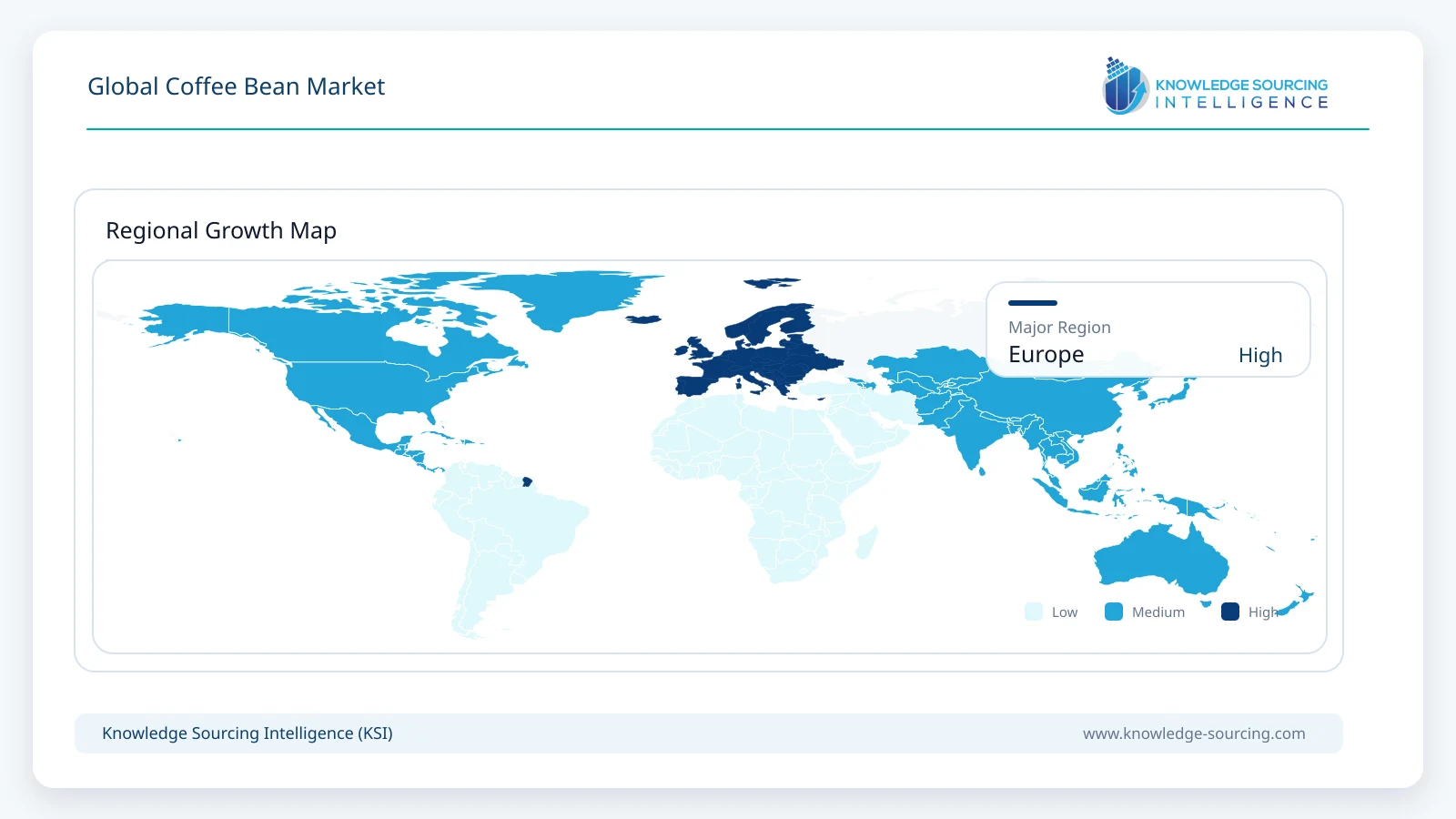
Europe remains the leading regional coffee bean market because of its large roasting industry, established consumer base and dependence on imported green coffee. European companies sourced approximately 3.3 million tonnes of green coffee in 2024, recovering from the decline recorded in 2023. Germany is the region’s largest green coffee importer and trading hub, with imports of approximately 1.16 million tonnes in 2024, while Italy imported approximately 623,000 tonnes directly from producing countries. Germany, Italy, Spain, Belgium, Switzerland and the Netherlands together account for around 80% of European imports from producing countries.
Germany also performs a significant redistribution function. Approximately 205,000 tonnes of green coffee were re-exported from Germany to other European countries in 2024, supported by major logistics infrastructure around Hamburg and the presence of international traders including Neumann Kaffee Gruppe. European demand spans Arabica and Robusta, with Italy and Spain using comparatively large Robusta volumes in espresso-oriented blends. Regulatory requirements are simultaneously increasing the importance of supply-chain traceability, making Europe both a major volume market and an important driver of changes in international sourcing practices.
Import, Export and International Trade Analysis
Coffee is one of the world’s most internationally traded agricultural commodities because production is concentrated in tropical regions while a substantial share of roasting and consumption takes place elsewhere. USDA forecasts world coffee bean exports at 123.8 million bags in 2025/26, 2.3 million bags above the previous season, as stronger shipments from Vietnam, Indonesia and Honduras offset lower availability from Brazil and Colombia. The ICO reported 12.23 million bags of exports in July 2026, compared with 11.84 million bags a year earlier, while cumulative exports for the first ten months of coffee year 2025/26 were broadly stable at 118.39 million bags.
Brazil remains the principal exporter overall, while Vietnam has an especially important role in Robusta trade. Colombia remains a major washed Arabica exporter, and Ethiopia, Indonesia, Uganda, Honduras, Peru and India contribute additional supply across different grades and harvest windows. Ethiopia’s 2025/26 exports are forecast at 7.8 million bags, supported by record production and policy reforms designed to improve producer access to international markets.
On the importing side, European countries and the United States remain central to global bean flows, while Asian demand is becoming increasingly important. Trade competitiveness depends on more than farm-level production cost. Bean quality, port access, shipping reliability, certification, traceability and the ability to supply consistent volumes throughout the purchasing cycle increasingly determine which origins are incorporated into major roaster programs.
Coffee Bean Price and Inventory Trends
Coffee pricing remains highly responsive to changes in production expectations because global inventories provide a relatively limited buffer. USDA’s 20.1 million-bag ending-stock forecast for 2025/26 represents the fifth consecutive annual decline even though overall production is expected to reach a record level. The ICO Composite Indicator Price averaged 287.29 US cents per pound in August 2026, with concerns over near-term Arabica supply supporting prices before improved Brazilian rainfall moderated the market later in the month.
Brazil provides a useful indication of the interaction between volume and pricing. Coffee exports in 2025 declined 17.1% to 41.9 million bags, yet export revenue reached a record USD 16.1 billion, approximately 30.3% above 2024, as the average value of exported coffee increased sharply. During the first four months of 2026, Brazilian export volumes remained constrained before the larger new crop became available. These conditions encourage major roasters and traders to combine futures hedging, forward purchasing, inventories and multi-origin sourcing when managing green coffee costs.
Competitive Landscape
The coffee bean market combines dedicated green coffee traders, integrated agricultural sourcing companies and large multinational roasters. Neumann Kaffee Gruppe, Sucafina, Louis Dreyfus Company, ECOM Agroindustrial and ofi participate directly in sourcing, trading and supply-chain management across multiple producing countries. Their capabilities include quality control, logistics, financing, sustainability programs and relationships with farmers, cooperatives and exporters.
Large downstream buyers including Keurig Dr Pepper/JDE Peet’s, Nestlé, Starbucks, Lavazza and illycaffè influence bean procurement through global roasting and consumer-brand portfolios. Consolidation is affecting this group. Keurig Dr Pepper acquired 96.22% of JDE Peet’s shares in April 2026, combining JDE Peet’s with KDP’s existing coffee operations and establishing the basis for a larger global coffee business.
Competition increasingly extends beyond access to physical beans. Major participants are investing in farm mapping, climate resilience, regenerative agriculture and deforestation monitoring because reliable future sourcing increasingly depends on supplier data and agricultural productivity. The Coffee Canopy Partnership and large-scale tree replacement programs illustrate how procurement strategy is becoming more closely connected with upstream agricultural investment.
Recent Developments
July 2026: Sucafina announced that German specialty green coffee importer Rehm & Co. joined the Sucafina Group, strengthening the group’s specialty coffee sourcing and distribution presence in Germany and Europe.
July 2026: The European Commission adopted measures updating the EUDR product scope and digital tools ahead of the regulation beginning to apply by the end of December 2026.
April 2026: JDE Peet’s, Louis Dreyfus Company, Neumann Kaffee Gruppe, Sucafina, Sucden, Touton and Tchibo launched the Coffee Canopy Partnership. Its initial East African mapping program covers approximately 1.2 million square kilometres.
April 2026: Keurig Dr Pepper acquired 96.22% of JDE Peet’s shares at settlement, bringing JDE Peet’s into the KDP Coffee Operating Unit.
March 2026: Starbucks announced that it had distributed 100 million coffee trees selected for performance under climate-adverse conditions and planned to distribute a further 50 million.
May 2026: Brazil’s Conab increased its 2026 coffee production estimate to 66.7 million bags, including 45.8 million bags of Arabica and 20.9 million bags of Conilon.
Coffee Bean Market Outlook
The global coffee bean market is expected to expand steadily through 2031 as record consumption combines with premiumization, growth in emerging coffee markets and continued diversification of prepared coffee formats. Supply conditions are improving in several important origins. Brazil’s 2026 crop is forecast at 66.7 million bags, Vietnam is expected to produce 31.7 million bags in 2025/26 and Indonesia’s output has recovered to an estimated 12.5 million bags. However, global stocks remain constrained and climatic conditions can quickly alter production expectations, maintaining volatility in international bean prices.
Arabica is expected to retain the leading market position because of its established role in specialty coffee, whole-bean retail and premium blends, while increasing Robusta availability broadens sourcing options for soluble coffee, espresso and mainstream applications. International procurement will simultaneously require stronger farm-level traceability and climate-resilience programs as buyers address regulatory requirements and long-term supply risks. The global coffee bean market is forecast to increase, with value growth supported by expanding consumption, differentiated quality and more sophisticated sourcing across global coffee supply chains.
Coffee Bean Market Scope:
| Report Metric | Details |
|---|---|
| Total Market Size in 2026 | USD 31.2 billion |
| Total Market Size in 2031 | USD 37.8 billion |
| Forecast Unit | Billion |
| Growth Rate | 3.95% |
| Study Period | 2021 to 2031 |
| Historical Data | 2021 to 2024 |
| Base Year | 2025 |
| Forecast Period | 2026 – 2031 |
| Segmentation | Type, End-User, Distribution Channel, Geography |
| Companies |
|
Market Segmentation
By Type
· Arabica
· Robusta
By End-User
· Food and Beverage
· Pharmaceuticals
· Personal Care and Cosmetics
By Distribution Channel
· Offline
· Online
By Geography
· North America
o United States
o Canada
o Mexico
· South America
o Brazil
o Argentina
o Colombia
o Others
· Europe
o Germany
o France
o United Kingdom
o Spain
o Italy
o Others
· Middle East and Africa
o Saudi Arabia
o Israel
o Others
· Asia Pacific
o China
o Japan
o India
o South Korea
o Vietnam
o Others
Table of Contents
1. INTRODUCTION
1.1. Market Overview
1.2. Market Definition
1.3. Scope of the Study
1.4. Market Segmentation
1.5. Currency
1.6. Assumptions
1.7. Base and Forecast Years Timeline
1.8. Key Benefits for Stakeholders
2. RESEARCH METHODOLOGY
2.1. Research Design
2.2. Research Process
2.3. Primary Research
2.4. Secondary Research
2.5. Market Estimation
2.6. Data Triangulation
2.7. Forecast Methodology
3. EXECUTIVE SUMMARY
3.1. Key Findings
3.2. Analyst View
4. MARKET DYNAMICS
4.1. Market Drivers
4.1.1. Growing Global Coffee Consumption
4.1.2. Expansion of Specialty and Premium Coffee
4.1.3. Increasing Robusta Availability
4.1.4. Expansion of Traceable Coffee Procurement
4.2. Market Restraints
4.2.1. Climate and Weather Volatility
4.2.2. Coffee Price and Inventory Volatility
4.2.3. Increasing Traceability and Compliance Requirements
4.3. Porter’s Five Forces Analysis
4.3.1. Bargaining Power of Suppliers
4.3.2. Bargaining Power of Buyers
4.3.3. Threat of New Entrants
4.3.4. Threat of Substitutes
4.3.5. Competitive Rivalry
4.4. Industry Value Chain Analysis
4.5. Global Coffee Bean Production and Consumption Trends
4.6. Import, Export and International Trade Analysis
4.7. Coffee Bean Price and Inventory Trends
4.8. Policies, Regulations and Traceability Requirements
4.9. Analyst View
5. GLOBAL COFFEE BEAN MARKET BY TYPE
5.1. Arabica
5.2. Robusta
6. GLOBAL COFFEE BEAN MARKET BY END-USER
6.1. Food and Beverage
6.2. Pharmaceuticals
6.3. Personal Care and Cosmetics
7. GLOBAL COFFEE BEAN MARKET BY DISTRIBUTION CHANNEL
7.1. Offline
7.2. Online
8. GLOBAL COFFEE BEAN MARKET BY GEOGRAPHY
8.1. North America
8.1.1. United States
8.1.1.1. By Type
8.1.1.2. By End-User
8.1.1.3. By Distribution Channel
8.1.2. Canada
8.1.2.1. By Type
8.1.2.2. By End-User
8.1.2.3. By Distribution Channel
8.1.3. Mexico
8.1.3.1. By Type
8.1.3.2. By End-User
8.1.3.3. By Distribution Channel
8.2. South America
8.2.1. Brazil
8.2.1.1. By Type
8.2.1.2. By End-User
8.2.1.3. By Distribution Channel
8.2.2. Argentina
8.2.2.1. By Type
8.2.2.2. By End-User
8.2.2.3. By Distribution Channel
8.2.3. Colombia
8.2.3.1. By Type
8.2.3.2. By End-User
8.2.3.3. By Distribution Channel
8.2.4. Others
8.3. Europe
8.3.1. Germany
8.3.1.1. By Type
8.3.1.2. By End-User
8.3.1.3. By Distribution Channel
8.3.2. France
8.3.2.1. By Type
8.3.2.2. By End-User
8.3.2.3. By Distribution Channel
8.3.3. United Kingdom
8.3.3.1. By Type
8.3.3.2. By End-User
8.3.3.3. By Distribution Channel
8.3.4. Spain
8.3.4.1. By Type
8.3.4.2. By End-User
8.3.4.3. By Distribution Channel
8.3.5. Italy
8.3.5.1. By Type
8.3.5.2. By End-User
8.3.5.3. By Distribution Channel
8.3.6. Others
8.4. Middle East and Africa
8.4.1. Saudi Arabia
8.4.1.1. By Type
8.4.1.2. By End-User
8.4.1.3. By Distribution Channel
8.4.2. Israel
8.4.2.1. By Type
8.4.2.2. By End-User
8.4.2.3. By Distribution Channel
8.4.3. Others
8.5. Asia Pacific
8.5.1. China
8.5.1.1. By Type
8.5.1.2. By End-User
8.5.1.3. By Distribution Channel
8.5.2. Japan
8.5.2.1. By Type
8.5.2.2. By End-User
8.5.2.3. By Distribution Channel
8.5.3. India
8.5.3.1. By Type
8.5.3.2. By End-User
8.5.3.3. By Distribution Channel
8.5.4. South Korea
8.5.4.1. By Type
8.5.4.2. By End-User
8.5.4.3. By Distribution Channel
8.5.5. Vietnam
8.5.5.1. By Type
8.5.5.2. By End-User
8.5.5.3. By Distribution Channel
8.5.6. Others
9. COMPETITIVE ENVIRONMENT AND ANALYSIS
9.1. Major Players and Strategy Analysis
9.2. Emerging Players and Market Lucrativeness
9.3. Mergers, Acquisitions, Agreements and Collaborations
9.4. Competitive Dashboard
10. COMPANY PROFILES
10.1. Neumann Kaffee Gruppe
10.2. Sucafina SA
10.3. Louis Dreyfus Company B.V.
10.4. ECOM Agroindustrial Corp. Ltd.
10.5. ofi
10.6. Keurig Dr Pepper
10.7. Nestlé S.A.
10.8. Starbucks Corporation
10.9. Luigi Lavazza S.p.A.
10.10. illycaffè S.p.A.
Navigate
Trusted by the world's leading organizations











