
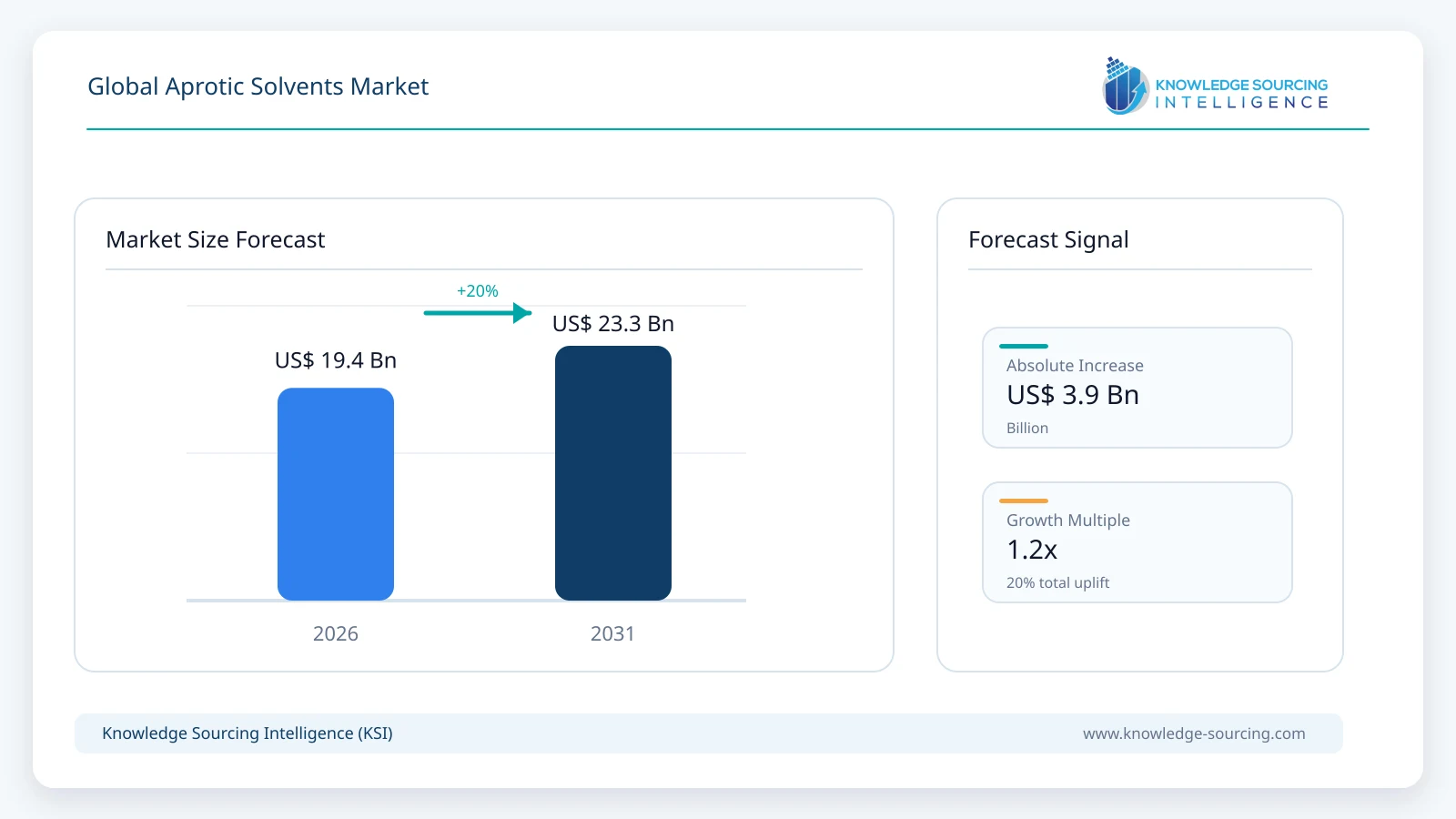
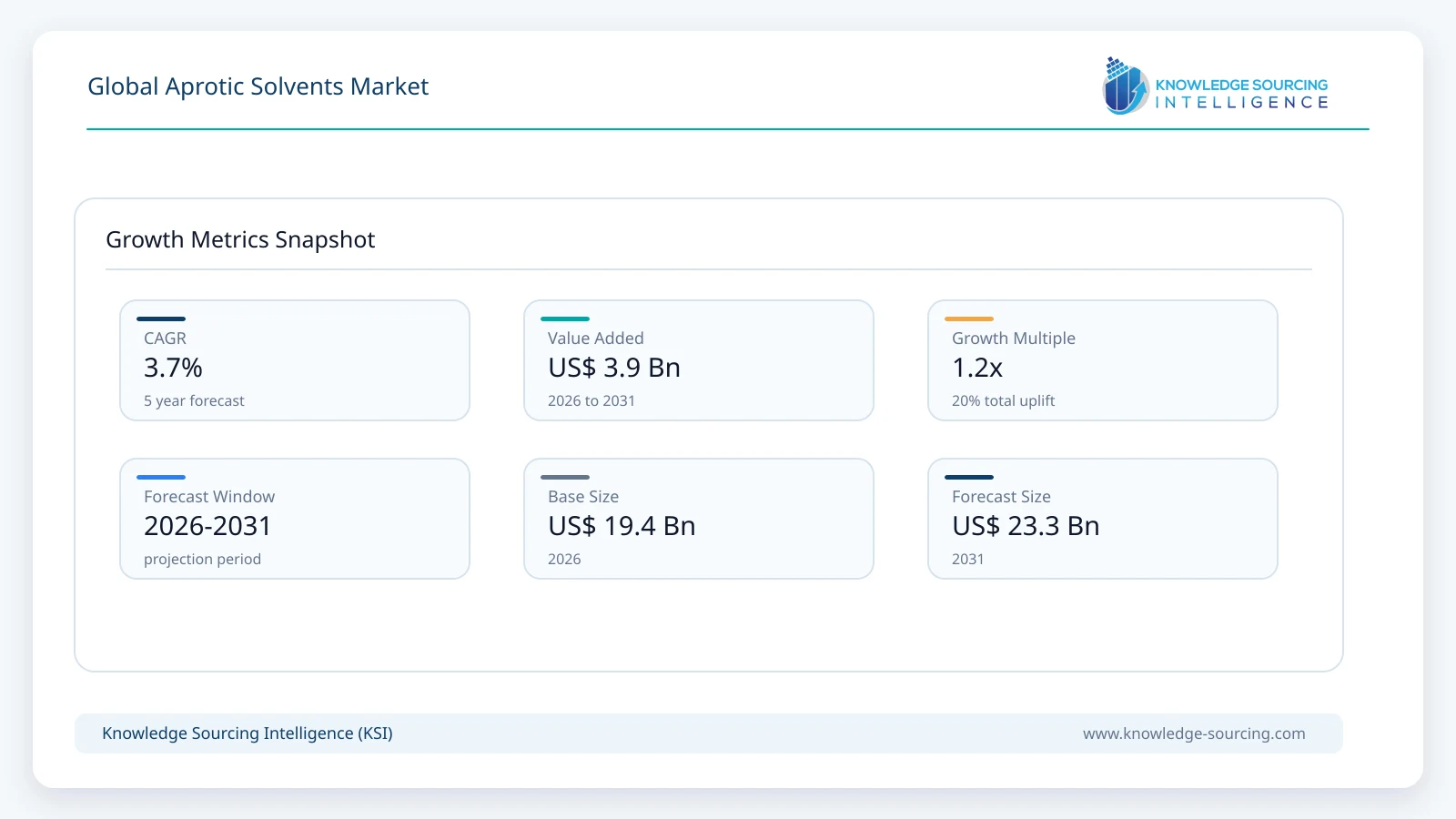
The global aprotic solvents market is forecast to grow at a CAGR of 3.7%, increasing from USD 19.45 billion in 2026 to USD 23.30 billion by 2031.
Highlights:
- 1Acetone generates approximately USD 5.84 billion of global aprotic solvent revenue in 2026.
- 2Electronics and battery applications account for approximately 11% of global aprotic solvent revenue in 2026.
- 3Commodity solvents continue to provide the largest physical-volume base across coatings and chemical processing.
- 4Asia Pacific accounts for approximately 45% of global aprotic solvent revenue in 2026.
- 5Solvent recovery is becoming commercially important in battery and specialty chemical manufacturing.
- 6Regulatory pressure is accelerating substitution in selected NMP, DMF and DMAc applications.
Aprotic solvents are used extensively as processing media, reaction solvents, extraction agents, cleaning materials and formulation components across chemical and manufacturing industries. Acetone and toluene retain broad-volume applications across coatings, adhesives, pharmaceuticals, cleaning products and chemical processing, while NMP, DMF, DMAc and acetonitrile have stronger positions in batteries, electronics, specialty polymers, pharmaceutical synthesis and other applications requiring specific solvency or purity characteristics.
Commercial dynamics differ considerably between commodity and specialty products. Acetone and aromatic solvents are closely linked to petrochemical feedstock pricing, plant operating rates and regional supply-demand balances. High-purity NMP and other specialty aprotic solvents can command considerably higher values because battery, semiconductor and pharmaceutical customers impose tighter requirements for moisture, metals and other impurities.
Battery manufacturing is strengthening this higher-value portion of the market. Balaji Amines announced in 2026 that it had developed electronic-grade NMP for India's emerging EV battery industry, while established suppliers including BASF continue to target batteries, pharmaceuticals, membranes, coatings and specialty chemical applications. These developments are broadening the commercial importance of purity, recovery capability and customer qualification alongside conventional solvent availability.
Market Trends
Greater use of solvent recovery and closed-loop processing
Solvent recovery is becoming more commercially important as manufacturers seek to control raw-material costs, reduce emissions and comply with occupational-exposure requirements. The trend is particularly visible in lithium-ion battery manufacturing, where NMP released during cathode drying can be captured, purified and returned to the production process. Mitsubishi Chemical Engineering provides systems designed to recover and purify NMP for reuse in battery plants, while environmental-service companies are expanding solvent-recycling capabilities around battery manufacturing. Higher recovery rates can moderate virgin NMP consumption per unit of cell output, but they also strengthen the continued commercial viability of NMP by reducing operating cost and waste-generation concerns.
Lower-carbon and safer solvent portfolios
Environmental differentiation is becoming more visible within solvent portfolios. BASF introduced NMP with a reduced product carbon footprint in March 2026, offering at least a 10% reduction compared with the company's conventional product from Ludwigshafen without requiring customers to change established formulations or production processes. Other suppliers are approaching the same issue through substitution. Solvay markets alternative solvents designed for applications where manufacturers are seeking to replace conventional high-concern solvents while retaining required solvency and processing performance. The market is consequently developing through both lower-impact versions of established chemistries and alternative solvent systems for applications where substitution is feasible.
Market Drivers
Expansion of lithium-ion battery and advanced electronics manufacturing
Battery manufacturing provides one of the strongest growth avenues for high-purity polar aprotic solvents. Global lithium-ion battery manufacturing capacity exceeded 4 TWh by the end of 2025, while expanding EV and energy-storage production is supporting new cell plants across multiple regions. NMP remains widely used in conventional cathode slurry preparation and electrode coating, creating demand for virgin material as well as solvent recovery and purification systems. Advanced electronics provide another high-value demand pool because semiconductor, display and electronic-material processes generally require substantially tighter impurity specifications than conventional industrial applications. As production expands, solvent manufacturers capable of maintaining electronic-grade purity and consistent supply are positioned to capture higher-value business even though electronics account for a smaller physical-volume base than coatings and general chemical processing.
Sustained demand from coatings, pharmaceuticals and chemical processing
Established industrial sectors continue to provide the market with a broad recurring demand base. Acetone, toluene, DMF, NMP and other solvents are used in resin processing, pharmaceutical synthesis, coatings, adhesives, chemical reactions, cleaning and separation processes. These applications generally expand more slowly than batteries and electronics but account for considerably larger existing manufacturing volumes. This diversity reduces dependence on any single end-use industry. Weakness in construction-related coatings, for example, can be partly offset by pharmaceutical, chemical or electronics demand. The availability of multiple application outlets also supports integrated solvent producers that can redirect production across customers and regions as relative margins change.
Market Restraint
Toxicological restrictions and substitution pressure
Regulation presents the most important structural challenge for several polar aprotic solvents. NMP, DMF, DMAc and NEP are subject to European REACH restrictions intended to control occupational exposure, and updated compliance guidance covering these substances was issued in 2026. Users may need enclosed processing systems, exposure monitoring, ventilation improvements and other controls, increasing the cost of continued use. The commercial effect differs considerably by application. Battery manufacturers may continue using NMP because existing cathode-coating processes, equipment and solvent-recovery infrastructure make substitution difficult in the near term. Coatings, cleaning products and some chemical applications have greater flexibility to reformulate around alternative solvents. Regulatory pressure therefore restricts growth more significantly in applications where customers can change chemistry without materially affecting product performance or manufacturing economics.
Segment Analysis
By Type - Acetone
Acetone remains the largest individual product category and accounts for approximately 30% of global aprotic solvent revenue in 2026. Its position reflects a broad application base spanning coatings, adhesives, pharmaceuticals, industrial cleaning, chemical synthesis and downstream intermediates. Large integrated production capacity also gives acetone greater global availability than more specialized polar aprotic solvents. INEOS operates significant acetone capacity across Europe, the United States and Asia, while Shell, Sasol, LG Chem and other petrochemical producers maintain established supply positions. Growth is relatively mature compared with battery-grade NMP, but the segment benefits from its scale, established handling infrastructure and widespread customer qualification. Pharmaceutical, electronics and specialty applications also support higher-purity grades alongside conventional industrial material.
By Application - Electronics and Batteries
Electronics and battery applications are projected to expand at approximately 5.5% CAGR between 2026 and 2031, making them one of the faster-growing demand areas within the market. Lithium-ion cell production is the principal contributor, particularly through the use of NMP in conventional cathode manufacturing, while electronics manufacturing creates additional requirements for highly purified solvents used in processing and cleaning. The segment is evolving alongside battery-production technology. Solvent recovery reduces the requirement for fresh NMP per unit of production, and alternative electrode-processing technologies may gradually reduce solvent intensity. Nevertheless, the scale of new battery manufacturing capacity expected during the forecast period outweighs these efficiency improvements in the near term. Expansion of battery manufacturing in India and other emerging locations is also creating opportunities for regional chemical suppliers to qualify higher-purity grades previously concentrated among established international producers. The segment is therefore projected to reach approximately USD 2.88 billion by 2031.
By Geography - Asia Pacific
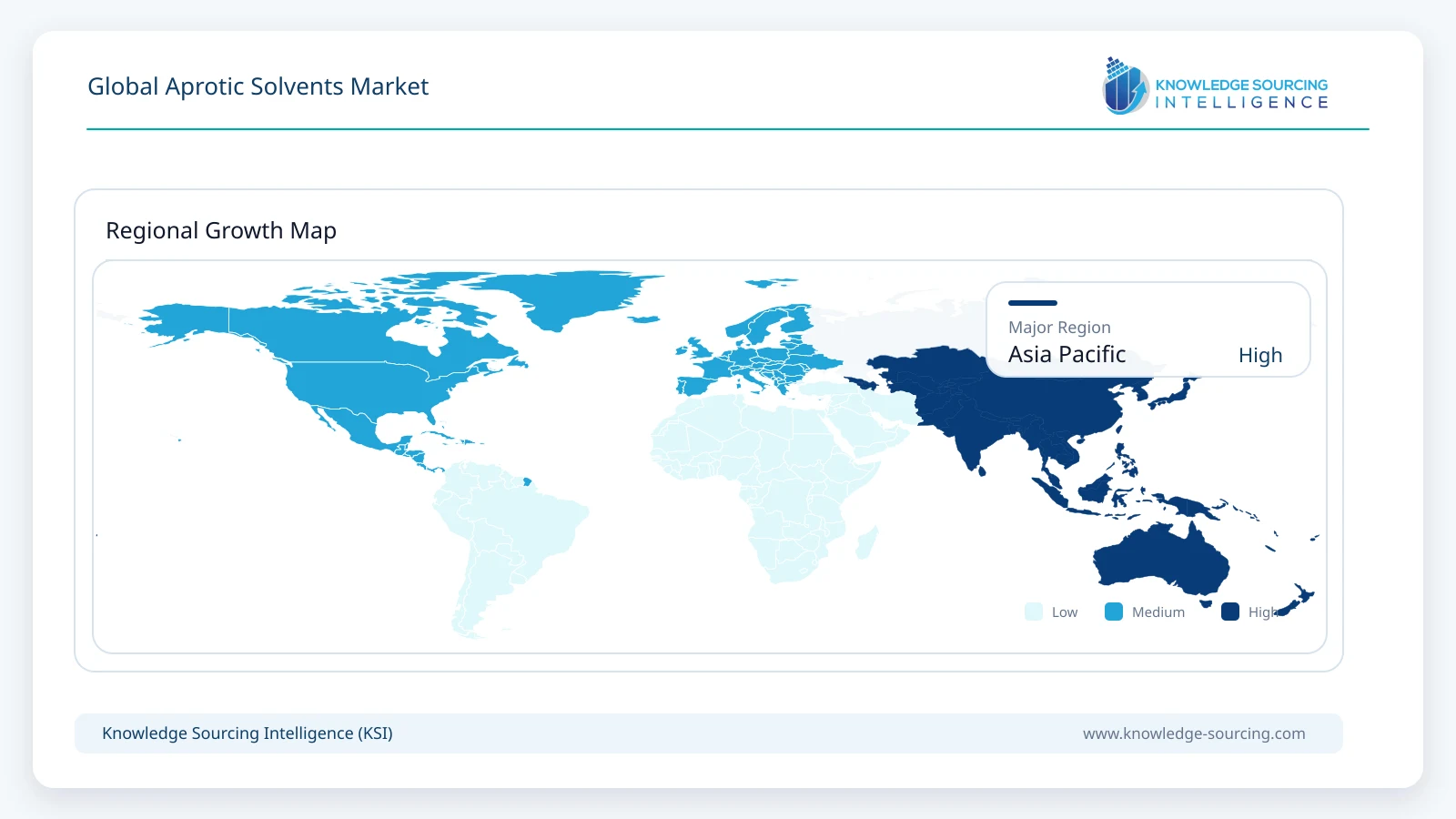
Asia Pacific remains the dominant regional market because China, South Korea, Japan, India, Taiwan and Southeast Asia combine substantial chemicals, electronics, pharmaceuticals, coatings and battery-manufacturing industries. China provides the largest demand base, particularly for battery-related solvents, while South Korea, Japan and Taiwan remain important consumers of electronic-grade products. Regional revenue is projected to reach approximately USD 11.1 billion by 2031. Growth increasingly extends beyond China as India develops battery-cell, pharmaceutical, specialty chemical and electronics manufacturing capacity, while Southeast Asian countries attract additional downstream chemical and electronics investment. Europe and North America remain substantial solvent markets but face stronger substitution pressure in several regulated applications, giving Asia Pacific a greater contribution to incremental global demand.
Competitive Environment
Competition varies considerably between commodity and specialty aprotic solvents. INEOS, Shell, Sasol, LG Chem and other integrated chemical producers compete strongly in large-volume acetone and aromatic solvents, where feedstock integration, production scale, operating rates and logistics materially influence profitability. BASF, Balaji Amines and other specialty chemical suppliers have stronger exposure to NMP and related higher-value products. Competition in these areas increasingly centers on purity, consistency, technical support, customer qualification and supply security rather than price alone.
Environmental positioning is also becoming a differentiator. BASF's reduced-carbon-footprint NMP represents one approach, while suppliers developing alternative solvents are targeting applications where customers are under pressure to reduce exposure to conventional substances of concern. Competitive strategy through 2031 will therefore involve both improving established solvents and developing products capable of replacing them.
Recent Developments
July 2026: European regulators released updated guidance addressing compliance with REACH restrictions applicable to NMP, DMF, DMAc and NEP.
March 2026: BASF introduced reduced-carbon-footprint NMP from Ludwigshafen with at least a 10% lower product carbon footprint than its corresponding conventional grade.
Aprotic Solvents Market Scope
| Report Metric | Details |
|---|---|
| Total Market Size in 2026 | USD 19.45 billion |
| Total Market Size in 2031 | USD 23.30 billion |
| Forecast Unit | Billion |
| Growth Rate | 3.7% |
| Study Period | 2021 to 2031 |
| Historical Data | 2021 to 2024 |
| Base Year | 2025 |
| Forecast Period | 2026 – 2031 |
| Segmentation | Type, Application, Geography |
| Companies |
|
Market Segmentation
By Type
Acetone
Toluene
N-Methyl-2-Pyrrolidone (NMP)
Dimethylformamide (DMF) and Dimethylacetamide (DMAc)
Acetonitrile
Tetrahydrofuran (THF)
Others
By Application
Electronics and Batteries
Paints and Coatings
Oil and Gas
Pharmaceuticals
Agrochemicals
Adhesives and Sealants
Chemical Processing
Others
By Geography
North America
USA
Canada
Mexico
South America
Brazil
Argentina
Others
Europe
Germany
France
United Kingdom
Italy
Spain
Netherlands
Others
Middle East and Africa
Saudi Arabia
UAE
South Africa
Israel
Others
Asia Pacific
China
India
Japan
South Korea
Taiwan
Thailand
Indonesia
Singapore
Others
Table of Contents
1. EXECUTIVE SUMMARY
1.1. Market Overview
1.2. Key Findings
1.3. Market Opportunities
2. MARKET SNAPSHOT
2.1. Market Definition
2.2. Market Segmentation
2.3. Market Size and Forecast
3. BUSINESS LANDSCAPE
3.1. Market Drivers
3.1.1. Expansion of Lithium-Ion Battery and Advanced Electronics Manufacturing
3.1.2. Sustained Demand from Coatings, Pharmaceuticals and Chemical Processing
3.2. Market Restraint
3.2.1. Toxicological Restrictions and Substitution Pressure
3.3. Market Opportunities
3.4. Porter's Five Forces Analysis
3.5. Industry Value Chain Analysis
3.6. Regulatory Environment
3.7. Strategic Recommendations
4. MARKET TRENDS
4.1. Greater Use of Solvent Recovery and Closed-Loop Processing
4.2. Lower-Carbon and Safer Solvent Portfolios
4.3. Growth of Electronic-Grade and Battery-Grade Solvents
5. GLOBAL APROTIC SOLVENTS MARKET BY TYPE
5.1. Acetone
5.2. Toluene
5.3. N-Methyl-2-Pyrrolidone (NMP)
5.4. Dimethylformamide (DMF) and Dimethylacetamide (DMAc)
5.5. Acetonitrile
5.6. Tetrahydrofuran (THF)
5.7. Others
6. GLOBAL APROTIC SOLVENTS MARKET BY APPLICATION
6.1. Electronics and Batteries
6.2. Paints and Coatings
6.3. Oil and Gas
6.4. Pharmaceuticals
6.5. Agrochemicals
6.6. Adhesives and Sealants
6.7. Chemical Processing
6.8. Others
7. GLOBAL APROTIC SOLVENTS MARKET BY GEOGRAPHY
7.1. North America
7.1.1. USA
7.1.2. Canada
7.1.3. Mexico
7.2. South America
7.2.1. Brazil
7.2.2. Argentina
7.2.3. Others
7.3. Europe
7.3.1. Germany
7.3.2. France
7.3.3. United Kingdom
7.3.4. Italy
7.3.5. Spain
7.3.6. Netherlands
7.3.7. Others
7.4. Middle East and Africa
7.4.1. Saudi Arabia
7.4.2. UAE
7.4.3. South Africa
7.4.4. Israel
7.4.5. Others
7.5. Asia Pacific
7.5.1. China
7.5.2. India
7.5.3. Japan
7.5.4. South Korea
7.5.5. Taiwan
7.5.6. Thailand
7.5.7. Indonesia
7.5.8. Singapore
7.5.9. Others
8. COMPETITIVE ENVIRONMENT AND ANALYSIS
8.1. Major Players and Strategy Analysis
8.2. Market Share Analysis
8.3. Mergers, Acquisitions, Agreements and Collaborations
8.4. Competitive Dashboard
9. COMPANY PROFILES
9.1. BASF SE
9.2. INEOS Group
9.3. Shell Chemicals
9.4. Exxon Mobil Corporation
9.5. Sasol Limited
9.6. Eastman Chemical Company
9.7. Arkema
9.8. Solvay SA
9.9. Balaji Amines Limited
9.10. Mitsubishi Chemical Group Corporation
9.11. Mitsui Chemicals, Inc.
9.12. LG Chem Ltd.
9.13. LyondellBasell Industries N.V.
9.14. Dow Inc.
9.15. Ashland Inc.
9.16. Hefei TNJ Chemical Industry Co., Ltd.
10. APPENDIX
10.1. Currency
10.2. Assumptions
10.3. Base and Forecast Years Timeline
10.4. Key Benefits for Stakeholders
10.5. Research Methodology
10.6. Abbreviations
List of Figures
List of Tables
Navigate
Trusted by the world's leading organizations











