Report Overview
IIoT Platform Market Size, Highlights
IIOT Platform Market Size:
The IIOT platform market is evaluated at US$14,337.571 million in 2025, growing at a CAGR of 10.46%, reaching the market size of US$23,576.857 million by 2030.
Among the elements of the Internet of Things is the Industrial Internet of Things (IIoT). Sensors and instruments are interconnected on the network and incorporated into the computer network for applications. In addition, cloud computing techniques are being used to develop high-trending applications. In this approach, large amounts of data are collected and sent to a cloud-based service, which is combined with other data and made available to end-users. Other factors contributing to the IIoT platform industry’s growth include technological advancements in semiconductors and electronics, increased use of cloud computing platforms, standardization of IPv6, and government support for research and development related to the IIoT platform.
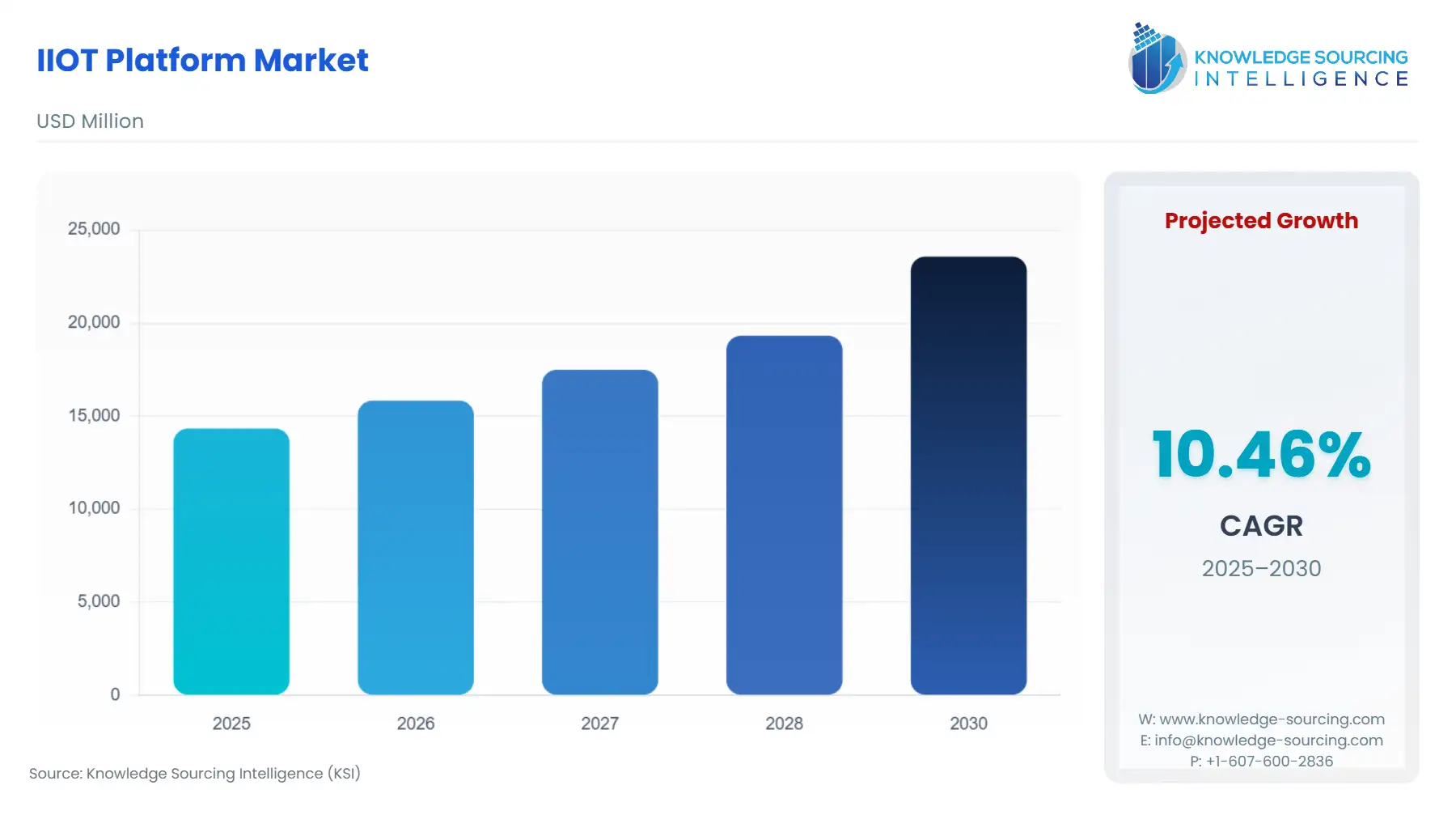
Technological advancements in the developing world and the emergence of big data analytics have fuelled the IIoT platform market expansion in recent years. Furthermore, the development of industry-specific platforms in developed regions and increased demand from the healthcare industry are likely to fuel this market’s growth
IIoT Platform Market Growth Opportunities:
- The rapid adoption of artificial intelligence (AI) and the Internet of Things (IoT) in the manufacturing sector
The manufacturing sector has been advancing rapidly in using AI and IoT. Integrating AI and IoT allows manufacturing processes to be optimized, send early warnings, improve quality control, and predict equipment failure. Manufacturers can differentiate themselves from competitors by collecting precise data and developing innovative AI applications. Manufacturing processes had to be improvised due to movement restrictions, lockdowns, and a lack of workforce. This resulted in an increase in IoT and AI usage in manufacturing. In the absence of a regular workforce, manufacturing units used AI and machine learning algorithms to track machine conditions and maintain equipment.
- Increasing demand for Self-driving cars impacts the IIoT platform market growth.
The automotive industry is anticipated to undergo a rapid revolution with the advent of autonomous or self-driving trucks and passenger cars. Approximately 1.3 million people die every year as a result of traffic accidents, primarily caused by truck accidents on the highways. Internet of Things (IoT) platforms will be used to develop automated and semi-autonomous trucks and other vehicles that will be able to communicate with each other via data collection and cloud storage. According to a new report from the United Nations Economic Commission for Europe (UNESE), self-driving vehicles can enhance comfort, safety, and efficiency while reducing environmental impacts. This resulted in creating a market for autonomous trucks and other vehicles on an IIoT platform.
- Expanding need for real-time data services and solutions
All industries aim to utilize real-time data insights for better decision-making, predictive maintenance, and operational efficiency. Using IIoT solutions, businesses can improve resource utilization, identify anomalies, and operate efficiently by gathering, analyzing, and visualizing real-time data from connected devices. With increasing business demands for agility and responsiveness, IIoT-based real-time data solutions and services are rising. This is driving innovation and investment in the global IIoT market.
IIoT Platform Market Restraints:
- Technology vulnerabilities to cyberattacks in the IoT
Intelligent manufacturing systems are intertwined with IoT technologies. As a result of interconnected devices across a manufacturing facility, security holes are created throughout the facility, posing a threat to its operation. Hence, it is impossible to know where the data originates or where it ends from a security perspective. As such, data visibility on a factory floor is the greatest cybersecurity challenge in smart manufacturing. For instance, an attack involving DoppelPaymer ransomware occurred at a manufacturing facility owned by Visser Precision, which manufactures space and defense equipment. Upon exploiting vulnerabilities in the system, the hackers leaked sensitive documents and non-disclosure agreements.
IIoT Platform Market Geographical Outlooks:
- North America is witnessing exponential growth during the forecast period
The IIoT market in North America is driven by the broad implementation of Industry 4.0 principles across diverse industries. IIoT platforms are essential for integrating smart devices, sensors, and machines as companies aim for greater automation, connection, and data-driven decision-making. One of the main drivers has been the need for real-time data analytics and insights to maximize operational effectiveness, decrease downtime, and boost overall production. The growing emphasis on supply chain optimization, asset tracking, and predictive maintenance further accelerates the adoption of IIoT platforms in North America.
IIoT Platform Market Key Developments:
- October?2025: Siemens Digital Industries Software was named a Leader in the Gartner Magic Quadrant™ for Global Industrial IIoT Platforms, reflecting its scalable IIoT solutions driving digital transformation and analytics adoption.
- May?2025: eInfochips announced its EIC PROPEL™ IIoT platform won the 2025 Industrial IoT Product of the Year award, affirming its real?time monitoring, predictive maintenance, and integration capabilities.
- April?2025: Nokia launched its Industrial IoT Marketplace at Hannover Messe 2025, providing a platform for buyers to access ready?to?deploy Industry?4.0 solutions integrated with its industrial edge compute ecosystem.
- February?2025: Cisco was recognized as “Industrial IoT Company of the Year” in the 2025 IoT Breakthrough Awards, highlighting its IIoT networking and security solutions for industrial digitalization.
IIOT Platform Market Scope:
| Report Metric | Details |
|---|---|
| Study Period | 2021 to 2031 |
| Historical Data | 2021 to 2024 |
| Base Year | 2025 |
| Forecast Period | 2026 – 2031 |
| Report Metric | Details |
| IIOT Platform Market Size in 2025 | US$14,337.571 million |
| IIOT Platform Market Size in 2030 | US$23,576.857 million |
| Growth Rate | CAGR of 10.46% |
| Study Period | 2020 to 2030 |
| Historical Data | 2020 to 2023 |
| Base Year | 2024 |
| Forecast Period | 2025 – 2030 |
| Forecast Unit (Value) | USD Million |
| Segmentation |
|
| Geographical Segmentation | North America, South America, Europe, Middle East and Africa, Asia Pacific |
| List of Major Companies in the IIOT Platform Market |
|
| Customization Scope | Free report customization with purchase |
IIOT Platform Market Segmentation:
- By Platform Type
- Device Management Platform
- Application Management Platform
- Network Management Platform
- By Application
- Predictive Maintenance
- Business Process Optimization
- Asset Tracking and Management
- Logistics and Supply Chain Management
- Real-Time Workforce Tracking and Management
- Automation Control and Management
- Emergency and Incident Management
- Business Communication
- By End-User Industry
- Energy and Power
- Chemical
- Food and Beverage
- Automotive
- Manufacturing
- Semiconductor
- Healthcare
- Others
- By Geography
- North America
- United States
- Canada
- Mexico
- South America
- Brazil
- Argentina
- Others
- Europe
- Germany
- France
- Spain
- United Kingdom
- Others
- Middle East and Africa
- UAE
- Saudi Arabia
- Others
- Asia Pacific
- China
- Japan
- India
- South Korea
- Thailand
- Indonesia
- Taiwan
- Others
- North America