The point-of-care diagnostic devices market is growing as more people desire rapid, on-location testing and expedited clinical decisions. Growing applications in chronic and infectious disease detection, coupled with revolutionary portable technologies, are major factors behind the market growth. However, issues related to accuracy and regulations pose challenges.
Point-of-Care Diagnostic Devices Market Trends & Forecast
According to a research study published by Knowledge Sourcing Intelligence (KSI), the point-of-care diagnostic devices market will expand from USD 48.4 billion in 2026 to USD 88.8 billion in 2031 at a CAGR of 12.9% during the forecast period.
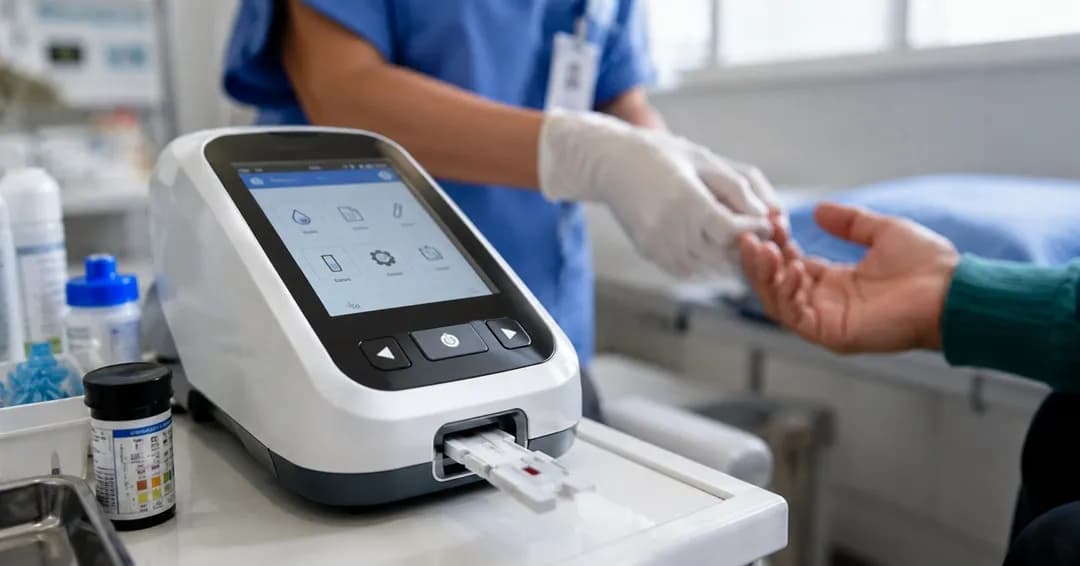
The point-of-care (poc) diagnostic devices market is witnessing robust and constant growth due to the worldwide change towards decentralized healthcare, quick diagnosis, and patient-centric care models. POC devices, which allow patient testing at or near the point of care, such as clinics, physician offices, pharmacies, and even homes, are being preferred far more than the traditional laboratory-based diagnostics mainly because they can provide results faster, they are more convenient, and they have the capability to deliver real-time clinical decision support. The market includes a variety of technologies like glucose monitoring systems, infectious disease testing kits, cardiac biomarkers, blood gas analyzers, pregnancy and fertility tests, and advanced molecular diagnostics platforms.
Request a free sample copy or view the report summary: Point-of-Care Diagnostic Devices Market Report
Point-of-Care Diagnostic Devices Market Report Highlights
The infectious disease testing instruments are the segment witnessing the fastest growth because of the increasing incidence of diseases such as COVID-19, influenza, HIV, and tuberculosis, as well as the need for rapid and early diagnosis. These instruments yield quick and accurate results at the point of care, which is useful for making decisions about treatment on time and minimizing the spread of the disease. Constant innovation in rapid test kits and portable diagnostic devices is boosting this segment's growth as well.
Molecular diagnostics is the fastest-growing segment because of its highly accurate, sensitive, and early detection capability of diseases. The rising use of PCR and other nucleic acid amplification methods in point-of-care situations, mainly for the identification of infectious diseases, is the main driver of demand. Besides, the development of compact and easy-to-use molecular instruments helps the growth of this market.
The growing preference for self-testing and remote patient monitoring is making home care settings the fastest-growing segment of application. Diagnostic kits that are easy to use, cost-effective, and readily available have made it possible for patients to perform tests at home. Besides, the shift toward patient-centric healthcare models, telehealth integration, and increased awareness are helping to support the trend.
The Asia-Pacific region is the fastest-growing market for point-of-care diagnostic devices, driven by a large patient population, rising prevalence of chronic and infectious diseases, and improving healthcare infrastructure.
Point-of-Care Diagnostic Devices Market Growth Drivers and Restraints
Growth Drivers:
Rising Prevalence of Chronic and Infectious Diseases: The rising worldwide incidence of diseases like diabetes, cardiovascular diseases, respiratory diseases, and infectious diseases is one of the main factors leading to the growth of the POC diagnostics market. These diseases necessitate regular and quick testing, which POC devices make possible directly at the patient's site, thereby enhancing the management of the disease and the quality of the patient's life.
Growing Demand for Rapid and Real-Time Diagnostics: Healthcare systems worldwide are changing their focus to quick clinical decision-making. Point-of-care devices offer instant results, which leads to a shorter turnaround time when compared to central laboratories. This is very important in emergency care, intensive care, and infectious disease control.
Restraints:
Stringent Regulatory Requirements: The POC diagnostic devices should meet stringent regulatory standards to guarantee safety and effectiveness. Obtaining approval usually involves lengthy and expensive procedures, which may even delay the launch of the products and hinder market entry for newcomers.
Point-of-Care Diagnostic Devices Market Key Development
Collaboration: In August 2025, the Technology Development Board (TDB), a Government of India department under the Ministry of Science and Technology, entered into a collaboration with M/s Primary Healthtech Pvt. Ltd., New Delhi, for the project "IoT-enabled Point-of-care Blood Testing Device for Affordable and Accessible Healthcare powered by AI/ML algorithms."
Product Launch: In June 2025, Royal Philips, a health technology company with a strong global presence, introduced the Flash Ultrasound System 5100 POC worldwide. This is a point-of-care (POC) ultrasound system designed to meet the rapidly evolving requirements of anesthesia, critical care, emergency medicine, and musculoskeletal imaging.
Point-of-Care Diagnostic Devices Market Segmentation
Knowledge Sourcing Intelligence has segmented the point-of-care diagnostic devices market based on product type, technology, application, and region:
Point-of-Care Diagnostic Devices Market, By Product Type
Glucose Monitoring Devices
Infectious Disease Testing Devices
Cardiac Marker Testing Devices
Blood Gas & Electrolyte Analysers
Pregnancy & Fertility Testing Devices
Point-of-Care Diagnostic Devices Market, By Technology
Lateral Flow Assays
Immunoassays
Molecular Diagnostics
Microfluidics
Point-of-Care Diagnostic Devices Market, By Application
Hospitals & Clinics
Diagnostic Laboratories
Home Care Settings
Ambulatory Care Centers
Point-of-Care Diagnostic Devices Market, By Region
North America
USA
Canada
Mexico
Europe
United Kingdom
Germany
France
Spain
Others
Asia Pacific
China
India
Japan
South Korea
Indonesia
Thailand
Others
South America
Brazil
Argentina
Others
Middle East and Africa (MEA)
Saudi Arabia
UAE
Others
Point-of-Care Diagnostic Devices Market Key Players
Abbott Laboratories
Roche Diagnostics
Siemens Healthineers
Thermo Fisher Scientific
Becton Dickinson and Company
QuidelOrtho Corporation
Everlywell
LetsGetChecked
OraSure Technologies
Cue Health
Need specialized data cuts or competitive intelligence?
Our analyst team provides bespoke market sizing, supplier audits, and country-level feasibility reports tailored to your enterprise roadmap.
Speak With an Industry Analyst →Ask an Industry Analyst
Have questions regarding this briefing or market projections? Inquire with our sector lead.
Related Press Releases
View All →
ADC Manufacturing & CDMO Market is expected to reach USD 10.49 billion by 2031
Aug 7, 2026
Lifestyle-Associated Cancer Epidemiology Market is expected to reach USD 13.12 billion by 2031
Aug 5, 2026
Psycho-Oncology Digital Health Market is anticipated to surpass USD 290.01 million in 2031 at a CAGR of 8.5%
Jul 30, 2026
Intratumoral Injection Therapy Market is expected to reach USD 630.39 million by 2031
Jul 24, 2026
Palliative Care in Oncology Market is expected to reach USD 244.1 billion by 2031
Jul 22, 2026More Press Releases
Oncology Drug Resistance Testing Market is projected to reach USD 3.41 billion in 2031 at a CAGR of 6.6 %
The oncology drug resistance testing market is expanding due to rising cancer prevalence, increasing drug resistance, and growing adoption of precision oncology. Advances in NGS-based testing, companion diagnostics, and targeted therapies, alongside FDA approvals and investments in personalized medicine, are accelerating demand for effective resistance monitoring across hospitals and clinical diagnostics worldwide.
TROP-2 Targeted Therapy Market is anticipated to surpass USD 3.29 billion in 2031 at a CAGR of 8.6 %
The TROP-2 Targeted Therapy market is expanding rapidly due to increasing precision oncology adoption, rising cancer prevalence, and growing use of antibody-drug conjugates. North America leads the market, while Asia Pacific shows the fastest growth. Continuous clinical trials, regulatory approvals, and strategic collaborations are accelerating innovation and commercial adoption worldwide.
Second Primary Cancer Prevention Market is expected to reach USD 24.7 billion by 2031
The Second primary cancer prevention refers to strategies aimed at reducing the risk of developing a new, unrelated cancer in individuals with a prior cancer diagnosis. Growing cancer survivorship, advances in treatment, and increasing awareness of long-term health outcomes have heightened the importance of prevention and surveillance programs. Key approaches include routine screening, genetic risk assessment, lifestyle modification, and long-term follow-up care. Government agencies and healthcare organisations increasingly emphasise survivorship care plans and evidence-based screening protocols to detect new malignancies at earlier stages. Continued investments in early detection technologies and personalised risk assessment are expected to support advancements in second primary cancer prevention.