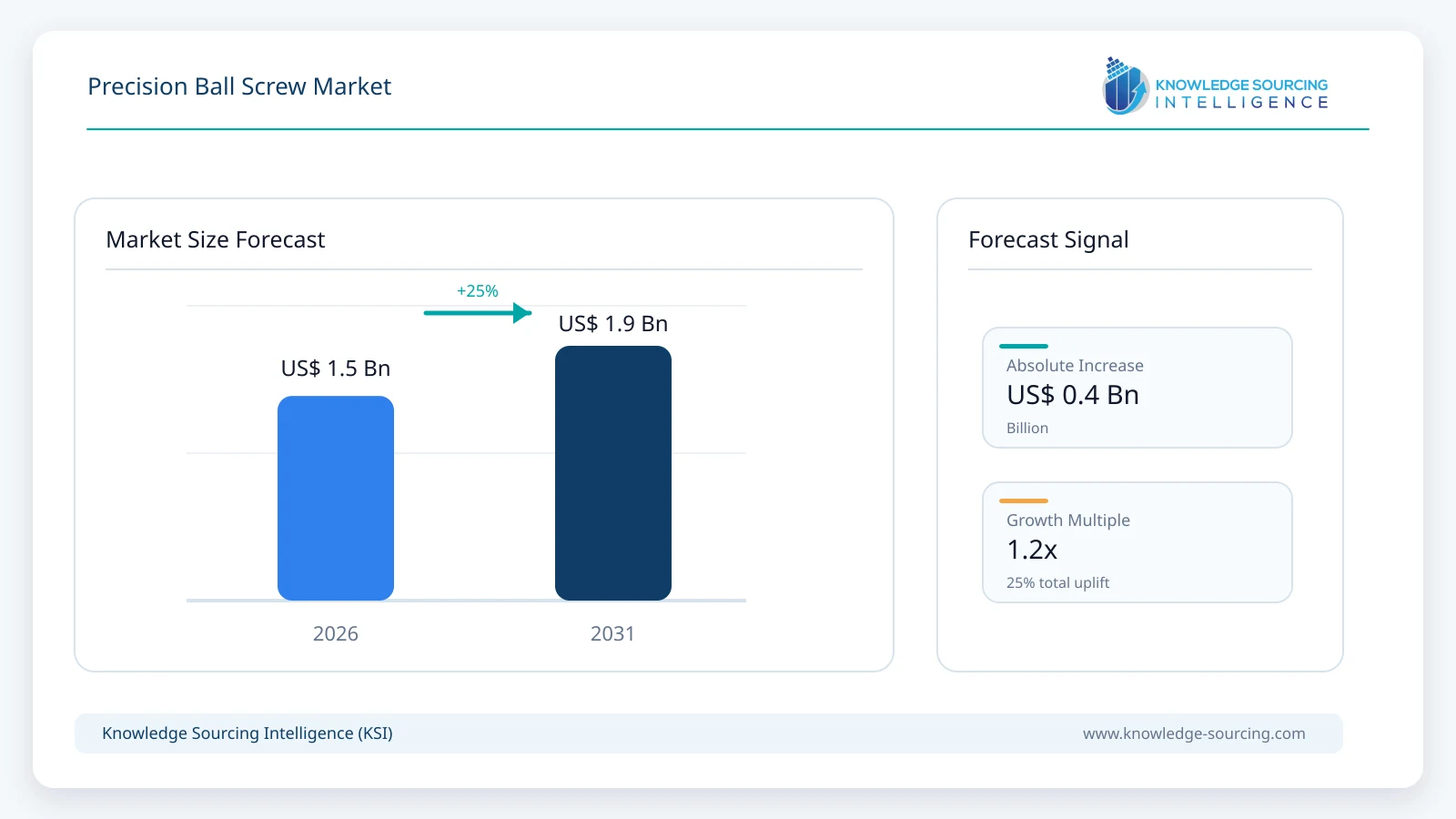
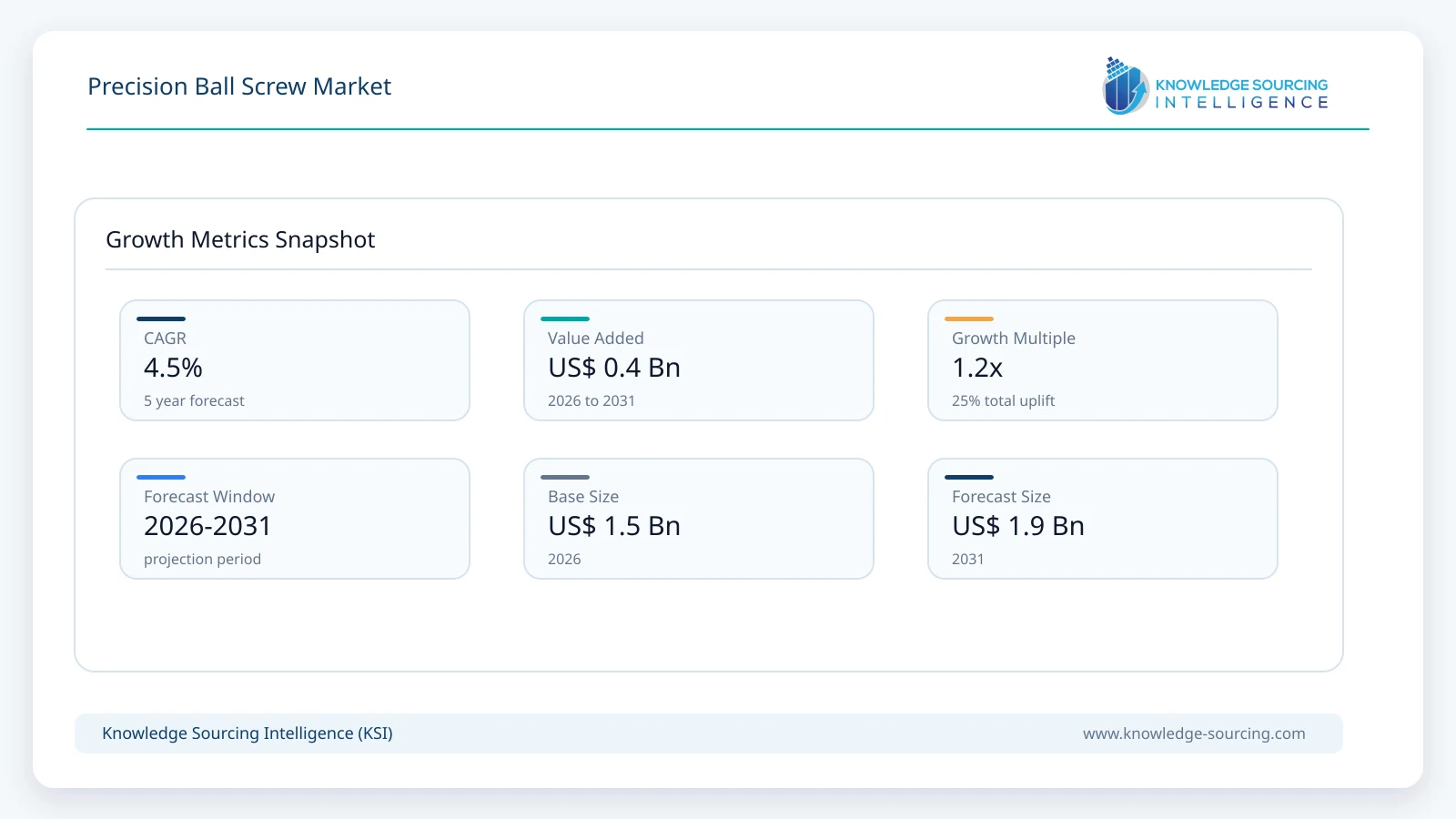
The Precision Ball Screw Market is forecast to grow at a CAGR of 4.48%, reaching USD 1.88 billion in 2031 from USD 1.51 billion in 2026.
Highlights:
- 1Manufacturers are adopting precision ball screws to improve positioning accuracy, repeatability, and production consistency in automated systems.
- 2Robotics and machine tool manufacturers are incorporating advanced ball screw assemblies to support precise, high-speed linear motion.
- 3Aerospace, automotive, electronics, and semiconductor manufacturers are creating opportunities for application-specific precision motion components.
- 4Component suppliers are improving ball screw speed capabilities, load handling, durability, and energy efficiency through product engineering.
The precision ball screw market comprises the design, manufacture, distribution, and sale of mechanical transmission components used to convert rotary motion into controlled linear movement. A typical assembly consists of a threaded screw shaft, a ball nut, recirculating ball bearings, and supporting components. Unlike conventional sliding lead screws, ball screws use rolling contact between the balls and the raceways to reduce friction and enable efficient, repeatable movement.
Precision ball screws are particularly important in equipment where positioning accuracy, stiffness, backlash control, and predictable performance influence the quality of the final product. Their applications include computer numerical control (CNC) machine tools, industrial robots, semiconductor manufacturing equipment, inspection systems, medical devices, aerospace machinery, and automated production lines. Depending on the application, buyers evaluate lead accuracy, axial clearance, preload, rigidity, maximum permissible speed, load capacity, lubrication requirements, and expected operating life.
The market's development is closely connected to the expansion of automated manufacturing and the increasing technical requirements of industrial equipment. However, demand is not determined by automation alone. Equipment investment cycles, manufacturing output, component prices, maintenance requirements, and the availability of alternative motion technologies also influence purchasing decisions. Ground precision ball screws are generally suited to applications with demanding accuracy requirements, while rolled products can be attractive where cost and production volume carry greater weight.
Official industry evidence supports the relevance of these demand drivers. The International Federation of Robotics reported in September 2026 that global industrial robot installations reached approximately 603,000 units in 2025, an increase of 11% year over year. The worldwide operational stock exceeded five million robots. These figures indicate a substantial installed base of automated equipment, although they do not directly measure ball screw sales or imply that every robot uses a ball screw transmission.
Precision Ball Screw Market Growth Drivers:
Increasing demand for automation
Industrial automation is an important demand driver for precision ball screws because automated equipment depends on accurate, repeatable motion to perform manufacturing and handling tasks. CNC machines, robotic positioning systems, assembly equipment, material-handling mechanisms, and automated inspection platforms all require motion components that can deliver controlled displacement under specified operating conditions. Ball screws can meet these requirements where their load capacity, stiffness, speed, and precision characteristics align with the application's engineering needs.
The continued deployment of industrial robots provides a useful indicator of the wider automation environment. According to the International Federation of Robotics' 2026 announcement, installations increased to around 603,000 units in 2025, while the operational stock reached approximately 5.079 million units. Electronics and automotive installations each increased by 10%, and installations in the metal and machinery sector rose by 22%. The latter is particularly relevant because machine-building and metalworking equipment frequently requires precision linear positioning. These industry figures are an indirect demand indicator rather than a direct measure of ball screw consumption.
As manufacturers pursue shorter production cycles, consistent product quality, and reduced manual intervention, motion-control systems must maintain accuracy under repeated operation. Precision ball screws can contribute to these objectives when integrated with suitable servo motors, linear guides, encoders, controllers, and lubrication systems. Their value is especially apparent in equipment requiring controlled feed rates, fine positioning, and predictable movement across repeated production cycles.
Nevertheless, the benefits depend on system design. Installation errors, thermal expansion, inadequate lubrication, contamination, excessive loading, and incorrect preload can affect accuracy and service life. Consequently, manufacturers increasingly need to assess the complete motion system rather than selecting a ball screw solely by its nominal precision class or maximum speed rating.
Growing shift toward electric vehicles
The electrification of road transport supports demand for advanced manufacturing equipment used to produce electric motors, battery packs, power electronics, steering components, and other vehicle systems. Precision ball screws can be incorporated into assembly fixtures, automated pressing equipment, component testing systems, machining centres, and production-line positioning mechanisms. The opportunity arises primarily from the manufacturing infrastructure required to produce these components, rather than from the assumption that every electric vehicle directly contains a large number of ball screws.
The International Energy Agency's Global EV Outlook 2026 reported that worldwide electric car sales exceeded 20 million in 2025, representing approximately one-quarter of new car sales. Its May 2026 outlook projected sales of around 23 million electric cars in 2026. These figures provide a current indication of the scale of vehicle electrification and the associated requirements for production capacity, although actual investment in manufacturing equipment varies by manufacturer and location.
Battery manufacturing is one area where precise motion control can be important. Equipment used for cell handling, module assembly, inspection, and selected pressing or positioning operations may require controlled movement and repeatability. Automotive manufacturers also use automated systems for motor assembly, powertrain production, and dimensional inspection. These applications can create opportunities for appropriately specified precision ball screws.
However, battery and vehicle manufacturing environments differ considerably. Some processes require high-speed positioning, while others prioritise force control, contamination management, thermal stability, or compact equipment design. Alternative technologies, including linear motors, hydraulic actuators, pneumatic systems, and roller screw mechanisms, may be more suitable in particular applications. Suppliers therefore compete on application performance, total system cost, durability, and integration support, rather than on precision alone.
Precision Ball Screw Market Segmentation Analysis:
Wide range of applications
The precision ball screw market serves manufacturing, automotive, aerospace, electronics, semiconductor, medical equipment, and other industrial applications. These sectors use linear motion systems for different purposes, making application requirements an important determinant of product selection. Machine tools require controlled feed movement and dimensional accuracy, while industrial automation systems may prioritise cycle speed, repeatability, compactness, and reliability over extended operating periods.
In automotive manufacturing, ball screws can support robotic positioning, assembly fixtures, automated inspection, and selected pressing operations. Aerospace applications can require high stiffness, controlled movement, and reliable operation in specialised manufacturing or testing equipment. Electronics and semiconductor production may require compact motion components capable of fine positioning and consistent operation under tightly controlled environmental conditions.
Medical and laboratory equipment can also use precision ball screws in positioning stages, imaging systems, sample-handling equipment, and other mechanisms where controlled movement matters. Suitability depends on application-specific requirements, including vibration, noise, cleanliness, lubrication compatibility, and maintenance access. Not all medical equipment uses ball screw drives, and some applications favour alternative linear-motion technologies.
From a commercial perspective, this diversity creates opportunities for suppliers to offer standardised products alongside customised assemblies. Standard components can simplify procurement and replacement, while application-specific designs can address particular requirements involving shaft dimensions, mounting arrangements, preload, sealing, and operating speed. Suppliers that provide engineering assistance and predictable lead times may be better positioned to serve customers with complex equipment requirements.
Growth in the ground precision ball screw type segment
Ground precision ball screws are designed for applications that require demanding lead accuracy, controlled surface geometry, and consistent motion characteristics. Their manufacturing process involves grinding the screw raceway to achieve the required dimensional and geometric properties. Although the process can be more expensive than rolling, it is suitable for applications in which positioning performance and predictable movement justify the additional manufacturing cost.
Demand for ground precision ball screws can be supported by high-accuracy machine tools, precision inspection equipment, semiconductor manufacturing systems, and specialised industrial machinery. In these applications, small positioning errors can influence machining tolerances, alignment, process consistency, or the quality of the finished component. Buyers therefore assess the accuracy class, preload, rigidity, thermal behaviour, and compatibility with the rest of the motion-control system.
Technological developments are also expanding the potential operating range of precision ball screws. For example, THK announced on 24 September 2026 that it had revised the DN value of its SDA-V/VZ and SDAN-V/VX high-speed compact precision ball screw models from 160,000 to 180,000 following high-speed durability testing. The change provides additional options for applications with demanding speed requirements, subject to the specified operating limits. It is a documented product development, not evidence of a quantified increase in the overall market.
Ground products nevertheless face competition from rolled ball screws and other motion technologies. Rolled products can offer a cost-effective solution for applications where the required precision and production economics permit their use. The choice between ground and rolled designs depends on the equipment's accuracy requirements, expected loads, duty cycle, production volume, and lifecycle cost. Consequently, the ground segment's performance should be evaluated in relation to the specific application mix rather than assuming that every industrial automation investment will favour ground products.
Precision Ball Screw Market Geographical Outlook:
North America precision ball screw market is expected to witness steady growth over the forecast period.
North America represents an important market for precision ball screws because of its established aerospace, automotive, medical equipment, industrial machinery, and advanced manufacturing industries. Demand is linked to investment in machine tools, automated production lines, precision assembly, and equipment modernisation. Manufacturers operating in these sectors may require ball screws that meet defined positioning, rigidity, reliability, and maintenance requirements.
The United States is particularly relevant to the regional outlook because of its manufacturing base and continued interest in advanced production technologies. The U.S. Census Bureau introduced an experimental robotic equipment data product on 10 September 2026, consolidating information on robotics expenditures collected through its Annual Integrated Economic Survey. The initial dataset covers collection years 2023 and 2024 and includes national industry estimates, with additional state-level manufacturing estimates. Although the data does not measure precision ball screw expenditure directly, it offers an official framework for examining investment in industrial robotics.
Demand opportunities extend beyond general industrial automation. Aerospace manufacturers require accurate equipment for machining, assembly, and component inspection, while medical technology producers use specialised positioning systems in selected manufacturing and testing processes. Automotive factories may also invest in automation for vehicle assembly, electric powertrain production, and component quality control. These applications create opportunities for suppliers offering application-specific engineering and reliable product availability.
However, regional growth depends on capital expenditure, industrial output, import conditions, and the economics of automation projects. Higher-performance components may command greater technical requirements and prices, but manufacturers still evaluate total ownership cost, replacement intervals, maintenance needs, and integration expenses. North America's established industrial base therefore provides a foundation for demand, while individual industry investment cycles will influence the pace of expansion.
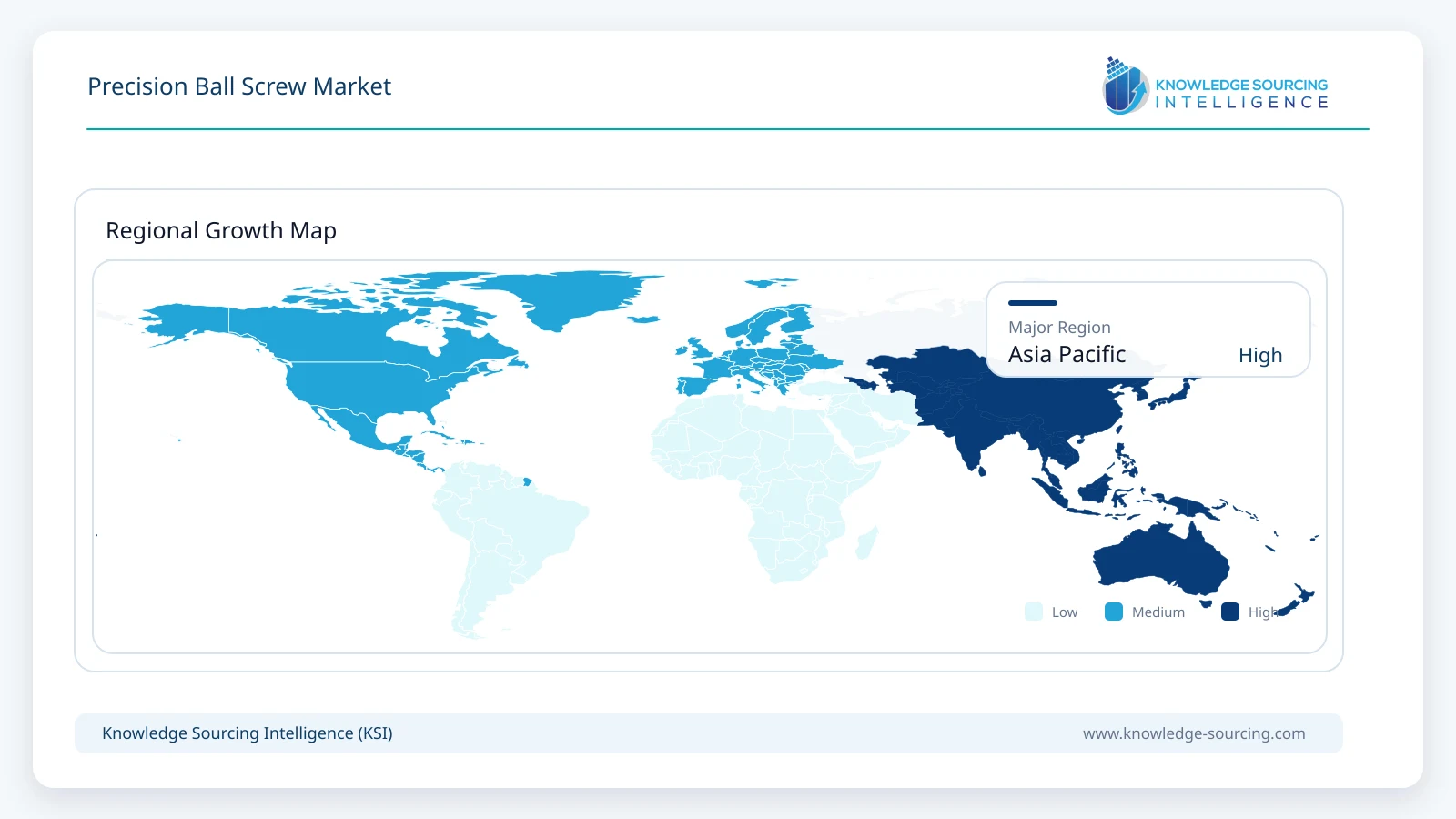
Asia Pacific accounted for a substantial market share and remains an important growth centre.
Asia Pacific is an important region for precision ball screws because of its extensive manufacturing ecosystem, machinery production, electronics industry, semiconductor investment, and automotive supply chains. China, Japan, and South Korea are significant industrial economies, while other regional markets are developing manufacturing capabilities across electronics, transport equipment, and industrial machinery. These activities support demand for components that enable controlled linear movement in production equipment.
The scale of industrial automation in Asia reinforces the region's relevance. The International Federation of Robotics reported in its 2026 release that China installed approximately 354,000 industrial robots in 2025, accounting for 59% of global installations. This concentration illustrates the scale of Chinese factory automation and the associated ecosystem of machinery, motion-control systems, and industrial components. It does not establish that China or Asia Pacific has the highest precision ball screw market growth rate, which would require directly comparable regional market data.
Japan has an established base of precision machinery and motion-control suppliers, while South Korea's electronics, semiconductor, and automotive industries require advanced production equipment. China's extensive manufacturing capacity creates opportunities across machine tools, industrial robots, automated assembly, and equipment production. Meanwhile, expanding industrial investment elsewhere in Asia may increase demand for standard and customised motion components as local production capabilities develop.
Competition in Asia Pacific can be intense, particularly in applications where buyers compare price, technical performance, delivery time, and local service. Manufacturers may choose different ball screw grades according to the accuracy and operating requirements of their equipment. As a result, suppliers need to balance high-precision product development with manufacturing efficiency, supply-chain resilience, and after-sales support.
Overall, Asia Pacific's industrial scale and automation activity make it a major region to monitor. However, the extent of future market growth will depend on manufacturing investment, technology adoption, local supplier capabilities, and demand across individual end-use sectors.
Precision Ball Screw Market: Recent Developments
Company announcements provide evidence of current product engineering and industry strategy. The following developments are drawn from official manufacturer sources and relate directly to ball screw products or their industrial applications.
September 2026: THK raises high-speed ball screw DN ratings. THK revised the DN value of its SDA-V/VZ and SDAN-V/VX precision ball screw models to 180,000 after conducting high-speed durability tests, broadening specified operating options.
July 2026: Bosch Rexroth expands Performance Line ball screw assemblies. The company introduced the FEH-E-B flanged single nut in eight sizes for vertical and highly dynamic linear applications, targeting improved process quality and service life.
July 2026: Bosch Rexroth highlights application-specific screw drives. Its announcement described customised ball and planetary screw assemblies, including modifications to screws, nuts, and coatings for machine tools, robotics, medical technology, semiconductor manufacturing, and intralogistics.
May 2026: NSK and NTN announce a proposed business integration. The companies signed a memorandum concerning integration through a joint holding company. The disclosed strategic plans include broader applications for ball-screw technology used in brakes, alongside production and procurement improvements.
Precision Ball Screw Market Scope:
| Report Metric | Details |
|---|---|
| Total Market Size in 2026 | USD 1.51 billion |
| Total Market Size in 2031 | USD 1.88 billion |
| Forecast Unit | Billion |
| Growth Rate | 4.48% |
| Study Period | 2021 to 2031 |
| Historical Data | 2021 to 2024 |
| Base Year | 2025 |
| Forecast Period | 2026 – 2031 |
| Segmentation | Type, Precision Grade, Diameter, End-User, Geography |
| Companies |
|
Market Segmentation
By Type
Ground Precision Ball Screw
Rolled Precision Ball Screw
By Precision Grade
C3
C5
C7
Others
By Diameter
Up to 10 mm
10 to 20 mm
Greater than 20 mm
By End-User
Automotive
Aerospace
Electronics & Semiconductor
Medical & Healthcare
Others
By Geography
North America
USA
Canada
Mexico
South America
Brazil
Argentina
Others
Europe
Germany
France
United Kingdom
Spain
Italy
Others
Middle East and Africa
Saudi Arabia
UAE
Israel
Others
Asia Pacific
China
India
Japan
South Korea
Indonesia
Thailand
Others
Table of Contents
1. EXECUTIVE SUMMARY
2. MARKET SNAPSHOT
2.1. Market Overview
2.2. Market Definition
2.3. Scope of the Study
2.4. Market Segmentation
3. BUSINESS LANDSCAPE
3.1. Market Drivers
3.2. Market Restraints
3.3. Market Opportunities
3.4. Porter’s Five Forces Analysis
3.5. Industry Value Chain Analysis
3.6. Policies and Regulations
3.7. Strategic Recommendations
4. TECHNOLOGICAL OUTLOOK
5. PRECISION BALL SCREW MARKET BY TYPE
5.1. Introduction
5.2. Ground Precision Ball Screw
5.3. Rolled Precision Ball Screw
6. PRECISION BALL SCREW MARKET BY PRECISION GRADE
6.1. Introduction
6.2. C3
6.3. C5
6.4. C7
6.5. Others
7. PRECISION BALL SCREW MARKET BY DIAMETER
7.1. Introduction
7.2. Up to 10 mm
7.3. 10 to 20 mm
7.4. Greater than 20 mm
8. PRECISION BALL SCREW MARKET BY END-USER
8.1. Introduction
8.2. Automotive
8.3. Aerospace
8.4. Electronics & Semiconductor
8.5. Medical & Healthcare
8.6. Others
9. PRECISION BALL SCREW MARKET BY GEOGRAPHY
9.1. Introduction
9.2. North America
9.2.1. USA
9.2.2. Canada
9.2.3. Mexico
9.3. South America
9.3.1. Brazil
9.3.2. Argentina
9.3.3. Others
9.4. Europe
9.4.1. Germany
9.4.2. France
9.4.3. United Kingdom
9.4.4. Spain
9.4.5. Italy
9.4.6. Others
9.5. Middle East and Africa
9.5.1. Saudi Arabia
9.5.2. UAE
9.5.3. Israel
9.5.4. Others
9.6. Asia Pacific
9.6.1. China
9.6.2. India
9.6.3. Japan
9.6.4. South Korea
9.6.5. Indonesia
9.6.6. Thailand
9.6.7. Others
10. COMPETITIVE ENVIRONMENT AND ANALYSIS
10.1. Major Players and Strategy Analysis
10.2. Market Share Analysis
10.3. Mergers, Acquisitions, Agreements, and Collaborations
10.4. Competitive Dashboard
11. COMPANY PROFILES
11.1. Barnes Industries Inc.
11.2. Hiwin Corporation
11.3. JTEKT Corporation
11.4. Kuroda Jenatec, Inc
11.5. Nidec Corporation
11.6. PMI GROUP
11.7. Schaeffler AG
11.8. SKF Group
11.9. THK Co. Ltd.
11.10. NTN Corporation
11.11. KSS Co., Ltd
12. APPENDIX
12.1. Currency
12.2. Assumptions
12.3. Base and Forecast Years Timeline
12.4. Key benefits for the stakeholders
12.5. Research Methodology
12.6. Abbreviations
LIST OF FIGURES
LIST OF TABLES
Navigate
Trusted by the world's leading organizations