
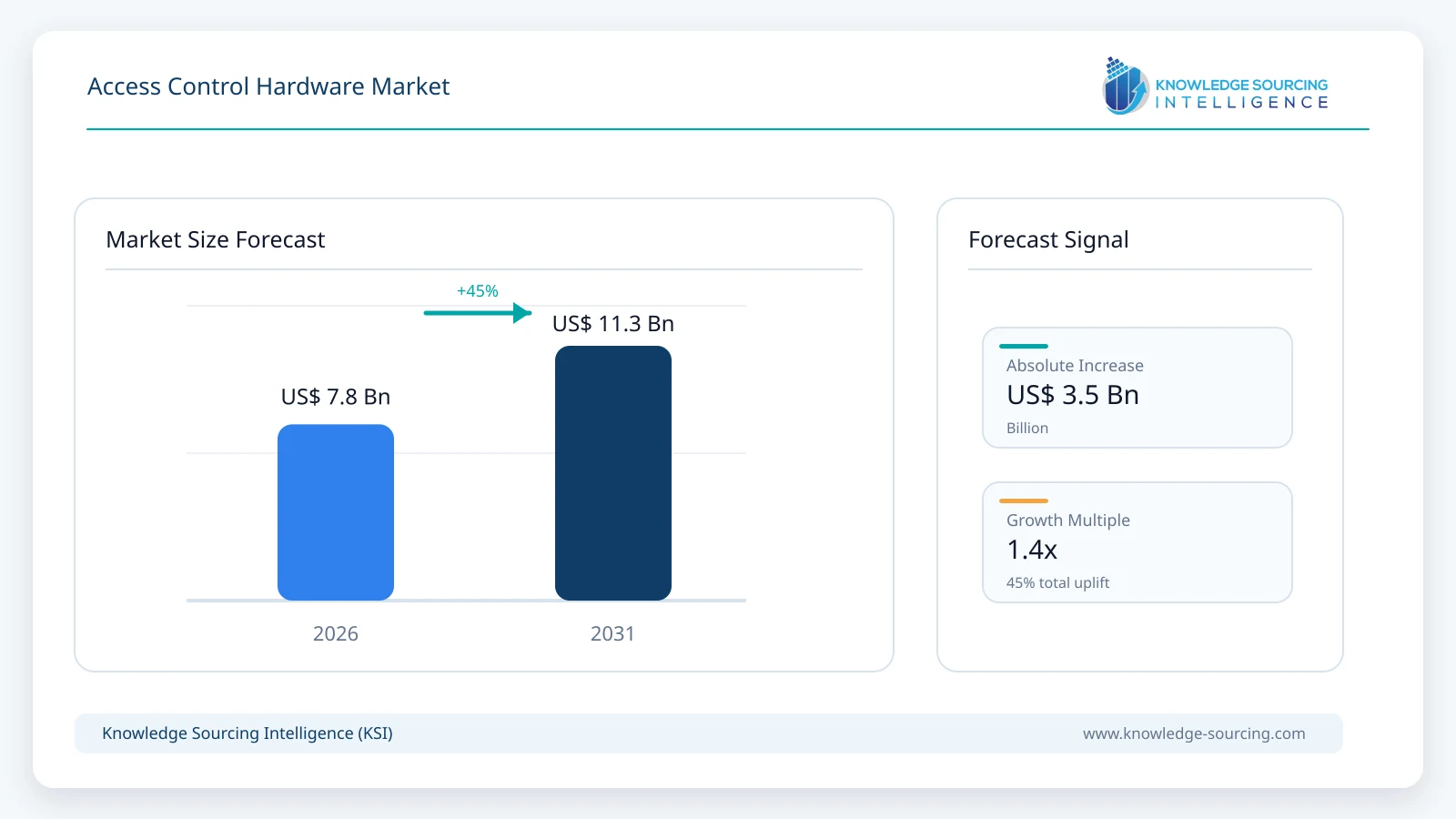
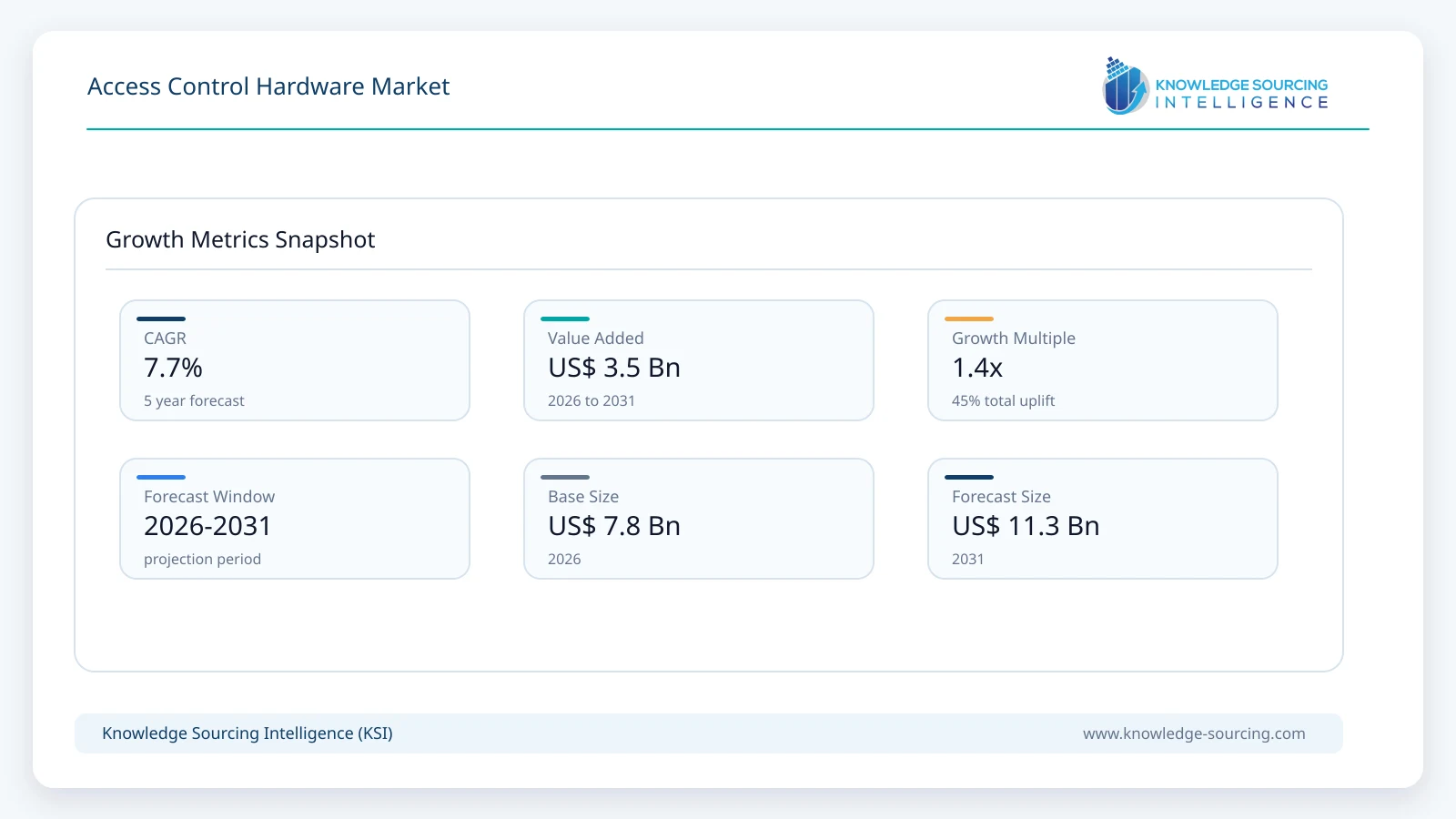
The global access control hardware market is forecast to grow from USD 7.85 billion in 2026 to USD 11.35 billion in 2031, representing a CAGR of 7.7% during the forecast period.
Highlights:
- 1Cards, credentials and electronic readers are estimated to account for approximately 42.0% of global access control hardware revenue in 2026, reflecting the large installed base of RFID, smart-card and mobile-ready reader infrastructure.
- 2Commercial buildings are estimated to represent approximately 47.0% of 2026 market revenue, supported by offices, data centers, hospitality, retail, education and multi-tenant properties.
- 3North America is estimated to account for approximately 36.0% of global market revenue in 2026, supported by a large installed base, non-residential construction and rapid migration toward mobile and cloud-managed physical access.
- 4Mobile credentials are changing reader replacement cycles because organizations can modernize credentials without replacing every door controller at once when readers support both legacy cards and newer NFC/BLE standards.
- 5Biometric terminals are becoming more capable rather than simply more numerous, with 2026 products combining face, fingerprint, RFID, mobile access, QR and PIN within one device.
- 6Access hardware is increasingly sold as part of a connected platform spanning readers, controllers, locks, mobile credentials and cloud management, but the market excludes software-only physical security platforms and conventional mechanical locks without electronic access functionality.
Market Overview
The access control hardware market covers electronic devices used to authenticate users and physically control entry to buildings, rooms, gates and restricted areas. The scope includes card and mobile-credential readers, smart credentials, biometric terminals, electronic door controllers, interface modules, electronic locks directly integrated with access control, turnstile and gate access devices, and related physical authentication hardware.
The study excludes conventional mechanical locks and cylinders without an electronic access function, video-surveillance cameras, intrusion alarms, software-only access-control subscriptions and identity-access-management software used only for digital systems. This boundary keeps the market focused on physical electronic access hardware rather than the broader security-products industry.
The market is supported by a very large installed base that is migrating gradually from proprietary cards toward encrypted smart credentials, mobile wallets and multi-factor authentication. ASSA ABLOY continues to invest through HID in mobile-ready readers and biometrics, while Allegion is expanding mobile-first multifamily access, dormakaba is strengthening access-control hardware and credentials, and Suprema introduced the AI-enabled BioStation 3 Max biometric terminal in 2026.
Current company scale confirms that electronic access hardware is embedded inside much larger access-solutions businesses. Allegion generated USD 4.07 billion of total 2025 revenue across security products and solutions, while dormakaba reported CHF 2.38 billion of 2025/26 Access Solutions revenue. Only the electronic access-control hardware portions of these portfolios are included in this market, preventing mechanical door hardware and unrelated entrance products from inflating the estimate.
The principal technology transition is convergence. Organizations increasingly want one credential to work across physical doors and digital systems, mobile devices to function as secure credentials, and cloud-managed platforms to administer distributed sites. Hardware therefore needs secure elements, modern encryption, remote provisioning and backward compatibility with existing building infrastructure.
Market Trends
Mobile Credentials Shift Value Toward Multi-Technology Readers
Mobile access is expanding through NFC and Bluetooth credentials stored on smartphones and wearables. Reader vendors are responding with multi-technology devices capable of supporting legacy cards and newer mobile credentials during long migration periods.
This protects installed-system investments while creating a replacement opportunity at high-traffic doors and new projects. HID and Allegion are both expanding wallet and mobile-credential support, particularly in enterprise and multifamily applications.
Biometric Hardware Consolidates Multiple Credentials into One Terminal
Biometric access is moving toward multi-modal terminals rather than single-purpose fingerprint readers. Suprema introduced BioStation 3 Max in 2026 with face, fingerprint, RFID, mobile, QR and PIN support in one device.
High-security, data-center, industrial, healthcare and government environments increasingly use biometrics as an additional assurance layer. Privacy and governance requirements limit universal adoption, but higher-value biometric terminals support market revenue growth.
Cloud-Managed Access Changes Controller and Gateway Design
Cloud management does not eliminate hardware. Doors still require readers, controllers, lock interfaces and secure network connectivity. However, cloud-managed architectures favor IP-connected controllers, edge processing and remotely configurable hardware.
This creates opportunities for vendors that can combine physical devices with open APIs and subscription management while maintaining offline operation and life-safety integration.
Physical and Digital Identity Begin to Converge
Organizations increasingly want credentials that work across doors, workstations and applications. HID highlighted converged credentials in 2026 that combine physical access technologies with FIDO2, PKI and OATH digital authentication.
This convergence can extend replacement cycles for legacy credentials while raising the value of secure card, key and reader ecosystems. It also increases coordination between physical-security and cybersecurity teams.
Market Drivers
Replacement of Legacy Credential Technologies
Older proximity cards and proprietary systems are being replaced by more secure smart cards, encrypted credentials and mobile-compatible readers. Security teams are also reducing dependence on easily cloned technologies.
The large installed base makes this a multi-year replacement cycle rather than a one-time technology transition, supporting steady reader and credential demand.
Growth of Data Centers and Critical Infrastructure
Data centers, utilities, transport infrastructure and high-security industrial sites require layered physical access and detailed audit trails. These environments often deploy multiple authentication factors and redundant controllers.
AI and hyperscale data-center construction is particularly hardware-intensive because access control extends from site perimeter and lobby to data halls, cages and selected cabinets.
Mobile-First Building Access
Employees and residents increasingly expect phones and wearables to replace or supplement physical cards. Mobile credentials reduce badge distribution and can be provisioned remotely.
This encourages investment in readers with NFC and BLE support, secure credential-management infrastructure and electronic locks capable of integrating with cloud platforms.
Smart Building and Multi-Site Security Integration
Access control is increasingly connected with visitor management, video, elevators, building management and identity systems. Large organizations want centralized policies across multiple facilities.
This integration raises hardware requirements for open protocols, network connectivity, edge processing and secure firmware management.
Market Restraints
Long Hardware Replacement Cycles
Electronic readers and controllers can remain operational for many years. Organizations often preserve installed infrastructure until security risk, credential migration or building renovation justifies replacement.
This limits annual unit growth and makes backward compatibility important for vendors trying to upgrade large installed estates.
Integration with Legacy Systems
Large facilities may contain several generations of readers, controllers, locks and credential technologies. Replacing all equipment simultaneously is expensive and disruptive.
Projects therefore require staged migration, protocol bridging and careful integration with life-safety, elevator and building systems.
Biometric Privacy and Governance Requirements
Biometric systems can improve authentication assurance but create privacy, consent, retention and cybersecurity obligations. Regulations vary by jurisdiction and can restrict how biometric templates are captured and stored.
This increases procurement scrutiny and can slow deployment outside high-security applications.
Price Pressure in Standard Reader and Credential Hardware
Basic RFID readers, credentials and controllers are increasingly standardized, creating competition from regional and lower-cost suppliers. Buyers can separate hardware procurement from software in open architectures.
Leading vendors therefore differentiate through cybersecurity, credential security, interoperability, mobile support and service ecosystem rather than hardware specifications alone.
Segment Analysis
By Type - Cards, Credentials and Readers
Cards, credentials and electronic readers are estimated at approximately USD 3.30 billion in 2026. The segment includes smart cards, secure RFID credentials, mobile-ready readers, multi-technology wall readers and related physical authentication devices.
This is the largest value pool because reader infrastructure is deployed at every controlled opening and often remains in service for many years. Migration toward encrypted cards and mobile credentials is encouraging selective replacement without requiring full building-system replacement.
By Application - Commercial Buildings
Commercial buildings are estimated at approximately USD 3.69 billion in 2026. Offices, data centers, hospitality, retail, education, logistics facilities and multi-tenant properties deploy large numbers of readers, controllers and electronic locks across perimeter and internal access points.
Commercial demand is supported by hybrid work, contractor access, mobile credentials, tenant turnover and the need to administer multiple sites centrally. Data centers and other critical facilities also require layered access at gates, buildings, secure zones and cages.
By Geography - North America
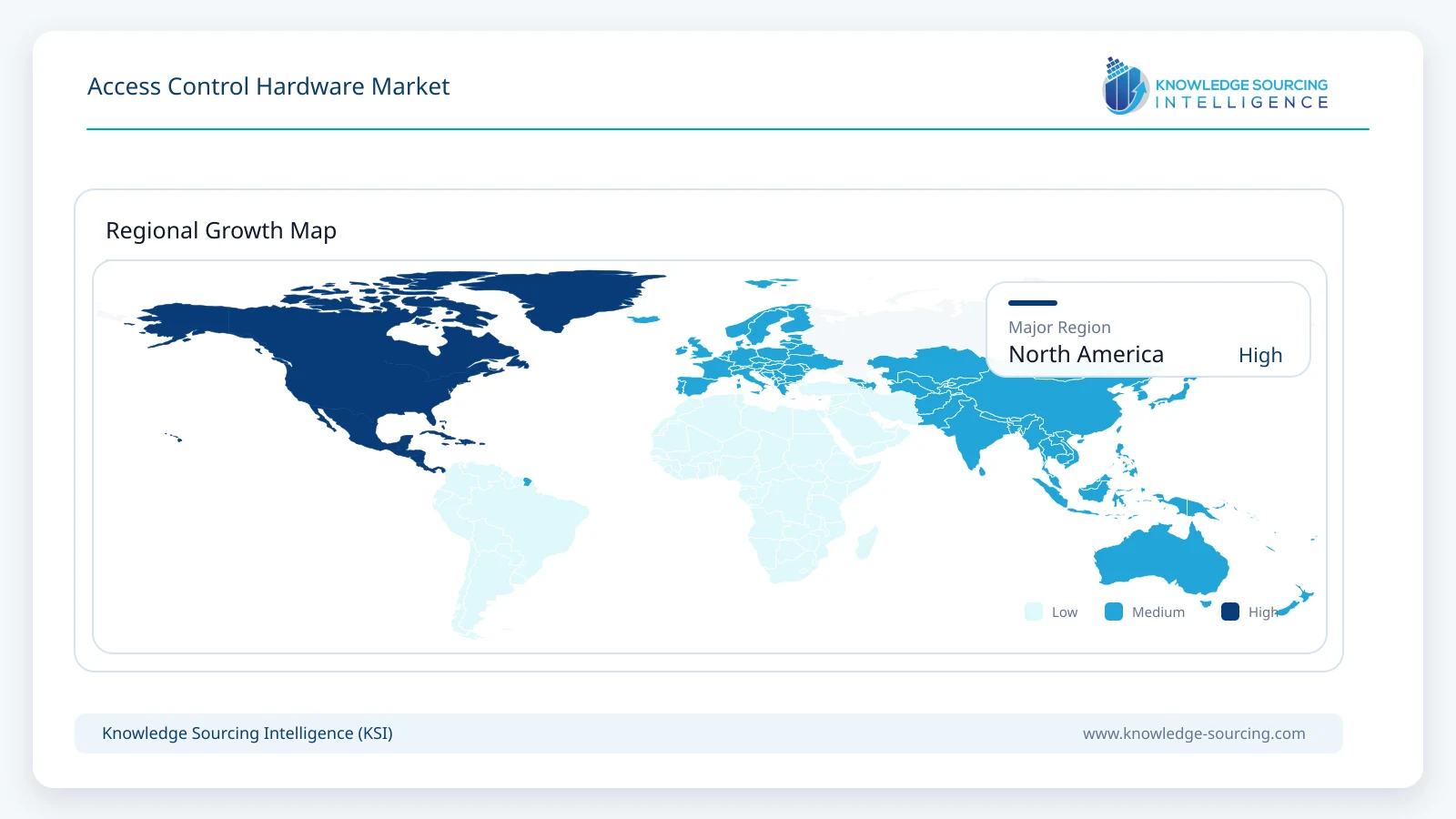
North America is estimated at approximately USD 2.83 billion in 2026. The region has a large installed base of electronic access systems and a strong vendor ecosystem spanning ASSA ABLOY/HID, Allegion, Honeywell, Johnson Controls, Brivo, Kisi and other providers.
Non-residential construction, data-center expansion, multifamily modernization and mobile credential adoption support spending. The region is also a major early market for cloud-managed access, creating replacement demand for controllers and readers that can operate within newer architectures.
Regional Outlook
North America
North America is the largest regional market, supported by extensive commercial building stock, data-center construction, multifamily modernization and strong adoption of mobile and cloud-managed access. Allegion reported continued strength in Americas non-residential markets entering 2026.
The region is also an important innovation center for mobile credentials, open APIs and converged physical-digital identity.
Europe
Europe has a mature access-control installed base and several major global vendors, including dormakaba, ASSA ABLOY, SALTO, Nedap and Paxton. Demand is driven by commercial renovation, transportation, healthcare, critical infrastructure and energy-efficiency upgrades that often include security modernization.
Privacy regulation influences biometric deployment, encouraging careful data governance and on-device template processing.
Asia Pacific
Asia Pacific combines high-volume commercial construction with major local biometric and electronic-security suppliers. China, India, Japan, South Korea and Southeast Asia continue to expand access control across offices, manufacturing, transport and smart-building projects.
Biometric adoption is relatively strong in government, industrial and high-throughput applications, while mobile credentials are expanding in new premium commercial developments.
Middle East and Africa
Gulf countries are important buyers for airports, hospitality, government, data centers and large mixed-use developments. New projects allow modern mobile and biometric access architectures to be designed from the outset.
African demand is more concentrated in corporate, banking, telecom, mining and government facilities.
South America
South American demand is led by Brazil and other large urban markets. Commercial buildings, financial institutions, logistics facilities and residential developments are adopting electronic access systems as security requirements increase.
Currency volatility and project financing can influence investment timing, supporting a mix of multinational and regional hardware suppliers.
Competitive Environment
The market is led by diversified access-solutions companies and specialist physical-access vendors. ASSA ABLOY competes through HID and related access technologies, Allegion through Schlage and connected access platforms, dormakaba through credentials, readers and electronic access systems, and Honeywell through LenelS2 and related physical-security assets. Johnson Controls maintains enterprise access-control hardware and integration through C•CURE and connected building-security systems.
Specialist competitors include Suprema in biometrics, Gallagher Security in enterprise access control, SALTO Systems in electronic locking and smart access, Nedap in enterprise physical access, Paxton in commercial systems, Brivo and Kisi in cloud-managed access, Axis in networked door controllers and Motorola Solutions/Avigilon in unified video and access.
Competitive differentiation is shifting toward secure mobile credentials, cybersecurity, cloud management, biometric accuracy, interoperability and the ability to support staged migrations from legacy hardware. Vendors with large installed bases benefit from replacement demand but must preserve backward compatibility while moving customers toward newer credential standards.
Recent Developments
August 2026: dormakaba acquired the operating business of Azure, a U.S.-based supplier of next-generation access control hardware, strengthening its physical access control systems offering in North America.
August 2026: ASSA ABLOY highlighted HID converged credentials that combine physical access with digital authentication methods including FIDO2, PKI and OATH.
May 2026: Suprema introduced BioStation 3 Max, an AI-powered biometric terminal supporting face, fingerprint, RFID cards, mobile access, QR codes and PIN.
2025-2026: Allegion expanded mobile-first multifamily access by integrating the Schlage XE360 Series with the Zentra platform and extending wallet-based resident credentials.
2026: Access-control vendors continued increasing support for cloud-managed controllers, mobile credentials and open integration as enterprise security teams consolidate multi-site operations.
Market Outlook
The access control hardware market is expected to expand steadily through 2031 as the installed base moves toward encrypted credentials, mobile access, modern controllers and higher-assurance authentication. Growth will be strongest where hardware refresh is tied to building renovation, data-center construction, multifamily modernization and security convergence.
Hardware will remain indispensable even as software and cloud management grow. Every controlled opening still requires a physical authentication and locking layer, but future value will favor devices that are secure, updateable, interoperable and compatible with both legacy and mobile credential ecosystems.
Access Control Hardware Market Scope:
| Report Metric | Details |
|---|---|
| Total Market Size in 2026 | USD 7.85 billion |
| Total Market Size in 2031 | USD 11.35 billion |
| Forecast Unit | Billion |
| Growth Rate | 7.7% |
| Study Period | 2021 to 2031 |
| Historical Data | 2021 to 2024 |
| Base Year | 2025 |
| Forecast Period | 2026 – 2031 |
| Segmentation | Type, Application, Geography |
| Companies |
|
| Customization Scope | 15% Free Customization included with purchase — Request Custom Breakdown → |
| Sample & Data Access | PDF Sample, Excel Databook & Analyst Briefing — Download Free Sample → |
Market Segmentation
By Type
Cards, Credentials and Readers
Biometric Terminals
Controllers and Interface Modules
Electronic Locks and Door Hardware
Turnstile, Gate and Other Access Devices
By Application
Commercial Buildings
Residential and Multifamily
Military, Government and Critical Infrastructure
Hospitals and Healthcare
Education
Others
By Geography
North America
United States
Canada
Mexico
South America
Brazil
Argentina
Others
Europe
Germany
United Kingdom
France
Spain
Others
Middle East and Africa
Saudi Arabia
UAE
Others
Asia Pacific
China
India
Japan
South Korea
Southeast Asia
Others
Table of Contents
1. INTRODUCTION
1.1. Market Overview
1.2. Market Definition
1.3. Scope of the Study
1.4. Market Segmentation
1.5. Currency and Study Period
2. RESEARCH METHODOLOGY
2.1. Research Design
2.2. Secondary Research
2.3. Primary Validation
2.4. Market Estimation and Forecasting
2.5. Data Triangulation and Quality Control
3. EXECUTIVE SUMMARY
3.1. Key Findings
3.2. Global Market Size, 2026-2031
3.3. Technology Transition Summary
3.4. Regional Opportunity Summary
4. MARKET DYNAMICS
4.1. Market Drivers
4.1.1. Replacement of Legacy Credential Technologies
4.1.2. Growth of Data Centers and Critical Infrastructure
4.1.3. Mobile-First Building Access
4.1.4. Smart Building and Multi-Site Security Integration
4.2. Market Restraints
4.2.1. Long Hardware Replacement Cycles
4.2.2. Integration with Legacy Systems
4.2.3. Biometric Privacy and Governance Requirements
4.2.4. Price Pressure in Standard Hardware
4.3. Porter’s Five Forces Analysis
4.4. Industry Value Chain Analysis
5. ACCESS CONTROL HARDWARE MARKET BY TYPE
5.1. Introduction
5.2. Cards, Credentials and Readers
5.3. Biometric Terminals
5.4. Controllers and Interface Modules
5.5. Electronic Locks and Door Hardware
5.6. Turnstile, Gate and Other Access Devices
6. ACCESS CONTROL HARDWARE MARKET BY APPLICATION
6.1. Introduction
6.2. Commercial Buildings
6.3. Residential and Multifamily
6.4. Military, Government and Critical Infrastructure
6.5. Hospitals and Healthcare
6.6. Education
6.7. Others
7. ACCESS CONTROL HARDWARE MARKET BY GEOGRAPHY
7.1. Introduction
7.2. North America
7.2.1. United States
7.2.2. Canada
7.2.3. Mexico
7.3. South America
7.3.1. Brazil
7.3.2. Argentina
7.3.3. Others
7.4. Europe
7.4.1. Germany
7.4.2. United Kingdom
7.4.3. France
7.4.4. Spain
7.4.5. Others
7.5. Middle East and Africa
7.5.1. Saudi Arabia
7.5.2. UAE
7.5.3. Others
7.6. Asia Pacific
7.6.1. China
7.6.2. India
7.6.3. Japan
7.6.4. South Korea
7.6.5. Southeast Asia
7.6.6. Others
8. COMPETITIVE ENVIRONMENT AND ANALYSIS
8.1. Major Players and Strategy Analysis
8.2. Credential and Reader Positioning
8.3. Biometric Hardware Positioning
8.4. Mobile and Cloud-Managed Access
8.5. Mergers, Acquisitions and Partnerships
8.6. Competitive Dashboard
9. COMPANY PROFILES
9.1. ASSA ABLOY AB
9.2. Allegion plc
9.3. dormakaba Holding AG
9.4. Honeywell International Inc.
9.5. Johnson Controls International plc
9.6. Suprema Inc.
9.7. Gallagher Security
9.8. SALTO Systems
9.9. Axis Communications AB
9.10. IDEMIA Secure Transactions
9.11. Nedap N.V.
9.12. Paxton Access Ltd.
9.13. Kisi Inc.
9.14. Brivo, Inc.
9.15. Motorola Solutions
10. APPENDIX





Frequently asked questions
What is the projected market size of access control hardware by 2031?
The Access Control Hardware Market is forecast to reach USD 11.35 billion by 2031.
What is the compound annual growth rate (CAGR) for 2026-2031?
The Access Control Hardware Market is forecast to grow at a 7.7% CAGR.
Which access control hardware segment dominates revenue in 2026?
Cards, credentials, and readers lead with approximately 42.0% revenue.
Which industry vertical holds the largest market revenue share in 2026?
Commercial buildings dominate with approximately 47.0% of 2026 market revenue.
Which region is estimated to account for the largest market share in 2026?
North America holds the largest share, approximately 36.0% in 2026.
What key trend is driving access control hardware modernization?
Migration to mobile, cloud-managed access, and connected platforms.
Cite this report
Knowledge Sourcing Intelligence. (Sep 2026). Access Control Hardware Market - Strategic Insights and Forecasts (2026-2031). https://www.knowledge-sourcing.com/report/access-control-hardware-market