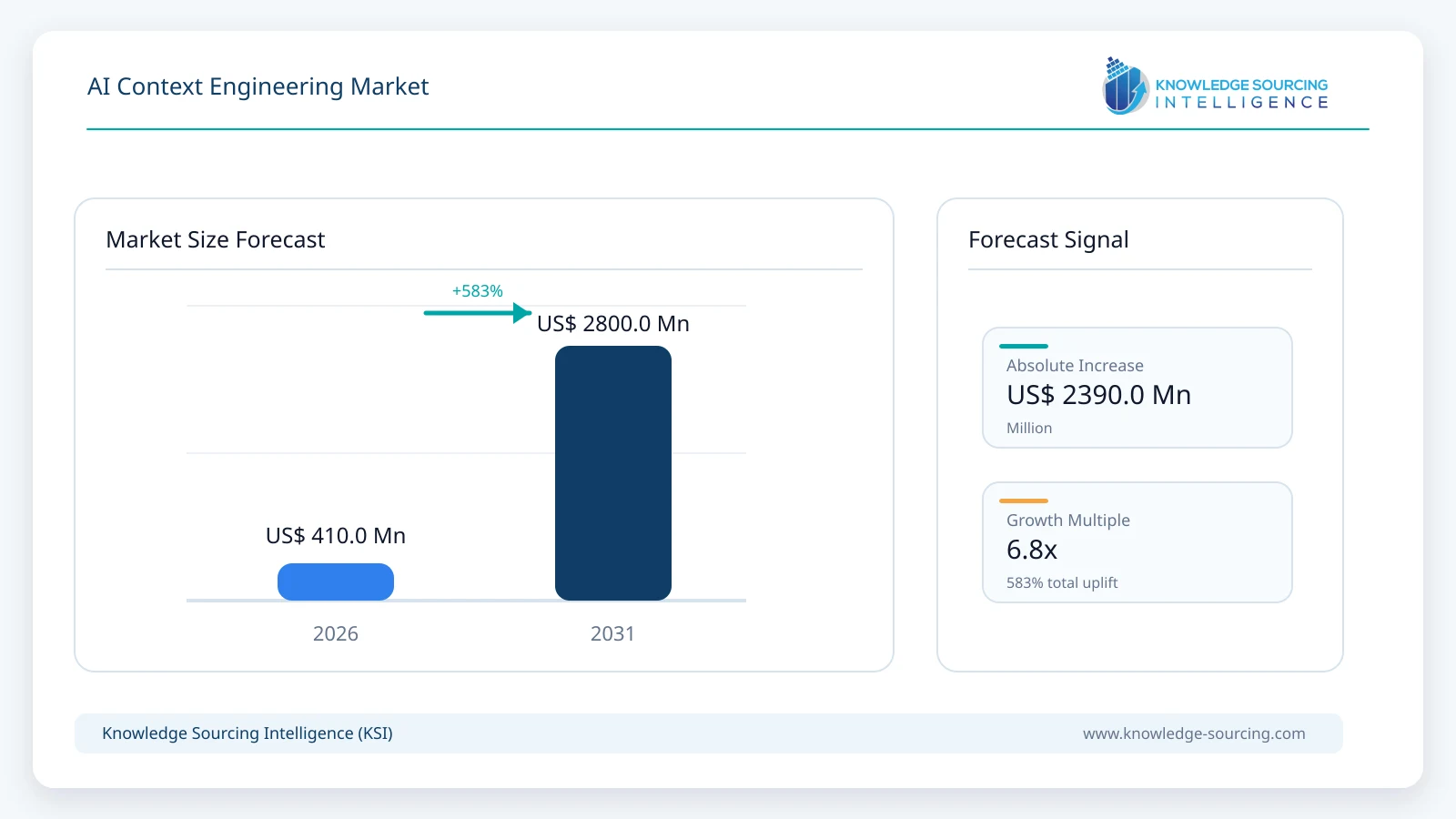
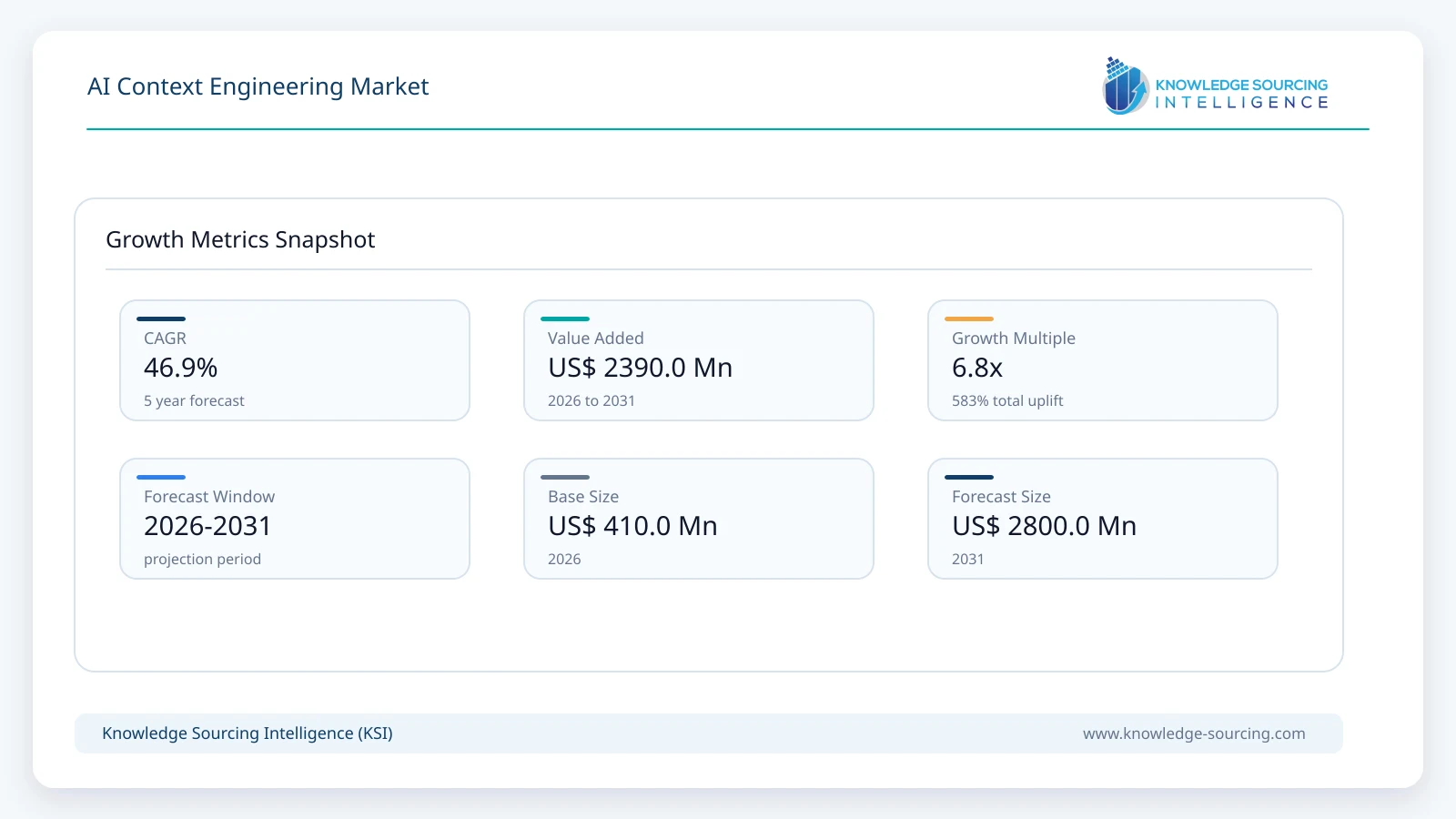
The AI Context Engineering Market is forecast to grow at a CAGR of 46.9%, reaching USD 2,800.0 million in 2031 from USD 410.0 million in 2026.
Highlights:
- 1Dedicated context platforms and APIs account for approximately 43% of global market value in 2026 as developers purchase specialized retrieval, assembly, and context-control functions.
- 2Dynamic retrieval and context assembly represent around 35% of 2026 revenue, reflecting the continuing importance of controlled access to relevant enterprise content.
- 3Managed cloud deployment holds approximately 62% of market value in 2026, supported by usage-based services and the operational advantages of managed AI platforms.
- 4North America accounts for approximately 42% of global market revenue in 2026 due to established enterprise AI deployment and a concentrated supplier ecosystem.
- 5Asia Pacific is projected to be the fastest-growing region through 2031 as agent adoption broadens across China, India, Japan and other enterprise software markets.
The market covers commercially attributable software and services that retrieve, select, structure, compress, and govern runtime information delivered to large language models and autonomous agents. It includes specialized context interfaces, independently attributable context functions within managed agent platforms, and implementation services directly tied to these functions.
Production AI applications increasingly rely on information arriving from external enterprise systems, tools, and intermediate agent steps rather than from a single static prompt. LangChain organizes the discipline around writing, selecting, compressing, and isolating context, while Anthropic describes context engineering as managing the information available to an agent at each decision point. These approaches address both the relevance of incoming information and the accumulation of obsolete material over lengthy tasks. In a production deployment, the same document can be useful for one employee and confidential to another, so authorization must be assessed alongside semantic relevance. Context systems also need to retain enough task state to preserve decisions, while removing obsolete tool outputs that otherwise crowd the next inference call. This combination makes context selection an ongoing runtime process rather than a one-time document-search operation.
Market Overview
Enterprise agents often require a mixture of instructions, documents, conversation state, application permissions, tool responses, and current business data to complete a task accurately. Context engineering systems decide which of those inputs belong in the active model window, how they should be ordered, and how the agent can retrieve omitted material later. The commercial value lies in improving the reliability of an AI workflow without repeatedly sending the entire available information set to the model.
LangChain and LangGraph support middleware and stateful agent workflows that can offload large tool results, summarize earlier exchanges, and load selected skills only when required. Anthropic describes just-in-time retrieval, compaction and isolated subagents as ways to maintain performance over long task sequences. These designs are gaining importance where an agent may query several systems and produce intermediate files before reaching its final result.
Cloud and enterprise suppliers offer related capabilities through broader platforms. Google Cloud describes context assembly across business knowledge and live tools, while Microsoft Agent Framework includes context providers and persistent state. AWS announced its proposed AWS Context service in June 2026, alongside agent-related improvements. Commercial demand extends beyond any individual framework because enterprises require governance, testing, and maintainability across model and infrastructure choices.
Market Trends
Just-in-Time Retrieval Replaces Broad Prompt Loading
AI agents increasingly obtain specific documents, database rows, and tool outputs at the moment they are required rather than placing large source collections into every prompt. Anthropic’s context-engineering framework emphasizes progressive disclosure, and LangChain’s October 2026 retrieval guidance recommends searching before reading and offloading oversized results for later recovery.
The shift supports demand for selective retrieval controls, context packaging, and tool-output filters that can lower irrelevant token volume while preserving access to source material. Customers still need reliable search indexes and permission systems, but the context layer makes decisions about what reaches the model.
Compaction and Recovery Become Routine Agent Controls
Long-running coding, research, and business-process agents accumulate tool traces, drafts, and decisions faster than their useful working context can accommodate. LangChain’s Deep Agents patterns use offloading, summarization and subagents to control this growth; OpenAI documents server-side and explicit compaction options that preserve state for subsequent turns.
Buyers are moving toward recoverable summaries and checkpointed state rather than simple deletion of earlier context, particularly for tasks where an omitted detail can alter the eventual answer.
Context Quality Is Evaluated Alongside Model Quality
Cohere introduced Rerank 5 in October 2026 with a Context Focus feature designed to identify relevant passages within retrieved documents. Its approach reflects a larger shift from retrieving documents to selecting the specific evidence that should influence an agent’s next response.
Enterprises increasingly compare retrieval relevance, grounded-answer quality, token consumption and latency when selecting context pipelines. A cheaper language model supplied with accurate evidence may sometimes outperform a more expensive model carrying excessive or outdated context.
Governed Enterprise Context Becomes More Important
Enterprise context pipelines must respect document entitlements, user identities, and data-retention requirements when agents draw information from several business systems. Google Cloud positions context engineering as a structured environment connecting enterprise data, tools and rules, while Microsoft Agent Framework supports context providers around agent execution.
Commercial projects increasingly require source provenance, access-aware filtering and configurable policies so that the agent does not receive information outside the requesting user’s permissions.
Segment Analysis
By Offering: Dedicated Context Platforms and APIs
Dedicated context platforms and APIs are the largest offering category because development teams increasingly need reusable context assembly, retrieval selection, and compression controls across applications and model providers. Independent products can deliver these capabilities through managed APIs or software infrastructure rather than requiring every application to build custom retrieval and state-management logic.
This segment is projected to reach approximately USD 1.34 billion in 2031, supported by production agent deployments and demand for provider-independent context services. LangChain and LlamaIndex are prominent framework participants, while Cohere provides commercial reranking services that can improve the relevance of retrieved material.
By Functionality: Dynamic Retrieval and Context Assembly
Dynamic retrieval and context assembly accounts for the largest functional share because agents must continuously decide which enterprise records, user inputs, tool results, and task artifacts should enter their working context. Better retrieval is especially valuable when a question spans several internal systems and must be answered using current, permissioned information. The strongest implementations combine search, freshness checks, and content-ranking rules with a clear mechanism for obtaining the underlying original document when the initial summary is insufficient. These controls are increasingly important for customer-facing assistants where outdated product terms or inconsistent policy extracts can directly affect service quality.
The category is projected to reach approximately USD 896 million in 2031. LangChain’s search-before-read techniques and AWS’s context-intelligence direction both illustrate how the market is expanding beyond static document insertion into selective, agent-controlled access.
By Architecture: Agentic and Just-in-Time Context Systems
Agentic and just-in-time architectures allow an AI workflow to request additional evidence as a task evolves, while storing large intermediate outputs outside the model window. This is particularly useful for coding agents, research workflows and operations assistants that handle numerous tool calls and files.
The architecture segment is expected to reach approximately USD 1.20 billion by 2031, overtaking more static retrieval pipelines as software suppliers standardize agent middleware, recoverable offloading, and on-demand access to tools and skills.
By Application: Enterprise Knowledge Assistants
Enterprise knowledge assistants represent a major application for context engineering because employees expect answers grounded in internal policies, customer histories, authorized documents, and recent operational data. Context pipelines must present concise, relevant evidence while maintaining source traceability and user-level permissions. The commercial opportunity is most visible when organizations want one application to answer questions across many disconnected repositories without merging all permissions or copying every document into a prompt. Reliable context assembly can support auditability by retaining the source and date of the information used for each response.
This application is forecast to generate approximately USD 812 million in 2031. Software-engineering agents are expected to expand more quickly as their long-running workflows create demand for recoverable file-based context, compaction and isolated subagent execution.
Market Drivers
Scaling of Production AI Agents
Enterprises deploying agents for customer operations, knowledge work and software development need context systems that can manage repeated tool calls and evolving task state. Google Cloud’s agent guidance and LangChain’s managed-agent releases show vendors moving beyond isolated chatbot prototypes toward sustained workflows.
Need for Higher Retrieval Relevance
Business records, product documentation, and internal knowledge bases often contain overlapping or outdated information, requiring systems to distinguish relevant evidence before it reaches the model. Cohere’s October 2026 Rerank 5 release places additional emphasis on passage selection, improving the commercial case for specialized context filtering.
Pressure to Control Token and Latency Costs
Long context windows can increase inference expense when applications resend documents, historical tool outputs and stale conversation content. Compaction, selective retrieval, and progressive disclosure help developers reserve model capacity for the information that matters to the current step.
Demand for Cross-System Enterprise Integration
AI workflows are increasingly connected to document repositories, CRM systems, databases, and operational APIs, making context assembly a repeatable infrastructure problem rather than a prompt-writing task. AWS’s June 2026 context-intelligence announcement underscores the requirement for governed access to linked enterprise knowledge.
Expansion of Long-Horizon Coding and Research Agents
Software agents and research assistants operate over files, intermediate results, and multiple model calls, creating the need for recoverable state and more selective context windows. Anthropic, OpenAI, and LangChain have each published designs that manage these demands through compaction, structured state, and task isolation.
Market Restraints
Bundled and Open-Source Competition
LangGraph, Deep Agents and provider-native agent features supply important context techniques without always creating a separate software charge. This limits the amount customers are willing to pay for standalone controls unless suppliers demonstrate stronger reliability, governance, or operational savings.
Difficulty Measuring Context-Driven Performance
AI response quality depends on model capability, the underlying knowledge source, retrieval relevance and task design, making it difficult to isolate the commercial benefit of context software. Enterprises require systematic evaluations and meaningful production benchmarks before committing to large deployments.
Security and Permission-Management Complexity
Context pipelines that connect multiple enterprise systems must maintain user-specific access permissions while preserving audit trails and retention settings. These requirements can lengthen procurement and integration cycles, particularly in regulated industries.
Integration with Existing Retrieval Infrastructure
Many enterprises already operate search indexes, vector databases, and orchestration tools, so adopting a new context layer often requires engineering changes rather than a simple software purchase. Migration risks rise when applications depend on custom prompts, connectors, and tool schemas.
Limited Revenue Transparency
Many context functions are bundled into broader AI platforms, making dedicated pricing and procurement comparisons difficult for customers. Vendors must communicate clear service boundaries and service-level commitments to support predictable licensing and value assessment.
Regional Outlook
North America
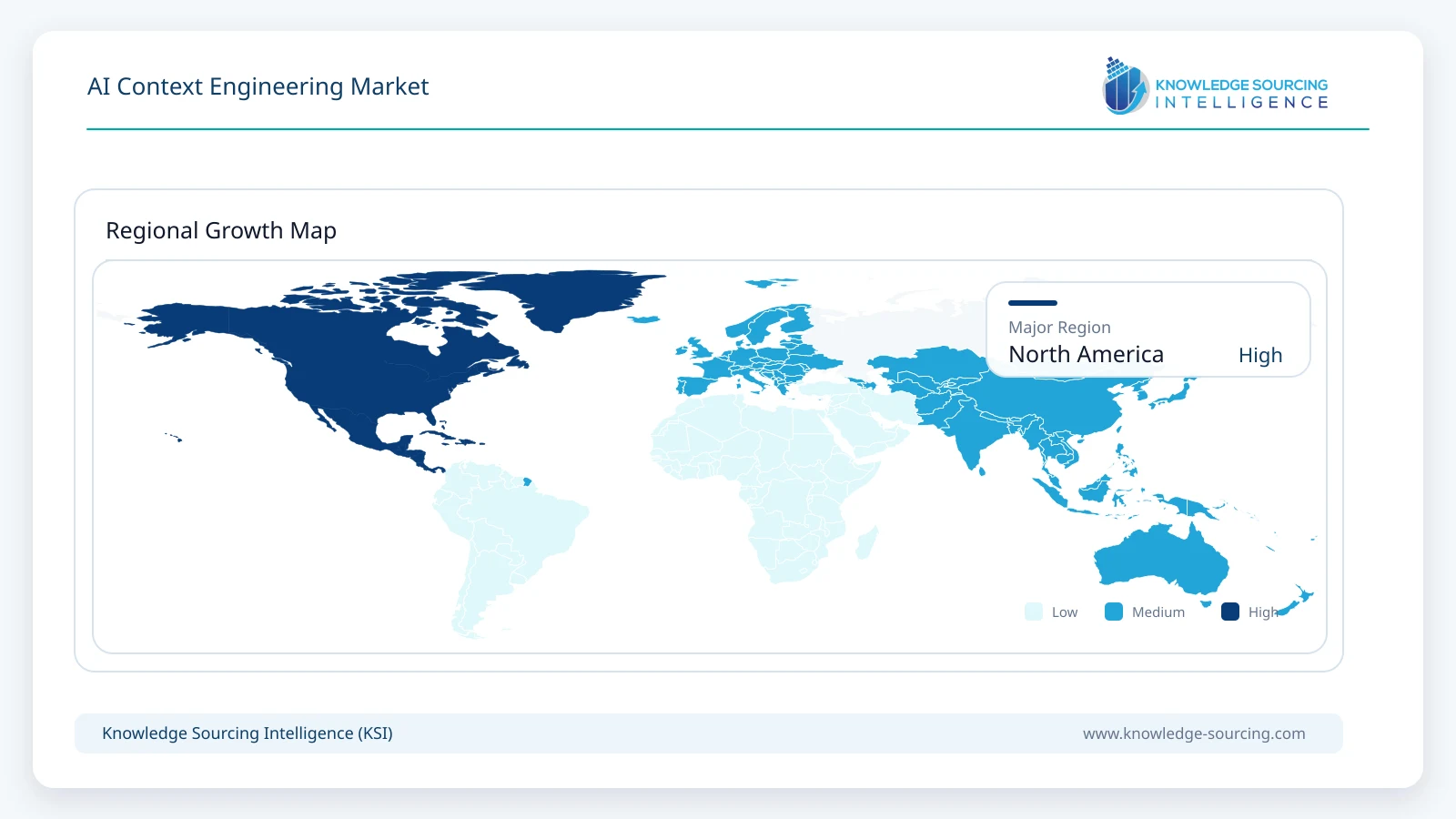
North America remains the largest regional market for AI context engineering because the United States combines major AI framework suppliers, extensive cloud infrastructure, and early commercial deployment of enterprise agents. Large customers are integrating retrieval, session controls, and governance into customer service, internal search, and software-engineering workflows. North American buyers are also comparatively advanced in formalizing evaluation workflows, which can support recurring contracts for context relevance testing and governed integrations. Financial services and software companies are likely early sources of demand because they operate large knowledge estates and support intensive multi-step agent workflows.
The region is expected to reach approximately USD 1.06 billion by 2031. Enterprise demand increasingly favors solutions that connect approved internal sources while controlling what each agent can view, with development-platform ecosystems supporting adoption across software and financial-services organizations.
Asia Pacific
Asia Pacific is forecast to record the fastest regional expansion as China, India, Japan, South Korea and Australia develop more AI applications connected to enterprise knowledge and operational software. Growth is supported by demand for multilingual retrieval, cost-efficient model usage and context pipelines that can work within local data-governance requirements. Regional market development is unlikely to follow a single uniform model: mature Japanese and Australian enterprises may prioritize governed integration, while faster-growing digital-service developers in India and Southeast Asia may emphasize cloud APIs and token-cost control. These requirements support both managed and self-managed deployment models.
Regional revenue is projected to reach approximately USD 840 million in 2031, compared with USD 102.5 million in 2026. Wider use of customer-service agents, software-development tools and enterprise assistants is expected to increase demand for selective retrieval, session management and deployment-specific context governance.
Competitive Landscape
The market combines specialist agent framework suppliers, commercial retrieval and reranking providers, and global cloud platforms that embed context-management capabilities within broader AI development services. LangChain and LlamaIndex support flexible application architectures, while Cohere supplies a separately monetized reranking layer; AWS, Google Cloud, Microsoft, OpenAI and Anthropic provide runtime, platform or developer services with context-related functions.
Competition is increasingly driven by relevance, recoverability, governed access, transparent unit economics and compatibility with multiple model providers. Pinecone, Redis, Weaviate and Databricks participate through underlying retrieval infrastructure, but the context-engineering revenue associated with these providers is narrower than their complete search, database or AI platform businesses.
Recent Developments
October 2026: LangChain published guidance on retrieval-first context engineering, recommending selective search, offloaded outputs and subagent review of large information sets to improve the efficiency of long-running agents.
October 2026: Cohere introduced Rerank 5 with Context Focus, allowing applications to select relevant text passages from documents rather than pass whole retrieved documents to an AI model.
October 2026: LangChain described Deep Agents context practices combining offloading, summarization, skills, subagents and file-based long-term memory for complex workflows.
June 2026: AWS announced plans for AWS Context, a proposed service connecting enterprise data relationships and agentic search; the announcement described future availability rather than a confirmed general launch.
May 2026: AWS demonstrated recursive document analysis with Amazon Bedrock AgentCore and Strands Agents, showing how agents can use external working state to handle source materials larger than a model context window.
May 2026: OpenAI published an Agents SDK example illustrating separate roles for compaction and reusable memory in long-running evidence-review workflows.
Market Outlook
AI context engineering revenue is expected to rise as enterprise AI applications increasingly need reliable methods to decide which instructions, records and tool outputs should influence each model call. Dedicated context interfaces and managed-agent functions are likely to develop in parallel, with customers choosing according to deployment control, source-system complexity and operating requirements.
Agentic architectures that retrieve evidence when needed, preserve large results outside the active window and carry forward compact task state should gain share over static prompt-loading approaches. Suppliers that demonstrate measurable improvements in grounded-answer quality, latency and inference efficiency will be better positioned to defend pricing against open-source alternatives.
North America is expected to retain the largest regional revenue base, while Asia Pacific grows faster through wider enterprise agent deployment and multilingual application development. Commercial differentiation will depend on secure cross-system data access, recoverable context, flexible model compatibility, and clear cost attribution rather than maximum context-window size alone.
AI Context Engineering Market Scope:
| Report Metric | Details |
|---|---|
| Total Market Size in 2026 | USD 410.0 million |
| Total Market Size in 2031 | USD 2,800.0 million |
| Forecast Unit | USD Million |
| Growth Rate | 46.9% |
| Study Period | 2021 to 2031 |
| Historical Data | 2021 to 2024 |
| Base Year | 2025 |
| Forecast Period | 2026 – 2031 |
| Segmentation | Offering, Functionality, Architecture, Deployment |
| Companies |
|
Market Segmentation
By Offering
Dedicated Context Platforms And APIs
Embedded Context Functions In Managed Agent Platforms
Context Implementation And Support Services
By Functionality
Dynamic Retrieval And Context Assembly
Context Filtering, Reranking And Grounding
Compaction And Token-Budget Optimization
Session-State And Context-Policy Management
By Architecture
Retrieval-Augmented Context Pipelines
Agentic And Just-In-Time Context Systems
Hybrid And Graph-Enriched Context Systems
By Deployment
Managed Cloud
Self-Managed And On-Premises
Hybrid
By Application
Enterprise Knowledge Assistants
Software Engineering Agents
Customer Service Automation
Enterprise Process Agents
Research And Analytics Agents
By End User
IT And Software
Banking, Financial Services And Insurance
Retail And E-Commerce
Healthcare And Life Sciences
Manufacturing And Industrial
Government, Education And Others
By Customer Type
Enterprise Direct Customers
AI-Native Application Developers
Systems Integrators And Managed Service Providers
By Geography
North America
United States
Canada
Mexico
South America
Brazil
Argentina
Chile
Rest Of South America
Europe
Germany
United Kingdom
France
Italy
Spain
Netherlands
Rest Of Europe
Middle East And Africa
Saudi Arabia
United Arab Emirates
Israel
South Africa
Rest Of Middle East And Africa
Asia Pacific
China
India
Japan
South Korea
Australia
Singapore
Rest Of Asia Pacific
Table of Contents
1. EXECUTIVE SUMMARY
1.1. Market Opportunity and Key Findings
1.2. AI Context Engineering Market Size, 2026–2031
1.3. Strategic Segment and Regional Outlook
2. MARKET SNAPSHOT
2.1. Market Overview
2.2. Market Definition
2.3. Scope of the Study
2.4. Market Segmentation
3. BUSINESS LANDSCAPE
3.1. Market Drivers
3.1.1. Scaling of Production AI Agents
3.1.2. Need for Higher Retrieval Relevance
3.1.3. Pressure to Control Token and Latency Costs
3.1.4. Demand for Cross-System Enterprise Integration
3.1.5. Expansion of Long-Horizon Coding and Research Agents
3.2. Market Restraints
3.2.1. Bundled and Open-Source Competition
3.2.2. Difficulty Measuring Context-Driven Performance
3.2.3. Security and Permission-Management Complexity
3.2.4. Integration with Existing Retrieval Infrastructure
3.2.5. Limited Revenue Transparency
3.3. Market Opportunities
3.4. Porter’s Five Forces Analysis
3.5. Industry Value Chain Analysis
3.6. Policies and Regulations
3.7. Strategic Recommendations
4. TECHNOLOGICAL OUTLOOK
4.1. Dynamic Context Assembly
4.2. Context Filtering and Reranking
4.3. Context Compaction and Recovery
4.4. Agent Middleware and Tool-Result Controls
4.5. Governed Context Access
4.6. Context Evaluation and Token Optimization
5. AI CONTEXT ENGINEERING MARKET BY OFFERING
5.1. Introduction
5.2. Dedicated context platforms and APIs
5.3. Embedded context functions in managed agent platforms
5.4. Context implementation and support services
6. AI CONTEXT ENGINEERING MARKET BY FUNCTIONALITY
6.1. Introduction
6.2. Dynamic retrieval and context assembly
6.3. Context filtering, reranking and grounding
6.4. Compaction and token-budget optimization
6.5. Session-state and context-policy management
7. AI CONTEXT ENGINEERING MARKET BY ARCHITECTURE
7.1. Introduction
7.2. Retrieval-augmented context pipelines
7.3. Agentic and just-in-time context systems
7.4. Hybrid and graph-enriched context systems
8. AI CONTEXT ENGINEERING MARKET BY DEPLOYMENT
8.1. Introduction
8.2. Managed cloud
8.3. Self-managed and on-premises
8.4. Hybrid
9. AI CONTEXT ENGINEERING MARKET BY APPLICATION
9.1. Introduction
9.2. Enterprise knowledge assistants
9.3. Software engineering agents
9.4. Customer service automation
9.5. Enterprise process agents
9.6. Research and analytics agents
10. AI CONTEXT ENGINEERING MARKET BY END USER
10.1. Introduction
10.2. IT and software
10.3. Banking, financial services and insurance
10.4. Retail and e-commerce
10.5. Healthcare and life sciences
10.6. Manufacturing and industrial
10.7. Government, education and others
11. AI CONTEXT ENGINEERING MARKET BY CUSTOMER TYPE
11.1. Introduction
11.2. Enterprise direct customers
11.3. AI-native application developers
11.4. Systems integrators and managed service providers
12. AI CONTEXT ENGINEERING MARKET BY GEOGRAPHY
12.1. North America
12.1.1. United States
12.1.2. Canada
12.1.3. Mexico
12.2. South America
12.2.1. Brazil
12.2.2. Argentina
12.2.3. Chile
12.2.4. Rest of South America
12.3. Europe
12.3.1. Germany
12.3.2. United Kingdom
12.3.3. France
12.3.4. Italy
12.3.5. Spain
12.3.6. Netherlands
12.3.7. Rest of Europe
12.4. Middle East and Africa
12.4.1. Saudi Arabia
12.4.2. United Arab Emirates
12.4.3. Israel
12.4.4. South Africa
12.4.5. Rest of Middle East and Africa
12.5. Asia Pacific
12.5.1. China
12.5.2. India
12.5.3. Japan
12.5.4. South Korea
12.5.5. Australia
12.5.6. Singapore
12.5.7. Rest of Asia Pacific
13. COMPETITIVE ENVIRONMENT AND ANALYSIS
13.1. Major Players and Strategy Analysis
13.2. Market Share Analysis
13.3. Mergers, Acquisitions, Agreements and Collaborations
13.4. Competitive Dashboard
14. COMPANY PROFILES
14.1. LangChain, Inc.
14.2. Amazon Web Services, Inc.
14.3. Google LLC
14.4. Microsoft Corporation
14.5. OpenAI OpCo, LLC
14.6. Anthropic, PBC
14.7. LlamaIndex, Inc.
14.8. Cohere Inc.
14.9. Databricks, Inc.
14.10. Pinecone Systems, Inc.
14.11. Redis Ltd.
14.12. Weaviate B.V.
15. APPENDIX
15.1. Research Methodology
15.2. Data Sources and Definitions
15.3. Market Estimation Methodology
15.4. Abbreviations
Navigate
Trusted by the world's leading organizations