
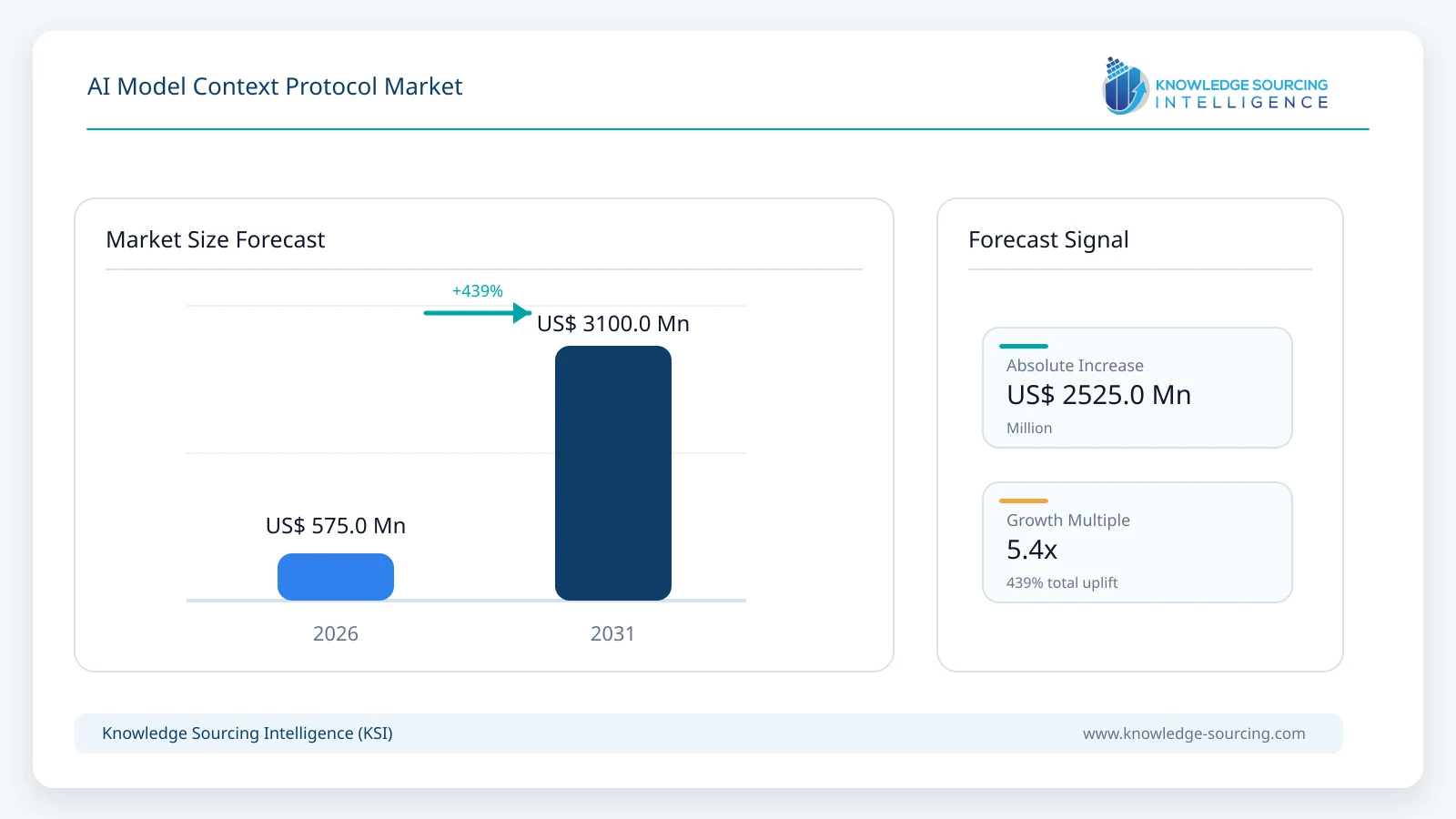
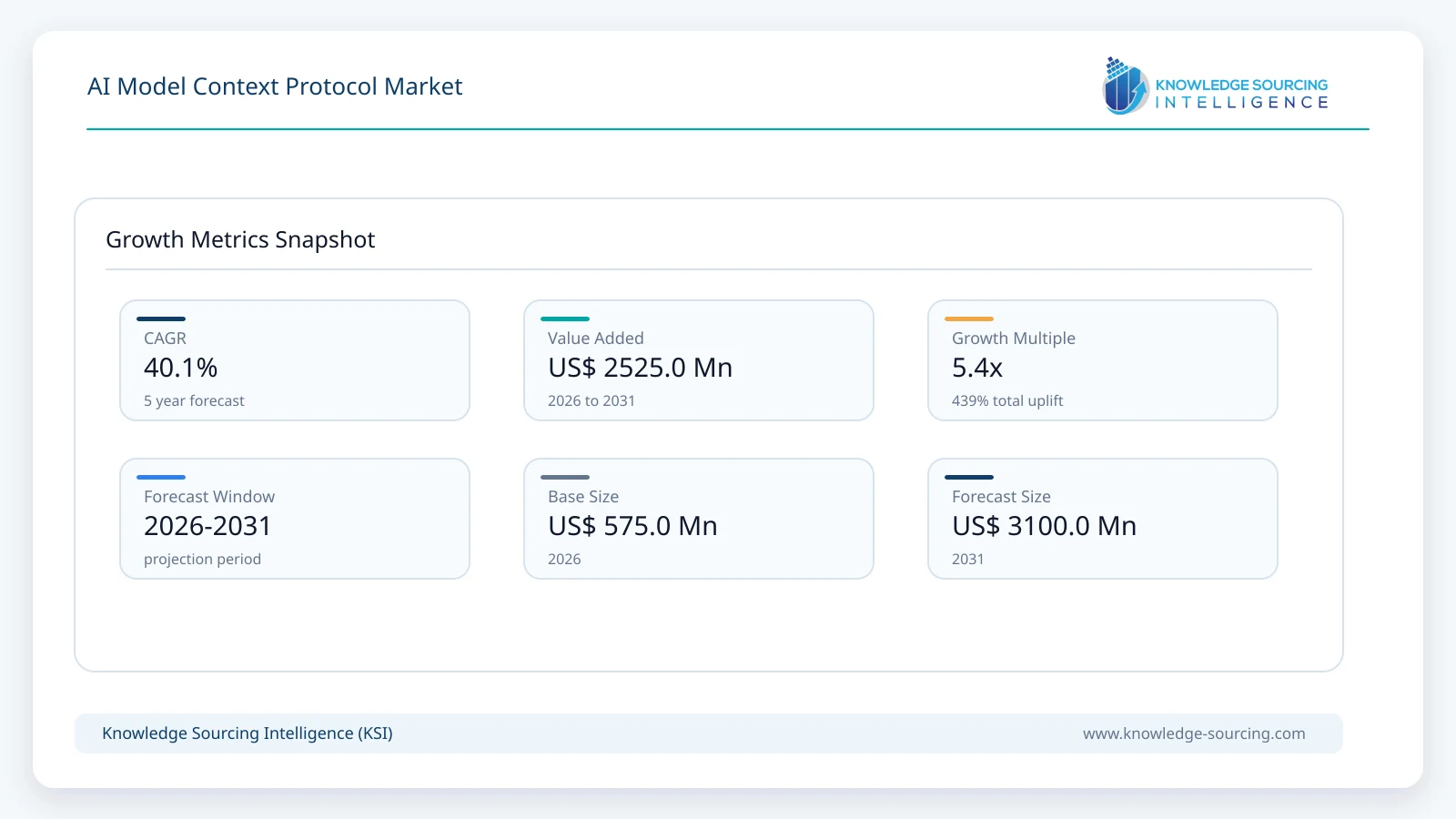
The AI Model Context Protocol Market is forecast to grow at a CAGR of 40.1%, reaching USD 3,100.0 million in 2031 from USD 575.0 million in 2026.
Highlights:
- 1Managed MCP gateways and server platforms account for approximately 37% of global market value in 2026 as enterprises centralize tool exposure and access controls.
- 2Tool discovery and invocation represent approximately 32% of 2026 revenue, reflecting demand for standardized access to business applications and developer systems.
- 3Managed public cloud deployment accounts for approximately 58% of market value in 2026, supported by consumption-based gateway services and reduced administration requirements.
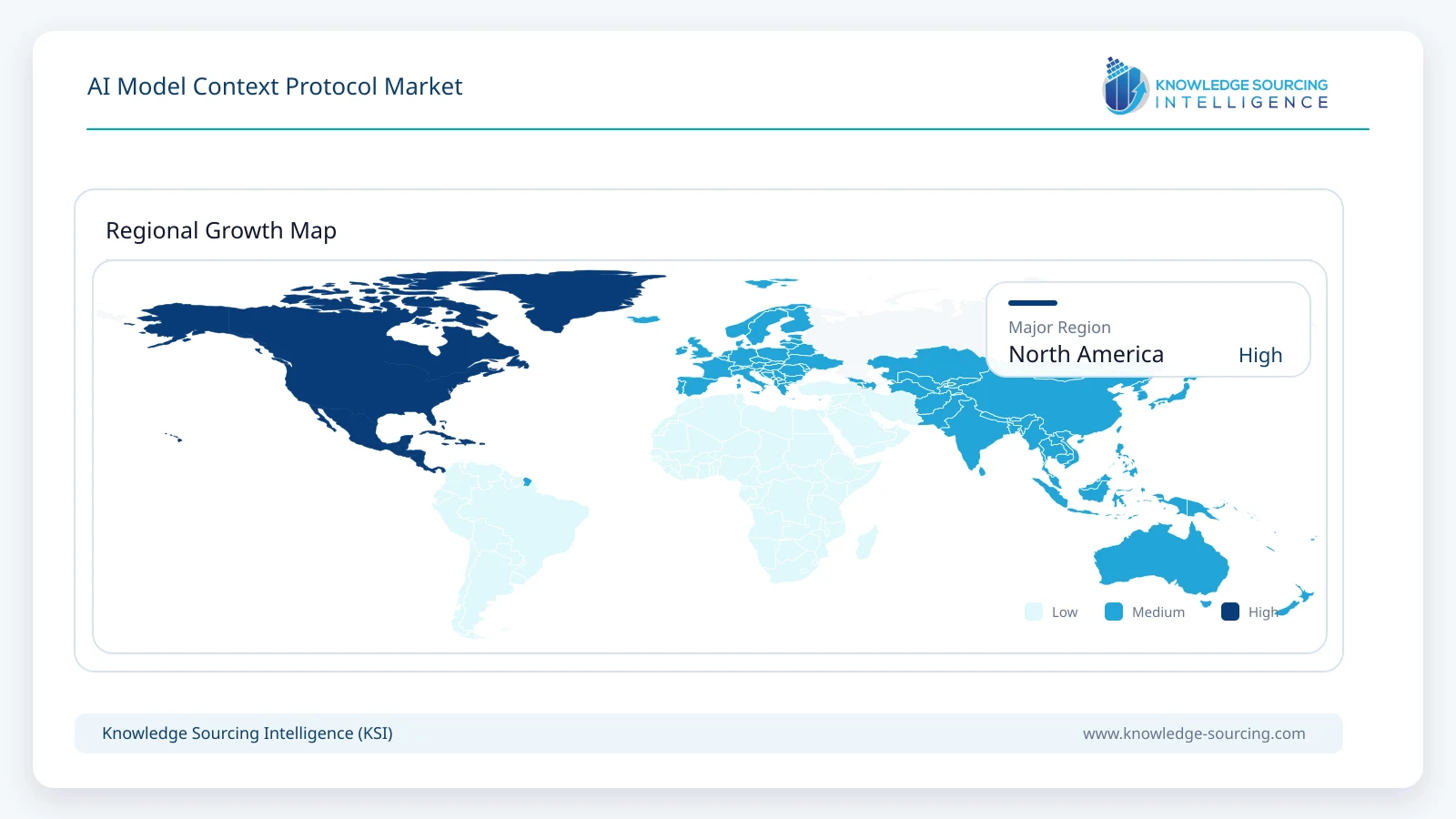
- 4North America represents approximately 43% of global revenue in 2026, supported by early enterprise-agent deployments and an established cloud software supplier base.
- 5Asia Pacific is projected to record the fastest regional expansion through 2031 as demand grows for governed AI-to-application access across enterprise software markets.
The market covers revenue from MCP-specific gateway and server management platforms, commercial connector and tool-access services, security and governance products, and directly related implementation and support. The protocol remains open and free to implement; the commercial market consists of the software and services organizations purchase to operate MCP connections securely and reliably.
MCP allows a compatible AI application to discover available tools and invoke them through a standardized interface instead of requiring a separate custom integration for each model and business service. Amazon Bedrock AgentCore Gateway, Microsoft Azure API Management, Cloudflare MCP server portals, and Docker MCP Gateway illustrate distinct implementation models, from managed cloud services to local container-based governance. These products address tool exposure, credentials, permissions, and operational visibility rather than replacing the AI model or the underlying business application.
Market Overview
AI agents that operate across CRM platforms, knowledge repositories, development tools, and internal services require a way to identify available actions and exchange structured inputs and results. MCP provides a common client-server interface for tools and other resources, reducing the engineering required to connect different assistants to the same system. Customers nevertheless need authentication, lifecycle management, and operational controls when these connections are deployed outside a single developer workstation.
Anthropic introduced MCP in November 2024 and donated it to the Agentic AI Foundation under the Linux Foundation in December 2025. The specification released in July 2026 moved the protocol toward stateless request handling, introduced header-based routing metadata, and strengthened authorization. These revisions support scalable remote services but also create compatibility requirements for vendors managing older MCP deployments and credentials across several clients.
Cloud service and integration suppliers now offer different commercial paths to MCP adoption. AWS prices AgentCore Gateway operations on a consumption basis, Microsoft allows APIs to be exposed as MCP tools through Azure API Management, and Google Cloud announced more than 50 managed MCP servers in April 2026. Boomi and Workato connect agent workflows to managed enterprise integrations. Cloudflare provides portals that combine approved servers through one endpoint, while Docker distributes tools for deploying and isolating server processes. The common purchasing requirement is dependable connectivity with enforceable access rules.
Market Trends
Enterprise MCP Gateways Are Replacing Disconnected Server Configurations
Enterprise IT teams increasingly want one administrative layer for approved MCP servers rather than separate connection settings for every AI assistant. Cloudflare made MCP server portals generally available in September 2026, offering one endpoint with logging, identity integration, and configurable policies. Boomi and Workato similarly promote centralized governance for tools exposed to multiple agents.
Centralized management can lower connector-maintenance work and make it easier to replace an AI application without rebuilding each back-end integration. The value becomes more pronounced when an organization operates several assistants that all need access to the same governed business systems.
Stateless Remote Transport Is Changing MCP Infrastructure
The July 2026 protocol revision moves the core toward request-response, stateless communication, allowing gateways and servers to scale without preserving protocol sessions across individual requests. AWS documents compatibility with both the new and earlier versions, while Kong and GitHub have published information on support for the revised specification.
The transition supports serverless and distributed deployments, but enterprise buyers still need version negotiation, authentication-state handling, and testing to keep earlier clients working during migration.
Tool Security and Traceability Are Becoming Procurement Requirements
MCP tools can carry out meaningful actions in enterprise applications, so agent identity, user permissions, and access restrictions have direct operational consequences. GitHub introduced enterprise-managed MCP allowlists in August 2026, and Okta documented additional oversight for sensitive operations in its MCP server earlier in the year.
As more organizations approve AI-initiated changes to records, payments, repositories and internal systems, audit trails and least-privilege policies will have greater commercial importance than basic protocol compatibility alone.
MCP Connector Providers Are Introducing Usage-Based Economics
Commercial MCP access is increasingly sold through a mixture of per-call metering, contracted enterprise deployment and specialized access-management services. AWS publishes separate Gateway invocation charges, while Composio and Arcade offer usage-based tool and authentication services alongside enterprise contracts.
These billing structures make small pilots easy to start, but they also encourage companies to compare the value of managed connectors with open-source servers and existing API-management software.
Segment Analysis
By Offering: Managed MCP Gateways and Server Platforms
Managed MCP gateways and server platforms represent the largest offering group because enterprises need a shared control point for tool registration, connectivity, access policies and server lifecycle management. Cloudflare MCP portals, AWS AgentCore Gateway and Microsoft Azure API Management illustrate demand for a unified layer that can connect multiple AI clients to approved tools.
The segment is projected to reach approximately USD 1.33 billion in 2031. Growth is supported by expansion from isolated developer integrations into production estates where uptime, policy enforcement, protocol-version management and usage visibility justify recurring commercial spend.
By Functionality: Tool Discovery and Invocation
Tool discovery and invocation form the largest functional category as AI applications need to enumerate available actions, select a suitable capability and execute it against a remote or local service. The underlying protocol standardizes this interaction, while commercial infrastructure adds routing, authorization, access logging, and reliability controls.
This functionality is expected to generate approximately USD 930 million by 2031. The value is concentrated in managed invocation and discovery services rather than in free tool-definition schemas or the cost of executing an unrelated business API.
By Application: Enterprise Knowledge and Productivity Assistants
Enterprise assistants increasingly access document services, ticketing platforms, calendars, customer records, and internal databases through MCP-compatible tools. Shared connector infrastructure helps companies deploy assistants across departments while retaining control over credentials and user-specific permissions.
The application segment is forecast to reach approximately USD 868 million by 2031. Adoption is supported by cloud productivity ecosystems, enterprise integration platforms, and the ability to reuse approved tools across different AI assistants without maintaining a separate connection for every model.
Market Drivers
Expansion of Enterprise AI Agents
Enterprises deploying assistants for customer operations, internal knowledge and software engineering need a standardized way to connect AI applications to operational tools. The existence of MCP support across major AI platforms increases the value of commercial infrastructure that can manage approved connections at scale.
Demand for Secure and Governed Tool Access
AI-initiated actions can change business records and trigger transactions, making user identity, permissions, auditability and approval controls essential for production deployment. Vendors offering consistent policies across many MCP servers can address a larger compliance need than individual connection scripts.
Reduction in Integration and Maintenance Work
Development teams often maintain multiple bespoke interfaces between AI applications and business APIs. Standard MCP connectivity can reduce duplicate integration work, while managed connector services absorb schema changes, token refresh, server updates and infrastructure operations.
Broader Availability of Cloud-Based MCP Infrastructure
AWS, Microsoft, and Cloudflare offer different managed routes for deploying MCP-compatible tool access, making production configurations accessible without requiring enterprises to build every gateway component independently. Consumption pricing and existing cloud procurement relationships support the shift from pilots to governed services.
Growth in Multi-Platform Agent Ecosystems
Organizations increasingly operate multiple AI assistants across developer and business workflows, creating demand for a shared inventory of tools and consistent permissions. MCP-compatible infrastructure allows an approved service to be accessed by more than one client, improving the return on investment in connectors and security controls.
Market Restraints
Free Protocol Implementations and Bundled Capabilities
MCP is an open standard supported by free SDKs, community-maintained servers, and features bundled in existing platforms. Vendors therefore need to demonstrate an incremental benefit from managed operation, governance, or support rather than charge for access to the protocol itself.
Security Risks in Third-Party Tool Connections
Untrusted or misconfigured servers can expose confidential data or perform actions beyond the user’s intent. Organizations must evaluate server provenance, permission boundaries, and response handling, which can slow authorization of new tools and require additional testing.
Protocol and Client Compatibility Requirements
The July 2026 transition to a stateless transport changes operational assumptions for remote clients and gateways, while older installations remain in use. Suppliers must test compatibility across supported versions and handle authorization and application state separately from the new stateless protocol core.
Attribution Challenges in Bundled Platform Pricing
Cloud and integration suppliers often include MCP features within broader API management, security or automation subscriptions. This makes it difficult for enterprise procurement teams to compare MCP-specific unit economics and limits the visibility of standalone supplier revenue.
Implementation Complexity in Legacy Enterprises
Large organizations frequently maintain fragmented application permissions, undocumented APIs, and older identity configurations. Making those systems available through MCP can require connector engineering, approval workflows, and data-governance reviews before agents can safely invoke them.
Regional Outlook
North America
North America holds the largest AI Model Context Protocol market because major cloud platform vendors, enterprise software suppliers and early adopters of AI agents are concentrated in the United States. Organizations in financial services, technology and business services are integrating AI assistants with internal tools and increasingly need centralized credentials, approved server catalogs and records of tool activity.
Regional revenue is projected to reach approximately USD 1.21 billion by 2031. The region benefits from established API-management procurement, strong developer ecosystems and growing use of regulated tool access, allowing commercial gateway and security offerings to complement open-source MCP implementations.
Asia Pacific
Asia Pacific is projected to grow faster than the other regions as companies in China, India, Japan, South Korea and Australia expand AI-enabled software and enterprise automation. Demand includes connectors that can serve different cloud deployments, local business applications and regulated data environments without tying every agent to a single model supplier.
The regional market is expected to reach approximately USD 899 million in 2031, compared with USD 132.25 million in 2026. Managed cloud gateways are likely to expand alongside systems integrators and local enterprise-platform suppliers, particularly where companies need reusable tool access across multilingual business processes and multiple AI clients.
Competitive Landscape
AI Model Context Protocol infrastructure is supplied by hyperscale cloud platforms, enterprise integration providers, API gateway vendors and specialist tool-execution services. AWS, Microsoft and Cloudflare offer gateway and management capabilities, while Boomi and Workato extend their enterprise integration platforms toward MCP-compatible tool exposure. Docker supports server packaging and isolation, and Composio and Arcade provide managed connector execution, authentication and usage-based access.
Competition centers on security, connector coverage, operational reliability, protocol compatibility, predictable pricing and support for several AI clients. Kong and Postman participate through gateway compatibility, discovery and developer tooling; Okta contributes identity-oriented MCP capabilities. The presence of free software and bundled services is likely to keep basic transport features commoditized, encouraging vendors to differentiate through governance and managed operations.
Recent Developments
September 2026: Cloudflare made MCP server portals generally available, allowing organizations to access approved servers through one managed endpoint with logging and policy integrations.
September 2026: The Linux Foundation’s Agentic AI Foundation introduced the Model Context Protocol Associate certification, formalizing foundational protocol, security and governance knowledge for developers.
August 2026: GitHub introduced generally available enterprise-managed MCP allowlists, allowing organizations to restrict which local and remote tool servers supported clients may access.
July 2026: The MCP maintainers released specification version 2026-07-28, introducing a stateless core, updated routing metadata and stronger authorization mechanisms.
July 2026: Boomi published updated Connect documentation describing a managed MCP connector service for enterprise systems, including authentication and tool execution through a unified interface.
June 2026: GitHub made its Copilot SDK generally available with custom-tool registration and MCP server connectivity for developers building AI applications.
Market Outlook
Revenue from commercial MCP infrastructure is expected to rise as enterprises increase the number of AI applications able to access business tools and replace individually administered connections with shared gateways, managed connectors and consistent access controls. The open protocol should support interoperability, while enterprise requirements for secure execution and lifecycle management create opportunities for paid software and services.
Managed gateways and cloud-hosted connector services are likely to capture a growing share of industry spending as customers prioritize deployment simplicity and provider-neutral tool access. Security and authorization software should also benefit from growth in production agents that can perform actions on behalf of users, although free implementations will continue to restrain pricing for basic protocol functions.
North America is expected to remain the largest regional market, while Asia Pacific expands more rapidly as demand for enterprise automation, developer agents, and local application connectivity increases. Winning suppliers will need to demonstrate reliable integration, transparent operating costs, and enforceable permission boundaries rather than merely advertise MCP compatibility.
AI Model Context Protocol Market Scope:
| Report Metric | Details |
|---|---|
| Total Market Size in 2026 | USD 575.0 million |
| Total Market Size in 2031 | USD 3,100.0 million |
| Forecast Unit | USD Million |
| Growth Rate | 40.1% |
| Study Period | 2021 to 2031 |
| Historical Data | 2021 to 2024 |
| Base Year | 2025 |
| Forecast Period | 2026 – 2031 |
| Segmentation | Offering, Functionality, Deployment, Integration Target |
| Companies |
|
Market Segmentation
By Offering
Managed MCP gateways and server platforms
MCP connector and tool-access services
MCP security and governance software
MCP integration and support services
By Functionality
Tool discovery and invocation
Connector translation and integration
Identity, permissions and policy enforcement
Registry and server lifecycle management
Observability, testing and audit trails
By Deployment
Managed public cloud
Self-managed and private deployment
Hybrid deployment
By Integration Target
Developer tools and code repositories
Enterprise SaaS and productivity applications
Databases, search and analytics systems
Enterprise operations and workflow systems
Infrastructure, commerce and other APIs
By Application
Developer copilots and coding agents
Enterprise knowledge and productivity assistants
Customer-service and support agents
Business-process and workflow agents
Research, analytics and specialist agents
By End User
IT, software and cloud services
Banking, financial services and insurance
Retail and e-commerce
Healthcare and life sciences
Manufacturing and industrial
Government, education and other industries
By Customer Type
Direct enterprise customers
AI-native developers and software vendors
Systems integrators and managed service providers
By Geography
North America
United States
Canada
Mexico
South America
Brazil
Argentina
Colombia
Rest of South America
Europe
Germany
United Kingdom
France
Netherlands
Italy
Spain
Rest of Europe
Middle East and Africa
United Arab Emirates
Saudi Arabia
Israel
South Africa
Rest of Middle East and Africa
Asia Pacific
China
Japan
India
South Korea
Australia
Singapore
Rest of Asia Pacific
Table of Contents
1. EXECUTIVE SUMMARY
1.1. Market Opportunity and Key Findings
1.2. AI Model Context Protocol Market Size, 2026–2031
1.3. Strategic Segment and Regional Outlook
2. MARKET SNAPSHOT
2.1. Market Overview
2.2. Market Definition
2.3. Scope of the Study
2.4. Market Segmentation
3. BUSINESS LANDSCAPE
3.1. Market Drivers
3.1.1. Expansion of Enterprise AI Agents
3.1.2. Demand for Secure and Governed Tool Access
3.1.3. Reduction in Integration and Maintenance Work
3.1.4. Broader Availability of Cloud-Based MCP Infrastructure
3.1.5. Growth in Multi-Platform Agent Ecosystems
3.2. Market Restraints
3.2.1. Free Protocol Implementations and Bundled Capabilities
3.2.2. Security Risks in Third-Party Tool Connections
3.2.3. Protocol and Client Compatibility Requirements
3.2.4. Attribution Challenges in Bundled Platform Pricing
3.2.5. Implementation Complexity in Legacy Enterprises
3.3. Market Opportunities
3.4. Porter’s Five Forces Analysis
3.5. Industry Value Chain Analysis
3.6. Policies and Regulations
3.7. Strategic Recommendations
4. TECHNOLOGICAL OUTLOOK
4.1. MCP Hosts, Clients and Servers
4.2. Tool Discovery and Execution
4.3. Streamable HTTP and Stateless Core
4.4. Identity, Authorization and Permissions
4.5. MCP Gateways, Registries and Server Lifecycle
4.6. MCP Security, Observability and Deployment
5. AI MODEL CONTEXT PROTOCOL MARKET BY OFFERING
5.1. Introduction
5.2. Managed MCP gateways and server platforms
5.3. MCP connector and tool-access services
5.4. MCP security and governance software
5.5. MCP integration and support services
6. AI MODEL CONTEXT PROTOCOL MARKET BY FUNCTIONALITY
6.1. Introduction
6.2. Tool discovery and invocation
6.3. Connector translation and integration
6.4. Identity, permissions and policy enforcement
6.5. Registry and server lifecycle management
6.6. Observability, testing and audit trails
7. AI MODEL CONTEXT PROTOCOL MARKET BY DEPLOYMENT
7.1. Introduction
7.2. Managed public cloud
7.3. Self-managed and private deployment
7.4. Hybrid deployment
8. AI MODEL CONTEXT PROTOCOL MARKET BY INTEGRATION TARGET
8.1. Introduction
8.2. Developer tools and code repositories
8.3. Enterprise SaaS and productivity applications
8.4. Databases, search and analytics systems
8.5. Enterprise operations and workflow systems
8.6. Infrastructure, commerce and other APIs
9. AI MODEL CONTEXT PROTOCOL MARKET BY APPLICATION
9.1. Introduction
9.2. Developer copilots and coding agents
9.3. Enterprise knowledge and productivity assistants
9.4. Customer-service and support agents
9.5. Business-process and workflow agents
9.6. Research, analytics and specialist agents
10. AI MODEL CONTEXT PROTOCOL MARKET BY END USER
10.1. Introduction
10.2. IT, software and cloud services
10.3. Banking, financial services and insurance
10.4. Retail and e-commerce
10.5. Healthcare and life sciences
10.6. Manufacturing and industrial
10.7. Government, education and other industries
11. AI MODEL CONTEXT PROTOCOL MARKET BY CUSTOMER TYPE
11.1. Introduction
11.2. Direct enterprise customers
11.3. AI-native developers and software vendors
11.4. Systems integrators and managed service providers
12. AI MODEL CONTEXT PROTOCOL MARKET BY GEOGRAPHY
12.1. North America
12.1.1. United States
12.1.2. Canada
12.1.3. Mexico
12.2. South America
12.2.1. Brazil
12.2.2. Argentina
12.2.3. Colombia
12.2.4. Rest of South America
12.3. Europe
12.3.1. Germany
12.3.2. United Kingdom
12.3.3. France
12.3.4. Netherlands
12.3.5. Italy
12.3.6. Spain
12.3.7. Rest of Europe
12.4. Middle East and Africa
12.4.1. United Arab Emirates
12.4.2. Saudi Arabia
12.4.3. Israel
12.4.4. South Africa
12.4.5. Rest of Middle East and Africa
12.5. Asia Pacific
12.5.1. China
12.5.2. Japan
12.5.3. India
12.5.4. South Korea
12.5.5. Australia
12.5.6. Singapore
12.5.7. Rest of Asia Pacific
13. COMPETITIVE ENVIRONMENT AND ANALYSIS
13.1. Major Players and Strategy Analysis
13.2. Market Share Analysis
13.3. Mergers, Acquisitions, Agreements and Collaborations
13.4. Competitive Dashboard
14. COMPANY PROFILES
14.1. Amazon Web Services, Inc.
14.2. Microsoft Corporation
14.3. Cloudflare, Inc.
14.4. Docker, Inc.
14.5. Boomi, LP
14.6. Workato, Inc.
14.7. Sampark Inc. (Composio)
14.8. Arcade AI, Inc.
14.9. Kong Inc.
14.10. Postman, Inc.
14.11. Okta, Inc.
14.12. Google LLC
15. APPENDIX
15.1. Research Methodology
15.2. Data Sources and Definitions
15.3. Market Estimation Methodology
15.4. Abbreviations
Navigate
Trusted by the world's leading organizations











