
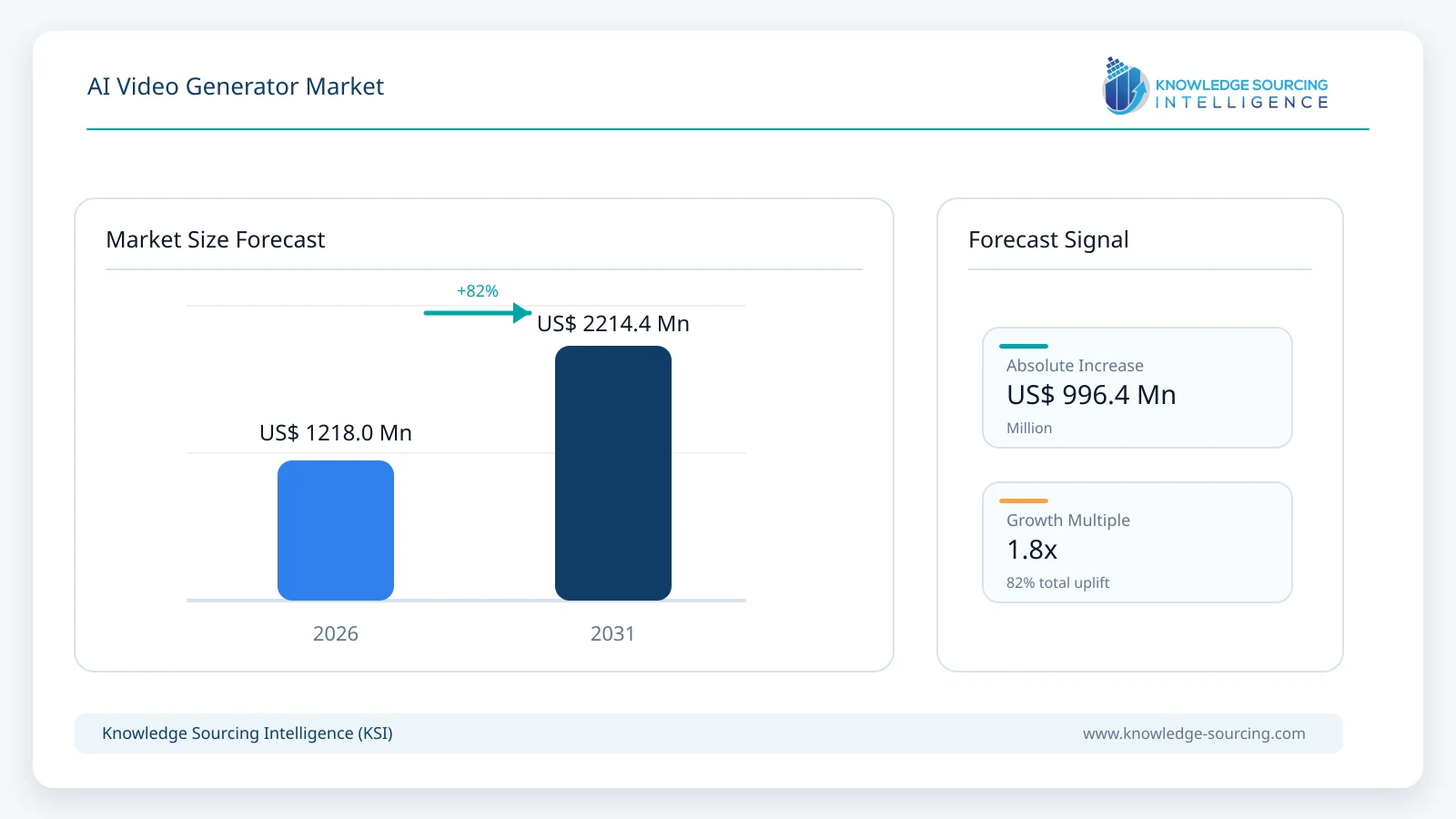
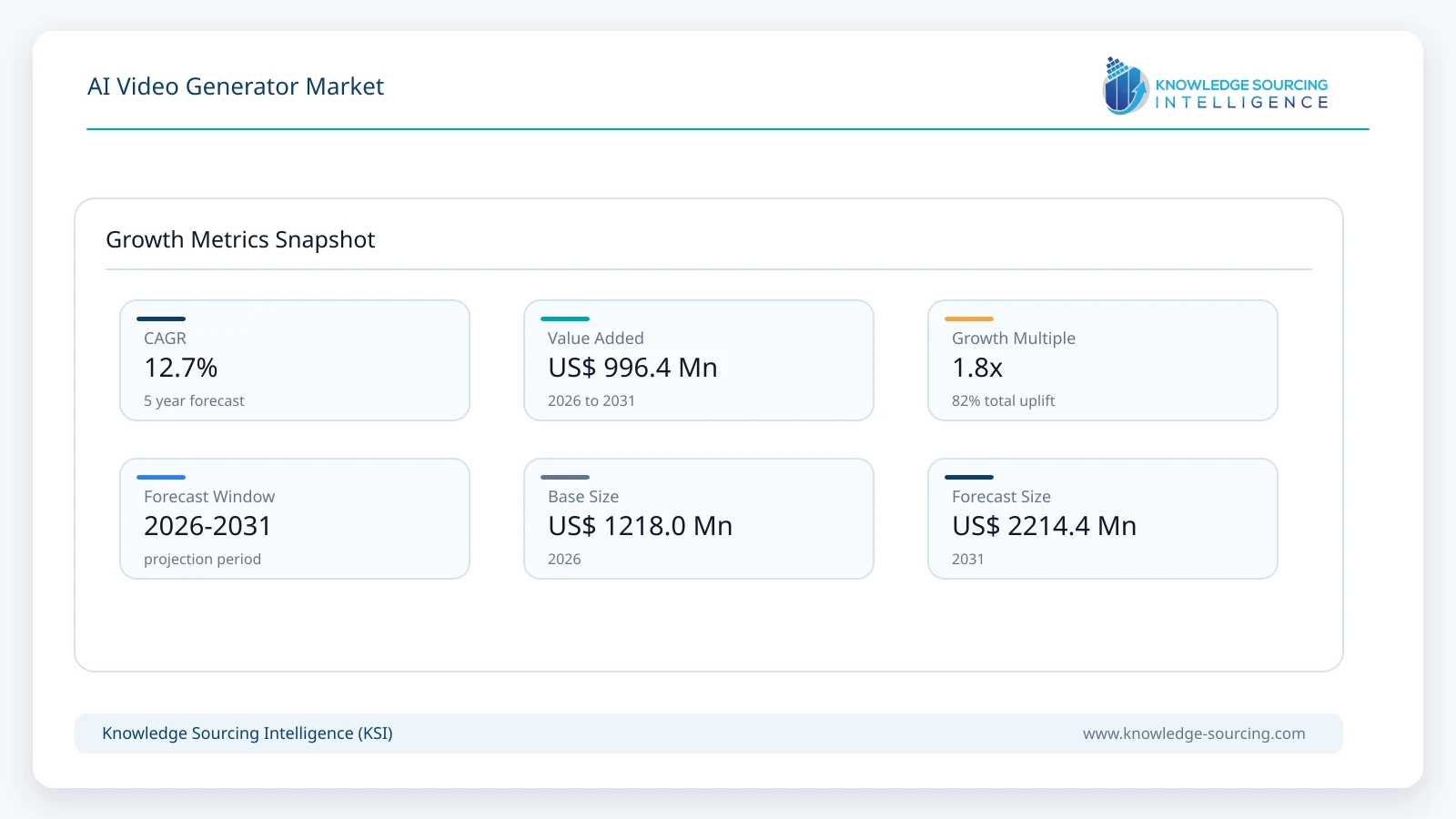
The AI Video Generator Market is forecast to grow at a CAGR of 12.70%, reaching USD 2,214.45 million in 2031 from USD 1,218.00 million in 2026.
Highlights:
- 1Growing enterprise demand for scalable video content production is the primary commercial driver supporting software adoption.
- 2Text-to-video solutions represent one of the most commercially attractive segments due to broad business usability.
- 3Asia Pacific continues to present substantial opportunities as digital content creation expands across businesses and education sectors.
- 4Improvements in generative AI models are enhancing avatar realism, multilingual voice generation, and production efficiency.
- 5Emerging AI governance policies are encouraging vendors to strengthen transparency, copyright compliance, and data security capabilities.
- 6Competition increasingly centers on enterprise integration, workflow automation, subscription flexibility, and platform interoperability.
The AI Video Generator Market comprises software platforms and associated services that use artificial intelligence to automate or accelerate video creation from inputs such as text, images, presentations, voice, and digital avatars. These platforms combine large language models, generative image models, speech synthesis, computer vision, and video rendering technologies to reduce production time and lower content creation costs. The market serves organizations that require high volumes of personalized or multilingual video content without relying exclusively on traditional production teams.
Demand is being shaped by the growing importance of video as the preferred communication format across marketing, corporate training, education, customer support, and social media. Organizations are shifting budgets toward AI-assisted content production because conventional video creation requires skilled editors, production equipment, and lengthy revision cycles. AI-generated video addresses these constraints by enabling rapid content updates, localized messaging, and scalable production while maintaining acceptable quality for commercial applications.
Buyer priorities differ across industries but consistently emphasize ease of use, integration with existing digital workflows, output quality, data privacy, language support, and intellectual property protection. Marketing agencies seek faster campaign execution and personalization, educational institutions prioritize multilingual instructional content, while enterprises evaluate security controls and compatibility with collaboration platforms and digital asset management systems. Procurement decisions increasingly involve both marketing and information technology departments because AI video platforms process corporate data and often integrate with enterprise software.
The commercial structure of the industry includes AI model developers, software platform providers, creative workflow vendors, cloud infrastructure providers, and implementation service specialists. Subscription licensing remains the principal revenue model, supplemented by enterprise contracts, API access, premium rendering capacity, consulting services, and customized deployment. Vendors continue to invest in model accuracy, avatar realism, voice synchronization, editing flexibility, and enterprise governance features to improve customer retention and expand average contract values.
Cloud deployment dominates purchasing decisions because it allows customers to scale rendering capacity without investing in specialized hardware. At the same time, larger enterprises increasingly request private cloud or dedicated deployment models to satisfy internal security requirements and comply with data governance regulations. This trend has encouraged vendors to introduce flexible deployment architectures alongside enhanced administrative controls.
Competitive differentiation extends beyond video quality alone. Buyers increasingly compare multilingual capabilities, template libraries, collaboration tools, API ecosystems, workflow automation, content moderation, watermark controls, and integration with productivity platforms. As enterprise adoption expands, vendors are placing greater emphasis on compliance features, audit trails, permission management, and intellectual property safeguards that support organizational governance requirements.
Market Drivers
Rising enterprise demand for scalable marketing content
Organizations now produce substantially more digital content than traditional creative teams can efficiently manage. Product launches, regional campaigns, promotional videos, customer onboarding, and personalized advertising require continuous content generation across multiple channels. AI video generation reduces production timelines while enabling businesses to customize messaging for different customer segments. Software vendors respond by expanding automation features, template libraries, and multilingual support, making AI platforms attractive investments for organizations seeking greater marketing productivity.
Expansion of digital learning and corporate training
Educational institutions and enterprises increasingly depend on video-based learning because distributed workforces and online education require accessible instructional content. AI-generated presenters, automated narration, subtitle generation, and multilingual translation reduce production costs while supporting frequent curriculum updates. Buyers value platforms capable of maintaining consistent instructional quality without requiring professional video production expertise, encouraging wider adoption across education providers and corporate learning departments.
Growth of e-commerce and personalized customer engagement
Retailers require large volumes of product demonstrations, promotional campaigns, and localized advertisements across numerous digital channels. AI video generation enables merchants to create product-specific videos using standardized templates and automated narration. This capability improves merchandising efficiency while supporting faster product launches. Vendors compete by integrating directly with e-commerce platforms, allowing businesses to automate content generation using existing product catalogs.
Continuous improvements in generative AI capabilities
Advances in foundation models, neural rendering, speech synthesis, and computer vision continue to improve video realism and editing flexibility. Better facial animation, natural voice generation, motion consistency, and multilingual capabilities reduce quality differences between AI-generated and traditionally produced content for many commercial applications. Technology improvements also encourage enterprises to expand deployment into customer communications, sales enablement, and internal knowledge management.
Market Restraints and Challenges
Intellectual property and copyright uncertainty
Businesses remain cautious regarding ownership of AI-generated content and the datasets used to train underlying models. Copyright disputes involving generated media create legal uncertainty for organizations operating in regulated industries or publishing branded material. Vendors are responding by improving content provenance, licensing transparency, and copyright protection mechanisms, but legal interpretations continue to evolve across jurisdictions.
Data privacy and enterprise security concerns
Many enterprise users process confidential presentations, customer information, and proprietary documentation through AI platforms. Organizations operating under strict compliance requirements often require detailed security certifications, encryption, access controls, and regional data hosting. These requirements increase implementation complexity and can lengthen procurement cycles, particularly among financial institutions, healthcare providers, and government organizations.
Variability in output quality
Although AI video generation has improved substantially, output quality remains dependent on prompt design, source material, and model limitations. Inaccurate visual rendering, unnatural facial expressions, inconsistent motion, or factual errors may require manual editing before publication. Organizations producing customer-facing content therefore continue to combine AI automation with human review, limiting complete workflow automation in quality-sensitive applications.
Competitive pricing pressure
The market has experienced rapid entry by software developers offering subscription-based platforms with overlapping capabilities. Price competition, generous free usage tiers, and bundled productivity software place pressure on margins, particularly for smaller vendors. Companies increasingly differentiate themselves through enterprise integrations, specialized workflows, industry-specific templates, and premium support services rather than competing solely on price.
Major Segment Analysis
Among the available source categories, Text-to-Video represents the most commercially important segment because it addresses the widest range of enterprise content requirements while minimizing production complexity. Marketing departments, educational institutions, consulting firms, software providers, and corporate communication teams increasingly convert written material directly into professional video content, reducing reliance on specialized editing expertise.
Buyer demand centers on platforms capable of accurately interpreting prompts, maintaining brand consistency, supporting multiple languages, and generating editable outputs suitable for different communication channels. Procurement teams also evaluate collaboration tools, content approval workflows, and integration with existing document management systems because enterprise video production often involves multiple stakeholders.
Competition within this segment focuses on language quality, rendering speed, editing flexibility, avatar realism, template availability, and API accessibility. Vendors capable of combining accurate language generation with efficient video rendering gain stronger enterprise adoption because they reduce production cycles while supporting scalable content localization. As organizations expand video communication across customer engagement, employee training, and knowledge management, text-to-video solutions continue to generate recurring subscription revenue and enterprise licensing opportunities.
Regional Analysis
North America remains an important commercial market due to strong enterprise software spending, widespread adoption of AI applications, mature cloud infrastructure, and substantial investment in digital marketing technologies. Large technology companies, creative agencies, educational organizations, and software developers continue to adopt AI-generated video to improve operational efficiency. However, buyers increasingly scrutinize data governance and AI transparency before approving enterprise deployments.
Europe demonstrates steady adoption supported by digital innovation initiatives and growing enterprise investment in AI-enabled productivity software. Regulatory emphasis on privacy, copyright, and responsible AI encourages buyers to prioritize vendors offering transparent governance capabilities. Organizations frequently evaluate compliance features alongside production performance when selecting enterprise platforms.
Asia Pacific represents one of the strongest demand centers due to expanding digital commerce, mobile content consumption, startup investment, and government support for artificial intelligence development. Businesses across China, Japan, India, South Korea, and Taiwan continue investing in localized digital marketing, online education, and creator economy platforms. Diverse language requirements also encourage adoption of multilingual AI video capabilities.
Middle East & Africa and South America are experiencing gradual adoption driven by expanding digital advertising, online education, and government modernization initiatives. Budget limitations, uneven digital infrastructure, and workforce skill gaps remain adoption constraints, although cloud-based subscription models improve accessibility for smaller organizations seeking affordable content production solutions.
Competitive Landscape
Competition in the AI Video Generator Market combines established creative software providers with specialized AI-native companies focused exclusively on automated video production. Vendors including Synthesia Ltd., VEED.IO, Rephrase.ai, Lumen5 Technologies Ltd., Colossyan Inc., Canva Pty Ltd., Pictory Inc., OpenAI, Wondershare Technology Group Co., Ltd. (Filmora), Fliki, Creatify, Runway AI, Inc., HeyGen, and SundaySky compete through continuous model improvement, workflow automation, multilingual capabilities, enterprise integrations, and subscription flexibility.
Product differentiation increasingly depends on avatar quality, editing precision, collaboration functionality, enterprise security, API ecosystems, and compatibility with productivity platforms rather than basic video generation capabilities alone. Strategic partnerships with cloud providers, marketing technology vendors, and enterprise software platforms broaden customer reach while supporting integration into existing business workflows. Geographic expansion also remains important as vendors strengthen multilingual support and regional infrastructure to address compliance requirements and improve customer responsiveness.
Recent Developments
May 2026: Runway announced continued expansion beyond AI video generation by advancing its world-model strategy while enhancing enterprise-grade video generation technologies, reinforcing its position in next-generation AI-powered video creation.
May 2026: Google showcased expanded Veo capabilities at Google I/O 2026, integrating its latest AI video generation technology into broader generative AI workflows for creative content production and filmmaking applications.
March 2026: Lightricks released LTX-2.3 alongside LTX Desktop, enabling creators to run advanced AI video generation locally on consumer hardware while expanding open-source video creation capabilities for developers and professionals.
February 2026: ByteDance officially launched Seedance 2.0, a multimodal AI video generation model supporting text, image, audio, and video inputs with native audio-video generation, delivering 4–15 second clips and significantly enhanced motion consistency.
Regulatory and Policy Environment
Governments and regulators are placing greater emphasis on responsible AI deployment, transparency, copyright protection, and consumer trust. Emerging AI governance frameworks require organizations to disclose AI-generated content in certain circumstances, strengthen risk management practices, and improve documentation surrounding automated decision systems.
Data protection regulations influence deployment strategies because enterprise customers frequently process confidential business information through AI platforms. Compliance with privacy requirements, secure cloud hosting, encryption standards, and regional data residency obligations increasingly affects vendor selection, particularly among regulated industries.
Copyright policy continues to evolve as policymakers evaluate ownership of AI-generated outputs and permissible use of training datasets. Vendors are responding by implementing content authentication technologies, usage monitoring, watermarking, and clearer licensing policies to reduce commercial risk for enterprise customers.
Outlook and Strategic Implications
Commercial demand for AI video generation is expected to broaden as organizations seek faster and more cost-effective methods of producing multilingual, personalized, and frequently updated video content. Procurement decisions will increasingly favor platforms that combine high-quality generation with enterprise governance, workflow integration, and flexible deployment options.
Investment priorities are likely to emphasize multimodal AI models, improved editing controls, API ecosystems, security enhancements, and collaboration capabilities that support enterprise-scale content operations. Organizations will continue integrating AI-generated video into marketing automation, customer service, employee training, and product communication workflows, expanding recurring software revenue opportunities.
Competition is expected to shift toward comprehensive content ecosystems rather than standalone video generation capabilities. Vendors capable of combining generative AI, document automation, translation, analytics, and enterprise collaboration within unified platforms are likely to strengthen long-term customer relationships. At the same time, evolving regulations, copyright obligations, and buyer expectations regarding transparency will remain important factors shaping product development, procurement decisions, and competitive positioning through the forecast period.
AI Video Generator Market Scope
| Report Metric | Details |
|---|---|
| Total Market Size in 2026 | USD 1,218.00 million |
| Total Market Size in 2031 | USD 2,214.45 million |
| Forecast Unit | Million |
| Growth Rate | 12.70% |
| Study Period | 2021 to 2031 |
| Historical Data | 2021 to 2024 |
| Base Year | 2025 |
| Forecast Period | 2026 – 2031 |
| Segmentation | Component, Source, Enterprise Size, Application, Geography |
| Companies |
|
Market Segmentation
By Component
- Solutions
- Services
By Source
- Text-to-Video
- Image-to-Video
- Avatar-Based Video
- Presentation-to-Video
By Enterprise Size
- Small & Medium Enterprises (SMEs)
- Large Enterprises
By Application
- Marketing
- Education
- E-commerce
- Social Media & Entertainment
- Others
By Geography
- North America
- USA
- Canada
- Mexico
- South America
- Brazil
- Argentina
- Others
- Europe
- United Kingdom
- Germany
- France
- Spain
- Others
- Middle East and Africa
- Saudi Arabia
- UAE
- Others
- Asia Pacific
- China
- Japan
- India
- South Korea
- Taiwan
- Others
Table of Contents
1. INTRODUCTION
1.1. Market Overview
1.2. Market Definition
1.3. Scope of the Study
1.4. Market Segmentation
1.5. Currency
1.6. Assumptions
1.7. Base and Forecast Years Timeline
1.8. Key Benefits for Stakeholders
2. RESEARCH METHODOLOGY
2.1. Research Design
2.2. Research Process
3. EXECUTIVE SUMMARY
3.1. Key Findings
4. MARKET DYNAMICS
4.1. Market Drivers
4.2. Market Restraints
4.3. Porter’s Five Forces Analysis
4.3.1. Bargaining Power of Suppliers
4.3.2. Bargaining Power of Buyers
4.3.3. Threat of New Entrants
4.3.4. Threat of Substitutes
4.3.5. Competitive Rivalry in the Industry
4.4. Industry Value Chain Analysis
4.5. Analyst View
5. AI VIDEO GENERATOR MARKET BY COMPONENT
5.1. Introduction
5.2. Solutions
5.3. Services
6. AI VIDEO GENERATOR MARKET BY SOURCE
6.1. Introduction
6.2. Text-to-Video
6.3. Image-to-Video
6.4. Avatar-Based Video
6.5. Presentation-to-Video
7. AI VIDEO GENERATOR MARKET BY ENTERPRISE SIZE
7.1. Introduction
7.2. Small & Medium Enterprises (SMEs)
7.3. Large Enterprises
8. AI VIDEO GENERATOR MARKET BY APPLICATION
8.1. Introduction
8.2. Marketing
8.3. Education
8.4. E-commerce
8.5. Social Media & Entertainment
8.6. Others
9. AI VIDEO GENERATOR MARKET BY GEOGRAPHY
9.1. Introduction
9.2. North America
9.2.1. By Component
9.2.2. By Source
9.2.3. By Enterprise Size
9.2.4. By Application
9.2.5. By Country
9.2.5.1. USA
9.2.5.2. Canada
9.2.5.3. Mexico
9.3. South America
9.3.1. By Component
9.3.2. By Source
9.3.3. By Enterprise Size
9.3.4. By Application
9.3.5. By Country
9.3.5.1. Brazil
9.3.5.2. Argentina
9.3.5.3. Others
9.4. Europe
9.4.1. By Component
9.4.2. By Source
9.4.3. By Enterprise Size
9.4.4. By Application
9.4.5. By Country
9.4.5.1. United Kingdom
9.4.5.2. Germany
9.4.5.3. France
9.4.5.4. Spain
9.4.5.5. Others
9.5. Middle East and Africa
9.5.1. By Component
9.5.2. By Source
9.5.3. By Enterprise Size
9.5.4. By Application
9.5.5. By Country
9.5.5.1. Saudi Arabia
9.5.5.2. UAE
9.5.5.3. Others
9.6. Asia Pacific
9.6.1. By Component
9.6.2. By Source
9.6.3. By Enterprise Size
9.6.4. By Application
9.6.5. By Country
9.6.5.1. China
9.6.5.2. Japan
9.6.5.3. India
9.6.5.4. South Korea
9.6.5.5. Taiwan
9.6.5.6. Others
10. COMPETITIVE ENVIRONMENT AND ANALYSIS
10.1. Major Players and Strategy Analysis
10.2. Market Share Analysis
10.3. Mergers, Acquisitions, Agreements, and Collaborations
10.4. Competitive Dashboard
11. COMPANY PROFILES
11.1. Synthesia Ltd.
11.2. VEED.IO
11.3. Rephrase.ai
11.4. Lumen5 Technologies Ltd.
11.5. Colossyan Inc.
11.6. Canva Pty Ltd.
11.7. Pictory Inc.
11.8. OpenAI
11.9. Wondershare Technology Group Co., Ltd. (Filmora)
11.10. Fliki
11.11. Creatify
11.12. Runway AI, Inc.
11.13. HeyGen
11.14. SundaySky
Navigate
Trusted by the world's leading organizations











